
Soil Sterilizer Market Size and Share
Market Overview
| Study Period | 2021 - 2031 |
|---|---|
| Market Size (2026) | USD 1.59 Billion |
| Market Size (2031) | USD 1.91 Billion |
| Growth Rate (2026 - 2031) | 3.74 % |
| Fastest Growing Market | Africa |
| Largest Market | Asia Pacific |
| Market Concentration | Medium |
Major Players *Disclaimer: Major Players sorted in no particular order Image © Mordor Intelligence. Reuse requires attribution under CC BY 4.0. | |
Soil Sterilizer Market Analysis by Mordor Intelligence
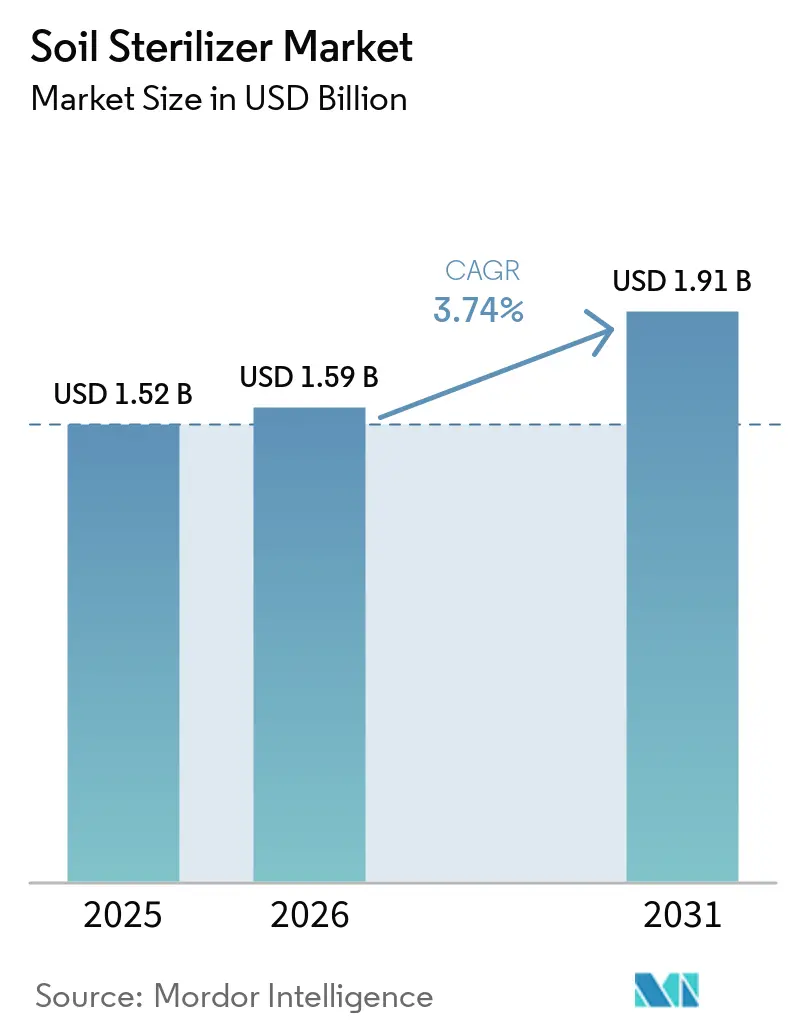
The soil sterilizer market size was valued at USD 1.52 billion in 2025 and is estimated to grow from USD 1.59 billion in 2026 to reach USD 1.91 billion by 2031, at a 3.74% CAGR during 2026-2031. Strong export-market scrutiny of maximum residue limits, compressed regulatory re-registration cycles for fumigants, and greenhouse expansion are transforming buying criteria from lowest cost per hectare to proven residue-free compliance. Suppliers are racing to balance controlled-release chemistry with bio-based alternatives that satisfy zero-residue audits, while equipment vendors refine mobile steam units that fit leasing models demanded by small growers. The global soil sterilizer market now pivots less on acreage expansion and more on the speed of technology refresh, portfolio diversification, and the alignment of subsidy timing.
Key Report Takeaways
- By sterilization method, chemical fumigants held the largest 64% share of the soil sterilizer market size in 2025, whereas biological are projected to record the fastest 9.8% CAGR during 2026-2031.
- By application, open-field agriculture held the largest 51% of the soil sterilizer market share in 2025, while greenhouse and nursery operations are set to post the fastest 7.5% CAGR through 2026-2031.
- By crop type, vegetables held the largest 38% of the soil sterilizer market share in 2025, yet fruit production is set to post the fastest 6.9% CAGR during 2026-2031.
- By formulation, liquid products commanded the largest 67.4% share in the soil sterilizer market size in 2025, and gas formulations are projected to grow at the fastest 6.5% CAGR through 2031.
- By distribution channel, direct sales held the largest share, accounting for 55% of the soil sterilizer market in 2025, while online platforms are projected to expand at the fastest 12.2% CAGR during 2026-2031.
- Asia-Pacific delivered the largest 38% contribution in 2025, and Africa is anticipated the fastest 6.8% CAGR through 2031.
Note: Market size and forecast figures in this report are generated using Mordor Intelligence’s proprietary estimation framework, updated with the latest available data and insights as of January 2026.
Global Soil Sterilizer Market Trends and Insights
Drivers Impact Analysis*
| Driver | (~) % Impact on CAGR Forecast | Geographic Relevance | Impact Timeline |
|---|---|---|---|
| Intensifying push for residue-free produce in export markets | +1.2% | Global with focus on Asia-Pacific exporters to the European Union and North America | Medium term (2-4 years) |
| Stricter fumigant re-registration cycles are shortening product life | +1.0% | North America and the European Union, with spillover to South America | Long term (≥ 4 years) |
| Subsidies that lower the upfront cost of soil-health equipment | +0.8% | Asia-Pacific core, European Union, and selective Middle East adoption | Short term (≤ 2 years) |
| Greenhouse acreage growth is driving repeat sterilization demand | +0.9% | Asia-Pacific, Middle East, and Southern Europe | Medium term (2-4 years) |
| Controlled-release bio-fumigants extending active life | +0.6% | Global with early traction in organic-certified zones | Long term (≥ 4 years) |
| Internet of Things enabled autonomous steam systems, curbing labor bills | +0.4% | North America and the European Union, pilots in the Asia-Pacific | Long term (≥ 4 years) |
| Source: Mordor Intelligence | |||
Intensifying Push for Residue-Free Produce in Export Markets
The European Commission’s postponement of the Sustainable Use Regulation in February 2024 has left the 50% pesticide reduction target by 2030 without enforcement[1]Source: European Commission, “Farm to Fork Strategy,” europa.eu. However, non-European suppliers still face strict Maximum Residue Levels and “mirror clauses” requiring compliance with European Union environmental standards. Kenya’s cut-flower industry, which earned USD 835 million in 2024, is now subject to European Union Regulation 2024/2004, effective April 2025. This regulation mandates a 25% shipment sampling rate at ports like Rotterdam to detect the False Codling Moth, increasing the risk of costly rejection fees exceeding USD 15,000 per container for pesticide over-tolerance. To mitigate these risks, growers are adopting solarization, renewable-energy-powered steaming, and certified biofumigants. Consequently, exporters are prioritizing soil sterilizers that guarantee residue-free outcomes, aligning compliance efforts with market demands and reducing the risk of shipment rejections.
Stricter Fumigant Re-Registration Cycles Forcing Rapid Technology Refresh
The United States Environmental Protection Agency (EPA), under the Federal Insecticide, Fungicide, and Rodenticide Act (FIFRA), now conducts more frequent and detailed pesticide reviews, assessing spray drift and toxicology earlier in the registration process. For chemicals like Ethylene Oxide (EtO), interim decisions are reassessed within 8 years to address worker safety and health risks[2]Source: United States Environmental Protection Agency, “1,3-Dichloropropene Interim Review,” epa.gov. Similarly, the 2024 regulatory action on 1,3-dichloropropene, which introduced 300-foot buffer zones, has restricted its use in peri-urban strawberry-growing regions. The European Union mirrors this trend, with the limited extension of metam-sodium approval until 2026 signaling stricter oversight globally. These regulatory pressures are reshaping the market, favoring companies with strong regulatory capabilities while smaller formulators either exit or seek partnerships, as seen in Corteva's 2025 collaboration with BASF on mustard genetics. This evolving landscape is accelerating the adoption of steam and bio-based soil sterilizers, which face fewer regulatory hurdles. The push for compliance and innovation is driving a rapid transition toward safer, sustainable alternatives, redefining competition in the soil sterilizer market.
Subsidies That Lower Upfront Cost of Soil-Health Equipment
Subsidies play a crucial role in reducing the financial burden of adopting soil-health equipment, such as steam sterilizers, by significantly shortening their payback period from five years to under three seasons. Programs like the Farm Readiness Grant Program (FRGP) in Massachusetts, offering up to USD 50,000 with an 80% project cost coverage, make such investments more accessible[3]Source: Massachusetts Department of Agricultural Resources, “Farm Readiness Grant,” mass.gov . Similar initiatives in Rhineland-Palatinate, Germany, and Hokkaido, Japan, subsidize 30-50% of equipment costs, accelerating adoption in sectors like tomato greenhouses. In Asia-Pacific, China’s Ministry of Agriculture has allocated CNY 2 billion (USD 280 million) for green pest management in 2024, establishing the region as a hub for subsidy-driven adoption. These incentives not only drive localized adoption but also create service ecosystems for maintenance and training. Vendors aligning their product launches with these grant opportunities consistently gain market share, highlighting the interconnected impact of subsidies on adoption, ecosystem development, and market growth.
Greenhouse Acreage Growth Driving Repeat Sterilization Demand
Protected cultivation has grown steadily, with Turkey alone adding over 60,000 hectares by 2024, each requiring up to four sterilizations annually. Mobile steam contractors, such as CM Regero, treat approximately 1 hectare per day, making per-use rental models practical for multiple crop cycles. Enclosed structures recirculate pathogens, reducing chemical efficacy over time and promoting the shift to physical or biological sterilization methods. While steam systems rely on diesel, leasing options distribute fuel cost risks to service providers, enhancing adoption. As greenhouse acreage expands in Asia-Pacific and Southern Europe, the rising need for frequent sterilization is driving consistent growth in the soil sterilizer market.
Restraints Impact Analysis*
| Restraint | (~) % Impact on CAGR Forecast | Geographic Relevance | Impact Timeline |
|---|---|---|---|
| Lengthy operator licensing requirements slow service scaling | -0.6% | North America and the European Union | Medium term (2-4 years) |
| High upfront cost of stationary steam units for smallholders | -0.5% | Global, acute in Africa, South Asia, and South America | Long term (≥ 4 years) |
| Nematode resistance to legacy chemistries in intensive belts | -0.4% | California, Spain, Israel, and select China regions | Short term (≤ 2 years) |
| Limited multi-season data for electric pulse sterilization | -0.2% | European Union and Japan pilots | Long term (≥ 4 years) |
| Source: Mordor Intelligence | |||
Lengthy Operator Licensing Requirements Slow Service Scaling
California's requirement of 40 hours of training and an examination for field fumigant handling increases onboarding costs, while the European Union's Plant Protection Products Regulation adds complexity with country-specific training durations, ranging from 20 hours in Spain to 60 hours in Germany. These regulations deter new applicators, reducing contractor availability and driving up labor costs for certified firms. Delayed curriculum updates, often trailing product launches by over a year, further hinder the adoption of next-generation fumigants. Consequently, small peri-urban growers, unable to access certified operators, either delay treatments or use unregulated inputs, undermining disease control and ultimately restricting the growth potential of the soil sterilizer market.
High Upfront Cost of Stationary Steam Units for Smallholders
Collateral challenges discourage commercial lenders, pushing growers toward cheaper chemical alternatives, even at the risk of export clearance issues. Cooperative ownership models succeed in countries like the Netherlands and Israel but face coordination barriers in fragmented farming regions. With fuel prices rising by 30% in 2024 and diesel forming a major part of operating costs, financial risks intensify. In the absence of stronger subsidies or pay-per-use rental options, smallholders are unlikely to adopt steam technology, restricting its penetration in the soil sterilization market.
*Our forecasts treat driver/restraint impacts as directional, not additive. The impact forecasts reflect baseline growth, mix effects, and variable interactions.
Segment Analysis
By Sterilization Method: Chemical Still Dominant while Biological Surges
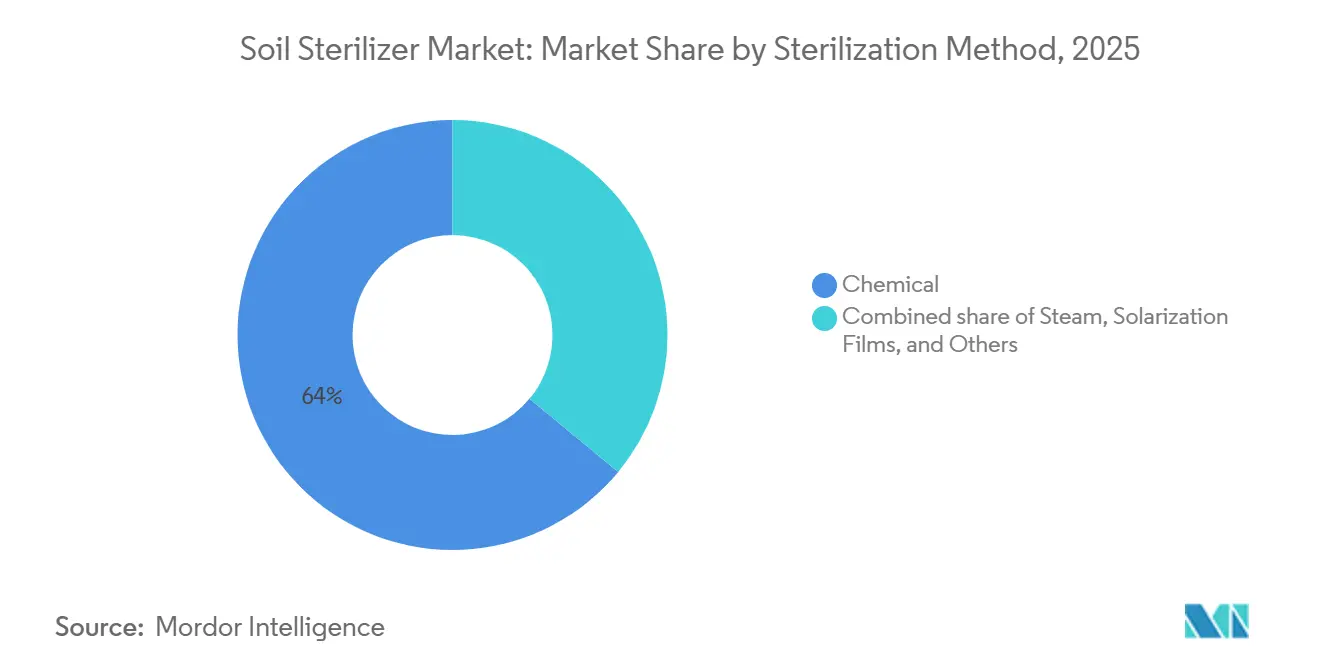
Chemical fumigants, holding 64% of the soil sterilizer market share in 2025, dominate due to their cost efficiency in open-field row crops. However, biological methods, while contributing a smaller share, are set to grow rapidly at a 9.8% CAGR from 2026 to 2031, driven by the rise in organic-certified acreage and stricter residue regulations. Steam and heat sterilization, with a 21% share, cater to greenhouse operations that justify higher spending for continuous production, while solarization films, at 7%, are concentrated in arid regions, achieving lethal soil temperatures of 50°C during summer. This segmentation reflects a market split between cost-driven conventional farms and compliance-focused specialty growers.
Growers are increasingly trialing integrated programs combining low-dose synthetic fumigants with encapsulated bioactives to mitigate the risk of single-mode failures. Modular boiler systems, promoted by equipment manufacturers, enhance field mobility and reduce per-hectare costs. Regulatory clarity on metam-sodium until 2026 provides temporary stability, but the shift toward biological solutions is evident as multinational companies diversify their portfolios. The market's trajectory will hinge on the ability of firms like MustGrow and Draslovka to demonstrate multi-season efficacy, potentially reshaping market dynamics and driving a transition toward sustainable and effective sterilization solutions.



By Application: Open Field Largest, Greenhouse Fastest
Open-field agriculture held the largest share of the soil sterilizer market, accounting for 51% of the market in 2025, driven by crops such as potatoes, carrots, and strawberries that require deep-penetrating fumigants. However, greenhouse and nursery applications are emerging as the fastest-growing segment, with a projected 7.5% CAGR from 2026 to 2031. This growth is fueled by the need for sterilization after each cropping cycle, which significantly increases product use frequency and positions greenhouses as a key driver of market expansion. Municipal pesticide regulations are further shaping the market, particularly in turf and ornamental applications, where restrictions on traditional chemicals are accelerating the adoption of steam and solarization methods.
Similarly, forestry and landscaping sectors rely on soil treatments in seedling nurseries to combat diseases like damping-off, underscoring the critical role of sterilization across diverse applications. Regional dynamics also highlight the market's evolution. In Spain’s Almería region, rental steam models thrive due to the region's dense greenhouse infrastructure, enabling cost-effective use for smaller operators. Conversely, in open-field settings, the limited steam system throughput during narrow planting windows reinforces reliance on chemical fumigants. For turf management, hot water injection systems are preferred to meet strict worker re-entry interval requirements. Policy measures, such as the Massachusetts Readiness Grant, further emphasize the growth potential in greenhouse applications, solidifying their role in driving the soil sterilizer market's future expansion.
By Crop Type: Vegetables Dominate Market Share, Fruits Drive Growth
Vegetables held the largest share of the soil sterilizer market at 38% in 2025, driven by the extensive cultivation of tomatoes, lettuce, and peppers in greenhouses and high tunnels. Fruits, led by strawberries and stone fruits, are projected to grow at a 6.9% CAGR from 2026 to 2031, fueled by export residue requirements and nematode resistance. Cereals and grains, primarily used in seed production or premium organic wheat, contribute significantly when higher margins justify treatment, while oilseeds and pulses, accounting for 9% of the market, are influenced by challenges such as root rots in chickpea and lentil rotations.
California’s USD 2.8 billion strawberry industry in 2024 underscores the critical role of soil sterilizers in managing pest sensitivity, with buffer zone expansions reshaping coastal acreage patterns. Meanwhile, vegetable operations in Spain and Israel are adopting biofumigants to comply with European Union regulations. Although commodity grain sterilization remains limited due to cost constraints, ultra-low-cost microbial treatments priced at USD 150 per hectare or less present a strategic opportunity. The premium pricing of fruits not only offsets higher input costs but also reinforces their growing momentum, positioning them as a key driver in the soil sterilizer market.
By Formulation: Liquids Dominate, Gas Leads in Growth
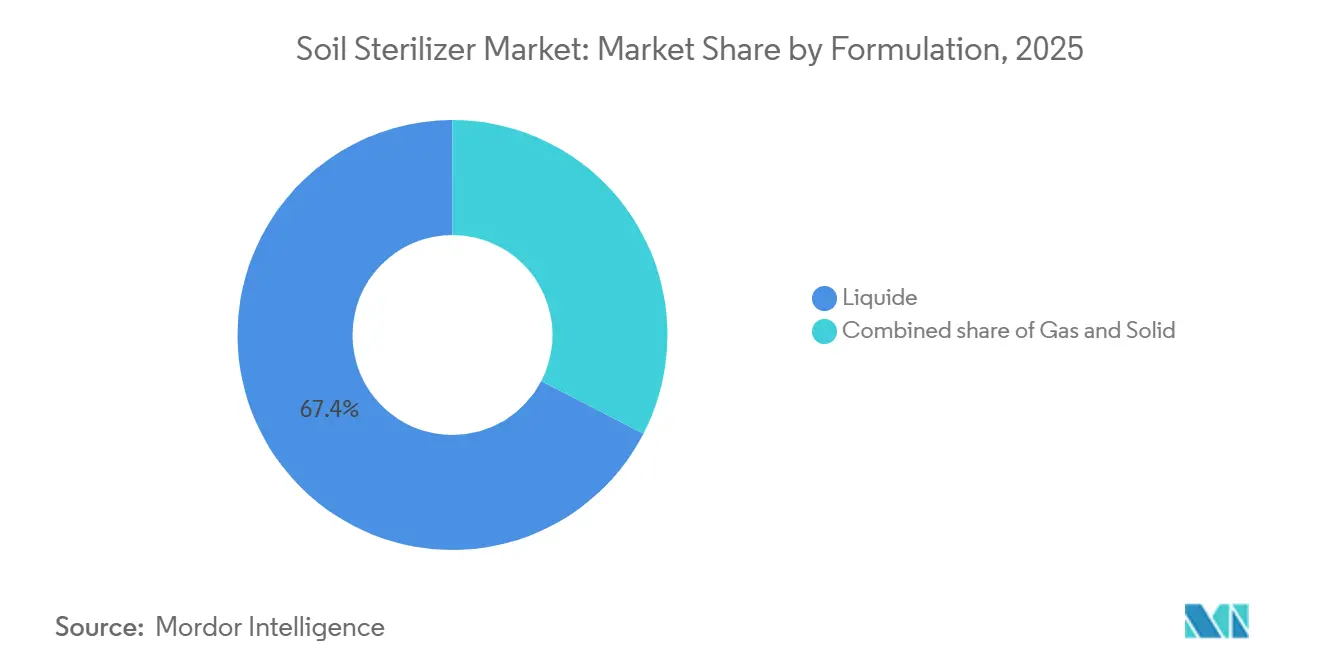
Liquid formulations, driven by the efficient use of metam-sodium and dimethyl disulfide in drip irrigation, accounted for 67.4% of the soil sterilizer market revenue in 2025. Gas formulations, with a projected CAGR of 6.5% from 2026 to 2031, are gaining traction due to 1,3-dichloropropene's deep soil penetration, effectively addressing root-knot nematodes below 30 centimeters. Solid granules like dazomet hold an 8% share, catering to niche applications such as nursery potting soil. Equipment revenue is increasingly tied to subsidy programs and replacement cycles, with leasing contracts strengthening vendor-customer relationships.
The rising demand for gas-based sterilizers in orchards and perennial fruit plantations highlights the need for deeper soil penetration to support robust root systems. Concurrently, advancements in liquid encapsulation aim to reduce off-site drift, aligning with upcoming European Union emission regulations. Solid granules remain a practical choice for smallholders without injection equipment, though their performance depends on soil moisture. The shift of equipment manufacturers toward service-based revenue models underscores the market's focus on recurring income streams, reflecting a broader trend of aligning product innovation and service offerings to meet diverse customer needs.
By Distribution Channel: Direct Sales Lead, Online Platforms Show Rapid Growth
Direct sales captured 55.0% of the soil sterilizer market share in 2025, driven by growers' reliance on bundled agronomy support and compliance guidance that reduces operational risks. These agreements, offering on-farm trials and multi-season supply guarantees, justify higher costs compared to generic alternatives. Meanwhile, online platforms are projected to grow at a 12.2% CAGR from 2026 to 2031, fueled by the convenience of ordering solarization films, bio-fumigant concentrates, and spare parts exempt from restricted-use regulations. Together, these channels highlight the current dominance of full-service relationships while signaling a shift toward digital convenience in future demand.
Dealer and distributor outlets remained relevant in 2025 by ensuring inventory was available near farms and by offering credit terms aligned with harvest cycles. Rental and service models, though smaller in market share, are expanding steadily through 2026-2031 as greenhouse clusters in Europe, Turkey, and Mexico adopt pay-per-hectare steam treatment to avoid capital expenditures. These complementary channels balance the market by addressing diverse grower needs, ensuring technical and financial support aligns with product complexity. Collectively, these distribution channels stabilize the soil sterilizer market while adapting to evolving grower preferences and operational requirements.
Geography Analysis
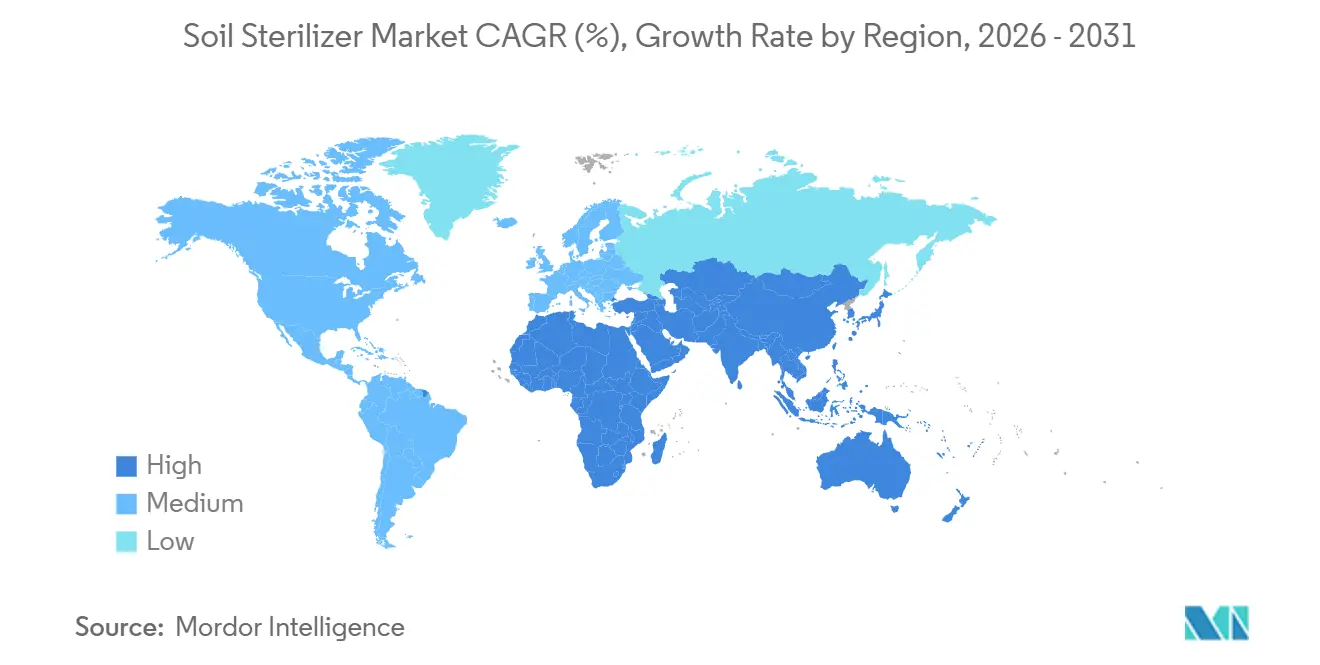
In 2025, Asia-Pacific led the market with a 38% share, driven by China's protected cultivation expansion and India's focus on residue-compliant exports. Government subsidies covering up to 50% of steam equipment costs have reduced payback periods, accelerating the adoption of bio-fumigants. Africa, the fastest-growing region with a projected CAGR of 6.8% during 2026-2031, is expanding greenhouse tomato and cut-flower production in Kenya, Egypt, and South Africa to meet European Union demand, supported by rising export audits and national grants for soil-health tools.
North America benefits from state grants in the United States, which offset higher compliance costs tied to Environmental Protection Agency re-registration reviews. Europe is transitioning to non-chemical methods, as farm-level subsidies align with the European Union's pesticide-reduction goals, despite challenges from the Sustainable Use Regulation setback. South America is diversifying into horticulture, where nematode pressure is driving the adoption of fumigants and steam sterilization. In the Middle East, investments in desert greenhouses requiring frequent sterilization sustain demand for mobile steam services.
Globally, subsidy programs, greenhouse expansion, and stricter residue regulations are interlinked drivers boosting the adoption of bio-fumigants, steam sterilization, and solarization. Vendors aligning product launches with grant cycles are capturing market share, as growers time purchases with funding availability. Mobile equipment rentals and controlled-release formulations further lower entry barriers, encouraging adoption among small and mid-sized farms. These interconnected dynamics are collectively strengthening and expanding the global soil sterilizer market through 2031.

Competitive Landscape
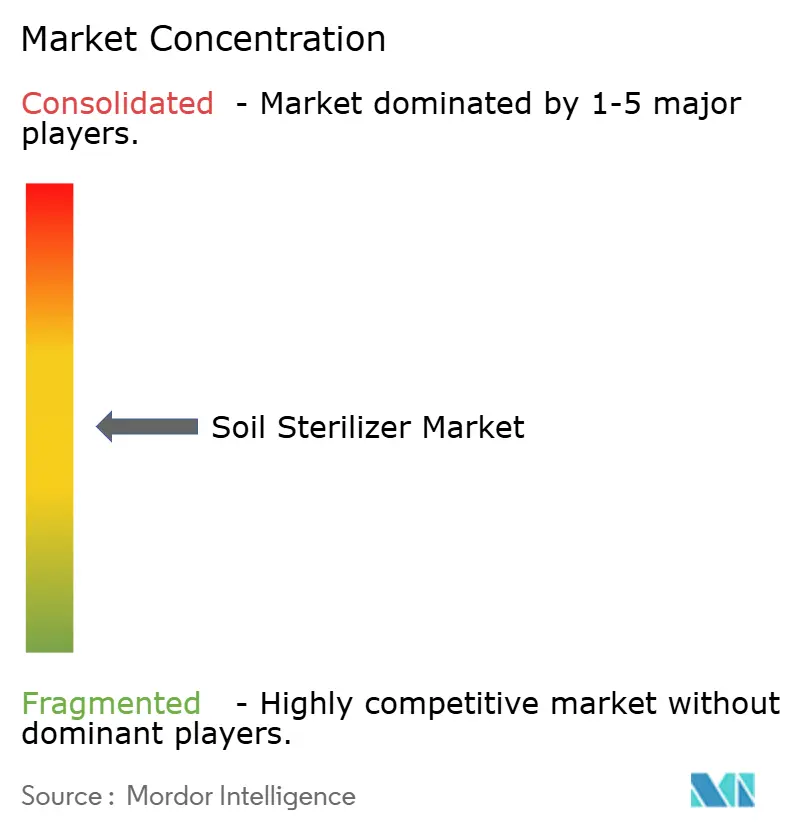
The soil sterilizer market in 2025 is moderately concentrated, with the top five suppliers accounting for the majority of revenue. BASF SE and Syngenta Group Co., Ltd. lead the market by setting benchmarks in service depth and regulatory compliance. BASF SE integrates soil fumigants with foliar products, as seen in its 2025 launch of Integral Pro in Brazil, which supports integrated pest-management contracts and ensures multiyear volumes. Syngenta Group Co., Ltd. capitalizes on its extensive dealer network to cross-sell steam-equipment partnerships alongside chemical products, creating a comprehensive portfolio that raises switching costs for greenhouse consortia.
Other key players, including Corteva, Inc., UPL Limited, and FMC Corporation, strengthen their positions through global logistics and regional manufacturing while diversifying into bio-based pipelines. Corteva, Inc.'s 2024 partnership with BASF SE to develop Clearfield mustard genetics reflects a strategic shift toward bio-fumigant feedstock amid tightening synthetic regulations. UPL Limited focuses on localized formulations in emerging markets, combining cost-effective active ingredients with agronomic advisory services for small- and mid-sized farms. FMC Corporation emphasizes precision application tools and encapsulated chemistries to address regulatory restrictions in Europe and North America.
Innovative niche players are further shaping the market. MustGrow Biologics Corp. and Draslovka secured approvals for mustard-seed extract and ethanedinitrile in 2024, respectively, targeting gaps left by phased-out fumigants. Regional specialists such as CM Regero Industries SAS and Soil Steam International AS offer mobile steam unit rentals, converting capital expenses into manageable operating costs. Precision Combustion Inc. offers catalytic steam generators with GPS mapping, delivering fuel efficiency and uniform soil temperatures, appealing to labor-constrained growers in North America. As regulations shorten product life cycles and subsidies favor non-chemical solutions, the market is converging toward bio-based portfolios, rental services, and precision equipment. This interconnected evolution among established players and new entrants is expected to drive the soil sterilizer market's growth through 2031.
Soil Sterilizer Industry Leaders
BASF SE
Syngenta Group Co., Ltd.
Corteva, Inc.
UPL Limited
FMC Corporation
- *Disclaimer: Major Players sorted in no particular order

Recent Industry Developments
- February 2026: BASF SE and Corteva, Inc. introduced the Clearfield Mustard Production System in India, pairing BASF’s Kifix herbicide with non-transgenic herbicide-tolerant mustard hybrids to curb Orobanche infestations, protect yields, and support the nation’s 8 million-hectare mustard sector
- November 2025: BASF SE launched Integral Pro fungicide in Brazil, complementing soil treatments against Fusarium and Cercospora. The broader portfolio encourages growers to bundle foliar and soil solutions, a practice that lifts overall spending on sterilizer programs and supports market growth.
- November 2024: The European Commission extended the approval of metam-sodium to 31 Dec 2026, adding stricter buffer requirements. This regulatory clarity prevents sudden product withdrawals, keeping fumigant supply stable and maintaining demand for associated application equipment and sealing films.


Global Soil Sterilizer Market Report Scope
Soil sterilizers refer to methods or agents such as heat, steam, and chemical fumigants that are used to eliminate harmful pathogens, insects, weed seeds, and bacteria in soil. Their application promotes healthier seedlings and minimizes the risk of diseases. The Soil Sterilizer Market Report is Segmented by Sterilization Method (Chemical, Steam, Solarization, Biological), Application (Open-Field, Greenhouse, Turf, Forestry), Crop Type (Vegetables, Fruits, Cereals, Oilseeds), Formulation (Liquid, Gas, Solid, Equipment), Distribution Channel (Direct, Dealer, Online, Rental), and Geography (North America, South America, Europe, Asia-Pacific, Middle East, Africa). Market Forecasts are in Value (USD).
| Chemical |
| Steam |
| Solarization Films |
| Biological |
| Open-Field Agriculture |
| Greenhouse and Nursery |
| Turf and Ornamentals |
| Forestry and Landscaping |
| Vegetables |
| Fruits |
| Cereals and Grains |
| Oilseeds and Pulses |
| Liquid |
| Gas |
| Solid |
| Direct Sales |
| Dealer |
| Online |
| Rental |
| North America | United States |
| Canada | |
| Rest of North America | |
| South America | Brazil |
| Argentina | |
| Rest of South America | |
| Europe | Germany |
| France | |
| Italy | |
| Spain | |
| Russia | |
| Rest of Europe | |
| Asia-Pacific | China |
| India | |
| Japan | |
| Australia | |
| Rest of Asia-Pacific | |
| Middle East | Saudi Arabia |
| United Arab Emirates | |
| Rest of Middle East | |
| Africa | South Africa |
| Egypt | |
| Rest of Africa |
| By Sterilization Method | Chemical | |
| Steam | ||
| Solarization Films | ||
| Biological | ||
| By Application | Open-Field Agriculture | |
| Greenhouse and Nursery | ||
| Turf and Ornamentals | ||
| Forestry and Landscaping | ||
| By Crop Type | Vegetables | |
| Fruits | ||
| Cereals and Grains | ||
| Oilseeds and Pulses | ||
| By Formulation | Liquid | |
| Gas | ||
| Solid | ||
| By Distribution Channel | Direct Sales | |
| Dealer | ||
| Online | ||
| Rental | ||
| By Geography | North America | United States |
| Canada | ||
| Rest of North America | ||
| South America | Brazil | |
| Argentina | ||
| Rest of South America | ||
| Europe | Germany | |
| France | ||
| Italy | ||
| Spain | ||
| Russia | ||
| Rest of Europe | ||
| Asia-Pacific | China | |
| India | ||
| Japan | ||
| Australia | ||
| Rest of Asia-Pacific | ||
| Middle East | Saudi Arabia | |
| United Arab Emirates | ||
| Rest of Middle East | ||
| Africa | South Africa | |
| Egypt | ||
| Rest of Africa | ||


Key Questions Answered in the Report
How large is the soil sterilizer market in 2026?
The soil sterilizer market size is projected at USD 1.59 billion in 2026.
Which sterilization method leads to revenue?
Chemical fumigants maintain the largest 64% share of the soil sterilizer market revenue in 2025, driven by open field crops that favor low-cost per-hectare solutions.
What is the fastest-growing application segment?
Greenhouse and nursery operations post the fastest 7.5% CAGR through 2026-2031, as protected cultivation requires three to four soil treatments annually.
Which region will grow the quickest by 2031?
Africa shows the fastest CAGR of 6.8% through 2026-2031, driven by expanding greenhouse tomato and floriculture exports that require residue-free soil treatment.
Page last updated on:





