
Slovenia MVNO Market Size and Share
Market Overview
| Study Period | 2019 - 2030 |
|---|---|
| Forecast Data Period | 2025 - 2030 |
| Historical Data Period | 2019 - 2023 |
| Market Size (2025) | USD 63 Million |
| Market Size (2030) | USD 77 Million |
| Growth Rate (2025 - 2030) | 4.31 % |
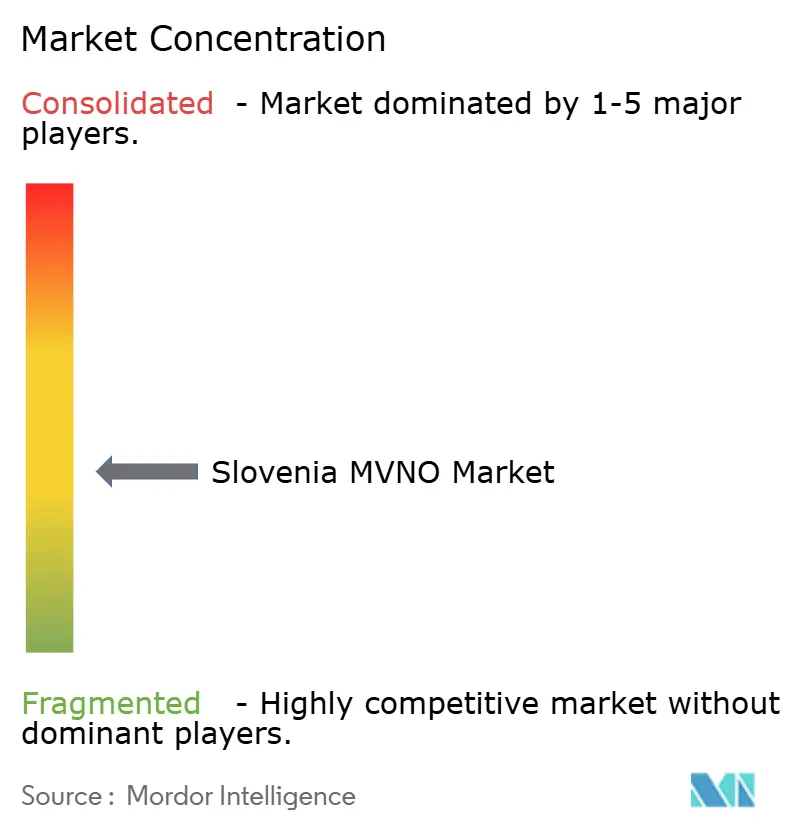
| Market Concentration | Medium |
Major Players *Disclaimer: Major Players sorted in no particular order Image © Mordor Intelligence. Reuse requires attribution under CC BY 4.0. | |

Slovenia MVNO Market Analysis by Mordor Intelligence
The Slovenia MVNO Market size is estimated at USD 63 million in 2025, and is expected to reach USD 77 million by 2030, at a CAGR of 4.31% during the forecast period (2025-2030). In terms of subscriber volume, the market is expected to grow from 184.02 thousand subscriber in 2025 to 219.24 thousand subscriber by 2030, at a CAGR of 3.56% during the forecast period (2025-2030).
The market’s steady rise reflects disciplined regulatory alignment with European Union rules, nationwide 5G roll-outs, and the mainstreaming of cloud-native core networks that lower entry barriers for new virtual network operators. Consumer appetite for low-cost prepaid services, coupled with the country’s 90.38% internet penetration, continues to fuel subscriber churn in favor of flexible digital-only brands. At the same time, the migration toward 5G standalone architecture and network slicing is opening specialized revenue pools in enterprise IoT, logistics, and manufacturing. Competitive differentiation hinges on feature agility—eSIM, VoLTE, and cloud billing stacks—rather than on traditional price wars, while EU-mandated wholesale price ceilings anchor predictable margin structures for smaller players.
Key Report Takeaways
- By deployment model, cloud-based operations accounted for 74.54% of the Slovenia MVNO market share in 2024.
- By operational mode, the Full MVNO segment led with 60.87% revenue share in 2024, while the same segment is projected to expand at a 13.51% CAGR through 2030.
- By subscriber type, consumer connections held 81.86% share of the Slovenia MVNO market size in 2024; IoT subscriptions are advancing at a 24.05% CAGR to 2030.
- By application, discount packages represented 51.08% of revenue in 2024, whereas cellular M2M use cases are forecast to rise at a 21.56% CAGR over the period.
- By network technology, 4G/LTE services held a dominant 71.12% share in 2024, while 5G lines are growing at a 24.05% CAGR as enterprise slicing scales.
- By distribution channel, online and digital-only storefronts captured 53.29% share in 2024 and are growing at an 8.28% CAGR.
- Telekom Slovenije, A1 Slovenia, and Telemach jointly controlled 91% of underlying host network traffic in 2024, with Telekom Slovenije alone holding a 45% share of the retail mobile base.
Slovenia MVNO Market Trends and Insights
Drivers Impact Analysis*
| Driver | (~) % Impact on CAGR Forecast | Geographic Relevance | Impact Timeline |
|---|---|---|---|
| EU-mandated wholesale access price regulation | +1.2% | Nationwide under EU harmonization | Medium term (2-4 years) |
| Rapid adoption of eSIM and digital-only plans | +0.8% | Ljubljana, Maribor, and other high-density urban corridors | Short term (≤ 2 years) |
| Rising demand for low-cost prepaid by migrants | +0.6% | Industrial regions drawing foreign labor | Medium term (2-4 years) |
| 5G SA network slicing for enterprise services | +1.1% | Business districts and industrial parks | Long term (≥ 4 years) |
| Expanding IoT/M2M connections in industry | +0.7% | Manufacturing hubs around Celje and Koper | Long term (≥ 4 years) |
| Retail grocery chains launching MVNO brands | +0.4% | Nationwide through existing retail footprints | Medium term (2-4 years) |
| Source: Mordor Intelligence | |||
EU-Mandated Wholesale Access Price Regulation
The European Commission’s 2025 cost-model update harmonized wholesale roaming and voice-termination tariffs across the bloc, removing discretionary mark-ups that once squeezed smaller Slovenian virtual operators. [1] European Commission, “Roaming Regulation Review 2025,” europa.eu AKOS embedded the ceiling rates into national rules, forcing host mobile network operators (MNOs) to publish transparent rate cards that now reflect current 5G investment costs rather than outdated 3G averages. The reform secures margin headroom for emerging brands and tempers the risk of predatory pricing, encouraging new entrants to pursue niche propositions without prohibitive wholesale charges. Predictable costing also supports long-term financial planning, allowing investors to underwrite Slovenia MVNO market expansion with greater confidence.
Rapid Adoption of eSIM and Digital-Only Plans
Consumer expectations favor instant, paper-free onboarding, and eSIM activation meets this need. HoT mobil became the first local MVNO to roll out eSIM, VoLTE, and VoWiFi in 2024, cutting SIM logistics costs while letting subscribers go live in minutes. [2]HoT mobil, “eSIM and Advanced Voice Features Launch,” hot-mobil.si Digital-only workflows dovetail with Slovenia’s 90.38% internet penetration and 89.87% mobile ownership, removing the biggest friction point—physical store visits—and widening addressable demand in the Slovenia MVNO market. For operators, fewer retail overheads translate into slimmer cost structures and faster breakeven, while standardized GSMA eSIM specs guarantee cross-handset compatibility.
Growing Demand for Low-Cost Prepaid Among Migrant Workforce
Slovenia’s construction and manufacturing sectors continue to attract cross-border labor. These transient workers want voice and data plans without credit checks or long-term contracts. SPAR Mobil’s flat 6.6-cent unit pricing for calls, texts, and megabytes exemplifies how MVNOs court this demographic with transparent tariffs. [3]SPAR, “SPAR Mobil Price List,” spar.si EU roaming portability layers additional value since many migrants travel weekly. Steady inflows of seasonal staff thus underpin subscriber gains for discount-oriented brands, shaping a resilient low-ARPU but high-volume stratum inside the Slovenia MVNO market.
5G SA Network-Slicing Unlocking Enterprise MVNO Opportunities
Standalone 5G now blankets 70% of Slovenia’s population, giving virtual operators technical hooks to carve out latency-controlled network slices for factories, ports, and public services. Enterprises can contract guaranteed bandwidth or ultra-reliable connections without building private networks. For MVNOs, the shift moves the conversation from “cheaper connectivity” to “fit-for-purpose connectivity,” allowing premium pricing and multi-year service-level agreements. Early pilots in automotive logistics and smart manufacturing validate revenue per-line that is 4-6 times higher than consumer averages, underpinning long-run growth in the Slovenia MVNO market.
Restraints Impact Analysis*
| Restraint | (~) % Impact on CAGR Forecast | Geographic Relevance | Impact Timeline |
|---|---|---|---|
| Saturated mobile penetration | -0.9% | Urban markets where SIM density exceeds 1 per capita | Long term (≥ 4 years) |
| Limited wholesale discounts from top MNOs | -0.7% | Nationwide, as three hosts dictate access terms | Medium term (2-4 years) |
| Stringent KYC and SIM-registration laws | -0.5% | Nationwide under AML-driven regulations | Short term (≤ 2 years) |
| Host-network consolidation curbing options | -0.6% | National impact once Telemach absorbs T-2 | Medium term (2-4 years) |
| Source: Mordor Intelligence | |||
Saturated Mobile Penetration Limiting Subscriber Growth
With active SIM penetration topping 96%, Slovenia’s mobile base is effectively fully addressed. As a result, the Slovenia MVNO market can no longer rely on first-time SIM buyers. Growth now means luring customers away from incumbent MNOs or from rival MVNOs. Heavy promotional traffic and bundled offers from host operators compress retail pricing, eroding MVNO margin cushions. To stay viable, brands must target underserved niches—senior citizens, digital nomads, or IoT devices—rather than mass-market consumer voice.
Limited Wholesale Discounts from Dominant MNOs
Telekom Slovenije and A1 Slovenia still hold 76% share of hosted traffic, so they have little incentive to cut wholesale rates for potential rivals. Even after EU caps, room for negotiated discounts remains narrow, pushing virtual operators to optimize lean cost bases instead of banking on cheaper access. The impending Telemach–T-2 merger could further reduce bargaining power, as MVNOs will have just two fully independent networks from which to lease capacity. That dynamic curtails aggressive price-based strategies and steers the Slovenia MVNO market toward service innovation plays.
*Our forecasts treat driver/restraint impacts as directional, not additive. The impact forecasts reflect baseline growth, mix effects, and variable interactions.
Segment Analysis
By Deployment Model: Cloud Infrastructure Drives Operational Efficiency
Cloud-native hosting represented 74.54% of the Slovenia MVNO market size in 2024 as most brands shifted core network functions to virtualized environments. Elastic scaling, pay-as-you-grow OPEX, and embedded analytics allow smaller entrants to punch above their weight. The model is forecast to compound at 7.64% through 2030, mirroring nationwide roll-outs of NFV and SDN in 5G cores. On-premise set-ups persist among regulated verticals, but they account for a minority slice. The capital-light cloud path lets startups prioritize marketing and customer-experience budgets, accelerating competition in the Slovenia MVNO market.
Operator roadmaps increasingly depend on multi-tenant platforms where differentiated service logic resides in software layers while underlying compute pools remain shared. Robust API frameworks shorten time-to-launch for niches like travel eSIM bundles or machine-diagnostics lines. For investors, the architecture lowers capex risk and aligns spend with subscriber growth. Vendors such as Ericsson’s Packet Core-as-a-Service already underpin several Slovenian virtual operators . As 5G core functions migrate fully to Kubernetes containers, cloud adoption will become even more pronounced across the Slovenia MVNO industry.



By Operational Mode: Full MVNO Model Dominates Through Service Control
Full MVNOs captured 60.87% of Slovenia MVNO market share in 2024 and are projected to grow at 13.51% annually, indicating that brand owners value end-to-end control over SIM profiles, numbering resources, and billing. This autonomy enables rapid feature launches like family-sharing data wallets or country-specific roaming add-ons without host-operator dependencies. Light or brand MVNOs still fill fast-entry scenarios but face ceiling effects once differentiation becomes imperative. Reseller models, where only marketing is owned, occupy marginal niches.
Regulators require interoperability and lawful-interception readiness, and Full MVNOs meet these by operating HSS/HLR and interconnect gateways. That architecture pairs well with the cloud model above, letting operators spin up network elements on demand. The result is a more vibrant Slovenia MVNO market where virtual players can challenge MNOs on service richness rather than solely on headline price.
By Subscriber Type: Consumer Dominance with IoT Growth Acceleration
Consumer SIMs accounted for 81.86% of revenue in 2024, but that segment is nearing saturation. IoT SIMs, although small, are rocketing at a 24.05% CAGR. Smart-metering, fleet management, and connected agriculture projects now seek local-language support and predictable billing schemes. Enterprise handsets form a sizeable middle ground as small firms migrate to bundled voice-data solutions with cloud PBX add-ons.
Increasing adoption of industry 4.0 tools puts upward pressure on fixed and cellular convergence, a realm where agile MVNO stacks outpace slower legacy host systems. By targeting device-centric connectivity, operators unlock low-churn, multi-year contracts that stabilize cash flow inside the Slovenia MVNO market.
By Application: Discount Services Lead with M2M Acceleration
Discount voice-and-data bundles captured 51.08% of the Slovenia MVNO market in 2024 because price transparency resonates with cost-sensitive households. Brands such as Bob charge 4 cents for each minute, SMS, or megabyte to keep value propositions simple. Nevertheless, cellular M2M links are expanding at 21.56% annually, propelled by smart-city pilots and logistics sensors along the Davča–Koper corridor. As industrial players digitize operations, MVNOs able to guarantee network uptime and provide developer-friendly APIs are winning new lines that dwarf traditional consumer ARPUs.
By Network Technology: 4G/LTE Dominance with 5G Transition
In 2024, 4G/LTE remained the default standard with a 71.12% share, balancing coverage and cost. However, 5G subscriptions are growing at 24.05% CAGR as enterprise slices go live. Because Slovenia licensed 700 MHz and 3.5 GHz spectrum portfolios early, virtual players can lease 5G capacity without waiting for multi-country roaming harmonization. Meanwhile, legacy 2G/3G still powers narrowband IoT devices due to lower power draw, though sunset timelines loom by 2030. The technology mix underscores the dual-speed nature of the Slovenia MVNO market, pairing stable consumer LTE lines with cutting-edge enterprise 5G contracts.


By Distribution Channel: Digital-Only Channels Drive Market Evolution
Digital storefronts booked 53.29% of 2024 activations, riding on widespread e-banking familiarity and high smartphone penetration. Sign-up journeys now take under five minutes, and identity verification leverages national e-ID schemas introduced in 2024. Physical retail remains useful for handset financing or older demographics, but its footprint is shrinking year on year. The rising dominance of self-service portals reduces churn because users can toggle add-ons without call-center friction, boosting net promoter scores across the Slovenia MVNO market.
Geography Analysis
Most addressable demand clusters in Ljubljana, Maribor, Kranj, and Celje, where fiber backhaul and 3.7 GHz 5G cells overlap. Urban localities account for more than 70% of data traffic, creating fertile ground for premium unlimited bundles and streaming add-ons. Coastal regions around Koper see elevated seasonal traffic from tourism, compelling MVNOs to craft short-stay eSIM packs that marry domestic and EU roaming allowances. Rural areas still face sporadic coverage gaps, yet satellite-backhauled small cells launched in 2025 are mitigating dead zones for agriculture IoT and safety-critical services.
Border commerce with Italy, Austria, Croatia, and Hungary shapes cross-border tariffs. MVNOs differentiate through inclusive roaming that respects EU “Roam Like at Home” ceilings yet offers higher data allotments than incumbent MNOs. Consequently, the Slovenia MVNO market serves not only residents but also daily commuters and truck fleets traversing the Alpine corridors. Government investments worth EUR 946 million into nationwide digital infrastructure, part-funded by the EU Recovery and Resilience Facility, assure future backhaul resilience. The spend covers fiber-to-the-home in 1,027 white-spot villages and funds additional 5G towers, making even low-density regions economically viable for virtual entrants.
Cities sponsoring smart-parking, air-quality monitoring, and public Wi-Fi projects generate anchor IoT contracts. MVNOs bundling connectivity with cloud dashboards are winning municipal tenders that specify open APIs. Regionally, Central Slovenia leads early digital adoption while Drava and Savinja statistical regions generate emerging demand from medium-sized manufacturing plants. Overall, tight geography enhances brand visibility, enabling low-budget marketing to achieve national reach inside the Slovenia MVNO market.
Competitive Landscape
Eight active MVNOs split market revenue, none exceeding 14% individually, giving an overall moderate concentration. Price-led players—SPAR Mobil, Bob, IZI Mobil—prioritize ARPU stability through lean structures and grocery-store cross-promotions. HoT mobil sets itself apart on technology, adding eSIM support, VoWiFi, and extended roaming zones. Lycamobile serves migrant communities with bundled international minutes, keeping churn low due to entrenched ethnic distribution networks.
Telekom Slovenije’s wholesale arm remains the largest enabler, yet its retail focus on premium quad-play packages leaves discount niches open. A1 Slovenia nurtures sub-brand Bob to ring-fence value-seekers while preventing cannibalization of its flagship postpaid base. Telemach is poised to integrate T-2 assets by late 2025, a move that will merge mobile and fixed footprints under one billing stack. The resulting host-network triopoly could raise wholesale negotiating hurdles, but it also promises better rural 5G coverage for MVNOs purchasing capacity.
Strategic maneuvers include cloud-billing partnerships with Nokia and Ericsson core-as-a-service platforms, plus loyalty-program tie-ins that convert grocery points into mobile data. Several operators are piloting AI-driven real-time pricing, adjusting data add-on costs based on network load. Across the Slovenia MVNO market, survival will depend on specializing—either in cost leadership, technology edge, or vertical-specific IoT contracts—rather than chasing universal reach.
Slovenia MVNO Industry Leaders
HoT mobil
IZI mobil
Spar Mobil
Softnet
Bob
- *Disclaimer: Major Players sorted in no particular order

Recent Industry Developments
- August 2025: Telemach Slovenia agreed to purchase a 98.06% stake in T-2, settling EUR 90 million in liabilities and accelerating market consolidation.
- July 2025: The European Commission released updated wholesale cost models that incorporate 5G expenditures, guiding future EU roaming caps.
- June 2025: Telemach revamped fixed and mobile tariffs, raising data ceilings while adjusting monthly fees; the VEČ tier now includes 50 GB EU/EAA roaming data.
- May 2025: HoT mobil introduced the HoT MEGA plan with unlimited minutes, SMS, and data for EUR 9.99 monthly, bundled with eSIM, VoLTE, and VoWiFi support.


Slovenia MVNO Market Report Scope
| Cloud |
| On-premise |
| Reseller |
| Service Operator |
| Full MVNO |
| Light / Brand MVNO |
| Consumer |
| Enterprise |
| IoT-specific |
| Discount |
| Business |
| Cellular M2M |
| Others |
| 2G/3G |
| 4G/LTE |
| 5G |
| Satellite/NTN |
| Online/Digital-only |
| Traditional Retail Stores |
| Carrier Sub-brand Stores |
| Third-Party/Wholesale |
| By Deployment Model | Cloud |
| On-premise | |
| By Operational Mode | Reseller |
| Service Operator | |
| Full MVNO | |
| Light / Brand MVNO | |
| By Subscriber Type | Consumer |
| Enterprise | |
| IoT-specific | |
| By Application | Discount |
| Business | |
| Cellular M2M | |
| Others | |
| By Network Technology | 2G/3G |
| 4G/LTE | |
| 5G | |
| Satellite/NTN | |
| By Distribution Channel | Online/Digital-only |
| Traditional Retail Stores | |
| Carrier Sub-brand Stores | |
| Third-Party/Wholesale |


Key Questions Answered in the Report
What revenue are Slovenian MVNOs projected to generate by 2030?
They are forecast to post USD 77 million in annual revenue by 2030.
What compound annual growth rate is expected for Slovenian MVNOs between 2025 and 2030?
The segment is set to grow at a 4.31% CAGR over that period.
Which operational mode is expanding the fastest in Slovenia?
The Full MVNO model is rising at a 13.51% CAGR through 2030?
How large is the cloud deployment share among virtual operators in Slovenia?
Cloud-based architectures already account for 74.54% of deployments?
Which subscriber category is showing the strongest momentum?
IoT connections are advancing at a 24.05% CAGR?
Who are the main host network providers for Slovenian MVNOs?
Telekom Slovenije, A1 Slovenia, and Telemach supply 91% of wholesale capacity?
Page last updated on:





