
Latvia MVNO Market Size and Share
Market Overview
| Study Period | 2019 - 2030 |
|---|---|
| Forecast Data Period | 2025 - 2030 |
| Historical Data Period | 2019 - 2023 |
| Market Size (2025) | USD 46.96 Million |
| Market Size (2030) | USD 56.77 Million |
| Growth Rate (2025 - 2030) | 3.87 % |
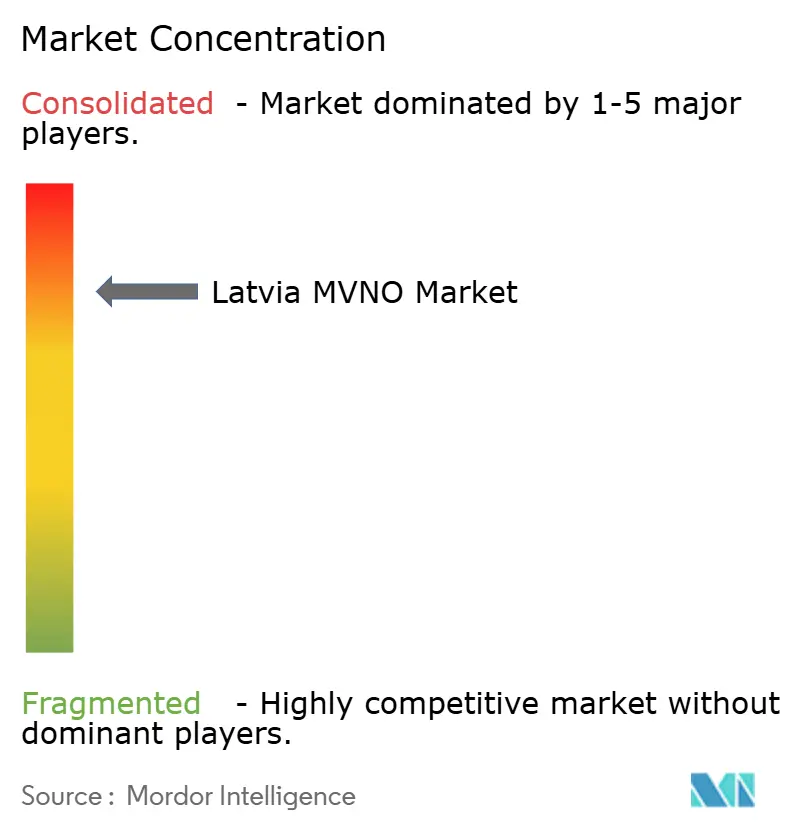
| Market Concentration | High |
Major Players *Disclaimer: Major Players sorted in no particular order Image © Mordor Intelligence. Reuse requires attribution under CC BY 4.0. | |
Latvia MVNO Market Analysis by Mordor Intelligence
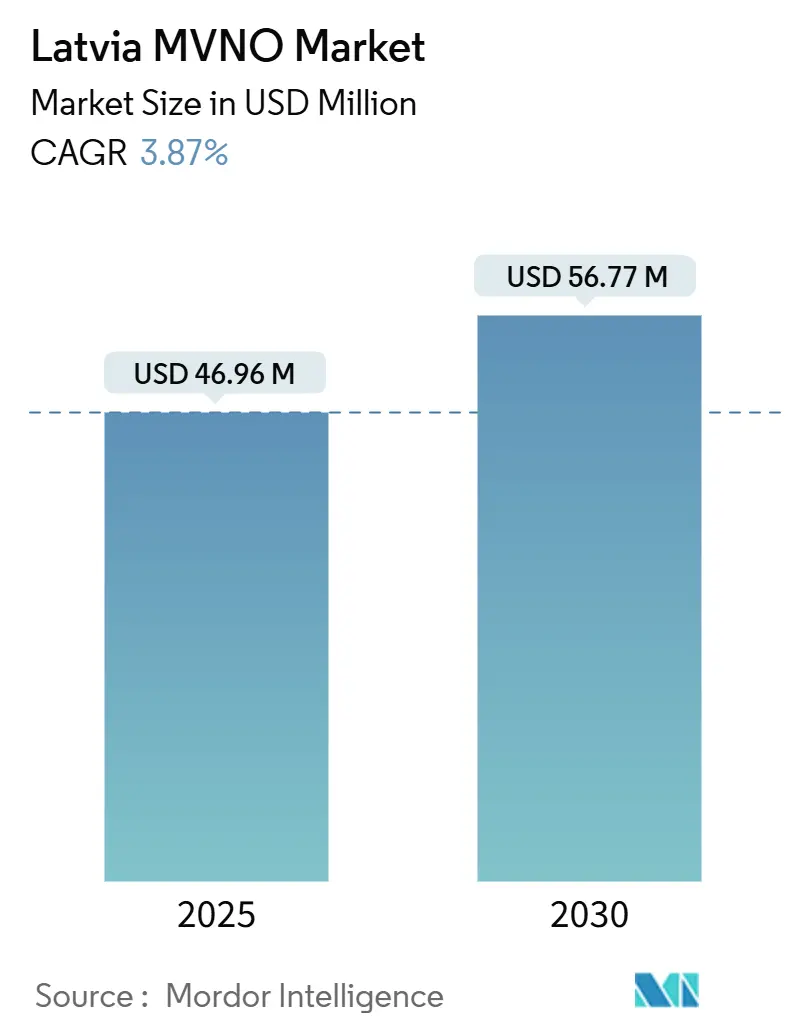
The Latvia MVNO Market size is estimated at USD 46.96 million in 2025, and is expected to reach USD 56.77 million by 2030, at a CAGR of 3.87% during the forecast period (2025-2030). In terms of market size, the market is expected to grow from 69.22 thousand subscribers in 2025 to 78.19 thousand subscribers by 2030, at a CAGR of 2.47% during the forecast period (2025-2030).
The Latvia MVNO market continues to evolve as the three host network operators—LMT, Tele2 and Bite modernize 5G infrastructure, deepen wholesale arrangements and re-allocate spectrum from legacy 3G toward high-capacity services. Shifts toward eSIM, accelerated device refresh cycles and wide consumer acceptance of Latvia’s eParaksts ID verification tools sustain digital-first onboarding, compress acquisition costs and widen target demographics. Niche enterprise and IoT propositions gain traction as EU-funded 5G corridors open wholesale 5G/NTN capacity, while the 2022 “Roam-Like-at-Home” recast creates a favorable regulatory umbrella for cross-border discount brands. Selective market entry is nevertheless tempered by limited population scale, high wholesale access fees and the capital burden of mandatory device upgrades linked to 2G/3G sunsets. Latvia MVNO market participants therefore prioritize cloud-native core platforms, service-operator depth and specialist branding to maintain margins while expanding into adjacent verticals such as logistics, public safety and connected vehicles.
Key Report Takeaways
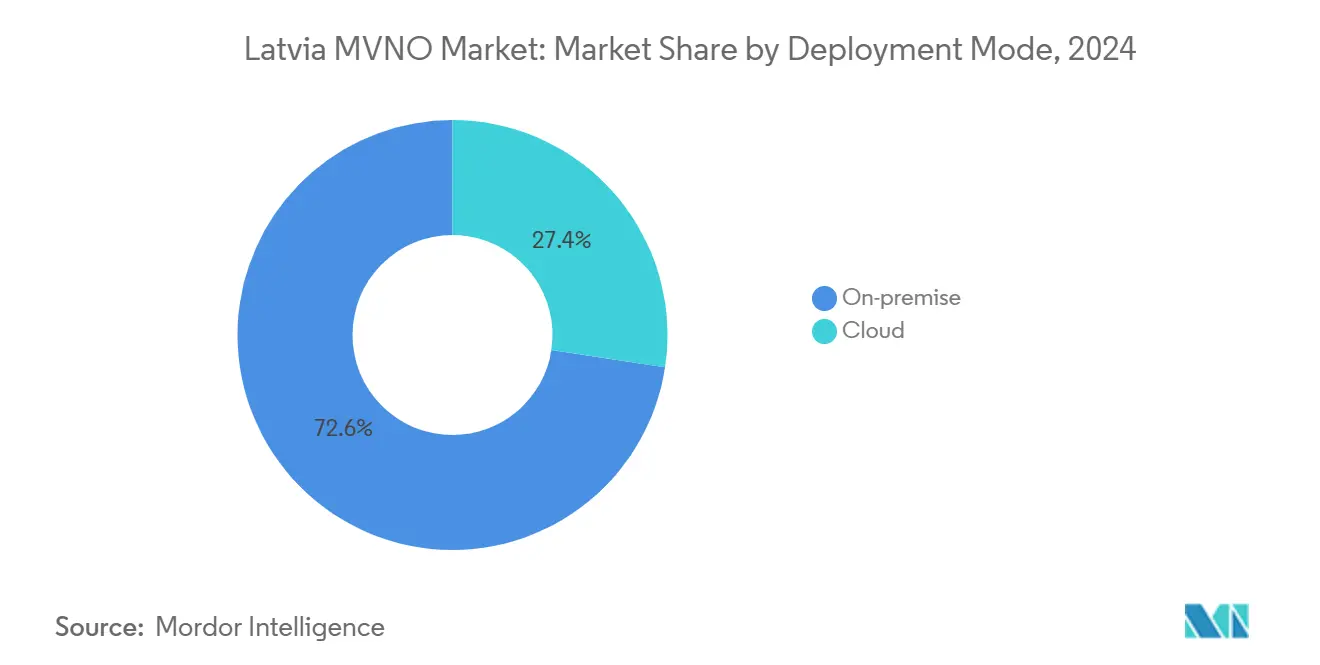
- By deployment model, on-premise solutions accounted for 72.61% Latvia MVNO market share in 2024; cloud deployments are advancing at a 21.48% CAGR to 2030.
- By operational mode, reseller and light MVNOs held 66.01% of the Latvia MVNO market size in 2024, while service-operator configurations are expanding at a 12.30% CAGR through 2030.
- By subscriber type, consumer segments captured 78.87% of the Latvia MVNO market size in 2024; IoT services are projected to grow at a 20.36% CAGR between 2025-2030.
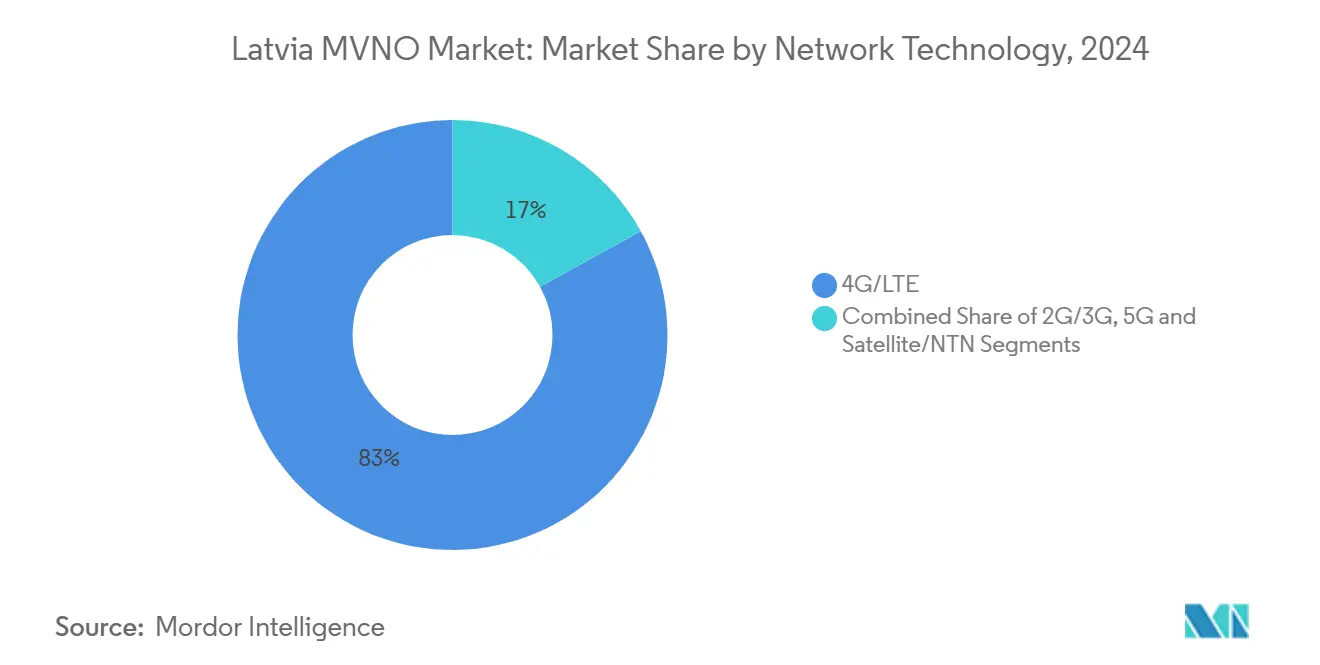
- By network technology, 4G/LTE dominated with 83.02% Latvia MVNO market size in 2024 and 5G subscriptions are growing at a 32.13% CAGR through 2030.
- By distribution channel, online-only sales commanded 42.04% of the Latvia MVNO market size in 2024 and are expanding 9.04% annually to 2030.
Latvia MVNO Market Trends and Insights
Drivers Impact Analysis*
| Driver | (~) % Impact on CAGR Forecast | Geographic Relevance | Impact Timeline |
|---|---|---|---|
| Advanced national e-government ID eases digital KYC | +0.8% | Urban Latvia | Short term (≤ 2 years) |
| Rising mobile-data price sensitivity | +0.6% | National, rural skew | Medium term (2-4 years) |
| EU “Roam-Like-at-Home” regulation | +0.4% | Baltic corridor | Medium term (2-4 years) |
| eSIM proliferation | +0.5% | Riga early adoption | Long term (≥ 4 years) |
| Wholesale 5G/NTN capacity for enterprise & IoT | +0.7% | Industrial zones | Long term (≥ 4 years) |
| Hybrid satellite–cellular logistics projects | +0.3% | Rural & maritime | Long term (≥ 4 years) |
| Source: Mordor Intelligence | |||
Advanced national e-government ID eases digital KYC for fully online MVNO onboarding
eParaksts and eID card systems completed more than 1 million remote identity verifications in 2025, enabling full service activation without store visits and slashing onboarding costs by up to 70% for digital MVNOs. [1]Latvia State Portal, “Annual eParaksts Usage Statistics 2025,” latvija.lv Seamless API integration with 40+ state portals and 30 commercial platforms also accelerates cross-sell opportunities and drives trust among senior subscribers unfamiliar with purely online brands. GDPR-aligned back-end compliance reduces legal overhead and supports EU-wide recognition, facilitating expansion across the Nordic-Baltic corridor via common eIDAS standards.
Rising mobile-data price sensitivity spurs discount-focused MVNO launches
At EUR 3 per GB, Latvia ranked 197th globally for data affordability, leaving clear headroom for budget offerings. [2]Cable.co.uk Team, “Worldwide Mobile Data Pricing 2025,” cable.co.ukDiscount MVNOs bundle large data allowances with low-commitment prepaid tariffs to serve students, seniors and rural households affected by rising inflation. Wholesale obligations under SPRK prevent discriminatory pricing, allowing virtual brands to exploit falling termination rates and capture 8-12% subscriber share within two years in underserved districts outside Riga.
EU “Roam-Like-at-Home” regulation encourages cross-border virtual operators
Declining wholesale caps to EUR 1.00 per GB by 2027 lower input costs for MVNOs serving cross-border commuters along the Latvia-Lithuania-Estonia axis. The recast also formalizes aggregator models, letting virtual brands pool traffic to reach scale and use fair-use ceilings to craft travel-centric bundles attractive to logistics firms and seasonal workers.
eSIM proliferation lowers entry barriers and operating costs for niche MVNOs
All three MNOs activated consumer eSIM support by 2025, and device penetration surpassed 35% of smartphones sold in Latvia that year. MVNOs issuing QR-based profiles eliminate physical SIM logistics and enable instant plan switches, cutting acquisition costs by 50% and opening micro-segment niches such as connected caravans, sports events and short-term tourists.
Restraints Impact Analysis*
| Restraint | (~) % Impact on CAGR Forecast | Geographic Relevance | Impact Timeline |
|---|---|---|---|
| Limited population size restricts scale efficiencies | -0.9% | Nationwide | Short term (≤ 2 years) |
| High wholesale access fees squeeze MVNO margins | -0.7% | National | Medium term (2-4 years) |
| Latvian-language content rules add localization costs | -0.3% | National | Short term (≤ 2 years) |
| Mandatory 2G/3G sunset device upgrades raise capex | -0.4% | Nationwide | Medium term (2-4 years) |
| Source: Mordor Intelligence | |||
Limited population size restricts scale efficiencies for new entrants
With 1.9 million residents and three entrenched MNOs, Latvia offers fewer than 700,000 incremental subscribers addressable by independent MVNOs, constraining brand-building leverage and marketing ROI. [3]Coface Country Report Latvia 2025, coface.com Population decline and urban migration funnel most disposable income to Riga, requiring virtual players to run lean omnichannel strategies while still subsidizing device replacement for rural voice-centric customers.
High wholesale access fees from dominant MNOs squeeze MVNO margins
Mobile termination rates ranged from EUR 0.0505 to EUR 0.2872 per minute in 2024, eroding MVNO gross margins by as much as 350 basis points relative to peers in Poland or Germany. Absence of active MVNE aggregators limits bulk-buying power, forcing smaller brands either to remain light-reseller models with thin ARPU or to exit niche segments altogether.
*Our forecasts treat driver/restraint impacts as directional, not additive. The impact forecasts reflect baseline growth, mix effects, and variable interactions.
Segment Analysis
By Deployment Model: Cloud migration accelerates amid on-premise predominance
On-premise solutions controlled 72.61% Latvia MVNO market size in 2024 as finance, healthcare and public-sector entities prioritized domestic data residency and direct network control under GDPR. Cloud deployments, however, are expanding at a 21.48% CAGR thanks to EU Recovery and Resilience Facility grants and the arrival of new regional data centers from AWS and Microsoft that resolve latency and sovereignty concerns.
Cloud-native MVNO cores give smaller entrants elasticity and lower capex, letting them spin up VoLTE, VoWiFi and converged IoT services without dedicated switching hardware. Hybrid architectures that keep subscriber databases on-premise but use public cloud for BSS functions emerge as popular middle-ground, especially for retailers converting loyalty apps into MVNO billing front-ends.


By Operational Mode: Service operator depth rises
Reseller and light MVNOs retained 66.01% Latvia MVNO market share in 2024, reflecting ease of launch and minimal network investment. Yet service-operator models are growing at 12.30% CAGR as established brands seek differentiated QoS, bespoke APNs and advanced billing. Enterprises with mission-critical IoT fleets demand private IMS instances and SLA-backed latency metrics, encouraging upgrades from reseller to service-operator status without full-core ownership.
Light MVNOs remain relevant among content providers and banks that leverage brand equity rather than network differentiation. Full MVNOs are rare but feasible for logistics specialists that need in-country break-out and edge computing for real-time asset monitoring.
By Subscriber Type: Enterprise IoT sparks next-wave revenue
Consumer lines still contribute 78.87% Latvia MVNO market size, but the IoT segment is forecast to expand at 20.36% CAGR on the back of EU 5G corridors, NB-IoT smart meters and connected fleet roll-outs along Via Baltica. MVNOs bundle SIM management portals, device diagnostics and analytics layers, monetizing recurring data plans with multi-year contracts that cushion churn.
Consumer-IoT convergence gains pace as auto OEMs embed eSIMs and wearable brands push health-data bundles. MVNOs exploit single-billing across human and machine lines to raise blended ARPU.
By Application: M2M cellular disrupts discount-only focus
Discount voice-data bundles commanded 46.13% market revenue in 2024, driven by prepaid youth and senior segments. Machine-to-Machine connectivity is scaling at 19.16% CAGR, capturing smart-manufacturing demand around Riga Freeport and Liepāja’s industrial parks. MVNOs integrate private APNs, static IP and VPN overlay, moving beyond nano-pricing wars into high-margin managed connectivity.
Business applications such as secure mobile workforce solutions also grow steadily, aided by Latvia’s Digital Accelerator vouchers that reimburse SMEs for cybersecurity audits and MDM adoption.
By Network Technology: 5G reshapes offers
4G/LTE retained 83.02% Latvia MVNO market size in 2024 given universal handset support and wide rural footprint. 5G lines are racing at 32.13% CAGR as LMT shuts 3G bands and reallocates 900 MHz and 2100 MHz to capacity-rich 5G SA, lowering latency to sub-10 ms for industrial AR use-cases. MVNOs leverage early 5G wholesale to differentiate gaming, video call and low-power IoT tiers.
Satellite–cellular convergence gains attention with trial NTN links over Baltic Sea lanes for maritime logistics MVNOs. Legacy 2G sunsetting in 2027 forces feature-phone users to upgrade, driving SIM churn but also opening upsell paths to 4G-capable seniors.

By Distribution Channel: Digital-first strategy dominant
Digital-only distribution amassed 42.04% Latvia MVNO market share in 2024 and is rising 9.04% annually. eParaksts-enabled KYC, instant eSIM QR issuance and AI chatbots lower CAC and support 24/7 activation. Traditional kiosk and petrol-station SIM top-up chains remain vital for cash-preferring rural demographics, although their share of gross additions fell below 30% in 2025.
Co-branded fintech and supermarket MVNOs exploit existing loyalty apps to cross-sell data packs at checkout. Meanwhile, airline travel-SIM brands like airBalticcard Mobile tap Riga’s hub status to deliver pre-loaded roaming bundles at airport vending kiosks.
Geography Analysis
Latvia’s compact geography concentrates 55% of telecom revenue in Riga metro, compelling MVNOs to tailor urban 5G content bundles while limiting rural physical retail. Suburbs of Mārupe and Ķekava exhibit above-average ARPU and early eSIM uptake, drawing targeted social-media marketing. Southeastern Latgale remains under-served in 5G, presenting roaming-heavy MVNO deals that blend LTE coverage from Lithuanian towers under “Roam-Like-at-Home” without surcharge.
Cross-border commerce along Via Baltica and forthcoming Rail Baltica elevates demand for seamless tri-national data plans. MVNOs collaborate with Estonian and Lithuanian aggregators to provide single-SIM multi-IMSI solutions, facilitated by the fall in wholesale roaming caps. EU structural funds earmarked for rural broadband pilot new neutral-host 5G sites where virtual operators can pre-buy capacity at subsidized rates.
Ports of Liepāja and Ventspils generate IoT connectivity for cargo tracking and dredging telemetry. Maritime MVNO niches rely on hybrid NTN-cellular packages, integrating LEO satellite backup for near-shore blackspots. Northern Kurzeme’s forestry companies deploy private LTE slices via service-operator MVNOs to manage autonomous harvesters, underscoring geographic verticalization trends.
Competitive Landscape
Latvia MVNO market is moderately concentrated; top three host operators control wholesale access and together with two sub-brands hold roughly 78% of retail SIMs. Defensive strategies include selective wholesale partnerships and network-sharing joint ventures such as the Tele2-Bite rural 4G grid that curtails infrastructure duplication. Still, regulatory oversight under SPRK mandates reference offers and non-discriminatory terms, leaving room for agile, cloud-native virtual entrants.
International eSIM aggregators like Surfroam and Truphone leverage roaming frameworks to penetrate without local IMSIs, reducing bargaining reliance on Latvian MNOs. Domestic challenger Xomobile differentiates via zero-rating of streaming education portals, while Triatel pivots legacy CDMA spectrum toward fixed-wireless substitution packages for rural SMEs.
Strategic moves in 2025 include Tele2’s EUR 20 million 5G base-station rollout, LMT’s 3G shutdown and Bite’s leadership change alongside 800 MHz carrier aggregation tests. Collectively, these investments raise wholesale 5G capacity, albeit with tariff renegotiations that could compress MVNO margins by 2-3 percentage points if pass-through is partial. Nevertheless, first-mover MVNOs bundling 5G FWA achieve ARPU uplift into the EUR 18-20 range, compared with national mobile ARPU of EUR 11.
Latvia MVNO Industry Leaders
Megatel
Balticom
Triatel
Xomobile
- *Disclaimer: Major Players sorted in no particular order

Recent Industry Developments
- March 2025: Bite Latvia launched a pilot 3G phase-out, mirroring rivals’ spectrum re-farm and beginning customer handset swap campaigns.
- March 2025: LMT finalized its nationwide 3G network shutdown, reallocating spectrum to 5G and 4G and prompting MVNO firmware updates for legacy SIMs.
- January 2025: Tele2 invested EUR 20 million in 300 new 5G sites to reach 90% territorial coverage by year-end.
- June 2024: Tele2 conducted Latvia’s first 5G video call, showcasing low-latency capacity for future MVNO OTT bundles


Latvia MVNO Market Report Scope
| Cloud |
| On-premise |
| Reseller |
| Service Operator |
| Full MVNO |
| Light / Brand MVNO |
| Consumer |
| Enterprise |
| IoT-specific |
| Discount |
| Business |
| Cellular M2M |
| Others |
| 2G/3G |
| 4G/LTE |
| 5G |
| Satellite/NTN |
| Online/Digital-only |
| Traditional Retail Stores |
| Carrier Sub-brand Stores |
| Third-Party/Wholesale |
| By Deployment Model | Cloud |
| On-premise | |
| By Operational Mode | Reseller |
| Service Operator | |
| Full MVNO | |
| Light / Brand MVNO | |
| By Subscriber Type | Consumer |
| Enterprise | |
| IoT-specific | |
| By Application | Discount |
| Business | |
| Cellular M2M | |
| Others | |
| By Network Technology | 2G/3G |
| 4G/LTE | |
| 5G | |
| Satellite/NTN | |
| By Distribution Channel | Online/Digital-only |
| Traditional Retail Stores | |
| Carrier Sub-brand Stores | |
| Third-Party/Wholesale |


Key Questions Answered in the Report
How large is the Latvia MVNO market in 2025?
The Latvia MVNO market size was USD 46.96 million in 2025 and is projected to grow at a 3.87% CAGR to USD 56.77 million by 2030.
Which segment is expanding fastest?
IoT-specific subscriptions lead growth with a forecast 20.36% CAGR as enterprises deploy NB-IoT and LTE-M devices across logistics, utilities and smart-city projects.
What is driving cloud adoption among Latvian MVNOs?
EU recovery grants, new regional data centers and the need for elastic core capacity are pushing MVNOs to shift BSS and IMS workloads into the cloud, which is growing 21.48% annually.
How will 5G affect virtual operators?
5G wholesale access lets MVNOs launch premium FWA, gaming and ultra-low-latency packages, although renegotiated fees may compress margins if not offset by higher ARPU.
Are Latvian regulations favorable to MVNOs?
Yes. SPRK enforces non-discriminatory wholesale access and EU “Roam-Like-at-Home” rules lower roaming costs, but high access fees and language localization mandates still challenge profitability.
Page last updated on:





