
Slovak Republic Facility Management Market Size and Share
Market Overview
| Study Period | 2020 - 2031 |
|---|---|
| Forecast Data Period | 2026 - 2031 |
| Base Year Market Size (2025) | USD 0.74 Billion |
| Market Size (2026) | USD 0.8 Billion |
| Market Size (2031) | USD 1.18 Billion |
| Growth Rate (2026 - 2031) | 8.12 % |
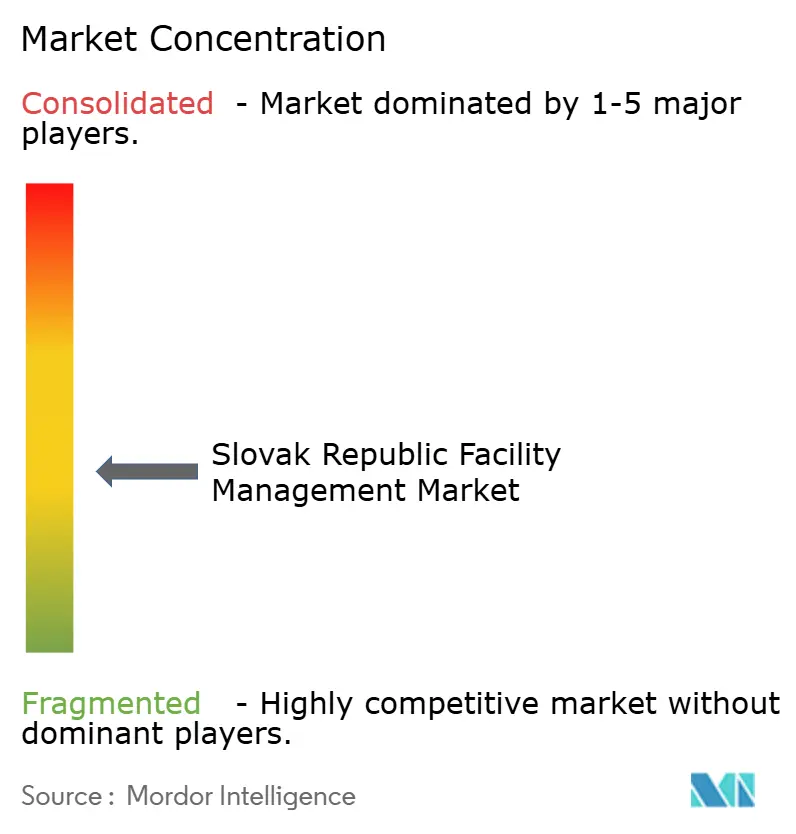
| Market Concentration | Medium |
Major Players *Disclaimer: Major Players sorted in no particular order Image © Mordor Intelligence. Reuse requires attribution under CC BY 4.0. | |
Slovak Republic Facility Management Market Analysis by Mordor Intelligence
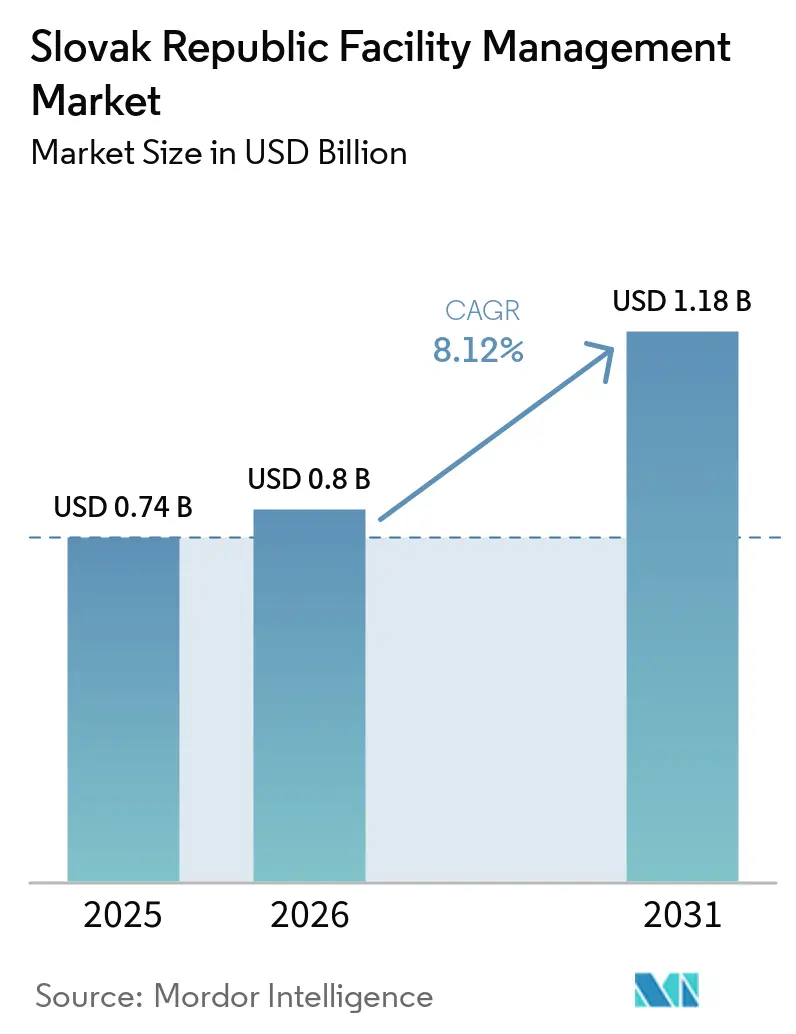
The Slovakia facility management market size is projected to be USD 0.74 billion in 2025, USD 0.8 billion in 2026, and reach USD 1.18 billion by 2031, growing at a CAGR of 8.12% from 2026 to 2031. Slovakia’s manufacturing-centric economy, rapid EU Recovery and Resilience Fund (RRF) deployment, and enforcement of the Energy Performance of Buildings Directive (EPBD) underpin this expansion. Battery and electronics plant construction in the western corridor, coupled with nationwide hospital, rail and education upgrades financed via roughly EUR 6 billion in RRF grants, enlarges the addressable base for technical and integrated service contracts.[1] Rising ESG reporting, 78% of large Slovak firms now publish sustainability data, pushes premium demand for green building bundles and AI-enabled predictive maintenance. Yet tight labour markets, concentrated in certified HVAC and electrical trades, and sustained Bratislava office vacancies temper immediate margin expansion.
Key Report Takeaways
- By service type, Hard Services captured 60.15 % of the Slovakia facility management market share in 2025 while Soft Services advance at a 8.74 % CAGR through 2031.
- By offering, the Outsourced model held 61.45 % of the Slovakia facility management market size in 2025 and is projected to grow at 8.35 % CAGR to 2031.
- By end-user, Commercial facilities led with 35.85 % revenue share in 2025; Institutional & Public Infrastructure is forecast to expand at an 8.42 % CAGR through 2031.
Note: Market size and forecast figures in this report are generated using Mordor Intelligence’s proprietary estimation framework, updated with the latest available data and insights as of 2026.
Slovak Republic Facility Management Market Trends and Insights
Drivers Impact Analysis*
| Driver | (~) % Impact on CAGR Forecast | Geographic Relevance | Impact Timeline |
|---|---|---|---|
| RRF-backed hospital, rail & education upgrades | +2.1% | National, Bratislava & regional hubs | Medium term (2-4 years) |
| Automotive, battery & electronics plant expansion | +1.8% | Western Slovakia | Short term (≤ 2 years) |
| EPBD-driven IoT/BMS & AI maintenance adoption | +1.4% | National | Long term (≥ 4 years) |
| ≥70% outsourcing penetration in Grade-A offices | +0.9% | Bratislava | Medium term (2-4 years) |
| ESG & green-certification demand | +1.2% | National | Medium term (2-4 years) |
| Retrofit of 700 k prefabricated residential blocks | +0.8% | Urban centres | Long term (≥ 4 years) |
| Source: Mordor Intelligence | |||
EU Recovery & Resilience Fund Infrastructure Modernization
Record-high EU fund absorption directs EUR 6 billion into Slovak hospital, rail and education projects through 2026, producing large multi-year technical FM contracts that replace fragmented commercial jobs. The Poprad-Tatry railway overhaul alone (EUR 369 million) demands logistics coordination, safety monitoring and commissioning services. [2]IMF analysis confirms public-investment-led GDP support, reinforcing multi-segment demand. Providers able to bundle hard and soft disciplines with robust KPI tracking secure higher-margin, long-duration contracts.
Automotive Sector Battery Manufacturing Expansion
Hyundai Mobis (USD 257 million) and InoBat-Gotion (EUR 1 billion) anchor a battery cluster requiring cleanroom operations, hazardous-materials logistics and precision climate control. Output targets of 300 k EV power units and 240 k vehicle batteries annually necessitate 24/7 predictive maintenance, specialised fire suppression and energy-management protocols. Government incentives worth USD 28 million underline policy continuity, ensuring a stable pipeline of industrial FM opportunities.
EPBD Implementation and Smart Building Technology Integration
Slovakia adopted the EU EPBD in early 2024, mandating building system upgrades, minimum energy standards and EV-charging infrastructure. [3] IoT-enabled BMS paired with AI analytics can cut office energy use by up to 37%. The government’s “Zelená domácnostiam” energy-voucher scheme exhausted EUR 47 million within months, signalling sizeable latent demand for smart-tech retrofits. FM firms offering turnkey audit-design-operate packages capture premium pricing.
ESG Compliance and Green Certification Demand
Mandatory sustainability disclosures under the Corporate Sustainability Reporting Directive elevate demand for carbon-tracking, renewable-sourcing and BREEAM/LEED compliance services. Banks in Central Europe now tie more than three-quarters of commercial real-estate lending decisions to external sustainability credentials, reshaping FM procurement norms. Integrated providers that deliver energy optimisation, waste-reduction and transparent ESG metrics enjoy higher renewal rates and fee uplifts.
Restraints Impact Analysis*
| Restraint | (~) % Impact on CAGR Forecast | Geographic Relevance | Impact Timeline |
|---|---|---|---|
| Shortage of certified HVAC, electrical & fire-safety technicians | -1.6% | National | Short term (≤ 2 years) |
| >14% office vacancy in Bratislava | -0.8% | Bratislava | Medium term (2-4 years) |
| Commoditised pricing trims mid-tier EBIT margins | -0.7% | National | Medium term (2-4 years) |
| Fragmented micro-vendor base | -0.5% | National | Long term (≥ 4 years) |
| Source: Mordor Intelligence | |||
Technical Labour Shortage Crisis
EU-wide data list plumbers, electricians and HVAC engineers among the top shortage occupations, and Bratislava’s 2.3% unemployment masks acute skills gaps. [4]Cedefop projects these imbalances persisting to 2035, elevating wage inflation and hindering service scalability. Providers are implementing apprenticeship pipelines and foreign-labour recruitment yet still operate below optimal capacity.
Bratislava Office Market Vacancy Pressures
Hybrid work adoption holds Bratislava office vacancy above 14%, compressing soft-FM volumes and favouring shorter, price-sensitive contracts. Investment reports note bid-ask spreads and muted transaction flows across European secondary cities, intensifying competition for a shrinking occupier base. FM firms must pivot toward logistics, life-science and mixed-use assets to offset lost cleaning and catering hours.
*Our forecasts treat driver/restraint impacts as directional, not additive. The impact forecasts reflect baseline growth, mix effects, and variable interactions.
Segment Analysis
By Service Type: Technical Upgrades Sustain Hard-Service Leadership
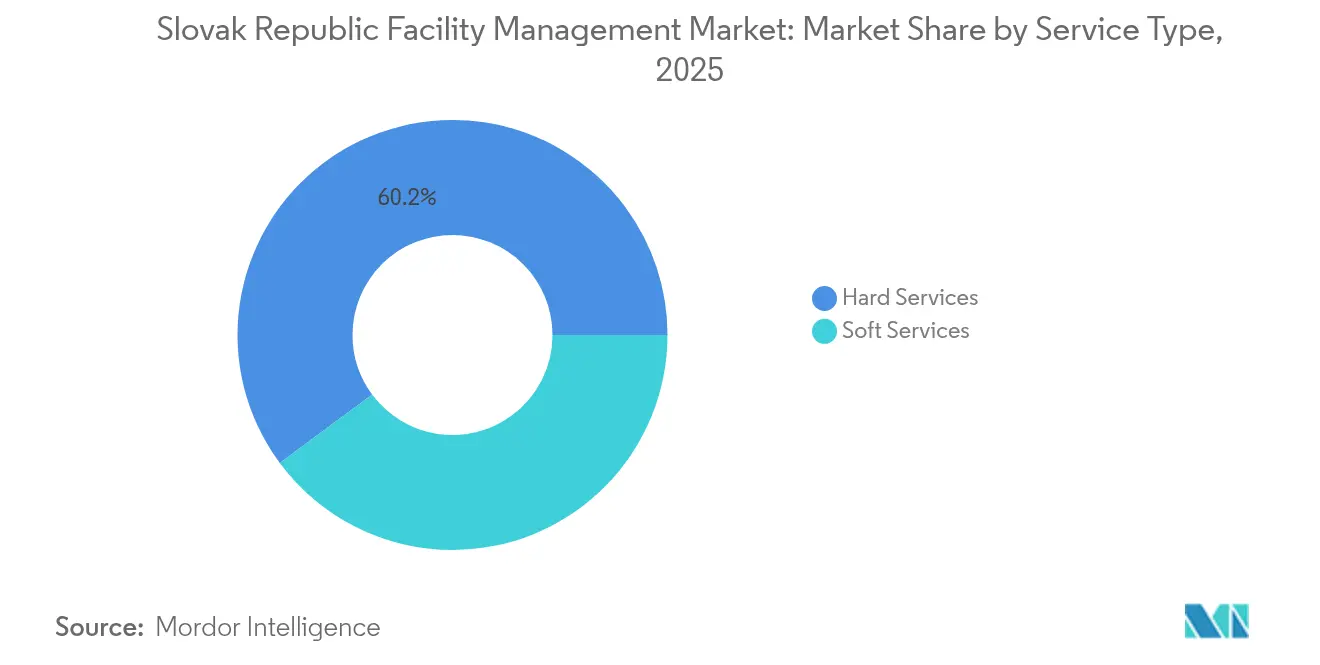
Hard Services held a commanding 60.15 % Slovakia facility management market share in 2025, propelled by mandatory fire, HVAC and electrical system standards in industrial and public buildings. Compliance with the EPBD and stringent automotive cleanroom requirements keeps long-cycle maintenance contracts buoyant, anchoring the Slovakia facility management market size for technical disciplines to an 7.65 % CAGR through 2031. Soft Services, despite commoditisation, outpace overall growth at 8.74 % CAGR as Grade-A offices in Bratislava outsource security, reception and specialised cleaning aligned with ESG hygiene norms.
Digital convergence is blurring service silos: bundled energy management, waste optimisation and workplace-experience platforms encourage cross-sale from hard-service incumbents into soft-FM categories, smoothing revenue volatility and lifting blended margins above the sub-5 % sector average.

By Offering: Outsourcing Intensifies Across Public and Private Projects
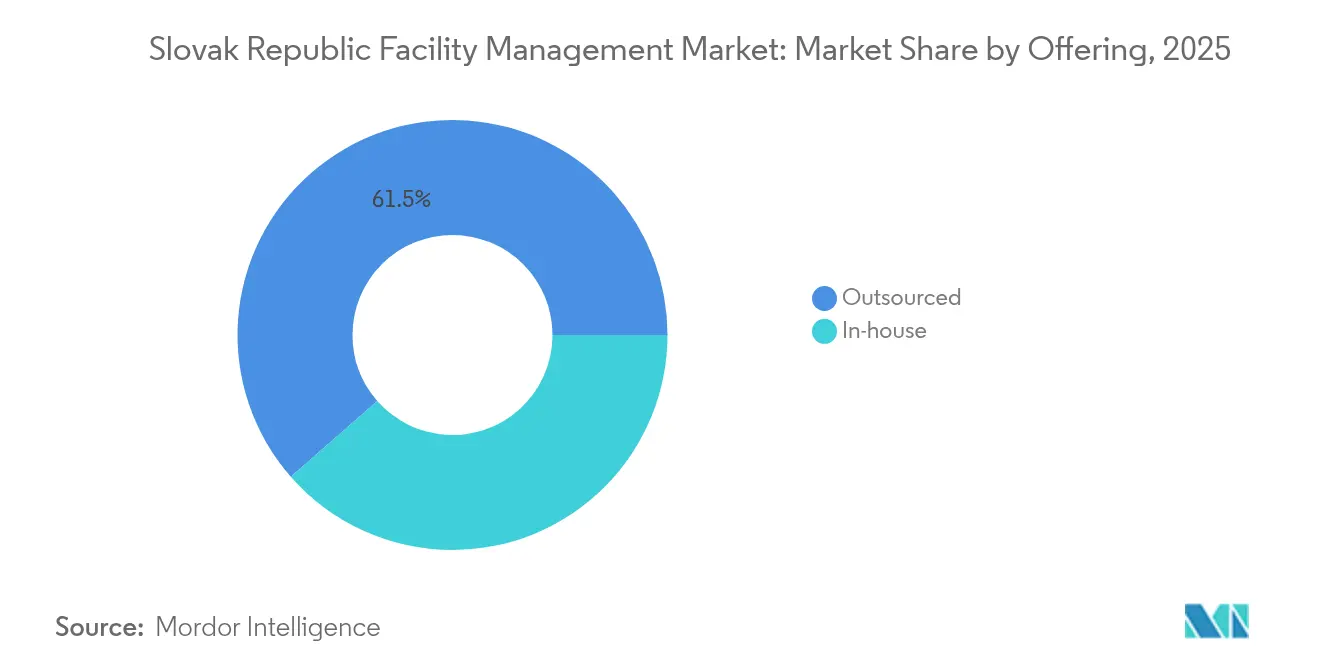
The Outsourced model accounted for 61.45 % of the Slovakia facility management market size in 2025 and is forecast to expand at 8.35 % CAGR to 2031 as corporates and municipalities shift risk and capex to specialist partners. Integrated FM sits at the premium apex, commanding double-digit contract value growth via multi-site, multi-service bundles under unified KPIs. Single and Bundled FM remain gateways for SMEs and regional public bodies embarking on first-time outsourcing journeys.
In-house operations still cover 38.55 % of facilities, notably in energy and petrochemical plants where safety oversight is viewed as core. Yet budget-constrained ministries are piloting Public-Private Partnership FM models on new rail depots and hospitals, signalling further share gains for the outsourced cohort.
By End-User: Public Infrastructure Emerges as Fastest-Growth Node
Commercial real estate—retail, warehousing and hospitality—retained leadership with 35.85 % revenue share in 2025, reflecting Slovakia’s mid-European logistics role. Energy-efficient store retrofits and hotel pipeline recovery post-pandemic sustain demand but at a moderating pace.
Institutional & Public Infrastructure is set to grow at 8.42 % CAGR, catalysed by RRF-funded hospital overhauls, university dormitory modernisation and the EUR 369 million Poprad-Tatry rail upgrade. Industrial & Process sites gain from battery-plant capex and brownfield automotive expansions, while multi-housing and leisure complexes surface as niche, higher-margin pockets for community-oriented service providers.
Geography Analysis
Bratislava controls roughly 39.40 % of the Slovakia facility management market share in 2025, underpinned by the nation’s highest GDP per capita and dense inventory of Grade-A offices and government buildings. Premium ESG-linked contracts and multilingual workforce availability allow rate premiums relative to regional averages.
Western Slovakia records the quickest uptake—about 9.85 % CAGR—to 2031 as Novaky, Trnava and Nitra host automotive and battery megaprojects requiring continuous technical FM presence and advanced safety protocols. Central Slovakia grows steadily on the back of diversified manufacturing and logistics corridors, while Eastern regions leverage EU cohesion funding to retrofit schools, courts and regional hospitals, gradually narrowing service-quality gaps.
OECD labour data underscore disparities: Bratislava’s unemployment sits at 2.1% versus 10.7% in the East, shaping wage structures and vendor density. Providers tailoring cost-sensitive models for eastern municipalities—while deploying AI-driven monitoring centrally—can capture untapped public-sector volumes.
Regulatory Landscape
Facility management demand in Slovakia is increasingly shaped by public-asset governance reform and EU-aligned building and digital compliance. The Ministry of Interior has been establishing a Central Coordinating Body for Administrative Building Management, alongside a 2026 implementation plan to centralize facility management, energy monitoring, and investment planning for state-owned buildings. The approach includes pilots on Interior Ministry properties and a longer runway for digitized, standardized asset data and procurement workflows.
On the building side, Slovakia is implementing the EU Energy Performance of Buildings Directive (adopted in early 2024), reinforcing requirements around energy efficiency upgrades, building-system modernization, and EV-charging readiness. These translate into recurring hard-FM work (HVAC, electrical, fire safety, and controls) and higher documentation obligations. Digital requirements are also tightening: amendments to the Electronic Communications Act (Law No. 452/2021 Z.z.) include a May 11, 2026 deadline for operators to report physical infrastructure availability to the Single Information Point (Jednotne informacne miesto). In parallel, ongoing EU-level digital rules, including the EU AI Act framework adopted in 2024, are lifting attention on data handling, transparency, and governance for FM providers deploying AI-enabled monitoring and reporting tools in client environments.
Value Chain Analysis
The Slovak Republic facility management value chain begins with inputs such as skilled labor (certified HVAC, electrical inspection, fire-safety technicians), equipment and consumables (spare parts, filtration, chemicals, PPE), and building-technology components (BMS/controls, sensors, metering). Service delivery is then carried out by single-service specialists and integrated FM (IFM) providers that plan, staff, and operate hard services (MEP, HVAC, fire systems, asset maintenance) and soft services (cleaning, security, waste, reception) under service-level agreements. CAFM systems and central dispatch are increasingly used to manage work orders, compliance records, and multi-site reporting.
Downstream, services are procured by industrial clients (automotive, battery, electronics), commercial real estate owners and occupiers, and public-sector bodies managing hospitals, rail assets, and education facilities, where performance and ESG reporting are being embedded in tender requirements. Industry standardization and capability development are supported by bodies such as the Slovak Association of Facility Management (SAFM). Its 2025 SAFM GUIDE highlighted digital transformation, AI-enabled predictive maintenance, and ESG reporting, supporting a shift in value capture away from commoditized labor-only contracts toward providers that can coordinate subcontractors, integrate building data, and document outcomes across portfolios.
Competitive Landscape
The Slovakia facility management industry exhibits moderate fragmentation. Global majors ISS Facility Services, Sodexo Slovakia and ATALIAN Global Services secure multi-site industrial, finance and public-sector contracts by leveraging standardised processes and IoT platforms. Regional specialists Apleona HSG, Reiwag and ENGIE Services differentiate via deep technical certifications and local compliance fluency, especially in fire-safety and cleanroom management.
Technology is becoming the defining moat: leaders deploy digital twins, sensor-based condition monitoring and mobile workforce apps to reduce reactive callouts and enable performance-based pricing. Leadec’s circular-economy offering—encompassing waste-heat reuse and closed-loop coolant systems—illustrates ESG-led service diversification.
Margin pressure in soft-FM accelerates consolidation; smaller janitorial and security outfits unable to finance tech upgrades increasingly accept acquisition or subcontractor roles. Concurrently, rising public-sector outsourcing opens space for joint ventures that pair international capital strength with Slovak SMEs’ regional networks.
Slovak Republic Facility Management Industry Leaders
-
Apleona HSG s.r.o.
-
Reiwag Facility Services GmbH
-
OKIN FACILITY
-
BBS Facility Management s.r.o.
-
Danube Facility Services
- *Disclaimer: Major Players sorted in no particular order
Market Opportunities and Future Outlook
Digitization of asset management and maintenance workflows is a clear whitespace area. The market context indicates that many Slovak facility teams use building management systems mainly for basic monitoring rather than advanced analytics and predictive maintenance. This gap supports opportunities for FM providers to productize CAFM-led, sensor-enabled maintenance programs (metering, condition monitoring, mobile work orders) that reduce reactive callouts while strengthening audit trails for safety and energy compliance, particularly in hard-services-heavy portfolios.
Regulatory and process changes are also creating commercially actionable opportunities in retrofit-led technical FM. Energy-performance requirements under Act No. 555/2005 on Energy Performance of Buildings, including automation and control requirements when technically and economically feasible during significant renovations, and time-bound mandates for non-residential automatic lighting controls in higher-capacity systems, push building owners toward controls upgrades. FM providers can package these needs as audit-design-operate offerings. Separately, the new Construction Act No. 25/2025 Coll., effective from April 1, 2025 and referenced in mid-2026 as being in force for over a year with centralized electronic permitting, raises the value of digitally documented commissioning, as-built data continuity, and handover-to-operations workflows. That favors operators that can connect construction closeout with ongoing maintenance, compliance reporting, and ESG dashboards.
Recent Industry Developments
- July 2026: OKIN Facility Slovakia reported surpassing 9,000 managed locations across its portfolio. The milestone points to scaling multi-site service delivery and stronger leverage of standardized processes and digital tools in contracted operations.
- June 2025: Gotion and InoBat broke ground on an approximately EUR 1 billion EV battery plant in Slovakia. Large-format industrial builds of this type expand demand for integrated hard-FM capabilities such as cleanroom operations, hazardous-material handling, precision HVAC, and 24/7 maintenance regimes.
- May 2024: Slovakia moved into early-stage national implementation of the EU Energy Performance of Buildings Directive (EPBD), tightening requirements around building-system upgrades and minimum energy standards. The step-up in compliance emphasis supports more structured demand for building automation, energy management, and documentation-heavy technical FM services.
Research Methodology Framework and Report Scope
Market Definition and Coverage
This market covers revenues earned from facility management services delivered for buildings and sites in the Slovak Republic, including hard services (such as MEP upkeep) and soft services (such as cleaning and security), whether managed in-house or outsourced under single, bundled, or integrated contracts.
Scope exclusions: We exclude pure construction and one-off renovation projects that do not relate to ongoing operations, maintenance, or support services.
Segmentation Overview
- By Service Type
- Hard Services
- Asset Management
- MEP and HVAC Services
- Fire Systems and Safety
- Other Hard FM Services
- Soft Services
- Office Support and Security
- Cleaning Services
- Catering Services
- Other Soft FM Services
- Hard Services
- By Offering Type
- In-house
- Outsourced
- Single FM
- Bundled FM
- Integrated FM
- By End-user Industry
- Commercial (IT and Telecom, Retail and Warehouses, etc.)
- Hospitality (Hotels, Eateries, Large-scale Restaurants)
- Institutional and Public Infrastructure (Govt, Education, Transportation)
- Healthcare (Public and Private Facilities)
- Industrial and Process (Manufacturing, Energy, Mining)
- Other End-user Industries (Multi-housing, Entertainment, Sports and Leisure)
Data Sources, Market Sizing, and Validation
Desk Research
Desk research started with public and official data to understand the building base and the activity level that typically drives outsourced services. We used Eurostat for sector output and labor indicators, the Statistical Office of the Slovak Republic for business activity and employment series, and national energy efficiency publications that can shift maintenance and retrofit cycles.
We also reviewed procurement and tender portals for cleaning, security, and building operations contracts, alongside building and property information from industry associations and reputable press coverage. Company annual reports, local filings, and investor presentations were used to map service mixes and to check how much work is handled through outsourced contracts versus internal teams. Where needed, paid subscriptions for company financials and news intelligence, along with a contracts and tenders database, were used to fill gaps and to cross-check the timing of major contract wins. The desk sources listed are illustrative and not exhaustive, and we reviewed additional materials to collect data, validate assumptions, and clear up open questions.
Primary Interviews and Surveys
Our Slovakia interviews and surveys cover FM buyers, providers, property and operations leaders, and public-facility decision makers. Respondents clarify outsourcing shares, contract values, renewal timing, service mix, and changes in demand within Slovakia. Follow-up contacts are used to resolve gaps and compare these responses with the market-sizing model.
Distribution of primary research fieldwork respondents
| Company type | Respondent position |
|---|---|
| Top tier: 28% | CXOs: 16% |
| Mid tier: 47% | Functional/Unit leaders: 34% |
| Smaller Players: 25% | Managers: 50% |
Market-Sizing & Forecasting
For sizing, the main build used a top-down approach where commercial and industrial building activity, outsourcing penetration, and service intensity were used to reconstruct the reachable spend pool for facility services in Slovakia, and then converted into USD using consistent average exchange rate timing for the year. We corroborated results with selective bottom-up approximations, including sampled contract values, provider revenue splits, and ASP-by-service checks for common bundles.
Key inputs tracked in the model include office and industrial stock additions (especially logistics and manufacturing facilities), public and private tender volumes for cleaning and security, labor availability and wage movement in building services, energy efficiency related operating needs that can change maintenance frequency, and the share of sites moving from single service to bundled or integrated delivery. When a provider did not disclose Slovakia-only revenue, we handled gaps using regional splits discussed in interviews and applied service mix shares to known contract footprints, then tightened the range through repeated checks with buyers and contractors.
Forecasts were developed using scenario analysis anchored on pipeline visibility for commercial real estate and industrial parks, combined with expert views on outsourcing rates and contract repricing. Growth paths were stress-tested for wage inflation and energy cost volatility, since these items often affect FM budgets and pricing more than demand volume in a given year.
Data Validation & Update Cycle
Model outputs were checked against independent signals such as tender announcements, changes in building services employment, and disclosed contract renewals reported in the press. Variances were investigated when the implied spend per square meter or per site moved outside reasonable ranges for common service bundles, and then assumptions were revisited before sign-off.
A second analyst review was completed to confirm that scope and unit logic were consistent across years, after which the final numbers were approved through an internal cross-check. Reports are refreshed annually, and interim updates are triggered when major public contracts, regulatory shifts, or sharp currency moves create a material change. Before delivery, we complete a final update pass so clients receive the latest view aligned to the most recent events and validated assumptions.
Mordor Intelligence's Slovak Republic Facility Management Market Size Compared With Other Published Estimates
Published market sizes for facility management in Slovakia can differ because service boundaries are not always the same, and the treatment of in-house delivery versus outsourced contracts changes totals quickly. Differences also come from the year used for currency conversion, whether values reflect reported revenue or addressable spend, and how contract repricing is handled during high wage inflation periods.
The main gap comes from whether residential building management and property management revenues are folded into the same bucket. In this approach, Mordor Intelligence counts facility management as hard and soft services for operating buildings (including in-house and outsourced delivery) and keeps property management turnover out of the market total.
Benchmark comparison
| Source | Market Size | Gaps in Research Methodology |
|---|---|---|
| Mordor Intelligence | USD 0.74 B (2025) | |
| Industry Media Outlet A | USD 0.72 B (2023) | Uses a revenue figure for building management that blends facility management with property management and housing administration, and the value is reported in EUR for a different year before being compared in USD. |
| Global Insights Publisher B | USD 0.84 B (2026) | Leans more on forecast-led totals and a broader end-use list that can mix adjacent services, and the step-up to 2026 may assume faster contract repricing and outsourcing gains than what buyer interviews typically support. |
Across the three figures, the spread is mainly explained by scope alignment and timing, rather than a disagreement that the market is growing. When the same service basket, year, and currency timing are enforced, the estimate becomes easier to trace back to building activity, outsourcing intensity, and contract pricing steps that can be repeated year after year.
Key Questions Answered in the Report
What is the current value of the Slovak Republic facility management market?
The Slovak Republic facility management market size is USD 0.80 billion in 2026.
How fast is the market expected to grow?
The market is forecast to expand at an 8.12% CAGR, reaching USD 1.18 billion by 2031.
Which service category dominates the market?
Hard Services lead with 60.15 % market share due to stringent technical and regulatory requirements in industrial and public buildings.
Why is outsourcing gaining traction in Slovak Republic?
Corporates and public bodies favour outsourced models to transfer risk, access specialised skills and meet EU compliance mandates, giving outsourced FM 61.45 % market share in 2025.
How does ESG regulation affect facility management providers?
Mandatory sustainability reporting and green-loan criteria incentivise integrated providers that can deliver energy optimisation, carbon tracking and certification support, unlocking premium pricing potential.