
Market Overview
| Study Period | 2020 - 2031 |
|---|---|
| Forecast Data Period | 2026 - 2031 |
| Base Year Market Size (2025) | USD 1.98 Billion |
| Market Size (2026) | USD 2.10 Billion |
| Market Size (2031) | USD 2.63 Billion |
| Growth Rate (2026 - 2031) | 4.60 % |
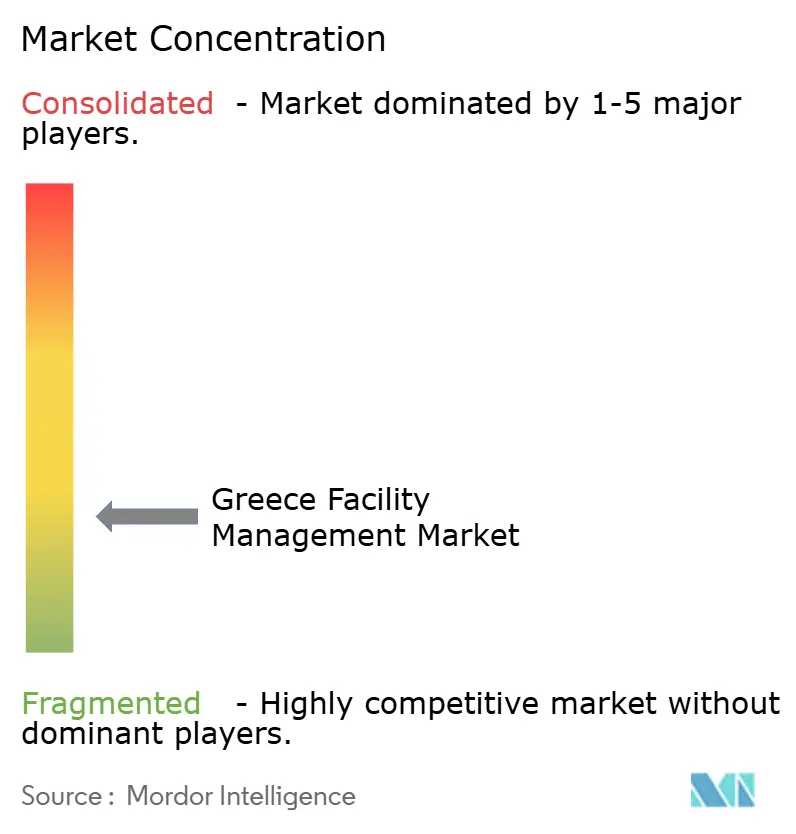
| Market Concentration | Low |
Major Players *Disclaimer: Major Players sorted in no particular order Image © Mordor Intelligence. Reuse requires attribution under CC BY 4.0. | |
Greece Facility Management Market Analysis by Mordor Intelligence
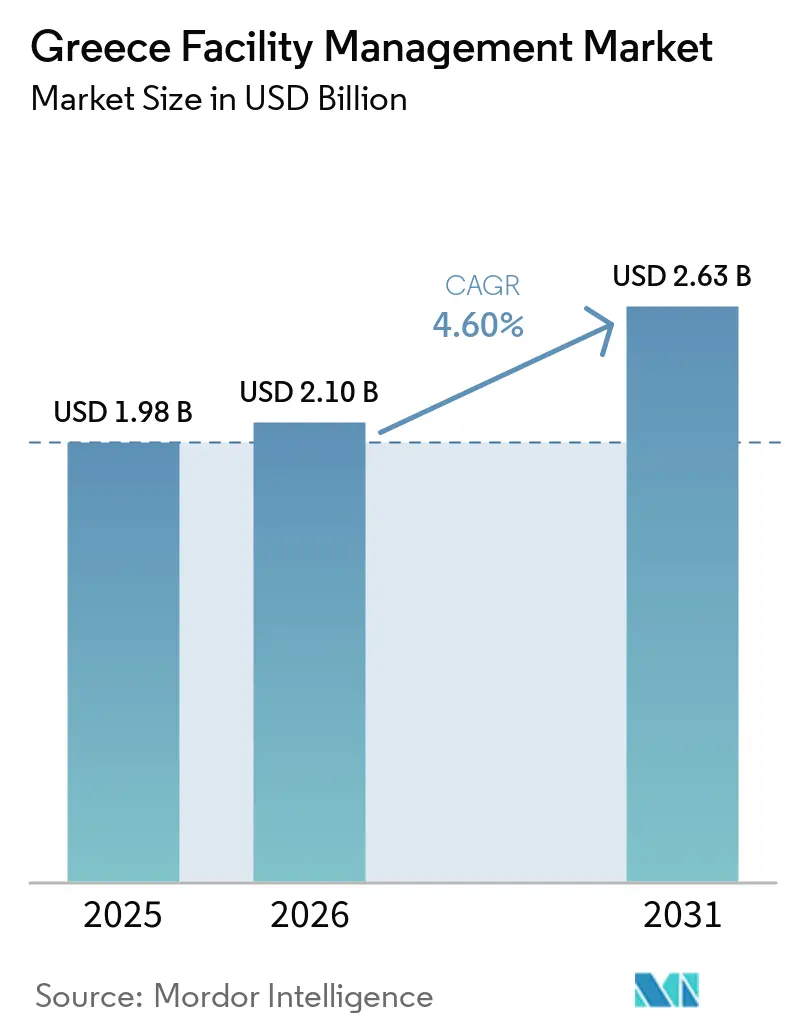
The Greece Facility Management Market size is projected to expand from USD 1.98 billion in 2025 and USD 2.10 billion in 2026 to USD 2.63 billion by 2031, registering a CAGR of 4.60% between 2026 and 2031.
Demand is holding steady despite elongated public‐sector approval cycles, because European Union Recovery and Resilience Facility (RRF) disbursements continue to finance infrastructure upgrades and a robust tourism rebound is sustaining cash flows across hospitality assets. Corporate occupiers in Athens and Thessaloniki have moved from cost-cutting toward experience-led workplace strategies, placing hygiene, energy efficiency, and digital monitoring on equal footing with traditional maintenance. International hotel brands entering the country bring global procurement standards that elevate service specifications and drive adoption of integrated contracts. At the same time, wage inflation in technical trades is compressing hard-service margins and pushing smaller vendors to consolidate or partner with multinational platforms. Across every end-user group, ESG reporting requirements are changing the definition of service delivery, because owners must now document environmental performance in auditable formats that lenders and tenants scrutinize.
Key Report Takeaways
- By service type, soft services accounted for 68.07% share of the market in 2025, while hard services led with 5.51% CAGR through 2031 in the Greece facility management market.
- By offering type, outsourced arrangements accounted for 67.82% of Greece facility management market share in 2025, while integrated contracts are forecast to expand at a 5.09% CAGR to 2031.
- By end-user, the commercial segment held 27.57% of Greece facility management market size in 2025 and is projected to post a 3.73% CAGR during 2026-2031. By end-user, hospitality segment, is expanding at 5.63% CAGR through 2031 in the Greece facility management market.
Note: Market size and forecast figures in this report are generated using Mordor Intelligence’s proprietary estimation framework, updated with the latest available data and insights as of 2026.
Greece Facility Management Market Trends and Insights
Drivers Impact Analysis*
| Driver | (~) % Impact On CAGR Forecast | Geographic Relevance | Impact Timeline |
|---|---|---|---|
| Technology-Led Integrated FM Driving Operational Excellence | +0.6% | National, Early Adoption In Athens And Thessaloniki | Medium Term (2–4 Years) |
| ESG-Compliant FM Solutions Gaining Market Traction | +0.4% | National, Strongest In Hospitality And Institutional Sectors | Medium Term (2–4 Years) |
| Outsourcing Shift From In-House To Integrated FM Contracts | +0.5% | National, Led By Commercial And Hospitality Occupiers | Short Term (≤ 2 Years) |
| EU RRF Funding Catalyzing Smart Building Renovations | +0.7% | National, Priority In Public Infrastructure And Healthcare | Short Term (≤ 2 Years) |
| Tourism Supercycle Fueling Hospitality FM Demand | +0.5% | Coastal Regions And Major Islands | Short Term (≤ 2 Years) |
| Aging Commercial Real-Estate Retrofit Wave Unlocking Lifecycle Asset Management Deals | +0.4% | Athens And Thessaloniki CBDs | Long Term (≥ 4 Years) |
| Source: Mordor Intelligence | |||
Technology-Led Integrated FM Driving Operational Excellence
IoT sensors, cloud dashboards, and AI-based diagnostics are allowing managers to replace reactive work orders with data-driven, condition-based interventions that extend asset life and cut downtime. SingularLogic’s EnergySense deployment across nationwide fuel stations illustrates typical cost savings of 15-20 percent while giving clients an auditable pathway to ISO 50001 compliance.[1] Yet fewer than 12 percent of commercial buildings possess open-protocol controllers, so integrators must retrofit gateways before unified analytics become possible, adding cost and elongating payback periods. Multinational vendors amortize these platform investments across pan-European contracts, giving them a price advantage that local providers struggle to match. Procurement teams have begun specifying BACnet or Modbus compatibility in recent tenders, a sign that standardization is emerging and will accelerate adoption over the next two years.
ESG-Compliant FM Solutions Gaining Market Traction
Greece transposed the EU Taxonomy into national law in 2024, compelling listed companies and financial institutions to disclose how much revenue, capex, and opex align with climate objectives. Facility managers now track energy, water, waste, and refrigerant leakage at building level and integrate those metrics into investor reports. LEED and BREEAM certifications, once niche, have become prerequisites for premium rents in Athens, commanding uplifts of 8-12 percent. Vendors showcase their own certified headquarters to win business; Manifest upgraded its offices to LEED Gold and earned ISO 50001 accreditation to underscore energy-management credibility.[2] Because no centralized performance database exists, each provider designs bespoke measurement protocols, elevating compliance costs and making cross-portfolio benchmarking difficult. A pilot digital fire-safety registry launched in 2025 reduced certificate processing to one day, proving that government digitalization can remove similar ESG reporting frictions.[3]
Outsourcing Shift From In-House to Integrated FM Contracts
Budget-constrained occupiers are dissolving internal facilities teams and bundling cleaning, security, catering, and technical maintenance under single vendors, converting fixed payroll into variable service fees. International hotel chains entering on the back of a EUR 2.8 billion (USD 3.3 billion) investment pipeline tend to mandate integrated agreements from day one, accelerating the trend in resort destinations. Domestic corporates follow suit, attracted by lifecycle costing and risk transfer, but fragmented ownership, multiple landlords in a single tower, forces vendors to negotiate floor-by-floor, dampening economies of scale. Public tenders remain dominated by single-service awards because drafting integrated specifications requires expertise many agencies lack, perpetuating a two-speed market.
EU RRF Funding Catalyzing Smart Building Renovations
The country will receive RRF inflows equivalent to 3.6 percent of GDP by 2026, channeling capital into energy-efficiency retrofits, healthcare upgrades, and digital infrastructure. All projects carry mandatory green and digital components, so technical requirements often exceed local building codes and favor FM vendors certified to ISO 50001 or with LEED AP staff. Although award timelines can stretch beyond six months, once projects mobilize they create annuity-like maintenance contracts that bundle hard and soft services for tenors of three to five years. Administratively, the e-Authorities platform has proven that digitizing permit workflows can compress delays and, if extended to FM contracts, could lift market growth by a further 0.3-0.5 percentage points.
Restraints Impact Analysis*
| Restraint | (~) % Impact On CAGR Forecast | Geographic Relevance | Impact Timeline |
|---|---|---|---|
| Labor Market Constraints Limiting Service Expansion | -0.5% | National, Acute In HVAC And Electrical Trades | Short Term (≤ 2 Years) |
| Economic Volatility Tempering Capital Allocation | -0.3% | National, Linked To Eurozone Monetary Policy | Medium Term (2–4 Years) |
| Fragmented Building Ownership Structure Hindering Integrated Contracts | -0.4% | Athens And Thessaloniki Urban Cores | Long Term (≥ 4 Years) |
| Public Procurement Red Tape Delaying FM Contract Award Cycles | -0.4% | National Public-Sector Buyers | Medium Term (2–4 Years) |
| Source: Mordor Intelligence | |||
Labor Market Constraints Limiting Service Expansion
Unemployment fell below 9 percent in 2025, but shortages in HVAC, electrical, and fire-safety engineering remain acute as skilled technicians migrate to higher-wage Northern EU jobs.[4] Wage inflation of 12-15 percent since 2023 erodes the cost advantage that once justified outsourcing, pressuring provider margins. The talent gap is most severe in digital competencies, sensor installation and BMS programming, because traditional vocational curricula do not cover data analytics. Apprenticeship programs are being co-developed with institutes, but new graduates will not appear for at least two years, leaving near-term capacity constrained.
Public Procurement Red Tape Delaying FM Contract Award Cycles
Single-bid submissions still dominate more than 70 percent of public tenders, suggesting limited competition and lengthy clarification rounds that postpone contract starts by up to a year. Even after an award, vendors face further delays due to site handovers and permit approvals. The administrative burden locks working capital and discourages smaller firms from bidding, lowering competitive intensity and keeping pricing opaque. While e-procurement portals are expanding, comprehensive reform is required to move from service-specific to integrated FM tenders that better match modern asset-management needs.
*Our forecasts treat driver/restraint impacts as directional, not additive. The impact forecasts reflect baseline growth, mix effects, and variable interactions.
Segment Analysis
By Service Type: Diverging Growth Paths for Hard and Soft Services
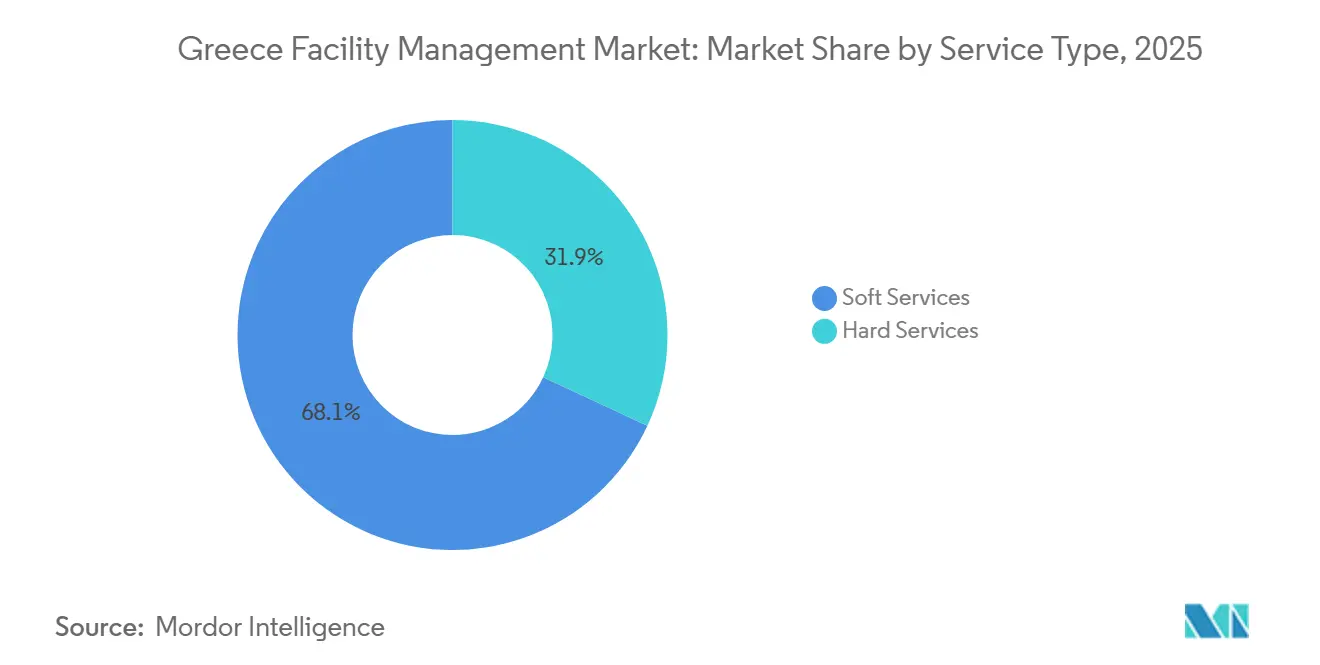
Hard services commanded a 31.93% of Greece facility management market share in 2025, reflecting the capital intensity of mechanical, electrical, and plumbing (MEP) upgrades in a building stock where 60 percent of commercial properties predate 2000. MEP and HVAC contracts dominate, because the Mediterranean climate drives heavy cooling loads and the EU F-gas phase-down compels refrigerant retrofits. Fire-safety compliance under Decree 13/2021 has also elevated demand for system inspections and certifications, adding steady recurring revenue. Soft services, is forecasted to grow 4.15% annually through 2031. Permanent post-pandemic hygiene protocols in healthcare and hospitality require documented disinfection routines, while hybrid work models increase demand for variable cleaning rosters and flexible reception staffing.
Asset owners are layering predictive analytics onto hard-service scopes, embedding remote monitoring and automated fault detection into new contracts. That pivot supports outcome-based pricing, in which vendors guarantee uptime or energy savings, a model gaining traction among multinational tenants. On the soft side, bundling cleaning, landscaping, and catering into single invoices is simplifying vendor management for corporate occupiers. Successive tenders now stipulate ISO 45001 health and safety accreditation as a minimum threshold, nudging smaller janitorial operators either to invest in systems or partner with larger integrators. Collectively, these factors ensure that both service families remain indispensable pillars of the Greece facility management market across the forecast horizon.
By Offering Type: Outsourced Models Cement Dominance
Outsourced delivery captured 67.82% of spending in 2025, led by multinational corporations seeking centralized dashboards and standardized KPIs across regional portfolios. Integrated facility management contracts, where a single provider assumes responsibility for all hard and soft services under performance-linked payment terms, are expanding at a 9.68% CAGR. Early adopters include blue-chip office landlords and branded hotel chains importing global procurement policies. Single-service contracts remain common among smaller landlords, but administrative cost savings from consolidation are nudging them toward bundled or integrated solutions when existing agreements expire.
In-house teams still control 32.18% of expenditure, mainly inside large hospitals and industrial plants that value institutional memory and regulatory familiarity. Yet even these entities are moving to hybrid approaches: they retain mission-critical technicians yet outsource cleaning, catering, or grounds maintenance. Public institutions often default to single-service awards because integrated tenders require comprehensive scopes that many agencies lack capacity to write. The gap represents an education opportunity for vendors willing to host workshops on lifecycle costing, although the payback can exceed 18 months and deters firms with limited business-development budgets. Overall, outsourcing will keep increasing its Greece facility management market share as administrative reform and digital reporting needs make specialist providers more attractive.
By End-User Industry: Commercial Core, Hospitality Catalyst
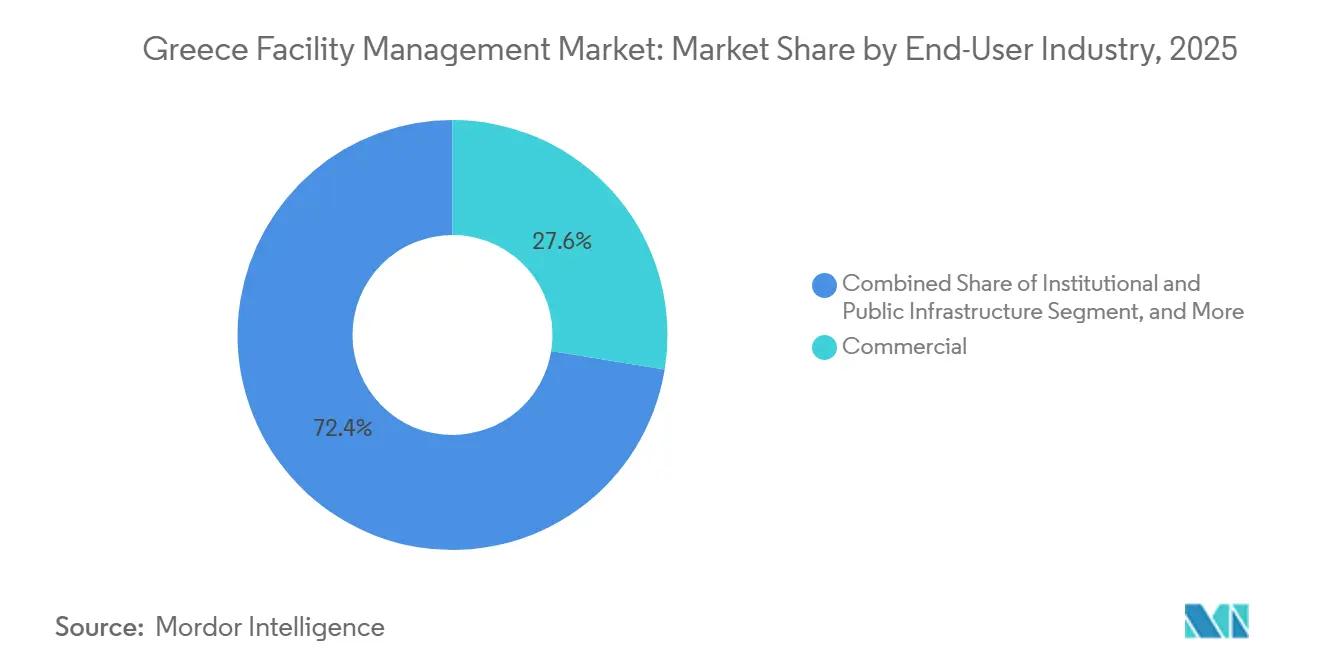
Commercial real estate held 27.57% of Greece facility management market size in 2025, anchored in Athens and Thessaloniki central business districts where landlords upgrade aging towers to compete for multinational tenants. ESG certifications and tenant-experience apps are quickly transforming FM from a cost line into a revenue enabler, reinforcing demand for energy dashboards, indoor-air-quality monitoring, and concierge-style front-of-house services. Retrofit activity is set to accelerate further because many Class B assets need smart readiness scores to remain marketable.
Healthcare grows at 6.52% CAGR, closely followed by hospitality is the second fastest-expanding vertical, powered by a 5.63% CAGR owing to rise in tourism receipts during the first half of 2025. New openings in Mykonos, Santorini, and Crete now specify IoT-enabled preventive maintenance, guest-room energy management, and outsourced laundry and catering in their base-build budgets. International operators typically mandate three- to five-year integrated contracts covering HVAC, cleaning, landscaping, and security from day one, injecting a step-change in service specifications. Institutional and public infrastructure, spanning ministries, universities, and transport hubs, benefit from RRF-funded renovations but still wrestle with delayed tender cycles. Healthcare is moving rapidly because EU money earmarked for digital hospital upgrades requires long-term maintenance agreements featuring medical-grade cleaning and critical-system uptime guarantees. Industrial, retail, education, and residential collectively form the remaining demand pool, each with distinctive but lower-growth profiles.

Geography Analysis
Athens and its metropolitan fringe account for the largest slice of national spending, together with Thessaloniki they represent roughly around two-third of the Greece facility management market. Athens concentrates headquarters offices, government ministries, and high-footfall cultural venues, all of which increasingly demand LEED or BREEAM compliance and therefore continuous performance monitoring. Thessaloniki’s blend of port logistics, manufacturing zones, and university campuses produces a different service mix, heavy on process-critical maintenance and laboratory cleaning. Vendor footprints mirror this distribution: multinational platforms maintain 24/7 control rooms in Athens, while regional branches in Thessaloniki handle industrial clients.
Coastal destinations such as Mykonos, Santorini, Crete, and Rhodes create pronounced seasonality. From April to October, outsourced providers ramp temporary staff for housekeeping, pool treatment, landscaping, and event catering. The same assets then downshift to skeleton crews during winter, challenging utilization planning and pressuring annual profitability. Vendors with mobile teams and strong labor agency partnerships outperform during these cycles. Fire-safety enforcement under Decree 13/2021 applies nationwide, but inspection intensity is noticeably higher in Athens and Thessaloniki, raising compliance workloads there.
Secondary cities, Patras, Heraklion, Larissa. and rural prefectures make up the remaining 40-45 percent of spending. Budgets are tighter, and public buyers often award to the lowest bidder, favoring local single-service firms over integrated contracts. The RRF is attempting to balance this disparity by allocating funds to regional road, rail, and broadband projects that will require ongoing FM. However, limited local administrative capacity slows mobilization, so national providers frequently partner with smaller firms to satisfy regional set-aside rules while maintaining quality oversight. This patchwork demands high operational flexibility and underscores why scale advantages alone do not guarantee success in the Greece facility management market.
Regulatory Landscape
Facility management providers in Greece work within overlapping building, safety, and digital compliance requirements. Building energy performance and related inspection requirements fall under the Ministry of Environment and Energy (YPEN), while permitting for facility modifications is routed through the Technical Chamber of Greece's e-adeies platform, making digital permitting a key dependency for retrofit-led hard services. Fire-safety compliance continues to shape inspection and maintenance scopes, reinforced by Decree 13/2021 requirements that keep recurring certification work embedded in FM delivery.
Workplace safety obligations also affect FM staffing models and subcontractor governance. Under Law 3850/2010 and Law 4808/2021, employers must maintain occupational health and safety arrangements, including appointing a safety technician and occupational physician where applicable, which pushes FM contractors to formalize HSE processes and documentation. For sites with significant ICT and connectivity footprints, infrastructure sharing and colocation rules governed by the Hellenic Telecommunications and Post Commission (EETT) influence how in-building telecom rooms and shared facilities are managed. National cybersecurity compliance adds an additional layer for essential and important entities under the National Cybersecurity Authority, including NIS2 implementation via Law 5160/2024 and CER transposition via Law 5236/2025, with critical-entity designation required by July 17, 2026.
Value Chain Analysis
The Greece facility management value chain includes asset owners (commercial landlords, hotel operators, and public bodies), FM primes (multinational and local operators), specialist subcontractors (HVAC, electrical, and fire systems), and a growing technology layer supplying BMS, IoT sensing, analytics, and digital-twin tooling. Technology integration tends to begin upstream at the retrofit and controls layer, given that fewer than 12% of commercial buildings have open-protocol controllers. That constraint makes gateway installation and BMS modernization frequent prerequisites for integrated FM services that can produce auditable ESG metrics and support condition-based maintenance.
On the delivery side, integrated contracts centralize vendor management and reporting with the FM prime, which then orchestrates cleaning, security, catering, and technical maintenance, alongside compliance documentation for safety and energy performance. Public-sector renovation and digitalization programs are also pulling systems integrators and software vendors deeper into FM scopes, as reflected in the June 2025 Yodiwo and CORDIA smart building and energy management implementation for the General Secretariat for Information Systems and Digital Governance (GSISDG), which combined IoT devices with platform-led monitoring. Industry bodies such as IFMA Greece can accelerate capability diffusion through technical forums, and large developers exploring in-house or captive FM entities create another channel between real estate development and service delivery, as seen in Lamda Development processes to establish a dedicated FM entity for major assets.
Competitive Landscape
Innovation and Client Relations Drive Success
Competition is moderate, with the top five multinational operators, ISS, Sodexo, CBRE, JLL, and Cushman and Wakefield, collectively holding about 25-30 percent share. They leverage scale advantages and cloud platforms that deliver remote diagnostics, KPI benchmarking, and energy analytics. Multinationals secure pan-European master service agreements, such as ISS’s 2025 multi-country contract valued above USD 14.3 million, and then extend those scopes to Greek facilities. Local specialists like Manifest Services, Cowa Hellas, Globe Williams, Module FM, and IMAGIN control a combined 40-45 percent share by stressing client proximity and regulatory fluency.
Domestic firms differentiate through tailored pricing, granular knowledge of fragmented building ownership, and the ability to mobilize technicians quickly during tourist season peaks. Many have invested in ISO 50001 and ISO 45001 accreditations to remain competitive in public tenders. Technological gaps persist, though: fewer than 12 percent of Greek buildings possess the sensor networks required for full digital twins, so local providers often bundle retrofitting into their proposals, offsetting upfront hardware costs with multi-year service agreements. Consolidation is accelerating as wage inflation compresses margins and buyers favor integrated scopes. Several family-owned enterprises are now exploring minority stake sales to international strategic partners that can inject capital and digital toolkits.
White-space opportunities lie in outcome-based contracting, where payments hinge on energy savings or tenant satisfaction indices. Only a handful of vendors currently underwrite such commitments, but successful pilots within the commercial office segment could reshape pricing norms. Certifications have become a competitive filter; bids lacking LEED, BREEAM, or ISO credentials are increasingly shortlisted only for lower-spec contracts. Participation in industry groups such as the Hellenic Institute of Construction Fire Protection further enhances credibility.[5] Collectively, these dynamics ensure rivalry will intensify, but capabilities rather than price alone will decide long-term winners in the Greece facility management market.
Greece Facility Management Industry Leaders
-
Cowa Hellas Facility Management AE
-
Manifest Services SA
-
MELKAT
-
IMAGIN Facility Management SA
-
IDMON Property Advisors & Technical Experts
- *Disclaimer: Major Players sorted in no particular order
Market Opportunities and Future Outlook
A key opportunity lies in scaling retrofit-led, standards-based automation that turns legacy buildings into monitorable, compliance-ready assets. The payload shows concrete traction through named deployments, including PRODEA Investments using Siemens Building X across a portfolio of over 120 properties to manage energy consumption and operational optimization, and Thelcon completing BEMS and KNX building controls at ELEMKA's new headquarters in Neo Irakleio, Athens, integrating lighting and HVAC monitoring. These projects connect directly to occupier demand for auditable energy and indoor-environment performance, and they also create attach points for FM providers to bundle monitoring, verification, and preventive maintenance into ongoing contracts.
Another opportunity is standardizing integrated facility management delivery models that reduce fragmentation across multi-tenant portfolios and multi-service scopes. In June 2026, Manifest and EFSIM Facilities Management Services announced a strategic partnership focused on unified governance, ESG standards, and digital performance monitoring tools, pointing to more repeatable IFM playbooks rather than bespoke bundles. Public-sector digitalization programs and RRF-funded upgrades also broaden the addressable scope for FM firms that can cover permitting, compliance documentation, and technology operations together, supported by the June 2025 GSISDG smart building and energy management implementation by Yodiwo and CORDIA, which integrated IoT sensors, smart meters, and solar energy systems into a single platform-managed environment.
Recent Industry Developments
- June 2026: Manifest Services SA and EFSIM Facilities Management Services announced a strategic partnership to develop an integrated facility management standard in Greece, positioning EFSIM as integrator/managing agent with Manifest as an authorized service delivery partner. The model emphasizes unified governance, ESG standards, and digital performance monitoring. It reinforces the shift from single-service awards toward structured IFM delivery with clearer accountability and platform-led reporting.
- April 2026: Cowa Facility Management implemented organized corporate catering services for Navilands through a partnership with Newrest Hellas, with Cowa acting as the principal service partner. The move expands FM scope beyond traditional technical and cleaning services into workplace services commonly bundled in integrated contracts. It also signals deeper collaboration between FM operators and specialist foodservice providers for large corporate sites.
- April 2025: The General Secretariat of Public Administration reduced active fire-protection certificate processing time to one day via the e-Authorities portal. Faster certification cycles cut administrative friction for building owners and FM contractors managing compliance-critical inspections and documentation. The change supports higher service cadence in hospitality and commercial assets where operational readiness depends on timely approvals.
Research Methodology Framework and Report Scope
Market Definition and Coverage
For this study, the Greece facility management market covers the value of services used to run and maintain buildings and sites, so day-to-day operations stay safe, comfortable, and efficient across commercial, public, and industrial facilities.
Scope exclusions: We exclude one-off construction and major renovation contracting that is not part of ongoing facility operations and maintenance.
Segmentation Overview
- By Service Type
- Hard Services
- Asset Management
- MEP and HVAC Services
- Fire Systems and Safety
- Other Hard Facility Management Services
- Soft Services
- Office Support and Security
- Cleaning Services
- Catering Services
- Other Soft Facility Management Services
- Hard Services
- By Offering Type
- In-House
- Outsourced
- Single Facility Management
- Bundled Facility Management
- Integrated Facility Management
- By End-User Industry
- Commercial
- Hospitality
- Institutional and Public Infrastructure
- Healthcare
- Industrial and Process
- Other End-User Industries
Data Sources, Market Sizing, and Validation
Desk Research
Desk research helped set the market perimeter and built starting points for demand and supply signals in Greece. We relied on public and official sources such as Eurostat for structural business statistics, the Hellenic Statistical Authority (ELSTAT) for national activity and price indicators, and European Commission publications for public buildings and energy efficiency direction.
For building stock and performance signals that feed maintenance and upgrades, we also referenced sources such as the International Energy Agency (IEA) and EU energy performance documentation. To convert these signals into an FM value view, we reviewed company annual reports and investor materials, press coverage on outsourcing deals, and public procurement announcements where service scopes are described.
A paid subscription for company financials and news was used selectively to normalize fragmented contractor revenues and to avoid double counting in multi-service contracts. The desk source list above is illustrative and not exhaustive, since other public documents were also used to collect data points, validate assumptions, and clarify open questions.
Primary Interviews and Surveys
Within Greece, we consult FM buyers, service providers, procurement teams, technical leaders, and site managers. Their input helps clarify outsourcing levels, contract mix, labor costs, service pricing, and demand across offices, hospitality, public facilities, and industrial sites. Responses are compared with ELSTAT and other desk data, with follow-up checks when an assumption does not fit observed activity.
Distribution of primary research fieldwork respondents
| Company type | Respondent position |
|---|---|
| Top tier: 28% | CXOs: 15% |
| Mid tier: 47% | Functional/Unit leaders: 35% |
| Smaller Players: 25% | Managers: 50% |
Market-Sizing & Forecasting
Sizing was built using a top-down and bottom-up approach, where national service activity is first reconstructed through outsourcing penetration and then cross-checked with supplier-side reality. On the top-down side, we mapped the addressable building and site universe and applied indicators such as outsourcing share by end-user, typical contract scope mix across hard and soft services, and service intensity for sectors like hospitality, public infrastructure, and commercial offices.
To keep totals grounded, we added selective bottom-up checks using sampled contract values, observed pricing ranges for common bundles (for example, cleaning plus security, or MEP maintenance plus energy services), and revenue normalization for multi-service operators that report blended lines. Where disclosure is limited, we used conservative ranges from primary interviews and then applied sensitivity checks so one large contract does not distort the country total.
For forecasting, we used scenario analysis supported by short-series smoothing on stable cost lines, since growth is influenced by practical drivers rather than a fast adoption curve. Key forward inputs included public and private outsourcing appetite, wage inflation for labor-heavy soft services, energy cost pressure shaping maintenance choices, tourism-linked occupancy affecting site usage, and the pace of building upgrades tied to energy efficiency programs. These variables were reviewed with interviewees to confirm the direction and realistic speed of change before finalizing the outlook.
Data Validation & Update Cycle
Validation was done through multiple checks that look for mismatches between the model output and independent signals, and then adjust assumptions only when the reason is clear. We compared implied FM spending per square meter, the split between hard and soft service value, and outsourced share assumptions against what facility managers and contractors see in active contracts.
Before sign-off, we reviewed anomalies such as step changes in pricing, unusual sector mixes, or sharp year-on-year swings with another analyst. Follow-up calls were triggered when variance stayed unexplained. Reports are refreshed annually, and interim updates are made when material events occur, such as policy changes affecting building operations or a shift in public procurement volumes. Right before delivery, a final pass is completed so the numbers reflect the latest available inputs.
Mordor Intelligence's Greece Facility Management Market Sizing Compared With Other Published Estimates
It is common to see different market sizes for facility management because the service bundle can be defined in more than one way, and because some estimates mix in adjacent activities that sit near FM but are not always contracted as FM. Differences also come from how in-house activity is treated, what year is used for pricing, and how currency conversion timing is handled.
The main gap comes from whether estimates add large one-time building upgrade and renovation spending into FM totals, where Mordor Intelligence counts recurring operations and maintenance services and excludes project-led construction and refurbishment work. Another driver is the assumed outsourcing penetration by end-user, since hospitality, public infrastructure, and commercial offices can have very different contract coverage in Greece. Refresh timing matters too, since labor- and energy-related cost lines move quickly and can shift annual contract values even when volumes stay stable.
Benchmark comparison
| Source | Market Size | Gaps in Research Methodology |
|---|---|---|
| Mordor Intelligence | USD 1.98 B (2025) | |
| Trade Journal A | USD 1.94 B (2024) | Uses EUR turnover commentary for the sector and converts it at a spot rate without aligning to contract timing, and it is not clear if in-house FM is partially included through general operating spend. |
| Regional Consultancy B | USD 2.45 B (2025) | Appears to include capital-heavy refurbishment and energy retrofit project work inside FM, which inflates the total when public and tourism-driven upgrades are elevated in a given year. |
Across the three values, the spread is mainly explained by what is treated as recurring FM services versus project-led building works, followed by different outsourcing and pricing assumptions. By tying the total back to contractable service bundles and then checking it against practical rate and mix inputs from interviews, we keep the sizing repeatable and easy to audit year to year.
Key Questions Answered in the Report
How big is the Greece facility management market in 2026?
It is expected to reach USD 2.10 billion in 2026, on its way to USD 2.63 billion by 2031.
What is driving demand for integrated facility management in Greece?
ESG reporting mandates, RRF-funded smart renovations, and multinational hotel chains that require single-vendor accountability are pushing occupiers toward integrated contracts.
How is soft services category growth is expected to deliver over the forecast period?
Soft services is expected to grow at 4.15% through 2031, however soft services especially focused to catering, is projected to expand at a 5.20% CAGR through 2031.
Why are hard-service margins under pressure?
Skills shortages in HVAC and electrical trades are pushing wages higher, while older assets still need intensive technical upgrades, squeezing provider profitability.
How will EU RRF funds affect the sector?
RRF inflows equivalent to 3.6 percent of GDP fund energy-efficient retrofits and digital infrastructure, creating multi-year maintenance opportunities once construction completes.