
Market Overview
| Study Period | 2020 - 2031 |
|---|---|
| Forecast Data Period | 2026 - 2031 |
| Base Year Market Size (2025) | USD 4.52 Billion |
| Market Size (2026) | USD 5.16 Billion |
| Market Size (2031) | USD 8.35 Billion |
| Growth Rate (2026 - 2031) | 10.11 % |
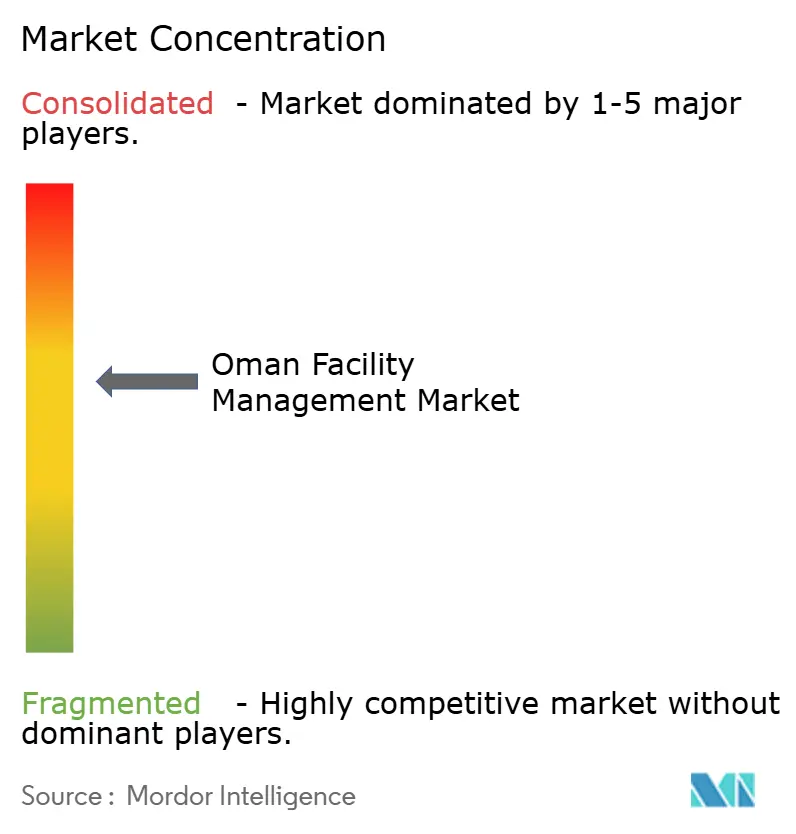
| Market Concentration | Medium |
Major Players *Disclaimer: Major Players sorted in no particular order Image © Mordor Intelligence. Reuse requires attribution under CC BY 4.0. | |
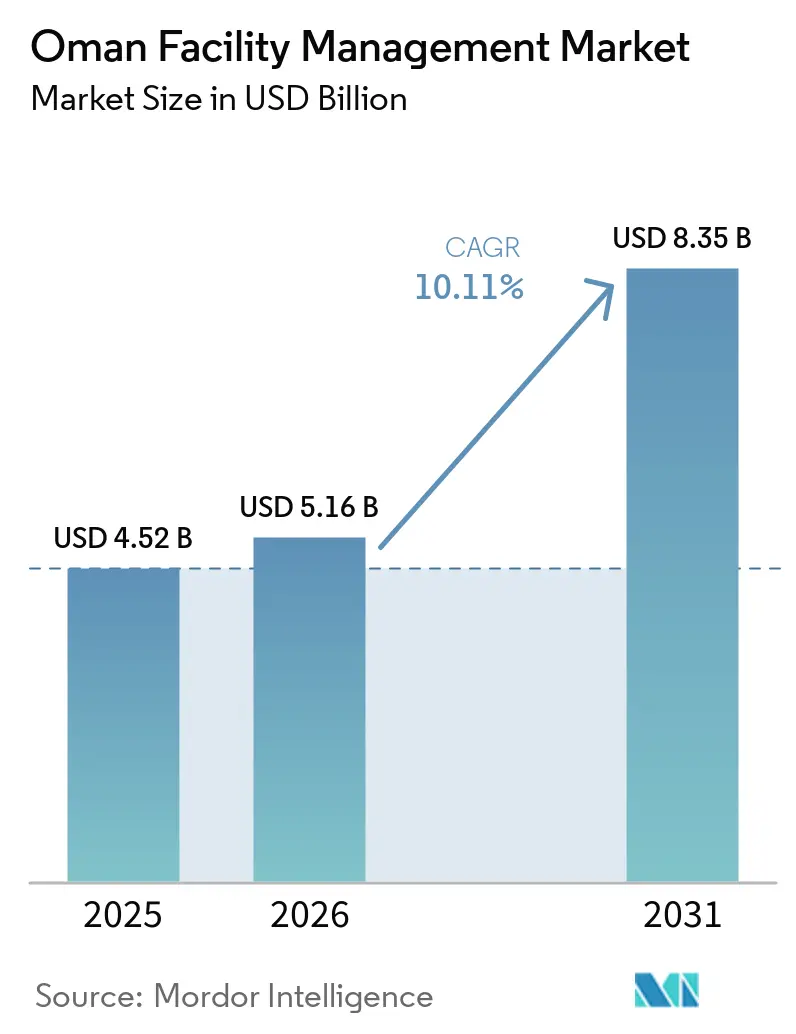
Oman Facility Management Market Analysis by Mordor Intelligence
The Oman Facility Management Market size is projected to be USD 4.52 billion in 2025, USD 5.16 billion in 2026, and reach USD 8.35 billion by 2031, growing at a CAGR of 10.11% from 2026 to 2031.
Rapid commercial real-estate expansion, Vision 2040 infrastructure spending, and the steady replacement of in-house teams with integrated service providers anchor demand and keep the Oman facility management market on a steep upward trajectory. Hard services continue to dominate project scopes because large industrial assets require specialized mechanical, electrical, and fire-safety maintenance; however, soft services show the fastest percentage gains as employers redesign workplaces around employee well-being and the visitor experience. A parallel shift toward outsourced, multidisciplinary contracts allows clients to focus on core activities, while providers differentiate themselves through Internet of Things (IoT) platforms, predictive maintenance analytics, and energy management solutions. Moderate market concentration persists as incumbents such as Renaissance Services and G4S compete with agile, technology-first entrants, a situation likely to spark partnerships and digital investments through 2030.
Key Report Takeaways
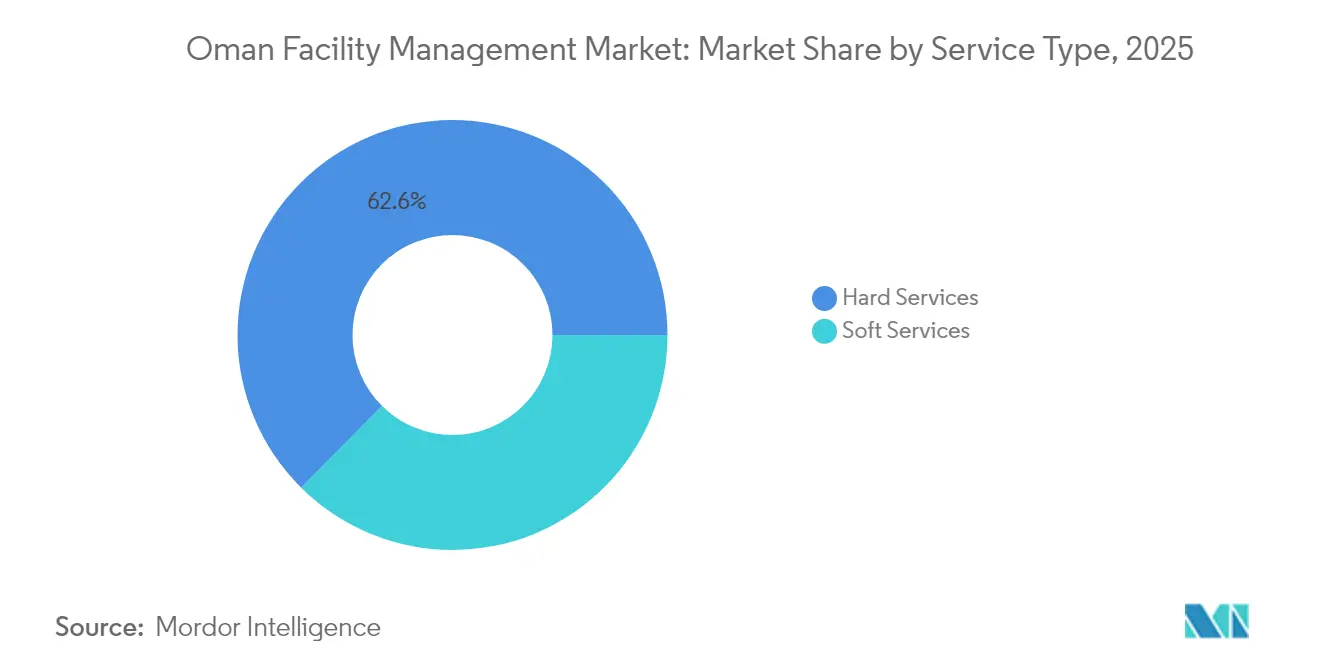
- By service type, hard services led with 62.58% of the Oman facility management market share in 2025, while soft services are set to advance at a 13.62% CAGR through 2031.
- By offering type, outsourced models accounted for 66.78% of the Oman facility management market size in 2025; the same category is projected to grow at a 13.28% CAGR to 2031 as clients replace fragmented in-house teams with integrated contracts.
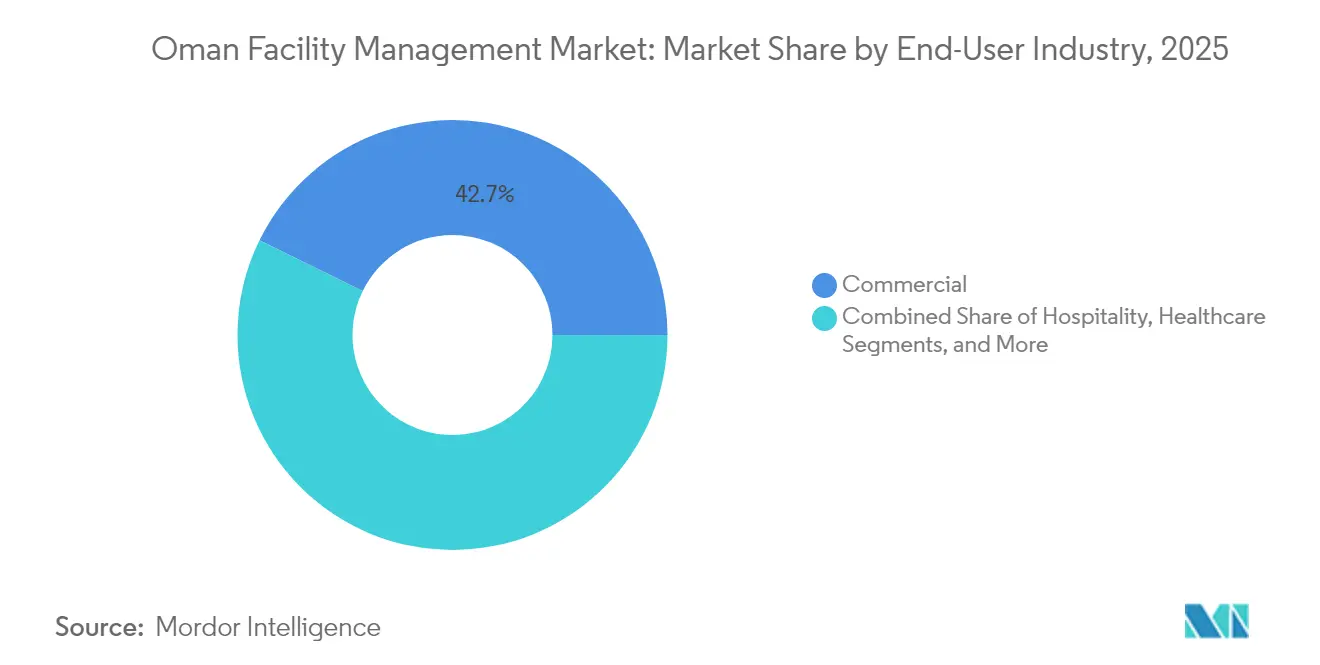
- By end-user industry, commercial facilities held 42.74% of the Oman facility management market size in 2025, whereas industrial and process sites record the highest expected CAGR of 13.12% through 2031 on the back of energy and manufacturing projects.
Note: Market size and forecast figures in this report are generated using Mordor Intelligence’s proprietary estimation framework, updated with the latest available data and insights as of 2026.
Oman Facility Management Market Trends and Insights
Drivers Impact Analysis*
| Driver | ( ~ ) % Impact on CAGR Forecast | Geographic Relevance | Impact Timeline |
|---|---|---|---|
| Rapid commercial real-estate expansion | +3.2% | Muscat, Salalah, Duqm | Medium term (2-4 years) |
| Technology integration (IoT, AI, automation) | +2.8% | Urban centres, industrial zones | Long term (≥ 4 years) |
| Increasing outsourcing trend | +2.1% | National, commercial hubs | Short term (≤ 2 years) |
| Rising focus on workplace experience | +1.7% | Commercial districts, government assets | Medium term (2-4 years) |
| Government Vision 2040 diversification | +2.4% | National, special economic zones | Long term (≥ 4 years) |
| Growth in tourism and hospitality footprint | +1.3% | Coastal regions, heritage sites | Medium term (2-4 years) |
| Source: Mordor Intelligence | |||
Technology Integration (IoT, AI, Automation)
Predictive analytics, cloud-based asset registers, and sensor-rich building management systems are redefining how the Oman facility management market approaches reliability, safety, and energy optimisation.[1]Petroleum Development Oman used an IoT-enabled platform to cut procurement steps from 46 to 14, saving 2,300 hours a year, and proving the operational payback of digital retrofits. Renaissance Services set up a Centre of Excellence for Energy Management in Muscat that pilots automation for cleaning, environmental monitoring, and Wi-Fi management in large accommodation villages. Government smart-city pilots in Knowledge Oasis Muscat further validate the business case for integrated digital infrastructure that feeds real-time data to facility dashboards. Continuous data flows reduce unplanned downtime, lower energy bills, and help providers meet stricter environmental, social, and governance criteria demanded by multinational tenants. Over the long term, widespread adoption of AI-driven diagnostics is expected to lift service margins and reinforce the competitive edge of technology-savvy contractors.
Rapid Commercial Real-Estate Expansion
Multi-billion-dollar projects such as Sultan Haitham City (15 million m²) and New City Salalah waterfront (7.3 km²) add vast new inventories of offices, malls, and mixed-use assets that need round-the-clock maintenance, cleaning, and security. The Duqm Special Economic Zone already hosts USD 30 billion in committed capital and maintains occupancy rates above 85%, translating into a steady pipeline for hard and soft facility services. Every new square meter of grade-A space increases lifecycle spending on HVAC, fire-detection systems, and elevators, thereby expanding the Oman facility management market. Developers also specify green-building certifications, which require continuous commissioning, energy audits, and waste-management programmes. Medium-term impact is reinforced by Rakiza’s infrastructure fund that channels institutional investment into logistics parks, hospitality complexes, and healthcare campuses, locking in multi-year service contracts across governorates.
Increasing Outsourcing Trend
Corporate and public-sector owners increasingly outsource non-core operations to focus scarce managerial bandwidth on revenue generation. Outsourced contracts already command two-thirds of the Oman facility management market and are advancing faster than any other service model. PDO’s Manazil accommodation villages illustrate the shift from fragmented self-operation to end-to-end design, build, operate, and maintain agreements that unify cleaning, catering, and technical services under one vendor. The economic logic centres on lower total cost of ownership and guaranteed service-level agreements that mitigate compliance risk. Short contracting cycles in retail and small office tenancies speed decision-making, while large industrial clients move towards 5- to 10-year integrated deals that bundle energy, water, and waste optimisation. As service depth expands, providers invest in cross-trained teams to maximise resource utilisation and minimise call-out delays, strengthening the outsourcing value proposition nationwide.
Government Vision 2040 Diversification Initiatives
Vision 2040 targets 6% headline growth from non-hydrocarbon sectors, triggering USD 69.3 billion in foreign direct investment by Q3 2024. Tourism, logistics, renewable energy, and manufacturing clusters each generate specialised facility-management needs that propel the Oman facility management market into new verticals such as green hydrogen, data centres, and full-service logistics hubs. The government also aims for 11.7 million tourists by 2040, a target that drives hotel chains and leisure developers to secure long-term soft-service contracts covering housekeeping, guest services, and front-of-house operations. Through the Tanfeedh programme, each governorate is tasked with developing a sector focus—for example logistics in Al Batinah North and knowledge industries in Al Dakhiliya—creating spatially diverse demand pools for facilities upkeep. Long-term impact on the Oman facility management market is reinforced by mandates for smart, low-carbon infrastructure, which foster adoption of digital twin technology and energy-efficiency retrofits.
Restraints Impact Analysis*
| Restraint | ( ~ ) % Impact on CAGR Forecast | Geographic Relevance | Impact Timeline |
|---|---|---|---|
| Labour shortages and skill gaps | −2.1% | Nationwide, acute in remote zones | Short term (≤ 2 years) |
| Margin pressure from rising costs | −1.8% | Urban centres | Medium term (2-4 years) |
| High reliance on migrant workforce | −1.3% | Service-intensive sectors | Medium term (2-4 years) |
| Delayed payments in public-sector deals | −0.9% | Government facilities | Short term (≤ 2 years) |
| Source: Mordor Intelligence | |||
Labour Shortages and Skill Gaps
Omanisation quotas compel every fully foreign-owned firm to employ at least one Omani national within 12 months, yet only 31.4% of hospitality staff are citizens, underscoring a short-term mismatch between policy ambition and skills supply. [2] Facility management roles often involve weekend work, night shifts, and physically demanding tasks that attract limited local interest. Providers respond by investing in structured training academies and career-progression pathways to improve retention. Labour codes introduced in 2025 also cut the working week to 40 hours and extend sick leave to 182 days, boosting wage bills and overtime premiums. The short-term drag on the Oman facility management market is acute in remote industrial sites where staff quarters, health facilities, and logistics support add cost layers.
Margin Pressure from Rising Operational Costs
Input price inflation affects cleaning chemicals, HVAC filters, and security equipment, while energy tariffs tighten as subsidies phase out, squeezing contractor margins. [3]New regulatory standards mandate enhanced personal protective equipment and formalised refresher training, adding compliance overheads. Clients, however, remain cost-conscious and push for fixed-price contracts, forcing providers to unlock savings through automation and predictive maintenance. Digital work-order systems cut travel time between call-outs, and building-analytics dashboards flag energy anomalies before they erode profitability. Margin pressure will persist through the medium term, prompting continued consolidation in the Oman facility management market as smaller firms struggle to finance technology upgrades.
*Our forecasts treat driver/restraint impacts as directional, not additive. The impact forecasts reflect baseline growth, mix effects, and variable interactions.
Segment Analysis
By Service Type: Hard Services Retain Dominance While Soft Services Accelerate
Hard services captured 62.58% of the Oman facility management market share in 2025 and continue to benefit from capital-intensive assets such as airports, refineries, and integrated tourism complexes that require 24/7 mechanical, electrical, and fire-safety cover. Heavy-duty HVAC systems at Muscat International Airport and extensive utility networks at Duqm’s petrochemical plants anchor long-term maintenance contracts. Predictive condition monitoring helps providers reduce downtime and optimise spare-parts inventory, reinforcing client preference for end-to-end contracts.
Soft services, while starting from a smaller base, are forecast to expand at 13.62% CAGR through 2031, propelled by workplace-experience programmes in corporate offices and the hospitality sector’s pursuit of global service standards. Renaissance Services supplies more than 15 million meals annually to hospitals and construction camps, showing the scale at which catering contracts now operate. Security outsourcing also climbs as malls and large mixed-use complexes deploy analytics-enabled surveillance to meet insurance and tenant requirements. Specialist cleaning services for data centres and healthcare facilities open further growth lanes, ensuring soft services remain the fastest-growing component of the Oman facility management market.

By Offering Type: Outsourcing Gains Ground Through Integrated Agreements
Outsourced models controlled 66.78% of the Oman facility management market in 2025 and are projected to expand at 13.28% CAGR, as bundled and integrated contracts outperform single-service arrangements. Large energy operators migrate to five-year integrated deals that combine asset maintenance, catering, and waste services, reducing vendor interfaces and strengthening accountability. PDO’s Manazil accommodation villages demonstrate the financial and operational advantages of design-build-operate-maintain frameworks.
In-house teams, which account for the remaining 33.22%, persist in mission-critical defence, data-centre, and utilities assets where owners value direct control over security-sensitive systems. However, this share may erode as hybrid governance models use digital dashboards to retain strategic oversight while farming out execution to specialist vendors. Tight labour markets and new workforce regulations increase the cost of maintaining internal teams, tilting boardroom decisions toward outsourcing, thereby reinforcing growth prospects for the Oman facility management market.
By End-User Industry: Commercial Facilities Lead While Industrial Assets Accelerate
Commercial buildings held 42.74% of the Oman facility management market size in 2025 as banking, telecom, and retail tenants demand grade-A spaces with continuous uptime, stringent indoor-air-quality metrics, and five-star guest services. Commercial landlords adopt IoT-enabled energy-management platforms to reduce operating expenses, making comprehensive service contracts attractive. Muscat’s office pipeline continues to expand in Al-Khuwair and Ruwi districts, ensuring a stable flow of new tenders.
Industrial and process facilities register the highest forecast CAGR at 13.12% through 2031. Investments in green hydrogen clusters, solar-wind hybrid IPPs, and the Duqm refinery create specialised opportunities for reliability-centred maintenance, high-voltage asset care, and stringent safety compliance. Healthcare and hospitality properties add further diversity, each with bespoke hygiene, waste-segregation, and guest-services protocols. Together, these trends deepen the service portfolio and geographic reach of the Oman facility management market.
Geography Analysis
Muscat Governorate anchors the Oman facility management market with the highest share of built asset value, driven by the 15 million m² Sultan Haitham City, ongoing airport upgrades, and a dense concentration of government ministries. New mixed-use schemes require integrated hard and soft services delivered through multi-year contracts that incorporate energy benchmarking and smart-meter data analytics.
Dhofar Governorate emerges as a growth pole on the strength of tourism and renewable energy megaprojects. The New City Salalah waterfront plan spans 7.3 km² and dovetails with wind and solar IPPs exceeding 4 GW of installed capacity, creating steady, specialised demand for operations and maintenance services across hotels, malls, and generation assets.
Al Wusta Governorate, home to the Duqm Special Economic Zone, attracts USD 30 billion in pledged capital and rapidly fills logistics, petrochemical, and manufacturing plots. High land-occupancy rates trigger contracting activity for fire-protection systems, utilities operations, and accommodation services, further enlarging the Oman facility management market.
Regulatory Landscape
Facility management providers in Oman operate under a tightening set of building, labor, and digital compliance requirements that affect hard services, safety routines, and technology-enabled delivery. The Ministry of Housing and Urban Planning (MoHUP) introduced the Oman Building Code (OBC) in 2025 as a national framework spanning coordinated technical codes for mechanical, plumbing, and energy efficiency, and MoHUP communicated additional specialty code finalization activity in 2026 to support more standardized lifecycle maintenance expectations across new and existing assets.
Digital and connectivity rules are also moving to the center of FM delivery as contracts adopt IoT sensors, connected BMS, and cloud-based work order systems. In April 2025, the Ministry of Transport, Communications and Information Technology (MTCIT) issued Ministerial Decision No. 108/2025 for the Regulatory Framework for Government Digital Transformation, setting governance and implementation responsibilities across government units. In June 2026, Royal Decree No. 61/2026 established a new Cybercrime Law, while the Telecommunications Regulatory Authority (TRA) updated radio frequency/device registration rules (amending Decision No. 133/2008), reinforcing compliance requirements for connected devices used in smart-building and security systems deployed by FM contractors.
Value Chain Analysis
The Oman facility management value chain typically begins with asset owners and developers (government entities, industrial operators, and commercial landlords) that define service scopes through tenders, SLAs, and HSE requirements, then moves to integrated FM providers and specialist subcontractors. Large IFM contractors bundle hard services (MEP, HVAC, fire systems, utilities operations) with soft services (cleaning, security, catering), and increasingly add CAFM/CMMS and energy-management modules to run multi-site delivery, reporting, and renewal performance. Technology and OEM layers include building automation systems, IoT sensors, access control and surveillance equipment, and analytics platforms that enable predictive maintenance and asset registers.
Downstream execution depends on local field labor, spare parts and consumables supply (filters, cleaning chemicals, PPE), and specialist compliance services such as testing and commissioning and fire safety checks. The chain is consolidating and professionalizing: in November 2024, Imdaad and Oris (Ominvest Group) established Omdaad to deliver integrated facilities management in Oman, adding a regional IFM playbook to local delivery. In April 2026, Renaissance Services completed the acquisition of Socat LLC (the Omani arm of Sodexo), expanding scale and breadth in integrated services and reinforcing a model where large providers coordinate subcontractors, technology partners, and multi-governorate operations under fewer, larger contracts.
Competitive Landscape
The Oman facility management market remains moderately concentrated, with the top five providers jointly holding just under 50% of contract revenue. Renaissance Services leads through a portfolio that spans hard and soft services, manages 3 million m² of space, and employs 8,800 staff, supporting its ambition to achieve USD 2 billion market capitalisation by 2025. G4S Oman focuses on security-centric bundles that integrate electronic surveillance, access control, and manned guarding for industrial and commercial complexes. Qurum Business Group leverages its wider business-services footprint to cross-sell integrated facility contracts in sectors ranging from ports to healthcare.
Technology adoption defines the new battleground. Providers deploy IoT sensors for real-time monitoring, AI algorithms for predictive maintenance, and cloud platforms for consolidated help-desk management. Patent activity related to automated structural health monitoring and server-based building control points to emerging digital differentiation.
Sustainability credentials are becoming a decisive tender parameter. Energy-audit services, waste-segregation frameworks, and ESG reporting modules help contractors align with international tenant requirements and government decarbonisation targets. Firms that can marry digital diagnostics with low-carbon solutions stand to capture premium margins as the Oman facility management market enters its next growth phase.
Oman Facility Management Industry Leaders
-
G4S Limited
-
Qurum Business Group
-
Oman International Group SAOC
-
Renaissance Services SAOG
-
COMO Oman
- *Disclaimer: Major Players sorted in no particular order
Market Opportunities and Future Outlook
Technology-led integrated FM is a primary white-space area where owners prioritize measurable uptime, energy performance, and auditable compliance across portfolios. In industrial and large-campus environments, the shift is already visible: Petroleum Development Oman has used an IoT-enabled platform to reduce procurement steps (from 46 to 14) and save 2,300 hours per year, supporting the operational value of connected workflows and asset data for maintenance planning and parts readiness. At the same time, initiatives such as Renaissance Services energy-management capability building in Muscat point to demand for digital monitoring, automation for repetitive soft-services tasks, and energy optimization services that can be packaged within integrated contracts.
Smart-building and digital-government programs also expand the addressable opportunity for CAFM/CMMS and connectivity-ready services in commercial and institutional assets. The MTCIT Regulatory Framework for Government Digital Transformation (Ministerial Decision No. 108/2025) provides a governance anchor for digitized service delivery and reporting expectations in public assets, while the 2025 Oman Building Code raises requirements for systems performance and documentation in new developments. Provider and technology ecosystems are responding through partnerships and market entry: Tadoom signed a distribution agreement with Facilitrol-X in June 2024 to bring predictive maintenance and CAFM/CMMS modules into its smart building and asset management offerings, and the Imdaad-Oris Omdaad joint venture (launched November 2024) increases IFM capacity and competitive intensity. Together, these dynamics create room for differentiated offerings in outcome-based SLAs, energy services, and integrated service bundles across Muscat, Salalah, and special economic zones.
Recent Industry Developments
- June 2026: Musalih launched Xizmat, a maintenance and home services platform, in Uzbekistan in cooperation with UzOman, an investment platform backed by the Oman Investment Authority and the Uzbekistan Fund for Reconstruction and Development. The move highlights the spread of platform-led service orchestration models that can influence how outsourced maintenance is packaged and delivered. Cross-border scaling also increases visibility for digital-first service standards that can translate back into Oman operations.
- April 2026: Renaissance Services completed its acquisition of Socat LLC, the Omani arm of Sodexo, expanding its integrated facilities management footprint and service breadth in Oman. The transaction reinforces a consolidation theme in which larger providers widen capabilities across hard and soft services to compete for multi-year integrated contracts. A broader delivery base also supports more standardized processes and technology adoption across larger portfolios.
- November 2024: Imdaad announced its expansion into Oman through a joint venture with Oman Real Estate and Investment (Oris), part of Ominvest Group, to establish Omdaad for integrated facilities management services. The entry adds a regional integrated FM operator with established methods and vendor ecosystems, increasing competitive pressure on incumbents. It also supports market development by expanding capacity for bundled and integrated delivery models in commercial and infrastructure assets.
Research Methodology Framework and Report Scope
Market Definition and Coverage
For this study, the market covers the value of facility management services delivered in Oman to keep buildings and sites safe, functional, compliant, and cost-efficient across routine operations and planned upkeep.
Scope exclusions: Construction execution and standalone equipment sales (without an FM service contract) are excluded from the market totals.
Segmentation Overview
- By Service Type
- Hard Services
- Asset Management
- MEP and HVAC Services
- Fire Systems and Safety
- Other Hard FM Services
- Soft Services
- Office Support and Security
- Cleaning Services
- Catering Services
- Other Soft FM Services
- Hard Services
- By Offering Type
- In-house
- Outsourced
- Single FM
- Bundled FM
- Integrated FM
- By End-user Industry
- Commercial (IT and Telecom, Retail and Warehouses, etc.)
- Hospitality (Hotels, Eateries, Large-scale Restaurants)
- Institutional and Public Infrastructure (Govt, Education, Transportation)
- Healthcare (Public and Private Facilities)
- Industrial and Process (Manufacturing, Energy, Mining)
- Other End-user Industries (Multi-housing, Entertainment, Sports and Leisure)
Data Sources, Market Sizing, and Validation
Desk Research
Desk work started with building a clear picture of Oman building stock and service demand signals, before moving into revenue modeling. Public sources such as Oman Vision 2040 program updates, National Center for Statistics and Information releases, and Ministry of Commerce, Industry and Investment Promotion announcements helped anchor the pace of non-oil projects and commercial activity.
To size the addressable spend, we also referenced public tender portals and, where relevant, customs and trade statistics to triangulate maintenance input flows. We then used peer-reviewed engineering and energy-efficiency literature to reflect common FM workloads, for example HVAC upkeep. Company annual reports, audited statements, investor decks, and reputable local press were used to understand contract mix, service lines, and any visible pricing movement. In a few cases, paid subscriptions for company financials and an import-export shipment-level database supported cross-checks on supplier exposure and service intensity. These are illustrative sources only, and other references were used to collect data, validate assumptions, and clarify gaps.
Primary Interviews and Surveys
Primary work focused on validating the contract structure in Oman, where bundled and integrated contracts are becoming more common and where labor and compliance costs shape margins. We spoke with a mix of outsourced service providers, in-house FM heads, subcontractors, and large end users across commercial, hospitality, industrial sites, and public infrastructure, so assumptions around service frequency, staffing norms, and renewal cycles could be checked against on-the-ground practice.
Because this is a country market, inputs were reviewed across Muscat and key industrial and logistics clusters, then reconciled to the same service scope used in the model to close data gaps.
Distribution of primary research fieldwork respondents
| Company type | Respondent position |
|---|---|
| Top tier: 37% | CXOs: 15% |
| Mid tier: 48% | Functional/Unit leaders: 28% |
| Smaller Players: 15% | Managers: 57% |
Market-Sizing & Forecasting
Sizing used a top-down and bottom-up mix, where the starting point was Oman's addressable built-environment demand pool and the service spend intensity typically attached to it, and then the totals were stress-tested using selective supplier and contract roll-ups. In practice, the top-down side reconstructs demand using indicators such as commercial and hospitality floor space additions, public infrastructure commissioning, industrial site activity, outsourcing penetration by end-user type, and typical contract value per square meter or per site. The bottom-up checks then use sampled contract values, service line splits between hard and soft work, and channel checks on integrated versus single-service awards to adjust for over-counting.
Key inputs included labor cost and availability signals, HVAC and MEP maintenance cycles (especially in high-heat operating conditions), compliance-driven service frequency for fire systems and safety, energy-management adoption that changes monitoring workloads, and the share of contracts shifting from in-house delivery to outsourced bundles. Forecasting relied on scenario analysis supported by expert consensus, where construction handover timing, tender flow, and outsourcing momentum were varied to keep the growth path realistic. When company disclosures or tender values were incomplete, gaps were handled with conservative proxies tied to comparable contract types, then revalidated in follow-up calls.
Data Validation & Update Cycle
Validation was done through several checks so the totals stayed tied to observable Oman activity. Model outputs were compared against independent signals such as tender announcements, known handover pipelines, and the implied staffing and service frequency needed for the counted sites, and then unusual jumps were reviewed by another analyst before sign-off.
If a large project award, policy change, or sharp labor-cost shift is detected, assumptions are revisited and the affected parts of the model are re-run. Reports are refreshed annually, with interim updates for material events, and a final pre-delivery review is completed so clients receive the most current view available at the time of purchase.
Mordor Intelligence's Oman Facility Management Market Estimate Compared With Other Published Estimates
Published market sizes for Oman facility management can vary widely, even when they appear to describe the same topic. Differences usually come from what is counted as FM, whether in-house delivery is included, and how contract renewals and pricing are carried into projections over time.
The main gap comes from whether in-house FM and adjacent property support activities are included. In Mordor Intelligence, the total is built to include both in-house and outsourced delivery, while keeping the scope anchored to defined hard and soft FM services priced on contract and staffing norms, rather than broad real estate operations.
Benchmark comparison
| Source | Market Size | Gaps in Research Methodology |
|---|---|---|
| Mordor Intelligence | USD 4.52 B (2026) | |
| Trade Journal A | USD 0.75 B (2025) | Often reflects outsourced FM spend only, and it can exclude in-house delivery plus several hard-service lines that are embedded in engineering maintenance contracts, which pushes the total down. |
| Industry Blog B | USD 0.81 B (2024) | Uses a shorter base year window and simplified ASP uplift assumptions, and it may mix service revenues with narrower sub-categories without reconciling contract duration, renewal timing, and currency conversion dates. |
The spread across published figures is mainly explained by what gets counted and how contract value is carried forward into the forecast. By keeping inclusion rules explicit, tying inputs to contract structures seen in-country, and cross-checking totals with tender and staffing signals, the final market value stays traceable and repeatable for planning decisions.
Key Questions Answered in the Report
What is the current value of the Oman facility management market?
The Oman facility management market size is USD 5.16 billion in 2026 and is projected to reach USD 8.35 billion by 2031.
Which service category is growing fastest?
Soft services, including cleaning, catering, and security, are forecast to grow at a 13.62% CAGR through 2031, outpacing all other categories.
Why are outsourcing models gaining traction in Oman?
Organisations turn to outsourced integrated contracts to reduce total cost of ownership, meet Omanisation rules through specialised vendors, and tap into technology-enabled maintenance platforms.
How does Vision 2040 influence facility management demand?
Vision 2040 channels large-scale investment into tourism, logistics, and renewable energy, each of which requires professional facilities upkeep and thus expands the addressable market for service providers.
What technologies are reshaping facility management operations?
IoT sensors, AI-based predictive maintenance, cloud asset registers, and energy-management dashboards help contractors cut downtime and extend equipment life while supporting sustainability goals.
Which region outside Muscat offers the greatest growth potential?
Dhofar Governorate, driven by renewable energy megaprojects and coastal tourism developments, is emerging as the most dynamic secondary market for facility management services.