
Market Overview
| Study Period | 2020 - 2031 |
|---|---|
| Forecast Data Period | 2026 - 2031 |
| Base Year Market Size (2025) | USD 2.57 Billion |
| Market Size (2026) | USD 2.67 Billion |
| Market Size (2031) | USD 3.25 Billion |
| Growth Rate (2026 - 2031) | 3.98 % |
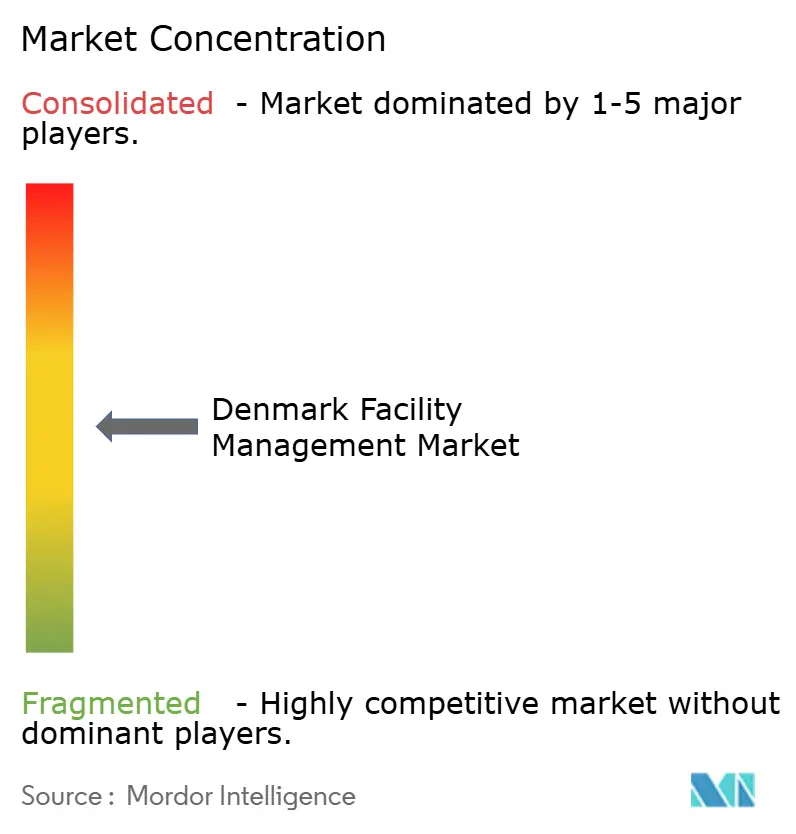
| Market Concentration | Medium |
Major Players *Disclaimer: Major Players sorted in no particular order Image © Mordor Intelligence. Reuse requires attribution under CC BY 4.0. | |
Denmark Facility Management Market Analysis by Mordor Intelligence
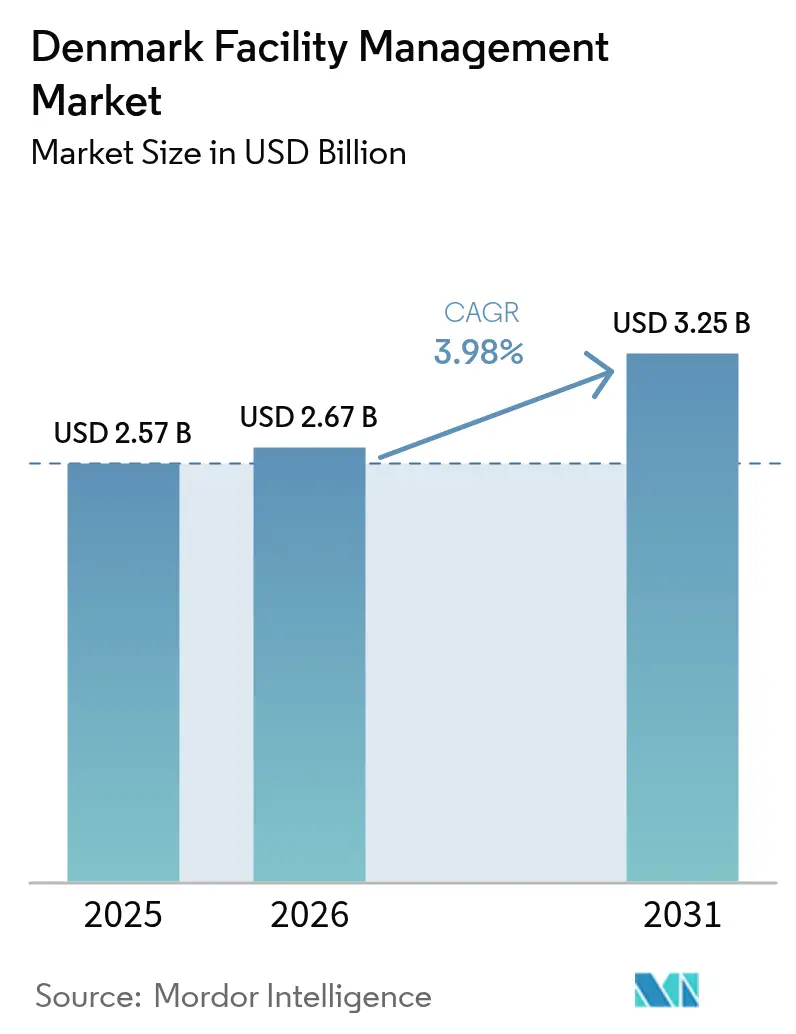
The Denmark facility management market size is expected to grow from USD 2.57 billion in 2025 to USD 2.67 billion in 2026 and is forecast to reach USD 3.25 billion by 2031 at 3.98% CAGR over 2026-2031. The Denmark facility management market benefits from tight commercial real-estate fundamentals; national office vacancy now stands at 6.7% below the long-run average, which drives recurring demand for integrated hard and soft services. Demand is further lifted by mandatory energy-performance upgrades linked to EU directives that push building owners toward outsourced, technology-enabled solutions. The outsourced delivery model already commands 70% of the Denmark facility management market and continues to widen its lead because organisations prefer to focus resources on core activities while relying on specialist partners for regulatory compliance, IoT deployment, and carbon-footprint tracking. Nordic incumbents strengthen competitive positions through AI, robotics, and sensor analytics that help offset Denmark’s elevated labour costs. Over the forecast period, public spending tied to the Recovery and Resilience Plan and a 60% green-allocation rule is expected to channel significant capital toward energy-efficient retrofits, further underpinning service uptake across institutional and infrastructure assets.
Key Report Takeaways
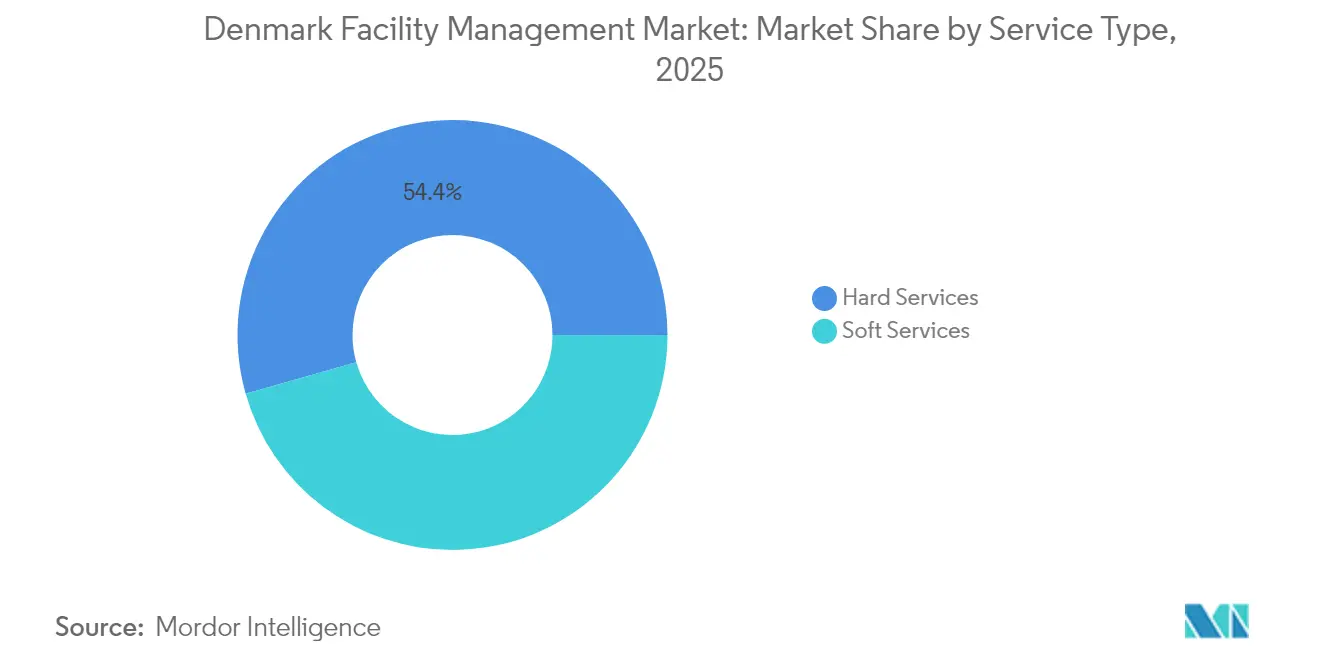
- By service type, hard services retained 54.40% Denmark facility management market share in 2025, while soft services are set to expand at a 5.95% CAGR through 2031.
- By offering type, outsourcing accounted for 69.20% of the Denmark facility management market size in 2025 and is projected to grow at 5.38% CAGR to 2031.
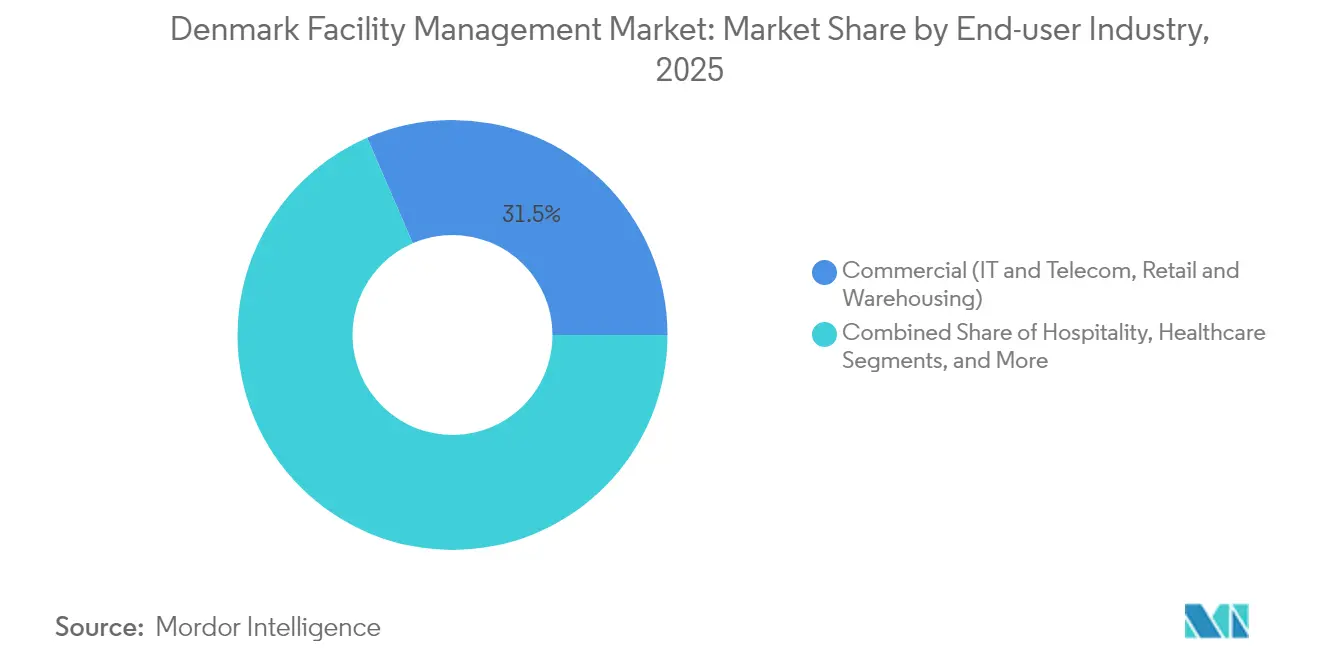
- By end-user, the commercial segment led with 31.50% of 2025 revenue; institutional and public infrastructure facilities hold the highest growth outlook at 4.72% CAGR.
Note: Market size and forecast figures in this report are generated using Mordor Intelligence’s proprietary estimation framework, updated with the latest available data and insights as of 2026.
Denmark Facility Management Market Trends and Insights
Drivers Impact Analysis*
| Driver | (~) % Impact on CAGR Forecast | Geographic Relevance | Impact Timeline |
|---|---|---|---|
| Current Occupancy Rates Drive Service Expansion | +1.2% | National, with concentration in Copenhagen, Aarhus, Odense | Short term (≤ 2 years) |
| Profitability Benchmarks Reshape Service Portfolios | +0.8% | National, stronger in commercial hubs | Medium term (2-4 years) |
| Labor Market Dynamics Accelerate Automation | +1.5% | National, early adoption in urban centers | Medium term (2-4 years) |
| Urbanization Patterns Reshape Service Distribution | +0.6% | Copenhagen, Aarhus, Odense, Aalborg, Esbjerg | Long term (≥ 4 years) |
| Public-sector Digitalisation and Rising Defence Outlays | +0.9% | National, concentrated in government facilities | Medium term (2-4 years) |
| Mandatory ESG Reporting (CSRD) Spurs Sustainable FM Demand | +1.1% | National, EU-wide compliance requirements | Short term (≤ 2 years) |
| Source: Mordor Intelligence | |||
Current Occupancy Rates Drive Service Expansion
Office utilisation in Copenhagen, Aarhus, and Odense has rebounded strongly, with vacancy now 6.7% below the historical mean.[1]EjendomDanmark, “Kontorudlejning i USA og Danmark: Som at sammenligne pærer og bananer,” ejd.dkHigher daily footfall forces landlords to increase cleaning frequency, security staffing, and indoor-air quality monitoring. Integrated providers capable of bundling these hard and soft services command price premiums as asset owners seek one-stop coverage. Rising density also elevates energy-use intensity, leading owners to sign performance-based contracts that link reimbursements to measurable efficiency gains. The result is accelerating contract value in the Denmark facility management market for both preventive maintenance and workplace-experience add-ons. Occupancy-driven expansion is expected to remain the single largest short-term catalyst because Denmark continues to encourage on-site collaboration rather than fully remote work models.
Labor Market Dynamics Accelerate Automation
Denmark’s unemployment rate remains below 3% and union agreements keep wages elevated relative to continental peers. Facility managers, therefore, deploy cleaning robots, automated scheduling algorithms, and IoT-enabled predictive maintenance to protect margins. AI-driven rostering tools have cut manual supervisory hours by up to 20%, freeing scarce labour for higher-value tasks. Automation also helps large providers comply with Denmark’s strict worker-safety statutes by reducing exposure to routine hazards. Early adopters of robotics have secured multi-year extensions from retail and transport clients, illustrating the competitive edge technology confers within the Denmark facility management market. Over the medium term, AI and robotics are forecast to shave 1.5 percentage points off labour-line cost growth, thereby broadening outsourcing’s value proposition.
Mandatory ESG Reporting (CSRD) Spurs Sustainable FM Demand
The Corporate Sustainability Reporting Directive forces Danish organisations with over 250 employees or EUR 40 million (USD 46.59 million) to publish detailed environmental metrics from 2025. This regulatory trigger has turned carbon-monitoring dashboards, energy analytics services, and waste-segregation audits into core contract deliverables rather than optional extras. Providers able to document cradle-to-gate emissions now win tenders at a 15-20% higher success rate, according to bid-evaluation data compiled by market leaders. Demand is surging for sustainability consulting, carbon accounting, and circular-economy advisory bundled with traditional hard-services execution. The Denmark facility management market, therefore, gains both volume and value uplift, as ESG compliance fees are typically priced at a 5-10% premium to baseline maintenance.
Public-sector Digitalisation and Rising Defence Outlays
Central government agencies automate administrative workflows and modernise property portfolios under Denmark’s joint procurement framework. The Ministry of Defence recently awarded ISS a DKK 3 billion (USD O.47 billion) integrated services contract that extends to canteens, cleaning, security, and technical maintenance across 500 locations.[2]ISS World, “Intelligent Solutions,” issworld.com Similar multi-site contests are expected from the Ministry of Taxation and the Police Service, each specifying sensor-based monitoring and cyber-secure building-management systems. In parallel, defence real-estate spending increases with NATO readiness targets, boosting long-term demand for specialised services such as high-grade access control and on-site energy generation. These developments give the Denmark facility management market a stable pipeline of publicly funded opportunities, insulated from short-term economic volatility.
Restraints Impact Analysis*
| Restraint | (~) % Impact on CAGR Forecast | Geographic Relevance | Impact Timeline |
|---|---|---|---|
| Regulatory Complexity Raises Entry Barriers | -0.7% | National, EU-wide compliance requirements | Medium term (2-4 years) |
| Macroeconomic Headwinds Constrain Discretionary Spending | -0.9% | National, with spillover effects from European markets | Short term (≤ 2 years) |
| Stringent Labour Regulations Inflate Operating Costs | -0.8% | National, particularly affecting labor-intensive services | Long term (≥ 4 years) |
| Up-front Capital Needed for Advanced IoT / AI Platforms | -0.6% | National, concentrated in technology-intensive segments | Medium term (2-4 years) |
| Source: Mordor Intelligence | |||
Regulatory Complexity Raises Entry Barriers
Multiple compliance layers building energy certification, ISO 9001:2015 for energy labelling, worker-safety audits, and GDPR requirements, add significant cost and administrative friction for new entrants. [3]Danish Energy Agency, “Energikonsulenter,” ens.dk Achieving full certification can take 18 months and consume up to 8% of annual revenue for smaller providers, limiting competitive churn and reinforcing incumbent dominance. EU-wide sustainability directives further complicate reporting, especially for foreign firms unfamiliar with Danish municipal codes. While this environment secures quality and safety, it also restricts supplier diversity and may slow innovation at the fringes of the Denmark facility management market.
Macroeconomic Headwinds Constrain Discretionary Spending
Inflation and energy-price volatility diminish tenant budgets for elective facility upgrades. Many SMEs postpone IoT retrofits and experiential office enhancements, focusing only on essential maintenance and statutory compliance. Providers struggle to pass through rising wages and material costs under fixed-price contracts, squeezing margins. Some clients renegotiate service scopes mid-contract, particularly within retail and light-manufacturing estates exposed to consumer-demand swings. This restraint depresses short-term spend in the Denmark facility management market, though it simultaneously motivates efficiency-oriented innovations that lower lifecycle cost.
*Our forecasts treat driver/restraint impacts as directional, not additive. The impact forecasts reflect baseline growth, mix effects, and variable interactions.
Segment Analysis
By Service Type: Soft Services Gain Digital Edge
Soft services delivered the fastest revenue trajectory with a 5.95% CAGR outlook to 2031, even though hard services retained 54.40% denmark facility management market share in 2025. Cleaning, security, and front-of-house support have become data-rich operations managed through AI scheduling and real-time quality dashboards. Occupier demand for wellness-centred work environments pushes providers to embed sensors that monitor air quality, foot-traffic patterns, and temperature comfort. Catering extends into nutrition analytics and contactless payment ecosystems, reinforcing its strategic role in employee-experience programmes. This digital repositioning elevates soft-service average contract value by 8-10% and cements its status as the fastest-growing pillar of the Denmark facility management market.
Hard services remain indispensable because mechanical, electrical, and plumbing infrastructure must comply with tightening energy-efficiency benchmarks. Asset managers accelerate the adoption of predictive analytics by fitting HVAC equipment with vibration and temperature sensors that trigger intervention before breakdown. In 2024, more than 60% of hard-service contracts included remote-monitoring clauses, up from 42% in 2022. Fire-safety regulations now require integrated evacuation-simulation tools during annual audits, expanding the advisory element within technical maintenance. Accordingly, the sub-segment adds incremental revenue through compliance consultancy even as core maintenance margins compress.



By Offering Type: Outsourcing Dominance Accelerates
The outsourced model commanded 69.20% of the Denmark facility management market size in 2025 and is slated for 5.38% CAGR growth through 2031. Integrated facility management, where a single provider delivers bundled hard and soft services under outcome-based KPIs, represents the fastest-scaling contract form. These arrangements often run five to seven years and include capital project management alongside routine operations, enabling clients to consolidate vendor portfolios and unlock 8-12% total-cost reductions. Bundled facility management appeals to the mid-market cohort that seeks service consolidation but retains selective internal oversight. Single-service outsourcing continues to serve specialised technical needs such as critical-power maintenance in data centres.
In-house management retained a 30.80% share in 2025, concentrated in healthcare, defence, and select manufacturing plants where security or process continuity is viewed as mission-critical. Yet even these sectors increasingly adopt hybrid models that keep strategic oversight internal while subcontracting execution. DSB’s announced USD 90.45 million 2024 profit was accompanied by more than USD 6.0 billion capital earmarked for rolling-stock upgrades, a financial burden that encourages partial outsourcing of depot maintenance and facilities supervision. Over the long term, labour shortages and technology capital requirements will erode the practicality of standalone in-house operations.
By End-user Industry: Institutional Sector Accelerates Growth
Institutional and public-infrastructure estates will post a 4.72% CAGR to 2031, outpacing all other verticals as municipal and central authorities channel Recovery and Resilience funds into green retrofits. Government campuses now embed digital twins for energy optimisation, and military installations require high-grade perimeter security, catering, and equipment-maintenance solutions. Education facilities demand smart-classroom support and student-experience analytics, broadening service scope beyond custodial routines.
Commercial real estate still generated 31.50% of 2025 revenue and remains the largest slice of the Denmark facility management market. Corporate tenants prioritise agile workspace configurations and occupancy analytics that accommodate hybrid working, reinforcing demand for sensor-enabled desk management and wellness-certified cleaning regimes. Retail and warehousing turn to flexible staffing models tied to foot-traffic data, while IT and telecom switch to uptime-driven service-level agreements for cooling and critical power. Industrial facilities leverage predictive maintenance to cut unplanned downtime by up to 15%, sustaining hard-service spend growth above inflation.
Geography Analysis
The Copenhagen metropolitan area accounted for the highest absolute spend in 2024, supported by the headquarters of multinational corporations, embassy clusters, and ministerial buildings. Office density in the capital exceeds the national average by 23%, driving premium demand for front-of-house, concierge, and wellness-related soft services. Aarhus and Odense post faster unit growth as companies decentralise operations in search of lower rents and access to regional talent pools; these cities now host a combined 18% of national Grade-A office stock. Aalborg and Esbjerg contribute steady expansion anchored to logistics, maritime, and energy supply chains, which require specialised hard services focused on corrosion control and hazard-class maintenance.
Nationwide, the Recovery and Resilience Plan funnels more than EUR 1.5 billion (USD 1.75 billion) into building renovations and energy optimisation projects. Because at least 60% of funds carry a green-transition mandate, municipalities across Jutland and Funen accelerate tenders for heat-pump retrofits, façade insulation, and solar-integrated roofs. Facility managers equipped with energy-performance contracting capabilities secure multi-year deals that bundle capex financing, installation oversight, and ongoing maintenance.
Geographic diversity gives rise to a dual-provider landscape. National full-service players operate central command centres that monitor thousands of properties, leveraging scale economies for helpdesk and analytics functions. Regional specialists compete successfully by offering hyper-local technician response times and cultural familiarity, particularly in small-city healthcare and elderly-care facilities. This mix ensures that the Denmark facility management market delivers tailored solutions across urban and peri-urban catchment areas.
Regulatory Landscape
Denmark facility management vendors operate within an EU-led building decarbonization framework and a state-procurement structure that concentrates demand in large, compliance-heavy tenders. Denmark is implementing the EU Energy Performance of Buildings Directive (Directive (EU) 2024/1275), including minimum energy performance standards (MEPS) for non-residential buildings effective May 29, 2026, which raises requirements for certified energy monitoring, audit readiness, and retrofit coordination within FM scopes.
On the public-sector side, Statens Facility Management (SFM), managed by the Danish Building and Property Agency (Bygningsstyrelsen), centralizes FM procurement for state institutions, with Wave 3 commencing operations on May 1, 2024. Digital policy also shapes delivery methods: the Joint Government Digital Strategy 2026-2029 emphasizes responsible AI use in public workflows, and Denmark's 2026 national digital roadmap (reported via the EU Digital Decade country profile) prioritizes connectivity and SME digitalization. This supports wider adoption of data-driven CAFM and BMS/EMS integration, along with secure handling of operational building data.
Value Chain Analysis
The Denmark facility management value chain begins with building owners and occupiers (commercial landlords, corporates, municipalities, and state agencies) that define service outcomes increasingly spanning hard services (MEP/HVAC, fire and safety, asset upkeep) and soft services (cleaning, security, catering, front-of-house). Delivery is dominated by outsourced and integrated facility management models, where prime contractors coordinate subcontractor networks for specialist trades, compliance audits, and 24/7 field service, while managing customer experience through helpdesks and service-level governance.
Upstream enablers include building-automation and software layers (CAFM, BMS/CTS, and energy monitoring systems), sensor and IoT device suppliers, and data and analytics partners that support predictive maintenance and ESG reporting. Industry and innovation networks such as WE BUILD DENMARK and Energiforum Danmark (including its Innovationsnetvaerk for digitale og intelligente bygninger) help connect FM providers with public building owners, technology vendors, and research bodies to pilot digital twins, smart-readiness tooling, and energy-optimization practices. Downstream, recurring O&M contracts sit alongside project-led retrofit workstreams driven by energy performance requirements, creating a handoff between installation and commissioning teams and steady-state FM operations that must document performance and compliance.
Competitive Landscape
Nordic heavyweights dominate revenue share yet face intensifying rivalry from tech-centric entrants. ISS A/S leverages Microsoft-powered AI platforms to optimise task allocation and deliver predictive analytics across 10,000 Danish sites. Coor Service Management executes a pan-Nordic sustainability roadmap that targets net-zero emissions by 2050 and has already rolled out climate-adaptation measures across 15 million m² of managed property. Compass Group Denmark captures first-time outsourcing wins in catering, supported by digital recipe-management tools that cut food waste by 26% and meet CSRD reporting needs.
Emerging competitors deploy cloud-native building-management systems capable of 35% energy savings. Venture-funded start-ups specialise in SaaS carbon-accounting modules that integrate directly with legacy CAFM suites, appealing to mid-market clients seeking cost-effective ESG compliance. Consolidation continues as larger players acquire HVAC and security boutiques to fill technical capability gaps; Apleona’s purchase of Air for All underlines this trend and is expected to boost cross-sell potential in Denmark once post-merger integration completes.
Barriers to entry remain moderate because incumbents possess entrenched customer relationships and nationwide technician networks. However, digital disruption lowers switching costs for clients, making service quality and data transparency pivotal competitive levers. Over the next five years, the Denmark facility management market is likely to witness a convergence between FM-as-a-service models and proptech platforms, compelling all providers to broaden skill sets beyond traditional facilities upkeep.
Denmark Facility Management Industry Leaders
Coor Service Management A/S
Compass Group Denmark A/S
Sodexo Facilities Management Denmark A/S
G4S Facilities Management Denmark A/S
Apleona GmbH (Nordic Operations)
- *Disclaimer: Major Players sorted in no particular order

Market Opportunities and Future Outlook
Energy-performance compliance and state procurement continue to open opportunities for providers that can link retrofit coordination with measurable operations data. The May 29, 2026 MEPS effective date for non-residential buildings under Denmark's implementation of the updated EPBD increases demand for energy monitoring, documentation, and performance-based maintenance delivered through BMS/EMS-linked workflows. Separately, Bygningsstyrelsen awarded the Statens Facility Management 2026 contract to ISS in April 2026, covering services for about 50 state institutions and 18,000 employees from October 1, 2026, which reinforces the need for scaled integrated delivery, standardized reporting, and multi-site mobilization.
Technology-led FM offerings gain traction when new builds and major refurbishments include technical scopes that carry into long-term O&M. In 2026, Bravida being selected for technical installations including BMS and ventilation for the new Novo Nordisk Fonden headquarters in Tuborg Strandeng (13,000 m2, DKK 150 million project value) and Region Syddanmark contracting an automated logistics facility for Esbjerg Sygehus with Element Logic, expanding the installed base for specialist maintenance, systems integration, and uptime governance. Public digitalization priorities in the Joint Government Digital Strategy 2026-2029 and Denmark's EU-tracked 2026 digital roadmap also support adoption of AI-enabled scheduling, digital twins, and data-sharing standards. Programs such as the Utility Digitalisation Programme (FDP, established February 2024) and DanRETwin (supported by the Danish Energy Agency/EUDP) help move building-data integration and retrofit decision support from pilots into operational use cases that FM providers can package as managed services.
Recent Industry Developments
- June 2026: Coor Danmark began a new canteen operation contract at KAB effective June 1, 2026. The win expands Coor's on-site service footprint and reinforces the competitive position of bundled workplace services alongside traditional hard FM delivery.
- March 2026: Compass Group Denmark renewed a five-year facility management partnership with Alfa Laval in Aalborg. The multi-year extension supports continued outsourcing momentum among industrial sites and highlights the value of consistent service governance across complex facilities.
- June 2024: Coor Service Management extended its integrated facility management agreement with the Danish Police, the Public Prosecution Authority, and the Prison and Probation Service for 18 months, with the extension starting in September 2025. Continued coverage across justice-sector estates points to the stickiness of IFM contracts in highly regulated environments and the role of compliance-led service capabilities.


Research Methodology Framework and Report Scope
Market Definition and Coverage
For this report, the market covers the value of facility management services delivered for buildings and sites in Denmark, including ongoing operations support that keeps facilities safe, clean, compliant, and functioning across end users.
Scope exclusions: Excludes one-time construction works, major capital refurbishments, and pure real estate transactions that do not relate to ongoing FM service delivery.
Segmentation Overview
- By Service Type
- Hard Services
- Asset Management
- MEP and HVAC Services
- Fire Systems and Safety
- Other Hard FM Services
- Soft Services
- Office Support and Security
- Cleaning Services
- Catering Services
- Other Soft FM Services
- Hard Services
- By Offering Type
- In-house
- Outsourced
- Single FM
- Bundled FM
- Integrated FM
- By End-user Industry
- Commercial (IT and Telecom, Retail and Warehousing)
- Hospitality (Hotels, Eateries and Restaurants)
- Institutional and Public Infrastructure (Government, Education, Transport)
- Healthcare (Public and Private Facilities)
- Industrial and Process (Manufacturing, Energy, Mining)
- Other End-user Industries (Multi-housing, Entertainment, Sports and Leisure)
Data Sources, Market Sizing, and Validation
Desk Research
Desk research was used to build the initial demand and supply picture for Denmark, and then to make sure the model inputs match what is visible in public datasets. We relied on official and open sources such as Statistics Denmark releases, Eurostat structural business statistics, the European Commission energy efficiency and buildings policy pages, and Danish public procurement portals that show tendering patterns for services.
We also reviewed supporting material like company annual reports and investor presentations, association websites (such as cleaning, security, and building services bodies), and reputable news coverage to sense-check outsourcing appetite and pricing direction. Where available, a paid subscription for company financials and news intelligence was used to normalize reported revenues across entities and remove non-FM activities that would otherwise distort the size. The desk sources listed above are not exhaustive, and many other public documents and datasets were also reviewed to fill gaps and validate assumptions.
Primary Interviews and Surveys
We use interviews and surveys with facility service providers, buyers, property managers, procurement leaders, and public-sector estate teams in Denmark. Respondents help clarify outsourcing levels, contract renewal patterns, service pricing, and in-house activity, while analysts recheck gaps in the secondary data. Assumptions are compared across respondent groups before the final estimate is set.
Distribution of primary research fieldwork respondents
| Company type | Respondent position |
|---|---|
| Top tier: 30% | CXOs: 15% |
| Mid tier: 45% | Functional/Unit leaders: 35% |
| Smaller Players: 25% | Managers: 50% |
Market-Sizing & Forecasting
The core model starts from a top-down build where Denmark service demand is reconstructed using facility stock signals and service intensity, and then converted into value using prevailing pricing and outsourcing ratios. Key inputs used to anchor the sizing include commercial and public building activity indicators, outsourced versus in-house delivery split by end user, hard services versus soft services mix, typical contract tenures and renewal rates, and wage and inflation trends that affect service pricing.
After the top-down size is formed, we corroborate it with selective bottom-up checks, such as rolling up a sample of provider revenues that are attributable to Denmark FM, and then adjusting for non-covered activities and overlap in subcontracting. Where company disclosures are incomplete, gaps are handled using peer averages by service line and a conservative capture factor, which is then cross-checked with what interviewees describe as realistic market coverage.
For forecasting, scenario analysis is used so the base case reflects consensus from primary experts on outsourcing momentum, energy-efficiency upgrades that increase technical service needs, and cost inflation pass-through, with sensitivity bands applied around labor availability and public sector procurement cycles. When the forecast is finalized, the full series is kept internally consistent with the service mix and contract structure observed in the market.
Data Validation & Update Cycle
Validation is done through repeated checks that compare model outputs with independent signals, such as sector revenue trends, tender activity, and any visible shifts in service pricing and labor costs. If an outlier appears, the assumptions behind the service mix, outsourcing share, or implied price per facility are reviewed, and targeted re-contacts are triggered to confirm what changed and why.
Before publication, the work goes through multi-step internal review where calculations are audited, units and currency timing are checked, and variance versus prior editions is explained. Reports are refreshed annually, and interim updates are made when material events occur, such as major regulatory changes, large outsourcing shifts, or sharp cost movements. Right before delivery, an analyst performs a fresh pass so clients receive the most current view possible.
Mordor Intelligence's Denmark Facility Management Market Size Compared Against Other Published Estimates
Published market values for Denmark facility management often do not match, and the gaps usually come from what each publisher counts as FM spend and how they convert service activity into USD values. Differences also show up when updates are done at different times, because labor cost inflation and contract repricing can move the market noticeably within a year.
Construction-led works and major capital refurbishments sit outside Mordor Intelligence's scope, which is why some broader service-and-works estimates look higher even when they use similar growth rates. Another common gap driver is how outsourced spend is treated, because a few sources blend in-house cost equivalents into the same total, and they may also apply aggressive price escalation without checking it against wage indicators and tendered contract terms.
Benchmark comparison
| Source | Market Size | Gaps in Research Methodology |
|---|---|---|
| Mordor Intelligence | USD 2.57 B (2025) | |
| Regional Consultancy A | USD 2.80 B (2026) | Appears to use a broader services-plus-works definition, and the year is different, which can lift value when inflation and repricing are applied on a forward base. |
| Trade Journal B | USD 6.00 B (2024) | Likely blends adjacent categories (for example, broader building services and in-house cost equivalents) and may apply currency conversion and scaling assumptions without clear reconciliation to Denmark FM contract spend. |
The table shows that timing and scope are the two main reasons estimates spread apart in this market. By tying the value to repeatable inputs like outsourcing share, service mix, and realistic pricing progression, the final number stays traceable to observable demand signals and can be updated cleanly when costs or contract structures shift.


Key Questions Answered in the Report
What is the current value of the Denmark facility management market?
The Denmark facility management market size is USD 2.67 billion in 2026.
How fast is the market expected to grow?
It is projected to record a 3.98% CAGR between 2026 and 2031.
Which service category is expanding the quickest?
Soft services, including cleaning, security, and catering, are forecast to grow at a 5.95% CAGR through 2031.
Why is outsourcing preferred over in-house management?
Outsourcing delivers 8-12% total-cost savings and gives clients access to advanced IoT and ESG-reporting capabilities without heavy upfront investment.
What role does ESG regulation play in market demand?
Mandatory CSRD reporting now makes carbon monitoring and energy-efficiency services essential contract components, driving premium pricing for compliant providers.
Page last updated on:





