
Serbia Management Consulting Services Market Size and Share
Market Overview
| Study Period | 2020 - 2031 |
|---|---|
| Forecast Data Period | 2026 - 2031 |
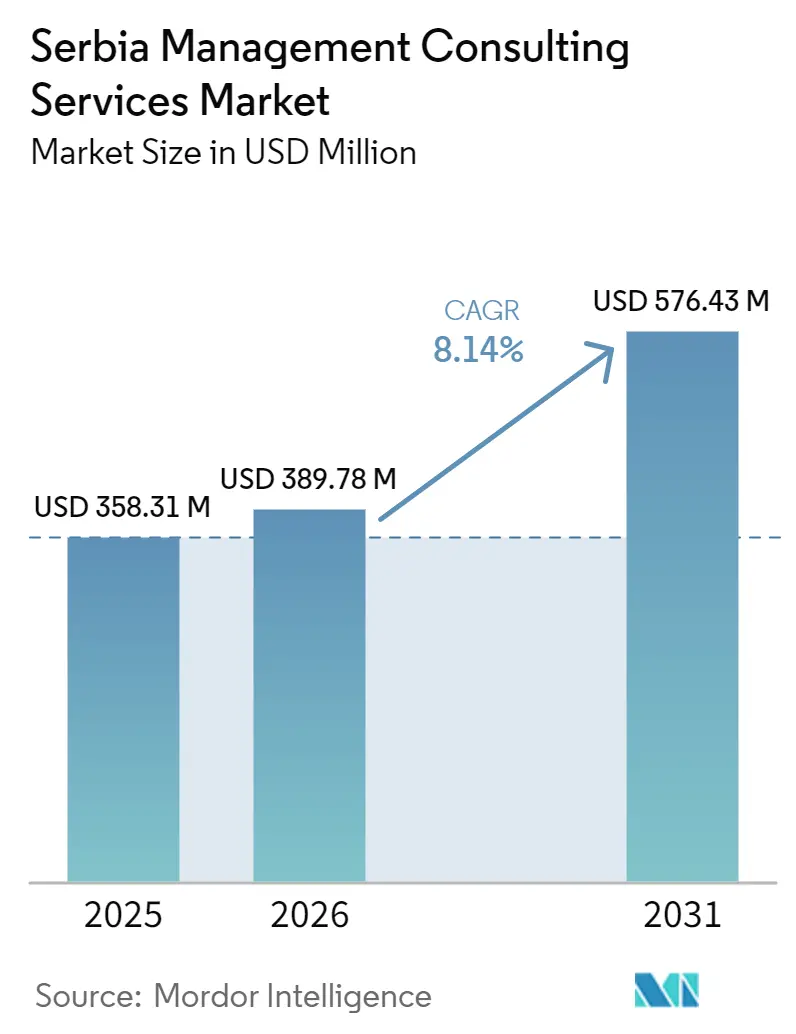
| Base Year Market Size (2025) | USD 358.31 Million |
| Market Size (2026) | USD 389.78 Million |
| Market Size (2031) | USD 576.43 Million |
| Growth Rate (2026 - 2031) | 8.14 % |
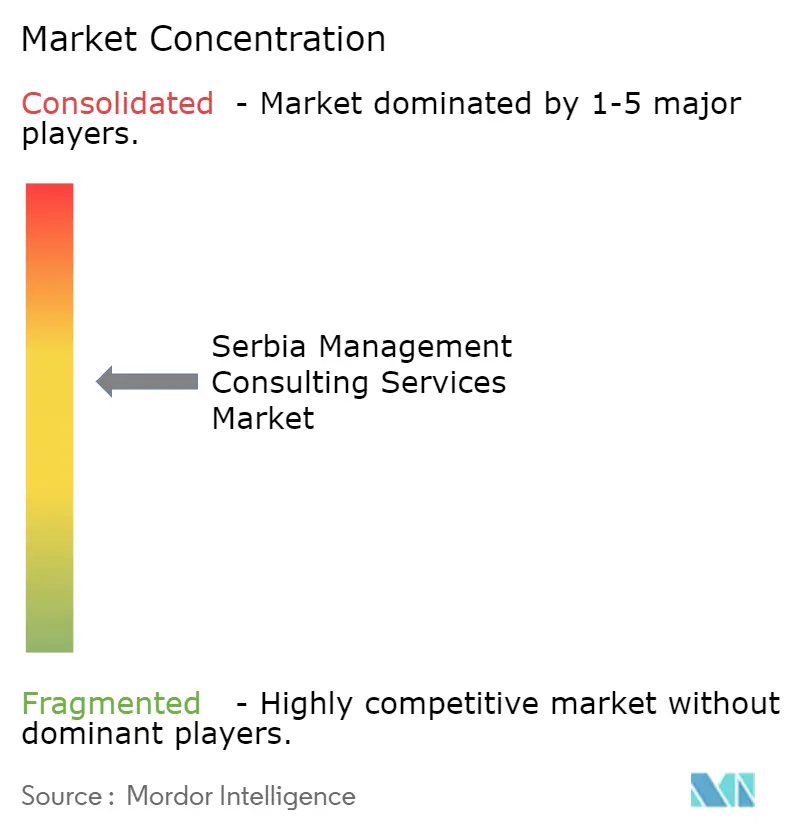
| Market Concentration | Medium |
Major Players *Disclaimer: Major Players sorted in no particular order Image © Mordor Intelligence. Reuse requires attribution under CC BY 4.0. | |
Serbia Management Consulting Services Market Analysis by Mordor Intelligence
The Serbia Management Consulting Services market size was valued at USD 358.31 million in 2025 and estimated to grow from USD 389.78 million in 2026 to reach USD 576.43 million by 2031, at an 8.14% CAGR during the forecast period (2026-2031). Heightened EU-accession activity, rising inflows of foreign direct investment, and the large public-spending envelope attached to EXPO 2027 Belgrade are drawing companies to professional advisors on governance, risk, and program delivery. Enterprises are accelerating digital-transformation timelines, which expands demand for cloud, AI, and process-automation consulting at a pace that exceeds regional peers. Meanwhile, nearshoring by Western European manufacturers and service centers is widening the scope for site-selection, workforce, and tax-structuring mandates within the Serbia Management Consulting Services market. Competitive rivalry remains moderate because the Big Four, a handful of global strategy houses, and a fast-growing tier of domestic boutiques specialize in complementary niches rather than head-to-head price wars.
Key Report Takeaways
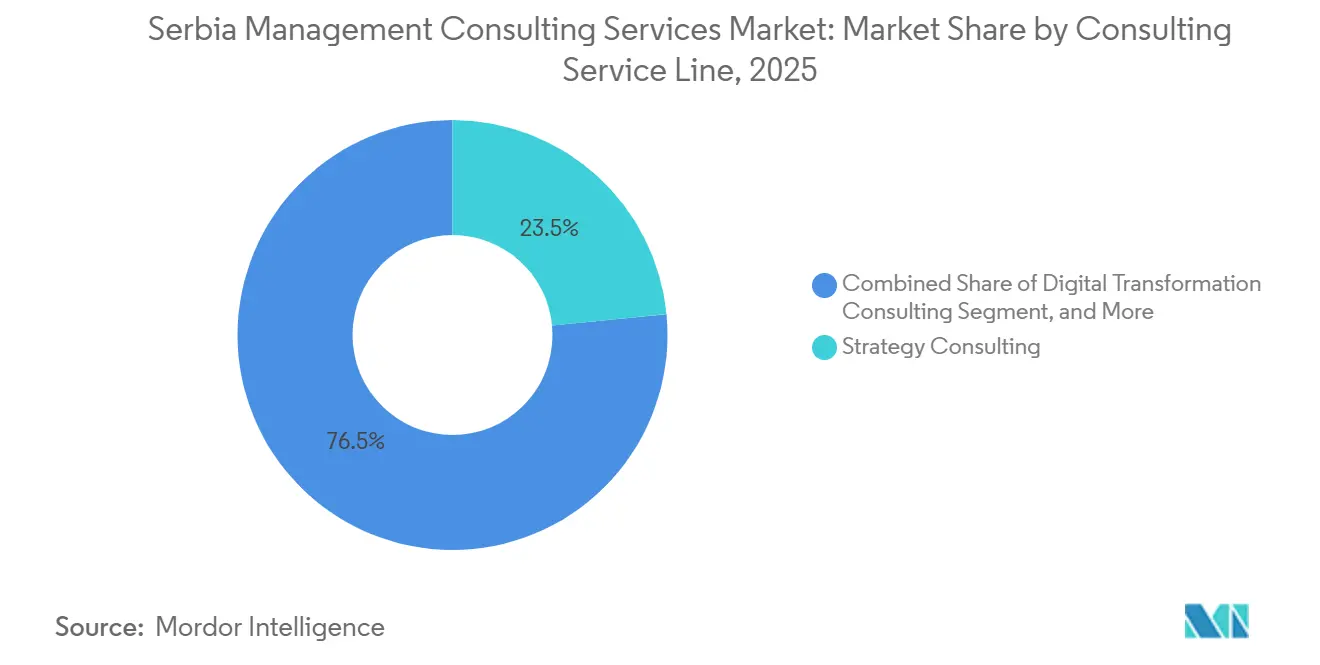
- By consulting service line, strategy consulting led with a 23.47% share of the Serbia Management Consulting Services market in 2025, while digital-transformation consulting is projected to grow at a 9.92% CAGR through 2031.
- By organization size, large enterprises controlled 61.79% of the Serbia Management Consulting Services market in 2025, yet the SME segment is forecast to expand at an 8.67% CAGR on the back of EU-funded grant programs.
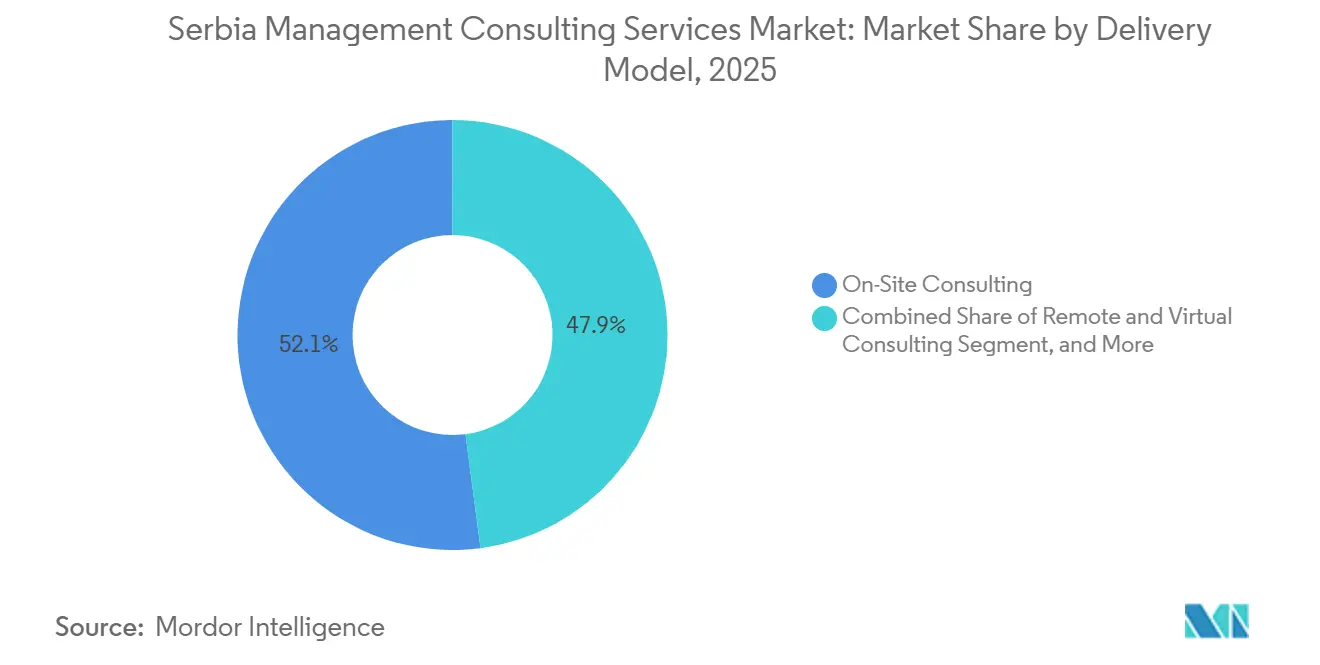
- By delivery model, on-site engagements held a 52.07% share of the Serbia Management Consulting Services market in 2025, although hybrid delivery is advancing at a 9.06% CAGR because of new cloud infrastructure.
- By end-user industry, banking and insurance accounted for 18.13% of the Serbia Management Consulting Services market in 2025, whereas IT and telecommunications represent the fastest-growing vertical with an 8.94% CAGR.
Note: Market size and forecast figures in this report are generated using Mordor Intelligence’s proprietary estimation framework, updated with the latest available data and insights as of January 2026.
Serbia Management Consulting Services Market Trends and Insights
Drivers Impact Analysis*
| Driver | (~) % Impact on CAGR Forecast | Geographic Relevance | Impact Timeline |
|---|---|---|---|
| Accelerated Digital-Transformation Spend by Enterprises | +2.1% | National, concentrated in Belgrade, Novi Sad, Niš | Medium term (2-4 years) |
| EU-Accession-Driven Compliance and Governance Demand | +1.8% | National, spillover to cross-border operations | Long term (≥ 4 years) |
| Inflow of FDI Into ICT and Manufacturing Sectors | +1.5% | Belgrade, Novi Sad, Kragujevac, Niš, Zrenjanin | Medium term (2-4 years) |
| Near-Shoring of Western European Service Centers | +1.3% | Belgrade metro, Novi Sad | Short term (≤ 2 years) |
| CBAM-Linked ESG Compliance Outsourcing Boom | +0.9% | Export-intensive manufacturing clusters nationwide | Short term (≤ 2 years) |
| EXPO 2027 Public-Investment Wave Requiring Project-Preparation Consulting | +0.6% | Belgrade with regional infrastructure linkages | Short term (≤ 2 years) |
| Source: Mordor Intelligence | |||
Accelerated Digital-Transformation Spend By Enterprises
Serbian companies are migrating core workloads from on-premise servers to cloud-native platforms, pulled by competitive export pressures and pushed by EU-funded stimulus for digital upgrades. The World Bank GovTech Index ranked Serbia second in Europe and sixth worldwide in 2025, reflecting 420 public-sector systems moved to a state cloud and 13,000 civil servants upskilled on e-workflows.[1] An AI assistant on government portals handled 200,000 citizen queries, trimming clerical interactions by 18%. In banking, Raiffeisen surpassed 500,000 mobile users, while Addiko automated 91% of retail-loan approvals.[2] These case studies prove to private firms that cloud adoption can lift productivity and shave costs, so advisory projects in API integration, data governance, and change management are multiplying. As a result, digital-transformation engagements are pacing the Serbia Management Consulting Services market.
EU-Accession-Driven Compliance and Governance Demand
Serbia opened 22 out of 35 negotiation chapters with the EU by 2025, and the associated Reform and Growth Facility funneled EUR 1.6 billion (USD 1.81 billion) into public-sector modernization.[3] Financial institutions adopted Open Banking rules on 6 May 2025, exposing APIs that require third-party penetration testing and audit trails. The e-Delivery platform became obligatory on 1 January 2026, forcing every registered entity to ingest official correspondence electronically. Compliance costs are steep, REACH chemical dossiers cost up to USD 226,000 and IPPC environmental permits reach USD 169,500, so companies increasingly outsource regulatory impact assessments to consultants. Governance projects therefore form a durable revenue stream for the Serbia Management Consulting Services market.
Inflow of FDI Into ICT and Manufacturing Sectors
ICT exports hit EUR 4.55 billion (USD 5.14 billion) in 2025 and sector employment crossed 125,000.[4] Ariston invested EUR 75 million (USD 84.75 million) to expand its Niš facility, while Finestamping committed EUR 47.1 million (USD 53.2 million) for an EV motor-core plant in Apatin. Automotive suppliers generated EUR 5.5-6.0 billion (USD 6.22-6.78 billion) in export receipts, yet margins compressed as wages climbed to RSD 153,000, or roughly USD 1,400, per month. Investors need site-selection studies, wage-inflation scenarios, and supply-chain optimization, which expand consulting pipelines.
Near-Shoring of Western European Service Centers
Foxconn-linked JUSDA opened an 11,000 m² logistics hub in Zrenjanin, underscoring Serbia’s pull as a nearshoring base with skilled labor rates of USD 50-99 per hour, well below Western Europe.[5] Oracle went live with Southeast Europe’s first hyperscale cloud region in Belgrade, and the National AI Platform with NVIDIA supplies ample compute.[6] Western firms therefore localize shared-service centers while relying on consultants for labor-market analytics, real-estate selection, and tax structuring. These engagements are short-cycle but high-margin, lifting the Serbia Management Consulting Services market.
Restraints Impact Analysis*
| Restraint | (~) % Impact on CAGR Forecast | Geographic Relevance | Impact Timeline |
|---|---|---|---|
| High Price Sensitivity of Domestic SMEs | -1.2% | Nationwide, sharper in secondary cities | Medium term (2-4 years) |
| Scarcity of Senior Consulting Talent | -0.9% | Belgrade, Novi Sad, Niš | Long term (≥ 4 years) |
| Large Informal Economy Limiting Formal Uptake | -0.7% | Construction, retail, hospitality across Serbia | Long term (≥ 4 years) |
| Twenty-Percent Withholding Tax on Cross-Border Fees | -0.5% | National, affecting multinational providers | Medium term (2-4 years) |
| Source: Mordor Intelligence | |||
High Price Sensitivity of Domestic SMEs
EY estimated the informal economy at 17.2% of GDP in 2023, squeezing formal-sector revenue and curbing advisory budgets.[7] Loan rates averaged 14.2% in 2025, making capital costly, while REACH and IPPC compliance can swallow more than a year of profits for small manufacturers. Only 8% of SMEs in Pančevo accessed IPA grants, suggesting that many firms either lack awareness or cannot afford application consultants. Consequently, SMEs barter scope for price, forcing boutiques to unbundle services into low-ticket modules and capping the Serbia Management Consulting Services market’s upside.
Scarcity of Senior Consulting Talent
Roughly 2,500 IT professionals emigrate each year, and AI roles show an 8:1 demand-supply imbalance. Senior salaries inflate by 12% annually, nearing Western European levels, eroding Serbia’s cost advantage. Vacancies for project directors and BIM managers remain open for 6-12 months in Belgrade commercial real estate.[8] Firms must promote juniors early or source offshore teams, straining margins and delaying projects, which suppresses the Serbia Management Consulting Services market growth rate.
*Our forecasts treat driver/restraint impacts as directional, not additive. The impact forecasts reflect baseline growth, mix effects, and variable interactions.
Segment Analysis
By Consulting Service Line: Digital Transformation Takes The Lead
Digital-transformation engagements generated the fastest momentum, expanding at a 9.92% CAGR to 2031, as cloud migration, AI integration, and API ecosystems top boardroom agendas. Banks alone budgeted roughly USD 18 million per institution to modernize payments and core systems, a scale that lifts the Serbia Management Consulting Services market size for technology-centric advisory. Strategy consulting, although still the biggest slice at 23.47% in 2025, is gradually ceding share to digital specialists who bundle design, build, and change-management services into multiyear programs.
The pivot is visible in finance where ProCredit and NLB Komercijalna accessed EBRD credit lines totaling EUR 60 million (USD 67.8 million) to digitize SME lending. Raiffeisen now books half of new accounts through digital channels, and Addiko slashed approval times with robotic underwriting. Cloud capacity from Oracle’s new region enables consultants to run data-heavy simulations remotely, an enabler for hybrid delivery. As sustainability mandates rise ahead of EXPO 2027, advisory on carbon accounting and green building certification is also wrapped into the digital-transformation toolkit, broadening wallet share within the Serbia Management Consulting Services market.

By Organization Size: SME Momentum Builds
Large corporations commanded 61.79% of 2025 revenue because they commission multi-tower engagements covering compliance, M&A, and agile at scale. However, the SME cohort is expected to deliver an 8.67% CAGR, outgrowing the overall Serbia Management Consulting Services market, as EU funds ease the cost of ISO accreditation and export-fitness audits. Grants under the Reform and Growth Facility specifically earmark digital skilling and process re-engineering, catalyzing first-time consulting spend among smaller manufacturers and tech startups.
Still, affordability is a constraint. High financing costs and an informal-sector drag mean many SMEs can only afford narrowly scoped studies, often delivered by domestic boutiques that charge 30-40% less than global brands. This dual structure, premium enterprise projects and volume SME work, defines revenue distribution across the Serbia Management Consulting Services market.
By Delivery Model: Hybrid Engagements Scale Up
On-site work captured 52.07% of revenue in 2025 because strategy and governance mandates rely on face-to-face workshops for stakeholder alignment. Nevertheless, hybrid engagements are projected to post a 9.06% CAGR, the fastest within the Serbia Management Consulting Services market, on the back of the Belgrade hyperscale cloud region, Kragujevac Tier IV data center, and nationwide fiber roll-out.
Hybrid delivery trims travel time, lets consultants tap dispersed talent pools, and supports always-on analytics dashboards. Remote work alone grows more slowly because high-trust kickoff sessions and regulatory audits still need in-person presence. Tax friction also nudges clients toward hybrid setups that keep part of the engagement on Serbian soil, reducing the 20% withholding burden on cross-border fees.
By End-User Industry: ICT and Telecoms Surge, Banks Invest Heavily
IT and telecommunications are forecast to grow at 8.94% through 2031, the top-performing vertical in the Serbia Management Consulting Services market, propelled by EUR 4.55 billion (USD 5.14 billion) of 2025 exports and chronic shortages of AI, DevOps, and cybersecurity skills. Advisory firms help telecoms adjust to 5G rollout, monetize data lakes, and comply with NIS2 security directives.
Banking retained the largest single share at 18.13% because compliance, Open Banking, and payment modernizations demand continuous advisory input. Manufacturing, especially automotive components, contributes steady work on operational excellence as EBITDA margins slid to 8-12% in 2025. Public-sector engagements tied to EXPO 2027 and the USD 1.81 billion Reform and Growth Facility round out demand, while energy consulting accelerates thanks to renewable-capacity auctions.
Geography Analysis
Belgrade dominates the Serbia Management Consulting Services market owing to its role as political capital, finance hub, and ICT cluster with 45,000-50,000 tech workers. Oracle’s cloud region, the National AI Platform, and most ministry headquarters reside here, turning the city into an anchor client pool. EXPO 2027’s USD 1.46 billion site spend alone spawns mandates in logistics, sustainability, and hospitality advisory.
Novi Sad is emerging as Serbia’s secondary consulting node. JUSDA’s logistics hub and SHAC’s facility signal that multinational manufacturers and service centers prefer the city for lower rental costs and a strong university pipeline. Consultants are engaged in workforce planning and supply-chain recalibration as firms tap labor markets across Vojvodina province.
Southern and central cities such as Niš, Apatin, and Kragujevac form an industrial belt that attracts plant-level operations consulting. Ariston’s USD 84.75 million expansion in Niš and Finestamping’s new EV motor-core plant in Apatin demand site supervision, lean layout, and regulatory filings. Kragujevac, with Stellantis output running below capacity, contracts advisors for efficiency turnaround. Despite these opportunities, smaller markets confront higher informal-sector activity and deeper SME price sensitivity, which limits consulting penetration relative to Belgrade.
Competitive Landscape
The Serbia Management Consulting Services market sits at a moderate concentration level where the Big Four and global strategy firms command flagship transformation and compliance work, while domestic boutiques carve niche digital, ESG, and agile assignments. McKinsey’s Belgrade office drives cross-border M&A diligence and operating-model redesign for regional banks. PwC leverages its ESG Lideri program to anchor sustainability advisory, and KPMG publishes thought leadership on e-invoicing that converts into compliance projects. EY’s push into neuroinclusion and AI-enabled workforce analytics widens its HR consulting funnel.
Local challengers such as Quantox, BrightMarbles, and Gekko Advisory Hub win contracts by pairing sector know-how with 20-40% lower rates than international incumbents, a value proposition that resonates with SMEs. Brightscout’s 2026 market entry shows Serbia’s talent pool can attract U.S. boutique strategists who in turn lift competitive pressure. Technology adoption, cloud regions, AI toolkits, and secure virtual workspaces, becomes a differentiator for firms vying for hybrid projects. Yet all competitors battle a 12% annual wage-inflation spiral and an 8:1 talent gap in AI roles, capping delivery capacity and keeping fees from collapsing into commodity levels.
White-space remains in healthcare digitization, energy decarbonization, and SME export-readiness, especially as only a fraction of eligible firms tap EU grant windows. Multinationals eye Bosnia-Herzegovina and North Macedonia as offshore delivery extensions to alleviate Serbia’s talent shortages, suggesting that regional footprint will shape the next wave of rivalry in the Serbia Management Consulting Services market.
Serbia Management Consulting Services Industry Leaders
-
Deloitte Serbia
-
PwC Serbia
-
KPMG Serbia
-
EY Serbia
-
Accenture Plc Serbia
- *Disclaimer: Major Players sorted in no particular order
Recent Industry Developments
- February 2026: The EBRD extended EUR 50 million (USD 56.5 million) to ProCredit Bank Serbia for SME digital lending modernization, cutting approval times from weeks to days.
- February 2026: Brightscout opened a Belgrade office to capitalize on Serbia’s engineering talent and lower operating costs.
- February 2026: SGS and the International Finance Corporation launched a joint program helping Serbian exporters navigate the EU Carbon Border Adjustment Mechanism.
- January 2026: The mandatory e-Delivery system went live nationwide, driving urgent demand for IT integration and cybersecurity consulting.
Serbia Management Consulting Services Market Report Scope
The Serbia Management Consulting Services Market Management Consulting Services Market Report is Segmented by Consulting Service Line (Strategy Consulting, Operations Consulting, HR Consulting, Financial Advisory Consulting, Digital Transformation Consulting, Risk and Compliance Consulting, and Other Consulting Service Lines), Organization Size (Large Enterprises, and Small and Medium-Sized Enterprises), Delivery Model (On-Site Consulting, Remote and Virtual Consulting, and Hybrid Consulting), End User Industry (IT and Telecommunications, Manufacturing, Energy and Resources, Public Sector, Healthcare, Banking and Insurance, and Other End User Industries), and Geography. The Market Forecasts are Provided in Terms of Value (USD).
| Strategy Consulting |
| Operations Consulting |
| HR Consulting |
| Financial Advisory Consulting |
| Digital Transformation Consulting |
| Risk and Compliance Consulting |
| Other Consulting Service Lines |
| Large Enterprises |
| Small and Medium-Sized Enterprises |
| On-Site Consulting |
| Remote and Virtual Consulting |
| Hybrid Consulting |
| IT and Telecommunications |
| Manufacturing |
| Energy and Resources |
| Public Sector |
| Healthcare |
| Banking and Insurance |
| Other End User Industries |
| By Consulting Service Line | Strategy Consulting |
| Operations Consulting | |
| HR Consulting | |
| Financial Advisory Consulting | |
| Digital Transformation Consulting | |
| Risk and Compliance Consulting | |
| Other Consulting Service Lines | |
| By Organization Size | Large Enterprises |
| Small and Medium-Sized Enterprises | |
| By Delivery Model | On-Site Consulting |
| Remote and Virtual Consulting | |
| Hybrid Consulting | |
| By End User Industry | IT and Telecommunications |
| Manufacturing | |
| Energy and Resources | |
| Public Sector | |
| Healthcare | |
| Banking and Insurance | |
| Other End User Industries |
Key Questions Answered in the Report
How large is the Serbia Management Consulting Services market today, and how fast will it grow?
The market was valued at USD 358.31 million in 2025 and is projected to reach USD 576.43 million by 2031, registering an 8.14% CAGR over 2026-2031.
Which consulting segment is growing the fastest?
Digital-transformation services lead with a 9.92% CAGR as companies replace legacy IT with cloud-native and AI-enabled architectures.
Why are SMEs becoming a bigger customer group for consultants?
EU grants and nearshoring contracts require ISO and ESG certifications, prompting SMEs to seek advisory support even though price sensitivity remains high.
What delivery model is winning share in Serbia?
Hybrid consulting, combining on-site workshops with remote analytics, is expanding fastest because new cloud regions and fiber networks enable secure collaboration.
Which industries generate the most demand for consulting?
Banking commands the largest spend due to compliance needs, while IT and telecommunications show the highest growth rate thanks to rapid export expansion and talent shortages.
What is the main constraint on market expansion?
A structural shortage of senior consulting talent, driven by emigration and wage inflation, limits project capacity and raises delivery costs.