
Bulgaria Management Consulting Services Market Size and Share
Market Overview
| Study Period | 2020 - 2031 |
|---|---|
| Forecast Data Period | 2026 - 2031 |
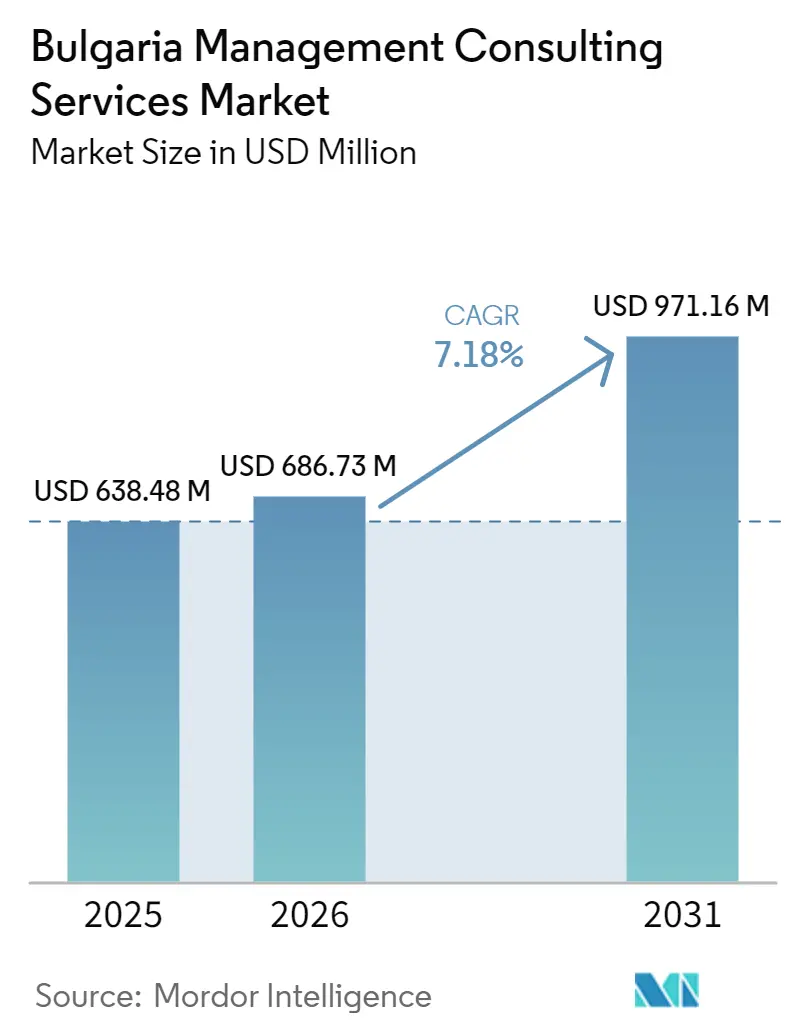
| Base Year Market Size (2025) | USD 638.48 Million |
| Market Size (2026) | USD 686.73 Million |
| Market Size (2031) | USD 971.16 Million |
| Growth Rate (2026 - 2031) | 7.18 % |
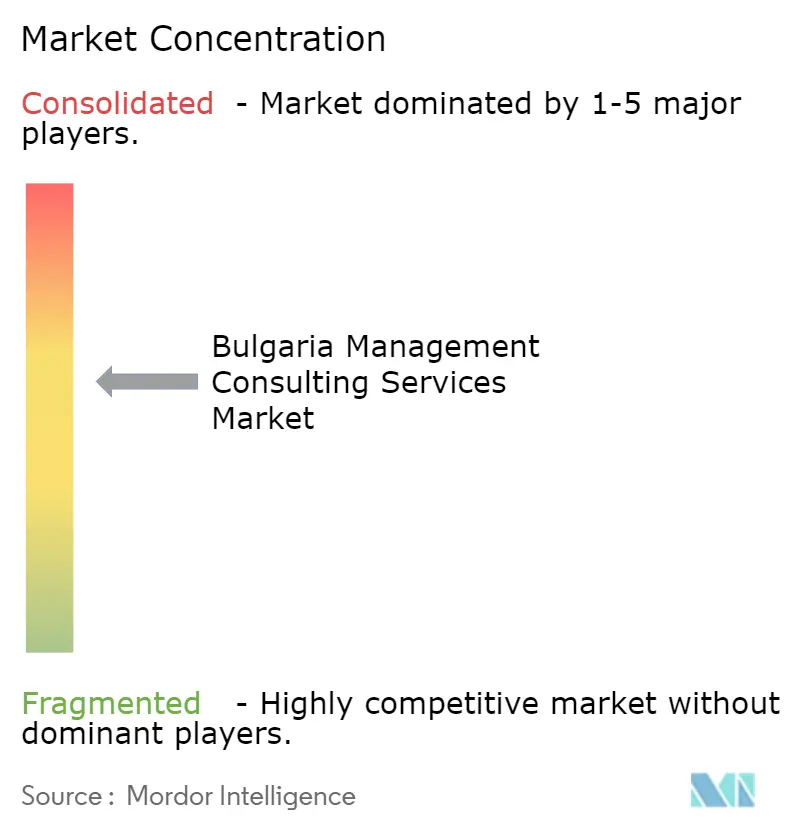
| Market Concentration | Medium |
Major Players *Disclaimer: Major Players sorted in no particular order Image © Mordor Intelligence. Reuse requires attribution under CC BY 4.0. | |
Bulgaria Management Consulting Services Market Analysis by Mordor Intelligence
The Bulgaria management consulting services market size is expected to grow from USD 0.64 billion in 2025 to USD 0.69 billion in 2026 and is forecast to reach USD 0.97 billion by 2031 at 7.18% CAGR over 2026-2031. Robust demand is flowing from Schengen accession cost-savings, eurozone preparation projects, and a widening digital-skills gap that keeps advisory pipelines full. Multinationals are restarting cross-border supply-chain redesign work that had been deferred until full EU integration, while treasury and tax teams are commissioning euro-conversion roadmaps. Public co-financing under the Recovery and Resilience Facility is expanding consulting addressability among price-sensitive small firms, and near-shoring economics are prompting Western European consultancies to source Bulgarian talent for regional projects. Competitive intensity remains moderate because Big Four incumbents dominate audit-adjacent work, leaving space for boutiques that specialize in information security, business-intelligence integration, and EU-grant navigation.
Key Report Takeaways
- By consulting service line, Strategy Consulting led with 28.32% revenue share in 2025, whereas Digital Transformation Consulting is advancing at a 7.36% CAGR through 2031.
- By organization size, Large Enterprises held 65.24% share in 2025, while Small and Medium-Sized Enterprises are set to expand at a 7.39% CAGR as grant funding lowers adoption barriers.
- By delivery model, On-Site Consulting captured 57.42% of revenue in 2025, yet Hybrid Consulting is projected to log a 7.43% CAGR through 2031.
- By end user industry, IT and Telecommunications delivered 22.19% of 2025 spending, whereas Energy and Resources is poised for the fastest 7.52% CAGR to 2031.
Note: Market size and forecast figures in this report are generated using Mordor Intelligence’s proprietary estimation framework, updated with the latest available data and insights as of January 2026.
Bulgaria Management Consulting Services Market Trends and Insights
Drivers Impact Analysis*
| Driver | (~) % Impact on CAGR Forecast | Geographic Relevance | Impact Timeline |
|---|---|---|---|
| Digital Transformation Initiatives Among Bulgarian Enterprises | +1.8% | National, concentrated in Sofia, Plovdiv, Varna | Medium term (2-4 years) |
| EU-Funded Programs and Structural Funds Requiring Advisory Services | +1.5% | National with spill-over to Romania, Greece, North Macedonia | Medium term (2-4 years) |
| Economic Convergence With the EU Spurring Strategic Planning Demand | +1.2% | National, especially Sofia financial cluster | Long term (≥ 4 years) |
| Near-Shoring of Western European Consulting Projects to Bulgaria | +0.9% | Sofia, Plovdiv, Varna technology hubs | Short term (≤ 2 years) |
| Surge in ESG-Linked Performance-Based Lending Creating Advisory Demand | +0.7% | National, early adoption in banking, energy, large manufacturing | Medium term (2-4 years) |
| Bulgaria's 2025 Schengen Accession Prompting Cross-Border Compliance Upgrades | +0.6% | National, with early gains in logistics, customs, cross-border trade sectors | Short term (≤ 2 years) |
| Source: Mordor Intelligence | |||
Digital Transformation Initiatives Among Bulgarian Enterprises
Bulgarian firms are closing a 29-percentage-point digital-intensity gap with the EU average, yet only 8.5% used artificial intelligence in 2025, climbing to 26.2% among large organizations. Lack of expertise and high costs remain the top barriers, cited by 72.7% and 55.7% of non-adopters respectively, which keeps advisory assignments flowing for turnkey AI pilots, change management and upskilling programs.[1]National Statistical Institute, “Information and Communication Technologies in Enterprises 2025,” nsi.bg Government co-financing under the BGN 106 million (USD 59 million) Industry 4.0 scheme and the BG16RFPR001-1.012 digitalization procedure is underwriting ERP, CRM and ISO 27001 projects, translating grant paperwork into recurring implementation and training engagements.[2]Ministry of Innovation and Growth, “Industry 4.0 Programme,” mig.government.bg With only 28.4% of SMEs achieving basic digital intensity, the advisory runway extends well beyond the current budget cycle.
EU-Funded Programs and Structural Funds Requiring Advisory Services
Bulgaria’s EUR 6.17 billion (USD 6.97 billion) Recovery and Resilience Facility envelope is tied to strict milestone tracking, procurement audits and ESG reporting that beneficiaries often outsource to consultants. The second payment of EUR 438.6 million (USD 495.5 million) landed in 2025 and another EUR 485 million (USD 548 million) received EC approval, expanding the compliance workload for grant-application specialists and project-management advisors. Energy, healthcare, and digital-infrastructure tranches collectively exceed EUR 2 billion (USD 2.2 billion) and require intricate financial models, environmental assessments, and cybersecurity frameworks, deepening demand for niche technical consultancies.
Economic Convergence With the EU Spurring Strategic Planning Demand
Eurozone preparation accelerated in 2025, with 83% of state bodies adapting IT systems for euro compatibility and corporates seeking treasury, tax and reporting realignments.[3]Bulgarian Ministry of Finance, “Euro adoption preparation - IT systems adaptation,” minfin.bg KPMG, EY and PwC turned convergence checkpoints into strategic-planning engagements that cover operating-model redesign and green-finance readiness. Schengen membership, effective January 2025, eliminated border checks, unlocking cross-border compliance work for logistics and customs processes.
Near-Shoring of Western European Consulting Projects to Bulgaria
Sofia developers earned EUR 35,000-45,000 (USD 39,550-50,850) in 2025, roughly half Munich rates, while a flat 10% corporate tax and CET time-zone overlap ease collaboration. Western European firms facing 137,000 unfilled IT roles leverage Bulgarian talent at 40-44% lower cost, shifting delivery toward hybrid models that combine remote analysis with on-site workshops. EY’s Regional Shared Service Center in Sofia now supports 29 countries, showing how near-shoring moves from staff augmentation to permanent multi-country hubs.
Restraints Impact Analysis*
| Restraint | (~) % Impact on CAGR Forecast | Geographic Relevance | Impact Timeline |
|---|---|---|---|
| Consultant Talent Shortage and High Turnover Rates | -0.9% | National, acute in Sofia, Plovdiv, Varna | Short term (≤ 2 years) |
| Price Sensitivity Among Small and Medium-Sized Enterprises | -0.7% | National, particularly outside Sofia metropolitan area | Medium term (2-4 years) |
| Competition From Online Freelance Consulting Platforms | -0.4% | National, higher penetration in IT and digital-marketing segments | Short term (≤ 2 years) |
| Slow Rollout of Electronic Public Procurement Portal Reducing Public Consulting Spend | -0.3% | National, affecting public-sector and infrastructure consulting | Medium term (2-4 years) |
| Source: Mordor Intelligence | |||
Consultant Talent Shortage and High Turnover Rates
Bulgaria closed 2025 with roughly 38,000 unfilled IT roles, and wage growth in technology hovered at 8-12%, squeezing consulting margins as firms raised pay faster than bill rates. Turnover ran between 15% and 20% because Western European employers poached local talent through remote-first contracts that match near-Western salaries. The small pipeline of 2,000-5,000 new tech graduates each year cannot offset attrition, so firms rely on costly subcontractors and extended recruitment cycles. Hybrid-delivery models help source capacity abroad, yet they dilute the near-shoring cost advantage. Retention programs, in-house academies and equity-linked incentives have become mandatory line items in partner budgets.
Price Sensitivity Among Small and Medium-Sized Enterprises
Sixty percent of Bulgarian SMEs devoted less than 10% of their budgets to digitization in 2025, limiting appetite for premium consulting engagements . The average BG16RFPR001-1.012 grant was BGN 35,200 (USD 19,600), a figure that funds software licenses and light implementation but rarely covers multi-month advisory.[4]Ministry of Innovation and Growth, “BG16RFPR001-1.012 Digitalization of Enterprises,” mig.government.bg Many micro-firms fall below the revenue and headcount thresholds to qualify for grants, keeping them outside the paying client universe. Freelance marketplaces further depress pricing benchmarks by offering task-based services at hourly rates well under traditional consulting fee cards. Established firms thus package fixed-price templates and remote delivery to remain viable for this cohort.
*Our forecasts treat driver/restraint impacts as directional, not additive. The impact forecasts reflect baseline growth, mix effects, and variable interactions.
Segment Analysis
By Consulting Service Line: Strategy Anchors Revenue, Digital Transformation Outpaces
Strategy Consulting captured 28.32% of the Bulgaria management consulting services market share in 2025, reflecting board-level demand for euro-conversion roadmaps, Schengen-related supply-chain redesign, and ESG strategy alignments. Large programs at utilities and banks continue to require multiyear steering committees, scenario modelling, and cross-border tax studies that typically sit within the strategic scope. Digital Transformation Consulting is pacing the expansion cycle at a 7.36% CAGR through 2031 as firms work to close a 29-percentage-point digital-intensity gap with the European Union average. Grant-backed ERP and CRM rollouts, ISO 27001 mandates, and AI pilot projects constitute the bulk of new bookings, giving mid-tier integrators and cybersecurity boutiques recurring implementation and support revenue.
Operations Consulting benefits from Industry 4.0 grants and the EUR 857 million (USD 968 million) Greenabler grid-modernization project, which create workflow-optimization and asset-management engagements in manufacturing and energy. Financial Advisory remains buoyed by euro-adoption compliance, ESG-linked credit lines, and a new wave of public-private partnerships in healthcare infrastructure. Risk and Compliance work rose ahead of the Digital Services Act deadline, requiring content-moderation frameworks and transparency reporting for platforms. HR Consulting, while smaller, is indispensable for clients battling 15-20% staff churn and wage inflation surpassing 8% in technology roles. Together, these service lines keep the Bulgaria management consulting services market diversified and resilient across economic cycles.



By Organization Size: Large Enterprises Sustain Bulk Spend, SMEs Accelerate
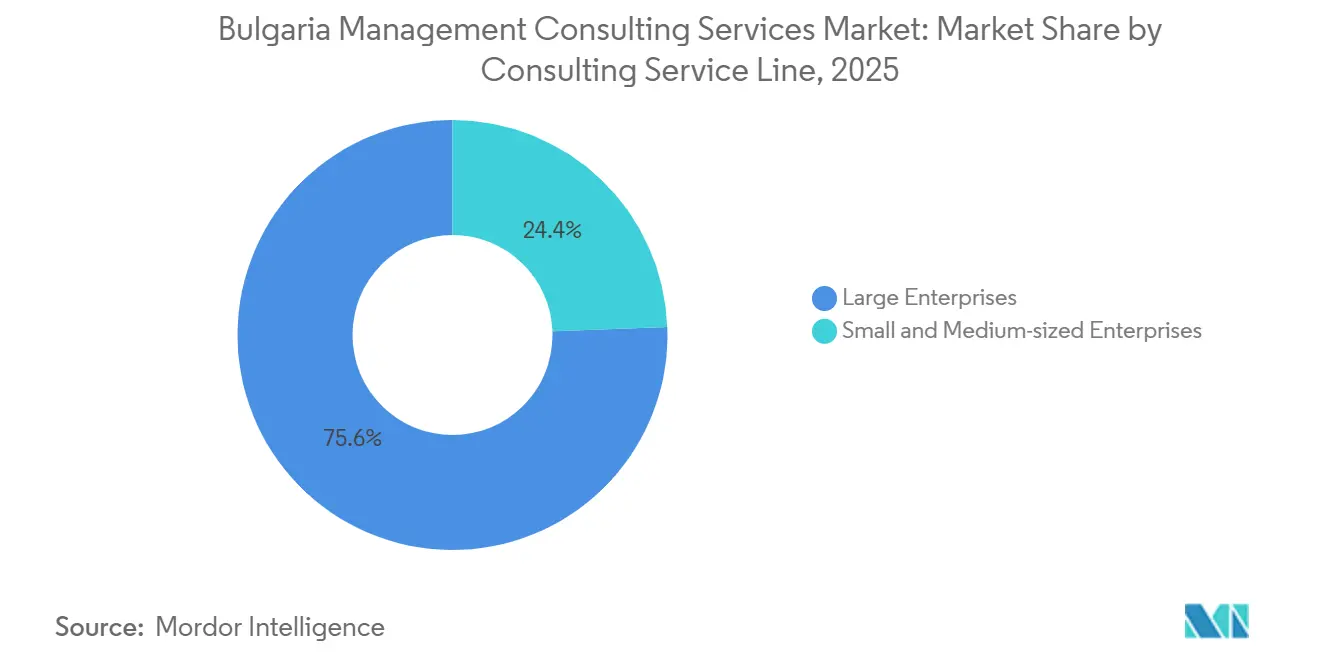
Large Enterprises continued to anchor spending with 65.24% of 2025 revenue as they commissioned multi-country SAP consolidations, finance-function redesigns, and euro-conversion readiness reviews that only tier-one firms can staff. Big Four incumbents routinely cross-sell audit findings into adjacent advisory, locking in multi-year revenue streams. Decision cycles are lengthy, yet engagement sizes are material, often combining strategy, technology, and change-management work under master-service agreements. Public-sector bodies preparing for eurozone entry and telemedicine expansion add further scale, reinforcing corporate demand for enterprise-grade methodologies and cross-border delivery capability.
Small and Medium-Sized Enterprises represent the faster lane, as the Bulgaria management consulting services market size for this cohort is projected to expand at a 7.39% CAGR between 2026-2031. The BG16RFPR001-1.012 program lowered the cash hurdle by covering 70% of eligible digitalization outlays, which sparked 1 642 approved applications by December 2025 and 1,300 signed contracts in early 2026. Consultants that productize ERP selection, low-code CRM deployment, and grant paperwork capture volumes with fixed-price offerings under USD 30,000. Yet ticket sizes remain modest and client price sensitivity forces aggressive scope control, standardized templates, and remote delivery models. Freelance platforms pressure margins on discrete tasks, prompting traditional firms to bundle advisory with software resale or managed services to defend value.
By Delivery Model: Hybrid Delivery Gains Traction Against On-Site Tradition
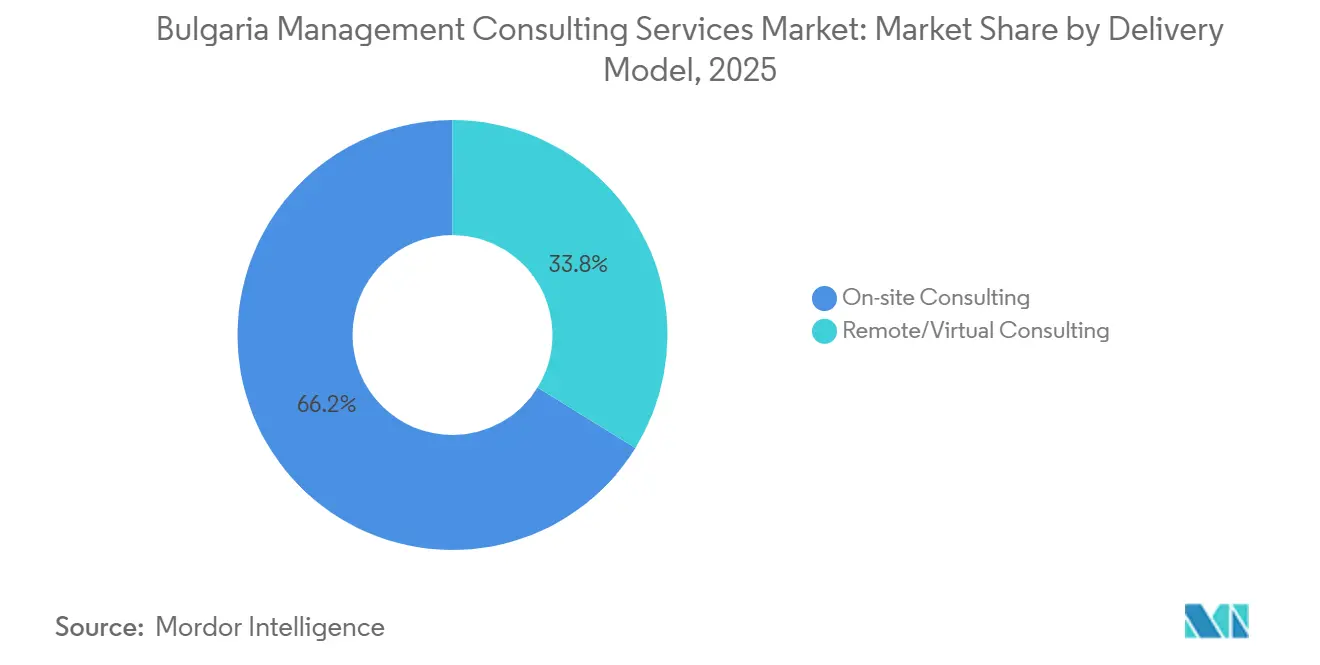
On-Site Consulting retained 57.42% of 2025 revenue because C-suite workshops, stakeholder alignment, and culture change still favor face-to-face settings. Clients in banking, energy, and public administration often insist on physical presence during design sprints and steering-committee checkpoints. That said, greater budget scrutiny post-pandemic is prompting procurement teams to accept virtual analysis and documentation phases as long as milestone workshops occur in person. Western European project sponsors look to Bulgarian teams for remote data modelling and process mapping, then fly senior partners for decision gates, creating a blended rhythm that reduces travel and labor costs.
The Bulgaria management consulting services market size for Hybrid Consulting is forecast to advance at a 7.43% CAGR during 2026-2031 as near-shoring economics improve. Sofia developers earn EUR 35,000-4,000 (USD 39,550-50,850) versus EUR 70,000-90,000 (USD 79,100-101,700) in Munich or Amsterdam, and a flat 10% corporate tax rate allows firms to scale shared-service hubs like EY’s 29-country center. Mandatory e-invoicing for public contracts and the Digital Transformation Strategy 2026-2030 normalize remote collaboration, embedding security protocols and digital twins that guarantee audit trails. Remote-only delivery has receded from the 2020 peak but still thrives for narrowly scoped engagements such as grant-application drafting, vendor shortlisting, or regulatory gap assessments, especially among grant-dependent SMEs.
By End User Industry: IT and Telecom Dominate Spend, Energy Sets Pace
IT and Telecommunications commanded 22.19% of 2025 outlays, driven by EUR 115 million (USD 135 million) satellite-communications upgrades, BGN 390 million (USD 217 million) rural broadband expansion, and 5G spectrum commercialization. Advisory workloads include network-rollout project management, vendor due diligence, and zero-trust cybersecurity blueprints. Banking and fintech players also sit within the tech orbit, commissioning digital-euro readiness audits and instant-payments integration mandated for 2025. Public-sector entities contract e-government architecture design and digital-identity frameworks that dovetail with the national Digital Transformation Strategy 2026-2030.
The Bulgaria management consulting services market size for Energy and Resources is projected to expand at a 7.52% CAGR between 2026-2031, powered by the EUR 857 million (USD 968 million) Greenabler grid upgrade and a 4.5 gigawatt renewable-capacity target. Projects such as the 238 megawatt Tenevo solar farm with 315 megawatts of battery storage trigger demand for engineering feasibility, offtake pricing models, and grid-connection studies. Industrial manufacturers accessing BGN 150,000-850,000 (USD 83,500-473 ,00) Industry 4.0 grants require robotics feasibility analyses and digital-twin simulations. Healthcare providers tap EUR 400 million (USD 452 million) in modernization funds for clinical-workflow redesign and telemedicine cybersecurity. These varied mandates ensure that consultants with sector-specific playbooks and regulatory fluency continue to win contracts across Bulgaria’s expanding renewable, manufacturing, and public-service landscapes.
Geography Analysis
Sofia remains the nerve center for consulting activity, housing Big Four headquarters, multinational shared-service campuses and the largest talent pools for strategy and digital specialists. The city benefits from a dense network of financial institutions and technology vendors that consistently contract full-scope transformation programs, which feeds recurring advisory demand. Plovdiv and Varna follow as secondary hubs on the strength of university pipelines, industrial parks and lower real-estate costs that help boutiques win cost-sensitive assignments, though C-suite road-mapping and cross-border M&A mandates still gravitate to the capital.
Schengen membership, effective January 2025, eliminated land and sea border checks, cutting logistics friction and positioning Bulgaria as a springboard for projects spanning Romania, Greece and North Macedonia. Near-shoring contracts increasingly originate in Western Europe but are staffed out of Sofia and satellite offices, leveraging a 40-44% labor-cost differential versus Munich or Amsterdam developer rates. Rural areas are beginning to catch up through the BGN 390 million (USD 217 million) broadband program that unlocks digital-adoption engagements for micro firms outside metropolitan zones.
Recovery and Resilience Facility funds flow across all regions, financing municipal e-government rollouts, smart-grid pilots and hospital-digitization projects that require local fieldwork paired with Sofia-based program-management teams. Euro-adoption deadlines compel regional banking centers in Plovdiv, Burgas and Varna to engage treasury and IT consultants for interface upgrades, cash-cycle redesign and staff training ahead of the currency switch. This distributed pipeline ensures that provincial offices of national consultancies maintain healthy utilization even as flagship contracts remain city-centered in the capital.
Competitive Landscape
Big Four incumbents, Deloitte, PwC, KPMG and EY, retain the largest contract backlogs thanks to audit cross-selling, brand equity and the ability to field multidisciplinary teams for public-sector reforms and euro-adoption programs. EY’s Regional Shared Service Center, launched in May 2024, now covers finance, HR and IT support for 29 countries from Sofia and signals a pivot toward permanent, multi-country delivery hubs. Deloitte reinforced its manufacturing credentials by hosting a Smart Factories roadshow in Ruse in January 2026, showcasing Industry 4.0 use cases to mid-sized plant owners.
Global strategy firms such as McKinsey, BCG and Bain win board-level assignments in financial services and telecom, but they often subcontract implementation to local technology integrators to control project economics. Accenture leverages a 300-person Sofia tech studio for regional SAP and cloud rollouts, while TMF Group’s 2022 acquisition of NOVACON extended payroll and accounting capabilities that dovetail with compliance consulting mandates. Local specialist Balkan Services claims roughly 30% of the business-intelligence integration niche after completing more than 750 projects across 16 countries, demonstrating that deep product expertise and quick-turn delivery can trump brand scale in data analytics engagements.
Competition is intensifying from freelance platforms that unbundle tasks such as UI prototyping and SEO audits at hourly rates far below traditional fee cards, pressuring established firms to launch standardized, fixed-price packages for grant-funded SMEs. Talent scarcity remains the biggest execution risk, with consultant turnover hovering near 20% and wage inflation outpacing average billing-rate growth. To defend margins, large firms are investing in AI-enabled knowledge platforms, remote-collaboration toolkits and in-house academies that accelerate junior onboarding while raising entry barriers for boutique challengers.
Bulgaria Management Consulting Services Industry Leaders
Deloitte Bulgaria EOOD
PricewaterhouseCoopers Bulgaria EOOD
KPMG Bulgaria OOD
Ernst & Young Bulgaria EOOD
Accenture Bulgaria EOOD
- *Disclaimer: Major Players sorted in no particular order

Recent Industry Developments
- February 2026: The Ministry of Innovation and Growth signed 1,300 contracts worth EUR 23.7 million (USD 26.8 million) under the BG16RFPR001-1.012 digitalization scheme, catalyzing a fresh wave of ERP, CRM and cybersecurity projects for local consultants.
- January 2026: Deloitte Bulgaria hosted a Smart Factories in Ruse event, underscoring its push to win Industry 4.0 advisory outside Sofia.
- December 2025: The ministry confirmed 172 additional BG16RFPR001-1.012 contracts totaling BGN 5.7 million (USD 3.2 million) in grants, expanding the implementation backlog for 2026.
- October 2025: EY was appointed financial advisor for Kozloduy Nuclear Power Plant Units 7 and 8, marking one of the country’s largest infrastructure-finance mandates.


Bulgaria Management Consulting Services Market Report Scope
The Bulgaria Management Consulting Services Market Report is Segmented by Consulting Service Line (Strategy Consulting, Operations Consulting, HR Consulting, Financial Advisory Consulting, Digital Transformation Consulting, Risk and Compliance Consulting, and Other Consulting Service Lines), Organization Size (Large Enterprises, and Small and Medium-Sized Enterprises), Delivery Model (On-Site Consulting, Remote and Virtual Consulting, and Hybrid Consulting), End User Industry (IT and Telecommunications, Manufacturing, Energy and Resources, Public Sector, Healthcare, Banking and Insurance, and Other End User Industries), and Geography. The Market Forecasts are Provided in Terms of Value (USD).
| Strategy Consulting |
| Operations Consulting |
| HR Consulting |
| Financial Advisory Consulting |
| Digital Transformation Consulting |
| Risk and Compliance Consulting |
| Other Consulting Service Lines |
| Large Enterprises |
| Small and Medium-Sized Enterprises |
| On-Site Consulting |
| Remote and Virtual Consulting |
| Hybrid Consulting |
| IT and Telecommunications |
| Manufacturing |
| Energy and Resources |
| Public Sector |
| Healthcare |
| Banking and Insurance |
| Other End User Industries |
| By Consulting Service Line | Strategy Consulting |
| Operations Consulting | |
| HR Consulting | |
| Financial Advisory Consulting | |
| Digital Transformation Consulting | |
| Risk and Compliance Consulting | |
| Other Consulting Service Lines | |
| By Organization Size | Large Enterprises |
| Small and Medium-Sized Enterprises | |
| By Delivery Model | On-Site Consulting |
| Remote and Virtual Consulting | |
| Hybrid Consulting | |
| By End User Industry | IT and Telecommunications |
| Manufacturing | |
| Energy and Resources | |
| Public Sector | |
| Healthcare | |
| Banking and Insurance | |
| Other End User Industries |


Key Questions Answered in the Report
What is the current Bulgaria management consulting services market size?
The market reached USD 638.48 million in 2025 and is projected to climb to USD 971.16 million by 2031.
How fast is the market expected to grow through 2031?
It is forecast to register a 7.18% CAGR over 2026-2031 thanks to digitalization grants, near-shoring demand and EU-funded programs.
Which consulting service line is expanding the quickest?
Digital Transformation Consulting is leading growth at a 7.36% CAGR through 2031 as firms close their technology-intensity gap.
Why are hybrid delivery models gaining traction?
Clients accept remote analysis phases to harness Bulgaria's 40-44% labor-cost advantage while still scheduling on-site workshops for stakeholder alignment.
Which end-user sector should drive the next wave of advisory spend?
Energy and Resources is projected to advance at a 7.52% CAGR on the back of grid-modernization and renewable-capacity targets.
What is constraining consulting-firm margins the most?
Persistent talent shortages and wage inflation of 8-12% in technology roles force firms to raise pay faster than they can lift billing rates.
Page last updated on:





