
Self-Administered Drugs Market Size and Share
Market Overview
| Study Period | 2021 - 2032 |
|---|---|
| Market Size (2027) | USD 134.11 Billion |
| Market Size (2032) | USD 198.27 Billion |
| Growth Rate (2027 - 2032) | 8.13 % |
| Fastest Growing Market | Asia Pacific |
| Largest Market | North America |
| Market Concentration | Medium |
Major Players *Disclaimer: Major Players sorted in no particular order Image © Mordor Intelligence. Reuse requires attribution under CC BY 4.0. | |
Self-Administered Drugs Market Analysis by Mordor Intelligence
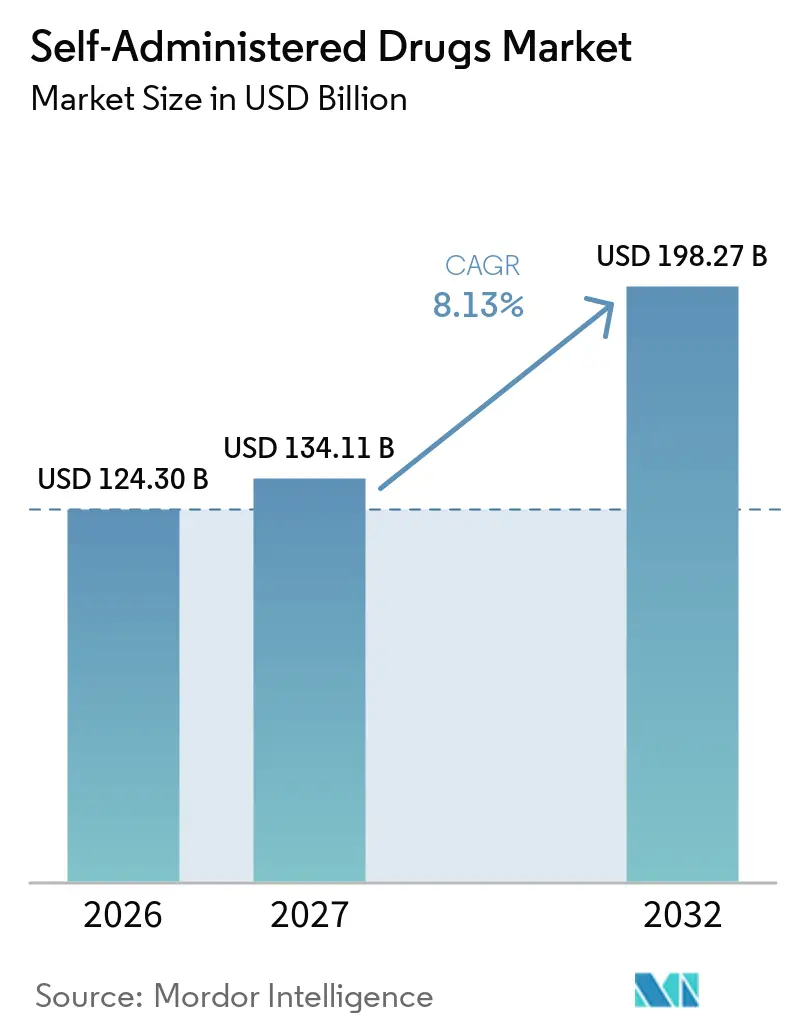
The Self-Administered Drugs Market size was valued at USD 124.30 billion in 2026 and is estimated to grow from USD 134.11 billion in 2027 to reach USD 198.27 billion by 2032, at a CAGR of 8.13% during the forecast period (2027-2032).
Continued progress in digital health tools, streamlined regulatory reviews for at-home biologics, and the maturation of user-friendly delivery devices are moving the locus of care from clinics to the home. North America and Europe jointly generated roughly 71% of global revenue in 2026, buoyed by robust reimbursement policies and well-established cold-chain logistics. At the same time, the Self-administered drugs market is widening rapidly in Asia-Pacific, where middle-class expansion, government support for home-based care, and rising chronic disease prevalence underpin a regional CAGR above 11.09%. Subcutaneous auto-injectables are growing faster as device ergonomics improve and patient training scales. Across device formats, innovative connected solutions-ranging from dose-tracking pens to sensor-enabled inhalers-are attracting pay-for-performance incentives that reward documented adherence.
Key Report Takeaways
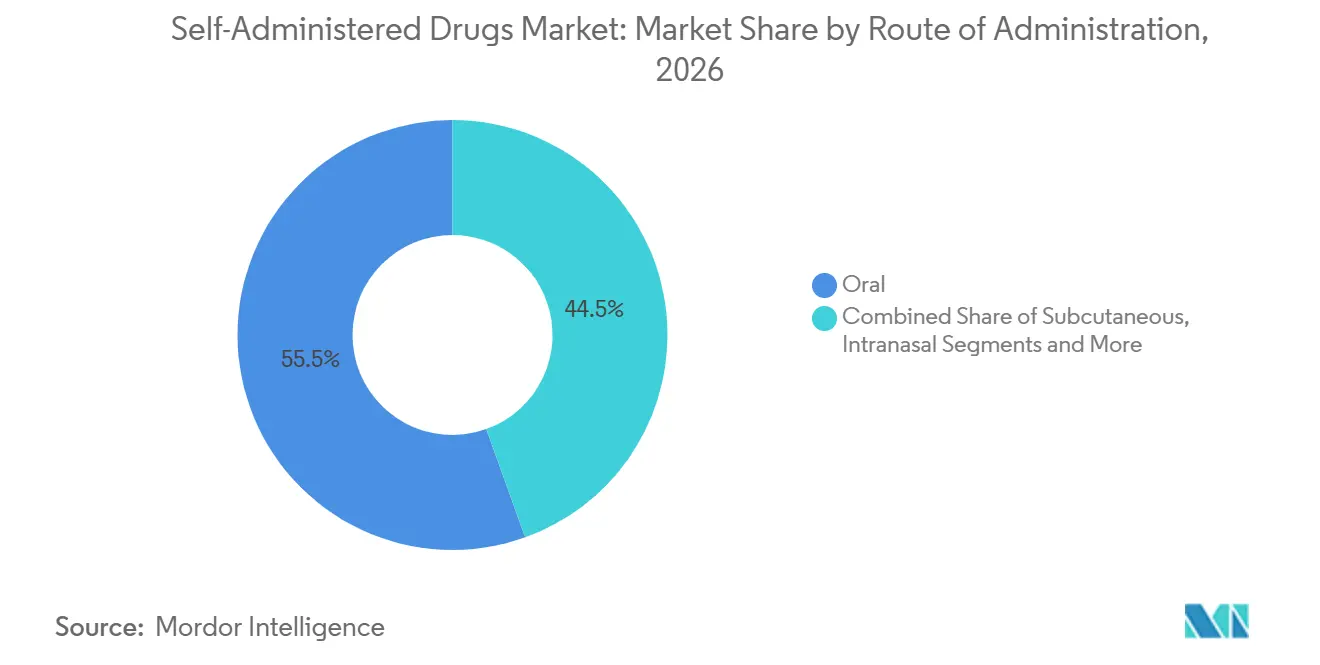
- By route of administration, oral products held 55.51% of the Self-administered drugs market share in 2026, while subcutaneous self-injectables are projected to post the quickest expansion at a 10.42% CAGR through 2032.
- By therapeutic area, diabetes accounted for 34.34% of the Self-administered drugs market size in 2026; autoimmune and biologic therapies are poised to rise at a 11.48% CAGR between 2027 and 2032.
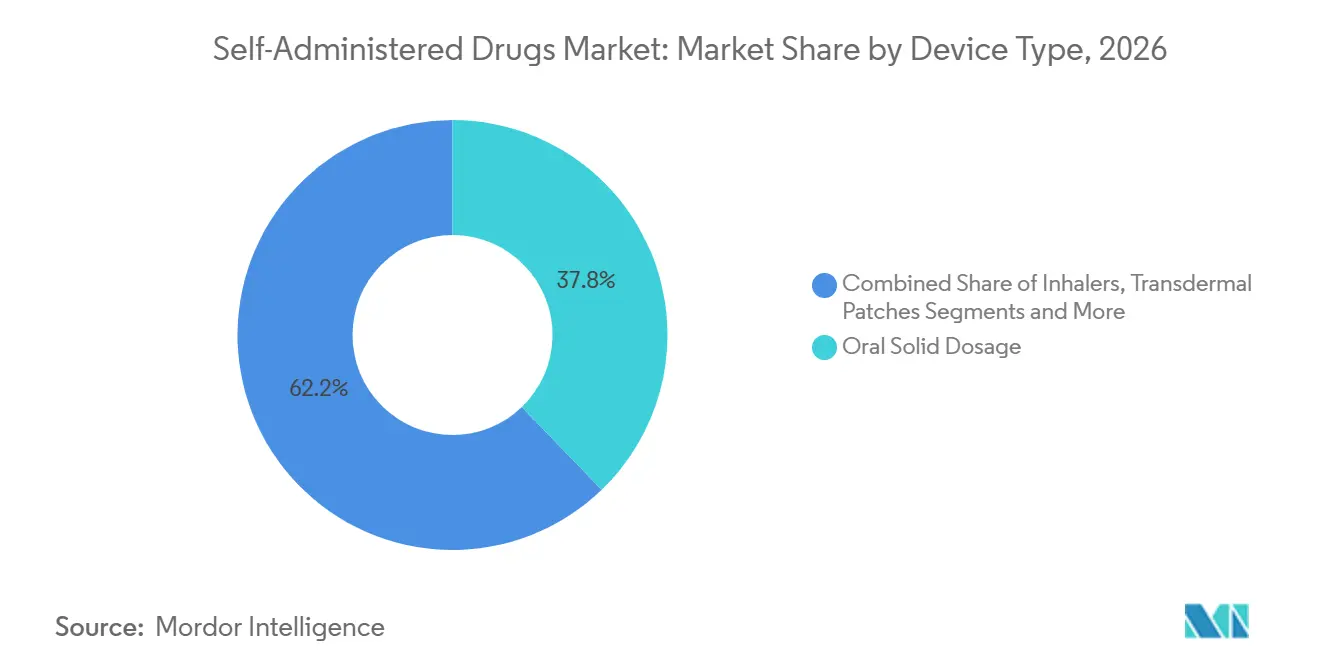
- By device type, oral solid dosage led with 37.79% revenue share in 2026, yet smart connected devices are forecast to scale at a 17.27% CAGR to 2032.
- By distribution channel, retail pharmacies commanded 46.23% of 2026 sales, whereas online pharmacies are on track for the fastest growth at a 12.48% CAGR through 2032.
- By geography, North America dominated with a 44.35% share in 2026; Asia-Pacific represents the most dynamic region, set to expand above a 11.09% CAGR during the outlook period.
Note: Market numbers in this report are based on Mordor Intelligence's proprietary estimation framework, which combines nine months of actuals with Q4 projections for base year 2026.
Market Trends and Insights
Drivers Impact Analysis of Self-Administered Drugs Market*
| Driver | (~) % Impact on CAGR Forecast | Geographic Relevance | Impact Timeline |
|---|---|---|---|
| Rising prevalence of chronic diseases | +1.80% | Global, highest in North America & Europe | Long term (≥ 4 years) |
| Growing preference for home healthcare & convenience | +1.50% | Global, early uptake in developed markets | Medium term (2-4 years) |
| Technological advances in self-injectors & inhalers | +1.20% | North America & EU lead, APAC follows | Medium term (2-4 years) |
| Supportive regulatory pathways for at-home biologics | +1.00% | Primarily North America & EU, expanding to APAC | Short term (≤ 2 years) |
| Digital adherence monitoring linked to pay-for-performance | +0.80% | North America lead, selective EU uptake | Short term (≤ 2 years) |
| Pharmacist-prescribed therapeutics & upcoming OTC biologic switches | +0.60% | North America & EU | Long term (≥ 4 years) |
| Source: Mordor Intelligence | |||
Rising Prevalence of Chronic Diseases
Escalating rates of diabetes, cardiovascular disorders, and autoimmune conditions are altering care pathways, making at-home delivery the practical default for long-term therapy. Diabetes care alone represented a USD 42.68 billion subset of the self-administered drugs market in 2026, powered by continuous glucose-monitoring integrations that enable dose titration in real time.[1] Aging demographics and lifestyle risks heighten demand for self-management solutions, while regulators fast-track combination drug-device filings to relieve systemwide cost pressures. Integrated platforms that track outcomes remotely amplify clinical value and are accelerating pay-for-performance contracts in high-income regions.
Growing Preference for Home Healthcare & Convenience
Consumer expectations forged by the pandemic now emphasize autonomy, lower visit burdens, and digital connectivity. Rheumatoid arthritis saw a 23% jump in autoinjector adoption during 2024, attributed to refined ergonomics and comprehensive coaching resources.[2] Younger cohorts accustomed to app-based services welcome delivery models that mesh with daily routines. Health systems are redesigning pathways to keep stable patients home, reallocating nurse capacity and expanding virtual check-ins. Drug makers that bundle onboarding apps, adherence nudges, and teleconsult access are capturing stickier market share.
Technological Advances in Self-Injectors & Inhalers
Engineering progress—covering needle-free propulsion, high-viscosity handling, and integrated sharps-safety locks—has unlocked at-home use for molecules once limited to infusion suites. Smart inhalers with usage sensors feed granular data to clinicians, narrowing the persistence gap in asthma and COPD. Rapid device miniaturization allows elderly patients with limited dexterity to self-dose confidently. Capacity ramps such as SHL Medical’s USD 220 million plant in South Carolina underscore confidence in sustained demand.
Supportive Regulatory Pathways for At-Home Biologics
Agencies on both sides of the Atlantic have condensed timelines by treating real-world device analytics as evidence of effectiveness. The FDA’s green light for Neffy, the first needle-free epinephrine, cemented a precedent for emergency therapeutics in spray form. EMA’s endorsement of patient-controlled rozanolixizumab infusion pumps similarly signals willingness to trust well-trained patients. Harmonization initiatives are smoothing multiregional launches, particularly for biosimilars pivoting to self-injected formats.[3]
Restraints Impact Analysis of Self-Administered Drugs Market*
| Restraint | (~) % Impact on CAGR Forecast | Geographic Relevance | Impact Timeline |
|---|---|---|---|
| Needle-phobia and adherence challenges | -1.20% | Global, higher in pediatric populations | Medium term (2-4 years) |
| Safety concerns & dosing errors outside clinical settings | -0.90% | Primarily emerging markets | Short term (≤ 2 years) |
| Cold-chain failures for temperature-sensitive biologics | -0.70% | APAC & emerging markets | Long term (≥ 4 years) |
| Data-privacy uncertainty for patient-generated device data | -0.50% | GDPR regions, expanding globally | Medium term (2-4 years) |
| Source: Mordor Intelligence | |||
Needle-Phobia and Adherence Challenges
Injection anxiety affects up to 25% of adults and 63% of children, capping reach for injectable biologics, particularly in pediatrics. Neffy’s nasal route sets a template for broader needle-free innovation that can convert hesitant segments. Sustained adherence also hinges on ongoing technical support, given the risk of device malfunction or forgotten doses over long regimens. Programs that pair behavioral coaching with alternative delivery routes—sublingual films, intranasal sprays, or long-acting implants—are alleviating discontinuation risk.
Safety Concerns & Dosing Errors Outside Clinical Settings
High-potency monoclonals have narrow therapeutic windows; even minor errors can trigger adverse events. The FDA has issued device-safety guidance urging mandatory confirmation steps on pen injectors. Manufacturers are responding with dual-chamber syringes that deliver audible confirmation clicks and lockouts after full dose transfer. Telemetry-enabled wearables send dosing data to clinicians, creating rapid feedback loops, yet adoption remains uneven in markets with limited broadband penetration.
*Our forecasts treat driver/restraint impacts as directional, not additive. The impact forecasts reflect baseline growth, mix effects, and variable interactions.
Self-Administered Drugs Market Segment Analysis
By Route of Administration:
Oral Dominance Challenged by Injectable InnovationOral segment retained a 55.51% self-administered drugs market share in 2026, buoyed by manufacturing familiarity and patient comfort. Nevertheless, subcutaneous formats are accelerating at a 10.42% CAGR on the back of biologic uptake and autoinjector ease. Rapid-absorption intranasal sprays, such as needle-free epinephrine, have showcased commercial potential by eliminating injection barriers. Continuous progress in pulmonary delivery, including digital inhalers that record every actuation, is recasting adherence standards in respiratory care. Transdermal patches now incorporate micro-sensors that verify skin contact duration, ensuring dose integrity over multi-day wear periods. Regulatory agencies are granting accelerated reviews where new routes replace costly infusion center visits.
Second-generation depot injectables and wearable pumps further shrink clinic touchpoints. As patient training curricula expand via virtual reality modules, even complex multi-step injections are completed successfully by elderly cohorts. Over the forecast horizon, innovators will likely package multiple routes within a single therapeutic franchise—oral maintenance tablets flanked by on-demand nasal rescue sprays—creating responsive dosing ecosystems inside the broader Self-administered drugs market.

By Therapeutic Area:
Diabetes Leadership Faces Autoimmune Growth SurgeDiabetes care anchored 34.34% of 2026 revenue, supported by mature insulin pens, continuous glucose sensors, and established reimbursement. The segment’s advance now focuses on closed-loop algorithms that auto-titrate delivery. Autoimmune & biologics can reasonably be positioned as the fastest-growing therapeutic area within the self-administered drugs market, particularly as more chronic autoimmune therapies shift from clinic-based infusions toward subcutaneous, patient-administered biologics. The autoimmune & biologics segment is expected to grow at a CAGR of 11.48% during the forecast period. With the self-administered drugs market size for autoimmune biologics expanding swiftly, device refinements that handle high-viscosity solutions are critical.
Anticoagulants and migraine therapies also benefit from at-home usability gains, lowering emergency department reliance. Hormone-replacement segments leverage discreet patches and pens that align with lifestyle needs. Respiratory disorders integrate smart inhalers that feed data directly into electronic health records, enabling real-time clinician interventions. Pain-management autoinjectors delivering non-opioid formulations present a compelling option for acute episodes, reducing refill regulatory burdens. Therapeutic diversification underscores a central finding: once self-administration is proven safe, payers and providers rapidly broaden indications to free clinic bandwidth.
By Device Type:
Smart Technology Disrupts Oral Solid Dosage LeadershipOral solid dosage captured 37.79% of 2026 sales, long lauded for dose precision and related safety. Connected add-ons—Bluetooth chips that log timestamped injections—are now table stakes for new launches. Smart devices, though still emerging, are projected to have a 17.27% CAGR, cementing them as the pivotal growth lever in the Self-administered drugs market. Inhalers embed pressure sensors and app-linked reminders, flipping historically poor compliance into quantifiable data streams. Transdermal patches embed micro-processors that alert users if adhesion loosens, protecting pharmacokinetics.
Nasal rescue devices demonstrate the viability of needle-free formats in life-threatening indications, widening the funnel for needle-averse populations. Oral smart packaging, using NFC tags to record pill removal, feeds adherence scores to payers that reimburse on outcome metrics. These digital footprints generate real-world evidence pivotal for accelerated label expansions and reimbursement negotiations. Device makers investing in robust, cloud-native security architectures are likely to lead as data-privacy scrutiny rises.
By Distribution Channel:
Online Growth Challenges Retail Pharmacy DominanceRetail outlets maintained a 46.23% revenue stake in 2026, leveraging walk-in counseling and insurance navigation. Yet shifting consumer expectations place convenience first, propelling e-pharmacies to a 12.48% CAGR through 2032 as cold-chain carriers prove capable of last-mile biologic delivery. Younger, digitally native users gravitate toward subscription refill models bundled with teleconsults. Specialty pharmacies are strengthening positions through full-service hubs that coordinate prior authorizations, patient education, and adverse-event triage in one ecosystem.
Hospital pharmacies still dominate induction dosing for complex therapies, but increasingly hand off maintenance scripts to community channels once adherence is demonstrated. Crucially, omnichannel strategies—click-and-collect lockers, AI-powered refill reminders, and pharmacist video chats—are blurring historical boundaries. Regulators are updating e-prescription statutes to seal safety gaps, thereby legitimizing web-based dispensers as co-equals to brick-and-mortar counterparts in the Self-administered drugs market.
Geography Analysis
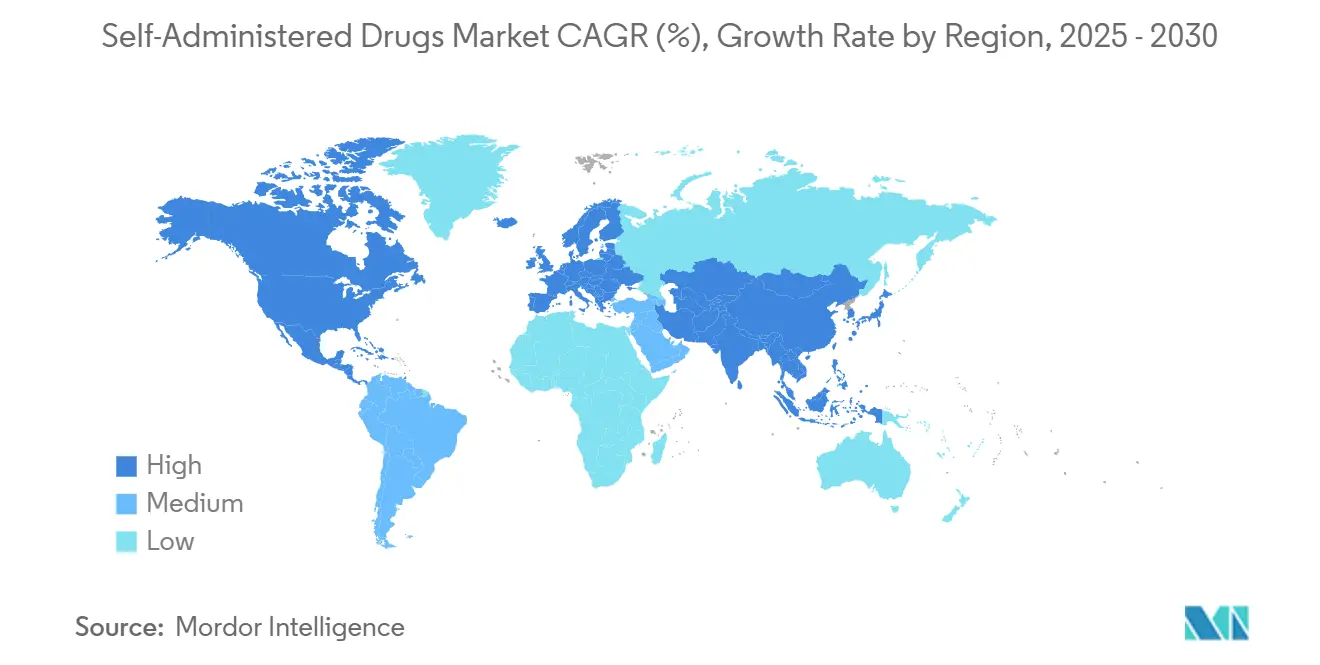
North America wielded a commanding 44.35% share of 2026 revenue, reflecting early adoption of connected devices and payer enthusiasm for at-home biologics. The United States leads in outcome-based reimbursement that ties payment to digitally verified adherence metrics. Canada is following suit, recently approving methotrexate pens for autoimmune cases to ease clinic bottlenecks. Across the region, value-based care contracts are accelerating the uptake of smart autoinjectors that furnish real-time dosing data.
Europe is expected to witness steady growth in the self-administered drugs market, supported by established outpatient treatment pathways, increasing adoption of home-based chronic disease management, and growing use of patient-friendly drug-delivery devices. The region's healthcare systems increasingly support treatment outside traditional clinical settings, encouraging the use of prefilled syringes, autoinjectors, inhalers, and other self-administration formats that can reduce the need for frequent healthcare-facility visits. Expansion of self-administered biologics and subcutaneous formulations for chronic and autoimmune diseases is also supporting market demand, alongside greater adoption of biosimilars and patient-centric delivery systems. However, Europe's comparatively mature pharmaceutical market and pricing pressure associated with reference-pricing policies and biosimilar competition are expected to moderate revenue growth relative to emerging markets. Consequently, Europe is projected to remain a major self-administered drugs market while gradually losing a small proportion of global share as Asia-Pacific expands more rapidly.
Asia-Pacific is expected to emerge as one of the fastest-growing markets for self-administered drugs, growing at a CAGR of 11.09% from 2027 to 2032, driven by expanding treatment of chronic diseases, improving healthcare access, increasing patient awareness, and growing adoption of home-based treatment. Rising utilization of biologics, biosimilars, insulin delivery devices, prefilled syringes, and autoinjectors is broadening the population able to manage long-term therapies outside healthcare facilities.
Competitive Landscape
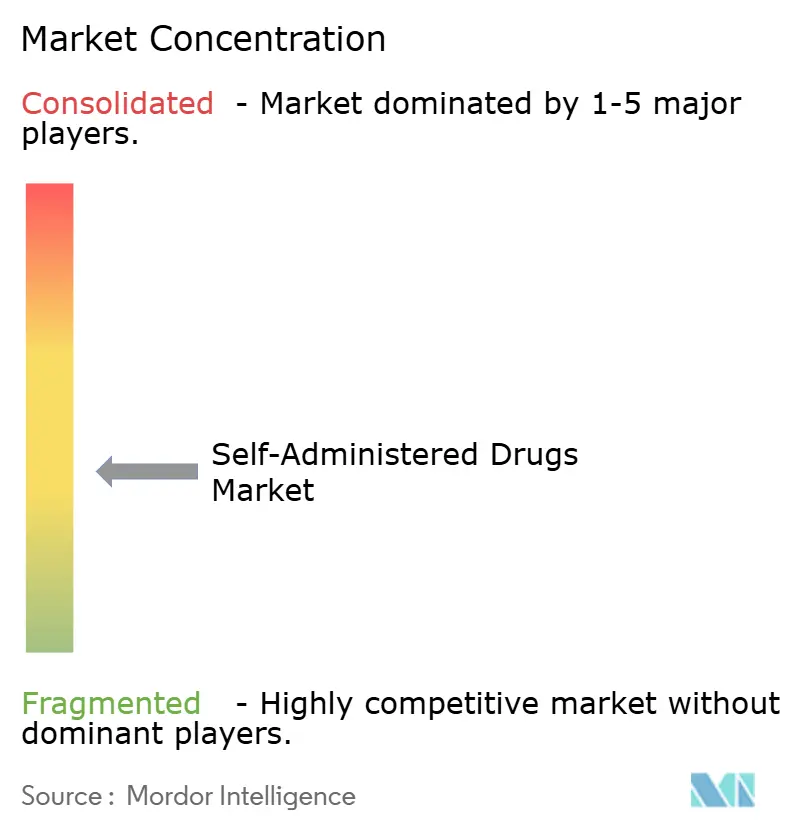
The self-administered therapeutics industry shows moderate concentration: the top five players collectively control nearly half of global revenue, leveraging end-to-end capabilities spanning molecule discovery, device engineering, and patient-support programming. Integrated portfolios allow incumbents to cross-subsidize innovations such as connected autoinjectors without relying solely on unit margins. BD’s alliance with Ypsomed on high-viscosity syringes typifies device-centric collaborations that unlock new biologic classes.
M&A activity is brisk. The 2025 Kindeva-Meridian merger created a contract-development powerhouse with 300+ autoinjector patents and expanded fill-finish capacity for inhalation and parenteral projects. Big Pharma’s verticalization runs parallel to biotech–device partnerships like Novartis and Lindy Biosciences, which are converting IV biologics to subcutaneous formats that fit at-home care models. Despite incumbent scale, white-space persists in pediatric-specific devices and latency-free digital dashboards.
Start-ups are capitalizing on cloud-native architectures and AI-driven dosing algorithms, often licensing molecules from mid-tier pharma to prove platform utility. Regional contenders in China and India are targeting price-sensitive segments with simplified mechanical pens. Data-governance expertise is emerging as a differentiator; manufacturers able to demonstrate GDPR-compliant data pipelining gain an edge in EU tenders. Overall, sustained device innovation and real-world-data fluency underpin competitive advantage across the Self-administered drugs market.
Self-Administered Drugs Industry Leaders
-
Novo Nordisk A/S
-
Eli Lilly & Co.
-
Sanofi
-
GlaxoSmithKline plc
-
Pfizer Inc.
- *Disclaimer: Major Players sorted in no particular order
Self-Administered Drugs Market Companies Covered in this Report
- Novo Nordisk
- Eli Lilly and Company
- Sanofi
- GlaxoSmithKline
- Pfizer
- Novartis
- AstraZeneca
- Johnson & Johnson (-Janssen)
- Amgen
- Roche
- Teva Pharmaceutical (Viatris)
- Boehringer Ingelheim
- CSL Behring
- Becton Dickinson & Co.
- Ypsomed
- Medtronic plc (Drug-Delivery)
- B. Braun
- Takeda Pharmaceuticals
- Merck
- Lupin
Recent Industry Developments in Self-Administered Drugs Market
- April 2026: AstraZeneca received the United States FDA approval for Saphnelo (anifrolumab-fnia) as a once-weekly, subcutaneous self-administered autoinjector for adults with systemic lupus erythematosus (SLE) receiving standard therapy. The approval was supported by the Phase III TULIP-SC trial, which demonstrated a statistically significant and clinically meaningful reduction in disease activity versus placebo. The development is particularly important to the self-administered drugs market because Saphnelo was previously available as an IV infusion, and the new Saphnelo Pen enables treatment outside an infusion setting, providing patients with greater flexibility in how and where treatment is administered.
- March 2025: Novartis invested USD 20 million with Lindy Biosciences to microglassify intravenous biologics into self-injected formulations.
- February 2025: Kindeva Drug Delivery and Meridian Medical Technologies merged, forming a global CDMO for combination products.
- December 2024: BD pledged USD 1.2 billion to expand pre-fillable syringe capacity, supporting temperature-sensitive therapeutics.
Global Self-Administered Drugs Market Report Scope
As per the scope of the report, self-administered drugs are medications that patients can safely take or administer independently outside formal clinical settings, without direct assistance from healthcare professionals.
The self-administered drugs market is segmented by route of administration, therapeutic area, device type, distribution channel, and geography. By route of administration, the market is segmented into oral, subcutaneous (self-injectables), intranasal, pulmonary/inhalation, transdermal, and other routes of administration (ocular, buccal, etc.). By therapeutic area, the market is segmented into diabetes care, anticoagulation, hormone & reproductive health, respiratory disorders, pain management & migraine, autoimmune & biologics, and other therapeutic areas. By device type, the market is segmented into prefilled syringes, autoinjectors & pen injectors, inhalers (MDI, DPI, soft-mist), transdermal patches, nasal sprays, oral solid dosage, and smart connected devices. By distribution channel, the market is segmented into retail pharmacies, hospital pharmacies, online pharmacies, and specialty pharmacies.
By geography, the market is segmented as North America, Europe, Asia-Pacific, the Middle East and Africa, and South America. The market report also covers the estimated market sizes and trends for 17 countries across major regions globally. The report offers the value (in USD) for the above segments.
| Oral |
| Subcutaneous (Self-injectables) |
| Intranasal |
| Pulmonary / Inhalation |
| Transdermal |
| Other Routes of Administration |
| Diabetes Care |
| Anticoagulation |
| Hormone & Reproductive Health |
| Respiratory Disorders |
| Pain Management & Migraine |
| Autoimmune & Biologics |
| Other Therapeutic Areas |
| Prefilled Syringes |
| Autoinjectors & Pen Injectors |
| Inhalers (MDI, DPI, Soft-mist) |
| Transdermal Patches |
| Nasal Sprays |
| Oral Solid Dosage |
| Smart Connected Devices |
| Retail Pharmacies |
| Hospital Pharmacies |
| Online Pharmacies |
| Specialty Pharmacies |
| North America | United States |
| Canada | |
| Mexico | |
| Europe | Germany |
| United Kingdom | |
| France | |
| Italy | |
| Spain | |
| Rest of Europe | |
| Asia Pacific | China |
| Japan | |
| India | |
| South Korea | |
| Australia | |
| Rest of Asia Pacific | |
| Middle East & Africa | GCC |
| South Africa | |
| Rest of Middle East & Africa | |
| South America | Brazil |
| Argentina | |
| Rest of South America |
| By Route of Administration | Oral | |
| Subcutaneous (Self-injectables) | ||
| Intranasal | ||
| Pulmonary / Inhalation | ||
| Transdermal | ||
| Other Routes of Administration | ||
| By Therapeutic Area | Diabetes Care | |
| Anticoagulation | ||
| Hormone & Reproductive Health | ||
| Respiratory Disorders | ||
| Pain Management & Migraine | ||
| Autoimmune & Biologics | ||
| Other Therapeutic Areas | ||
| By Device Type | Prefilled Syringes | |
| Autoinjectors & Pen Injectors | ||
| Inhalers (MDI, DPI, Soft-mist) | ||
| Transdermal Patches | ||
| Nasal Sprays | ||
| Oral Solid Dosage | ||
| Smart Connected Devices | ||
| By Distribution Channel | Retail Pharmacies | |
| Hospital Pharmacies | ||
| Online Pharmacies | ||
| Specialty Pharmacies | ||
| By Geography | North America | United States |
| Canada | ||
| Mexico | ||
| Europe | Germany | |
| United Kingdom | ||
| France | ||
| Italy | ||
| Spain | ||
| Rest of Europe | ||
| Asia Pacific | China | |
| Japan | ||
| India | ||
| South Korea | ||
| Australia | ||
| Rest of Asia Pacific | ||
| Middle East & Africa | GCC | |
| South Africa | ||
| Rest of Middle East & Africa | ||
| South America | Brazil | |
| Argentina | ||
| Rest of South America | ||
Key Questions Answered in the Report
What is the projected value of the Self-administered therapeutics market by 2032?
The market is expected to reach USD 198.27 billion in 2032 underpinned by an 8.13% CAGR.
Which region is expanding fastest in Self-administered therapeutics?
Asia-Pacific is forecast to compound above 11.09% annually, supported by policy reforms and growing middle-class demand.
Which therapeutic area currently generates the most revenue?
Diabetes care leads, accounting for 34.34% of 2026 revenue thanks to mature insulin delivery ecosystems.
Which device category is growing quickest?
Smart connected delivery systems, including sensor-enabled autoinjectors and inhalers, are on track for a 17.27% CAGR through 2032.
How are distribution channels shifting?
Retail pharmacies still dominate sales, but online pharmacies are expanding at a 12.48% CAGR as cold-chain home delivery matures.
What are the main barriers to broader adoption?
Needle-phobia, safety concerns with at-home dosing, cold-chain challenges in emerging markets, and data-privacy regulations temper uptake.