
Seed Processing Machinery Market Size and Share
Market Overview
| Study Period | 2021 - 2031 |
|---|---|
| Market Size (2026) | USD 4.80 Billion |
| Market Size (2031) | USD 6.87 Billion |
| Growth Rate (2026 - 2031) | 7.60 % |
| Fastest Growing Market | Asia-Pacific |
| Largest Market | North America |
| Market Concentration | Low |
Major Players *Disclaimer: Major Players sorted in no particular order Image © Mordor Intelligence. Reuse requires attribution under CC BY 4.0. | |
Seed Processing Machinery Market Analysis by Mordor Intelligence
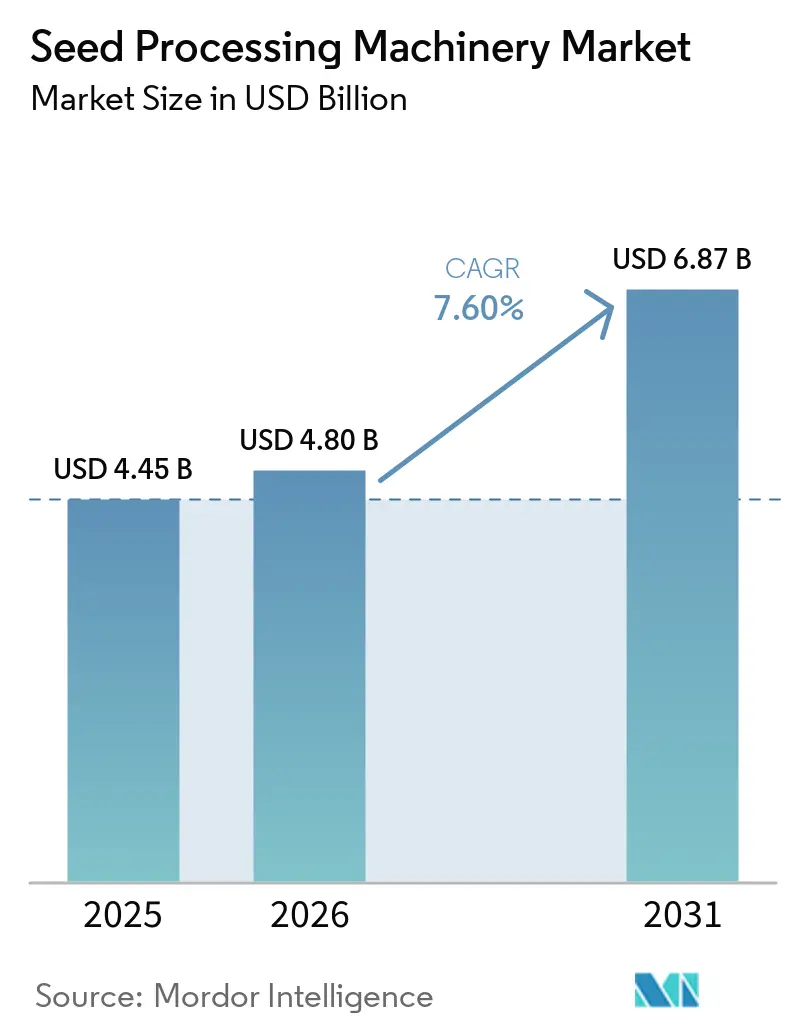
The seed processing machinery market size was valued at USD 4.45 billion in 2025 and is projected to grow from USD 4.80 billion in 2026 to USD 6.87 billion by 2031, registering a 7.6% CAGR from 2026 to 2031. The market is influenced by ongoing agricultural modernization, increased adoption of certified and treated seeds, and the growing use of automated processing lines in both developed and emerging agricultural economies. There is a noticeable shift from labor-intensive mechanical sorting to artificial intelligence-enabled optical inspection, particularly in areas where purity standards, export compliance, and lot traceability are critical. Additionally, regulatory changes concerning coating chemistry, especially in Europe, are driving upgrades in treaters, dryers, and other line components to accommodate new material requirements. The expansion of commercial seed multiplication hubs is generating demand for complete processing lines, while replacement investments remain robust in North America as processors transition to connected and digitally controlled systems. Consequently, the market is experiencing quality-driven investments in optical sorting, traceability, and automation, outpacing the overall growth rate indicated by aggregate figures.
Key Report Takeaways
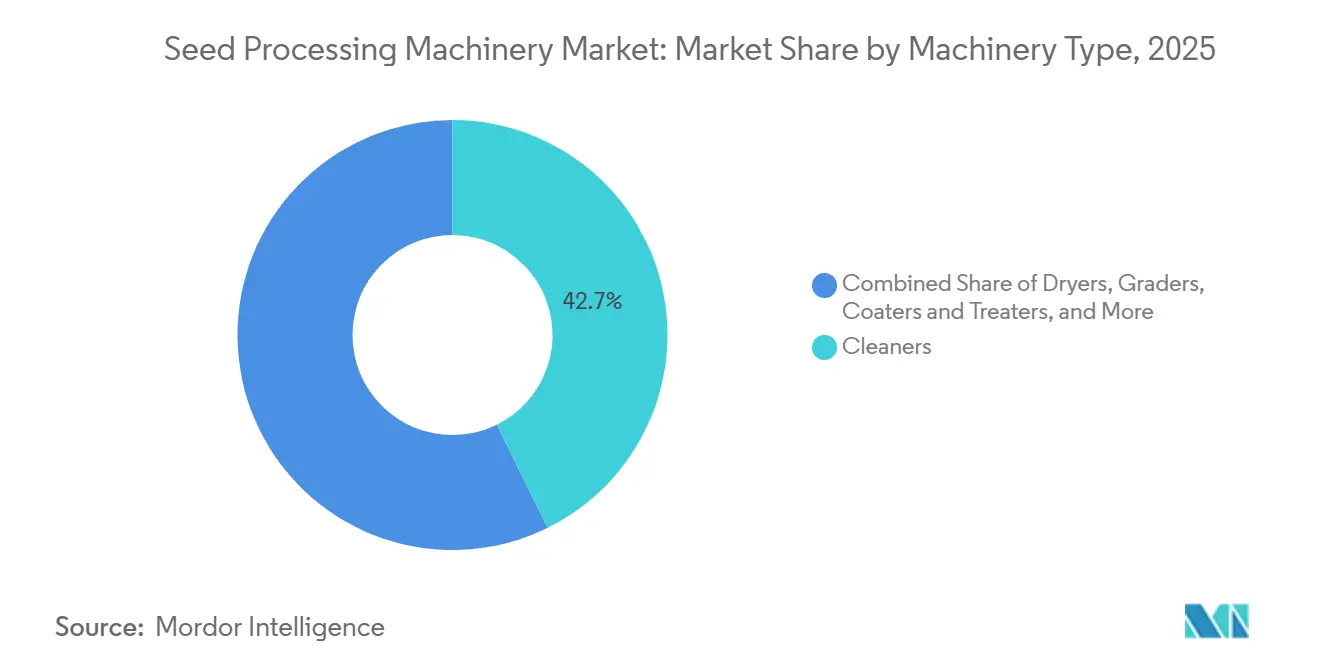
- By machinery type, the seed processing machinery market share for the cleaners segment accounted for the largest 42.7% in 2025, while the seed processing machinery market size for the optical sorters segment will advance to grow at the fastest 7.6% CAGR from 2026 to 2031.
- By operation mode, the seed processing machinery market share for the automatic systems accounted for the largest 70.6% in 2025, and the automatic systems market size will forecast to grow at the fastest 8.0% CAGR from 2026 to 2031.
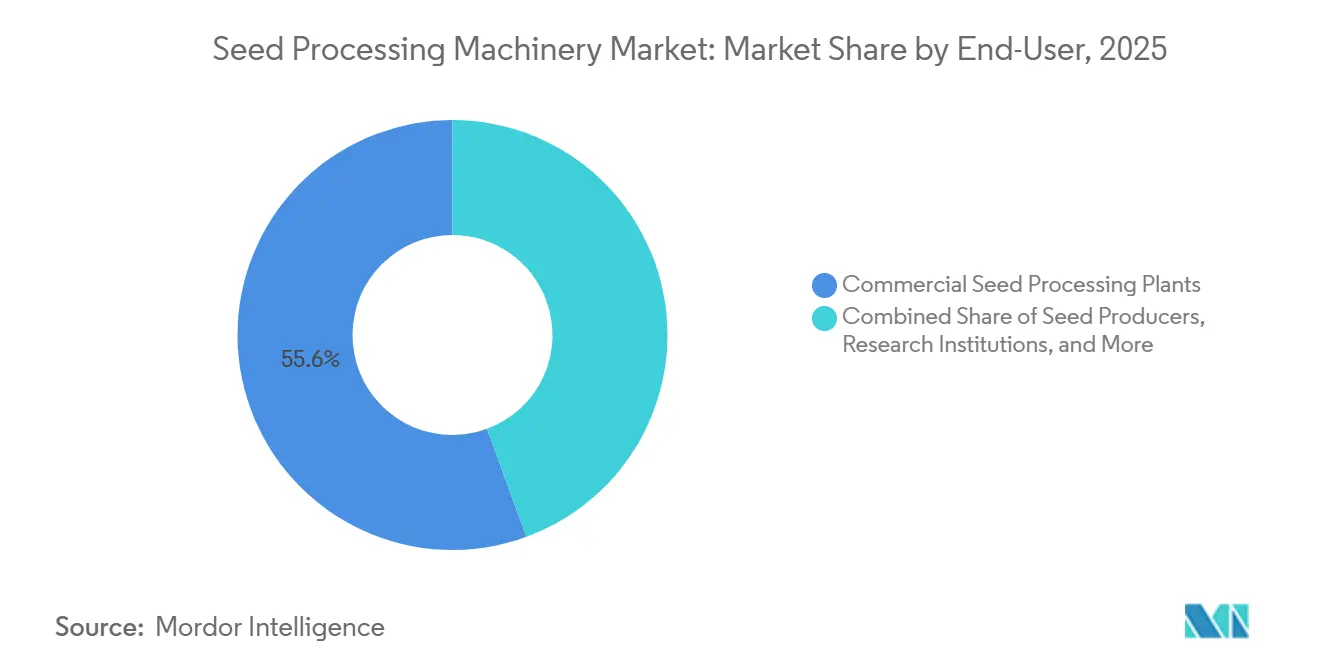
- By end-user, the seed processing machinery market share for the commercial seed processing plants accounted for the largest 55.6% in 2025, while the seed processing machinery market size for on-farm facilities will forecast to grow at the fastest 6.4% CAGR from 2026 to 2031.
- By geography, the seed processing machinery market share in North America held the largest 34.1% in 2025, while the seed processing machinery market size for Asia-Pacific will be projected to grow at the fastest 8.1% CAGR from 2026 to 2031.
Note: Market size and forecast figures in this report are generated using Mordor Intelligence’s proprietary estimation framework, updated with the latest available data and insights as of 2026.
Global Seed Processing Machinery Market Trends and Insights
Drivers Impact Analysis*
| Driver | (~) % Impact on CAGR Forecast | Geographic Relevance | Impact Timeline |
|---|---|---|---|
| Automation of optical sorting enhances efficiency and reduces labor costs | +2.0% | Global | Short term (≤ 2 years) |
| Increasing demand for treated and value-added seeds | +1.8% | Global, strongest in North America and Europe | Medium term (2-4 years) |
| Government subsidies boost post-harvest mechanization efforts | +1.4% | Asia-Pacific core, spillover to South America and Africa | Medium term (2-4 years) |
| Growth in commercial seed multiplication centers | +0.9% | Asia-Pacific and North America | Long term (≥ 4 years) |
| Microplastic-free coating transition drives treater and dryer retrofits | +0.7% | Europe primarily and with global spillover | Medium term (2-4 years) |
| Digital traceability and certification workflows drive inline sampling and labeling upgrades | +0.5% | Global | Medium term (2-4 years) |
| Source: Mordor Intelligence | |||
Automation of Optical Sorting Enhances Efficiency and Reduces Labor Costs
Automation is enhancing performance standards in the seed processing machinery market by minimizing manual intervention in sorting and defect removal processes. Artificial intelligence-enabled optical systems can identify variations in color, texture, and shape at the single-seed level, enabling processors to improve purity without compromising line speed. The launch of Bühler’s SORTEX AI700 in 2025 exemplifies the transition toward deep-learning sorting systems aimed at improving inspection quality in seed and grain applications[1]Source: Bühler Group, “SORTEX AI700 Launches Next Generation Optical Sorting Technology,” buhlergroup.com. As the market shifts from multiple mechanical stages to fewer intelligent sorting units, each line achieves higher productivity but also faces increased vulnerability to unplanned stoppages. This development underscores the growing importance of predictive maintenance, remote diagnostics, and robust service contracts in commercial procurement within the seed processing machinery market.
Increasing Demand for Treated and Value-Added Seeds
The seed processing machinery market is experiencing growth driven by advancements beyond basic fungicide treatments, including bioactive inoculants, micronutrient coatings, and specialized polymer films. These high-value seed products necessitate precise coating consistency, improved drying control, and enhanced lot segregation, as inconsistencies in application quality can compromise the performance of an entire certified batch. In October 2024, India’s National Mission on Edible Oils and Oilseeds allocated INR 10,103 crore (USD 1.19 billion) and established 65 new seed hubs, generating direct downstream demand for equipment used in treating, coating, and packaging seeds[2]Source: Government of India, “Cabinet Approves PM-Rashtriya Krishi Vikas Yojana and Krishonnati Yojana,” pib.gov.in. Additionally, the market is witnessing increased demand for ancillary equipment, such as cleaners, packagers, and labeling systems, to maintain lot integrity throughout the processing chain. The rise of biological treatments has further driven equipment demand, as processors require low-shear and temperature-controlled coating and drying systems to ensure the viability of microorganisms.
Government Subsidies Boost Post-Harvest Mechanization Efforts
Public policies are promoting the adoption of seed processing machinery, especially in regions where private financing has not enabled timely upgrades to commercial-grade equipment. In February 2025, the State Council Information Office of China expanded its agricultural machinery subsidy program to include color sorters and grain dryers as eligible equipment categories, while also raising the maximum subsidy thresholds for specific machinery types. Similarly, in the Philippines, 2024 guidelines requiring certification from the Agricultural Machinery Testing and Evaluation Center for procured machinery have reinforced formal quality standards. This has benefited established suppliers with proven equipment performance and supported broader mechanization adoption within the seed processing machinery market.
Growth in Commercial Seed Multiplication Centers
The seed processing machinery market is experiencing growth due to the establishment of commercial seed multiplication hubs, which require comprehensive plant engineering rather than minor upgrades to existing systems. In April 2026, BASF SE announced an investment of EUR 40 million (USD 44.4 million) to expand and modernize its vegetable seed processing facility in Nunhem, Netherlands, increasing the site by 6,000 square meters. Modern post-harvest machinery enhances handling efficiency and adds value compared to manual farming methods, particularly in regions with high post-harvest losses and limited mechanization. The market benefits not only from initial equipment sales but also from ongoing demand for services, consumables, and upgrades within the production catchment areas.
Restraints Impact Analysis*
| Restraint | (~) % Impact on CAGR Forecast | Geographic Relevance | Impact Timeline |
|---|---|---|---|
| High up-front cost of smart machinery | -2.2% | Developing regions, especially Asia-Pacific, Africa, and South America | Short term (≤ 2 years) |
| Supply chain volatility for precision components | -1.1% | Global | Short term (≤ 2 years) |
| Operator and service-skill bottlenecks limit uptime | -0.7% | Africa, South America, and parts of Asia-Pacific | Medium term (2-4 years) |
| Data ownership and cyber security concerns around connected equipment | -0.4% | Europe and North America | Medium term (2-4 years) |
| Source: Mordor Intelligence | |||
High Up-Front Cost of Smart Machinery
High initial costs remain a significant barrier to the adoption of advanced seed processing machinery. Buyers often compare the costs of advanced optical sorting systems with conventional mechanical equipment, finding optical sorters to be 40% to 60% more expensive. Additionally, expenses related to automation controls, connectivity infrastructure, and supervisory control and data acquisition systems further increase the overall project investment. These financial challenges are particularly pronounced in regions with limited access to agricultural financing and long equipment replacement cycles. Consequently, the high capital investment required continues to hinder the adoption of advanced seed processing machinery by cooperatives, farm-level processors, and small to medium-scale commercial operators.
Supply Chain Volatility for Precision Components
The seed processing machinery market relies on sensors, control modules, image-processing hardware, and precision actuators, which are sourced from supply chains vulnerable to geopolitical risks and concentrated manufacturing hubs. In this market, delays in custom electronic components can significantly impact operations, potentially delaying the commissioning of entire processing lines. Extended lead times for specialized components may compel buyers to opt for lower-specification equipment to maintain project timelines. Additionally, after-sales service becomes more challenging in remote markets due to the unavailability of replacement parts locally, leading to higher total ownership costs over the system's lifespan.
*Our forecasts treat driver/restraint impacts as directional, not additive. The impact forecasts reflect baseline growth, mix effects, and variable interactions.
Segment Analysis
By Machinery Type: Cleaners Lead As Optical Sorters Define The Next Performance Tier
The seed processing machinery market share for the cleaners segment accounted for the largest 42.7% in 2025. Cleaners continue to dominate as primary seed cleaning is essential before subsequent operations, such as grading, treatment, drying, coating, and packaging, can commence. Air-screen cleaners are widely preferred due to their scalability, low maintenance requirements, and compatibility with various crop types and downstream equipment systems. Additionally, dryers and treatment systems are gaining significance in regions addressing post-harvest moisture management challenges and the increasing adoption of biological seed treatments. The cleaners segment benefits from sustained demand across commercial seed plants, grain handlers, and integrated seed-processing facilities managing large multi-crop processing workflows globally.
The seed processing machinery market for the optical sorters segment will advance to grow at the fastest CAGR of 7.6% from 2026 to 2031. This growth is driven by rising demand for export-grade seed purity, digital quality control, and automated defect detection technologies. Optical sorters are increasingly utilized as artificial intelligence-enabled imaging systems enhance processing precision and minimize contamination risks in high-value seed operations. Manufacturers are also incorporating compliance monitoring, traceability, and data-management features into sorting platforms to meet certification requirements. Despite the rapid growth of advanced sorting systems, cleaners remain the dominant equipment category, as primary seed-cleaning processes continue to serve as the operational foundation for commercial seed-processing workflows globally.



By Operation Mode: Automation Consolidates Its Market Position
The seed processing machinery market share for the automatic systems accounted for the largest 70.6% in 2025. Commercial seed processors increasingly prefer automatic systems due to their ability to improve throughput consistency, reduce labor dependency, and support continuous-flow operations across multi-crop processing facilities. These systems also enhance process monitoring, predictive maintenance, and quality standardization in high-volume commercial environments. Large processing plants prioritize digitally controlled systems as they improve operational efficiency and minimize downtime during peak seasonal activity. Additionally, the segment benefits from the growing adoption of integrated processing lines that combine cleaning, grading, sorting, treatment, and packaging functions into centralized automated seed-processing operations globally.
The seed processing machinery market size for the automatic systems segment will forecast at the fastest 8.0% CAGR from 2026 to 2031. This growth is driven by increasing modernization efforts among midsized processors and the expanding adoption of automation technologies in emerging agricultural economies. Integrated automatic systems are gaining traction as they provide greater processing consistency compared to isolated equipment upgrades. Meanwhile, semi-automatic systems remain relevant for smaller commercial facilities, research institutions, and farm-based operations where manual oversight is still essential. Many suppliers now offer upgrade-ready configurations, enabling gradual transitions toward full automation. This staged modernization approach continues to support equipment demand, addressing both current operational needs and future automation investment cycles globally.
By End-User: Commercial Plants Anchor Demand While On-Farm Facilities Accelerate
The seed processing machinery market share for the commercial seed processing plants accounted for the largest 55.6% in 2025. This dominance is attributed to higher processing volumes, greater capital investment capacity, and widespread adoption of integrated seed-cleaning, grading, and optical-sorting systems. These facilities are increasingly investing in advanced treatment and process-control technologies to support certified seed programs and large-scale crop multiplication. Additionally, commercial plants often implement complete processing lines rather than standalone machinery, enhancing overall project value and equipment integration. A growing focus on seed traceability, export compliance, and product consistency continues to drive significant investment in commercial seed-processing infrastructure across major agricultural production regions worldwide.
The seed processing machinery market size for on-farm facilities will be projected to grow at the fastest 6.4% CAGR from 2026 to 2031. This growth is driven by increasing investments in localized processing, identity-preserved seed production, and compact modular processing systems. Smaller operators and growers are adopting flexible processing units to enhance seed quality control and reduce reliance on centralized commercial facilities. Research institutions are also contributing to demand for smaller precision-processing systems used in breeding and validation programs. Compact processing technologies are gaining popularity due to their operational flexibility and reduced infrastructure requirements. This trend is fueling demand for modular cleaning, sorting, and treatment equipment designed for decentralized agricultural processing and specialized seed-handling applications globally.
Geography Analysis
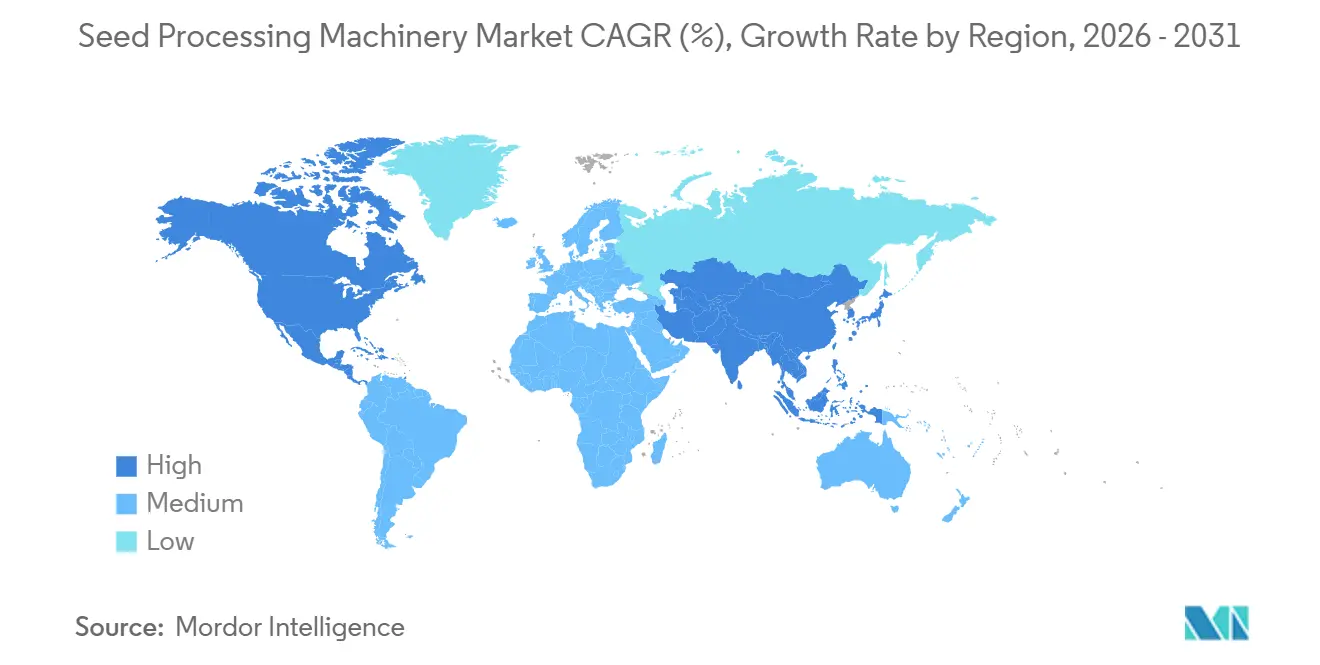
The sedd processing machinery market share for North America accounted for the largest 34.1% in 2025. The region benefits from a well-established commercial seed industry, widespread adoption of precision seed-treatment technologies, and extensive row-crop production systems. The large-scale cultivation of corn and soybeans drives strong demand for advanced seed-cleaning, grading, and optical-sorting systems. Commercial seed companies in the United States and Canada are increasingly investing in integrated processing infrastructure to enhance traceability, meet purity standards, and ensure export compliance. Factors such as strong replacement demand, digital process integration, and established seed-certification systems continue to reinforce North America’s leading position in commercial seed-processing equipment and infrastructure development globally.
The sedd processing machinery market size for Asia-Pacific is projected to grow at the fastest 8.1% CAGR from 2026 to 2031. This growth is driven by the expansion of certified seeds, government-supported agricultural modernization initiatives, and increasing investments in commercial processing infrastructure across China, India, and Southeast Asia. Public funding for seed hubs, processing units, and grain-handling infrastructure is accelerating the adoption of modern cleaning, drying, and sorting systems throughout the region. Additionally, the rise of commercial agriculture and growing demand for high-quality certified seeds are fostering the modernization of processing operations. More developed agricultural economies, such as Japan, Australia, and South Korea, are focusing on optical sorting, digital compliance systems, and automated processing technologies within their commercial seed-production networks.
South America remains a significant growth region due to the extensive cereal and oilseed seed multiplication activities in Brazil and Argentina, which are closely tied to export-oriented agriculture. According to the Food and Agriculture Organization of the United Nations, Ethiopia’s Postharvest Management Strategy 2024-2030 has allocated ETB 14.3 billion (USD 266 million) for post-harvest mechanization and processing technology deployment[3]Source: Food and Agriculture Organization of the United Nations, “Postharvest Management Strategy of Ethiopia (PHMSE),” fao.org. This initiative supports the broader modernization of seed and grain infrastructure. In the Middle East and Africa, there is a growing focus on food security, controlled-environment agriculture, and improvements in post-harvest efficiency. These developments are gradually driving demand for modern seed-cleaning, sorting, and handling technologies in developing agricultural economies.

Competitive Landscape
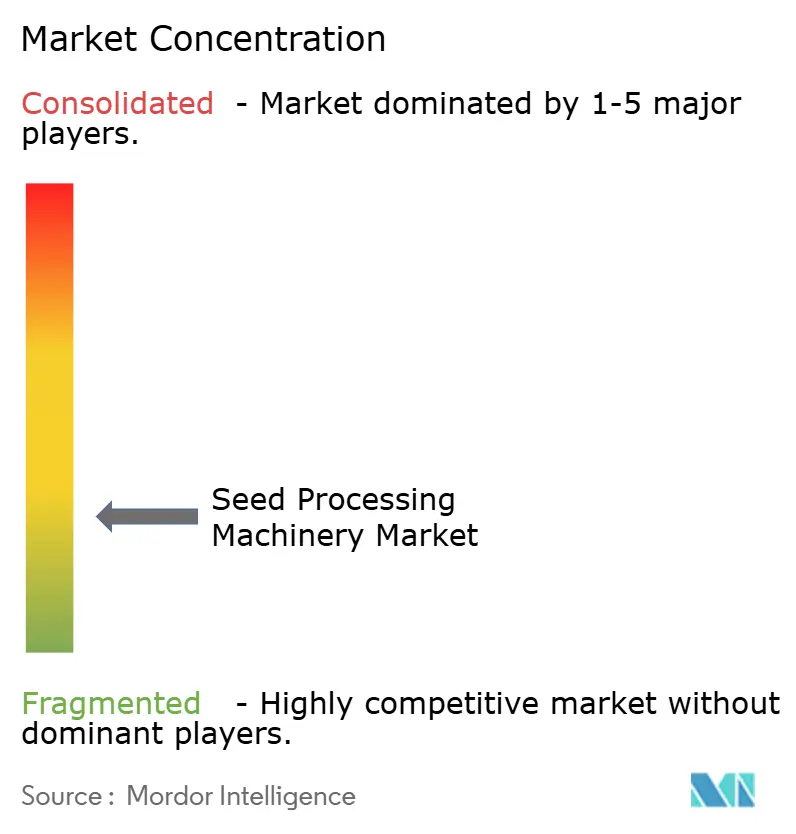
The market is moderately fragmented at the premium technology level, with Bühler AG, Cimbria A/S (Grain & Protein Technologies), PETKUS Technologie GmbH, Satake Corporation, and Ag Growth International Inc., holding strong positions in optical sorting, plant engineering, and integrated processing systems. Regional suppliers in India, China, and South America remain competitive in lower-capacity and cost-sensitive equipment categories. Competitive differentiation is increasingly driven by software integration, traceability support, and service responsiveness, rather than solely by mechanical performance. This dynamic fosters intense competition in entry-level equipment while maintaining concentration in large integrated processing projects and advanced optical-sorting technologies.
Manufacturers are focusing on integrated processing solutions that combine automation, optical sorting, traceability, and compliance-ready digital systems. Strategic investments are directed toward large-scale processing facilities requiring advanced engineering and long-term service support. Companies are enhancing software-enabled quality management capabilities to streamline certification workflows and enable remote diagnostics. Modular automation upgrades and retrofit-ready equipment are gaining importance as processors prioritize gradual modernization over complete system replacements. Product development strategies are increasingly centered on fully connected processing ecosystems rather than standalone machinery, fostering long-term supplier relationships and addressing the growing demand for operational efficiency, process transparency, and digital workflow integration in global commercial seed-processing environments.
Competitive opportunities are strongest in retrofit automation, modular processing systems, and digital traceability integration for smaller commercial operators. Ag Growth International Inc. reported a consolidated order book of USD 725 million as of March 31, 2025, driven by robust commercial demand in Brazil and the Europe, Middle East, and Africa region. Smaller manufacturers remain competitive by offering localized service support and lower-capital equipment solutions. The increasing connectivity between processing machinery and certification systems is also driving demand for cybersecurity, interoperability, and remote monitoring capabilities within modern commercial seed-processing infrastructure.
Seed Processing Machinery Industry Leaders
Bühler AG
Cimbria A/S (Grain & Protein Technologies)
PETKUS Technologie GmbH
Satake Corporation
Ag Growth International Inc.
- *Disclaimer: Major Players sorted in no particular order

Recent Industry Developments
- December 2025: Cimbria A/S (Grain & Protein Technologies), in partnership with its exclusive United States distributor, Bratney Companies, completed a comprehensive processing line redesign for Richardson Seeds. This project replaced multiple incremental upgrades with a fully integrated system, incorporating the Cimbria SEA TR color sorter, Delta air and screen cleaner, and Heid gravity tables.
- May 2025: Bühler AG introduced the SORTEX AI700 optical sorter, incorporating deep-learning artificial intelligence technology to enhance seed and grain purity, traceability, and sorting efficiency in processing facilities.
- December 2024: PETKUS Technologie GmbH introduced a modular seed processing line at EUROTIER 2024. The system is designed for multi-crop flexibility and scalability, enabling processing facilities to adjust workflows without the need to replace fixed-line mechanical infrastructure.


Global Seed Processing Machinery Market Report Scope
Seed processing machinery encompasses equipment used in agriculture to clean, sort, grade, dry, treat, and package seeds, improving their quality and viability for planting. These machines play a critical role in removing impurities, ensuring uniformity, and safeguarding seeds from pests and diseases. The seed processing machinery market report is segmented by machinery type (pre-cleaners, cleaners, dryers, graders, coaters and treaters, separators and destoners, polishers, optical sorters, seed packagers, and other specialized equipment), by operation mode (automatic and semi-automatic), by end-user (commercial seed processing plants, seed producers, research institutions, on-farm facilities, and grain handling facilities), and by geography (North America, Europe, Asia-Pacific, South America, Middle East, and Africa). The market forecasts are provided in terms of value (USD).
| Pre-cleaners |
| Cleaners |
| Dryers |
| Graders |
| Coaters and Treaters |
| Separators and Destoners |
| Polishers |
| Optical Sorters |
| Seed Packagers |
| Other Specialized Equipment |
| Automatic |
| Semi-Automatic |
| Commercial Seed Processing Plants |
| Seed Producers |
| Research Institutions |
| On-Farm Facilities |
| Grain Handling Facilities |
| North America | United States |
| Canada | |
| Mexico | |
| Rest of North America | |
| Europe | Germany |
| France | |
| Italy | |
| Spain | |
| United Kingdom | |
| Russia | |
| Rest of Europe | |
| Asia-Pacific | China |
| India | |
| Japan | |
| Australia | |
| South Korea | |
| Rest of Asia-Pacific | |
| South America | Brazil |
| Argentina | |
| Rest of South America | |
| Middle East | Saudi Arabia |
| United Arab Emirates | |
| Turkey | |
| Rest of Middle East | |
| Africa | South Africa |
| Egypt | |
| Rest of Africa |
| By Machinery Type | Pre-cleaners | |
| Cleaners | ||
| Dryers | ||
| Graders | ||
| Coaters and Treaters | ||
| Separators and Destoners | ||
| Polishers | ||
| Optical Sorters | ||
| Seed Packagers | ||
| Other Specialized Equipment | ||
| By Operation Mode | Automatic | |
| Semi-Automatic | ||
| By End-User | Commercial Seed Processing Plants | |
| Seed Producers | ||
| Research Institutions | ||
| On-Farm Facilities | ||
| Grain Handling Facilities | ||
| By Geography | North America | United States |
| Canada | ||
| Mexico | ||
| Rest of North America | ||
| Europe | Germany | |
| France | ||
| Italy | ||
| Spain | ||
| United Kingdom | ||
| Russia | ||
| Rest of Europe | ||
| Asia-Pacific | China | |
| India | ||
| Japan | ||
| Australia | ||
| South Korea | ||
| Rest of Asia-Pacific | ||
| South America | Brazil | |
| Argentina | ||
| Rest of South America | ||
| Middle East | Saudi Arabia | |
| United Arab Emirates | ||
| Turkey | ||
| Rest of Middle East | ||
| Africa | South Africa | |
| Egypt | ||
| Rest of Africa | ||


Key Questions Answered in the Report
What is driving growth in seed processing equipment demand through 2031?
Growth is being supported by automation, wider use of treated and certified seeds, and investment in commercial seed multiplication hubs and it is projected to be at USD 6.87 billion by 2031.
Which machinery type leads revenue in 2025?
Cleaners led with the largest 42.7% share in 2025 because they are used across nearly every seed workflow before grading, treating, drying, and packaging.
Why is Asia-Pacific growing faster than other regions?
Asia-Pacific is forecast to grow at the fastest 8.1% CAGR from 2026 to 2031 due to machinery subsidies in China, seed hub development in India, and the expansion of formal certified seed systems across the region.
What is limiting adoption in developing markets?
High upfront costs for smart machinery remain the main barrier. Optical and connected systems can cost 40% to 60% more than mechanical alternatives, and financing access is still limited in many rural markets.
Page last updated on:


 Your data is secure and never sold or shared.


