
Rice Milling Machinery Market Size and Share
Market Overview
| Study Period | 2021 - 2031 |
|---|---|
| Market Size (2026) | USD 1.27 Billion |
| Market Size (2031) | USD 1.72 Billion |
| Growth Rate (2026 - 2031) | 6.21 % |
| Fastest Growing Market | Middle East |
| Largest Market | Asia Pacific |
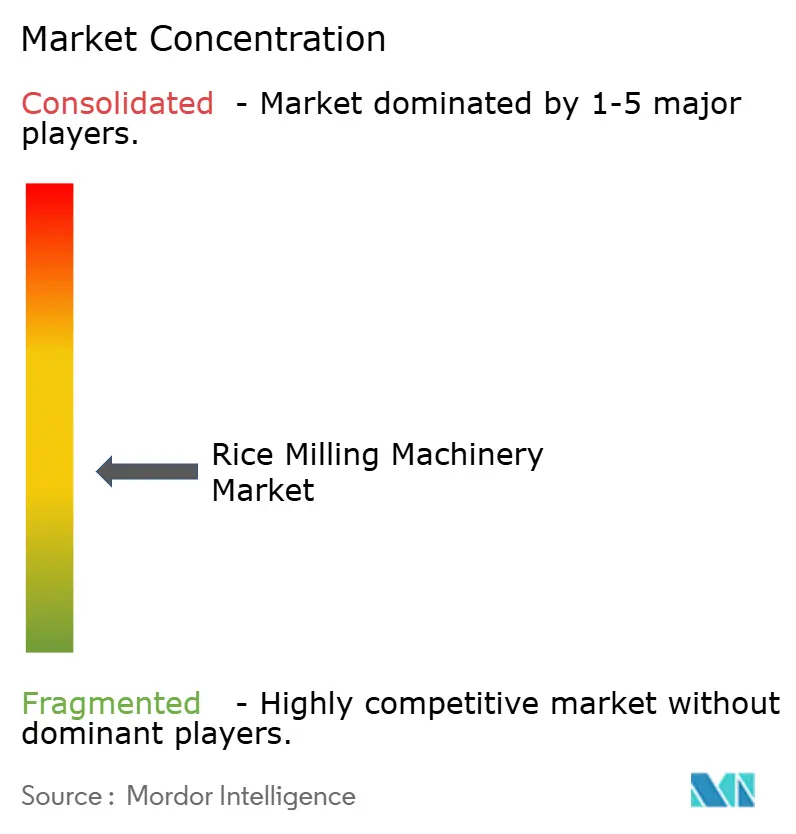
| Market Concentration | Medium |
Major Players *Disclaimer: Major Players sorted in no particular order Image © Mordor Intelligence. Reuse requires attribution under CC BY 4.0. | |
Rice Milling Machinery Market Analysis by Mordor Intelligence
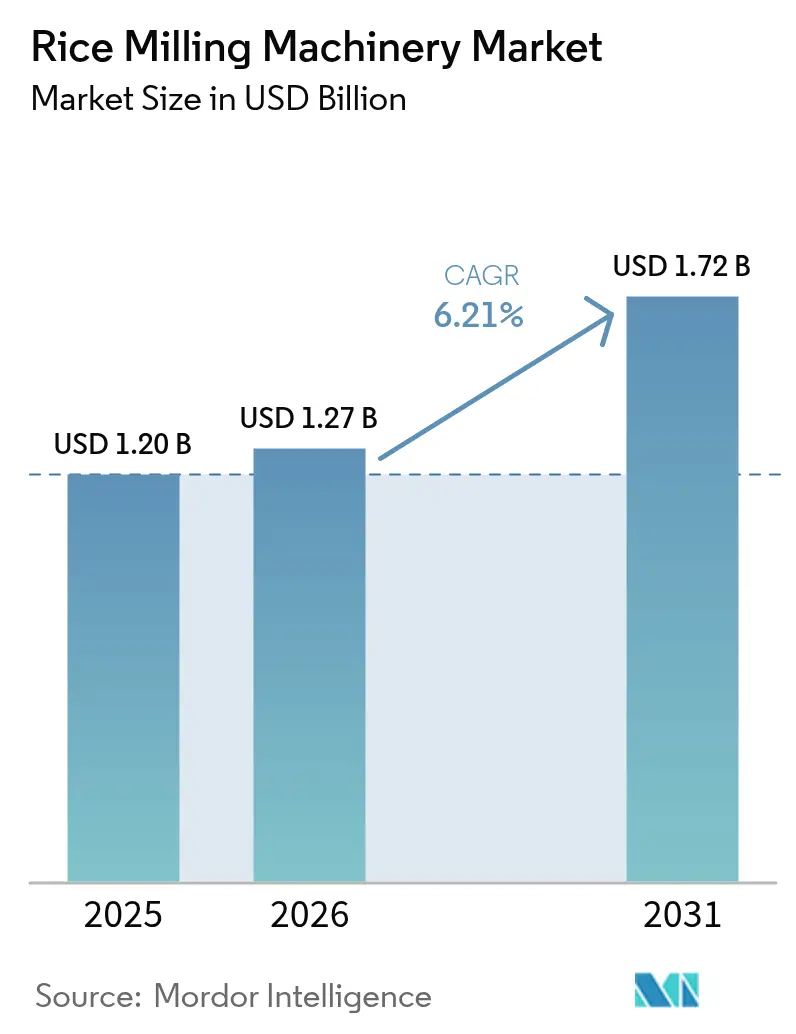
The rice milling machinery market size is expected to grow from USD 1.20 billion in 2025 to USD 1.27 billion in 2026 and is forecast to reach USD 1.72 billion by 2031 at 6.21% CAGR over 2026-2031. Sustained growth stems from rising global rice consumption, government-backed mechanization schemes, and rapid technology upgrades that streamline processing efficiency. Asia-Pacific remains the demand center as India, China, and Southeast Asian economies scale post-harvest infrastructure, while equipment replacement cycles in North America and Europe pivot on energy cuts and automation gains. Intensifying export competition is spurring processors to adopt high-precision grading and whitening systems that improve head-rice recovery and unlock premium margins. Parallel digital retrofits and pay-per-use business models lower entry barriers for small and mid-size mills, and advances in optical sorting and predictive maintenance are narrowing life-cycle costs, broadening adoption across emerging markets.
Key Report Takeaways
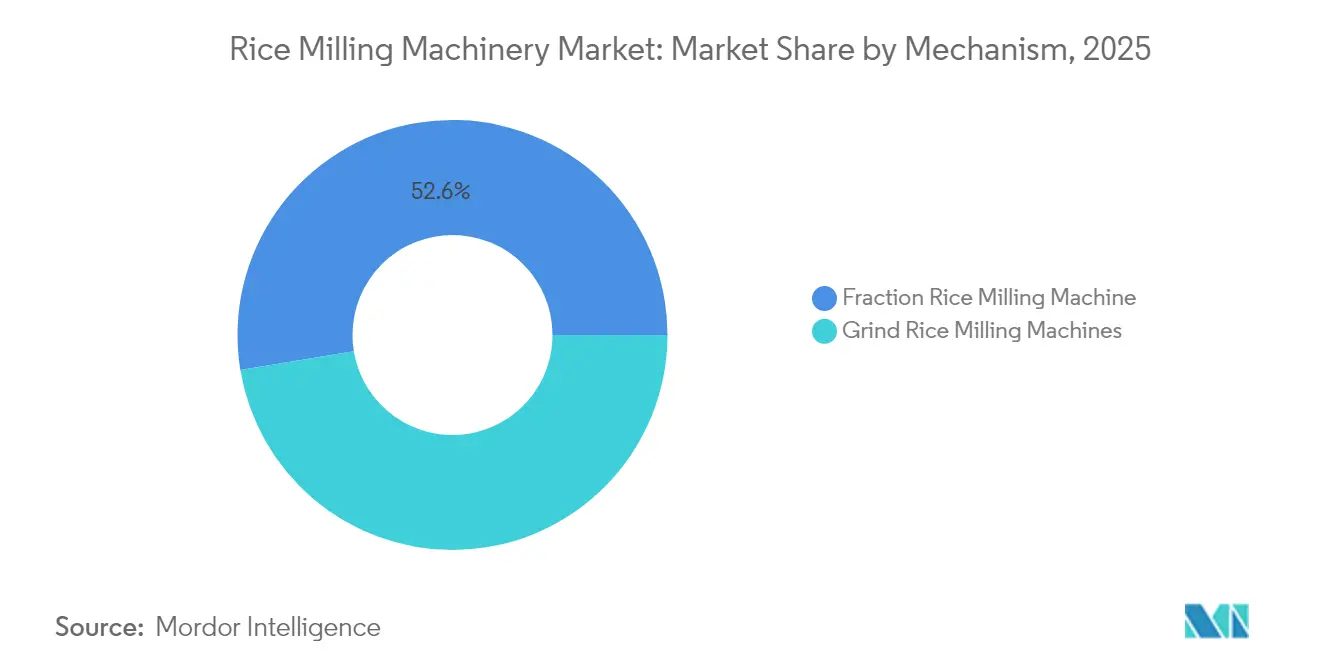
- By mechanism, fraction rice milling machines led with 52.60% of the rice milling machinery market share in 2025, grind rice milling machines are projected to record the fastest CAGR at 7.54% from 2026-2031.
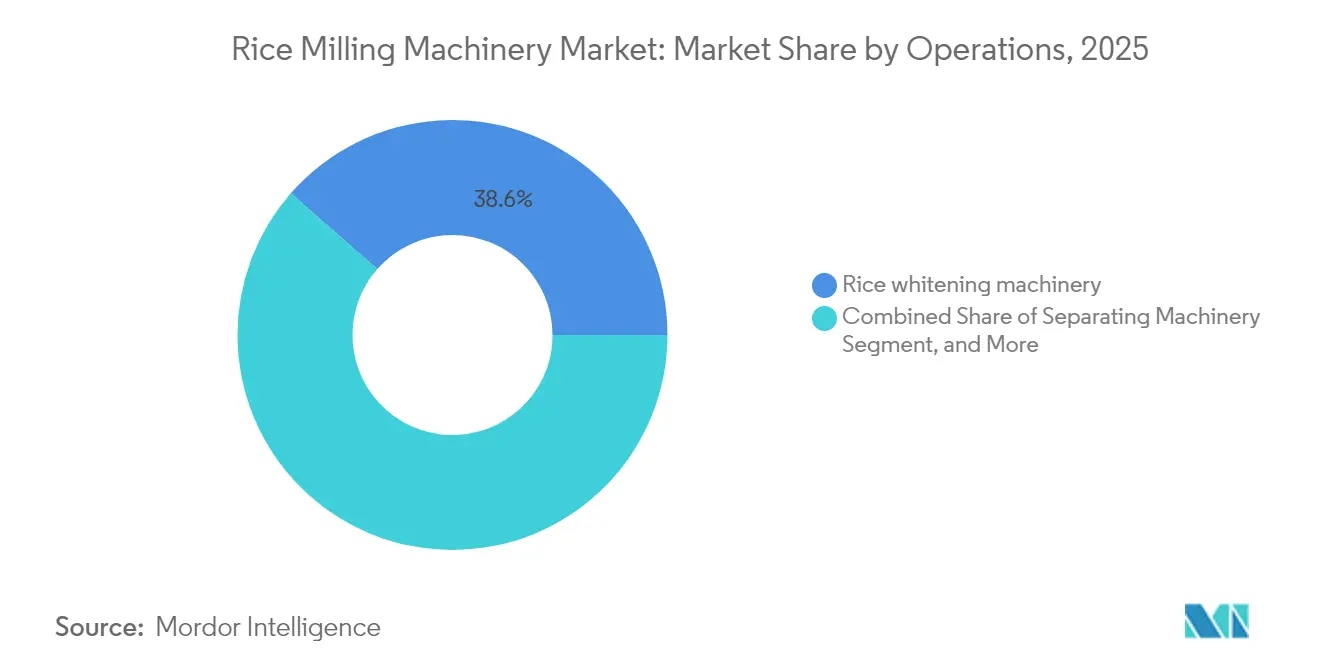
- By operations, rice whitening machinery held 38.55% of the rice milling machinery market size in 2025, grading machinery is positioned to post the highest segment CAGR at 9.04% through 2031.
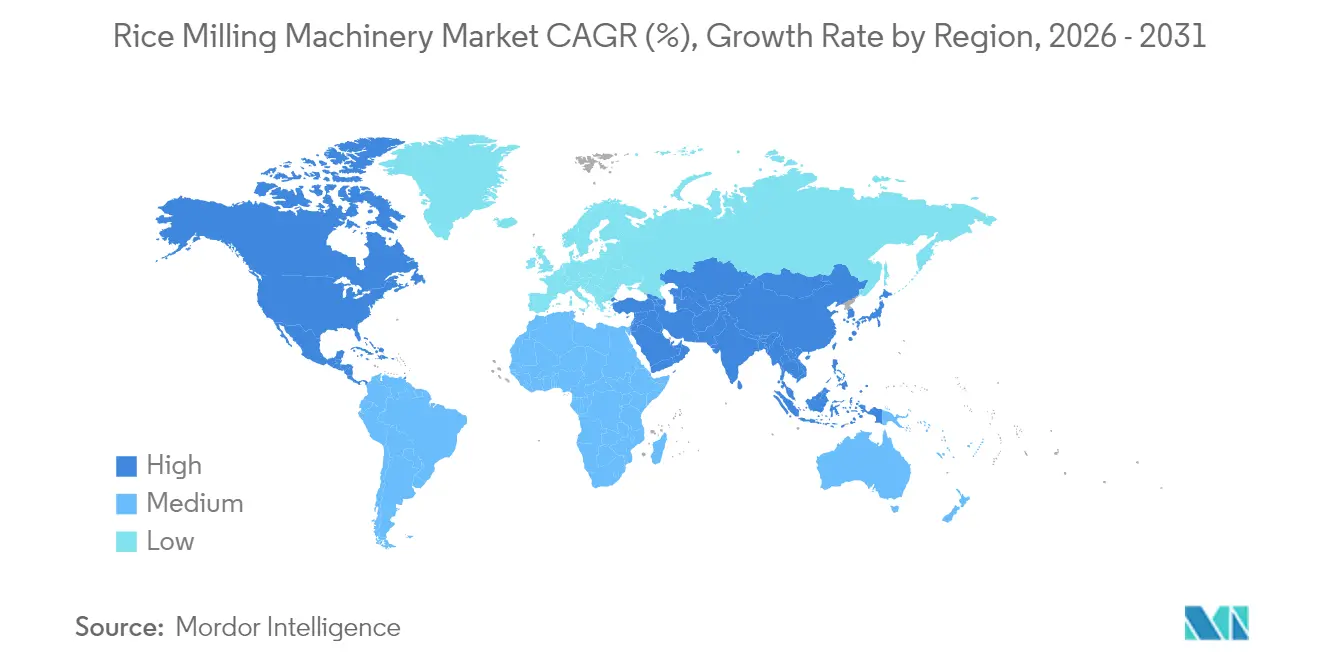
- By geography, Asia-Pacific captured 71.35% of the rice milling machinery market size in 2025. The Middle East is anticipated to expand at a market-leading 7.55% CAGR to 2031.
Note: Market size and forecast figures in this report are generated using Mordor Intelligence’s proprietary estimation framework, updated with the latest available data and insights as of 2026.
Market Trends and Insights
Drivers Impact Analysis of Rice Milling Machinery Market*
| Driver | (~) % Impact on CAGR Forecast | Geographic Relevance | Impact Timeline |
|---|---|---|---|
| Rising production and area under rice cultivation | +1.8% | Asia-Pacific core, spill-over to Africa and South America | Long term (≥ 4 years) |
| Growing export demand for milled rice | +1.2% | Global, with a concentration in Thailand, Vietnam, and India | Medium term (2-4 years) |
| Increasing technology advancements in rice mills | +1.5% | Global, early adoption in developed markets | Medium term (2-4 years) |
| Government mechanization subsidies | +0.9% | India, China, Southeast Asia, and selective African markets | Short term (≤ 2 years) |
| Digital retro-fits for SME mills cut energy use | +0.6% | Global, with emphasis on energy-constrained regions | Medium term (2-4 years) |
| Pay-as-you-mill business models improve access | +0.4% | Emerging markets in Asia-Pacific, Africa, South America | Long term (≥ 4 years) |
| Source: Mordor Intelligence | |||
Rising Production and Area Under Rice Cultivation
Expanded planting areas in India, Vietnam, and Nigeria are boosting global paddy output, and each hectare generates 4-6 metric tons of grain that requires immediate milling capacity. Sub-Saharan African irrigation projects and the adoption of improved seeds underscore the long-term need for automated plants that can handle seasonal surges without compromising quality. Vietnam’s export-oriented processors, exemplified by Olam’s 16-24 metric tons per hour facility, demonstrate how upstream production gains translate into higher capital expenditures on modern lines [1]. The push toward self-sufficiency multiplies demand for scalable cleaning and whitening units that can be expanded as acreage rises. Automated conveying, husking, and polishing modules eliminate labor bottlenecks, enabling producers to capitalize on harvest peaks quickly. Continuous crop growth, therefore, locks in a structural requirement for larger, more efficient rice milling machinery market installations.
Growing Export Demand for Milled Rice
Premium importers insist on head-rice recovery above 70%, catalyzing investments in optical sorters, color cameras, and multi-wavelength Near-Infrared (NIR) detectors that meet the stringent grades demanded by European and Middle Eastern buyers [2]. Thailand and Vietnam remain supply pivots but face new challenges from Nigeria and Brazil, which are upgrading lines to capture fortification premiums that can top USD 200 per metric ton over rough rice. Equipment capable of blending micronutrient premixes uniformly is now a must-have for exporters serving institutional feeding programs. As tariff differentials shrink, precision processing becomes the decisive competitive edge, placing high-performance grading machinery at the center of the rice milling machinery market.
Increasing Technology Advancements in Rice Mills
Industry 4.0 is shifting rice plants from labor-intensive sites to data-driven factories. IoT sensors track moisture, vibration, and throughput, feeding machine-learning models that fine-tune whitener pressure in real time and curb breakage. Satake’s Multi NIR platform integrates six wavelengths to spot sub-surface defects that older cameras miss, pushing export-grade yields higher. Digital twins simulate load distribution and power draw, allowing mills to shave 20-30% off energy bills while keeping target whiteness bands intact. Traceability mandates from organic and fair-trade buyers are embedding blockchain modules that lock batch IDs at each unit operation, forcing machine builders to guarantee data capture across the entire line. Technology progress, therefore, remains a substantive forward driver for the rice milling machinery market.
Government Mechanization Subsidies
India’s Agriculture Infrastructure Fund earmarked USD 13 billion for post-harvest assets and now covers up to 35% of mill equipment costs under the Pradhan Mantri Formalisation of Micro Food Processing Enterprises Scheme (PMFME). China’s provincial grants, which offset 30-50% of purchase costs, are equally pivotal, releasing pent-up demand from Small and Medium-sized Enterprises (SMEs) and accelerating the turnover of outdated hullers. These subsidies compress payback periods and build a virtuous cycle of reinvestment as profitability lifts. While grant windows sometimes create supply squeezes, they also seed a larger installed base that requires periodic component upgrades and aftermarket support, widening the long-term rice milling machinery market.
Restraints Impact Analysis of Rice Milling Machinery Market*
| Restraint | (~) % Impact on CAGR Forecast | Geographic Relevance | Impact Timeline |
|---|---|---|---|
| High initial investment in rice mills | -1.1% | Global, particularly acute in emerging markets | Short term (≤ 2 years) |
| Competition from imported rice | -0.8% | Domestic markets in Africa, the Middle East, and North America | Medium term (2-4 years) |
| Volatility of paddy prices affects cap-ex cycles | -0.7% | Global, with regional variations in price sensitivity | Short term (≤ 2 years) |
| Fragmented after-sales service in emerging markets | -0.5% | Africa, Southeast Asia, and North America | Long term (≥ 4 years) |
| Source: Mordor Intelligence | |||
High Initial Investment in Rice Mills
Full-scale automated plants range from USD 0.5 million for 2 MT-hour lines to USD 5 million for 10 MT-hour integrated complexes, figures well beyond the cash holdings of most family-run mills. Indian banks often demand 25-50% down payment and collateral equal to half the loan value, which pushes many applicants out of contention. Loan amortization over 7 years clashes with income volatility tied to harvest cycles, derailing many expansion plans. Without stronger leasing options, high capital thresholds will continue to curb near-term outlays and weigh on the rice milling machinery market.
Competition from Imported Rice
Cheaper Thai and Vietnamese milled rice undercuts local factory gate prices by 8-12% in West Africa, even after freight and duty. Domestic processors then slash margins to stay relevant, shrinking funds earmarked for machinery upgrades. Currency depreciation compounds pain since machinery is priced in USD while revenue stays in weakening local units. Protectionist tariffs offer only short reprieves and can deter needed modernization by propping up inefficient plants, keeping machinery demand below potential.
*Our forecasts treat driver/restraint impacts as directional, not additive. The impact forecasts reflect baseline growth, mix effects, and variable interactions.
Rice Milling Machinery Market Segment Analysis
By Mechanism:
Automation Drives Premium PositioningFraction rice milling machines retained 52.60% of the rice milling machinery market share in 2025, supported by their adaptable flow paths that protect long-grain varieties destined for premium export slots. They anchor mid-sized plants across India, Vietnam, and Brazil, where processors balance capacity and grain integrity. The rice milling machinery market size for fraction units is projected to widen along with rising exports of aromatic and organic rice, which must maintain kernel length for branding purposes.
Grind rice milling machines post the highest 7.54% CAGR as high-volume complexes chase tighter whiteness control and uniform output for fortified and broken-rice derivatives. Predictive abrasion wheels limit kernel damage, while vacuum transport cuts contamination, boosting export compliance. Real-time dashboards integrate moisture data to tweak roller gaps on the fly, a capability highly prized in humid tropical climates. Integrators now bundle robotic bagging to lower labor costs, strengthening the cost argument for grind-machine upgrades inside the rice milling machinery industry.

By Operations:
Quality Control Becomes Competitive DifferentiatorRice whitening units captured 38.55% of 2025 revenue, establishing themselves as the core value generator because end-consumer perception hinges on luster and color uniformity. Smart whiteners featuring adjustable air-flow paths and precise friction pressures now interface with optical sorting pipelines, assuring consistent 42-45 whiteness index across varied harvest moisture profiles. Their dominance in the rice milling machinery market is projected to prevail, given rising premiumization.
Grading machinery records a 9.04% forecast CAGR as export contracts tighten kernel length tolerances. Dual-deck graders now achieve throughput above 5 metric tons per hour with sub-1% length variance to AI-driven servo control. Processors eye richer margins from sushi-grade and infant cereal applications, reinforcing the rush toward advanced graders. When incorporated with digital traceability, grading machinery provides processors with batch-level certification trails, cementing its strategic role within the rice milling machinery market.
Geography Analysis
APAC, Middle East and Europe Rice Milling Machinery Market
Asia-Pacific captured 71.35% of the market size in 2025 and the Middle East is anticipated to expand at a market-leading 7.55% CAGR to 2031. India and China, whose subsidy packages reduce effective purchase costs. Provincial grants in Guangdong and Jiangsu fast-track upgrades to AI-enabled color sorters, ensuring compliance with stringent domestic food safety norms. Southeast Asian exporters such as Vietnam and Thailand channel private capital into cutting-edge optical sorters to exceed 70% head-rice recovery targets set by Japanese and European buyers. Indonesia follows with brownfield retrofits to curb reliance on imported Vietnamese finished rice, aligning with national food security targets. These trends collectively fortify Asia-Pacific’s primacy within the rice milling machinery market.
The Americas and EMEA Rice Milling Machinery Market
North America and Europe operate mature plants focused on energy optimization. United States mills retrofit variable-frequency drives and adopt blockchain traceability to serve organic retailers. European processors integrate dust-control enclosures that meet stringent worker safety directives and invest in nitrogen flushing systems to prolong the shelf life of parboiled variants. Replacements rather than new builds therefore govern demand in these regions. Global rice production continues expanding, with the United States Department of Agriculture (USDA) projecting increased cultivation area across major producing regions, particularly in response to food security concerns and population growth . Africa and the Middle East provide long-run upside. Middle East consumers shift to basmati and jasmine imports, prompting Gulf investors to co-fund processing hubs in Pakistan and Thailand that deploy cutting-edge graders and whiteners. South America showcases moderate growth. Brazil aligns milling upgrades with ethanol cogeneration by using rice husk boilers that feed residue power to the grid, lowering net operating costs. Argentina pursues expanded parboiled capacity to tap premium Andean markets, investing in hydrothermal pre-heaters and tempered dryers integrated into existing facilities.
Regulatory Landscape
Compliance requirements for rice milling are increasingly shaped by machinery safety standards, food product standards, and trade-linked registration rules that affect equipment specifications and mill eligibility. In China, JB/T 14760-2024 sets technical requirements for small rice processing equipment (up to 3 t/h), and GB/T 44981-2024 (effective June 2025) specifies safety and performance requirements for packaged rice production lines, tightening documentation and conformity expectations for OEMs and integrators supplying the market.
In India, machinery supplied under government-assisted programs is routed through formal testing and performance verification, which raises the role of Farm Machinery Training and Testing Institutes (FMTTIs) and associated testing portals for subsidy-tied deployments. Trade compliance is also acting as a gatekeeper for export-oriented mills, for example India to China shipments that require mill registration and alignment with importing-side requirements. Environmental compliance is additionally pushing retrofit demand: in 2026, the Haryana State Pollution Control Board introduced enhanced pollution-control and monitoring requirements for rice mills, which is prompting plant owners to upgrade air pollution control devices and related monitoring infrastructure and affecting auxiliary equipment selection and plant layout decisions.
Competitive Landscape
The rice milling machinery market remains moderately fragmented, as the top five suppliers account for a significant share of the global value. Buhler Group and Satake Corporation anchor the high-technology tier with proprietary optical, digital twin, and whole-plant integration stacks that command premium prices. Chinese firms, such as Zhejiang QiLi Machinery Co. Ltd., focus on economic models that meet essential performance requirements at lower price points, winning contracts in Africa and South Asia.
Competition is increasingly technology-driven. Satake Corporation’s Multi NIR sorter and Buhler Group’s next-gen Integrated Grinding System tighten quality tolerances and automate line optimization, feeding data to cloud analytics that pre-empt unplanned stoppages. Vendors bundle subscription-based monitoring, which raises switching costs and locks clients into long-term service agreements. Regional manufacturers respond with stripped-down solutions but now add optional IoT kits to narrow the gap.
Strategic moves illustrate accelerating innovation. In 2025, Satake Corporation released a field-upgradable firmware that slashes calibration downtime by two-thirds, and Buhler Group opened a digital service hub in Singapore to serve several mills with virtual reality maintenance guides. AGI Milltec clinched turnkey projects worth USD 25 million across Nigeria and Brazil, bundling husk-fueled boilers that leverage local biomass. Olam’s Vietnam facility rises as a model of BRC, Halal, ISO, and HACCP-compliant vertical integration, establishing new benchmarks for emerging market mills.
Rice Milling Machinery Industry Leaders
-
Buhler Group
-
Satake Corporation
-
AG Growth International Inc.
-
Fowler Westrup India Pvt. Ltd.
-
Zhejiang QiLi Machinery Co. Ltd. (QiLi Group)
- *Disclaimer: Major Players sorted in no particular order
Rice Milling Machinery Market Companies Covered in this Report
- Buhler Group
- Satake Corporation
- AG Growth International Inc.
- Fowler Westrup India Pvt. Ltd.
- Zhejiang QiLi Machinery Co. Ltd. (QiLi Group)
- Hubei Bishan Machinery Co. Ltd. (Bishan Group)
- Mill Master Machinery Pvt. Ltd.
- G S International
- G.G. Dandekar Machine Works Ltd.
- Leshan Dongya Machinery Co. Ltd.
- PETKUS Technologie GmbH
- Koolmill Systems Ltd.
- Ricetec Machinery Pvt. Ltd.
- Henan Huatai Machinery
- Perfect Equipments Pvt. Ltd. (PEPL)
Market Opportunities and Future Outlook
Public-sector investments in integrated post-harvest infrastructure are creating a clear demand pool for suppliers that can deliver complete, automated processing blocks, not only standalone machines. In the Philippines, the Department of Agriculture and JICA signed a JPY 1.7 billion grant in February 2026 to establish a modern rice processing system in Isabela with mechanical dryers, a multi-stage rice mill, and grain silos. DA and PhilMech also inaugurated a PHP 62.8 million Rice Processing System II facility in Zamboanga Sibugay in April 2026 with multi-stage milling and recirculating dryers. These projects support demand for packaged lines (drying, storage, milling, and handling), as well as commissioning, training, and after-sales service, where turnkey execution and local support are differentiators.
Another opportunity is export-grade quality assurance and compliance-led upgrades, where mills look to improve head-rice recovery and tighten defect removal using multi-spectral/NIR and IR optical sorting, traceability-ready controls, and energy-focused retrofits. Trade requirements, including documented mill registration and process controls for specific destinations (for example, China-facing procedures managed via Indian export bodies), are raising the premium for equipment that supports auditable operating parameters and standardized SOP execution. For OEMs and integrators, this extends the aftermarket for sensor kits, digital retrofits, sorter upgrades, and line balancing services that increase yield and reduce energy use without full greenfield rebuilds.
Recent Industry Developments in Rice Milling Machinery Market
- June 2026: APEDA issued an updated standard operating procedure for rice exports from India to China, tightening compliance around mill registration and required testing documentation. The updated SOP increases the operational premium on export-ready milling lines with standardized process controls and traceability-friendly documentation flows, and it can concentrate export volumes among compliant, better-equipped mills.
- December 2025: Buhler Group partnered with Nigeria-based BUA Group to build a 32-ton-per-hour paddy rice processing line as part of an expansion project. The scale of the installation points to a shift toward high-capacity, integrated plants in import-reliant markets, supporting demand for whole-plant engineering, automated handling, and industrial drying and cleaning systems.
- April 2024: PETKUS Technologie GmbH launched the OS f3.0 optical sorter with AI-enabled grain sorting, extending its application footprint into rice and cereal milling workflows. This launch reinforces competitive momentum around advanced sorting as a pathway to export compliance and premium grading, accelerating replacement and upgrade cycles for mills targeting higher quality specifications.
Rice Milling Machinery Market Report Scope and Research Methodology
Market Definition and Coverage
This market covers machines and equipment used to convert paddy into milled rice, starting from intake and cleaning through separation, whitening, and final grading, as sold into commercial and industrial milling operations. Values are expressed in USD and reflect equipment demand tied to rice processing activity.
Scope exclusions: It does not count paddy cultivation inputs, packaged rice retailing, or downstream food processing lines beyond rice milling and basic grading.
Segments Covered in This Report
- By Mechanism
- Fraction rice milling machines
- Grind rice milling machines
- By Operations
- Pre-cleaning machinery
- Separating machinery
- Grading machinery
- Rice whitening machinery
- Other operations
- By Geography
- North America
- United States
- Canada
- Mexico
- Rest of North America
- Europe
- Germany
- United Kingdom
- France
- Italy
- Spain
- Rest of Europe
- Asia-Pacific
- India
- China
- Japan
- Rest of Asia-Pacific
- South America
- Brazil
- Argentina
- Rest of South America
- Middle East
- Saudi Arabia
- United Arab Emirates
- Rest of Middle East
- Africa
- South Africa
- Egypt
- Rest of Africa
- North America
Data Sources, Market Sizing, and Validation
Desk Research
Desk work starts with building a fact base for rice production, milling throughput, and equipment adoption patterns, since these are the practical demand anchors for machinery. Public sources such as FAOSTAT, UN Comtrade, national agriculture and food ministries, customs and tariff schedules, and peer-reviewed agri engineering journals are used to understand production volumes, trade flows, and typical mill configurations.
We also review company annual reports, product catalogs, investor presentations, and association publications to map equipment categories, replacement cycles, and pricing direction. Where helpful, we use paid subscriptions for company financials and intelligence, patent databases, and shipment-level import and export datasets to cross-check supplier activity and trade-linked demand signals. The desk sources listed here are illustrative only, and additional public and paid references are used to collect data, validate assumptions, and clarify gaps.
Primary Interviews and Surveys
Primary work is used to pressure test the desk-built model with the people closest to purchasing and deploying rice milling lines, including mill owners, plant managers, distributors, and equipment service teams. We also speak with engineering and sales leaders to confirm capacity ranges, typical line mixes (cleaning, separation, whitening, grading), and how pricing changes with automation and local fabrication. Coverage is balanced across APAC, EMEA, and the Americas to reflect where rice milling capacity is concentrated.
Distribution of primary research fieldwork respondents
| Company type | Respondent position | Region |
|---|---|---|
| Top tier: 34% | CXOs: 18% | APAC: 51% |
| Mid tier: 48% | Functional/Unit leaders: 36% | EMEA: 31% |
| Smaller Players: 18% | Managers: 46% | Americas: 18% |
Market-Sizing & Forecasting
Sizing is built using a top-down approach where rice output, milling throughput, and trade signals are converted into an addressable pool of operating mills, which is then translated into equipment demand by process step. The totals are checked with selective bottom-up approximations, such as sampled average selling price bands by machine type, channel feedback on annual unit movements, and a limited roll-up of supplier revenue exposure to rice milling.
Key inputs include paddy and rice production volumes, commercial milling penetration, typical plant capacity utilization, replacement and refurbishment timing, and the share of automation in new installations, since these factors shape equipment order cycles. When input data is missing for smaller countries, we bridge gaps using proxy indicators like rice output clusters, import dependence for machinery, and expert-estimated mill density, and then re-check results against regional patterns.
Forecasts are developed using scenario analysis supported by short-run smoothing of demand drivers, where the forward path is aligned to expected rice processing volumes, modernization programs, and import duty or subsidy changes that can shift buying behavior. Assumptions are finalized only after they match the interview-backed direction on pricing progression and the pace of mill upgrades.
Data Validation & Update Cycle
Outputs are validated through multiple checks that compare model results with independent signals, such as machinery trade values, rice milling capacity additions, and observable shifts in automation adoption. Any sharp variance by region or by year is reviewed back to the driver level, and analysts re-contact sources when a change cannot be explained by production, pricing, or policy movement.
Before sign-off, the model is reviewed in steps, starting with unit and price sanity checks, followed by peer review of assumptions, and then a consistency check across regions so totals reconcile cleanly. Reports are refreshed annually, and interim updates are made when material events occur, such as major policy shifts, sudden currency moves affecting equipment imports, or notable capacity additions. Right before delivery, a fresh pass is completed so clients receive the latest updated view.
Mordor Intelligence's Rice Milling Machinery Market Size Compared With Other Published Estimates
Published market sizes for rice milling machinery can differ even when the topic label looks the same, because boundaries around what counts as milling equipment are not consistent. The year chosen as the starting point, the way prices are converted into USD, and how replacement demand is treated can all change the final number.
Key gaps usually come from scope choices, such as including paddy handling equipment beyond the mill gate, or counting adjacent grain processing machines that are not rice-specific. Assumptions can also drift when a study applies a single global price trend, uses a base year that is not rechecked against recent trade movements, or does not validate utilization and replacement timing with operators. By tracking milling-throughput linked demand signals and refreshing USD conversion timing, Mordor Intelligence keeps the 2026 value tied to rice processing activity rather than broader grain equipment spending.
Benchmark comparison
| Source | Market Size | Gaps in Research Methodology |
|---|---|---|
| Mordor Intelligence | USD 1.27 B (2026) | |
| Industry Publisher A | USD 1.29 B (2024) | Uses a different base year and frames the market as paddy and rice milling machinery, which can pull in earlier-cycle demand and a wider equipment boundary, making year-to-year comparison to a 2026 starting point uneven. |
| Industry Publisher B | USD 1.30 B (2025) | Starts from a 2025 estimate and often presents broader segmentation and growth framing, which can lift totals when adjacent processing equipment or more aggressive adoption and ASP progression assumptions are included. |
The spread across the three values is mostly explained by timing and what is counted inside the machinery boundary, not by a single data point. When the demand pool is anchored to rice milling throughput and then cross-checked with trade and channel signals, the estimate stays easier to replicate and simpler to audit year by year.
Key Questions Answered in the Report
What is the 2026 value of the rice milling machinery market?
The market stands at USD 1.27 billion in 2026.
How fast will global demand grow through 2031?
Revenue is projected to rise at a 6.21% CAGR, reaching USD 1.72 billion by 2031.
Which machine type leads current adoption?
Fraction rice milling machines held 52.60% of 2025 revenue.
Why are grading machines gaining popularity?
Exporters need precise length and defect sorting, driving a 9.04% CAGR for grading units.
How do subsidies influence equipment purchases?
Programs in India and China offset up to 50% of machine costs, sharply shortening payback periods.