
| Study Period | 2019 - 2030 |
| Forecast Data Period | 2025 - 2030 |
| Historical Data Period | 2019 - 2023 |
| Market Size (2025) | USD 3.76 Billion |
| Market Size (2030) | USD 5.57 Billion |
| CAGR (2025 - 2030) | 8.20% |
| Market Concentration | Low |
Major Players *Disclaimer: Major Players sorted in no particular order |
Asia-Pacific Planting Machinery Market Analysis by Mordor Intelligence
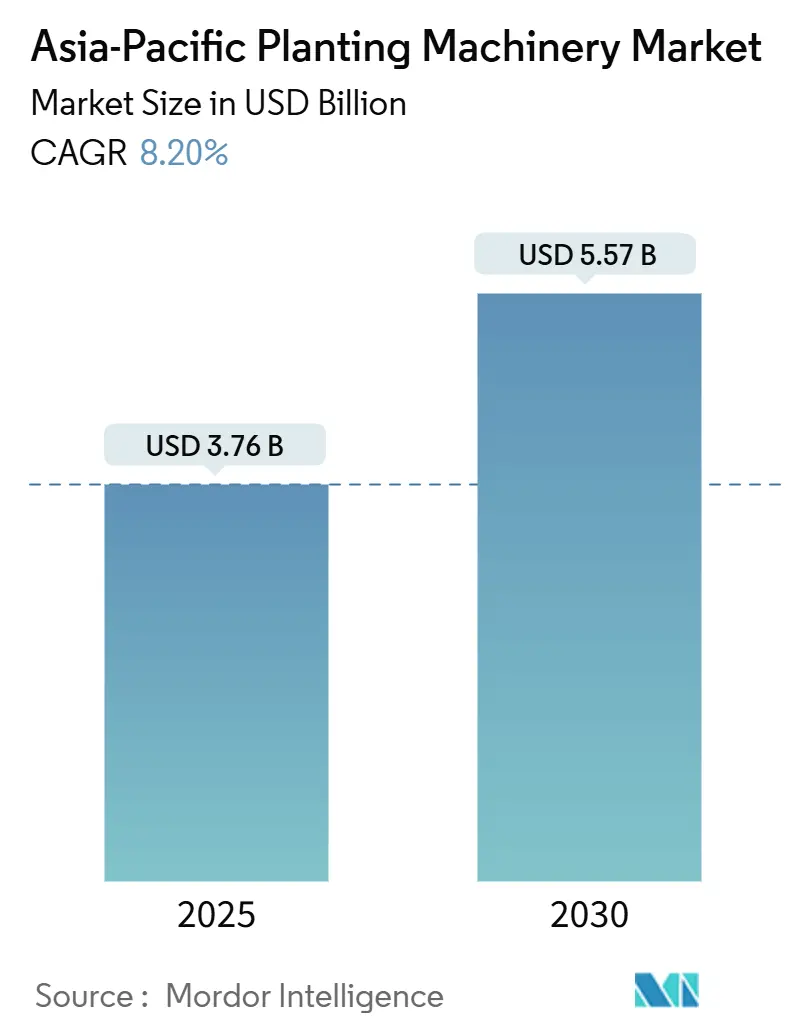
The Asia-Pacific Planting Machinery Market size is estimated at USD 3.76 billion in 2025, and is expected to reach USD 5.57 billion by 2030, at a CAGR of 8.20% during the forecast period (2025-2030).
The Asia-Pacific region is one of the largest and fastest-growing markets for planting machinery, driven by the need to modernize agricultural practices to meet the demands of the growing population. Countries like China and India are major players, given their large agricultural bases and investments in modern farming techniques. The market has been expanding due to increased awareness of precision agriculture, which uses technology to enhance the efficiency of planting and overall crop management.
India's planting machinery industry is poised for significant growth, bolstered by its burgeoning population, economic reliance on agriculture, evolving demographics, and pressing food security concerns. As a pivotal player in the Asia-Pacific, India's deep-rooted agricultural reliance and tech adoption enthusiasm drive the region's agricultural equipment market. Moreover, India grapples with a labor shortage in farming as its workforce pivots from traditional farming to other industries. Urbanization accelerates this mechanization trend, with a notable migration from rural to urban centers. According to data from the World Bank, agricultural employment dropped from 44% of the population in 2021 to 43% in 2022.
Besides, rice serves as a primary staple food across Asia, particularly in China, India, Indonesia, Bangladesh, Vietnam, Thailand, and the Philippines. Population growth and urbanization drive increased rice consumption, necessitating more efficient farming methods. In China, the world's largest rice consumer, farmers adopt rice transplanters to improve production efficiency and manage labor costs. The region's significant crop production drives demand for seed drills in the Asia Pacific agricultural planting machinery market. India's rice production increased from 203.6 million metric tons in 2022 to 206.7 million metric tons in 2023, according to FAOSTAT. Seed drills enhance planting operations through precise seed placement in rows at specific depths and intervals, improving crop yields and reducing labor costs. Growing food requirements, driven by population growth and changing dietary preferences, continue to support the adoption of advanced seeding equipment.
Note: Market size and forecast figures in this report are generated using Mordor Intelligence’s proprietary estimation framework, updated with the latest available data and insights as of January 2026.
Asia-Pacific Planting Machinery Market Trends and Insights
Increasing Demand for Food Production and Shrinking Arable Land
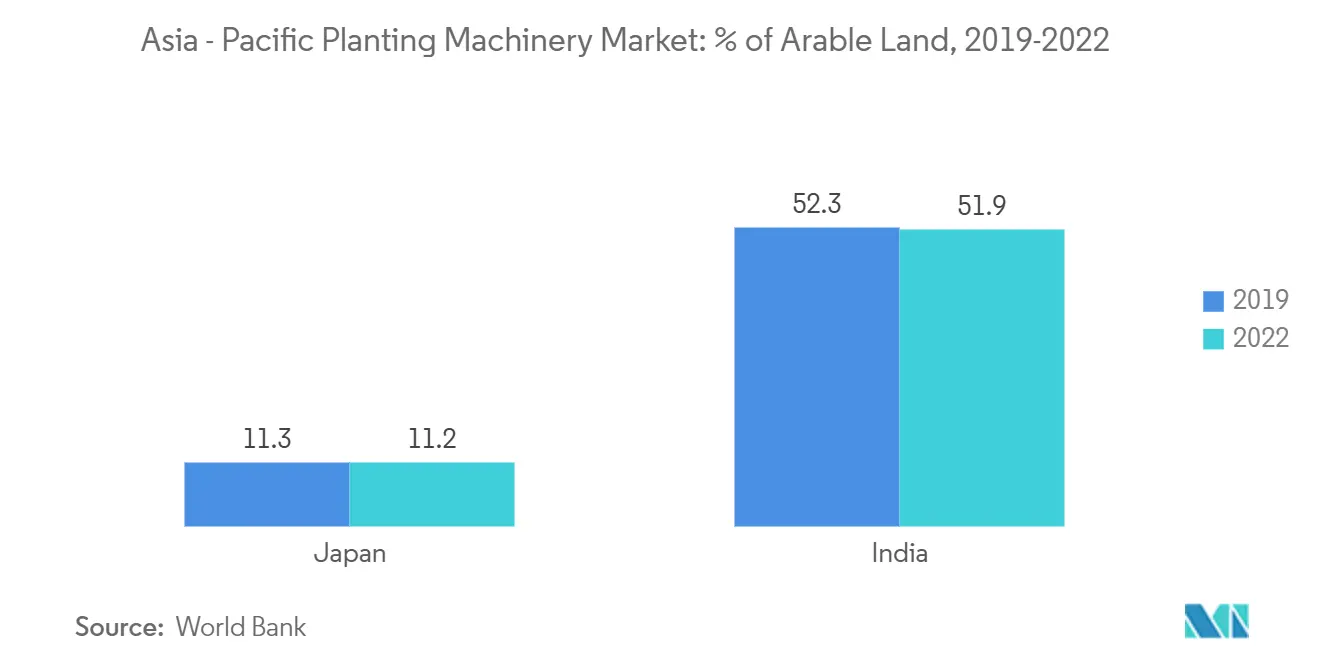
The Asia-Pacific region is home to nearly 60% of the world’s population, with countries like China and India being the most populous in the world. The continuous increase in population directly leads to greater food consumption, necessitating higher agricultural productivity to meet the dietary needs of more people. Rapid urbanization, industrialization, and infrastructure development have led to the conversion of farmland into residential and commercial properties. As available arable land decreases, farmers must find ways to maximize crop yields on the land they have. For instance, according to World Bank data, arable land in Japan was 11.3% in 2019, which decreased by 11.2 % in 2022. Likewise, arable land in India was 52.3% in 2019, which decreased by 51.9% in 2022. Further, soil erosion, nutrient depletion, and desertification can reduce the productivity of existing farmland. Planting machinery that can optimize soil health and planting efficiency becomes essential for maintaining or improving productivity.
Unpredictable weather patterns, droughts, floods, and extreme temperatures affect crop yields and make traditional farming methods less reliable. For instance, according to FAOSTAT, Japan's yield of cereals was 6,787.3 Kg/ha in 2021, which decreased by 6,273 Kg/ha in 2022. Therefore, advanced planting machinery helps farmers adapt by enabling more precise seed placement, better water management, and improved soil conditions. There is a growing emphasis on sustainable agricultural practices that maintain soil fertility and conserve water. Planting machinery that supports no-till farming, reduced chemical use, and efficient water use can help mitigate the impact of climate change on food production.
China Dominate the market
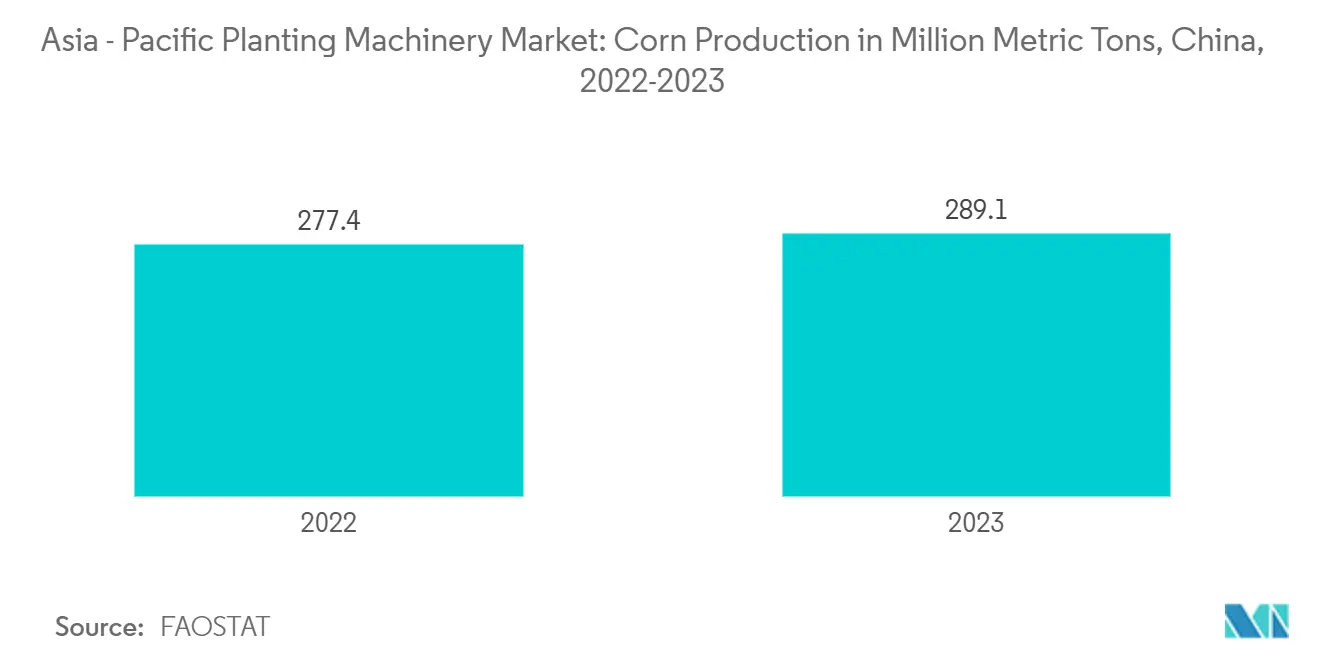
China represents one of the largest markets for planting machinery in the Asia Pacific region. The country has advanced in agricultural modernization, with farms increasingly adopting sophisticated planting machinery, including GPS-guided seeders, automated planters, and drones for precision planting. The government's emphasis on mechanized farming to increase productivity, combined with the scale of farming operations for crops like rice, wheat, and corn, drives the demand for planting machinery. According to FAOSTAT, China's corn production increased from 277.4 million metric tons in 2022 to 289.1 million metric tons in 2022, demonstrating the need for efficient planting equipment across diverse crop types and farming practices.
The Chinese government has implemented supportive policies and subsidies to promote modern farming equipment adoption. The "Modern Agricultural Development Plan" focuses on agricultural modernization through machinery and technology implementation to enhance farming efficiency and food security. In 2023, the Ministry of Finance of China allocated USD 1.4 billion in central government subsidies for grain farmers to purchase agricultural materials. The government aims to achieve a 75% comprehensive mechanization rate for crop plowing, planting, and harvesting by 2025.
China has incorporated precision farming technologies, including GPS, sensors, and IoT-based solutions, to optimize planting and resource utilization. This technological integration has increased the efficiency and appeal of advanced planting machinery. The transition to mechanized farming has been particularly notable in traditionally farming-dominant regions, generating increased demand for planting machinery that supports large-scale operations.
Competitive Landscape
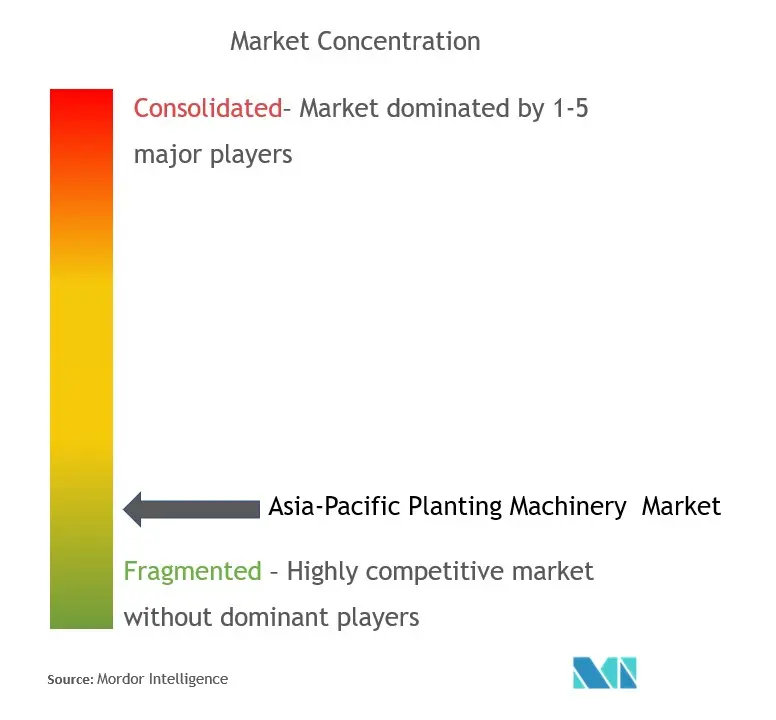
The Asia Pacific planting machinery market exhibits a fragmented structure. Companies compete through product quality and promotional activities while implementing strategic initiatives to expand their market presence. Key players controlling significant market shares through their products, services, and ongoing product development include John Deere, AGCO Corporation, Kuhn Group, YANMAR HOLDINGS CO., LTD, and Kverneland AS.
Asia-Pacific Planting Machinery Industry Leaders
-
Deere & Company.
-
AGCO Corporation
-
Kuhn Group
-
Kverneland AS
-
YANMAR HOLDINGS CO., LTD
- *Disclaimer: Major Players sorted in no particular order
Recent Industry Developments
- May 2023: Mahindra & Mahindra, a leading Indian multinational in the automotive realm, has launched its first-ever plant dedicated solely to farm machinery (including planting machinery) in Pithampur, Madhya Pradesh. This venture signifies Mahindra's entry into the specialized farm machinery arena, underscoring a significant milestone for a company with over seventy years of prominence in India's automotive landscape.
- October 2022: Kubota company opened the Global Institute of Technology in Osaka, Japan, which aims to increase research and development for new product developments per the region's business landscape and needs.
Asia-Pacific Planting Machinery Market Report Scope
Planting machinery encompasses equipment designed for seed planting and soil preparation for crop cultivation. This includes seed drills, row-crop planters, and sowing machines. The Planting Machinery Market Report is Segmented by Type (Seed Drills and Planters & Transplanted) and the Fertilizing Machinery Segment (seed Cum Fertilizer Drills and Fertilizer Spreaders). The Market is Also Segmented by Geography (North America, Europe, Asia-Pacific, South America, and Africa). The Report Offers the Market Sizes and Forecasts in Value (USD) for all the Above Segments.
Type
| Planting Machinery | Seed Drills |
| Planters & Transplanters | |
| Fertilizing Machinery | Seed-cum-Fertilizer Drills |
| Fertilizer Spreaders |
Geography
| China |
| India |
| Japan |
| Australia |
| Rest of Asia-Pacific |
| Type | Planting Machinery | Seed Drills |
| Planters & Transplanters | ||
| Fertilizing Machinery | Seed-cum-Fertilizer Drills | |
| Fertilizer Spreaders | ||
| Geography | China | |
| India | ||
| Japan | ||
| Australia | ||
| Rest of Asia-Pacific | ||
Key Questions Answered in the Report
How big is the Asia-Pacific Planting Machinery Market?
The Asia-Pacific Planting Machinery Market size is expected to reach USD 3.76 billion in 2025 and grow at a CAGR of 8.20% to reach USD 5.57 billion by 2030.
What is the current Asia-Pacific Planting Machinery Market size?
In 2025, the Asia-Pacific Planting Machinery Market size is expected to reach USD 3.76 billion.
Who are the key players in Asia-Pacific Planting Machinery Market?
Deere & Company., AGCO Corporation, Kuhn Group, Kverneland AS and YANMAR HOLDINGS CO., LTD are the major companies operating in the Asia-Pacific Planting Machinery Market.
What years does this Asia-Pacific Planting Machinery Market cover, and what was the market size in 2024?
In 2024, the Asia-Pacific Planting Machinery Market size was estimated at USD 3.45 billion. The report covers the Asia-Pacific Planting Machinery Market historical market size for years: 2019, 2020, 2021, 2022, 2023 and 2024. The report also forecasts the Asia-Pacific Planting Machinery Market size for years: 2025, 2026, 2027, 2028, 2029 and 2030.
Asia-Pacific Planting Machinery Market Report
Statistics for the 2025 Asia-Pacific Planting Machinery market share, size and revenue growth rate, created by Mordor Intelligence™ Industry Reports. Asia-Pacific Planting Machinery analysis includes a market forecast outlook for 2025 to 2030 and historical overview. Get a sample of this industry analysis as a free report PDF download.