
Agricultural Machinery Market Analysis by Mordor Intelligence
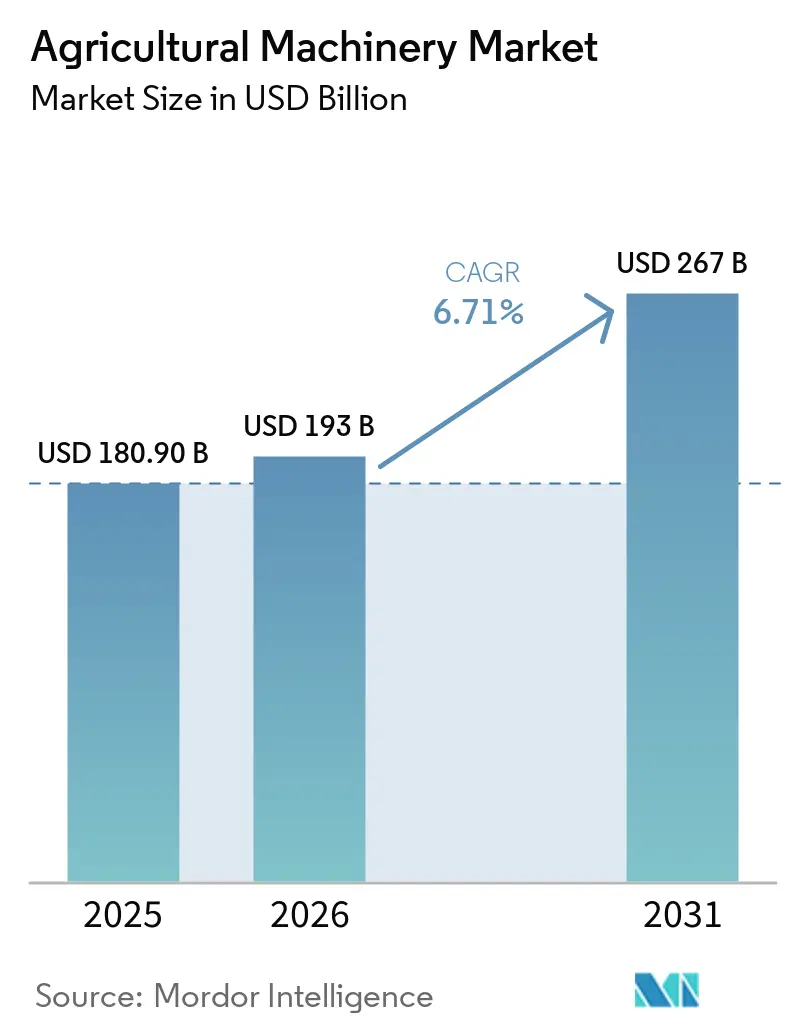
The agricultural machinery market size is expected to grow from USD 193 billion in 2026 to USD 206 billion in 2027 and is forecast to reach USD 280.6 billion by 2032 at 6.38% CAGR over 2027-2032.
Higher wages for directly hired U.S. farmworkers strengthen demand for labor-saving fieldwork, while Indian purchase subsidies can lower eligible buyers' acquisition burden. Subsidized rice-harvester distribution in the Philippines and shared access in India can extend mechanization beyond farmers able to buy individually. Dealer-based collaboration can bring specialist automation into established machinery channels as producers broaden their equipment offers. The forecast expansion therefore combines labor-saving demand and supported acquisition, while Indian smallholders' ownership burden and Illinois grain growers' depreciation costs limit how many buyers can afford to purchase machines outright.
Key Report Takeaways
- By type, tractors led with a 35.72% agricultural machinery market share in 2026, while harvesting machinery is forecast to grow fastest at a 7.7% CAGR over 2027-2032.
- Across automation levels, manual equipment accounted for a 45.54% share of the agricultural machinery market size in 2026, and automatic equipment is forecast to expand fastest at an 8.2% CAGR over 2027-2032.
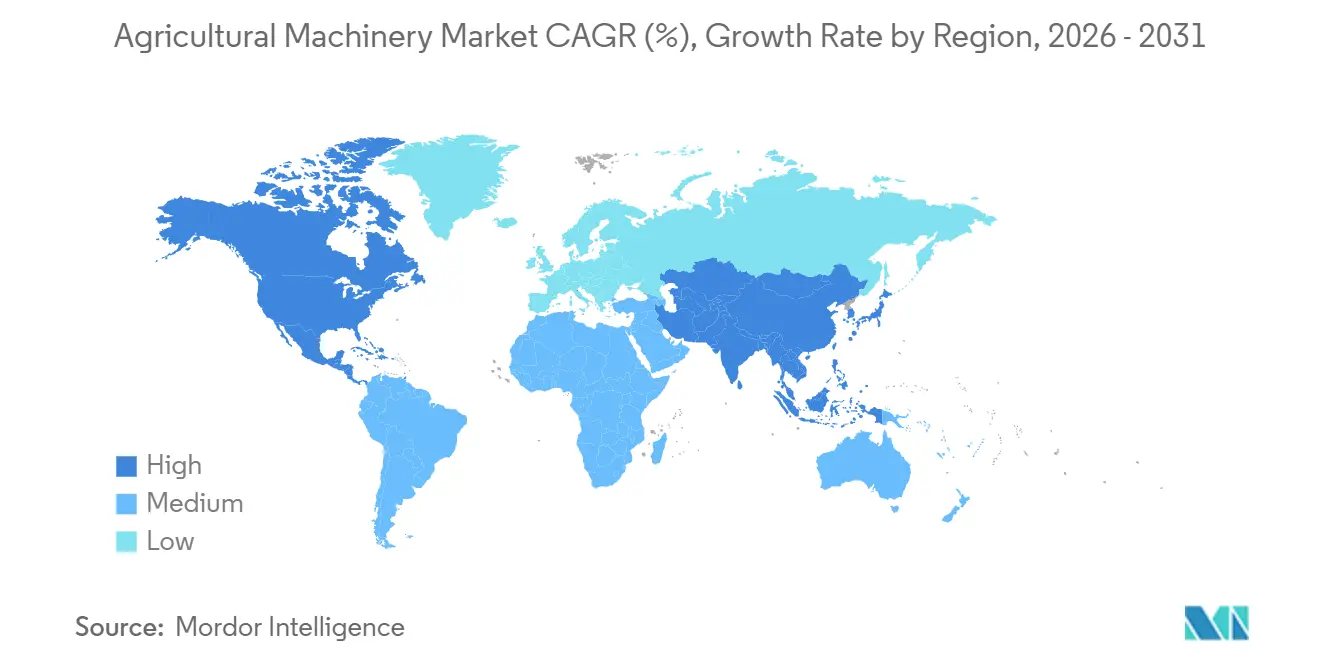
- Geographically, Asia-Pacific held a 36.94% share of the market in 2026, while North America is forecast to be the fastest-growing region with a 7.1% CAGR over 2027-2032.
Note: Market numbers in this report are based on Mordor Intelligence's proprietary estimation framework, which combines nine months of actuals with Q4 projections for base year 2026.
Market Trends and Insights
Drivers Impact Analysis of Agricultural Machinery Market*
| Driver | (~) % Impact on CAGR Forecast | Geographic Relevance | Impact Timeline |
|---|---|---|---|
| Farm labor scarcity and wage inflation | +2.5% | United States, excluding Alaska | Short term (≤ 2 years) |
| Precision agriculture and telematics integration | +2.2% | Spain, Finland, and Italy | Medium term (2-4 years) |
| Subsidies and mechanization credit support | +1.8% | Agricultural regions of India | Short term (≤ 2 years) |
| Farm consolidation and output-per-acre pressure | +1.7% | United States farming regions | Long term (≥ 4 years) |
| Custom hiring and equipment-as-a-service expansion | +1% | Agricultural regions of India | Medium term (2-4 years) |
| Regenerative and low-emission equipment funding | +0.6% | Agricultural regions of Japan | Medium term (2-4 years) |
| Source: Mordor Intelligence | |||
Farm labor scarcity and wage inflation
Higher hourly labor costs strengthen the case for machinery that can perform a farm operation with fewer paid hours. U.S. farm operators paid directly hired workers an average nominal gross wage of USD 19.52 per hour in April 2025, up 3% from April 2024, excluding Alaska and agricultural service workers.[1] Direct hiring makes the farm employer the buyer exposed to this particular wage pressure. Owner-operated fieldwork presents a different sales case because replacing the owner's time creates no equivalent direct payroll saving. Suppliers can therefore target labor-saving machinery at mechanizable hired tasks, concentrating the wage-based proposition on employers with paid work that equipment can replace.
Precision agriculture and telematics integration
Connected equipment creates demand for integration between the machine and the tools used to manage its work. In a 2026 European survey concentrated in Spain, Finland, and Italy, 66.4% of valid agricultural and forestry end-user respondents reported daily use of connected digital tools. That frequency makes integration relevant to ordinary operations, rather than only occasional equipment upgrades. AGCO Corporation reported that 88.4% of its machines sold with hardware in 2025 included connectivity-enabled assets, although it missed its initial fully connected fleet target. For these daily users, a machine that exchanges data with their tools offers a purchase argument that an unconnected alternative lacks, making integration commercially relevant when they replace equipment.
Subsidies and mechanization credit support
India's August 2026 Sub-Mission on Agricultural Mechanization (SMAM) guidelines provide 50% machinery-cost assistance to small and marginal farmers, Scheduled Caste and Scheduled Tribe farmers, women, and farmers in Northeast and Himalayan regions. Other farmers qualify for 40% assistance, with both rates subject to machine-wise caps. State and Union Territory governments implement this individual-ownership component. The scheme supported distribution of 2.16 million agricultural machines to individual farmers from 2014-15 through 2025-26. The differentiated rates create a stronger affordability proposition for the specified recipient groups, while the caps limit how far assistance scales with machine price. Suppliers serving these buyers therefore need to match the machine's eligible support to the farmer's remaining acquisition cost.
Farm consolidation and output-per-acre pressure
Larger farm operations can support equipment demand even when the number of potential purchasing accounts falls. USDA estimated that U.S. farm numbers fell from 2,023,200 in 2018 to 1,865,000 in 2025, while average farm size rose from 444 to 469 acres, using modeled 2025 estimates. For equipment suppliers, that combination shifts the relevant demand question toward the operating area served by each buyer. Greater capacity has a clearer economic role when its cost can be spread across a larger farm, although consolidation alone does not guarantee replacement purchases. The opportunity consequently shifts toward capacity per customer, giving machinery suited to larger operating areas a stronger rationale within a shrinking farm population.
Restraints Impact Analysis of Agricultural Machinery Market*
| Restraint | (~) % Impact on CAGR Forecast | Geographic Relevance | Impact Timeline |
|---|---|---|---|
| High upfront cost and financing pressure | -1.4% | Central Illinois grain-growing areas | Short term (≤ 2 years) |
| Fragmented farm structures and uneven payback | -1% | Agricultural regions of India | Long term (≥ 4 years) |
| Autonomous field-operation regulatory uncertainty | -0.4% | Agricultural areas of California | Medium term (2-4 years) |
| Data ownership, repair access, and interoperability frictions | -0.6% | European Union agricultural regions | Medium term (2-4 years) |
| Source: Mordor Intelligence | |||
High upfront cost and financing pressure
A machinery purchase must recover its capital cost as well as cover the expense of running the equipment. On high-productivity central Illinois grain farms in 2025, depreciation averaged USD 91 per acre, representing 53% of USD 170 in machinery-related costs for growing corn. Those machinery-related costs also included repairs, fuel and oil, and machine hire. Depreciation therefore exceeded the combined total of the other machinery-cost categories in this example. The acquisition decision consequently carries a capital-recovery burden that reductions in running expenses alone cannot remove.
Fragmented farm structures and uneven payback
Small holdings and high individual ownership costs create adverse economies of scale for machinery users in India. Dividing an expensive machine's cost across a limited operating area makes the ownership decision harder even when mechanization offers useful capabilities. A supplier targeting these buyers must distinguish demand for field operations from demand to own the equipment that performs them. India's Department of Agriculture & Farmers Welfare promotes Custom Hiring Centers to expand machinery access for small and marginal farmers. Shared access addresses the ownership problem, but an individual purchase still carries the farm's concentrated capital burden.
*Our forecasts treat driver/restraint impacts as directional, not additive. The impact forecasts reflect baseline growth, mix effects, and variable interactions.
Agricultural Machinery Market Segment Analysis
By Type:
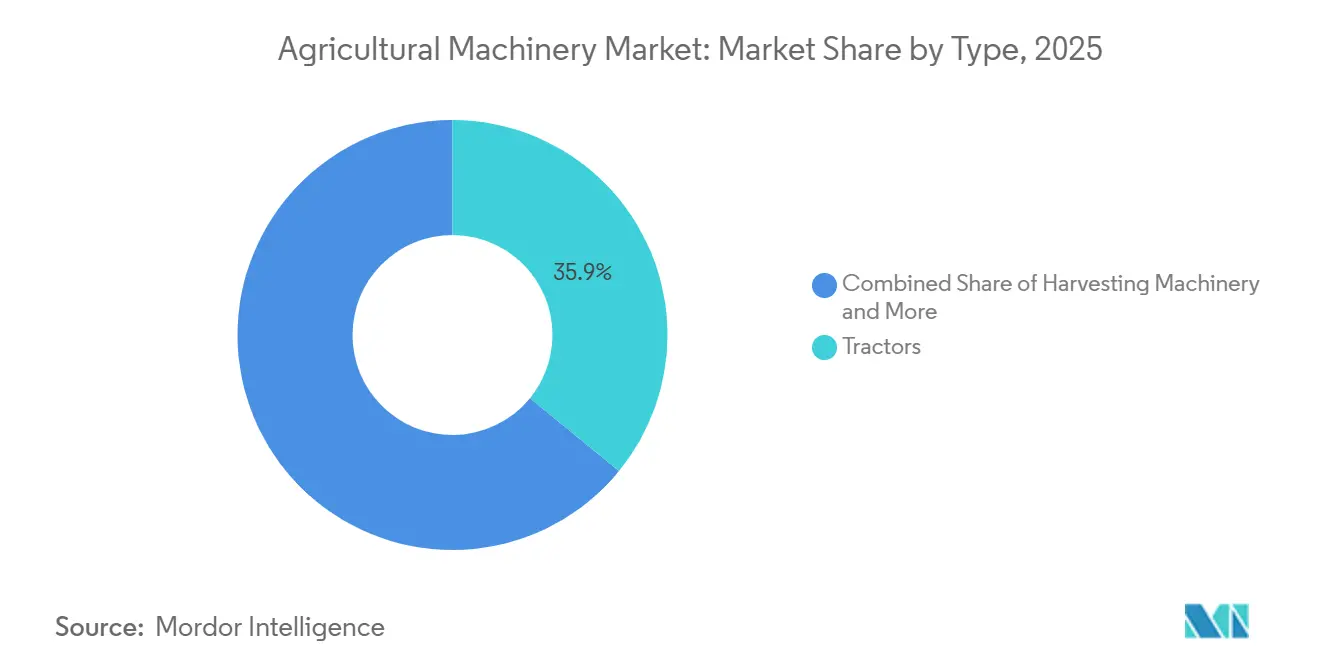
Tractor Scale and Organized Harvesting DeploymentTractors accounted for a 35.72% share of the agricultural machinery market size in 2026. The Federation of Automobile Dealers Associations (FADA) recorded 996,633 tractor retail registrations in India in calendar 2025, up 11.52% from 893,706 in 2024, excluding Telangana.[2] For the separate FY2026 industry-sales series, Mahindra & Mahindra Limited reported Indian tractor industry sales of 1,160,231 units, up 23.5% year over year. Mahindra attributed that growth to favorable monsoons, good reservoir levels, a cut in India's goods and services tax (GST) on tractors, and a broader GST-related rural income effect. Those reported crop and tax conditions make farm income and fiscal policy central to serving this substantial tractor buyer base.
Harvesting machinery is forecast to be the fastest-growing segment, with a 7.7% CAGR over 2027-2032. In the first half of 2026, the Philippine Center for Postharvest Development and Mechanization (PhilMech) delivered 700 rice combine harvesters under the Philippines' 2025 Rice Competitiveness Enhancement Fund allocation. The broader machinery rollout benefited farmers' cooperatives, associations, and local government units, providing an organized channel for equipment access. Meanwhile, the Association of Equipment Manufacturers (AEM) reported that preliminary U.S. retail sales of self-propelled combines fell 9.4% to 2,432 units in January-September 2026 from 2,683 a year earlier. Public-program deliveries to organized beneficiaries therefore provide a distinct equipment-access channel alongside the U.S. retail business, whose preliminary sales decline qualifies the near-term harvesting outlook.

By Automation Level:
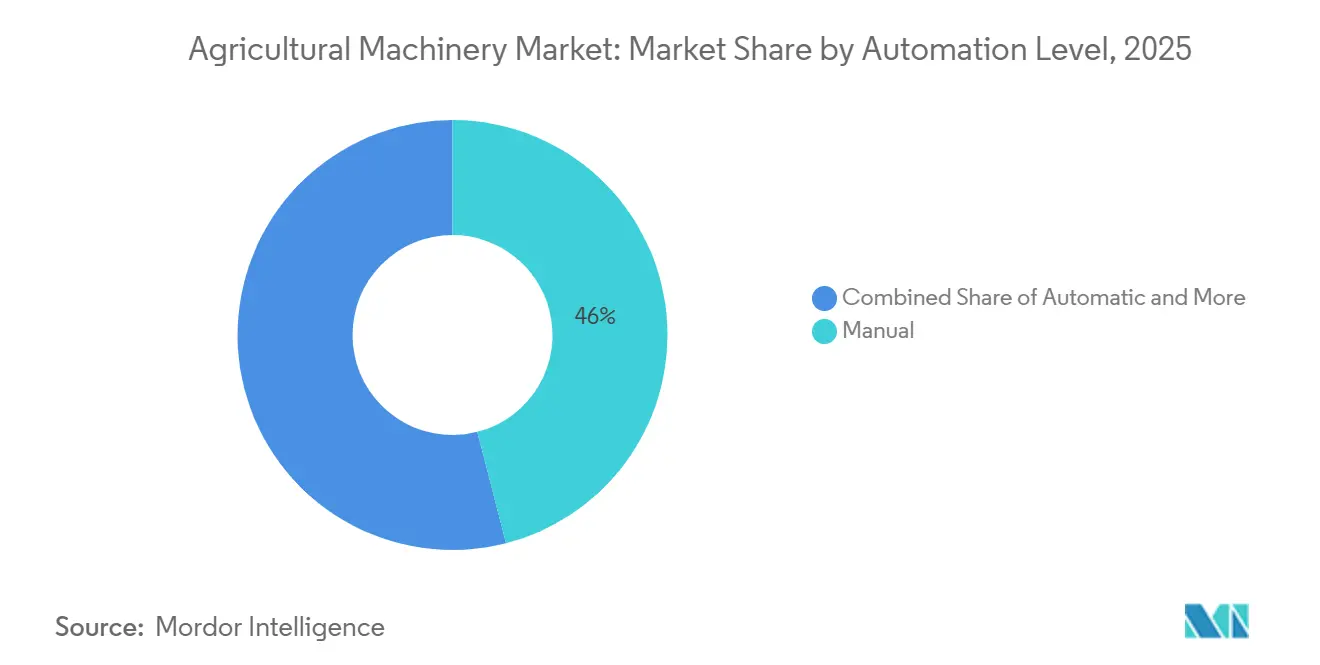
Direct Control and Autonomous FieldworkManual equipment represented a 45.54% agricultural machinery market share in 2026. In FY2026, the year ended March 31, Mahindra & Mahindra Limited sold a company-record 505,930 domestic tractors in India, including sales by Gromax Agri Equipment Limited. Mahindra held 43.6% of India's tractor market that year, leading it for the 43rd consecutive year. This commercial scale demonstrates a substantial national buyer base for operator-driven machinery. For suppliers, an operator-controlled offer therefore addresses an established source of equipment demand that a portfolio focused exclusively on autonomous fieldwork would leave outside its core proposition.
Automatic machinery is forecast to be the fastest-growing segment, with an 8.2% CAGR over 2027-2032. At the end of March 2026, LMB Rovadi delivered and commissioned AgXeed's first AgBot T2 7-Series at Princepeel Estate, a Dutch arable farm using the autonomous vehicle for field tasks. In 2025, AGCO Corporation's PTx Trimble OutRun retrofit platform had its autonomous grain-cart solution in production, providing autonomous capabilities for Fendt and certain competing machines. Its tillage application was in beta testing and fertilization in alpha testing that year. New automatic machines can expand driverless work from soil preparation to sowing, while retrofit autonomy gives compatible-machine owners an alternative to replacing their equipment.
Geography Analysis
Asia-Pacific Agricultural Machinery Market
Asia-Pacific accounted for a 36.94% share of the agricultural machinery market size in 2026. India's tractor industry reported 130,551 total sales, including exports, in September 2026, showing substantial commercial scale within one of the region's producer bases. First Tractor Company Limited, citing the National Bureau of Statistics, reported 465,200 tractors produced by China's manufacturers above a certain scale in 2025, down 4.9% year over year. Asia-Pacific's share leadership is therefore supported by the scale of national tractor industries even when output in a major producer country contracts.
North America Agricultural Machinery Market
North America is forecast to be the fastest-growing region, with a 7.1% CAGR over 2027-2032. By January 15, 2026, Bad Boy Mowers had produced its first tractor at its Monroeville, Alabama, facility. Mexico recorded 14,500 tractor sales in 2025, up 3.6% from 2024, establishing a growing annual sales base within the region. Meanwhile, the Association of Equipment Manufacturers reported September 2026 tractor sales down 16.4% year over year in the United States and 15.1% in Canada. The forecast expansion can draw on an additional assembly route and Mexican buyer activity, although weaker U.S. and Canadian tractor sales make the demand picture uneven.
CLIMMAR's 13-country European series, including Switzerland, recorded 96,323 new tractor registrations in 2025 against 104,395 in 2024, down about 8%, narrowing dealer opportunities (all powers in Austria and Italy, 50 hp minimum elsewhere). In South America, Uruguay's Rivera government offers machinery services to small producers with up to 10 hectares for conventional tillage or 20 hectares for direct seeding, with March and July registration. In the Middle East, Oman's agriculture ministry offers mechanization contributions of up to 50% of original equipment value, or 75% for social security families, subject to Omani nationality, document review, site inspection and approval. AGRA's 2025 report identified high capital costs, limited finance, weak repair services and inadequate infrastructure limiting mechanization viability in much of Central Africa, with small fragmented holdings making large-machine adoption inefficient. These Uruguayan machinery services and Omani contributions make program eligibility central to equipment access, alongside buyers' ability to fund individual purchases.
Regulatory Framework and Outlook
Selected jurisdictions are compared from the perspective of manufacturers placing new agricultural machinery on the market. Regulated products include nonroad compression-ignition engines in the United States, qualifying diesel machinery in China, and machinery covered by Brazil's MAR-I agricultural and road machinery emission phase. Germany's machinery-safety framework includes tractor-mounted machinery while excluding agricultural and forestry tractors covered by Regulation (EU) No 167/2013. These boundaries make product classification an important part of the manufacturer's compliance investment.
Regulatory Table of Agricultural Machinery Market
| Decision factor | United States | Germany | China | Brazil |
|---|---|---|---|---|
| Primary authority | Environmental Protection Agency | State product-safety market-surveillance authorities | Ministry of Ecology and Environment and State Administration for Market Regulation | IBAMA |
| Key instruments or direction | 40 CFR part 1039 Tier 4; SCR-inducement proposal with comments closed August 29, 2026 | Directive 2006/42/EC; Regulation (EU) 2023/1230 applies January 20, 2027 | Stage IV effective December 1, 2022; Stage V draft consultation June 12-July 18, 2026 | CONAMA Resolution 433/2011 and IBAMA Normative Instruction 06/2015; draft MAR-II phase-ins January 1, 2030 for 130-560 kW, January 1, 2032 for 75-130 kW, and January 1, 2034 for 19-75 kW |
| Commercial effect | New nonroad compression-ignition engines require emissions compliance and certification | Covered control systems must prevent hazardous faults; adopted framework adds connected-device safeguards and protections for signal/data hardware linked to compliance-critical software | Noncompliant diesel machinery and engines up to 560 kW cannot be produced, imported, or sold; actual-use testing above 37 kW and remote emissions/location reporting apply | LCVM configuration license before production or import of covered new machines, including own use; motor LCVM first when applicable; draft MAR-II covers new self-propelled machines within Annex B classification codes and permits early compliance recorded in LCVM |
| Current policy attractiveness | Medium | Medium | Low | Medium |
| Future direction of policy attractiveness | Easing | Hardening | Hardening | Hardening |
| Source: Mordor Intelligence | ||||
U.S. certification obligations support a moderate entry-burden assessment, while EPA's July 14, 2026 proposal for new nonroad diesel engines to replace selective catalytic reduction (SCR)-related engine power reductions with audible or visible notifications points toward easing. Germany has an established control-system safety baseline, but the adopted connected-device safeguards and protections against corruption of signal/data hardware linked to compliance-critical software add explicit design responsibilities under the 2027 framework. China's testing and reporting obligations weigh on attractiveness, while its Stage V public-comment draft points toward another compliance transition. Brazil's licensing sequence creates an entry burden, and its proposed MAR-II agricultural and road machinery emission schedule would add phased compliance work while retaining an early-compliance route.
Value Chain Stages
Value is compared across equipment production, dealer-based market access, and parts and maintenance support. In 2025, CNH Industrial N.V. reported approximately USD 6.7 billion in purchases from 2,681 direct-material suppliers.[3] Its top 150 suppliers accounted for 66% of purchase value and were strategic partly because of relationship length, production capacity, and spare-parts management. That concentration makes readiness for a supplier interruption material to a manufacturer's ability to deliver finished equipment.
Value Chain Analysis Table of Agricultural Machinery Market
| Primary activity | Key participants | Value capture | Bottleneck | Resilience response |
|---|---|---|---|---|
| Equipment manufacturing and assembly | Machinery producers such as CNH Industrial N.V., AGCO Corporation | Equipment sales | Some CNH components have a single supplier and cannot be replaced quickly | Diversify sourcing, monitor suppliers, and maintain contingency plans |
| Dealer-based market access | Manufacturer-led distribution networks such as CNH Industrial N.V., AGCO Corporation | Wholesale equipment and parts sales | Reaching geographically dispersed buyers through the sales channel | Extend reach through independent dealers and distributors |
| Parts and maintenance support | Parts suppliers such as CNH Industrial N.V., AGCO Corporation | Parts sales and maintenance or repair contracts | Travel and parts delivery for field repairs | Combine parts distribution with on-farm dealer service |
| Source: Mordor Intelligence | ||||
Aftersales creates an earnings route tied to equipment already sold, through parts and service contracts. In 2025, more than two-thirds of AGCO Corporation's North American dealers operated with more than 50% on-farm service capacity. Moving service capability toward the farm makes field support an additional source of differentiation after the original equipment transaction.
Competitive Landscape
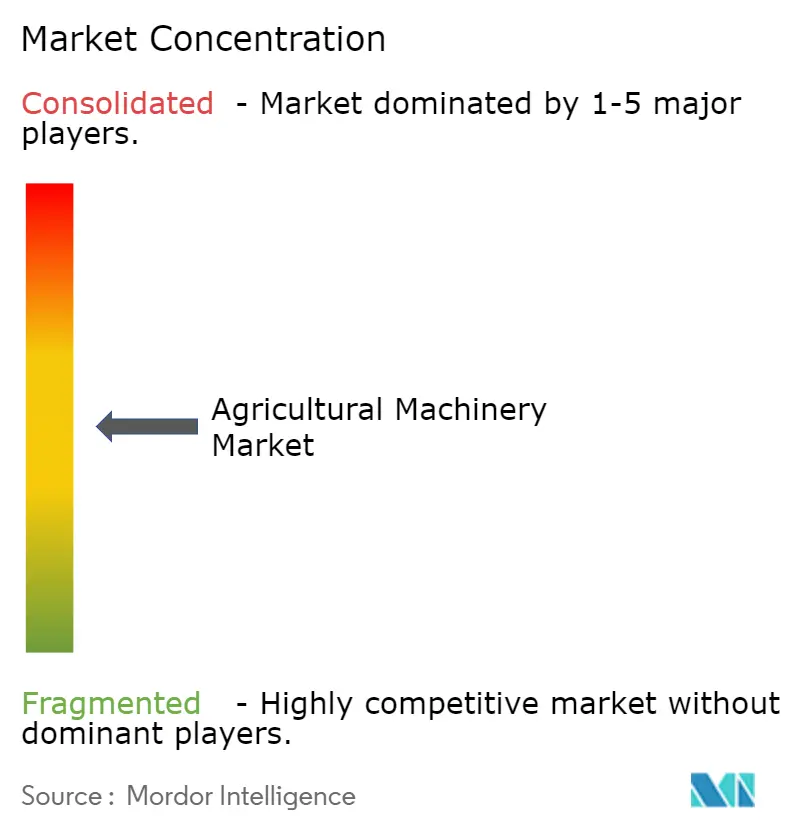
Competition is moderately concentrated around broad-portfolio manufacturers, with Deere & Company operating agricultural equipment segments and AGCO Corporation supplying Fendt, Massey Ferguson, PTx, and Valtra. On February 25, 2026, Deere's John Deere brand expanded its 8R/8RX range for heavy draft work and long days on large European farms, calling the 540 hp model the world's most powerful standard-design tractor. Kubota Corporation competes as an agricultural machinery producer. CNH Industrial N.V. supplies machinery, implements, and digital technologies through Case IH and New Holland, while CLAAS KGaA mbH manufactures tractors, combines, balers, and forage equipment, giving these competitors breadth across distinct farm operations.
On April 22, 2026, Kubota Corporation announced its investment in U.S.-based agricultural automation developer Agtonomy. By that announcement, Agtonomy services had achieved early commercial deployment through Kubota's agricultural machinery dealers in the western United States. For a specialist technology supplier, an established machinery channel offers a route to farm customers without requiring a complete equipment portfolio. On August 31, 2026, CNH Industrial N.V. announced a Bourgault alliance for a planned co-branded seeding range distributed through its dealers in North America, Australia, and other target markets. Bourgault would manufacture the range while CNH would contribute brands, precision technology, and customer support, making distribution capability an asset alongside specialist production.
In the United States, the Federal Trade Commission and five states announced a proposed settlement on July 8, 2026 that would require Deere to provide farmers and independent repair providers the same applicable repair resources as authorized dealers for 10 years. Access would be contingent on Deere granting access at more than 50% of dealer locations, with good-cause deadline extensions permitted. Embedded-software electronic control unit capabilities would be excepted until necessary third-party approval, which Deere would seek using reasonable best efforts. These conditions make the practical reach of repair access relevant to equipment differentiation alongside the machine's original capabilities. If the order is entered, independent repair providers could compete for work using the applicable resources, while the conditions would shape how quickly that opening becomes usable.
Agricultural Machinery Industry Leaders
-
Deere & Company
-
AGCO Corporation
-
Kubota Corporation
-
CNH Industrial N.V.
-
CLAAS KGaA mbH
- *Disclaimer: Major Players sorted in no particular order
Agricultural Machinery Market Companies Covered in this Report
- Deere & Company
- CNH Industrial N.V.
- AGCO Corporation
- Kubota Corporation
- Mahindra & Mahindra Limited
- CLAAS KGaA mbH
- SDF S.p.A.
- Yanmar Holdings Co., Ltd.
- Iseki & Co., Ltd.
- Argo Tractors S.p.A.
- Bucher Industries AG
- Valmont Industries, Inc.
- Lindsay Corporation
- Tractors and Farm Equipment Limited
- Maschio Gaspardo S.p.A.
Key Opportunities for Market Participants
Opportunities are compared across individual machinery ownership, shared hiring operations, and crop-specific mechanization in Bihar, India. Bihar's Department of Agriculture opened its 2026-27 SMAM individual-farmer and Custom Hiring Center application channels from October 1 through 31, 2026. These channels require verification, permit issuance, dealer supply, and physical verification before approved claims lead to subsidy payment. That sequence makes delivery terms part of the supplier's commercial proposition because grant payment follows the equipment transaction.
Market Opportunities Table of Agricultural Machinery Market
| Opportunity | Why now | Buyer / lead segment | Recommended play | Main barrier | Likely beneficiaries |
|---|---|---|---|---|---|
| Subsidy-supported individual ownership | Open 2026-27 SMAM application channel | Individual farmers in Bihar | Match the eligible machine and delivery offer to the issued permit | Supply and verification precede subsidy payment | Suppliers serving individual farm buyers |
| Shared machinery hiring operations | Open SMAM Custom Hiring Center channel | Progressive farmers, JEEVIKA, societies, self-help groups, and farmer groups in Bihar | Build an equipment offer around the proposed users' combined fieldwork | Coordinating demand across users before committing to a fleet | Machinery suppliers and shared-service operators |
| Sugarcane-farm mechanization | Sugarcane Industries Department applications open October 16-25, 2026 | Individual sugarcane farmers in Bihar | Prepare crop-specific machinery proposals within the application window | Completing the application within the defined window | Suppliers focused on sugarcane-farm operations |
| Source: Mordor Intelligence | |||||
The Custom Hiring Center channel is the central opening because suppliers can address several farmers' machinery needs through an approved applicant offering hiring services. Bihar accepts applications from progressive farmers, JEEVIKA, societies, self-help groups and farmer groups, subject to department verification, permit issuance, dealer supply and physical verification before claim approval. Because grant payment follows supply and verification, suppliers able to deliver equipment and support the required documentation can compete on completing the subsidized acquisition, beyond the machine specification alone.
Recent Industry Developments in Agricultural Machinery Market
- Sep 2026: AGCO Corporation launched its Fendt 1100 Vario MT Gen2 track tractor globally and made it available for order, with first deliveries scheduled to begin in 2027.
- Sep 2026: CLAAS KGaA mbH introduced the ARION 6, AXION 8, and AXION 9 tractor lines for North America and made them available for order through authorized dealers.
- Aug 2026: CNH Industrial N.V. announced a strategic alliance with Bourgault for a planned co-branded seeding portfolio distributed through CNH's dealers in North America, Australia, and other target markets, with Bourgault to manufacture the range.
Agricultural Machinery Market Report Scope and Research Methodology
Market Definition and Coverage
The agricultural machinery market measures annual global spending on mechanical equipment used in farming and post-harvest crop handling. It covers equipment sales across the Global market.
Scope exclusions: Separately sold replacement parts, repair, maintenance, and overhaul services, separately sold upstream inputs and components, livestock-handling and forestry machinery, and processed agricultural commodities and other finished crop products are excluded.
Segments Covered in This Report
- By Type
- Tractors
- By Horsepower
- Less than 40 HP
- 40 HP to 99 HP
- 100 HP and Above
- By Tractor Type
- Compact Utility Tractors
- Utility Tractors
- Row Crop Tractors
- Orchard and Vineyard Tractors
- By Horsepower
- Soil Preparation and Cultivation Machinery
- Plows
- Harrows
- Cultivators and Tillers
- Planting and Seeding Machinery
- Seed Drills
- Planters
- Broadcast Spreaders
- Transplanters
- Harvesting Machinery
- Combine Harvesters and Threshers
- Forage Harvesters
- Specialty Crop Harvesters
- Spraying and Crop Protection Machinery
- Self-Propelled Sprayers
- Trailed and Mounted Sprayers
- Aerial and Drone-Enabled Spraying Systems
- Hay and Forage Machinery
- Mower-Conditioners
- Balers
- Rakes and Tedders
- Irrigation Machinery
- Sprinkler Irrigation
- Drip Irrigation
- Mechanized Pivot Systems
- Tractors
- By Automation Level
- Manual
- Semi-Automatic
- Automatic
- By Geography
- North America
- United States
- Canada
- Mexico
- Rest of North America
- South America
- Brazil
- Argentina
- Rest of South America
- Europe
- Germany
- France
- United Kingdom
- Italy
- Russia
- Rest of Europe
- Asia-Pacific
- China
- India
- Japan
- Australia
- Rest of Asia-Pacific
- Middle East
- Saudi Arabia
- United Arab Emirates
- Turkey
- Rest of Middle East
- Africa
- South Africa
- Nigeria
- Rest of Africa
- North America
Data Sources, Market Sizing, and Validation
Desk Research
The Food and Agriculture Organization (FAO) collects annual machinery data on quantities in use, production and trade, while the World Bank's agricultural tractor indicator provides an annual installed-fleet series sourced from FAO. These sources, such as FAOSTAT and the World Development Indicators, help analysts distinguish equipment sales from fleet measures and compare country patterns. USDA Economic Research Service farm-income and investment data can inform buyers' purchasing capacity, and Association of Equipment Manufacturers releases provide timely monthly retail-sales signals for tractors and combines.
Company filings, investor presentations and reputable agricultural trade reporting supplement those public series with product mix, dealer shipments, pricing context and changes in production or distribution. These sources are checked against official trade classifications and the reported periods before they inform the market model. The named sources are not exhaustive and further sources inform collection, validation and clarification.
Primary Interviews and Surveys
Primary research covers agricultural machinery manufacturers, dealers and distributors, and farm or custom-hiring buyers across major global production and demand regions. Discussion guides test secondary estimates for new-machine transaction values, type and automation mix, selling-price changes, replacement timing and regional demand, with respondents asked to distinguish machine purchases from parts, service and rental fees. When source periods or country coverage leave gaps, analysts compare independent producer, trade and official indicators, record unresolved gaps in validation notes, and use follow-up questions to clarify material disagreements before incorporating the evidence.
Distribution of primary research fieldwork respondents
| Company type | Respondent position | Region |
|---|---|---|
| Top tier: 30% | CXOs: 20% | APAC: 40% |
| Mid tier: 45% | Functional/Unit leaders: 35% | EMEA: 33% |
| Smaller Players: 25% | Managers: 45% | Americas: 27% |
Market-Sizing & Forecasting
The model starts with a top-down estimate of annual manufacturer sales of new farming and post-harvest machinery worldwide, then checks selected totals with supplier revenue roll-ups, dealer shipment patterns and sampled average selling price multiplied by unit volume. It separates the value series from physical unit indicators. FAO production and trade data, World Bank tractor fleet counts, company shipments and association retail-sales reports help test volumes, while producer revenue, equipment mix and reported price changes indicate value and price mix. Farm income and machinery expenditure, crop area and mechanization programs, equipment trade, and changes in horsepower, precision content and automation serve as inputs to country and product forecasts. Their relationship to purchases is assessed with a multivariate regression where histories are sufficiently consistent, and scenario analysis is used where coverage or policy conditions make that relationship unstable. Segment shares are built from company product and regional sales, official trade and production patterns, registrations and buyer evidence, then reconciled across equipment type, automation level and sale geography. Selective bottom-up checks are compared with the top-down totals, and gaps caused by incomplete country reporting or incompatible classifications are recorded and resolved against the closest independent series or carried as an internal range. Primary respondents check variable assumptions and explain material departures before forecasts are finalized.
Data Validation & Update Cycle
Analysts triangulate manufacturer disclosures, official production and trade series, dealer or association sales signals and buyer-side indicators, then investigate anomalies such as abrupt share shifts, outlying price changes or totals that do not reconcile across product and regional cuts. A second review checks source dates, definitions, currency and units, while a senior analyst reviews resolved variances before sign-off. Re-contact is triggered when a material answer conflicts with independent evidence or leaves a key model input unclear. The evidence base is refreshed annually, revisited between cycles after material events such as major policy or supply changes, and subjected to a fresh source and calculation review immediately before delivery.
Mordor Intelligence's Agricultural Machinery Market Estimate Compared With Other Published Estimates
Published estimates can differ in the transactions and products they count and the inputs used to model demand. The agricultural machinery market measures annual global spending on mechanical equipment used in farming and post-harvest crop handling.
Key Gap Drivers include the study's defined coverage and market-specific modeling choices. Farm income and machinery expenditure, crop area and mechanization programs, equipment trade, and changes in horsepower, precision content and automation serve as inputs to country and product forecasts.
Benchmark comparison
| Source | Market Size | Gaps in Research Methodology |
|---|---|---|
| Mordor Intelligence | USD 206 B (2027) | |
| Global Consultancy A | USD 191.1 B (2025) | At its 2025 base, this estimate is 7.2% below this report's 2027 value of USD 206 B, 2 years later. The published estimate uses a 2025 base year, two years before this report's 2027 measurement year. |
| Global Consultancy B | USD 174.22 B (2025) | At its 2025 base, this estimate is 15.4% below this report's 2027 value of USD 206 B, 2 years later. The published estimate uses a 2025 base year, two years before this report's 2027 measurement year. |
Mordor Intelligence's analysts triangulate manufacturer disclosures, official production and trade series, dealer or association sales signals and buyer-side indicators, then investigate anomalies such as abrupt share shifts, outlying price changes or totals that do not reconcile across product and regional cuts.
Key Questions Answered in the Report
What is the agricultural machinery market size and expected growth?
The size is expected to reach USD 206 billion in 2027 and USD 280.6 billion by 2032, at a 6.38% CAGR over 2027-2032.
Which forces support farm equipment demand?
Higher wages for directly hired U.S. farmworkers outside Alaska and India's Sub-Mission on Agricultural Mechanization purchase assistance support mechanization. The Indian assistance rates are 40% or 50%, depending on farmer category and subject to machine-wise caps.
Which equipment type leads the agricultural machinery industry?
Tractors held 35.72% of the market in 2026, while harvesting machinery is forecast to grow fastest at a 7.7% CAGR over 2027-2032.
Which companies are major farm machinery suppliers?
Major suppliers include Deere & Company, AGCO Corporation, Kubota Corporation, CNH Industrial N.V., and CLAAS KGaA mbH.
What is a key cost challenge for agricultural equipment buyers?
On high-productivity central Illinois grain farms, depreciation averaged USD 91 per acre in 2025, or 53% of USD 170 in machinery-related costs for growing corn.
Which region leads the farm equipment industry and which will grow fastest?
Asia-Pacific held 36.94% of the market in 2026, while North America is forecast to grow fastest at a 7.1% CAGR over 2027-2032.