
Saudi Arabia NDT Market Size and Share
Market Overview
| Study Period | 2019 - 2030 |
|---|---|
| Forecast Data Period | 2025 - 2030 |
| Historical Data Period | 2019 - 2023 |
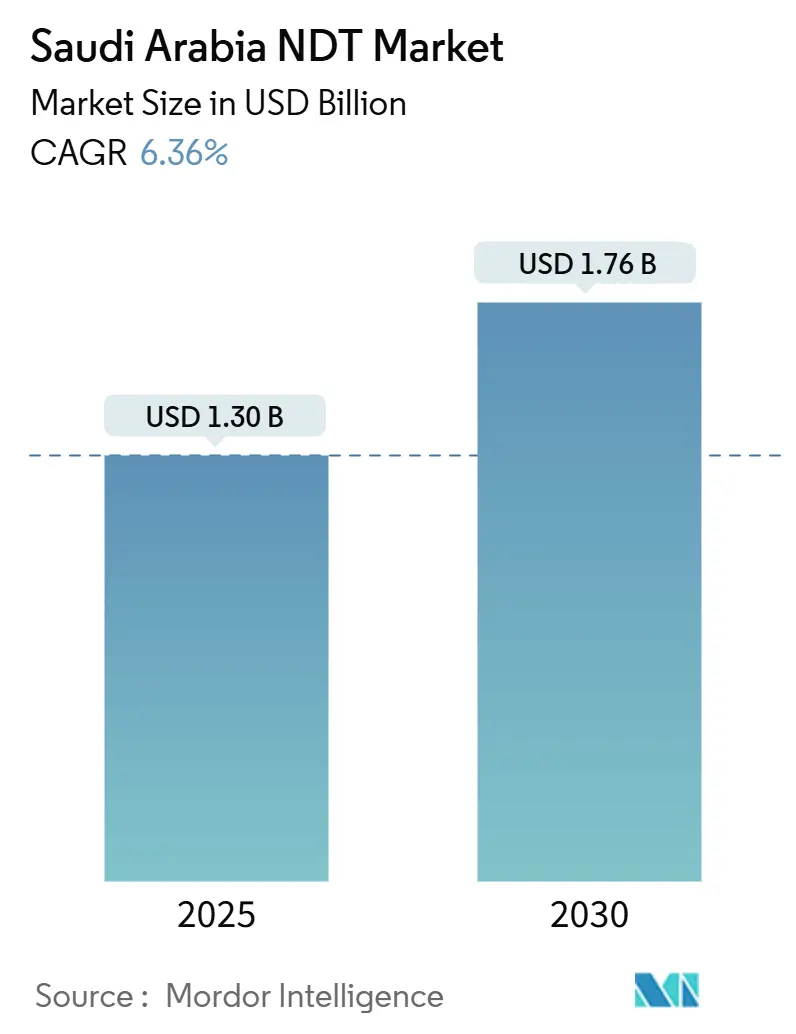
| Market Size (2025) | USD 1.30 Billion |
| Market Size (2030) | USD 1.76 Billion |
| Growth Rate (2025 - 2030) | 6.36 % |
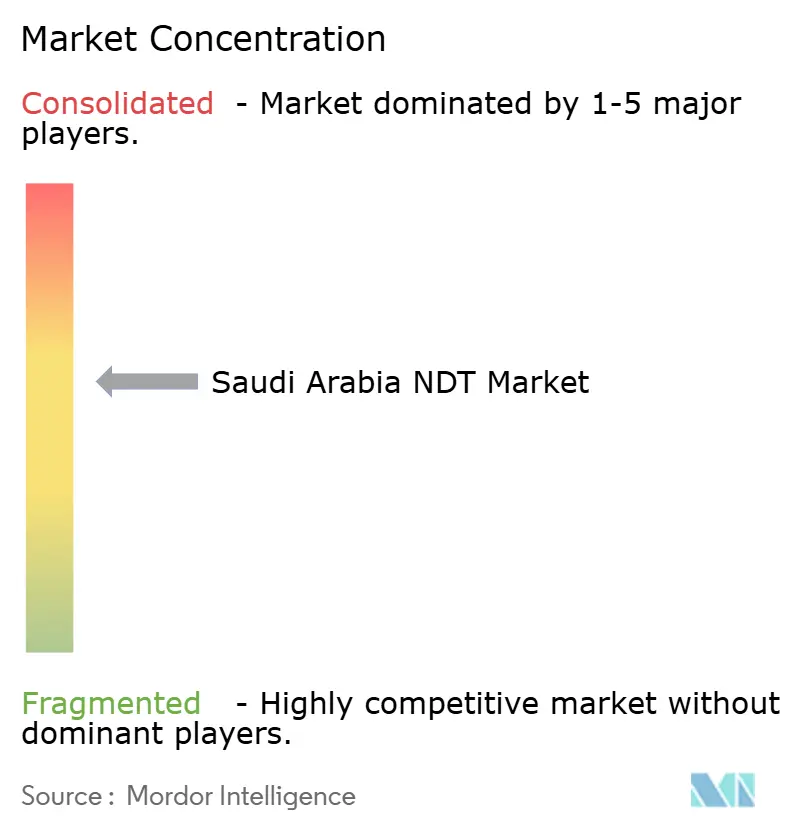
| Market Concentration | Medium |
Major Players *Disclaimer: Major Players sorted in no particular order Image © Mordor Intelligence. Reuse requires attribution under CC BY 4.0. | |
Saudi Arabia NDT Market Analysis by Mordor Intelligence
The Saudi Arabia NDT market size is projected to reach USD 1.30 billion in 2025 and is expected to grow to USD 1.76 billion by 2030, advancing at a 6.36% CAGR over the forecast period. Robust expansion of petrochemical pipelines, the refurbishment of aging power and desalination plants, and Vision 2030’s push for economic diversification converge to fuel steady demand for advanced inspection services. The market benefits further from the In-Kingdom Total Value Add (IKTVA) localization mandate, which steers procurement toward domestic suppliers and expands the addressable customer base for locally grown inspection firms. At the same time, digital transformation programs at Saudi Aramco and other tier-one operators are accelerating the adoption of AI-enabled analytics, which raises detection accuracy while reducing turnaround times. Heightened enforcement of ISO and ASME safety codes, combined with recurring mega-project activity in NEOM, the Red Sea coast, and the Riyadh metropolitan area, collectively sustains a healthy pipeline of inspection contracts.
Key Report Takeaways
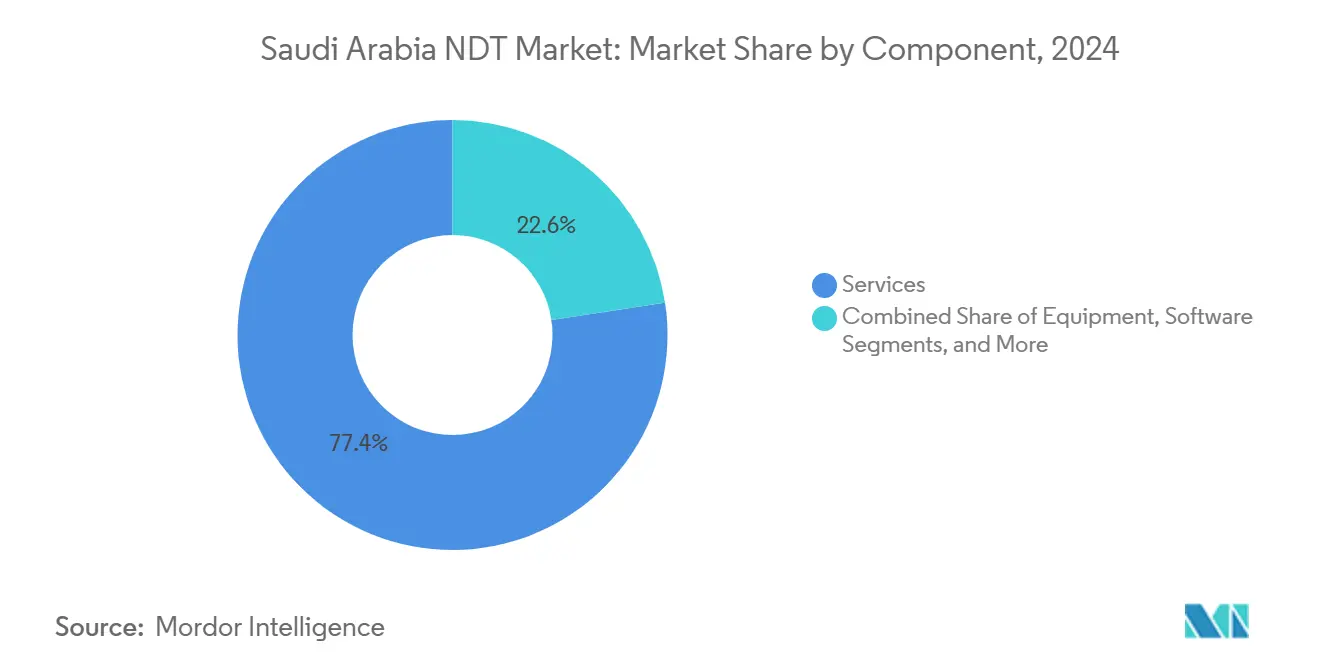
- By component, services accounted for 77.4% of Saudi Arabia's NDT market share in 2024, whereas software is projected to grow at a 10.3% CAGR through 2030.
- By testing method, ultrasonic techniques led with a 26.1% share of the Saudi Arabia NDT market size in 2024; eddy-current testing is forecast to register the fastest CAGR of 7.3% to 2030.
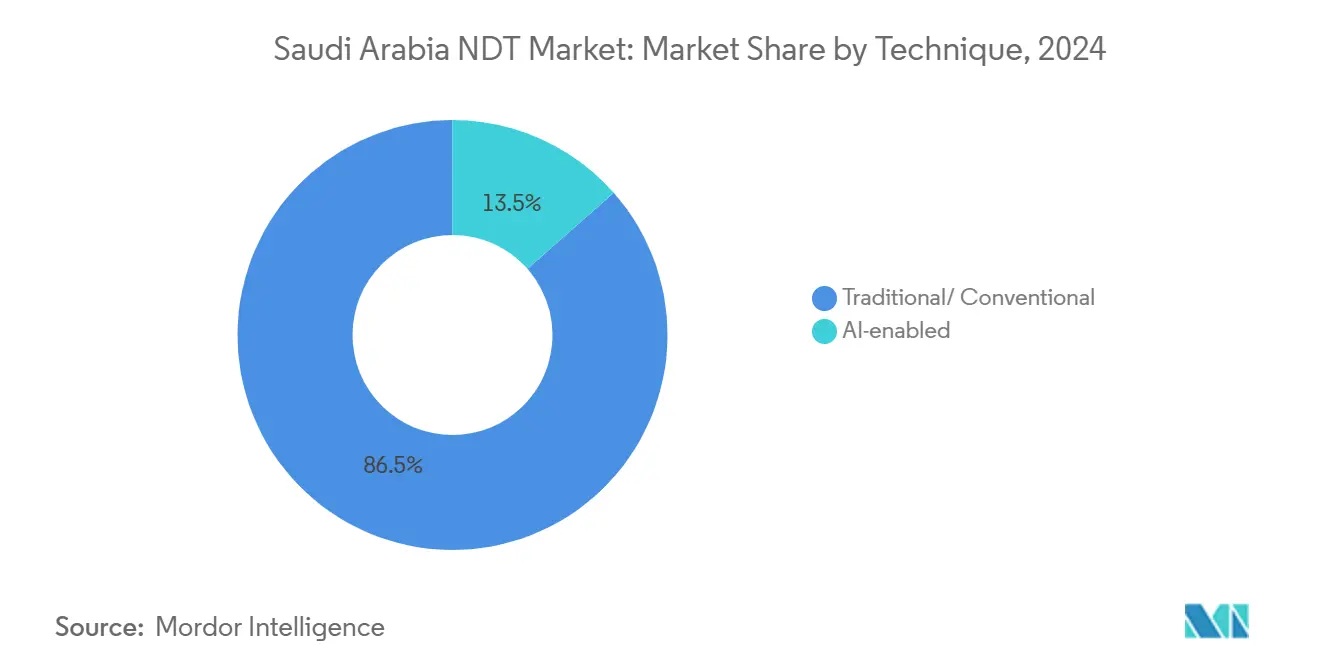
- By technique, traditional methods commanded 86.5 of % Saudi Arabia NDT market share in 2024, while AI-enabled approaches are slated to expand at a 13.4% CAGR during the outlook period.
- By end-user, the oil and gas sector held a 23.6% revenue share in 2024, while automotive and transportation exhibited the highest 7.2% CAGR through 2030.
Saudi Arabia NDT Market Trends and Insights
Drivers Impact Analysis*
| Driver | (~) % Impact on CAGR Forecast | Geographic Relevance | Impact Timeline |
|---|---|---|---|
| Continuous expansion of oil and gas infrastructure | +1.8% | National, concentrated in Eastern Province | Medium term (2-4 years) |
| Aging power generation and desalination assets | +1.4% | National, with a focus on coastal regions | Long term (≥ 4 years) |
| Industrial diversification under Vision 2030 | +1.2% | National, with early gains in Riyadh, Jeddah, and Jubail | Long term (≥ 4 years) |
| Stricter safety regulations (ISO/ASME alignment) | +0.9% | National | Short term (≤ 2 years) |
| IKTVA localization program boosting domestic demand | +0.7% | National, Eastern Province emphasis | Medium term (2-4 years) |
| KACARE nuclear research reactor initiative | +0.4% | Riyadh region | Long term (≥ 4 years) |
| Source: Mordor Intelligence | |||
Continuous Expansion of Oil and Gas Infrastructure
Saudi Aramco’s USD 48.4 billion capital program in 2024 focused on upstream expansion and Jafurah’s unconventional gas development, sustaining long runs of pipeline construction and refinery revamps.[1]World Oil Staff, “NDT Global, Aramco unveil 56-inch ultrasonic pipeline inspection tool,” World Oil, worldoil.com Inline ultrasonic tools, engineered for 56-inch trunk lines, now enable predictive maintenance on assets previously inspected only by magnetic flux leakage, thereby lifting inspection frequency and value per kilometer surveyed. Domestic service firms capture work scopes through IKTVA-compliant joint ventures, thereby reinforcing the recurring demand for high-specification procedures in corrosion monitoring, weld evaluation, and advanced flaw sizing.
Aging Power Generation and Desalination Assets
Thermal plants built in the 1970s-1980s by the Saudi Electricity Company, in conjunction with the Saline Water Conversion Corporation’s multi-stage flash desalination units, face a rising outage risk and require tighter inspection intervals to maintain power and water supply. The implementation of phased-array ultrasonic testing (PAUT) for boiler tubes and infrared thermography for rotating equipment has become routine, while drone-mounted visual testing reduces the need for confined-space entry. Renewal cycles coincide with Saudi Green Initiative solar and wind projects, so inspection providers now bundle legacy asset integrity with commissioning tests for photovoltaic trackers and nacelle castings, broadening revenue streams across the energy mix.
Industrial Diversification under Vision 2030
The Ministry of Industry issued 1,346 manufacturing licenses in 2024, unlocking USD 13.3 billion in committed capital and tens of thousands of jobs.[2]WAM Staff, “Over 1,300 Saudi Industrial Licenses Awarded in 2024,” WAM Saudi, wamsaudi.com Automotive newcomer Ceer’s EV assembly plant, along with an emerging aerospace cluster in Jeddah, requires inspection of aluminum extrusions, carbon-fiber skins, and composite adhesives. Service firms now deploy eddy-current arrays and computed tomography to qualify lightweight parts previously shipped overseas, aligning domestic quality control with global OEM acceptance thresholds and lessening reliance on oil-derived revenue.
Stricter Safety Regulations (ISO/ASME Alignment)
The Saudi Standards, Metrology, and Quality Organization has harmonized pressure equipment and structural codes with ISO 9712 and ASME Section V standards, increasing the number of mandatory inspection points across chemical, marine, and civil assets. Clients gravitate to providers boasting ISO/IEC 17025 labs and ASNT Level III personnel because certification eases the burdens of insurance, audits, and export compliance. Consequently, firms with accredited labs secure framework agreements faster than low-tier bidders, nudging the Saudi Arabia NDT market toward higher technical sophistication and service premiumization.
Restraints Impact Analysis*
| Restraint | (~) % Impact on CAGR Forecast | Geographic Relevance | Impact Timeline |
|---|---|---|---|
| Shortage of certified NDT technicians | -1.1% | National, acute in industrial cities | Short term (≤ 2 years) |
| High capital cost of advanced NDT equipment | -0.8% | National | Medium term (2-4 years) |
| Slow standardization for AI-enabled techniques | -0.5% | National | Long term (≥ 4 years) |
| Harsh desert environment increases calibration needs | -0.3% | National, severe in interior regions | Medium term (2-4 years) |
| Source: Mordor Intelligence | |||
Shortage of Certified NDT Technicians
Local academies graduate fewer PAUT and TOFD specialists than project tenders require, so international contractors import labor at premium rates, inflating service costs and stretching lead times. The ASNT Saudi Section has over 650 members, yet it must scale up to twice that number to meet the Vision 2030 objectives for building out. Scholarship incentives and fast-track apprenticeships are underway; however, the lag between classroom training and field readiness slows the pace at which capacity gaps are closed.
High Capital Cost of Advanced NDT Equipment
AI-ready radiographic arrays and multi-channel phased-array sets often exceed USD 500,000 per unit, a heavy burden on small and medium enterprises. Added expenses for desert-rated enclosures and shorter calibration cycles push life-cycle costs even higher, limiting technology refresh among cash-constrained firms and creating tiering between top-end and budget providers.
*Our forecasts treat driver/restraint impacts as directional, not additive. The impact forecasts reflect baseline growth, mix effects, and variable interactions.
Segment Analysis
By Component – Services Dominance Amid Software Acceleration
Services captured 77.4 of % Saudi Arabia NDT market share in 2024, owing to the field-intensive character of welding, corrosion, and reliability testing across sprawling hydrocarbon facilities. Structured inspection contracts remove the burden of staffing, competency tracking, and safety compliance from asset owners, leaving execution to certified firms staffed near industrial hubs. Meanwhile, the software segment is expected to surge at a 10.3% CAGR as digital repositories, automated report generators, and asset integrity dashboards migrate to the cloud. AI algorithms now flag defect clusters and predict remaining useful life, enabling data-driven maintenance and trimming unplanned downtime.
The Saudi Arabia NDT market benefits from Aramco’s push for real-time dashboards, which channel data from PAUT scanners and digital radiography straight into enterprise asset management systems. Platforms sold under subscription models lower the upfront cost for mid-tier contractors, while locking users into continuous updates, thereby increasing recurring revenue for software vendors. Equipment and consumables continue to track overall investment cycles—thickness gauges, couplants, and radiographic film remain staple purchases, but are increasingly bundled with calibration and technical support contracts to meet ISO/IEC 17025 requirements.



By Testing Method – Ultrasonic Leadership with Eddy-Current Acceleration
Ultrasonic testing held a 26.1% share of the Saudi Arabia NDT market size in 2024, supported by its versatility across wall-loss mapping, weld integrity, and structural bond assessment. Products range from single-hand probes for spot checks to autonomous crawlers scanning 56-inch pipelines. Customers choose ultrasonic testing over radiography when safety, speed, or in-service access are the primary decision criteria. Eddy-current techniques are expected to post a 7.3% CAGR as automotive and aerospace factories inspect thin-wall alloys and heat-treated fasteners.
Radiographic testing remains a key component of refinery shutdowns and pressure vessel certifications; however, digital X-ray detectors are gradually replacing film, reducing exposure times while enhancing image resolution and quality. Magnetic particle and liquid penetrant methods remain relevant for detecting surface-breaking flaws in structural steel, although many operators now combine them with phased-array scans to corroborate their findings. Thermography, computed tomography, and acoustic emission remain niche but expanding complements suited to composite inspection, turbine blade health, and online leak detection in power stations.
By Technique – AI-Enabled Innovation Disrupts Traditional Methods
Conventional inspection methods dominated the Saudi Arabia NDT market in 2024 with an 86.5% share, leveraging entrenched procedures and a skilled workforce. However, AI-enabled modalities are expected to grow at a 13.4% annual rate as defect libraries train neural networks to recognize flaw morphology and severity within seconds. Hybrid workflows now pair human interpreters with machine-learning classifiers, cutting analysis times and minimizing false negatives. Regulatory bodies are drafting addenda that recognize AI-assisted calls as acceptable evidence, a milestone that should accelerate the commercialization of AI-assisted calls.
VisiConsult’s partnership with FOERSTER Middle East bundles X-ray hardware, robotics, and analytics into turnkey cells deployable in aerospace, defense, and semiconductor fabs. Government road agencies are already equipping AI-enabled vehicles to audit pavement fatigue, signaling a potential spill-over into civil infrastructure. Industry adoption nevertheless hinges on technician upskilling and cyber-secure data stewardship, milestones that will mature gradually over the forecast period.
By End-User – Oil and Gas Stability Supports Automotive Growth
Oil and gas preserved a 23.6% revenue share in 2024, underpinned by Aramco’s persistent brownfield work and giant greenfield undertakings like Jafurah. Turnarounds typically coincide with cyclical peaks in demand for PAUT, TOFD, and digital radiography on high-pressure systems. Yet the automotive and transportation segment will expand by 7.2% CAGR as Ceer and international OEM partners localize EV platforms, axle assemblies, and battery enclosures. Inspection vendors respond by installing eddy-current test lines capable of high-throughput flaw screening on aluminum die-castings and laser-welded blanks.
Power generation, chemicals, and manufacturing segments follow overall industrial capex trajectories. Baker Hughes’ upgrade of its Dammam campus to include vibration monitoring rigs shifts some specialized testing in-country, reducing shipment delays and creating local opportunities for calibration and metrology services. The aerospace cluster rising in Jeddah, along with defense offsets, will require composite bond mapping and isotropic material verification, thereby diversifying the Saudi Arabia NDT industry portfolio beyond hydrocarbon lifecycles.
Geography Analysis
The Eastern Province accounted for roughly two-thirds of Saudi Arabia's NDT market demand in 2024, driven by the dense concentration of upstream, midstream, and petrochemical assets straddling Dammam, Jubail, and Al-Khobar. Frequent shutdowns of giant refinery complexes, along with the expansion of ethylene and ammonia trains, ensure a steady stream of ultrasonic, radiographic, and leak-testing campaigns. Universal Inspection Company’s multi-site footprint exemplifies the need for rapid mobilization and localized technical centers, which shorten travel time and enhance project responsiveness.[3]Universal Inspection Company, “Our Services,” ui.com.sa
The Riyadh-centric Central Region is on a faster growth trajectory, propelled by mega-projects such as the KACARE nuclear research reactor, the Qiddiya entertainment district, and multiple metal fabrication parks. Nuclear-grade welding and reactor pressure vessel surveillance introduce specialty disciplines, such as helium leak testing and neutron radiography, creating a premium tier within the Saudi Arabia NDT market. Improved road and rail corridors enable service crews to shuttle between disparate sites, alleviating some workforce bottlenecks but raising expectations for multi-method proficiency under a single mobilization.
The Western Region, spanning from Jeddah to the Red Sea coastline, leverages the inspection supply chain for large-scale construction projects in NEOM, the Red Sea Development, and new ship-repair yards. Aerospace composite frameworks, high-rise façades, and desalination modules widen the spectrum of tested material classes. Yanbu’s petrochemical estate, established in the 1970s, now conducts extensive life-extension studies, utilizing phased-array ultrasonic programs to detect stress-corrosion cracking in stainless piping. The combined dynamics mean Western Region demand is both segmentally diverse and schedule-intensive, prompting providers to establish satellite offices and mobile calibration vans on the Red Sea rim.
Competitive Landscape
The Saudi Arabia NDT market is moderately fragmented, featuring global certification houses such as SGS, Intertek, and Bureau Veritas alongside agile local players like Universal Inspection Company, Saudi Industrial NDT Company, and Bisco Integrated Services. International groups leverage proprietary digital ecosystems and enterprise-level contracts, while domestic firms exploit proximity, IKTVA scoring, and lower logistics overhead to secure frame agreements. Competitive intensity has intensified as AI-ready platforms enter tender specifications, elevating differentiation in data analytics, turnaround speed, and HSE track records.
Technology alliances shape positioning. NDT Global’s collaboration with Aramco resulted in a 56-inch ultrasonic inline tool, affording a first-mover advantage in inspecting extra-large pipelines. FOERSTER and VisiConsult’s venture bundles German X-ray robotics with regional service coverage, appealing to aerospace and semiconductor clients. Bisco Integrated Services’ multi-year SABIC contract underscores the value of cross-site coordination and integrated asset integrity offerings.[4]OnestopNDT Directory, “Bisco Integrated Services Co. Ltd,” onestopndt.com
Barriers to entry persist. Desert-rated enclosures, ISO 17025 lab accreditation, and Level III headcount require significant upfront expenditures. However, IKTVA incentives spur joint ventures and equipment localization, providing smaller outfits with a pathway to scale if backed by capital and expertise. Unmet niches include nuclear inspection, drone-based civil infrastructure surveys, and fully automated PAUT for EV battery lines—white spaces that savvy entrants may exploit as Vision 2030 industrial clusters mature.
Saudi Arabia NDT Industry Leaders
SGS Gulf Limited
MISTRAS Group - Saudi Arabia
Applus+ Velosi Arabia Ltd.
Bureau Veritas Saudi Arabia Co. Ltd.
TÜV Rheinland Arabia LLC
- *Disclaimer: Major Players sorted in no particular order

Recent Industry Developments
- February 2025: ACES acquired ITC inspection, testing, and certification activities, expanding integrated service coverage across the Gulf Coast.
- December 2024: FOERSTER Middle East and VisiConsult X-ray Systems formed a regional partnership to supply turnkey digital radiography cells.
- October 2024: NDT Global and Saudi Aramco unveiled a 56-inch ultrasonic inline inspection tool tailored for large-diameter pipelines.
- August 2024: Universal Inspection Company added branches in Kuwait, Bahrain, Oman, India, Qatar, and Malaysia, with plans for Brunei and Iran.


Saudi Arabia NDT Market Report Scope
| Equipment |
| Software |
| Services |
| Consumables |
| Ultrasonic Testing |
| Radiographic Testing |
| Magnetic Particle Testing |
| Liquid Penetrant Testing |
| Visual Inspection Testing |
| Eddy-Current Testing |
| Acoustic Emission Testing |
| Thermography / Infrared Testing |
| Computed Tomography Testing |
| Traditional / Conventional |
| AI-enabled |
| Oil and Gas |
| Power Generation |
| Aerospace |
| Defense |
| Automotive and Transportation |
| Manufacturing and Heavy Engineering |
| Construction and Infrastructure |
| Chemical and Petrochemical |
| Marine and Ship Building |
| Electronics and Semiconductor |
| Mining |
| Medical Devices |
| Others |
| By Component | Equipment |
| Software | |
| Services | |
| Consumables | |
| By Testing Method | Ultrasonic Testing |
| Radiographic Testing | |
| Magnetic Particle Testing | |
| Liquid Penetrant Testing | |
| Visual Inspection Testing | |
| Eddy-Current Testing | |
| Acoustic Emission Testing | |
| Thermography / Infrared Testing | |
| Computed Tomography Testing | |
| By Technique | Traditional / Conventional |
| AI-enabled | |
| By End-user Industry | Oil and Gas |
| Power Generation | |
| Aerospace | |
| Defense | |
| Automotive and Transportation | |
| Manufacturing and Heavy Engineering | |
| Construction and Infrastructure | |
| Chemical and Petrochemical | |
| Marine and Ship Building | |
| Electronics and Semiconductor | |
| Mining | |
| Medical Devices | |
| Others |


Key Questions Answered in the Report
What is the projected value of the Saudi Arabia NDT market by 2030?
The market is expected to reach USD 1.76 billion by 2030, growing at a 6.36% CAGR.
Which component dominates spending within Saudi Arabia’s nondestructive testing landscape?
Services lead the spending mix, accounting for 77.4% of the revenue share in 2024.
Which testing method records the fastest growth rate through 2030?
Eddy-current testing exhibits the highest 7.3% CAGR, driven by the uptake in the automotive and aerospace sectors.
How is Vision 2030 influencing demand for inspection services?
Diversification into automotive, aerospace, and advanced manufacturing is broadening inspection needs beyond traditional oil and gas assets.
Why are AI-enabled techniques gaining traction in Saudi Arabia?
They raise flaw detection accuracy, reduce manual analysis time, and align with digital transformation mandates at major operators.
What regional area inside Saudi Arabia generates the largest NDT demand?
The Eastern Province remains the largest market due to its dense concentration of oil, gas, and petrochemical facilities.
Page last updated on:





