
Saudi Arabia Contract Logistics Market Size and Share
Market Overview
| Study Period | 2020 - 2031 |
|---|---|
| Forecast Data Period | 2026 - 2031 |
| Base Year Market Size (2025) | USD 1.23 Billion |
| Market Size (2026) | USD 1.27 Billion |
| Market Size (2031) | USD 1.51 Billion |
| Growth Rate (2026 - 2031) | 3.52 % |
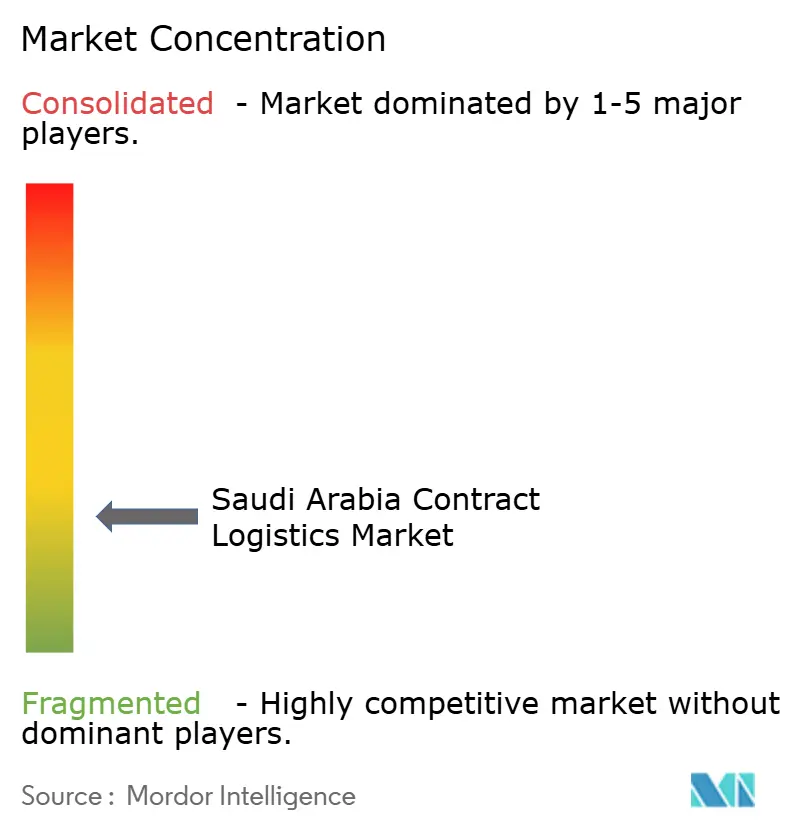
| Market Concentration | Low |
Major Players *Disclaimer: Major Players sorted in no particular order Image © Mordor Intelligence. Reuse requires attribution under CC BY 4.0. | |
Saudi Arabia Contract Logistics Market Analysis by Mordor Intelligence
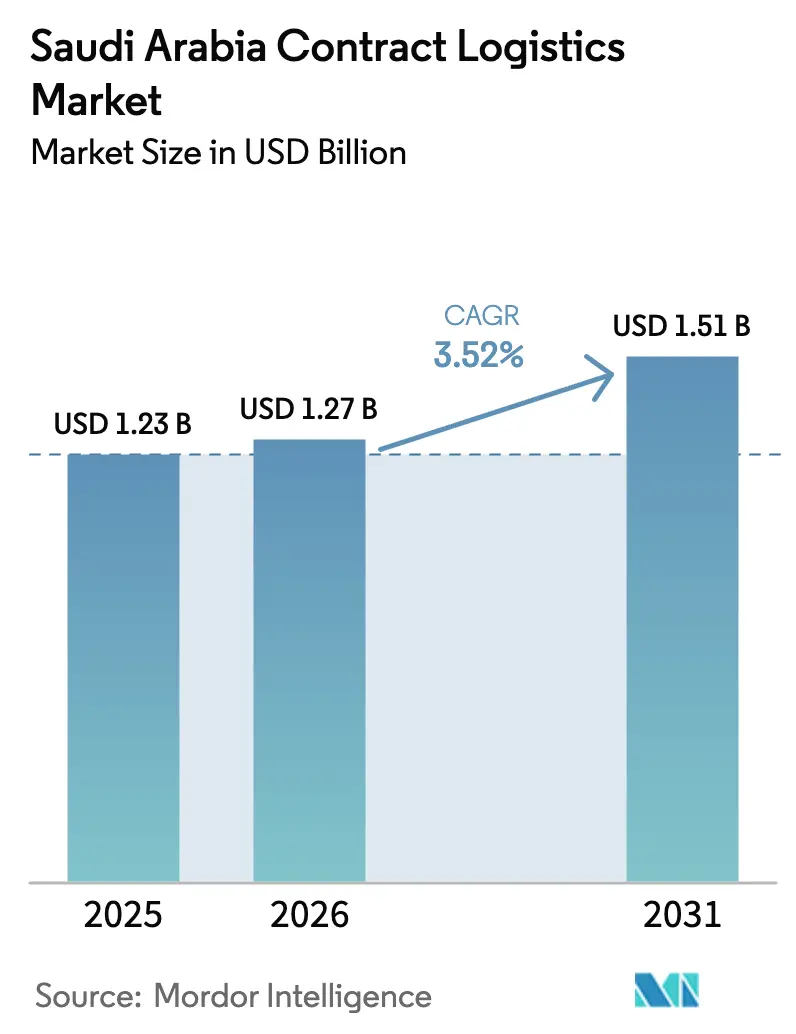
The Saudi Arabia Contract Logistics Market size was valued at USD 1.23 billion in 2025 and estimated to grow from USD 1.27 billion in 2026 to reach USD 1.51 billion by 2031, at a CAGR of 3.52% during the forecast period (2026-2031).
Vision 2030 infrastructure programs, cross-border e-commerce flows, and manufacturer outsourcing strategies position the Saudi Arabia contract logistics market for steady expansion. Transportation services continue to anchor revenue because most domestic freight still moves by road along the Riyadh–Dammam–Jeddah corridor, yet value-added services such as kitting and postponement are gathering momentum as clients seek leaner inventories. Long-term contracts dominate because shippers want supply-chain continuity, while new special economic zones grant 50-year tax holidays that draw foreign manufacturers and spur demand for bonded warehousing.
Key Report Takeaways
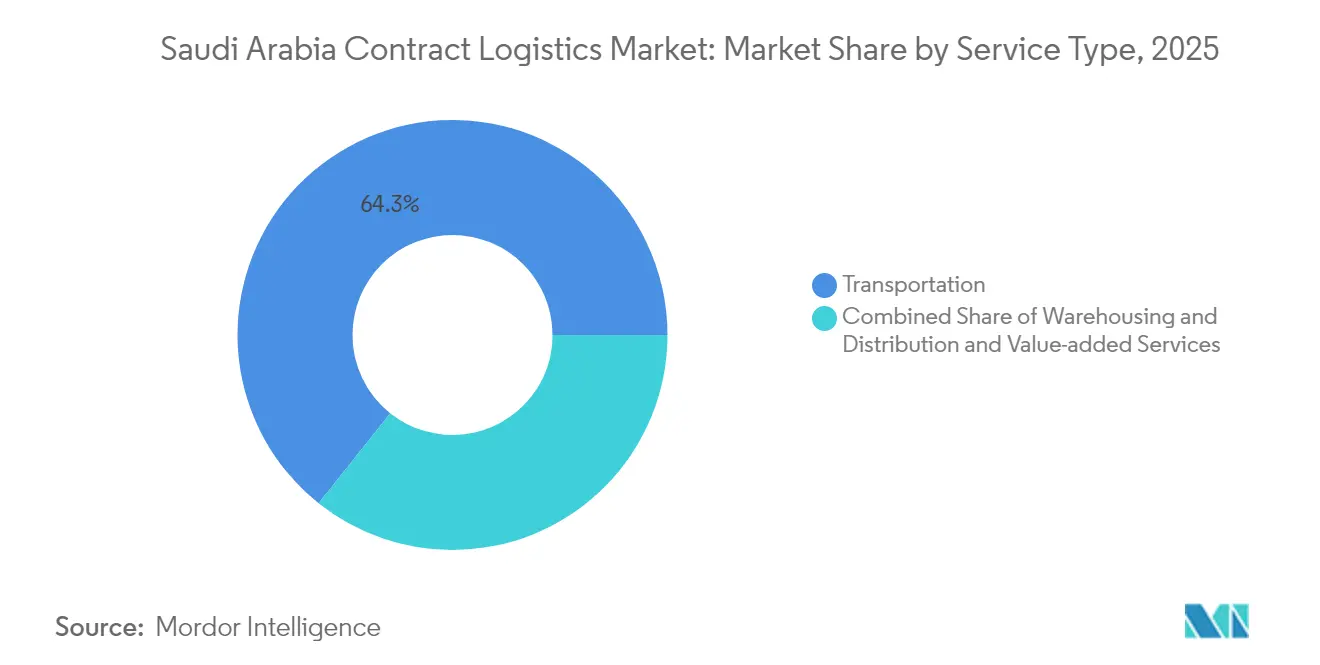
- By service type, transportation captured 64.30% of the Saudi Arabia contract logistics market share in 2025; value-added services are forecast to grow at a 3.05% CAGR through 2031.
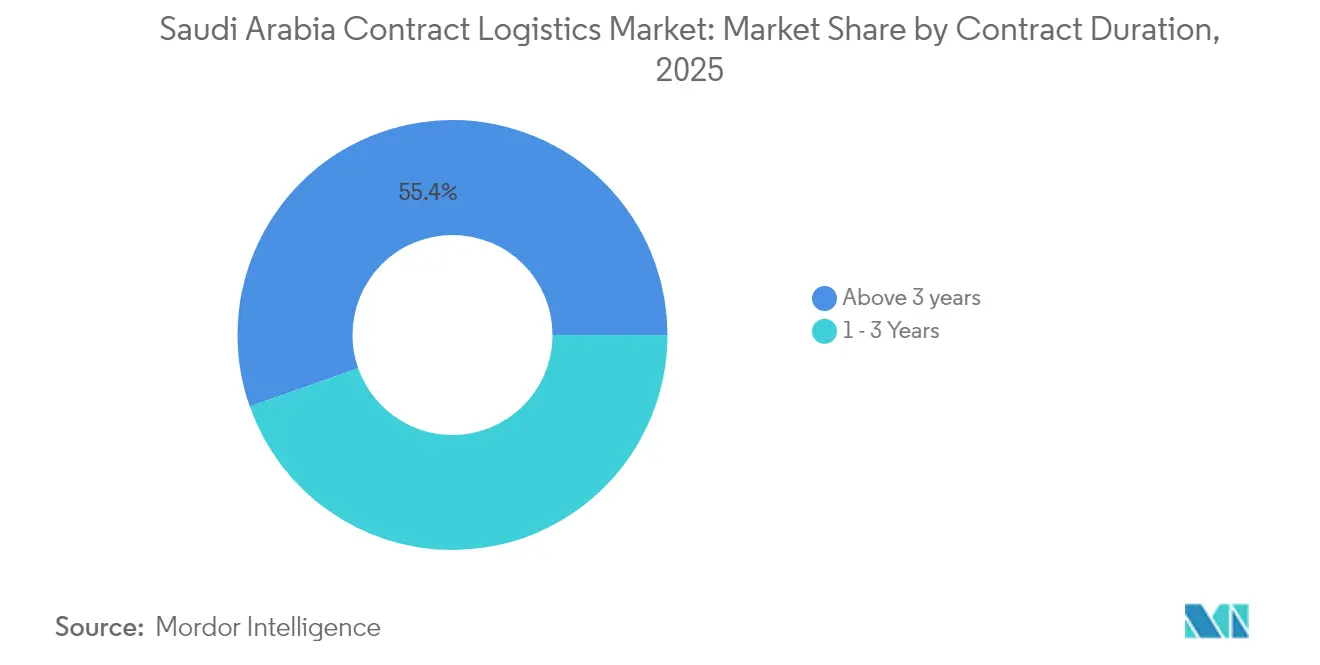
- By contract duration, agreements longer than three years held a 55.40% share in 2025, while they are projected to expand at a 3.72% CAGR to 2031.
- By end-user industry, retail and e-commerce accounted for 26.60% of the Saudi Arabia contract logistics market size in 2025; healthcare and pharmaceuticals are expected to advance at a 4.12% CAGR through 2031.
Note: Market size and forecast figures in this report are generated using Mordor Intelligence’s proprietary estimation framework, updated with the latest available data and insights as of 2026.
Market Trends and Insights
Drivers Impact Analysis of Saudi Arabia Contract Logistics Market*
| Driver | (~) % Impact on CAGR Forecast | Geographic Relevance | Impact Timeline |
|---|---|---|---|
| Vision 2030 logistics infrastructure megaprojects | +1.2% | National hubs in Riyadh, Eastern Province, NEOM | Long term (≥ 4 years) |
| Rapid e-commerce expansion & cross-border parcel flows | +0.8% | Riyadh, Jeddah, Dammam corridors | Medium term (2-4 years) |
| Manufacturer shift toward strategic outsourcing (3PL adoption) | +0.6% | Industrial zones nationwide | Medium term (2-4 years) |
| Special Economic & Logistics Zones with 50-year tax holidays | +0.4% | SILZ, KAEC, Jazan, Ras Al Khair | Long term (≥ 4 years) |
| Automation & cold-chain tech adoption | +0.3% | Major urban centers | Medium term (2-4 years) |
| Local supply-chain localization for giga-projects | +0.2% | NEOM, Red Sea, Qiddiya sites | Long term (≥ 4 years) |
| Source: Mordor Intelligence | |||
Vision 2030 Logistics Infrastructure Megaprojects
Massive port, rail, and road programs are concentrating cargo flows into purpose-built hubs that require integrated contract logistics solutions. The Saudi Port Authority has earmarked USD 4.5 billion to modernize container yards, digital gates, and bulk terminals, reducing vessel dwell times and lifting throughput reliability[1]. Rail track length will stretch from 3,650 km in 2025 to 8,000 km by 2030, compelling shippers to seek single-provider contracts covering rail, road, and warehouse processes. Private-sector participation is expected to cover 80% of logistics capital outlays, translating into SAR 240 billion (USD 64 billion) of opportunities for third-party providers. Multimodal nodes inside the planned Logistics Centers are designed with bonded storage, automated cross-docks, and customs one-stop shops, all of which intensify demand for end-to-end contract logistics agreements.
Rapid E-commerce Expansion & Cross-Border Parcel Flows
Online retail sales keep rising at double-digit rates, and parcel traffic increasingly originates from outside the Kingdom. Saudi customs agency ZATCA scrapped all export service fees in October 2024, lowering the cost of cross-border fulfillment for local merchants[2]. A flat SAR 15 (USD 4) clearance for shipments below SAR 1,000 (USD 266) boosts small-parcel economics and prompts 3PLs to add customs paperwork bundles inside their service menus. International parcel specialist J&T Express entered the Kingdom in 2024, adding competitive pressure and signaling confidence in local infrastructure. Contract logistics providers have responded by opening multi-channel fulfillment centers near airports where inventory, pick-pack, and clearance teams work under one roof.
Manufacturer Shift Toward Strategic Outsourcing (3PL Adoption)
Saudi Arabia’s Industrial Production Index rose 7.9% year-on-year in June 2025, led by an 11.1% surge in manufacturing and an 18.7% jump in chemicals. As factory capacity tightens, plant managers offload warehousing, inbound material planning, and export booking to seasoned 3PLs. Most agreements exceed three years, giving providers the time horizon to invest in fleet telematics, crane automation, and in-plant logistics cells. Local content requirements in government tenders further motivate manufacturers to partner with logistics firms that already embed Saudization programs and regulatory know-how.
Special Economic & Logistics Zones Offering 50-Year Tax Holidays
Free-trade enclaves such as the Saudi Industrial Logistics Zone grant 0% income tax for up to five decades, enticing multinationals to base Gulf distribution hubs inside the Kingdom[3]. Warehouse operators inside these zones handle bonded inventory, duty deferral, and light assembly, creating high-margin niches for contract logistics specialists. The Regional Headquarters initiative, which allows 0% corporate tax for 30 years, further cements Riyadh’s status as a control tower for Middle East supply chains.
Restraints Impact Analysis of Saudi Arabia Contract Logistics Market*
| Restraint | (~) % Impact on CAGR Forecast | Geographic Relevance | Impact Timeline |
|---|---|---|---|
| Persistent shipment visibility gaps | -0.6% | Rural lanes nationwide | Short term (≤ 2 years) |
| Road freight cost inflation amid capacity crunches | -0.4% | Intercity corridors | Medium term (2-4 years) |
| Acute shortage of skilled warehouse-automation technicians | -0.3% | Industrial parks | Medium term (2-4 years) |
| Customs-clearance unpredictability for cross-border e-commerce | -0.2% | Ports, airports, borders | Short term (≤ 2 years) |
| Source: Mordor Intelligence | |||
Persistent Shipment Visibility Gaps Across Domestic Transport
Real-time tracking remains patchy outside trunk highways, causing missed delivery windows and eroding shipper confidence. Although larger carriers deploy IoT tags and geofencing, many subcontracted trucks still rely on manual status updates. The deficiency is acute for cold-chain pharmaceuticals that require continuous temperature logs for regulatory audits. FSL Saudi’s Frescon dashboard, launched in 2025, is one of the few locally built platforms offering end-to-end multimodal visibility.
Acute Shortage of Skilled Warehouse-Automation Technicians
Saudi labor laws encourage local hiring, yet certified technicians able to install and maintain AS/RS cranes, AMRs, and sortation belts remain scarce. Bahri Logistics partnered with the Saudi Logistics Academy in 2024 to run mechatronics up-skilling cohorts, but the talent pipeline will take years to match demand. Smaller 3PLs struggle to fund scholarships, hindering the broad adoption of productivity-boosting automation.
*Our forecasts treat driver/restraint impacts as directional, not additive. The impact forecasts reflect baseline growth, mix effects, and variable interactions.
Saudi Arabia Contract Logistics Market Segment Analysis
By Service Type:
Transportation Dominance Drives Market StructureTransportation services generated 64.30% of 2025 revenue, reaffirming their status as the backbone of the Saudi Arabia contract logistics market. Road haulage remains irreplaceable for east-west flows that feed population centers and oil complexes. The Saudi Arabia contract logistics market size attributable to transportation is set to expand modestly as fleet telematics, drop-and-hook models, and rail-road intermodal lanes lift asset utilization. Value-added services, although smaller in absolute terms, are forecast to outpace all other categories with a 3.05% CAGR through 2031 because shippers now prefer to outsource postponement, labeling, and light assembly together with core carriage.
The shift reflects a broader transition toward one-stop solutions where 3PLs assume inventory risk in multi-client campuses. Mandatory palletization rules issued under Circular 6/2025 stimulate demand for pre-stow engineering, while e-commerce sellers request late-cut-off cross-docks that blend parcel sortation with returns handling. Providers that deploy automated put-wall stations and cloud WMS can command premium yields, sharpening competitive lines inside the Saudi Arabia contract logistics market.

By Contract Duration:
Long-Term Partnerships Reflect Strategic RelationshipsContracts exceeding three years controlled 55.40% of 2025 billings and are projected to widen their lead with a 3.72% CAGR to 2031. The tilt toward long tenors underpins capex-heavy investments in dedicated fleets, climate-controlled chambers, and IT integrations that would be uneconomical under short retainers. Consequently, many global shippers negotiate gain-share clauses that reward 3PLs for continuous improvement savings, locking both sides into partnership mindsets rather than transactional bidding cycles.
Shorter 1–3-year contracts persist in industries with rapidly shifting demand or in pilot projects where clients test service quality before full rollout. Still, the structural preference for longer durations signals the Saudi Arabia contract logistics market’s maturing risk profile. Providers with robust balance sheets and ISO-certified processes capture the largest slices because they can guarantee service continuity over multi-year concessions aligned to giga-project construction schedules.
By End-User Industry:
Healthcare Transformation Drives Fastest GrowthRetail and e-commerce remained the prime demand engine, contributing 26.60% of total 2025 revenue as smartphone adoption and digital wallets lift online spending. Yet healthcare and pharmaceuticals show the sharpest trajectory, tracking a 4.12% CAGR through 2031 thanks to a projected USD 7.04 billion domestic pharma market by 2028. The Saudi Arabia contract logistics market size linked to healthcare is expected to grow faster than any other segment because hospitals mandate GDP compliance, validated cold boxes, and batch-level traceability.
Manufacturing, automotive, chemicals, and food-and-beverage segments deliver steady baseline volumes that cushion cyclicality in consumer spending. Hazardous-goods handling and ISO tank cleaning services add revenue diversity for chemical shippers, while halal food exporters require HACCP-certified storage. The multiplicity of verticals reduces reliance on a single customer set, reinforcing resilience in the Saudi Arabia contract logistics market.
Geography Analysis
Riyadh and its surrounding Central Province generate the highest contract logistics spend, leveraging a population above 7 million and a growing cluster of regional headquarters. E-commerce volumes funneled into the province’s automated fulfillment centers underscore its role as a national distribution fulcrum. Jeddah anchors the Western Province with King Abdulaziz Port handling Red Sea trade lanes, pilgrimage flows, and new hospitality builds that require synchronized hotel-OS&E supply chains.
The Eastern Province benefits from oil-field services, petrochemicals, and metals processing near Jubail and Ras Al Khair. As refineries diversify into specialty chemicals, storage and drumming operations enlarge value-added revenue pools for contract logistics providers. Northern and Southern border areas enjoy new truck stops, bonded yards, and customs e-gateways that simplify trade with Jordan, Iraq, Yemen, and Oman, broadening the geographic spread of the Saudi Arabia contract logistics market.
Regulatory Landscape
Saudi Arabia’s contract logistics operations are governed by a multi-agency framework. The Transport General Authority (TGA) leads on commercial land transport licensing and compliance, including registration through the Wasl platform and vehicle inspection requirements. The Road Transport Law (2025) also shapes how 3PLs structure logistics centers, terminals, and distribution hubs, including the way dedicated and multi-client sites are operated and how subcontracted capacity is managed.
Rules affecting last-mile and cross-border parcels are tightening. From 1 January 2026, parcel delivery operators must reject shipments without a valid National Address, which increases the need for improved address data capture and onboarding workflows by both shippers and 3PLs. The TGA also introduced a regulatory framework for autonomous vehicle testing and operations in April 2026, and it set a 27 August 2026 deadline for correcting land-transport status. That timeline adds near-term compliance and fleet-documentation work for carriers supporting contract logistics networks.
Value Chain Analysis
The value chain starts with shippers, including manufacturers, retailers/e-commerce operators, healthcare providers, and chemicals firms. These customers outsource integrated services to 3PLs that bundle transport management, warehousing, and value-added activities such as labeling, kitting, and light assembly under multi-year contracts. Inbound cargo typically enters through sea gateways, with Jeddah Islamic Port functioning as a primary node, and port-adjacent logistics clusters around Jeddah (including the Khumrah area) then feed distribution to Riyadh and the Eastern Province via road and, increasingly, intermodal corridors.
Upstream and midstream enablers include port operators and industrial zone developers that provide bonded and multi-user facilities. Technology providers also sit in the middle of the chain, supplying WMS/TMS, track-and-trace, and customs documentation toolsets to address faster parcel-clearance requirements and ongoing visibility demands. Jeddah Islamic Port has 17 logistics centers currently operational, reinforcing a port-centric network for container stripping, cross-docking, and inventory postponement. On the network layer, the Logistics Corridors Initiative (launched March 2026) supports cargo transfer between GCC ports and Red Sea gateways such as Jeddah, complementing emerging hubs like Oxagon (NEOM) for high-control, project-driven supply chains.
Competitive Landscape
The Saudi Arabia contract logistics market hosts a blend of global integrators, regional champions, and homegrown specialists. DHL, DSV, and Maersk leverage worldwide networks, standardized IT stacks, and compliance protocols to service multinational customers. DHL’s 2025 pledge to invest EUR 500 million (USD 520 million) across Gulf countries, alongside its joint venture with Aramco’s ASMO, showcases long-term confidence in the Kingdom’s growth arc.
Regional operators such as Aramex and CEVA Logistics exploit deep familiarity with GCC customs processes and Arabic-language service desks. CEVA’s 2024 tie-up with Almajdouie created a hybrid entity that blends international SOPs with local asset bases, forming one of the largest multi-client platforms inside the Saudi Arabia contract logistics market. Domestic groups, including NAQEL Express, Almajdouie, and Bahri Logistics, excel in regulatory navigation, Saudization compliance, and desert-condition fleet maintenance, winning sizable shares of government and energy vertical contracts.
Technology intensity increasingly differentiates competitors. Market leaders deploy robotics, AI-driven slotting algorithms, and digital twins to deliver double-digit productivity gains. Bahri’s Infor WMS integration produced real-time labor visibility and 30% faster dock-to-stock cycles, sharpening its appeal to pharmaceutical importers. Smaller players may turn into acquisition targets if they cannot meet the capital demands of automation and ESG retrofits. The current configuration suggests gradual consolidation, yet niche specialists offering cold-chain or giga-project logistics continue to enter, preserving moderate market fragmentation.
Saudi Arabia Contract Logistics Industry Leaders
-
Almajdouie Group
-
Aramex
-
GAC
-
Bahri Logistics.
-
NAQEL Express
- *Disclaimer: Major Players sorted in no particular order
Saudi Arabia Contract Logistics Market Companies Covered in this Report
- Almajdouie Group
- Aramex
- GAC
- Bahri Logistics.
- NAQEL Express
- DHL Supply Chain
- DSV
- Yusen Logistics
- CEVA Logistics
- UPS Supply Chain Solutions
- FedEx Logistics
- Kuehne + Nagel
- Mosanada Logistics Services
- Hala Supply Chain Services
- Hoopoe Cargo and Logistics
- Al-Rashed Transport
- A2B Logistics
- TA Logistics
- Spine Logistics
- JIT-Ex
Market Opportunities and Future Outlook
Special Economic Zones (SEZs) create clear whitespace for contract logistics providers that can operate bonded warehousing, duty deferral, and light-manufacturing logistics under long-tenor agreements. Saudi Arabia has established five SEZs (including Riyadh Integrated, Jazan, Ras Al-Khair, and KAEC), and these zones reward 3PLs that can combine customs-facing services with value-added activities such as labeling and kitting for re-export and domestic distribution.
Port-proximate capacity build-outs are another opportunity area, because they convert public and developer investment into multi-user logistics demand. Investment tied to 34 logistics centers at ports exceeds SAR 15 billion, and Mawani has announced SAR 641 million (USD 170 million) for cargo handling expansion at Jeddah Islamic Port, increasing requirements for yard, warehouse, and distribution contracts. Along the Red Sea growth corridor, Port of NEOM (Oxagon) has invested over SAR 7.5 billion (USD 2 billion) in sustainable infrastructure, creating demand for providers focused on cold-chain, project logistics, and high-visibility control-tower offerings. In parallel, compliance-driven service design, including the 2026 National Address requirement for parcel acceptance, supports differentiated offerings in address validation, returns processing, and multi-channel fulfillment near major airports and urban clusters.
Recent Industry Developments in Saudi Arabia Contract Logistics Market
- July 2026: Saudi Ports Authority Mawani signed seven contracts worth SAR1 billion (USD 262 million) to develop and expand logistics centres at Jeddah Islamic Port and Al Khumra Logistics Zone. The move expands port-adjacent warehousing and container yard capacity, enabling higher handling volumes and regional clustering of logistics activities. The contracts also signal a acceleration of public-private collaboration to scale Saudi Arabia's contract logistics footprint near key maritime gateways.
- February 2026: Modon (Saudi Industrial Cities) / Medlog (MSC logistics arm) investment agreement for a SAR 137 million (USD 36.5 million) integrated logistics zone in Jeddah's Third Industrial City. The agreement strengthens integrated logistics zone footprint in a key Saudi port-adjacent area. The partnership accelerates MSC Medlog presence and regional warehousing consolidation and cross-border flows.
- January 2026: Ministry of Transport and Logistics Services (Saudi Arabia) reported that the Saudi logistics sector has secured over SAR 280 billion (USD 74.6 billion) in total investment contracts. Macro investment momentum in Saudi logistics sector supports long-term growth in contract logistics, infrastructure build-outs, and sector-wide capacity expansion.
Saudi Arabia Contract Logistics Market Report Scope and Research Methodology
Market Definition and Coverage
For this study, the market covers outsourced contract logistics services delivered in Saudi Arabia under formal agreements, where a provider manages all or part of a customer's logistics activities for an agreed fee.
Scope exclusions: Pure in-house logistics operations, asset sales (such as forklifts or racking), and standalone construction of warehouses are not counted unless tied to an ongoing logistics service contract.
Segments Covered in This Report
- By Service Type
- Transportation
- Road
- Rail
- Air
- Sea
- Warehousing & Distribution
- Value-added Services (Assembly, Labelling, Kitting)
- Transportation
- By Contract Duration
- 1 – 3 Years
- Above 3 years
- By End-user Industry
- Manufacturing & Automotive
- Food & Beverage
- Retail & E-commerce
- Healthcare & Pharmaceuticals
- Chemicals
- Other Industries
Data Sources, Market Sizing, and Validation
Desk Research
Desk research is used to set the operating context and to anchor the model to measurable logistics activity. We rely on public data series that indicate demand, such as Saudi trade and customs releases, the General Authority for Statistics (GaStat) for sector output and business activity, Saudi Central Bank (SAMA) indicators, and transport and logistics updates from the Ministry of Transport and Logistics Services, alongside port and airport traffic disclosures where available.
We also review company annual reports and investor presentations for service mix cues, contract duration patterns, and capacity expansion notes, which help refine how revenue is split across transportation, warehousing and distribution, and value-added services. To avoid missing smaller operators, supporting inputs are checked using paid subscriptions for company financials and intelligence, an import and export shipment-level database, and a logistics supply chain and freight rate database where it applies. The sources listed here are illustrative, and many other public documents and datasets were also used for collection, cross-checking, and clarification.
Primary Interviews and Surveys
Primary work is used to test the desk assumptions that are hardest to observe from public sources, especially service scope boundaries, pricing behavior, and how much work is truly outsourced versus managed internally. We speak with logistics providers, large shippers, and channel experts across core hubs like Riyadh, Jeddah, and the Eastern Province so that rate movements, warehouse utilization, and contract renewal behavior can be validated before the final model is locked.
Distribution of primary research fieldwork respondents
| Company type | Respondent position |
|---|---|
| Top tier: 36% | CXOs: 13% |
| Mid tier: 45% | Functional/Unit leaders: 38% |
| Smaller Players: 19% | Managers: 49% |
Market-Sizing & Forecasting
Sizing starts from a top-down build that uses Saudi logistics demand signals to reconstruct the outsourced revenue pool, and then it is narrowed to contract-managed activities by service type and end-user. The model is subsequently corroborated with selective bottom-up checks, such as sampled price per pallet position or per square meter for warehousing, lane-based transport pricing where it is observable, and provider revenue splits from interviews and public filings.
A few practical inputs keep the model grounded, including import and export throughput trends, industrial production and retail trade growth, e-commerce order intensity proxies, warehousing capacity additions and occupancy patterns, and contract duration mix (1 to 3 years versus above 3 years), which affects renewal timing and price resets. When bottom-up visibility is limited for smaller providers, gaps are handled through penetration assumptions by end-user and by applying conservative ranges that are stress-tested with shipper feedback.
For forecasting, we mainly use scenario analysis supported by trend extrapolation, since macro drivers, infrastructure project timing, and outsourcing appetite can shift the slope year to year. The scenarios are built around expected changes in trade activity, non-oil sector growth, and warehouse expansion pipelines, and then we apply reasonability checks so the resulting growth stays consistent with known capacity and service constraints.
Data Validation & Update Cycle
Validation is done through multiple checkpoints so that the final numbers are not dependent on one dataset or one interview. Model outputs are compared against independent signals such as trade volumes, sector growth indicators, and observed rate movements, followed by variance checks where any unusual step-change is flagged and re-tested. If a gap remains, we re-contact sources to confirm whether a contract win, pricing reset, or policy change explains the shift.
Before sign-off, the work is reviewed in steps by analysts who did not build the first draft model, which helps catch unit issues, double counting, or missing scope items. Reports are refreshed annually, and interim updates are made when material events affect demand, pricing, or capacity. Right before delivery, a final pass is completed so clients receive an up-to-date view.
Mordor Intelligence's Saudi Arabia Contract Logsitics Market Sizing Compared With Other Published Estimates
Published market sizes for Saudi Arabia contract logistics often do not match because the underlying scope is not consistent, and the revenue boundary between outsourced contract work and broader logistics spend gets treated differently. Differences also appear when one estimate counts only warehousing and distribution contracts, while another blends in general 3PL, freight forwarding, or spot transport that is not managed under a contract.
The largest gap drivers usually come from what is counted as contract logistics revenue, how value-added services are priced inside bundled agreements, and whether the estimate uses a base case or a more aggressive demand outlook tied to large project timelines. Currency timing and refresh cadence matter too, since transport rates and warehouse pricing can move within a year, and older assumptions can stay in the model longer than they should.
Benchmark comparison
| Source | Market Size | Gaps in Research Methodology |
|---|---|---|
| Mordor Intelligence | USD 1.23 B (2025) | |
| Industry Association A | USD 1.45 B (2025) | This figure appears to include a wider outsourced logistics spend pool, where ad-hoc transportation and freight forwarding activity can be blended with contract-managed services, which lifts the total versus a contract-only view. |
| Regional Consultancy B | USD 1.05 B (2026) | This estimate looks narrower on service scope and may treat value-added services as pass-through costs inside contracts, and it also starts from a later year which can suppress the level if rate resets are assumed to normalize quickly. |
The table shows that most of the spread is explained by contract scope choices and by how bundled services are priced and timed. By keeping spot and freight forwarding revenues outside the total unless they are part of a contracted, managed service, and by refreshing pricing and outsourcing assumptions through re-checks tied to trade and capacity indicators, the resulting number stays more repeatable, which is the approach used by Mordor Intelligence.
Key Questions Answered in the Report
How large is the Saudi Arabia contract logistics market in 2026?
The market is valued at USD 1.27 billion in 2026 and is forecast to reach USD 1.51 billion by 2031.
Which service type generates the highest revenue?
Transportation services account for 64.30% of 2025 revenue, reflecting the dominance of road and emerging rail freight.
Which end-user segment is expanding fastest?
Healthcare and pharmaceuticals is projected to grow at a 4.12% CAGR through 2031 on the back of rising cold-chain demand.
What drives the preference for long-term logistics contracts?
Multi-year Vision 2030 projects and capex-intensive automation encourage shippers and 3PLs to lock in agreements longer than three years.
How do special economic zones affect logistics demand?
SEZs grant 50-year tax holidays and bonded procedures, drawing manufacturers that require dedicated warehousing, customs, and value-added services.