
Texas Freight And Logistics Market Size and Share
Market Overview
| Study Period | 2020 - 2031 |
|---|---|
| Forecast Data Period | 2026 - 2031 |
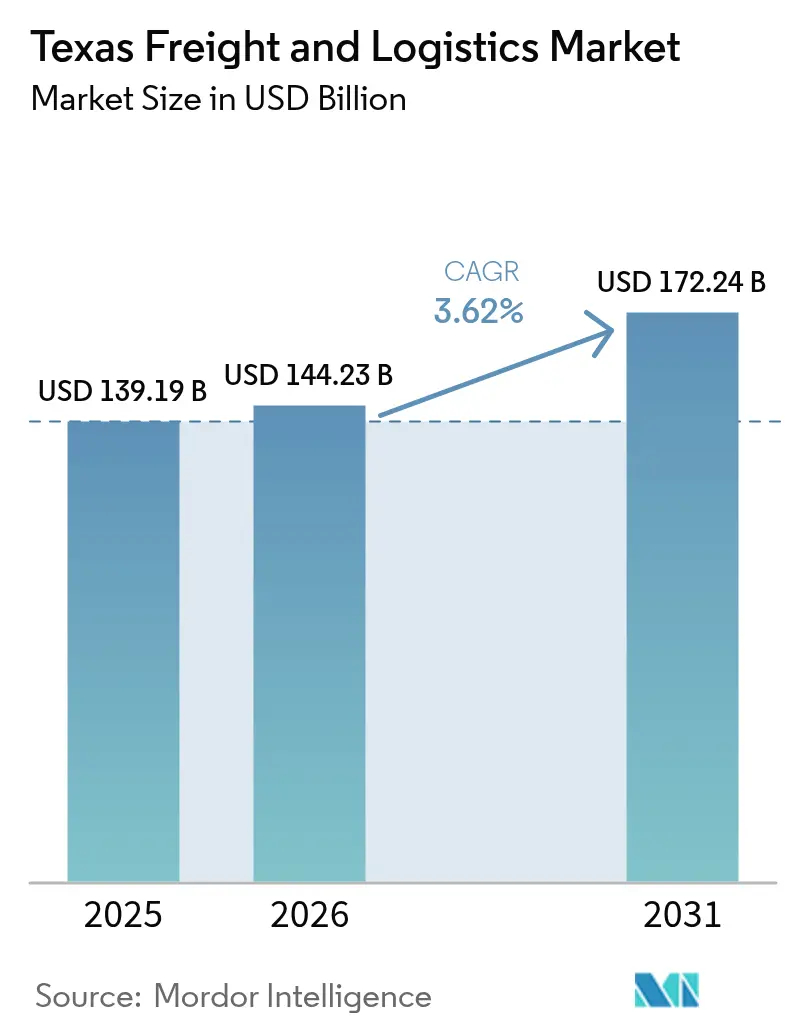
| Base Year Market Size (2025) | USD 139.19 Billion |
| Market Size (2026) | USD 144.23 Billion |
| Market Size (2031) | USD 172.24 Billion |
| Growth Rate (2026 - 2031) | 3.62 % |
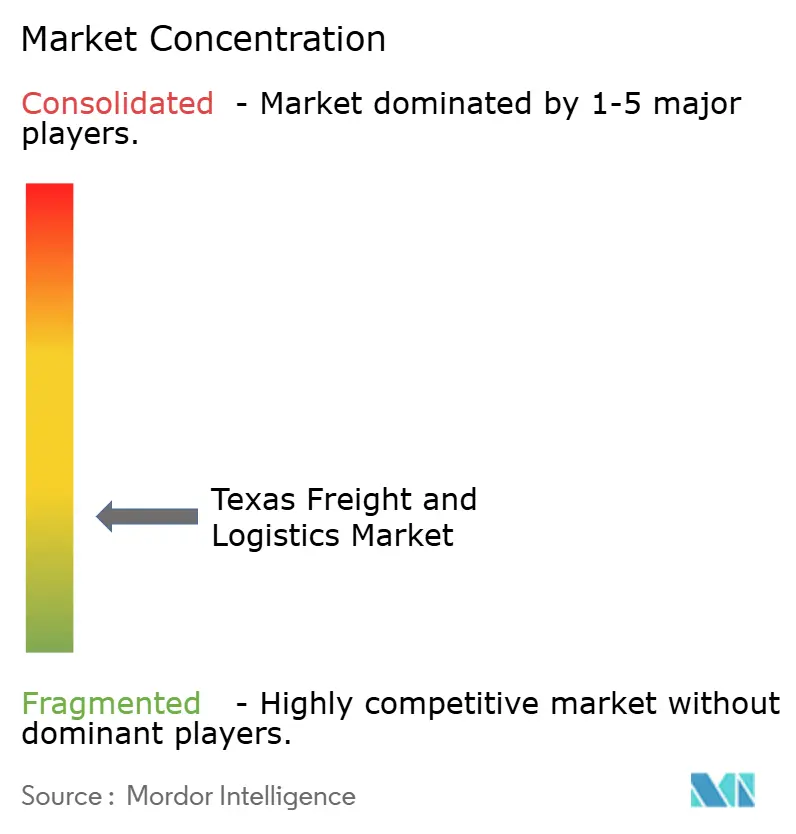
| Market Concentration | Low |
Major Players *Disclaimer: Major Players sorted in no particular order Image © Mordor Intelligence. Reuse requires attribution under CC BY 4.0. | |
Texas Freight And Logistics Market Analysis by Mordor Intelligence
The Texas Freight And Logistics Market size was valued at USD 139.19 billion in 2025 and estimated to grow from USD 144.23 billion in 2026 to reach USD 172.24 billion by 2031, at a CAGR of 3.62% during the forecast period (2026-2031).
The steady climb of the market rests on the state’s role as the United States’ primary gateway to Mexico, where surging cross-border trade aligns with accelerating nearshoring activity. Semiconductor fabrication megaprojects, renewable-energy buildouts, and an expansive e-commerce fulfillment network amplify freight flows across road, rail, air, sea, and pipeline assets, stabilizing demand even as individual sectors fluctuate. The Texas freight and logistics market benefits from government incentives under the CHIPS Act and Inflation Reduction Act, which add long-term project visibility for heavy-haul carriers supporting oversized cargo moves. Moderate competitive intensity persists because 20 national and regional players address a wide set of niche demands, from temperature-controlled warehousing to AI-enabled cross-border brokerage. Structural headwinds—chiefly truck-parking shortages on the I-35 and I-10 corridors, intermodal rail pinch-points in Houston and Dallas-Fort Worth, and hurricane-driven Gulf Coast disruptions—temper growth but do not derail the broader expansion trajectory.
Key Report Takeaways
- By logistics function, freight transport led with 61.85% revenue share in 2025; freight forwarding is projected to expand at a 3.87% CAGR through 2031.
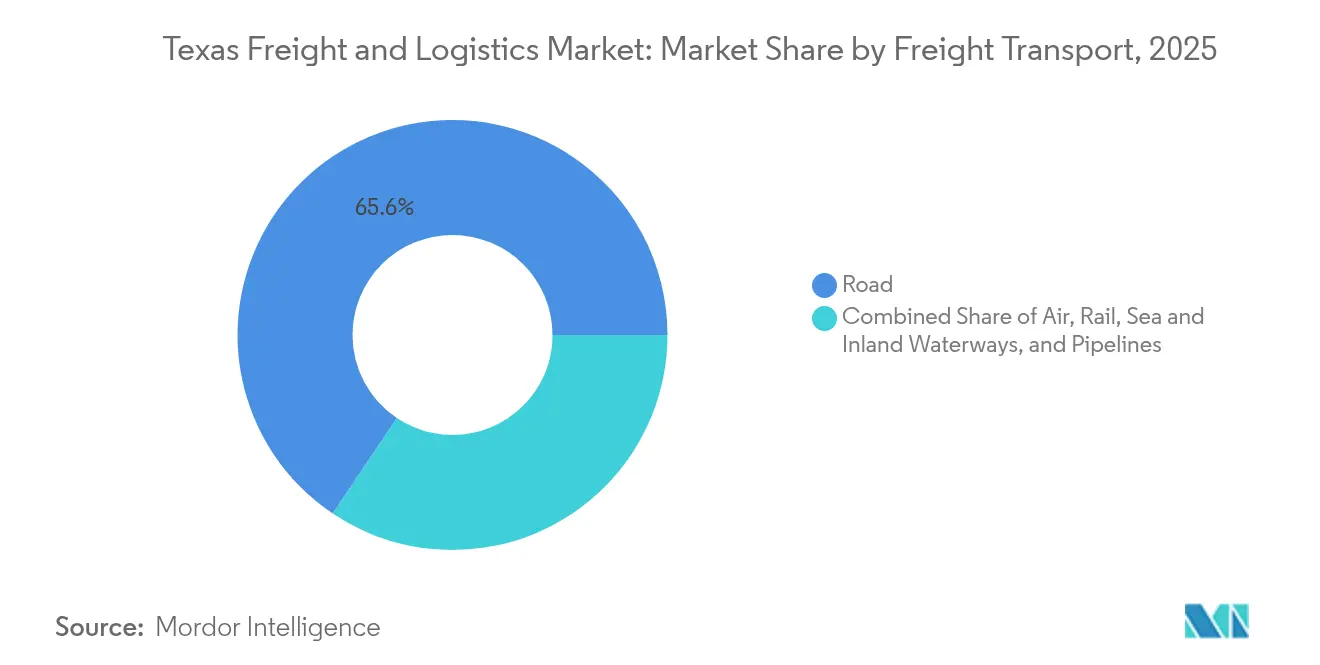
- By freight transport mode, road accounted for 65.60% of the Texas freight and logistics market share in 2025, while air freight exhibits the fastest 4.02% CAGR outlook.
- By CEP destination, domestic shipments held 87.12% share of the Texas freight and logistics market size in 2025; international CEP is expected to grow at a 4.16% CAGR to 2031.
- By warehousing temperature control, non-temperature facilities captured 73.55% of the Texas freight and logistics market size in 2025, whereas temperature-controlled space is advancing at a 4.05% CAGR through 2031.
- By freight forwarding mode, air services commanded 42.62% of segment revenue in 2025 and are forecast to post a 4.09% CAGR to 2031.
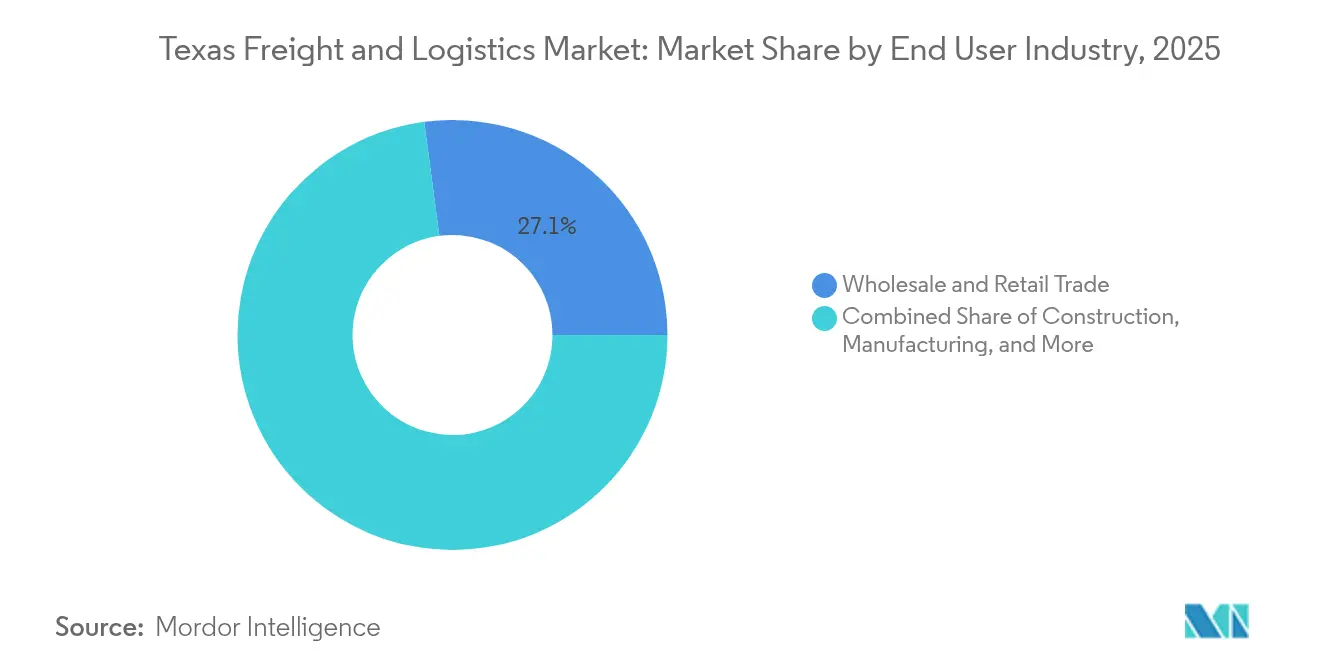
- By end user, wholesale and retail trade held 27.10% of the Texas freight and logistics market share in 2025 and is growing the fastest at a 4.32% CAGR.
Note: Market size and forecast figures in this report are generated using Mordor Intelligence’s proprietary estimation framework, updated with the latest available data and insights as of 2026.
Texas Freight And Logistics Market Trends and Insights
Drivers Impact Analysis*
| Driver | (~) % Impact on CAGR Forecast | Geographic Relevance | Impact Timeline |
|---|---|---|---|
| E-commerce fulfillment boom | +0.8% | Dallas–Fort Worth, Houston, Austin metros | Medium term (2-4 years) |
| Near-shoring flows from Mexico | +0.9% | South Texas border regions, I-35 corridor | Short term (≤ 2 years) |
| Energy-transition oversized cargo | +0.6% | Gulf Coast petrochemical corridor, East Texas | Long term (≥ 4 years) |
| Connected-freight corridor tech pilots | +0.4% | Dallas–Houston–San Antonio triangle | Medium term (2-4 years) |
| Rapid warehouse automation | +0.5% | Major metro distribution centers statewide | Short term (≤ 2 years) |
| Federal CHIPS/IRA semiconductor subsidies | +0.7% | Austin–San Antonio corridor | Long term (≥ 4 years) |
| Source: Mordor Intelligence | |||
E-commerce Fulfillment Boom Reshaping Distribution Footprints
Amazon’s statewide rollout of large-package delivery capabilities signals a decisive shift toward handling bulkier items that dominate e-commerce growth[1]. Texas distribution centers are reconfiguring dock space and adopting automated sortation to process furniture, appliances, and home-improvement goods more efficiently. Cold-storage landlords are retrofitting facilities for rapid grocery fulfillment as online food orders climb. Robotics providers report double-digit throughput gains when AI-driven inventory systems replace manual picking, accelerating turnover rates in key Dallas-Fort Worth and Houston submarkets. These productivity improvements reinforce Texas freight and logistics market competitiveness by compressing delivery windows and reducing labor costs.
Near-shoring Flows from Mexico Boosting Cross-Border Truckload
Mexico surpassed China as America’s top trade partner, driving a sharp rise in truck crossings at Laredo, Pharr, and El Paso[2]. Automotive and electronics parts now traverse the I-35 corridor at volumes that strain existing rest-area and bridge capacity. To preserve cycle times, brokers deploy predictive analytics to pre-clear customs data and schedule off-peak staging. Carriers with bilingual dispatch teams and C-TPAT certifications gain an edge in winning multiyear contracts from nearshoring manufacturers. These developments elevate the strategic importance of the Texas freight and logistics market for nationwide supply-chain managers seeking resilient regional networks.
Energy Transition Investments Spiking Oversized Cargo
ExxonMobil, Occidental, and other majors are channeling billions into blue hydrogen, carbon capture, and wind projects along the Gulf Coast, each requiring modules that weigh hundreds of tons[3]. Heavy-haul specialists secure premium rates to navigate route surveys, bridge engineering approvals, and night-move escorts across rural highways. Concurrent pipeline and compressor-station construction stimulates steady demand for specialized trailers and rigging crews. Permitting reforms by state agencies compress project timelines, leading shippers to lock in multi-year capacity with carriers that possess demonstrated compliance records. The Texas freight and logistics market, therefore, benefits from a distinct oversized-cargo revenue stream insulated from broader economic cycles.
Connected-Freight Corridor Tech Pilots Improving Asset Turns
TxDOT’s Connected and Automated Transportation initiative outfits the Dallas–Houston–San Antonio triangle with roadside sensors and vehicle-to-infrastructure communications[4]. Real-time routing updates trim peak-hour delays for truck fleets, while predictive maintenance alerts reduce unscheduled downtimes. Early field data show faster average speeds on pilot segments, enabling carriers to squeeze an extra weekly turn from long-haul tractors. Shippers reward that reliability with volume commitments, reinforcing the competitive standing of digitally enabled operators within the Texas freight and logistics market.
Restraints Impact Analysis*
| Restraint | (~) % Impact on CAGR Forecast | Geographic Relevance | Impact Timeline |
|---|---|---|---|
| Severe truck-parking deficit | –0.6% | I-35 Laredo–Dallas; I-10 El Paso–Houston | Short term (≤ 2 years) |
| Rail capacity pinch-points | –0.4% | Houston Ship Channel; Dallas-Fort Worth | Medium term (2-4 years) |
| Gulf-Coast extreme-weather disruptions | –0.5% | Houston metro, Gulf petrochemical corridor | Long term (≥ 4 years) |
| Driver and warehouse labor shortages | –0.3% | Rural counties and smaller metros | Medium term (2-4 years) |
| Source: Mordor Intelligence | |||
Severe Truck-Parking Deficit Along I-35 and I-10 Corridors
Truck stops on the Laredo-to-Dallas stretch operate at over 100% of design capacity during peak evenings, forcing drivers to stage on highway shoulders. Lost time securing legal parking erodes productivity and inflates detention costs. Hours-of-service limits, unchanged since the pandemic, magnify the operational hit when safe parking is scarce. State grants for new rest-area construction remain years away from delivery, meaning carriers must bake larger time buffers into schedules—an inefficiency that drags on the Texas freight and logistics market CAGR.
Gulf-Coast Extreme-Weather Disruptions Raising Insurance and Re-Routing Costs
Hurricane Beryl shuttered the Houston Ship Channel for four days in 2024 and cut electricity to distribution centers serving half the Gulf region. Insurers subsequently boosted premiums for warehouses inside the storm-surge zone. Carriers now pre-plan hurricane detours that add hundreds of miles to lanes connecting petrochemical exporters with Midwest buyers. These cost spikes weigh on competitiveness for operators anchored to Gulf infrastructure.
*Our forecasts treat driver/restraint impacts as directional, not additive. The impact forecasts reflect baseline growth, mix effects, and variable interactions.
Segment Analysis
By End User Industry: Wholesale and Retail Trade Drives Dual Leadership
Wholesale and retail trade captured 27.10% of the Texas freight and logistics market size in 2025 and is posting the highest 4.32% CAGR (2026-2031). Expansion of mega-fulfillment centers by both Amazon and traditional big-box retailers positions Texas as a national inventory staging point.
Manufacturing ranks second as semiconductor, aerospace, and machinery makers increase output destined for domestic and export customers. Energy extraction and processing remain core, but diversification into renewables tilts freight mix toward oversized turbines and hydrogen modules. Construction logistics stay robust on industrial capex cycles, while agricultural exports of beef, cotton, and grains sustain a meaningful baseline of specialized reefer and bulk freight.

By Logistics Function: Freight Transport Anchors Market Leadership
Freight transport generated 61.85% of the Texas freight and logistics market size in 2025, underscoring the state’s function as a continental transit hub linking Mexican factories, Gulf Coast refineries, and inland consumption centers. Robust intermodal connectivity enables carriers to shift seamlessly among road, rail, and waterway options, supporting commodity flows ranging from refined fuels to retail merchandise. Established 3PLs leverage economies of scale to lock in contract rates, while specialized heavy-haul operators capture premiums on equipment destined for semiconductor fabs and hydrogen plants.
The outlook through 2031 shows freight forwarding expanding at a 3.87% CAGR as nearshoring raises demand for customs brokerage, trade-compliance consulting, and multimodal coordination. Courier, express, and parcel (CEP) specialists face intensifying competition from retailer-controlled delivery networks, pushing them to differentiate via regional sort-center density and real-time visibility. Warehousing and storage providers use automation to trim operating ratios, while value-added “other services” such as sustainability audits and supply-chain risk modeling gain traction among ESG-focused shippers.
By Courier, Express, and Parcel Destination: Domestic Shipments Drive Volume
Domestic CEP dominated with an 87.12% share of the Texas freight and logistics market size in 2025, reflecting proximity to population clusters across the southern and central United States. Same-day and next-day expectations pressure carriers to densify micro-fulfillment nodes in Austin and San Antonio for rapid regional deliveries.
International CEP lanes exhibit a 4.16% CAGR (2026-2031) outlook as ship-from-Mexico replenishment strategies mature. Cross-border e-commerce parcels cross at Laredo and Brownsville under streamlined Section 321 rules, favoring brokers that offer embedded customs data tools. The large-package subsector grows faster than small parcel as furniture, appliances, and fitness equipment subscriptions accelerate, compelling CEP leaders to invest in oversized sortation systems.
By Warehousing and Storage Temperature Control: Automation Reshapes Non-Temperature Operations
Non-temperature warehouses held 73.55% of the Texas freight and logistics market size in 2025, servicing electronics, automotive, and general merchandise inventories. Robotics deployments trim labor hours per unit moved, elevating throughput and shrinkage control.
Temperature-controlled facilities, while a smaller slice, post a 4.05% CAGR (2026-2031) as pharmaceutical and grocery categories demand near-perfect cold-chain integrity. Americold’s newly acquired Houston site deploys mobile racking and AS/RS cranes, doubling pallet density relative to conventional configurations. FDA and USDA rules raise the compliance bar, presenting hurdles for new entrants but reinforcing value capture for incumbent cold-chain specialists.
By Freight Transport Mode: Road Dominance Faces Modal-Shift Pressures
Road carriers retained 65.60% of the Texas freight and logistics market share in 2025, buoyed by the flexibility required for last-mile delivery, cross-border trucking, and petrochemical drayage. Consistent lane density along the I-35 spine supports favorable backhaul ratios that keep rates competitive with rail on trips under 500 miles.
Air freight, although just a mid-single-digit slice of volume, leads modal growth at a 4.02% CAGR (2026-2031) as semiconductor component flows and next-day e-commerce transactions speed up. Railroads battle terminal congestion despite continuous capital outlays, while the Houston Ship Channel’s widening elevates barge and container volumes. Pipeline mileage for carbon dioxide expands quietly, supporting CCS projects that diversify the Texas freight and logistics market revenue base.
By Freight Forwarding Mode: Air Services Lead Growth Despite Constraints
Air freight forwarding secured 42.62% of forwarding revenue in 2025 and is tracking a 4.09% CAGR through 2031. Semiconductor fabs time equipment arrivals to tight construction milestones, paying a premium for dedicated-charter services.
Sea and inland waterways forwarding revolves around the Port of Houston’s petrochemical export dominance and growing container trade. Capacity bottlenecks at major Texas airports occasionally divert time-critical shipments through secondary hubs such as San Antonio, illustrating the nimbleness required of forwarders to sustain service levels in the Texas freight and logistics market.
Geography Analysis
The Texas Triangle—anchored by Dallas–Fort Worth, Houston, and San Antonio—concentrates 70% of the state population and the majority of logistics infrastructure, ensuring dense lane networks that reduce empty-mile rates. Dallas–Fort Worth’s dual Class I rail access and central location make it the hub for nationwide less-than-truckload consolidation, while Houston’s petrochemical complex feeds bulk and container exports through an expanding ship channel dredge project. State traffic initiatives apply connected-corridor technology to synchronize freight flows among these metros, bolstering the Texas freight and logistics market’s national role.
Border counties such as Webb, Hidalgo, and El Paso channel surging near-shoring volumes, with Laredo alone handling a sizable share of the U.S.-Mexico truck trade. Bridge expansions and unified cargo pre-inspection programs shorten border dwell, yet truck-parking deficits and limited dray staging space persist. The Rio Grande Valley increasingly hosts cross-dock facilities that transfer freight between Mexican and U.S. carriers under mirrored regulatory frameworks, cementing the region’s place in the Texas freight and logistics industry.
Regulatory Landscape
Texas freight operators work under a dual regime: federal Federal Motor Carrier Safety Administration (FMCSA) rules for interstate movements (safety, driver hours, and vehicle standards) and Texas Department of Motor Vehicles (TxDMV) credentialing for intrastate operations. Intrastate motor carriers typically keep a TxDMV Number Certificate alongside an active USDOT number, while interstate carriers also meet Unified Carrier Registration (UCR) requirements, which affects onboarding, audit readiness, and documentation practices across Texas lanes.
Oversize and overweight operations are permit-driven. TxDMV requires use of the Texas Permitting and Routing Optimization System (TxPROS) for self-issuing permits, including intermodal shipping container permits that support Gulf port corridors around Houston, Freeport, and Bayport. In parallel, the Texas Department of Transportation (TxDOT) freight-planning process through the Texas Freight Mobility Plan sets the statewide framework for multimodal freight policy and investment prioritization, with work on the 2027 update underway during 2026 through data inventory and supply chain reviews that feed corridor and facility programming decisions.
Value Chain Analysis
The Texas freight and logistics value chain links cross-border gateways (Laredo and other South Texas ports of entry) with Gulf Coast maritime nodes (including Port of Houston, Brownsville, and Galveston), Class I and short-line rail connections, airports, and a dense distribution-center network across the Texas Triangle. Service delivery is carried out by carriers (truckload, LTL, drayage, heavy-haul), forwarders and brokers managing customs and mode selection, and warehousing providers (ambient and temperature-controlled) that support inventory buffering and value-added services. Port-centered activity also anchors the state economy, with state port activity accounting for 28% of Texas GDP and supporting nearly 153,000 direct jobs, which underscores the role of port-centric trucking, rail dray, and transloading.
Operational friction shows up at known chokepoints, including congestion along key corridors (including I-35) and truck-parking shortages that raise dwell and detention. Intermodal terminals and border hubs also see episodic queuing that pushes shippers toward visibility tools and appointment-based operations. Capacity and connectivity upgrades in 2026 highlight where the chain is being reinforced: the Port of Brownsville completed the Brazos Island Harbor Channel Improvement Project (deepened to 54 feet at the entrance and 52 feet in the main channel), the Port of Galveston opened a USD 106 million cargo berth expansion at Pier 39-40, and the U.S. Surface Transportation Board authorized a 2.6-mile short-line connection in Laredo to link Gateway International Rail Park to Union Pacific, strengthening rail-enabled distribution and transload options in cross-border freight flows.
Competitive Landscape
The Texas freight and logistics market hosts major operators spanning trucking, warehousing, forwarding, parcel, and integrated solutions. National parcel giants FedEx and UPS deploy hub reallocations and ground-network redesigns to accommodate large-package growth, with FedEx’s Network 2.0 revamp cutting redundant handoffs and trimming delivery lead times. Asset-heavy truckload carriers J.B. Hunt, Schneider, and Werner layer brokerage and final-mile services onto traditional line-haul competencies to capture broader wallet share.
Regional specialists such as Texas Logistic & Fulfillment Service leverage local zoning knowledge to secure permits for oversized moves faster than national rivals, carving defensible niches in semiconductor and energy transition projects. Brokerage disruptors like Arrive Logistics and Redwood Logistics harness AI-driven load-matching engines to reduce empty miles and enhance predictive ETAs, appealing to shippers seeking real-time visibility.
M&A remains a strategic lever; DSV’s USD 14.9 billion pickup of DB Schenker intensifies scale economies, especially in cross-border forwarding. Cold-chain consolidation proceeds as Americold and Lineage Logistics acquire temperature-controlled warehouses in Houston and San Antonio to secure pharmaceutical and grocery contracts. Patent filings in autonomous yard tractors and warehouse robotics by incumbents and startups alike hint at a technology arms race poised to redefine cost structures across the Texas freight and logistics market.
Texas Freight And Logistics Industry Leaders
-
FedEx Corporation
-
UPS Inc.
-
Total Quality Logistics
-
Schneider
-
Penske Logistics
- *Disclaimer: Major Players sorted in no particular order
Market Opportunities and Future Outlook
Named 2026 infrastructure actions point to whitespace in port landside flow optimization, intermodal yard throughput, and border-linked transloading. Port Houston received a USD 48 million MARAD Port Infrastructure Development Program (PIDP) grant for Bayport Terminal improvements (including a new East Exit Gate) and a stated 440,000 TEU capacity addition. That combination supports opportunities for drayage, container yard services, and terminal-adjacent warehousing that reduce gate congestion. On the Gulf Coast, DP World entered exclusive negotiations in June 2026 to design, build, and operate a container terminal at the Port of Corpus Christi, widening the addressable market for ocean-to-rail and ocean-to-truck solutions that connect to Texas industrial and consumer corridors.
Cross-border and rail-linked development also centers opportunities around Laredo and other South Texas trade lanes, where nearshoring-driven volumes strain staging capacity. The City of Laredo secured a USD 25 million federal BUILD grant in July 2026 for the World Trade Bridge Expansion Project (adding commercial lanes and additional northbound capacity), and the Surface Transportation Board authorized a new short-line rail connection in Laredo. Together, these moves broaden the case for rail-served industrial parks, bonded and non-bonded cross-dock networks, and digital customs-and-appointment solutions. Deep-draft and berth expansions in Brownsville and Galveston further support project and breakbulk logistics offerings, including heavy-haul and engineered transport, tied to energy transition cargo and industrial capex moving through Texas.
Recent Industry Developments
- July 2026: Port of Galveston opened a USD 106 million cargo berth expansion at Pier 39-40, increasing the West Port Cargo Complex footprint and adding a new 1,410-foot-long berth. The added berth length and terminal area improve vessel call flexibility and support larger surges in breakbulk and project cargo, benefiting regional drayage, warehousing, and specialized handling providers.
- February 2026: Total Quality Logistics (TQL) expanded its Mexico cross-border services by opening a new office in Laredo and adding three transloading facilities with more than 200,000 square feet of storage and 75 dock doors near the World Trade Port of Entry. The expansion strengthens capacity for cross-dock and transload workflows that reduce border-cycle time and supports shippers shifting production and replenishment into Mexico-Texas corridors.
- July 2025: Schneider added direct intermodal service from Mexico and Texas to the Southeast United States using the CPKC network. This expands mode options for shippers looking for rail-based cross-border lanes, with implications for Texas intermodal ramps, transload operators, and brokers optimizing cost-to-serve beyond truck-only moves.
Research Methodology Framework and Report Scope
Market Definition and Coverage
This market counts the revenue earned from moving, handling, and storing goods linked to Texas, where services include freight transport, forwarding, warehousing, and related value-added logistics that support shipments across key corridors.
Scope exclusions: Passenger transportation, parcel-only consumer delivery not tied to freight movements, and in-house logistics costs that are not billed as third-party services are not counted.
Segmentation Overview
- By Logistics Function
- Courier, Express, and Parcel (CEP)
- By Destination Type
- Domestic
- International
- By Destination Type
- Freight Forwarding
- By Mode of Transport
- Air
- Sea and Inland Waterways
- Others
- By Mode of Transport
- Freight Transport
- By Mode of Transport
- Air
- Rail
- Road
- Sea and Inland Waterways
- Pipelines
- By Mode of Transport
- Warehousing and Storage
- By Temperature Control
- Non-Temperature Control
- Temperature Control
- By Temperature Control
- Other Services
- Courier, Express, and Parcel (CEP)
- By End User Industry
- Agriculture, Fishing, and Forestry
- Construction
- Manufacturing
- Oil and Gas, Mining and Quarrying
- Wholesale and Retail Trade
- Others
Data Sources, Market Sizing, and Validation
Desk Research
Desk research was used to build the factual backbone for the Texas demand pool and to keep the model tied to measurable freight activity. We referenced public sources such as the Bureau of Transportation Statistics, Texas Department of Transportation freight publications, US Census Bureau Economic Census and County Business Patterns, and the Energy Information Administration for activity signals that influence freight flows.
To translate those signals into market-ready inputs, we reviewed materials like company 10-Ks, investor presentations, and port and airport statistics pages, along with reputable press coverage of capacity additions and corridor changes. Where Texas-level splits were unclear, we used shipment-level import and export databases and a logistics supply chain and freight rate database selectively to sanity-check directionally, before finalizing assumptions. These examples are illustrative only, and additional references were used for collection, validation, and clarification.
Primary Interviews and Surveys
We use interviews and surveys with shippers, carriers, warehouse operators, freight forwarders, and public-sector specialists active across Texas freight corridors. Their feedback helps validate secondary data, fill gaps in service rates and utilization, and test the final Texas market model through analyst triangulation.
Distribution of primary research fieldwork respondents
| Company type | Respondent position |
|---|---|
| Top tier: 26% | CXOs: 18% |
| Mid tier: 49% | Functional/Unit leaders: 31% |
| Smaller Players: 25% | Managers: 51% |
Market-Sizing & Forecasting
Market sizing was built using a top-down approach where freight activity indicators for Texas are reconstructed into service revenues by mode and function, and then aggregated into one total. Inputs used in the model include freight tonnage and value moved, truck and rail traffic trends on key corridors, port and airport cargo throughput, warehousing footprint additions, and fuel and freight rate direction, which together help explain volume and price movement.
After the initial cut, we corroborated totals using selective bottom-up approximations, such as sampled price per shipment or per ton-mile proxies applied to corridor volumes, plus channel checks on warehousing and value-added service pricing. Where data gaps existed for smaller sub-functions, we used conservative proxy relationships tied to observable activity, then refined them using feedback from operators who see mix shifts directly. Forecasts were produced using scenario analysis anchored to macro and trade drivers, with assumptions on rate normalization and capacity utilization reviewed with experts so growth remains realistic.
Data Validation & Update Cycle
Validation was handled through multiple checks so the outputs stay aligned with real-world freight signals. Our team compares the modeled market totals against independent metrics such as corridor traffic direction, cargo throughput patterns, and reported logistics revenue trends, and we investigate any large variances before sign-off.
A second review pass confirms that definitions, currency handling, and growth assumptions are applied consistently across functions. Reports are refreshed annually, and interim updates are triggered when material events occur, for example a sharp rate change, a major policy shift at border crossings, or a large capacity addition. Before delivery, an analyst completes a fresh verification sweep so clients receive the latest updated view.
Mordor Intelligence's Texas Freight and Logistics Market Size Compared With Other Published Estimates
Published estimates for the Texas freight and logistics market can look far apart because the counted services, the base year, and how rates are projected forward are not always consistent. Some studies also blend state-level activity with national averages, which can shift totals away from what Texas-specific corridors and industries reflect.
By tracking corridor-level throughput and refreshing Texas-specific rate assumptions, Mordor Intelligence keeps the total tied to billed logistics functions that are consistently defined, rather than mixing in adjacent in-house costs or relying on broad benchmarks without local validation.
Benchmark comparison
| Source | Market Size | Gaps in Research Methodology |
|---|---|---|
| Mordor Intelligence | USD 139.19 B (2025) | |
| Global Consultancy A | USD 106.39 B (2026) | Uses a different base-year framing and a longer horizon, and it appears to apply broader corridor and service inclusions that can shift the state total depending on how cross-state flows and pipeline related activity are treated. |
| Industry Portal B | USD 0.09 B (2023) | The value is reported at a much smaller scale, which suggests a narrower service boundary or a unit-scale mismatch, and the stated totals do not align with typical Texas freight activity when checked against public throughput signals. |
The comparison mainly shows that scope and unit discipline matter as much as the math. When services are clearly bounded to freight transport, forwarding, warehousing, and value-added logistics, and when pricing and activity checks are tied back to Texas indicators, the resulting market size becomes easier to trace and repeat over time.
Key Questions Answered in the Report
What is the current value of the Texas freight and logistics market?
The Texas freight and logistics market size stands at USD 144.23 billion in 2026.
How fast is the market expected to grow through 2031?
It is forecast to expand at a 3.62% CAGR, reaching USD 172.24 billion by 2031.
Which logistics function holds the largest share?
Freight transport led with 61.85% of 2025 revenue.
What end-user segment is growing the fastest?
Wholesale and retail trade is advancing at a 4.32% CAGR through 2031.
How are semiconductor projects influencing logistics demand?
CHIPS Act-backed fabs in Taylor and Sherman require specialized air and heavy-haul moves, boosting premium freight services.
What major challenge could limit trucking efficiency in Texas?
Severe truck-parking deficits along I-35 and I-10 constrain driver productivity and lengthen delivery times.