
Saudi Arabia Automotive Steel Stamping Market Size and Share
Market Overview
| Study Period | 2019 - 2031 |
|---|---|
| Forecast Data Period | 2026 - 2031 |
| Base Year Market Size (2025) | USD 12.14 Billion |
| Market Size (2026) | USD 12.57 Billion |
| Market Size (2031) | USD 14.94 Billion |
| Growth Rate (2026 - 2031) | 3.52 % |
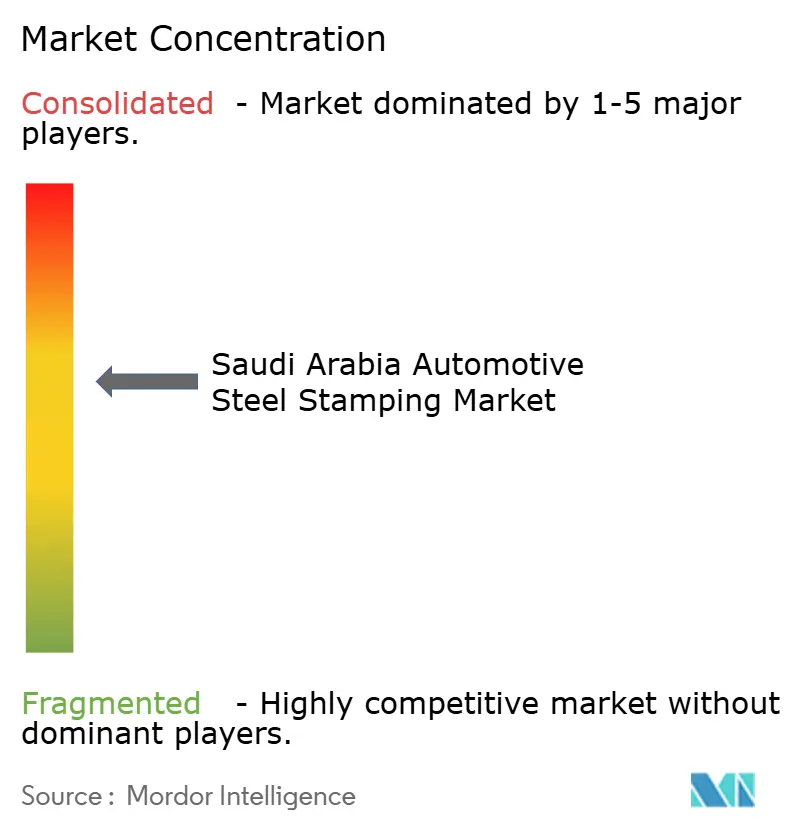
| Market Concentration | Medium |
Major Players *Disclaimer: Major Players sorted in no particular order Image © Mordor Intelligence. Reuse requires attribution under CC BY 4.0. | |
Saudi Arabia Automotive Steel Stamping Market Analysis by Mordor Intelligence
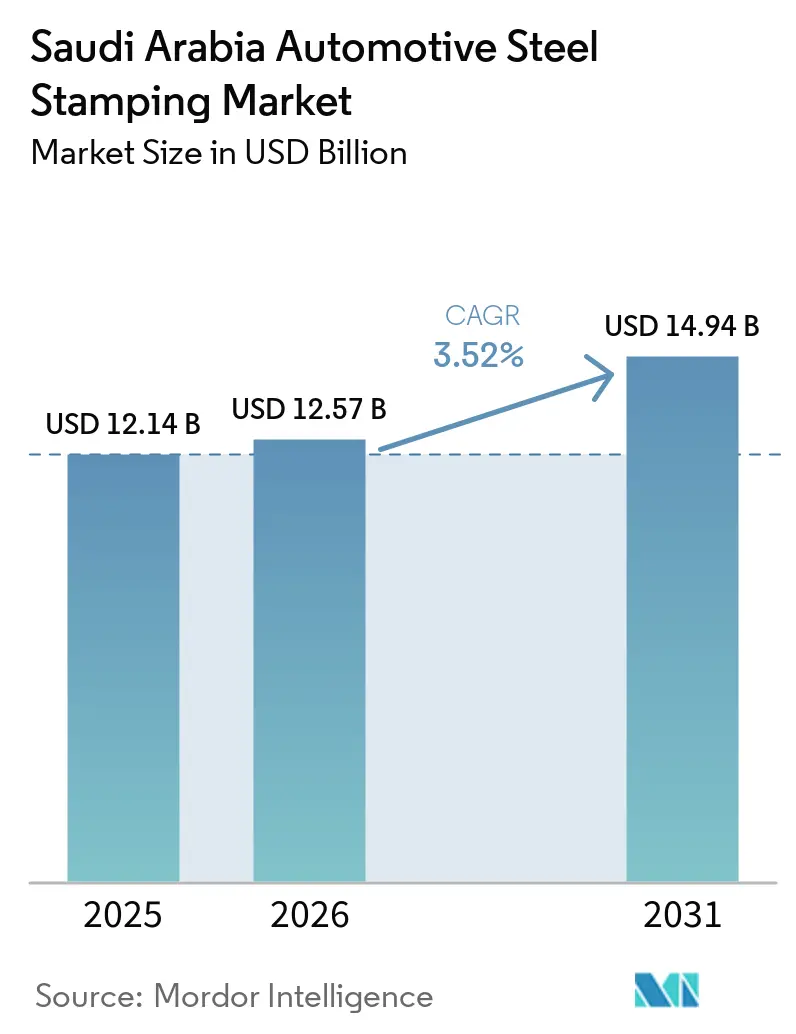
The Saudi Arabia Automotive Steel Stamping Market was valued at USD 12.14 billion in 2025 and is projected to grow from USD 12.57 billion in 2026 to USD 14.94 billion by 2031, at a CAGR of 3.52% during the forecast period (2026–2031). This steady growth reflects a structural transformation. The Kingdom's Public Investment Fund is spearheading three concurrent vehicle assembly projects. These include Ceer's SAR 5 billion (USD 1.3 billion) electric-vehicle facility, Lucid Motors' plant with an annual capacity of 155,000 units, and a Hyundai joint venture targeting 50,000 units per year starting in 2026. Each project incorporates explicit local-content requirements, shifting stamping from an import-substitution strategy to a competitive capability. The National Industrial Development Center has set a 45% localization target for Ceer suppliers by 2034. Additionally, a 10% price advantage is granted for domestically produced components, effectively securing demand for local stampers. However, these stampers must comply with stringent quality standards, including ISO 9001 and the automotive-specific IATF 16949 certifications.
Key Report Takeaways
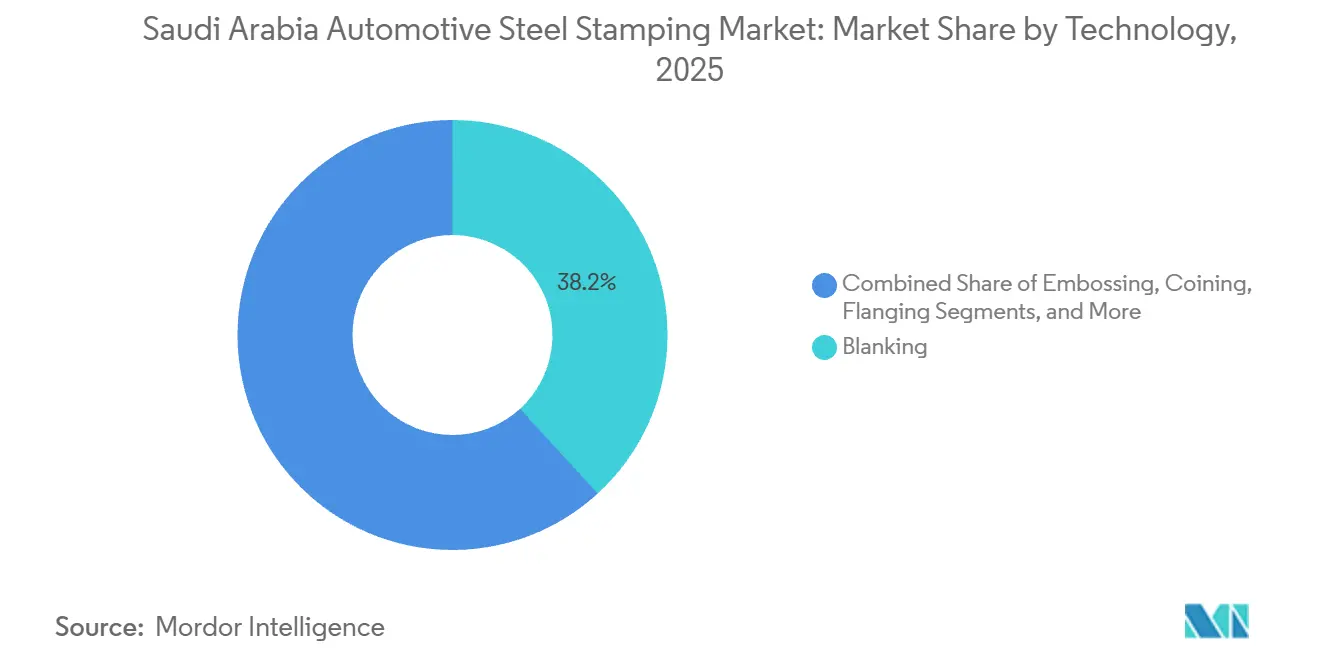
- By technology, blanking led with 38.15% of the Saudi Arabian automotive steel stamping market share in 2025, while embossing is on track to record a 4.65% CAGR through 2031.
- By process, sheet metal forming accounted for 29.44% of the Saudi Arabian automotive steel stamping market size in 2025, whereas hot stamping is forecast to expand at a 5.22% CAGR to 2031.
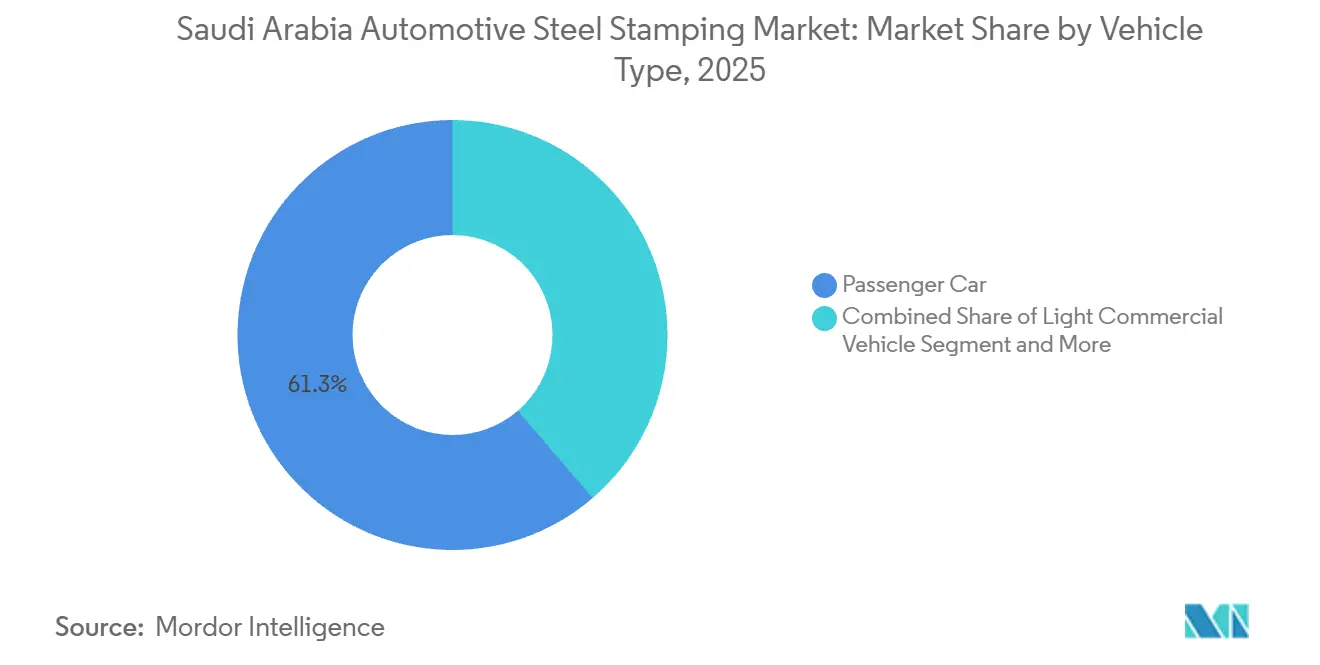
- By vehicle type, passenger cars captured 61.25% of demand in 2025, and are forecast to grow with a 3.96% CAGR through 2031.
- By propulsion, the internal combustion engine accounted for 75.63% of the Saudi Arabian automotive steel stamping market size in 2025, while electric vehicles are advancing at a 5.16% CAGR through 2031.
- By province, the Central Region held a 39.72% share of the Saudi Arabia automotive steel stamping market in 2025, while the Eastern Region is projected to grow at a 5.54% CAGR through 2031.
Note: Market size and forecast figures in this report are generated using Mordor Intelligence’s proprietary estimation framework, updated with the latest available data and insights as of January 2026.
Saudi Arabia Automotive Steel Stamping Market Trends and Insights
Drivers Impact Analysis*
| Driver | (~) % Impact on CAGR Forecast | Geographic Relevance | Impact Timeline |
|---|---|---|---|
| Incentive-led Localization Under Vision 2030 | +0.8% | National (Central and East) | Long term (≥ 4 years) |
| Post-Pandemic Rebound in Passenger Cars | +0.7% | Nationwide and GCC spillover | Medium term (2-4 years) |
| Shift to Lightweight AHSS and Hot Stamping | +0.6% | Central early adoption | Medium term (2-4 years) |
| PIF-backed Lucid and Ceer Capacity Build-up | +0.5% | Central and Western hubs | Long term (≥ 4 years) |
| Industry 4.0 Smart Press Lines Adoption | +0.4% | Central leading, Eastern following | Long term (≥ 4 years) |
| Mandated Local-Content Thresholds | +0.3% | National, IKTVA-aligned suppliers | Medium term (2-4 years) |
| Source: Mordor Intelligence | |||
Incentive-Led Localization Under Vision 2030
Backed by manufacturer incentives, Vision 2030, and the National Industrial Development and Logistics Program, the target is to achieve around 50% localized vehicle production by 2030. This initiative aims to boost domestic manufacturing capabilities, reduce reliance on imports, and foster economic growth within the automotive market[1]. The National Industrial Development Center's 45% local-content mandate for Ceer suppliers by 2034, paired with a 10% price preference for nationally produced components in government procurement, has converted stamping from a cost-arbitrage decision into a strategic necessity.
Post-Pandemic Rebound in Passenger Car Demand
Vehicle registrations rose considerably in 2024 as pent-up demand and improved financing revived the auto retail channel [2]. Hyundai's decision to establish a 50,000-unit-per-year joint venture with PIF, with production commencing this year, reflects confidence in sustained passenger-car volumes; the company already held one of the largest market shares in Saudi Arabia as of Q1 2025, providing a demand baseline that justifies localized stamping investment. Lucid Motors' phased ramp from 5,000 semi-knocked-down units in 2025 to 155,000 complete-built-unit capacity by the early 2030s hinges on domestic stamping for body-in-white and closure panels, creating a pull effect for press shops within the King Salman Automotive Cluster's logistics perimeter.
Shift Toward Lightweight AHSS and Hot Stamping Adoption
Ceer's partnership with Schuler to deploy the Middle East's first fully automated press-hardening shop—capable of 64 parts per minute and integrating destacking, roller-hearth furnaces, and robotic transfer—marks a technological leap that bypasses conventional cold-stamping learning curves. Hot-stamped components achieve tensile strengths up to 2,000 MPa (compared to 1,700 MPa for cold-formed martensitic advanced high-strength steels), enabling 20-30% mass reduction in B-pillars and door rings while meeting stringent crash-energy absorption requirements. By leveraging AHSS, automakers can achieve tensile strengths of up to 2,000 MPa while optimizing weight reduction by 20-30% [3]. Saudi plants are utilizing thermoforming presses to effectively reduce springback and enable the production of intricate geometries, offering advantages over traditional cold lines.
PIF-Backed OEM Entrants Boost Local Demand
Saudi Arabia is making waves in the electric vehicle (EV) sector, underscoring its commitment to economic diversification. The Kingdom has poured substantial investments into EV production and battery supply chains. Additionally, the King Salman Automotive Cluster's projected SAR 92 billion GDP contribution by 2035 implies a multiplier effect: every vehicle assembled generates demand for 200-300 stamped parts (body panels, chassis brackets, seat frames, battery enclosures), translating to approximately 15-20 million stamped components annually once all three OEMs reach full capacity. PIF's dual role as equity investor in OEMs and anchor tenant in TASARU aligns incentives: the fund benefits from vertical integration that keeps value-add within Saudi Arabia, while stampers gain access to patient capital and long-term offtake agreements that justify greenfield investments in press lines and tooling.
Restraints Impact Analysis*
| Restraint | (~) % Impact on CAGR Forecast | Geographic Relevance | Impact Timeline |
|---|---|---|---|
| Volatile Global Steel Prices | −0.6% | Global feedstock costs (all regions) | Short term (≤ 2 years) |
| Limited Domestic OEM Volumes | −0.4% | National assembly hubs | Medium term (2-4 years) |
| Influx of Cheaper Asian Panels | −0.3% | National, the highest at Eastern Region ports | Short term (≤ 2 years) |
| Uncertain EV Tooling ROI | −0.2% | Central and Western EV-production clusters | Long term (≥ 4 years) |
| Source: Mordor Intelligence | |||
Volatile Global Steel Prices
As global steel prices fluctuate, Saudi Arabia's automotive steel stamping market may face mounting challenges. These price swings might elevate production costs, destabilize supply chains, and shift market dynamics, potentially hindering growth during the forecast period. US hot-rolled coil prices climbed to USD 900-960 per ton in January 2026, driven by Section 232 tariffs at 50% and scrap-cost inflation, while extended lead times (4-9 weeks for HRC, 5-10 weeks for cold-rolled and galvanized) constrain stampers' ability to lock in predictable input costs. The European Union's Carbon Border Adjustment Mechanism, effective 2026, and tightened safeguard quotas imposing 50% out-of-quota tariffs from July 2026 are expected to sustain upward pressure on imported specialty steels (dual-phase, TRIP, martensitic grades) that SABIC Hadeed does not yet produce at automotive-grade tolerances.
Uncertain EV Tooling ROI
Hot-stamping press lines for electric-vehicle battery enclosures and structural battery integration demand capital outlays exceeding USD 35 million per line, including roller-hearth furnaces, hydraulic presses with programmable cushions, robotic transfer systems, and water-assisted quenching, yet face utilization risk if EV adoption lags government forecasts. Stampers must balance OEM pressure to invest in EV-specific tooling against the risk that ICE vehicles—still 75.63% of 2025 propulsion demand—will dominate volumes through 2028, rendering dedicated EV press capacity underutilized.
*Our forecasts treat driver/restraint impacts as directional, not additive. The impact forecasts reflect baseline growth, mix effects, and variable interactions.
Segment Analysis
By Technology: Blanking Underpins Volume, Embossing Scales Up
In 2025, blanking technology held a 38.15% market share, highlighting its role in producing flat blanks from coil stock for forming operations. Stampers for Ceer, Hyundai, and Lucid use high-speed blanking lines (30 strokes per minute) to meet the King Salman Automotive Cluster's 2-3 week lead-time targets. Embossing, with a smaller share, is growing at a 4.65% CAGR through 2031 as OEMs seek complex surface features on closure panels, reducing cycle time and scrap rates. Coining and flanging support niche applications like battery-tray edge stiffening and door-hinge mounting flanges, while bending operations for chassis brackets and seat frames benefit from Hyundai's 2026 capacity addition.
The shift to embossing aligns with premiumization trends. Ceer, as a premium electric SUV brand, requires Class-A surface finishes, achieved in one press stroke with embossing, avoiding post-stamping machining. Gestamp's GES-GIGASTAMPING technology, producing one-piece floor panels and door rings, reduces part count, assembly time, and weight. TASARU suppliers must adopt similar capabilities to stay competitive. Dana Steel's mid-2025 entry, with a USD 82 million investment in automation and AI analytics, targets embossing and coining work needing tighter tolerances, focusing on Tier-2 suppliers lacking in-house press capacity.

By Process: Sheet Metal Forming Stays Core, Hot Stamping Ramps
In 2025, sheet metal forming contributed 29.44% of process-based revenue, led by deep-drawing and stretch-forming for body panels. Hot stamping, growing at 5.22% CAGR, is driven by Ceer's Schuler press-hardening line and BENTELER's structural components in TASARU. This process heats boron-steel blanks above 900°C, transfers them to hydraulic presses, and quenches them to achieve tensile strengths of up to 2,000 MPa, reducing component mass by 20-30% while meeting crash standards. Roll forming supports high-volume, low-complexity parts like door beams and seat rails, while metal fabrication benefits from TASARU's assembly contracts with Shin Young.
Hot stamping's localization gains traction with productivity of 7-10 strokes per minute, offsetting energy costs of USD 15-20 per part and saving 2-3 days by eliminating heat-treatment steps. Schuler's automated line at Ceer integrates destacking, furnaces, robotic transfer, and press-hardening, producing 64 parts per minute. This positions Saudi Arabia to compete with Germany, Japan, and South Korea. ThyssenKrupp's AS Pro coating reduces hydrogen uptake during annealing, improving reliability and meeting OEM durability standards for 10 years or 150,000 km.
By Vehicle Type: Passenger Cars Dominate, Commercial Fleets Diversify
In 2025, passenger cars accounted for 61.25% of vehicle demand and are projected to grow at a 3.96% CAGR through 2031. Ceer, Lucid, and Hyundai collectively aim for an annual assembly capacity of 255,000 units by the early 2030s, with each vehicle requiring 200-300 stamped parts. LCVs and HCVs remain import-dependent, with stamping demand limited to aftermarket repairs and fleet maintenance, supported by SABIC Hadeed's galvanized coil. The Kingdom prioritizes passenger EVs and premium ICE segments due to higher margins justifying tooling costs.
Ceer targets premium electric SUVs with Class-A finishes, ±2 mm panel gaps, and over 10 years of corrosion resistance, favoring galvanized and zinc-magnesium coatings. Lucid's Air sedan, produced at KAEC, uses aluminum-intensive structures, limiting steel-stamping to underbody components. By the early 2030s, localized stamping will support closure panels and battery integration. Hyundai's joint venture, producing ICE and EV variants, diversifies demand and reduces EV adoption risks while leveraging the Kingdom's top-selling brand.
By Propulsion: ICE Still Rules, EV Panels Accelerate
In 2025, internal combustion engine (ICE) vehicles accounted for 75.63% of propulsion-based demand, led by Toyota, Hyundai, and Nissan models in Saudi Arabia. The electric vehicle (EV) segment is growing at a 5.16% CAGR through 2031, driven by Ceer, Lucid, and Hyundai's EV production. EV stampings require thicker gauges (2.0-3.0 mm vs. 0.7-1.2 mm), stronger steels (1,500-1,700 MPa vs. 600-800 MPa), and tighter tolerances (±0.5 mm vs. ±1.5 mm). Structural battery integration demands hot-stamped cross-members with tensile strengths up to 2,000 MPa, which Schuler and BENTELER can deliver in Saudi Arabia.
ICE dominance through 2028 forces stampers to choose between EV tooling or flexible press lines for ICE and EV parts. Schuler's servo-driven presses with 4-minute die changes allow dual-shift production, maintaining over 75% utilization. PIF's plan for 5,000 fast chargers by 2030 and a government order for 100,000 Lucid vehicles over 10 years support EV demand. However, stampers remain cautious due to high capital needs, as seen in Martinrea's USD 35 million investment in Ontario.
Geography Analysis
In 2025, the Central Region held a 39.72% share due to the King Salman Automotive Cluster's proximity to KAEC. This cluster includes OEMs like Ceer, Lucid, and Hyundai, and Tier-1 suppliers such as TASARU's Shin Young and BENTELER, enabling just-in-time delivery of components. Ceer's SAR 5.5 billion localization deals and Schuler's automated press-hardening line drive demand, while Hyundai's 50,000-unit annual output by Q4 2026 supports press-shop investments. The National Industrial Development Center's 45% local-content mandate by 2034 and 10% price advantage for national products protect Riyadh-based stampers from Asian imports despite lower costs.
The Eastern Province's 5.54% CAGR through 2031 is driven by SABIC Hadeed's vertical integration. Its Jubail facility, acquired by PIF in May 2024 for SAR 12.5 billion, produces 420,000 tonnes of cold-rolled and 240,000 tonnes of galvanized coils annually. Jubail Industrial City's infrastructure, including King Fahd Industrial Port, power generation, desalination, and a rail link to Dammam, supports energy-intensive hot-stamping operations. Dammam's 2nd Industrial City, with MODON incentives, offers opportunities for stampers targeting commercial vehicles and aftermarket segments.
The Western Region, including Makkah and Madinah, serves as a logistics hub. Jeddah's King Abdulaziz Port handles imported specialty steels like dual-phase and martensitic grades, distributed to Riyadh and Jubail. This adds 3-5 days to lead times but provides access to premium grades from thyssenkrupp and POSCO. The Northern and Southern Regions remain peripheral, with limited stamping demand for aftermarket repairs and agricultural equipment, met using SABIC Hadeed's steel products.
Competitive Landscape
The Saudi automotive stamping market is fragmented, with no player holding over 15% share. PIF's TASARU Supplier Hub is driving consolidation by pre-qualifying Tier-1 stampers like Shin Young and BENTELER and awarding long-term contracts, raising barriers for new entrants lacking government ties or IATF 16949 certification.
Global players like Gestamp (100 facilities) and Magna Cosma are considering USD 100-150 million greenfield investments but face risks of low demand visibility. Domestic firms like First Telecom Industries and Dana Steel leverage NIDC's 10% price preference and SIDF's 50% financing to capture early volumes. Opportunities include hot-stamping (Schuler's Ceer line operational by 2026), EV motor laminations (thyssenkrupp targeting 200,000 tons/year by 2027), and laser-welded blanks (ArcelorMittal's UAE facility operational by 2026).
Technology drives competition. Schuler's presses enable quick die changes and high utilization, while Gestamp's GES-GIGASTAMPING reduces part count, assembly time, and weight. Dana Steel's USD 82 million investment in AI analytics targets embossing and coining, offering tighter tolerances and higher margins. Local fabricators are upgrading to automotive-grade stamping by acquiring refurbished European press lines, saving 40-50% in costs but requiring IATF 16949 re-certification.
Saudi Arabia Automotive Steel Stamping Industry Leaders
-
Gestamp Automoción
-
Magna International (Cosma)
-
SABIC Hadeed
-
ThyssenKrupp AG
-
ArcelorMittal
- *Disclaimer: Major Players sorted in no particular order
Recent Industry Developments
- February 2026: ArcelorMittal Projects announced a third steel manufacturing facility in Sharjah's Hamriyah Free Zone (1.4 million sq ft), scheduled to begin operations in 2026, focusing on steel pipe manufacturing and specialized coating solutions for energy and infrastructure projects, with potential spillover to automotive-grade flat steel distribution serving Saudi OEMs via Jeddah logistics corridors.
- January 2025: Slovenian Steel Group (SIJ) signed a EUR 1.5 billion memorandum with WAHAJ to build electro-steel and premium hot-strip lines in Ras Al-Khair, anchoring feedstock for regional auto stampers.
Saudi Arabia Automotive Steel Stamping Market Report Scope
| Blanking |
| Embossing |
| Coining |
| Flanging |
| Bending |
| Other Technologies |
| Roll Forming |
| Hot Stamping |
| Sheet Metal Forming |
| Metal Fabrication |
| Other Processes |
| Passenger Car |
| Light Commercial Vehicle |
| Heavy Commercial Vehicle |
| Internal Combustion Engine (ICE) |
| Electric Vehicle |
| Central Region (Riyadh) |
| Western Region (Makkah and Madinah) |
| Eastern Region |
| Northern Region |
| Southern Region |
| By Technology | Blanking |
| Embossing | |
| Coining | |
| Flanging | |
| Bending | |
| Other Technologies | |
| By Process | Roll Forming |
| Hot Stamping | |
| Sheet Metal Forming | |
| Metal Fabrication | |
| Other Processes | |
| By Vehicle Type | Passenger Car |
| Light Commercial Vehicle | |
| Heavy Commercial Vehicle | |
| By Propulsion | Internal Combustion Engine (ICE) |
| Electric Vehicle | |
| By Province | Central Region (Riyadh) |
| Western Region (Makkah and Madinah) | |
| Eastern Region | |
| Northern Region | |
| Southern Region |
Key Questions Answered in the Report
How large is Saudi Arabia’s automotive steel stamping activity in 2025?
The Saudi Arabia Automotive Steel Stamping Market size USD 12.14 billion in 2025, with a 3.52% CAGR projected to reach USD 14.494billion by 2031.
Which technology currently generates the highest revenue?
Blanking leads with 38.15% share because it produces the base panels required across nearly every vehicle platform.
What growth rate is forecast for hot stamping through 2031?
Hot stamping is set to rise at a 5.22% CAGR, driven by AHSS adoption for lighter, safer body structures.
Why is Riyadh’s Central Region critical for stampers?
The King Salman Automotive Cluster, proximity to government contracting, and PIF-backed OEM headquarters give the region 39.72% of 2025 demand.
What short-term challenges will suppliers face?
The key hurdles are volatile steel input prices that can cut margins, and cheaper Asian panel imports that pressure local pricing.