
US Automotive Steel Stamping Market Size and Share
Market Overview
| Study Period | 2019 - 2031 |
|---|---|
| Forecast Data Period | 2026 - 2031 |
| Base Year Market Size (2025) | USD 3.91 Billion |
| Market Size (2026) | USD 4.12 Billion |
| Market Size (2031) | USD 5.36 Billion |
| Growth Rate (2026 - 2031) | 5.41 % |
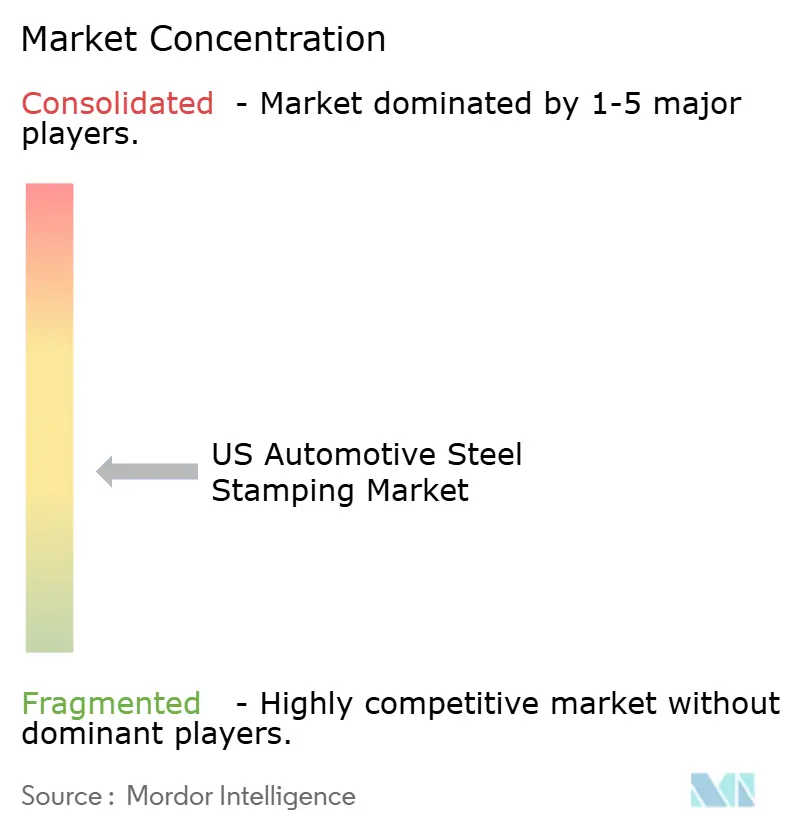
| Market Concentration | Medium |
Major Players *Disclaimer: Major Players sorted in no particular order Image © Mordor Intelligence. Reuse requires attribution under CC BY 4.0. | |
US Automotive Steel Stamping Market Analysis by Mordor Intelligence
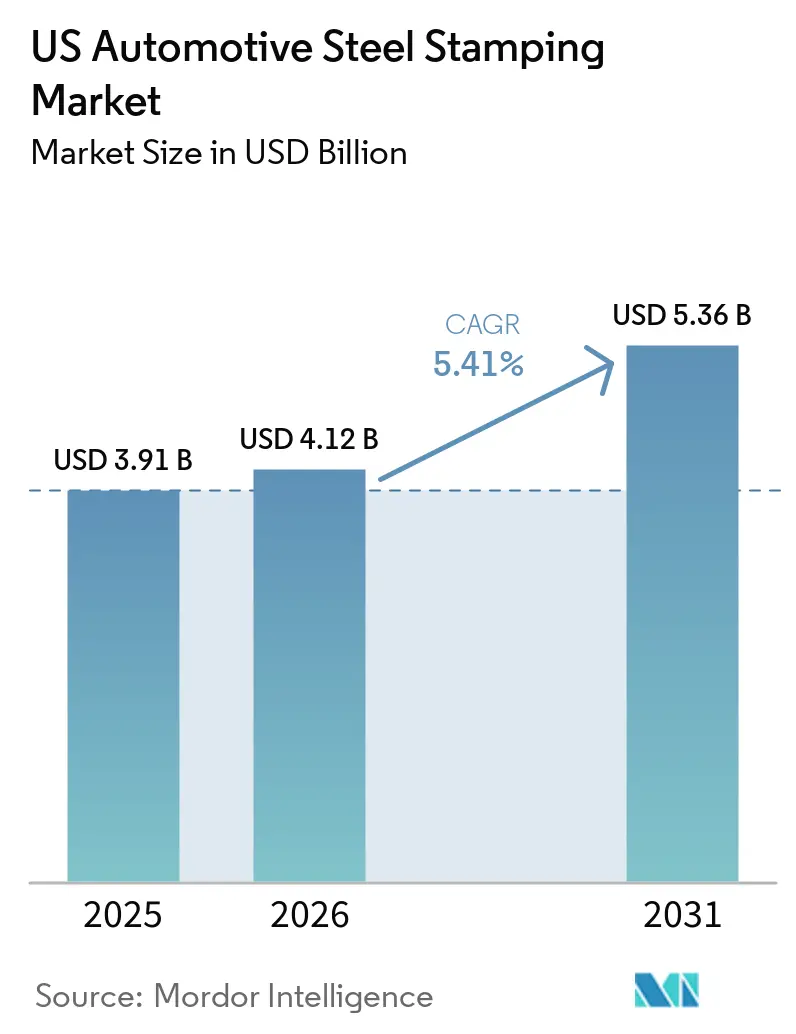
The US automotive steel stamping market size was valued at USD 3.91 billion in 2025, is estimated at USD 4.12 billion in 2026, and is projected to reach USD 5.36 billion by 2031, growing at a CAGR of 5.41% over 2026-2031. Automakers continue to specify advanced and ultra-high-strength steels to comply with Corporate Average Fuel Economy targets, even as battery-electric platforms trim overall steel intensity. Federal Reserve production data confirm that light-vehicle assemblies rebounded to 10.18 million units in 2025 and stabilized near 9.74 million units on a seasonally adjusted annual rate in January 2026, underpinning steady die-press utilization. Hot-stamping lines capable of quenching press-hardened steel are running close to capacity because OEMs need 1,500 MPa-class parts for B-pillars, rocker rings, and battery enclosures. Meanwhile, stampers face rising energy and coil costs, pushing them to secure long-term steel contracts or add surcharges. Investment momentum clusters along the Great Lakes and Southeast corridors, where Tier-1 suppliers expand servo-press and laser-blanking capacity to deliver parts just-in-time to nearby assembly plants.
Key Report Takeaways
- By technology, blanking led with 34.17% of the US automotive steel stamping market share in 2025; embossing is forecast to advance at a 6.42% CAGR through 2031.
- By process, hot stamping accounted for 27.87% share of the US automotive steel stamping market size in 2025 and is projected to expand at a 7.51% CAGR between 2026 and 2031.
- By vehicle type, passenger cars dominated with 56.57% revenue in 2025, while light commercial vehicles are poised to grow at a 6.45% CAGR to 2031.
- By propulsion, internal-combustion models retained 61.13% of share in 2025, and battery-electric models will log the fastest rise at a 6.48% CAGR through 2031.
Note: Market size and forecast figures in this report are generated using Mordor Intelligence’s proprietary estimation framework, updated with the latest available data and insights as of January 2026.
US Automotive Steel Stamping Market Trends and Insights
Drivers Impact Analysis*
| Driver | (~) % Impact on CAGR Forecast | Geographic Relevance | Impact Timeline |
|---|---|---|---|
| Rapid Adoption of Advanced and Ultra-High-Strength Steels | +1.5% | National, early in EV programs | Short term (≤2 years) |
| OEM Lightweighting Mandates | +1.2% | Michigan, Ohio, Indiana corridors | Medium term (2-4 years) |
| Rising United States Vehicle Production Rebound | +0.9% | Midwest clusters | Short term (≤2 years) |
| Surging EV Body Panel Demand | +0.8% | Michigan, Tennessee, Texas hubs | Medium term (2-4 years) |
| Domestic Re-Shoring of Metal Parts | +0.7% | Midwest and Southeast corridors | Medium term (2-4 years) |
| Servo-Press Upgrades Enabling Complex Geometries | +0.6% | Tier-1 plants nationwide | Long term (≥4 years) |
| Source: Mordor Intelligence | |||
Rapid Adoption of Advanced & Ultra-High-Strength Steels
Metallurgists already deliver 2 GPa-class complex-phase steels offering 9.66% elongation and 25.8 J Charpy toughness, removing the brittleness that once limited UHSS use. The payoff is thinner gauges and lower part counts when ribbing can be integrated. Tier-1 suppliers, therefore, upgrade to 3,000-ton servo presses, laser-assisted trimming, and remote-monitoring systems. Martinrea’s USD 35 million line, commissioned in 2025, quadrupled capacity for battery-floor assemblies, confirming that access to capital is the decisive variable [1]. Smaller Tier-2 shops that cannot fund similar conversions find themselves limited to lower-margin brackets and interior stampings.
OEM Lightweighting Mandates for Higher CAFE Targets
Stringent CAFE rules effective through model year 2026 require an 8% annual climb in fleet efficiency until 2025 and a 10% jump in 2026, driving automakers to shave vehicle mass with advanced steels [2]. Engineers favor press-hardened grades such as 22MnB5 and 37MnB4 because they cut weight by up to 15% while sustaining crash performance. Stampers able to run 900 °C austenitizing furnaces and <4 s quench cycles win the largest battery-enclosure and B-pillar contracts. Product-launch clustering means hot-stamping demand spikes around redesign years—Ford’s next-generation F-150 in 2027 and GM’s Ultium SUV line in 2028 will both specify tailored-property door rings. Capacity shortfalls encourage multiyear sourcing agreements, locking in volumes for suppliers that prove furnace uptime and die-maintenance reliability.
Rising United States Vehicle Production Rebound Post-Pandemic
Federal Reserve data show that North American final-assembly cadence regained 90% of 2019 levels during 2025, normalizing part-call-off rhythms [3]. Stable orders shrink idle press time, improving fixed-cost absorption for large transfer-press lines. Midwest clusters housing Detroit-Three plants capture most of the rebound, yet Southeastern greenfield sites such as Hyundai’s Montgomery complex and Kia’s West Point facility also lift regional parts demand. Balanced scheduling reduces overtime premiums, bolstering slim 1.4% average stamping margins.
Surging Electric-Vehicle Body Panel Demand
Battery-electric models use about 9 percentage points less steel than ICE vehicles, but they require thicker UHSS stampings around heavy battery packs. GM, Ford, and Stellantis specify hot-formed reinforcements with 1,500 MPa tensile strength for underbody crash rails. Toolshops now design embossing patterns that spread impact energy while keeping panels at 1.0-1.2 mm gauge. Although Tesla experiments with stainless-steel exoskeletons that bypass traditional progressive dies, mainstream platforms still rely on high-tonnage presses, ensuring that the US automotive steel stamping market gains net volume from the EV shift.
Restraints Impact Analysis*
| Restraint | (~) % Impact on CAGR Forecast | Geographic Relevance | Impact Timeline |
|---|---|---|---|
| Steel-Price Volatility Compressing Supplier Margins | -0.8% | Nationwide, especially spot buyers | Short term (≤2 years) |
| Material Substitution Toward Aluminum and Composites | -0.6% | EV-focused plants | Medium term (2-4 years) |
| Skilled Tool-and-Die Labor Shortages | -0.5% | Midwest and Southeast | Medium term (2-4 years) |
| High Upfront CAPEX for Progressive-Die Tooling | -0.4% | Smaller Tier-2/3 shops | Long term (≥4 years) |
| Source: Mordor Intelligence | |||
Steel-Price Volatility Compressing Supplier Margins
According to SMU, as of May 26, U.S. hot-rolled coil prices ranged from USD 1,070 to USD 1,120 per short ton, with an average of USD 1,095 per ton. The portal, citing market sources, reports that service centers are currently contending with supply delays and rising inventory levels, squeezing contracts indexed to yearly averages. Section 232 duties shield domestic mills, yet cheaper Southeast Asian offers create buying dilemmas around freight risk. With only 13% of purchasers able to negotiate downspot quotes, many stampers moved to quarterly hedges. Vendors running at 1.4% EBITDA have little cushion, so they push for pass-through clauses or introduce steel-surcharge lines on invoices.
Material Substitution Toward Aluminum and Composites in Battery Electric Vehicles
Aluminum closure panels cut mass by 7-9%, tempting OEMs despite higher raw-material outlays. The Aluminum Association indicates BEV city cars shed steel weight from 700 kg to 408 kg by adopting 5xxx- and 6xxx-series sheet, displacing door-inner stampings. Yet most US mills lack capacity for auto-grade alloys, forcing imports from Europe and Asia. Stampers must decide whether to install stretch-forming beds for aluminum or double down on UHSS specialties. Cybertruck-style stainless shells form a third disruptive vector that could bypass large-scale progressive dies altogether.
*Our forecasts treat driver/restraint impacts as directional, not additive. The impact forecasts reflect baseline growth, mix effects, and variable interactions.
Segment Analysis
By Technology: Blanking Retains Primacy as Embossing Accelerates
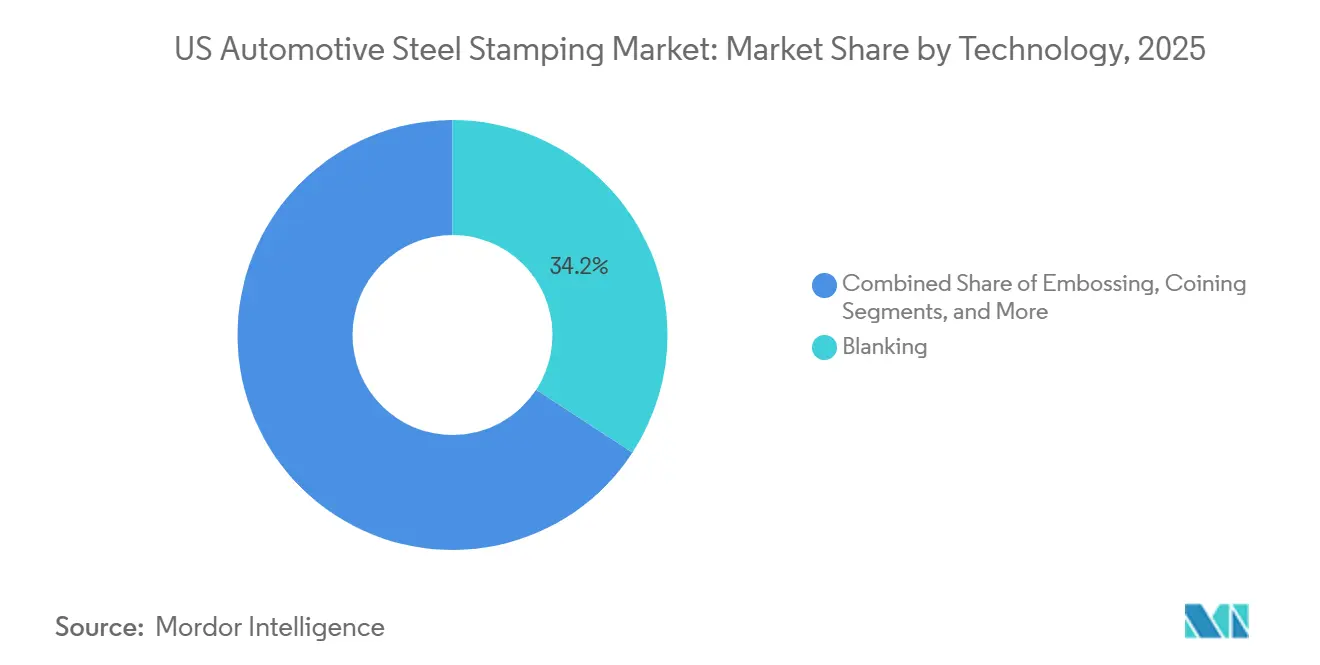
Blanking controlled 34.17% of 2025 volumes, underscoring its role as the essential final-separation step in nearly every die line. Progressive-die presses integrate blanking, coining, and flanging to reduce material handling, thereby increasing throughput and reducing scrap. Servo controls now allow programmable stroke curves, so a single ram executes blanking and shallow embossing in one hit. Such integration lowers cycle time by nearly 30% on door inner panels, freeing capacity without plant expansion.
Embossing expands at a 6.42% CAGR because OEMs add stiffening ribs to battery trays and underbody shields rather than increasing gauge. Tailored emboss patterns lift panel stiffness by 18% while holding mass constant, a lightweighting gain critical for range-constrained EVs. Stampers adopting servo-presses can maintain consistent rib depth, which avoids the re-hit operations common on mechanical presses. The capital hurdle remains tooling cost, yet Tier-1s offset it by higher value-added pricing to OEMs keen on part consolidation. As a result, embossing revenue is projected to exceed USD 790 million by 2031, raising its share of the US automotive steel stamping market to almost 16%.

By Process: Hot Stamping Extends Lead on Ultra-High-Strength Needs
Hot stamping delivered 27.87% of the 2025 revenue of the US automotive steel stamping market share, and is projected to expand at a 7.51% CAGR between 2026 and 2031. Press-hardening furnaces operating at 930 °C transform boron-alloy sheet into martensitic parts with a tensile strength of 1,500 MPa. Tailored tempering now adds ductile zones so door rings absorb impact without cracking. Quench-in-die cycles complete in under 6 s, enabling automakers to replace three welded, cold-formed parts with one hot-stamped ring. The economics improve with every redesign, so program managers increasingly schedule hot-stamped components at the concept phase.
Sheet-metal forming still dominates outer skins, roof panels, and floor pans where deep draws exceed hot-stamping formability. Roll forming holds a niche duty on long rocker channels but lacks shape flexibility. Metal fabrication, defined as welding and sub-assembly, captures downstream margin yet increasingly integrates directly into Tier-1 stamping plants. By 2031, hot stamping is forecast to approach USD 1.6 billion, sustaining its leadership thanks to widening EV-battery enclosure demand. Energy-efficiency pilots using induction heating could shave 20% of per-part CO2, a metric that will influence OEM sourcing scores by the decade’s end.
By Vehicle Type: Passenger Cars Still Rule, yet Light Commercials Surge
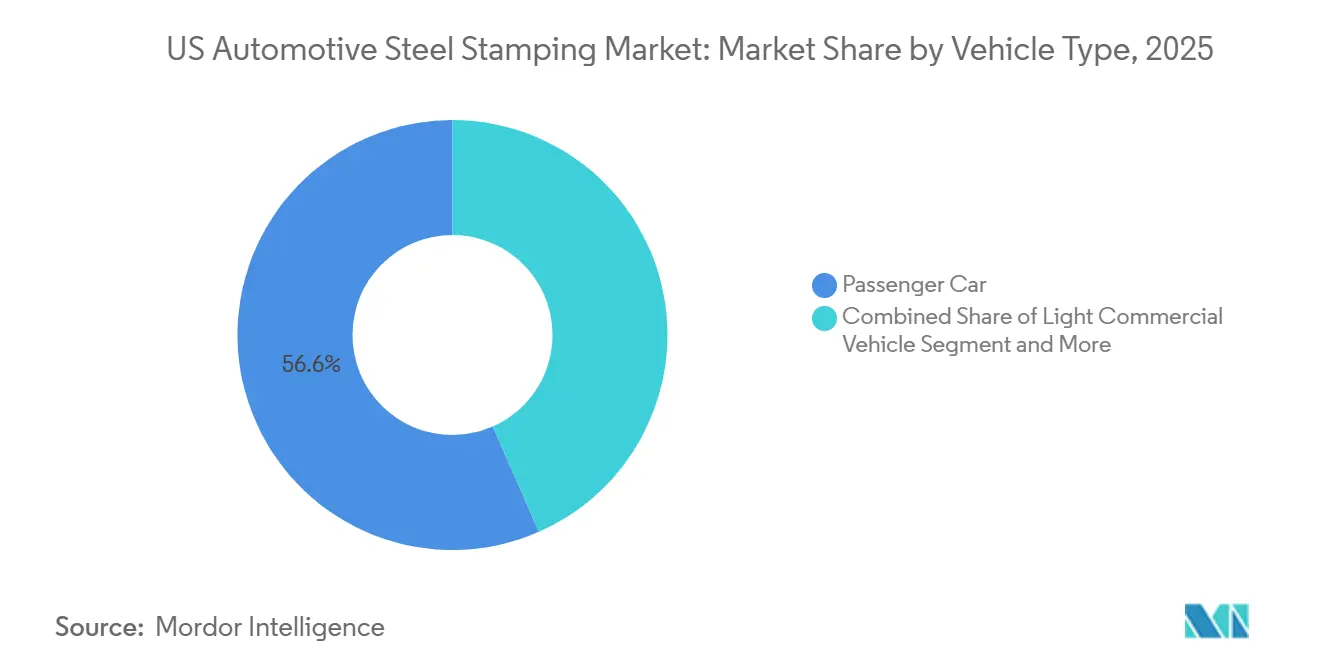
Passenger cars generated 56.57% of the 2025 revenue of the US automotive steel stamping market. Compact crossovers and midsize sedans require extensive body-in-white stampings, keeping press halls busy even as sedan assemblies slide. Yet consumers pivot toward trucks and SUVs, lifting light-commercial share. Ford, GM, and Stellantis allocate fresh capex to body-on-frame pickups that consume heavier-gauge floor stampings and cab side-outers. Consequently, the light-commercial vehicle registered a CAGR of 6.45% till 2031.
Medium and heavy commercial vehicles remain cyclical, driven by freight demand. Their cab shells and chassis brackets use stamped A-pillars and dash panels, but volumes are far lower than light-vehicle runs. The US automotive steel stamping market benefits from diversification when freight orders climb, yet base-load volumes still come from high-volume light-duty nameplates. Suppliers hedge by configuring die-sets that swap among sedan, SUV, and pickup inners with minimal adjustments.
By Propulsion: Internal Combustion Engine Retains Scale while Electric Vehicle Growth Outpaces
Internal-combustion models accounted for 61.13% of 2025 revenue in the US automotive steel stamping market. They continue to specify engine cradle, cross-member, and exhaust-shield stampings unique to piston powertrains. Hybrids also keep many ICE brackets while adding small battery mounts, sustaining mixed-model press queues.
Battery-electric units will record a 6.48% CAGR as state zero-emission policies escalate BEV adoption. Although each BEV lowers steel kilograms, battery-tray and crash-ring complexity lifts per-part price. A single hot-stamped floor enclosure for an Ultium SUV costs three times the price of a cold-formed muffler shield. Press shops with rapid-quench lines thus capture value even as tonnage dips. Flexibility is essential, so new furnace banks incorporate modular rollers and quick-change gas burners to swing between 22MnB5 and 37MnB4 sheets on the same shift.
Geography Analysis
The Great Lakes states account for a substantial share of U.S. automotive steel stamping capacity, with Michigan alone hosting numerous Tier-1 and advanced Tier-2 press shops. Proximity to GM’s Lansing Delta Township facility and Ford’s Dearborn operations supports daily milk-run logistics, reducing warehouse buffers to minimal inventory levels. The regional labor pool retains legacy tool-and-die expertise, although rising wages pressure profit margins.
The Southeast corridor, spanning Alabama to South Carolina, has emerged as the fastest-growing region, recording robust growth in press capacity. Hyundai, Kia, Volkswagen, and Mercedes drive consistent demand for outer-panel blanks. State incentive packages covering a substantial portion of capital expenditure encourage Northern suppliers to establish satellite plants. For example, Gestamp plans to expand its Chattanooga servo capacity, citing incoming EV-SUV programs.
The Southwest and Mountain states remain niche markets but continue to grow, supported by Tesla’s Austin Gigafactory and Lucid’s Casa Grande facility. Although volumes remain modest compared with those in Detroit, these plants require advanced hot-stamped battery crash rails that few local suppliers can currently provide. Consequently, stamped modules travel longer distances, renewing interest in rail-served logistics networks capable of handling heavy die sets at lower freight costs than truckload transportation.
Competitive Landscape
Competition in the U.S. automotive steel stamping industry remains fragmented but is trending toward consolidation as capital requirements increase. Autokiniton’s roll-up of Tower International and L&W created an extensive manufacturing footprint that supplies nearly every domestic OEM. Martinrea focuses on high-strength chassis components and leverages its large-capacity SIMPAC line to secure GM battery-tray awards. Gestamp follows a campus model that colocates welding, e-coat, and laser blanking operations with its presses, enabling it to quote delivered module prices rather than part-only bids.
Private equity drives many acquisitions. MiddleGround Capital combined Shiloh Industries with selected Benteler sites to create a hot-forming specialist serving Stellantis. This approach assigns dedicated EV business units, each with its own servo press fleets, separating them from legacy commodity outer-skin operations. Smaller Tier 2 suppliers often form joint ventures to share the cost of expensive die sets; however, many continue to struggle to meet the highly stringent quality rates required by Detroit Three scorecards.
Technology serves as the primary differentiator. Suppliers that can validate rapid-heating hot-stamping processes can significantly reduce per-part energy consumption, helping OEMs meet sustainability metrics. Others invest in in-line dimensional scanning to substantially reduce rework. The risk of displacement by aluminum remains, prompting several steel stampers to market multi-material offerings that incorporate stretch-forming beds and friction-stir welding cells. This hybrid capability positions these suppliers as one-stop body-structure partners rather than commodity steel processors.
US Automotive Steel Stamping Industry Leaders
-
Gestamp Automoción
-
Magna International (Cosma)
-
Tower International
-
Shiloh Industries
-
Martinrea International
- *Disclaimer: Major Players sorted in no particular order
Recent Industry Developments
- July 2026: Stellantis reinforced its multi-billion-dollar domestic manufacturing layout by adding a state-of-the-art blanking press to its Warren Stamping Plant (WSP) in Michigan. The expansion boosts internal stamping capacity for critical body closures (hoods, doors, and liftgates) across United States, Canadian, and Mexican supply chains
- July 2026: the Hoffmann Family of Companies finalized its acquisition of Allred Metal Stamping Works, scaling its custom heavy manufacturing and precision automotive fabrication portfolio.
- February 2025: ArcelorMittal committed USD 1.2 billion to build a non-grain-oriented electrical-steel facility in Alabama with 150,000 t yearly capacity for EV motor cores.
US Automotive Steel Stamping Market Report Scope
The scope of the report includes technology (Blanking, Embossing, Coining, Flanging, Bending, and Other Technologies), Process (Roll Forming, Hot Stamping, Sheet-Metal Forming, Metal Fabrication, and Other Processes), Vehicle Type (Passenger Car, Light Commercial Vehicle, and Medium and Heavy Commercial Vehicle), and Propulsion (Internal-Combustion Engine and Electric Vehicle). The Market Forecasts are Provided in Terms of Value (USD).
| Blanking |
| Embossing |
| Coining |
| Flanging |
| Bending |
| Other Technologies |
| Roll Forming |
| Hot Stamping |
| Sheet-Metal Forming |
| Metal Fabrication |
| Other Processes |
| Passenger Car |
| Light Commercial Vehicle |
| Medium and Heavy Commercial Vehicle |
| Internal-Combustion Engine (ICE) |
| Electric Vehicle (EV) |
| By Technology | Blanking |
| Embossing | |
| Coining | |
| Flanging | |
| Bending | |
| Other Technologies | |
| By Process | Roll Forming |
| Hot Stamping | |
| Sheet-Metal Forming | |
| Metal Fabrication | |
| Other Processes | |
| By Vehicle Type | Passenger Car |
| Light Commercial Vehicle | |
| Medium and Heavy Commercial Vehicle | |
| By Propulsion | Internal-Combustion Engine (ICE) |
| Electric Vehicle (EV) |
Key Questions Answered in the Report
How fast is demand growing for hot-stamped components?
Hot stamping revenue is projected to rise at a 5.51% CAGR through 2031 as automakers need 1,500 MPa-class parts for B-pillars and battery enclosures.
Which vehicle category is expanding the quickest?
Light commercial vehicles such as pickups and midsize SUVs show the fastest growth at a 6.45% CAGR due to shifting consumer preferences and the electrification of truck platforms.
What is the main restraint on supplier profitability?
Steel-price volatility compresses margins because the hot-rolled coil climbed to USD 1,030 per short ton in 2026, while average stamping EBITDA remains near 1.4%.
Why are servo presses gaining favor?
Servo drives cut cycle times by 30% and allow programmable stroke profiles, enabling blanking and embossing in the same hit for higher productivity and lower scrap.
How does electrification alter stamped-steel content?
Battery-electric models use minor steel per vehicle, yet they demand higher value ultra-high-strength stampings around heavy battery packs, partially offsetting tonnage loss.