
UAE Automotive Steel Stamping Market Size and Share
Market Overview
| Study Period | 2019 - 2031 |
|---|---|
| Forecast Data Period | 2026 - 2031 |
| Base Year Market Size (2025) | USD 694.19 Million |
| Market Size (2026) | USD 723.83 Million |
| Market Size (2031) | USD 892.14 Million |
| Growth Rate (2026 - 2031) | 4.27 % |
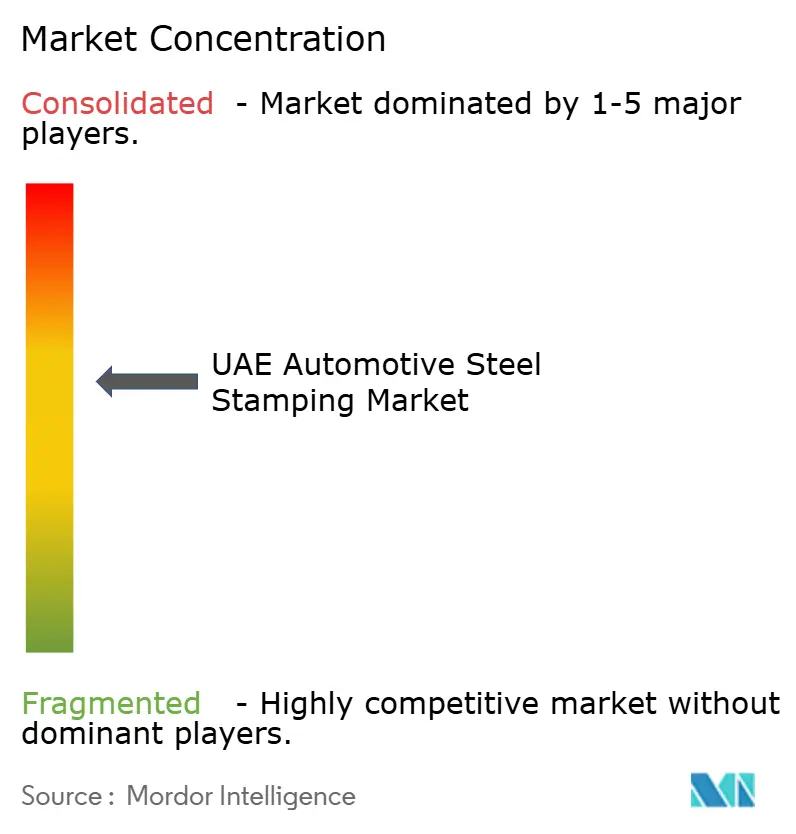
| Market Concentration | Medium |
Major Players *Disclaimer: Major Players sorted in no particular order Image © Mordor Intelligence. Reuse requires attribution under CC BY 4.0. | |
UAE Automotive Steel Stamping Market Analysis by Mordor Intelligence
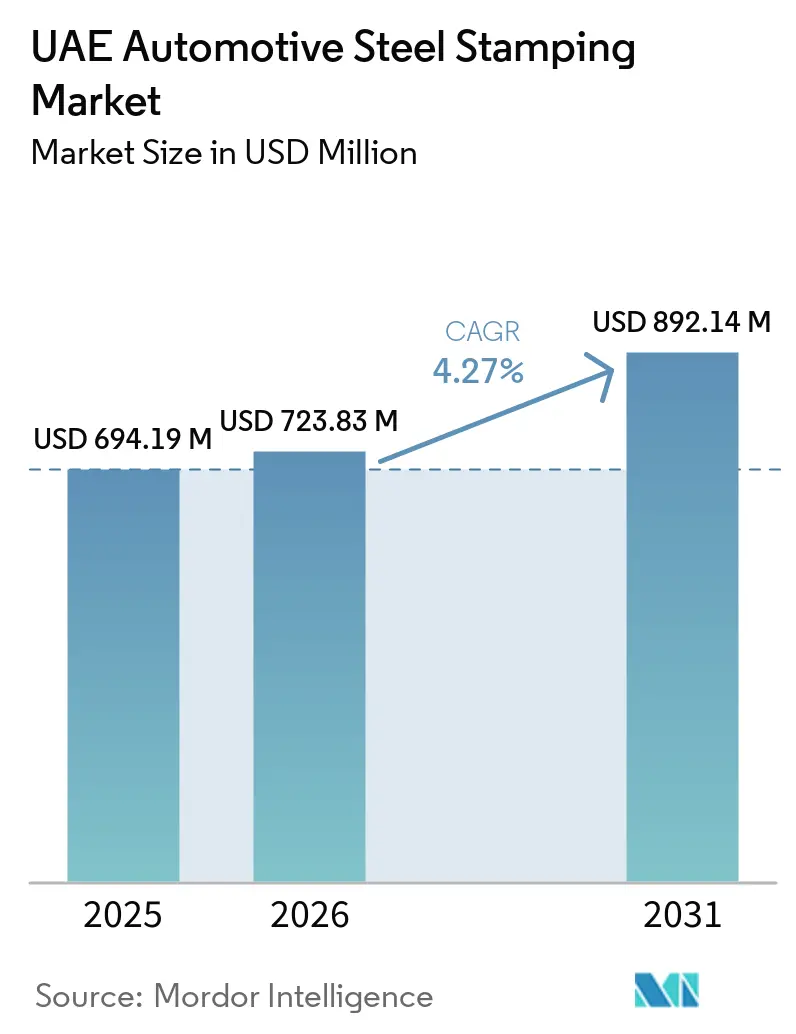
The UAE automotive steel stamping market size was valued at USD 694.19 million in 2025 and is estimated to grow from USD 723.83 million in 2026 to reach USD 892.14 million by 2031, at a CAGR of 4.27% during the forecast period (2026-2031). Three intertwined forces shape this trajectory. First, Etihad Rail Phase 2 significantly reduces coil-delivery lead times to inland plants, improving efficiency and freeing up working capital for stampers to reinvest in servo-mechanical presses. Second, zero-tax free zones in JAFZA and KEZAD have attracted substantial investments, steering stampers toward re-export channels. Third, the localization of battery-pack enclosures for a major gigafactory is introducing hot-stamped advanced high-strength steel parts that comply with the new occupant-safety code. Consequently, the UAE automotive steel stamping market is gradually shifting away from the country's modest assembly base and aligning its growth with the aftermarket, exports, and electric-vehicle subsystems [1].
Key Report Takeaways
- By technology, blanking led with 35.14% revenue share in 2025, and is projected to post the fastest 7.42% CAGR through 2031.
- By process, hot stamping held 38.27% of the UAE automotive steel stamping market share in 2025 and is forecast to expand at a 7.32% CAGR over 2026-2031.
- By vehicle type, passenger cars accounted for 60.84% of the UAE automotive steel stamping market in 2025, while light commercial vehicles are on track for the fastest CAGR, at 7.89%, to 2031.
- By propulsion, internal-combustion vehicles still accounted for 71.78% of 2025 demand, but the electric-vehicle segment is accelerating at a 10.79% CAGR through 2031, the highest across propulsion categories.
- By emirate, Abu Dhabi commanded 45.92% of the UAE automotive steel stamping market share in 2025, while Dubai is expected to record the fastest CAGR of 8.22% over 2026-2031.
Note: Market size and forecast figures in this report are generated using Mordor Intelligence’s proprietary estimation framework, updated with the latest available data and insights as of January 2026.
UAE Automotive Steel Stamping Market Trends and Insights
Drivers Impact Analysis*
| Driver | (~) % Impact on CAGR Forecast | Geographic Relevance | Impact Timeline |
|---|---|---|---|
| Lightweight Vehicle Demand | +1.2% | Global, with concentration in Abu Dhabi and Dubai | Medium term (2–4 years) |
| EV Incentives Boosting Adoption | +0.8% | National, with early gains in Abu Dhabi, Dubai | Short term (≤ 2 years) |
| Etihad Rail Enabling JIT Stamping | +0.6% | National, connecting all emirates | Long term (≥ 4 years) |
| Tax Holidays for Local Stamping | +0.4% | Dubai, Sharjah, and Northern Emirates | Medium term (2–4 years) |
| Localized EV Battery-Pack Enclosures | +0.7% | Abu Dhabi core, spill-over to Dubai | Medium term (2–4 years) |
| Safety Norms Driving Hot-Stamped AHSS | +0.5% | National compliance requirement | Short term (≤ 2 years) |
| Source: Mordor Intelligence | |||
Rising Demand for Lightweight, Fuel-Efficient Vehicles
The UAE's Corporate Average Fuel Economy standards, now aligned with global benchmarks, are pushing OEMs to reduce curb weight. This comes even as internal combustion vehicles, which still account for a significant portion of propulsion demand, dominate the market. High-strength low-alloy grades, known for achieving substantial mass reduction, are increasingly being used in door and fender programs. This trend is particularly evident in light commercial vehicles, which cater to a rapidly growing e-commerce sector. Large stampers, utilizing servo-mechanical presses to manage springback in HSLA sheets, are securing these contracts. In contrast, job shops with hydraulic equipment find themselves confined to low-margin aftermarket tasks. In a sign of upstream readiness to adapt to newer material demands, Emirates Steel Arkan has boosted its shipments of automotive-grade hot-rolled coils.
Government Incentives Accelerating EV Adoption
Dubai experienced a significant increase in electric vehicle registrations, driven by incentives such as free public parking, toll waivers, and registration discounts. Each new EV requires additional hot-stamped Advanced High-Strength Steel (AHSS) in its body-in-white to balance the battery's weight. These vehicles are also equipped with Advanced Driver-Assistance Systems (ADAS) sensors, which demand precise stamping tolerances. While the concentration of charging stations in Dubai and Abu Dhabi directs this demand to stampers located near JAFZA and KIZAD, shops in Sharjah face a potential downturn in volumes from the internal combustion engine (ICE) aftermarket.
Etihad Rail Logistics Corridor Enabling JIT Stamping Supply
A new freight network has commenced operations, swiftly transporting containerized coils from Jebel Ali Port to KIZAD. This innovation has drastically cut logistics costs, improving supply chain efficiency. Consequently, stampers can now maintain a leaner coil inventory, reducing storage requirements and associated expenses. This change not only conserves cash for press-line enhancements but also enables smaller firms to bid for Tier-2 contracts that were previously beyond their financial reach, fostering greater competition in the market.
OEM Localization of EV Battery-Pack Steel Enclosures
Statevolt is investing heavily to set up a gigafactory in Ras Al Khaimah. The factory aims to produce a significant volume of hot-stamped enclosures annually. This strategic move positions Statevolt in the UAE's burgeoning automotive steel-stamping market, targeting press shops with the coveted IATF 16949 certification. Local manufacturers stand to gain significantly from the rising demand for these enclosures, but only if they adhere to strict quality benchmarks. Yet, with the high cost of a single hot-stamping cell, many of the UAE's smaller stamping operations are opting for joint ventures with established global press manufacturers. Such partnerships not only alleviate financial strains for these smaller entities but also grant them access to cutting-edge technologies and expertise, bolstering their market presence.
Restraints Impact Analysis*
| Restraint | (~) % Impact on CAGR Forecast | Geographic Relevance | Impact Timeline |
|---|---|---|---|
| Limited Vehicle Assembly Base | -1.1% | National, particularly affecting export dependency | Long term (≥ 4 years) |
| High Power and Decarbonization Costs | -0.7% | National, with higher impact in Dubai and Northern Emirates | Medium term (2–4 years) |
| Die-Making Skill Shortages | -0.4% | National, concentrated in technical manufacturing zones | Medium term (2–4 years) |
| Imported Coil Steel Dependence | -0.3% | National, affecting all production centers | Short term (≤ 2 years) |
| Source: Mordor Intelligence | |||
Limited Domestic Vehicle-Assembly Base
Rabdan's production line and boutique volumes from W Motors highlight the UAE's automotive steel stamping market's strong dependence on aftermarket replacements and re-exports to the GCC. The market's reliance is further underscored by limited domestic production capacity and the growing demand for replacement parts in the region. While Chinese OEMs lead in EV sales, they have chosen to import many stampings rather than localize production. This move not only reduced domestic tonnage but also exposed stampers to fluctuations in foreign sourcing, creating additional challenges for the local market to achieve self-sufficiency.
High Electricity Tariffs and Decarbonization Compliance Costs
DEWA's industrial rates outpace those of its Saudi and Omani counterparts, inflating overheads for energy-intensive hot-stamping. This cost disparity places additional financial pressure on companies operating in the region. Federal regulations, with their stringent greenhouse gas audits and hefty fines for noncompliance, further complicate operational challenges. Although some larger stamping firms are securing solar Power Purchase Agreements (PPAs) to mitigate energy costs, the minimum off-take clauses are leaving smaller firms in the lurch. As a result, these smaller firms are increasingly exploring cross-border relocations to remain competitive.
*Our forecasts treat driver/restraint impacts as directional, not additive. The impact forecasts reflect baseline growth, mix effects, and variable interactions.
Segment Analysis
By Technology: Blanking Dominates While Hot-Stamped AHSS Accelerates
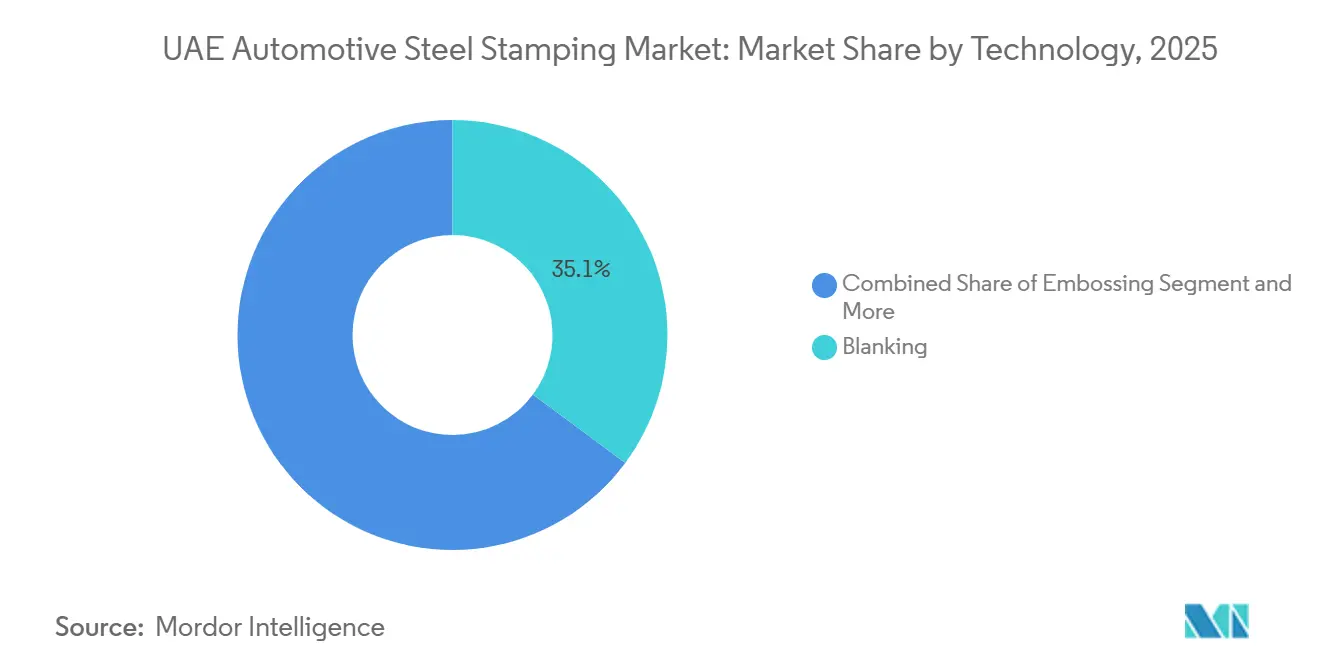
Blanking generated 35.14% of 2025 revenue as aftermarket door skins, hoods, and trunk lids continue to dominate collision-repair orders and are projected to post the fastest 7.42% CAGR through 2031. The UAE's automotive steel stamping market, particularly in blanking, benefits from a thriving used-car trade that continues to grow.
Several UAE groups have made significant investments in integrated hot-stamping cells, while many job shops continue to depend on hydraulic blanking lines. Although Emirates Steel Arkan's upgrade program enhances cold-rolled capacity, the exclusion of ultra-high-strength grades keeps the material supply heavily reliant on imports. Over time, hot-stamping is expected to reduce blanking's market share, but blanking will remain important for non-safety panels and cost-effective repair parts.

By Process: Hot Stamping Leads Innovation Drive
By process, hot stamping held 38.27% of the UAE automotive steel stamping market share in 2025 and is forecast to expand at a 7.32% CAGR over 2026-2031. It delivers single-piece B-pillars at 1,500 MPa that obsolete multi-component weldments, slashing OEM assembly cost and warranty exposure.
Roll forming and sheet-metal forming jointly serve long rails and deep-drawn fenders, respectively, anchoring demand among commercial-vehicle builders and the aftermarket. Statevolt’s enclosure tenders will swell hot-stamping volumes from 2027 onward, potetially pushing its share past 42% by 2031. Yet roll-formed beams remain favored by fleet operators that value post-collision repairability: straightening a deformed roll-formed part is cheaper than replacing a hot-stamped element. Meanwhile, metal fabrication content is drifting to Tier-1 module integrators co-located at assembly plants, diluting stampers’ downstream margins.
By Vehicle Type: Passenger Cars Drive Volume While Commercial Vehicles Show Promise
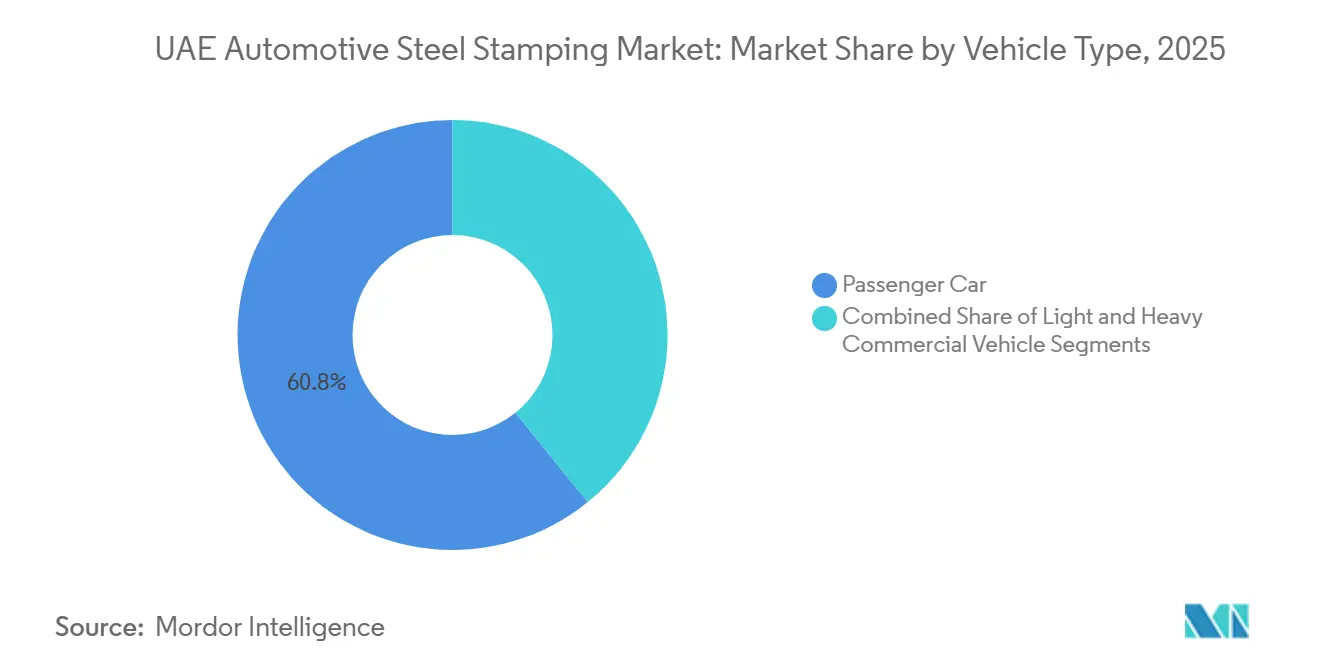
Passenger cars accounted for 60.84% of 2025 stamping revenue. The typical sedan incorporates 25-30 stamped pieces, and the EV subset increases that count because enclosure side members and roof bows are made of AHSS.
Light commercial vehicles are the fastest-growing segment, with a 7.89% CAGR. In the UAE's automotive steel stamping market, light commercial vehicles (LCVs) account for a significant share. These LCVs are experiencing growth due to increasing demand for courier and grocery deliveries. The appeal of electric LCVs, with their potential for substantial fuel cost savings, is encouraging fleet owners to transition. This shift is also driving an increase in stamping orders, particularly for underfloor battery shields. While heavy trucks represent a smaller share of the market volume, they contribute notably with high-thickness cab and chassis parts. These parts enhance revenue figures, even if they do not lead to a significant rise in unit sales
By Propulsion: ICE Dominance Faces EV Disruption
Internal-combustion vehicles accounted for 71.78% of 2025 demand, yet EV stamping is growing at 10.79% CAGR.
To protect batteries from side impacts, each BEV utilizes more hot-stamped materials. This safety improvement is now being incorporated into newer ICE models. The primary driver of this trend is the addition of ADAS hardware, which increases curb weight and drives convergence in design across different propulsion systems. Hybrid vehicles, positioned as an intermediate option, are experiencing consistent growth. These vehicles feature mild-steel outer skins combined with AHSS battery tunnels. In JAFZA and KIZAD, free-zone stampers are securing the majority of EV contracts by co-locating with battery suppliers and leveraging duty-free coil imports.
Geography Analysis
Abu Dhabi accounted for 45.92% of the 2025 value, driven by Emirates Steel Arkan’s integrated mill and an ambitious automotive strategy aimed at creating new jobs [2]. KEZAD’s proximity to Emirates Global Aluminum and Ras Al Khaimah Statevolt attracts suppliers of hybrid aluminum-steel structures, which use shared toolrooms with stampers.
Dubai, projected to compound at 8.22%, benefits from the expansive Dubai Auto Market and substantial automotive trade through Jebel Ali Port. Its free-zone status, efficient customs clearance, and Etihad Rail’s connection to inland clusters enable Dubai-based stampers to import coil duty-free, stamp it, and re-export it within a short timeframe. Sharjah and the Northern Emirates hold a modest market share, supported by BEEAH-LOHUM’s battery-recycling plant. However, these regions face challenges, including low capacity utilization and slower anticipated growth.
Competitive Landscape
The UAE automotive steel stamping market is fragmented, with no single player holding a significant market share. Emirates Steel Arkan is focusing on downstream expansion, while Dana Steel is establishing another plant in KEZAD. Conares has substantial capacity for ERW tubes and coils and supplies aftermarket blanks. Global press manufacturers such as Loire Gestamp and KIRCHHOFF Automotive are opting for technology-transfer partnerships instead of setting up greenfield plants, primarily to avoid high electricity costs. The adoption of servo-mechanical presses provides a notable advantage in scrap rates, enabling these adopters to offer more competitive pricing compared to hydraulic press users. Additionally, Chinese OEMs, which now account for a growing share of new vehicle registrations, are bringing their stamping partners into JAFZA through joint ventures, further intensifying price competition.
The Federal Decree-Law on emissions reporting is prompting stampers to install energy-monitoring systems, benefiting firms with greater capital resources. A persistent shortage of IATF-certified die makers is delaying product launches, encouraging foreign toolmakers to establish refurbishment centers in the UAE. To mitigate the impact of cyclical fluctuations in automotive demand, stampers are diversifying into ADNOC’s pressure-vessel program. This diversification enables them to use shared presses to manufacture both vessel heads and hot-stamped B-pillars.
UAE Automotive Steel Stamping Industry Leaders
-
Emirates Steel Arkan (EMSTEEL)
-
Dana Steel UAE
-
Oasis Metal Mfg.
-
Al Ghurair Iron & Steel
-
Automech Steel Industries LLC
- *Disclaimer: Major Players sorted in no particular order
Recent Industry Developments
- January 2026: EXEED has announced the launch of the VX plug-in hybrid electric vehicle (PHEV) in the United Arab Emirates, highlighting it as the only quad-motor AWD PHEV globally. The vehicle features an 85% high-strength steel body structure, 10 airbags, and 26 advanced driver assistance systems (ADAS).
- December 2025: Legend Holding Group, based in Dubai, has unveiled plans to expand its automotive operations in the Jebel Ali Free Zone (Jafza) by AED 500 million. The expansion will see the development of a sprawling one-million-square-foot regional headquarters, a motorcycle assembly line, and an export hub, all nestled within an integrated automotive ecosystem. The construction will unfold in two phases: the first, scheduled for completion by April 2026, will accommodate 5,000 vehicles. The second phase will see the expansion into a multi-story facility, capable of handling over 20,000 vehicles, slated for completion by January 2028.
UAE Automotive Steel Stamping Market Report Scope
The UAE automotive steel stamping market report is segmented by technology (blanking, embossing, and more), process (roll forming, hot stamping, and more), vehicle type (passenger cars, light commercial vehicles, and more), propulsion (internal-combustion engine and electric vehicles), and emirate (Abu Dhabi, Dubai, and Sharjah and Northern Emirates). The market forecasts are provided in terms of value (USD).
| Blanking |
| Embossing |
| Coining |
| Flanging |
| Bending |
| Other Technologies |
| Roll Forming |
| Hot Stamping |
| Sheet-Metal Forming |
| Metal Fabrication |
| Other Processes |
| Passenger Cars |
| Light Commercial Vehicles |
| Heavy Commercial Vehicles |
| Internal Combustion Engine (ICE) |
| Electric Vehicle (EV) |
| Abu Dhabi |
| Dubai |
| Sharjah and Northern Emirates |
| By Technology | Blanking |
| Embossing | |
| Coining | |
| Flanging | |
| Bending | |
| Other Technologies | |
| By Process | Roll Forming |
| Hot Stamping | |
| Sheet-Metal Forming | |
| Metal Fabrication | |
| Other Processes | |
| By Vehicle Type | Passenger Cars |
| Light Commercial Vehicles | |
| Heavy Commercial Vehicles | |
| By Propulsion | Internal Combustion Engine (ICE) |
| Electric Vehicle (EV) | |
| By Emirate | Abu Dhabi |
| Dubai | |
| Sharjah and Northern Emirates |
Key Questions Answered in the Report
How large is the UAE automotive steel stamping market in 2025?
The UAE automotive steel stamping market size stands at USD 694.19 million in 2025.
What CAGR is forecast for UAE automotive steel stamping through 2030?
The market is projected to grow at a 4.27% CAGR from 2025 to 2030.
Which technology segment is expanding fastest in UAE stamping?
Hot-stamped AHSS components are advancing at a 9.92% CAGR due to lightweighting and safety mandates.
Why is Abu Dhabi the leading emirate for automotive steel stamping?
Abu Dhabi offers upstream coil supply from Emirates Steel Arkan and industrial zones with rail-port integration, giving it 45.92% market share.
How will electrification influence UAE stamp-shop demand?
EV adoption, rising at a 19.12% CAGR, lifts demand for battery-enclosure and under-body stampings, reshaping tool and material requirements.
What infrastructure project supports just-in-time stamping logistics?
The 900 km Etihad Rail freight network enables rapid coil and finished-part movement across the federation, cutting inventory costs.