
Saudi Arabia Heavy Duty Truck Market Size and Share
Market Overview
| Study Period | 2019 - 2031 |
|---|---|
| Forecast Data Period | 2026 - 2031 |
| Base Year Market Size (2025) | USD 8.76 Billion |
| Market Size (2026) | USD 9.61 Billion |
| Market Size (2031) | USD 15.19 Billion |
| Growth Rate (2026 - 2031) | 9.61 % |
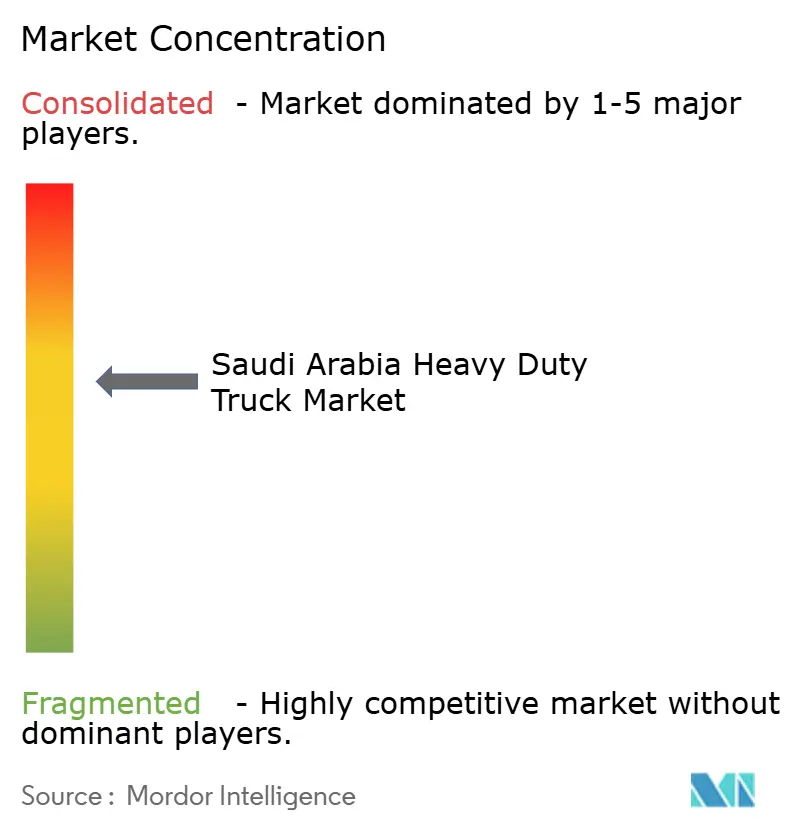
| Market Concentration | Medium |
Major Players *Disclaimer: Major Players sorted in no particular order Image © Mordor Intelligence. Reuse requires attribution under CC BY 4.0. | |
Saudi Arabia Heavy Duty Truck Market Analysis by Mordor Intelligence
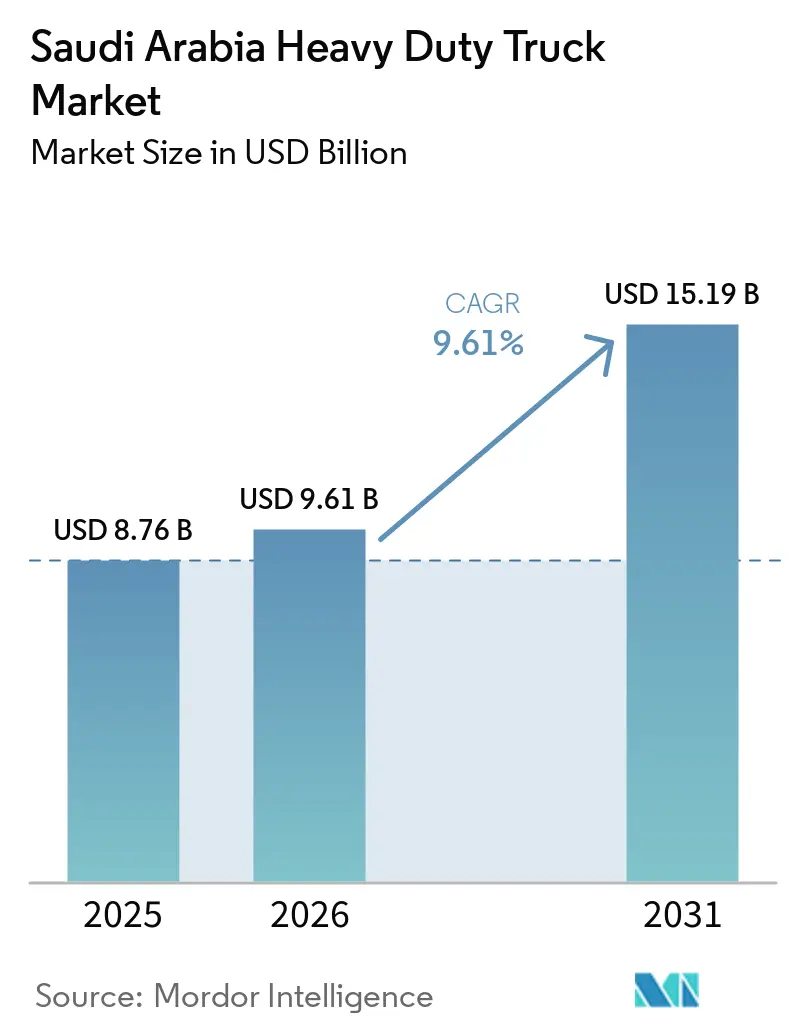
The Saudi Arabia heavy-duty truck market size was valued at USD 8.76 billion in 2025, is estimated at USD 9.61 billion in 2026, and is projected to reach USD 15.19 billion by 2031 at a 9.61% CAGR over 2026-2031. Demand momentum stems from Vision 2030 infrastructure programs, a mining-sector super-cycle, and fast-growing e-commerce distribution corridors that are gradually reducing the economy’s oil dependence. The Saudi Arabia heavy-duty truck market continues to benefit from port expansions at Jeddah Islamic Port and King Abdulaziz Port, the Saudi Landbridge rail-and-road corridor, and strict fleet-renewal regulations that cap truck operating life at 20 years. The Eastern Province accounts for over one-third of national volumes, supported by industrial free zones around Jubail and Dammam and by Ras Al-Khair’s metals clusters. Mining CAPEX by Ma’aden, combined with public-sector hydrogen investments at NEOM, is tilting procurement toward above-40-tonne tipper classes and piloting hydrogen fuel-cell trucks on long off-highway routes. Against this backdrop, the Saudi Arabian heavy-duty truck market shows early signs of propulsion diversification even as diesel remains dominant.
Key Report Takeaways
- By gross vehicle weight rating, the 26-40 tonne class led with 45.51% of the Saudi Arabian heavy-duty truck market share in 2025. The above-40 tonne class is the fastest-growing band, advancing at a 9.63% CAGR through 2031.
- By propulsion, internal-combustion engines accounted for 87.71% of 2025 shipments. Electrified powertrains—battery-electric, hybrid, and fuel-cell—are projected to record the highest growth at a 9.66% CAGR to 2031.
- By axle type, 6×4 configurations captured 48.15% of the 2025 mix. The 6×2 layout represents the quickest riser, with a forecast CAGR of 9.71% over 2026-2031.
- By truck type, rigid formats held a 61.24% share in 2025. Articulated units are set to expand the fastest, at a 9.73% CAGR to 2031.
- By application, construction and mining dominated with 45.54% revenue share in 2025. Freight and logistics are the most dynamic use cases, accelerating at a 9.77% CAGR through 2031.
- By geography, the Eastern Province commanded 34.28% of the 2025 demand. It is also the fastest-growing region, projected to rise at a 9.75% CAGR during 2026-2031.
Note: Market size and forecast figures in this report are generated using Mordor Intelligence’s proprietary estimation framework, updated with the latest available data and insights as of January 2026.
Competitive positioning in Saudi arabia includes both locally based firms and those operating across multiple regions. The market landscape in the global heavy duty trucks industry research shows how these players are arranged internationally.
Saudi Arabia Heavy Duty Truck Market Trends and Insights
Drivers Impact Analysis*
| Driver | (%) Impact on CAGR Forecast | Geographic Relevance | Impact Timeline |
|---|---|---|---|
| Vision 2030 Infrastructure Mega-Projects Pipeline | +2.8% | National, with concentration in Riyadh, Makkah, NEOM, Qiddiya | Long term (≥ 4 years) |
| Mandatory Truck-Age Cap and Fleet Renewal Rules | +2.1% | National, enforced by Ministry of Transport | Short term (≤ 2 years) |
| E-Commerce-Led Freight and Port-Expansion Demand | +1.9% | Eastern Province, Jeddah, Riyadh logistics corridors | Medium term (2-4 years) |
| Arabian Shield Mining Boom | +1.5% | Northern and Western regions (Ma'aden concessions), Ras Al-Khair | Long term (≥ 4 years) |
| Local Assembly Incentives for Commercial Vehicles | +1.3% | King Abdullah Economic City, Jeddah, Dammam industrial zones | Medium term (2-4 years) |
| Hydrogen Corridor Pilots Enabling FCEV Trucks | +0.7% | NEOM, Jubail industrial corridors, future expansion to mining routes | Long term (≥ 4 years) |
| Source: Mordor Intelligence | |||
Vision 2030 Infrastructure Mega-Projects Pipeline
Saudi Arabia awarded SAR 196 billion (USD 35.5 billion) for ports, airports, and rail infrastructure that demand concrete mixers, tippers, and flatbeds at giga-sites such as Qiddiya and Diriyah Gate. The 1,500-kilometer Saudi Landbridge requires parallel trucking for last-mile distribution, favoring 6x2 articulated formats that optimize fuel use on paved corridors. Construction output is rising 5.2% annually through 2028, yet project owners increasingly request hydrogen-ready trucks because NEOM’s 600-tonnes-per-day green-hydrogen plant will come online in mid-2026 [1]. OEMs from Europe and Asia are therefore shipping prototype fuel-cell trucks into pilot fleets ahead of firm tenders. As mega-projects converge with emerging zero-carbon mandates, the Saudi Arabia heavy-duty truck market is repositioning toward alternative drivelines without abandoning diesel leadership.
Mandatory Truck-Age Cap and Fleet Renewal Rules
Royal Decree 188/M sets a 20-year service ceiling and bans used-truck imports older than five years, forcing fleets to retire aging stock and triggering bulk orders for Euro 5/Euro 6 units. All commercial vehicles must carry GPS and telematics devices, with non-compliance fines up to SAR 160,000. Scania secured an 800-unit order from Al Bassami in 2026 and supplied G440 XT 6×4 trucks to Pioneers Transport, demonstrating pent-up renewal demand. With residual values for pre-2007 trucks collapsing, OEMs are bundling service contracts and telematics subscriptions to ease financing. Renewal intensity is projected to peak in 2027 as the last pre-2007 cohort exits.
E-Commerce-Led Freight and Port-Expansion Demand
The kingdom processed 79.6 million e-commerce delivery orders in Q1 2025, and last-mile logistics revenue is tracking toward USD 4.5 billion in 2026, up 19.2% year on year. Jeddah Islamic Port is lifting capacity from 2.5 million to 6.2 million TEUs, backed by a USD 800 million DP World terminal, while Saudi Global Ports is investing USD 933 million around Dammam. Higher sailing frequency has diversified inbound lanes and boosted the liner connectivity index, creating continuous small-payload truck demand. Full-truckload services still dominate, yet less-than-truckload volumes are climbing because of urban micro-fulfillment hubs. Mawani is scaling logistics zones from 22 to 59 by 2030, switching procurement from isolated rigids to integrated fleets that pair rigid trucks for intra-zone shuttles with articulated units for inter-city haulage [2].
Arabian Shield Mining Boom (Above 40 t Tipper Demand)
Ma’aden plans USD 110 billion in investments through 2040, including SAR 15.5 billion in 2026 CAPEX for the Phosphate 3 project and new gold deposits [3]. Mining GDP is targeted to climb from USD 17 billion in 2024 to USD 75 billion in 2030, stimulating demand for above-40-tonne tippers with 8×6 or 8×8 axles. More than 200 advanced dump trucks went live at Mahd Ad Dahab and Al Jalamid mines in May 2025. Lenders now link equipment financing to carbon-intensity metrics, a policy that accelerates interest in hydrogen and battery-electric variants even before clear total-cost parity with diesel.
Restraints Impact Analysis*
| Restraint | (%) Impact on CAGR Forecast | Geographic Relevance | Impact Timeline |
|---|---|---|---|
| Diesel-Price Volatility After Subsidy Reforms | -1.4% | National, with acute impact on independent operators and long-haul fleets | Short term (≤ 2 years) |
| Imported Chassis Supply-Chain Bottlenecks | -0.9% | National, concentrated in import-dependent operators awaiting European and Asian chassis | Short term (≤ 2 years) |
| Rail-Freight Corridor Weight Limits: Divert Traffic | -0.8% | Eastern Province to Jordan border corridor, Landbridge route, Haramain HSR catchment | Medium term (2-4 years) |
| Saudization Quotas Creating Heavy-Driver Shortage | -0.6% | National, with higher friction in Eastern Province industrial zones | Medium term (2-4 years) |
| Source: Mordor Intelligence | |||
Diesel-Price Volatility After Subsidy Reforms
Diesel rose to SAR 1.79 per liter in January 2026, 7.8% higher than in 2025 and sevenfold above the pre-2015 subsidized rate. Indexation to global prices introduces quarterly uncertainty, squeezing operators that cannot pass surcharges to shippers. Larger fleets are pre-purchasing Euro 6 trucks and considering gas conversions, while small independents delay replacement and cannibalize parts, a pattern that weighs on 16-26 tonne demand.
Imported Chassis Supply-Chain Bottlenecks
A March 2026 Strait of Hormuz closure rerouted shipping via the Cape of Good Hope, adding 10-14 days and 25-40% cost inflation. CMA CGM imposed USD 2,000-4,000 surcharges per container. Resulting lead-time spikes favor OEMs with the Saudi Arabia heavy-duty truck market assembly, such as Isuzu, Daimler, and UD Trucks, over fully imported brands. The Public Investment Fund’s Ras Al-Khair steel mill with Baowu will mitigate frame imports, but ramp-up runs to 2028.
*Our forecasts treat driver/restraint impacts as directional, not additive. The impact forecasts reflect baseline growth, mix effects, and variable interactions.
Segment Analysis
By Gross Vehicle Weight Rating: Mining Tippers Drive Above-40 t Surge
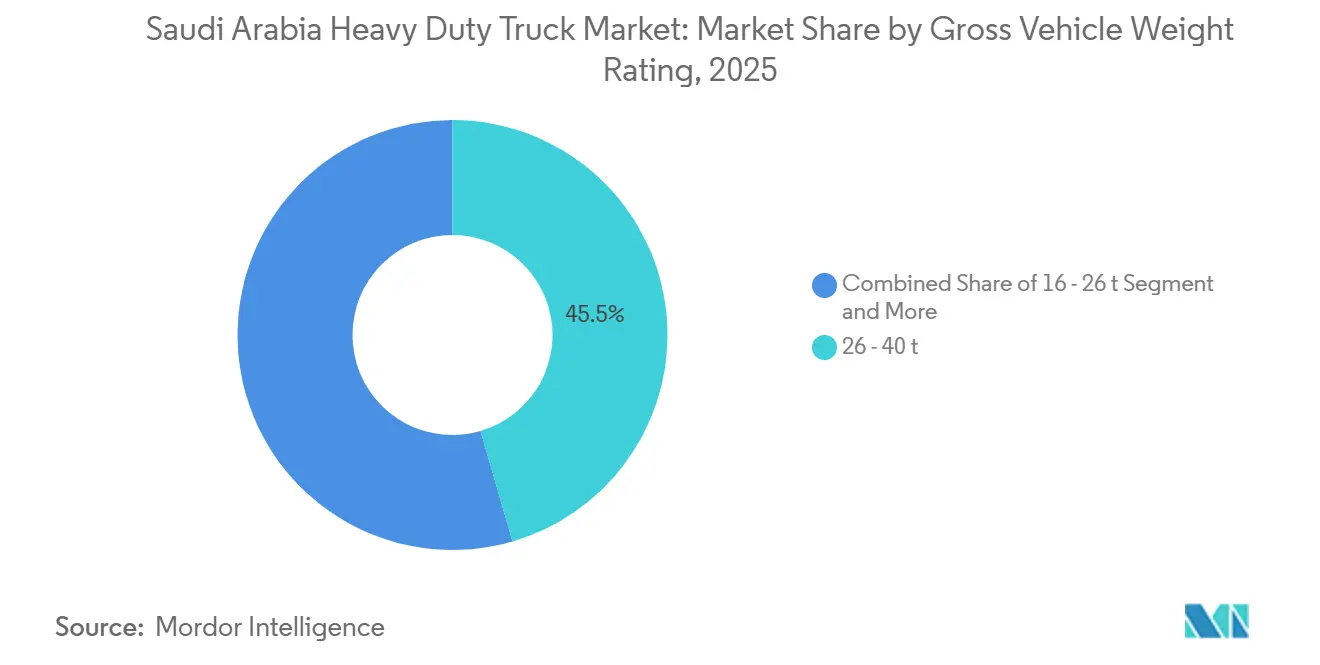
The 26-40 tonne segment accounted for 45.51% of the Saudi Arabia heavy-duty truck market in 2025, reflecting operator preference for payload-maneuverability balance on urban projects. Above-40-tonne units are on course for a 9.63% CAGR as Ma’aden’s SAR 15.5 billion 2026 spend and the wider Arabian Shield exploration pipeline create sustained haulage needs. This sub-segment’s share of the Saudi Arabia heavy-duty truck market size is projected to expand sharply once hydrogen prototypes gain financing support.
More than 200 new dump trucks were deployed in May 2025 at Mahd Ad Dahab and Al Jalamid, most with 8×6 or 8×8 axles suitable for rugged terrain. Chinese manufacturer XCMG has opened a Riyadh office to chase cost-sensitive miners, while European OEMs emphasize telematics and warranty bundling. Sustainability clauses written into mining finance agreements are steering procurement toward low-carbon drivelines well before diesel phase-outs begin.

By Propulsion: Electrified Powertrains Gain Traction
Internal-combustion engines held 87.71% propulsion share in 2025, but battery-electric, hybrid, and fuel-cell trucks are forecast to grow at 9.66% CAGR through 2031. With NEOM’s hydrogen plant nearing completion, OEM prototypes such as Aramco-Hyperview’s 240 kW fuel-cell truck are logging early trials. The Saudi Arabia heavy-duty truck market size for zero-emission variants remains small at present, yet Vision 2030 seeks over 1 million barrels per day fuel displacement by 2030.
Persistent barriers include high upfront costs—EU battery-electric trucks average USD 666,000 versus diesel at USD 321,900—and limited charging. EVIQ’s 88 public chargers must scale fiftyfold to hit 5,000 units by 2030. Policy modeling indicates that 40% of new heavy-duty registrations would need to be zero-emission by 2035 to align with a 25% CO₂ reduction trajectory, implying steep volume inflections from 2028 onward.
By Axle Type: 6x2 Configurations Edge Up on Highway Routes
6x4 trucks led with 48.15% 2025 share, due to construction and mining traction needs. The 6x2 category is expanding at a 9.71% CAGR as long-haul operators target lighter tare weight and lower tire wear on modernized highways. The Saudi Arabia heavy-duty truck market size attached to 6x2 trucks is therefore rising fastest within axle classes. Deployment of Volvo FH Aero tractors assembled at King Abdullah Economic City illustrates OEM commitment to fuel-saving aerodynamics.
Higher diesel prices at SAR 1.79 per liter accelerate the shift, while mandated telematics allow fleets to verify savings down to the route level. Off-highway specialists still prefer 6x4 or 8×6, but articulated long-haul operators between Jubail, Riyadh, and Jeddah increasingly calibrate procurement to total-cost-per-kilometer metrics, favoring 6x2.
By Truck Type: Articulated Units Capture Cross-Border Freight
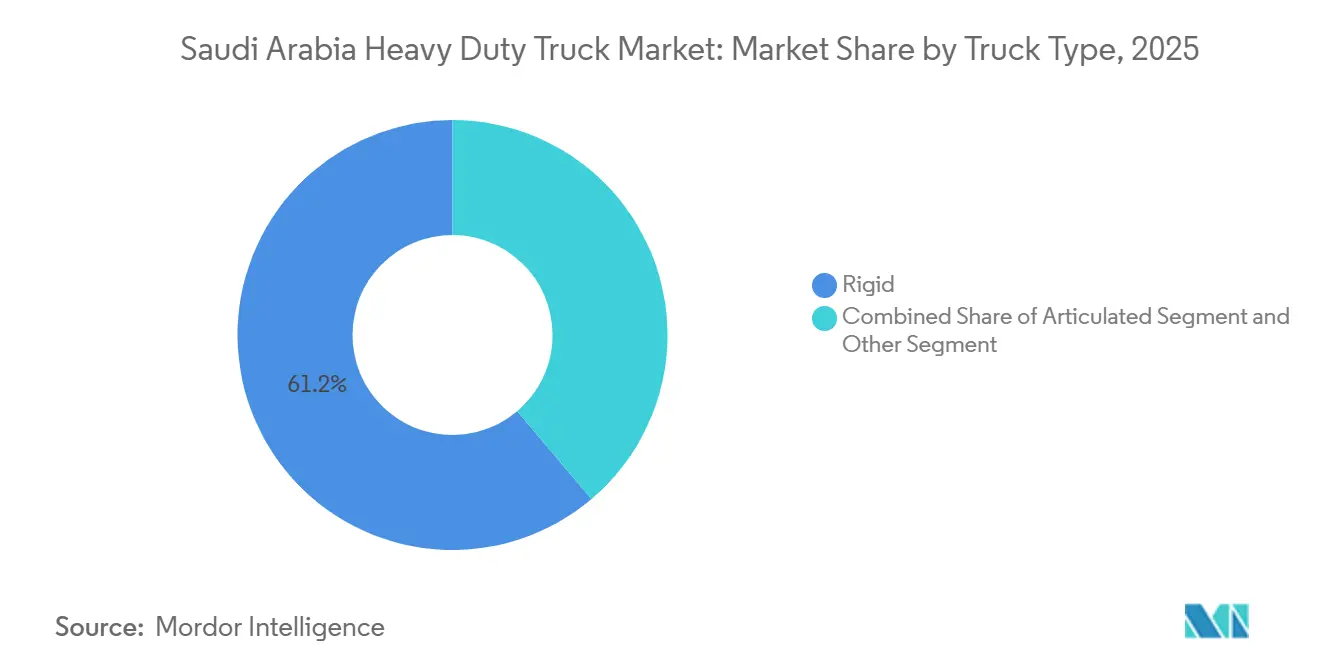
Rigid trucks held 61.24% share in 2025 for construction and municipal duties. Articulated units are forecast for a 9.73% CAGR, supported by international corridors linking Gulf ports to Jordan and by transshipment growth at Jeddah and Dammam. Saudi Railway Company’s new 1,700-kilometer route necessitates road legs handled primarily by articulated tractors.
Royal Decree 188/M’s import ban on older vehicles hurts rigid residual values more than articulated, skewing fleet economics. Mawani’s expansion to 59 logistics zones by 2030 further strengthens articulated demand in the Saudi Arabia heavy-duty truck market, particularly for container drays between ports and inland hubs.
By Application: Freight & Logistics Outpace Construction & Mining
Construction and mining commanded 45.54% of 2025 revenue, fueled by giga-projects and metals investments. Freight and logistics, however, are growing faster at 9.77% CAGR as e-commerce volumes surge and new shipping services call Saudi ports. Riyadh’s SAL logistics zone alone spans 1.57 million m² and is engineered to shrink empty-mile ratios through route optimization.
Long-haul lanes over 500 kilometers feel competitive pressure from rail on container loads, prompting fleets to diversify into less-than-truckload city pairs. The Eastern Province, already holding 34.28% share, adds capacity at SPARK and Jubail that compounds freight growth. As telematics adoption rises, operators pivot fleets toward contract logistics rather than project-specific haul, broadening the customer mix.
Geography Analysis
The Eastern Province generated 34.28% of Saudi Arabia's heavy-duty truck market share in 2025 and is expected to post a 9.75% CAGR through 2031. Ongoing expansions at King Abdulaziz Port, Ras Al-Khair metals complexes, and Jubail industrial zones sustain baseline demand for both rigid and articulated trucks. SPARK’s zero-tax regime draws upstream oil-equipment suppliers that run time-sensitive shuttle routes to Dhahran and Riyadh, reinforcing regional dominance.
Makkah Province benefits from the Jeddah Islamic Port upgrade to 6.2 million TEUs and from urban infrastructure that supports religious tourism. The 17-kilometer corridor to Al Khumrah Logistics Park and Riyadh’s eight-billion-riyal ring-road package feed articulated tractor demand. While Asir and Medina grow from tourism and agriculture, their combined share remains below that of the Eastern powerhouse.
Northern regions tied to the Arabian Shield see incremental upside as Ma’aden unlocks new concessions. Road haul dominates until rail spurs arrive, meaning dedicated dump fleets will stage equipment near project sites. The geographic pattern, therefore, crystallizes into a twin-hub model—Eastern Province and Jeddah—linked by upgraded highways and the forthcoming Landbridge rail, with remote mining districts as cyclical outliers.
Mordor Intelligence tracks the heavy duty trucks market across other major regions such as Europe and Africa, with additional country-level coverage spanning United States and Mexico, each reflecting localized structural drivers, restraints and more.
Competitive Landscape
The majority of the top players in the Saudi Arabian heavy-duty truck market hold a significant market share, producing a moderately fragmented arena. European incumbents—Daimler, Volvo, Scania, MAN—anchor premium segments, yet Chinese challengers such as FAW, Sinotruk, Shacman, and XCMG leverage aggressive pricing and assembly partnerships to win project tenders. Isuzu surpassed 60,000 cumulative local builds by 2025, confirming the strategic value of domestic lines.
Competitive strategy clusters around three levers. First, local assembly mitigates shipping shocks and meets localization quotas; Mercedes-Benz produces Actros Pro cabs in Jeddah, and Hyundai’s USD 500 million KAEC plant opens in late 2026. Second, telematics bundles satisfy the mandatory GPS tracker rule while generating new service revenue. Third, alternative-fuel positioning differentiates bids for mining fleets that face lender-imposed carbon thresholds.
Technology investments intensify. Isuzu’s predictive-maintenance algorithms cut dump-truck cycle times by 40% and fuel 22%. Aramco-Hyperview’s 800-kilometer fuel-cell prototype signals that legacy energy producers will fund early hydrogen deployments to safeguard long-term haulage margins. Following the March 2026 Strait of Hormuz closure, import-dependent brands accelerate Saudi localization to de-risk supply chains, effectively bifurcating the market into quick-turn local models and slower imported SKDs.
Saudi Arabia Heavy Duty Truck Industry Leaders
-
Daimler Truck
-
Volvo Trucks
-
MAN Truck & Bus
-
Isuzu Motors
-
Hino Motors
- *Disclaimer: Major Players sorted in no particular order
Recent Industry Developments
- June 2026: Saudi Arabia's Transport General Authority (TGA) backed the rollout of the Kingdom’s first heavy-duty autonomous truck powered completely by hydrogen. Built through a landmark corporate alliance between Procter & Gamble (P&G), local distributor Ismail Abudawood, and Chinese autonomous technology provider Hyperview, the long-haul vehicle achieves a 1,500 km range with zero emissions and refuels in minutes.
- January 2026: Al Muneef Company for Trade, Industry, Agriculture, and Contracting signed a SAR 7.875 million (USD 2.1 million) contract with China's Shanxi Heavy Vehicle Import and Export Co. to purchase fifty 2026-model SHACMAN H3000S tractor/semi-trailer heads.
- June 2025: Hyundai Motor Manufacturing Middle East broke ground on a USD 500 million plant in King Abdullah Economic City to build 50,000 vehicles annually from Q4 2026.
- March 2025: PIF and Hyundai Motor Company signed a joint venture to manufacture internal-combustion and electric vehicles domestically.
Saudi Arabia Heavy Duty Truck Market Report Scope
The scope of the report includes gross vehicle weight rating (16 to 26 t, 26 to 40 t, and above 40 t), Propulsion (Internal Combustion and Electrified), Axle Type (4x2, 6x4, 6x2, 6x6, 8x6, 8x8, and Others), Truck Type (Rigid, Articulated, and Others), Application (Construction and Mining, Freight and Logistics, Long-Haul, and Other Applications), and Geography (Riyadh Province, Makkah Province, Eastern Province, Asir Province, Medina Province, and Rest of Saudi Arabia). The Market Forecasts are Provided in Value (USD) and Volume (Units).
| 16 - 26 t |
| 26 - 40 t |
| Above 40 t |
| Internal-Combustion (ICE) | Diesel |
| Natural Gas (CNG / LNG) | |
| Electrified | Battery-Electric (BEV) |
| Hybrid & Plug-in Hybrid (HEV & PHEV) | |
| Fuel-Cell Electric (FCEV) |
| 4x2 |
| 6x4 |
| 6x2 |
| 6x6 |
| 8x6 |
| 8x8 |
| Others |
| Rigid |
| Articulated |
| Others |
| Construction & Mining |
| Freight & Logistics |
| Long-Haul |
| Other Applications |
| Riyadh Province |
| Makkah Province |
| Eastern Province |
| Asir Province |
| Medina Province |
| Rest of Saudi Arabia |
| By Gross Vehicle Weight Rating | 16 - 26 t | |
| 26 - 40 t | ||
| Above 40 t | ||
| By Propulsion | Internal-Combustion (ICE) | Diesel |
| Natural Gas (CNG / LNG) | ||
| Electrified | Battery-Electric (BEV) | |
| Hybrid & Plug-in Hybrid (HEV & PHEV) | ||
| Fuel-Cell Electric (FCEV) | ||
| By Axle Type | 4x2 | |
| 6x4 | ||
| 6x2 | ||
| 6x6 | ||
| 8x6 | ||
| 8x8 | ||
| Others | ||
| By Truck Type | Rigid | |
| Articulated | ||
| Others | ||
| By Application | Construction & Mining | |
| Freight & Logistics | ||
| Long-Haul | ||
| Other Applications | ||
| By Geography | Riyadh Province | |
| Makkah Province | ||
| Eastern Province | ||
| Asir Province | ||
| Medina Province | ||
| Rest of Saudi Arabia | ||
Key Questions Answered in the Report
What is the forecast value of the Saudi Arabian heavy-duty truck market in 2031?
It is projected to reach USD 15.19 billion by 2031.
Which GVWR class currently holds the largest share?
The 26-40 tonne class led with 45.51% share in 2025.
Which propulsion type is growing fastest?
Electrified powertrains, including battery-electric and fuel-cell trucks, are forecast to grow at a 9.66% CAGR from 2026 to 2031.
Why is the Eastern Province so important for fleet demand?
Its industrial free zones, port infrastructure, and petrochemical clusters accounted for 34.28% of 2025 truck demand and are expanding at a 9.75% CAGR.
How do new fleet rules influence truck procurement?
The 20-year age cap and five-year import limit accelerate replacement cycles and favor locally assembled Euro 5 and Euro 6 trucks equipped with mandatory GPS trackers.
What opportunities exist for zero-emission trucks?
Hydrogen pilots at NEOM and mining routes, combined with planned national fueling infrastructure, create early niches for fuel-cell trucks before 2031.