
North America Automotive Steel Stamping Market Size and Share
Market Overview
| Study Period | 2019 - 2031 |
|---|---|
| Forecast Data Period | 2026 - 2031 |
| Base Year Market Size (2025) | USD 19.43 Billion |
| Market Size (2026) | USD 20.13 Billion |
| Market Size (2031) | USD 24.09 Billion |
| Growth Rate (2026 - 2031) | 3.65 % |
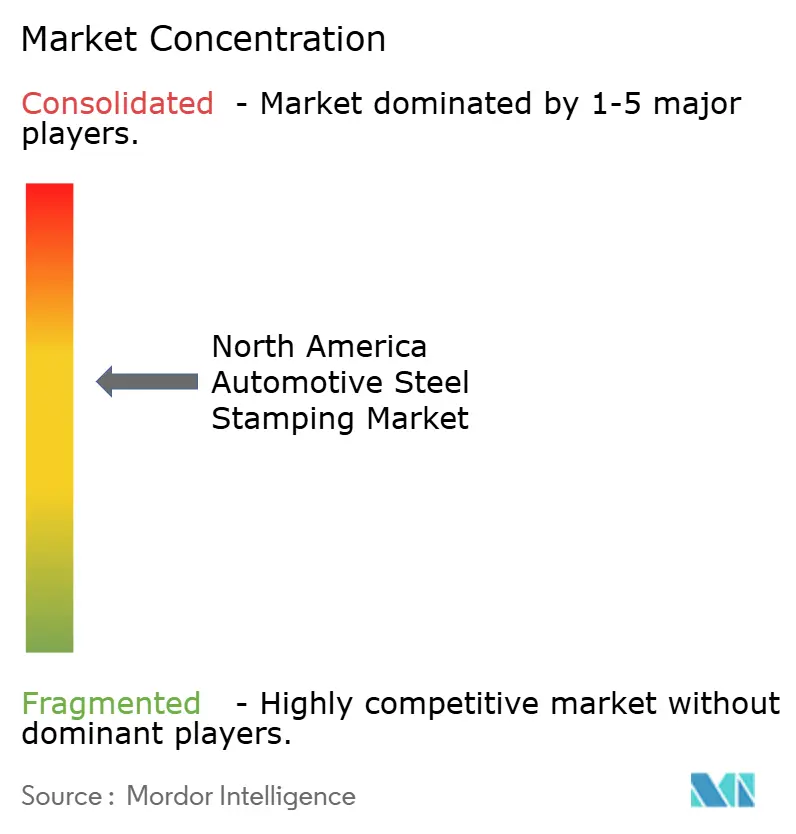
| Market Concentration | Medium |
Major Players *Disclaimer: Major Players sorted in no particular order Image © Mordor Intelligence. Reuse requires attribution under CC BY 4.0. | |
North America Automotive Steel Stamping Market Analysis by Mordor Intelligence
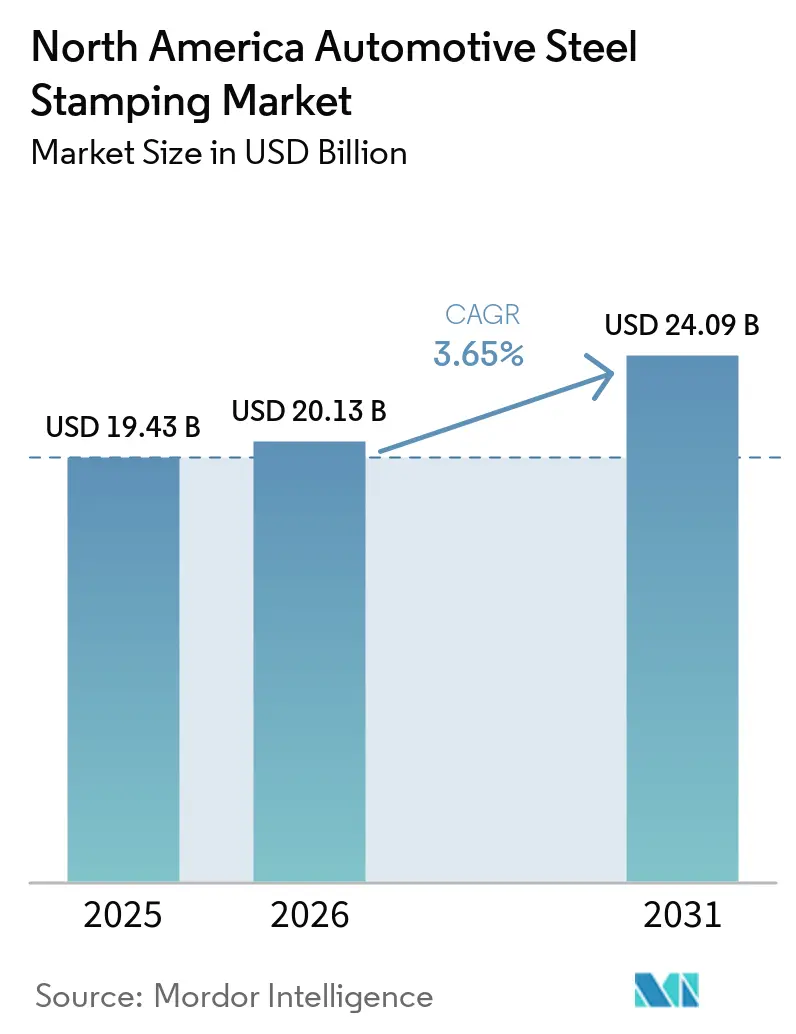
The North American automotive steel stamping market size was valued at USD 19.43 billion in 2025 and is estimated at USD 20.13 billion in 2026, and is projected to reach USD 24.09 billion by 2031, growing at a CAGR of 3.65% from 2026 to 2031. USMCA regional content mandates are bringing stamping capacity back onshore, while hot-stamped ultra-high-strength steel (UHSS) components help OEMs reduce vehicle weight without disrupting established supply chains. Servo-press automation is lowering per-part costs and mitigating the impact of elevated flat-steel prices. Tesla’s shift from aluminum gigacasting to steel megastampings highlighted the lower capital intensity of multi-piece steel architectures, encouraging legacy OEMs to invest in advanced stamping lines. However, stable light-vehicle production and slower battery electric vehicle (BEV) adoption continue to constrain near-term demand for stamped battery enclosures.
Key Report Takeaways
- By technology, blanking led with 31.28% of the North America automotive steel stamping market share in 2025, while embossing is projected to register the highest CAGR at 4.67% through 2031.
- By process, sheet-metal forming led with 38.15% of the North America automotive steel stamping market share in 2025, while hot stamping is set to grow at a 4.69% CAGR to 2031.
- By vehicle type, passenger cars commanded 67.17% of the North America automotive steel stamping market size in 2025, and light commercial vehicles are projected to expand at a 4.73% CAGR through 2031.
- By propulsion, internal-combustion platforms held 71.26% of demand in 2025; electric-vehicle stampings will post the fastest growth at 5.77% CAGR over 2026-2031.
- By country, the United States retained a 61.23% revenue share in 2025, whereas Mexico is forecast to record the highest CAGR of 5.81% during 2026-2031.
Note: Market size and forecast figures in this report are generated using Mordor Intelligence’s proprietary estimation framework, updated with the latest available data and insights as of January 2026.
Market Trends and Insights
Drivers Impact Analysis of North America Automotive Steel Stamping Market*
| Driver | (~) % Impact on CAGR Forecast | Geographic Relevance | Impact Timeline |
|---|---|---|---|
| OEM lightweighting push spurring demand | +1.1% | North America, with early adoption in United States and Canada | Long term (≥ 4 years) |
| Tighter USMCA regional-content rules favouring local steel stampers | +0.9% | Mexico (Bajío corridor), United States border states | Medium term (2-4 years) |
| Surge in North-American light-vehicle production rebound | +0.8% | United States, Canada, Mexico | Medium term (2-4 years) |
| On-shoring of battery-pack enclosure stamping | +0.7% | United States (Michigan, Ohio, Tennessee) | Medium term (2-4 years) |
| Automation investments lowering per-part cost | +0.6% | United States, Canada (Ontario automotive corridor) | Short term (≤ 2 years) |
| Demand for "gigacasting-replacement" steel megastampings | +0.5% | United States, Mexico (Tesla and legacy OEM plants) | Short term (≤ 2 years) |
| Source: Mordor Intelligence | |||
OEM Lightweighting Push Spurring Demand for AHSS and UHSS Stampings
Cleveland-Cliffs certified 1,500 MPa press-hardened steel in 2025, enabling 20–25% mass savings in B-pillars and door rings compared with conventional grades. Likewise, SSAB’s Docol 2200 MPa and Tata Steel’s 2.2 GPa offerings are commercially available, but adoption hinges on expensive hot-stamping lines that can cost USD 8–12 million each. Gestamp’s EUR 74 million hot-stamping plant in San Luis Potosí will leverage its Ges-Multistep technology to combine forming and quenching in a single cycle, cutting tooling expenses and improving dimensional repeatability. Tier-1s with the capital to fund such upgrades will capture high-margin UHSS programs, while smaller regional stampers risk commodity status on legacy mild-steel panels.
Tighter USMCA Regional-Content Rules Favoring Local Steel Stampers
USMCA’s regional value-content and steel procurement requirements have fully taken effect, directing work toward suppliers located near OEM hubs in Mexico’s Bajío Corridor and manufacturing plants in US border states. Mexico has strengthened its position as a leading source of US auto parts imports, gaining share relative to other supplying countries and attracting substantial new automotive foreign direct investment. This trend reflects the growing importance of regional supply chains, proximity to OEM production centers, and compliance with USMCA sourcing requirements. The upcoming treaty review introduces policy uncertainty; however, stricter labor value-content rules would likely further encourage nearshoring and benefit stampers with established manufacturing footprints across the United States, Mexico, and Canada.
Surge in North American Light-Vehicle Production Rebound Post-Pandemic
GM’s USD 1 billion multi-plant overhaul in Mexico and Toyota’s USD 912 million hybrid upgrade across five United States states highlight OEM confidence in regional capacity even as they hedge electrification timelines [1]. Stamping suppliers, therefore, face flat-to-low single-digit unit growth and must lean on automation and lean manufacturing to protect margins. Tier-1s able to absorb incremental demand without proportional labor increases will preserve pricing leverage, whereas smaller shops risk relegation to cost-plus contracts with limited upside.
Automation Investments Lowering Per-Part Cost in Stamping Presses
Martinrea’s new 3,000-ton SIMPAC servo press in Ontario delivers 15 strokes per minute with automated blank feeding, trimming labor cost per part by 22% and extending die life by up to 40% [2]. Trans-Matic runs 119 transfer presses and 15 progressive presses across Michigan and Monterrey, enabling lights-out batches of air-bag inflators and brake modules. Suppliers with annual volumes above 500,000 parts per SKU can now justify servo-press capex, whereas smaller job shops face consolidation or exit.
Restraints Impact Analysis of North America Automotive Steel Stamping Market*
| Restraint | (~) % Impact on CAGR Forecast | Geographic Relevance | Impact Timeline |
|---|---|---|---|
| Slower-than-expected BEV adoption curbing incremental stamping volumes | -0.7% | United States (primary), Canada, Mexico | Medium term (2-4 years) |
| Volatility in North-American flat-steel prices | -0.6% | United States, Canada, Mexico | Short term (≤ 2 years) |
| Tier-1 cash-flow squeeze from OEM "cost-down" mandates | -0.4% | United States, Canada (Ontario corridor) | Short term (≤ 2 years) |
| Competition from aluminium extrusion and composite moulding substitutes | -0.3% | United States, Canada (lightweighting-focused OEMs) | Long term (≥ 4 years) |
| Source: Mordor Intelligence | |||
Slower-Than-Expected BEV Adoption Curbing Incremental Stamping Volumes
The repeal of federal EV incentives in late 2025 led to a significant quarter-over-quarter decline in sales. BEV market share also declined in early 2026 compared with the previous year. Ford wrote down several EV programs, while GM deferred capacity expansion plans and shifted its near-term focus toward hybrids, which require smaller battery enclosures and fewer ultra-high-strength steel (UHSS) stampings. In the absence of policy support, suppliers face the risk of stranded EV-specific tooling. However, flexible dies that can support both ICE and BEV programs require substantially higher upfront investment.
Volatility in North American Flat-Steel Prices
Hot-rolled coil averaged USD 950–1,012 per ton in Q1 2026, pressured by elevated scrap costs and 25–50% import tariffs enacted in April 2025 [3]. Typical stamper EBIT margins sit at 4–6%—Valeo posted 4.7% in 2025—leaving little room to absorb raw-material spikes without renegotiating contracts. Fixed-price agreements signed during the trough now risk negative spreads, prompting OEMs to consider in-house stamping for high-volume parts and eroding the independent supplier addressable market.
*Our forecasts treat driver/restraint impacts as directional, not additive. The impact forecasts reflect baseline growth, mix effects, and variable interactions.
North America Automotive Steel Stamping Market Segment Analysis
By Technology:
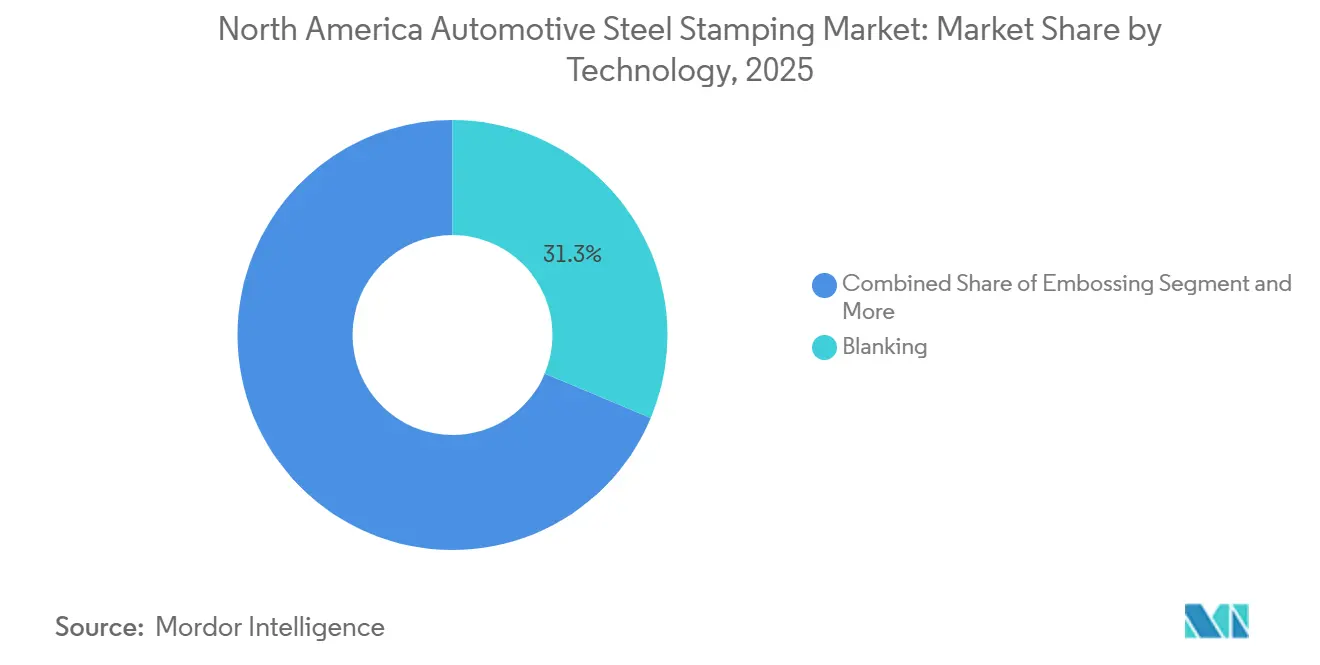
Blanking Anchors Volume, Embossing Gains TractionBlanking generated 31.28% of 2025 revenue due to its ubiquity across brackets, flat blanks, and pre-forms used downstream. Embossing, however, is projected to expand at a 4.67% CAGR as OEMs add stiffening ribs that eliminate weld-on reinforcements, trimming mass by 8–12% per panel. Embossing UHSS accelerates die wear by up to 50%, pushing annual tool-maintenance budgets as high as USD 200,000 for high-volume lines, yet stampers mastering predictive maintenance capture the premium. Coining, flanging, and bending remain niche yet essential for precision contacts, edge preparation, and chassis rails, respectively.
A parallel shift is unfolding toward integrated multi-station presses that combine blanking, embossing, and flanging in a single stroke, cutting handling steps and ensuring IATF 16949 traceability. Trans-Matic already offers 119 transfer presses in North America capable of such consolidation, allowing OEMs to rationalize supplier panels and lock in cost savings.

By Process:
Sheet-Metal Forming Dominates, Hot Stamping AcceleratesSheet-metal forming retained 38.15% of 2025 revenue on the back of high-volume outer panels and closure parts. Hot stamping is set to advance at a 4.69% CAGR, capturing structural roles demanding 1,500–2,200 MPa strength. Gestamp’s new San Luis Potosí line, due online in 2026, will supply GM and Stellantis with press-hardened door rings that cut weight 20–25% over cold-stamped counterparts. High capex keeps hot-stamping capacity concentrated among large Tier-1s, while sheet-metal forming continues to own commodity volumes. Suppliers that combine both processes secure broader program coverage and greater negotiating clout.
Roll forming and metal fabrication cover the long-profile and low-volume fringes, respectively. Still, OEM part-count reduction favors integrated megastampings, putting incremental pressure on these secondary processes unless they align with niche electrified commercial platforms.
By Vehicle Type:
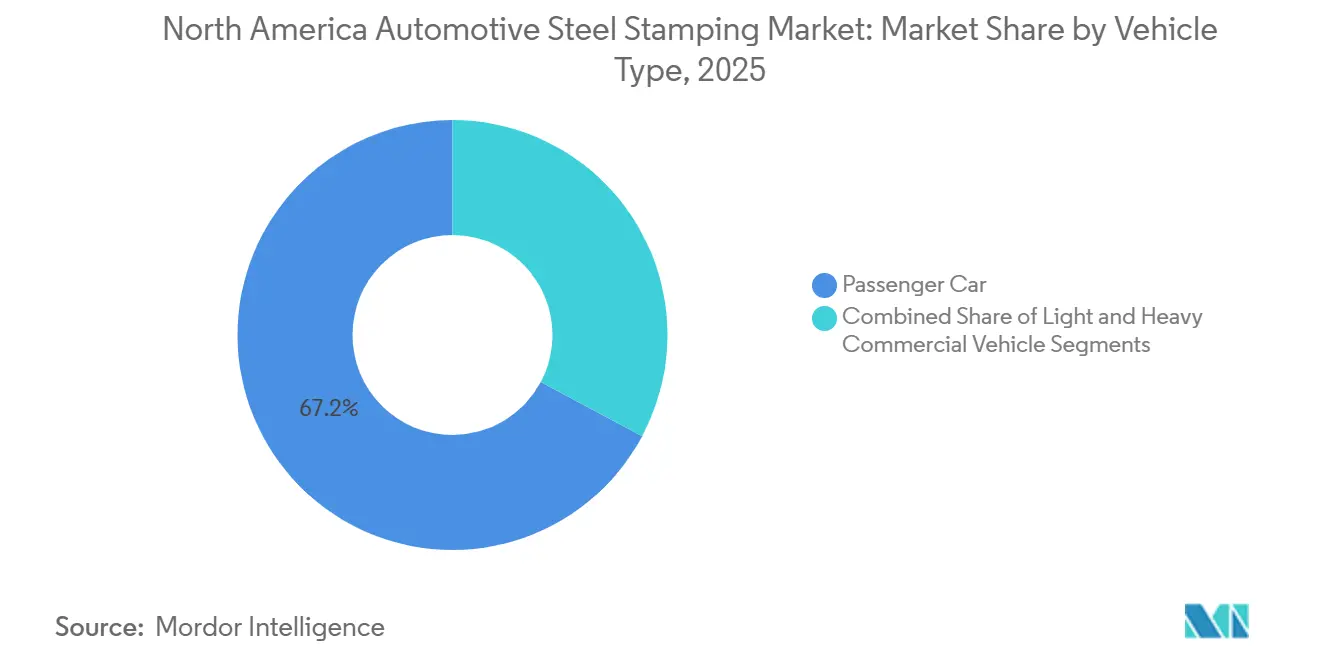
Passenger Cars Lead, LCVs Surge on E-Commerce DemandPassenger cars contributed 67.17% of stamped steel in 2025 and will remain the anchor, fueled by hybridization programs that preserve legacy body-in-white architectures. Yet light commercial vehicles (LCVs) should outpace with a 4.73% CAGR as Amazon, UPS, and FedEx electrify delivery fleets. The North American automotive steel stamping market for LCV applications is projected to exceed several billion dollars by the end of the forecast period. Ford’s E-Transit and GM’s BrightDrop vans use stamped battery trays made from ultra-high-strength steel, which generate substantially higher margins than passenger car equivalents. Heavy commercial vehicles remain behind due to range limitations and less stringent regulatory support. However, California’s Advanced Clean Trucks rule indicates long-term growth potential for stamped cabs and chassis rails.
Platform modularity is a growing design theme; shared underbodies across SUV and van derivatives enable OEMs to amortize tooling faster, directing contract wins to stampers that supply both segments and can meet mixed crash-load specifications.
By Propulsion:
ICE Dominates, EVs Accelerate Despite HeadwindsInternal-combustion designs absorbed 71.26% of the market share in 2025 as OEMs leaned on hybrids to meet efficiency targets with manageable capital outlay. Electric-vehicle stampings will nevertheless log the segment’s strongest growth at 5.77% CAGR, albeit from a small base.
The North America automotive steel stamping market for EV battery enclosures is forecast to grow substantially over the forecast period, contingent on material cost parity and the expansion of charging infrastructure. Suppliers that retain internal combustion engine (ICE) capacity for components such as engine cradles and transmission tunnels, while adding flexible battery-tray tooling, can hedge against demand volatility and expand customer adoption.
Geography Analysis
United States Automotive Steel Stamping Market
The United States continues to dominate contract allocations due to entrenched OEM assembly facilities in Michigan, Ohio, and Tennessee. However, cost-down mandates and elevated steel prices have compressed Tier-1 EBIT below 5%, spurring automation investments such as Martinrea’s Ontario servo-press installation that trimmed cycle times by 18%. Consolidation is heating up: Worthington Enterprises’ USD 205 million acquisition of LSI Group in January 2026 reflects a race for scale that improves bargaining power with both steel mills and OEMs. Domestic sourcing of battery enclosures underpins future resilience, even if BEV uptake remains muted.
Mexico Automotive Steel Stamping Market
Mexico is the region’s growth engine. Attractive labor economics, plus the 15% national-content rule layered on top of USMCA requirements, drive OEMs to co-locate body-shop and stamping operations within the Bajío corridor. Gestamp’s EUR 74 million hot-stamping facility, coming online in 2026, will supply GM and Stellantis SUVs, illustrating the country’s climb up the value curve. Yet quality-system maturity lags; OEMs now demand Cpk ≥1.67 and full Safe-Launch protocols, weeding out under-capitalized maquiladoras.
Canada Automotive Steel Stamping Market
Canada remains the smallest participant but carves out a niche in mixed-material architectures. A USD 40 million AISIN-Toyota Tsusho-Minth JV will deliver aluminum body-frame parts from Windsor starting in 2027, reinforcing the country’s specialization in lightweighting rather than volume scale. Canadian stampers rely on servo-press automation to offset wage premiums and on geographic proximity to Detroit engineering hubs for rapid product-development cycles. Policy divergence—possible United States tariffs on Canadian parts—poses the main strategic overhang.
Competitive Landscape
The market remains fragmented, with no single player holding a dominant revenue share and a low concentration level. Gestamp, Magna, and Martinrea lead the Tier-1 integrator landscape with global hot-stamping footprints. Regional players, including Shiloh, Flex-N-Gate, and Trans-Matic, focus on specialized process capabilities or local just-in-time (JIT) delivery. OEM cost-reduction initiatives continue to pressure margins, as reflected in Valeo’s constrained profitability. Input-price volatility further intensifies competition. Vertical integration is also reshaping value flows: ArcelorMittal Tailored Blanks has expanded door-ring production and expects substantial further growth over the long term, effectively internalizing a significant portion of the high-strength structural segment.
Technology capabilities increasingly define competitive advantage. Tier-1 suppliers that install advanced servo and hot-stamping lines secure contracts for ultra-high-strength steel (UHSS) safety components. In contrast, manufacturers relying on mechanical presses for mild-steel panels face increasing commoditization. Compliance requirements are also becoming more stringent. IATF certification, real-time statistical process control (SPC) monitoring, and Run@Rate tests covering a high volume of defect-free parts represent baseline entry requirements for new OEM programs.
M&A activity is expected to continue. Worthington’s acquisition of LSI Group and American Axle’s planned merger with Dowlais Group demonstrate a strategic shift toward greater scale, cross-selling opportunities, and shared capital expenditure for automation. Suppliers that maintain internal combustion engine (ICE) capabilities while expanding EV-ready production lines and operating across NAFTA countries are likely to benefit from diversified revenue streams and stronger bargaining power.
North America Automotive Steel Stamping Industry Leaders
-
Magna International Inc.
-
Gestamp Automoción S.A.
-
Martinrea International Inc.
-
Flex-N-Gate Corporation
-
Autokiniton US Holdings, Inc.
- *Disclaimer: Major Players sorted in no particular order
North America Automotive Steel Stamping Market Companies Covered in this Report
- Magna International Inc.
- Gestamp Automocion S.A.
- Martinrea International Inc.
- Autokiniton US Holdings, Inc.
- Shiloh Industries LLC
- Flex-N-Gate Corporation
- Aisin World Corp. of America
- Trans-Matic Manufacturing Co.
- Anchor Manufacturing Group Inc.
- Worthington Industries Inc.
- Multimatic Inc.
- American Axle and Manufacturing Holdings Inc.
- ThyssenKrupp North America
- Kenmode Precision Metal Stamping
- NIDEC ARISA (press solutions)
- U.S. Steel Automotive Center
- ArcelorMittal Tailored Blanks
- JIER North America (press lines)
Recent Industry Developments in North America Automotive Steel Stamping Market
- July 2026: Stellantis reinforced its multi-billion-dollar domestic manufacturing layout by adding a state-of-the-art blanking press to its Warren Stamping Plant (WSP) in Michigan. The expansion boosts internal stamping capacity for critical body closures (hoods, doors, and liftgates) across United States, Canadian, and Mexican supply chains
- July 2026: The Hoffmann Family of Companies finalized its acquisition of Allred Metal Stamping Works, scaling its custom heavy manufacturing and precision automotive fabrication portfolio.
- March 2026: Magna International launched its latest structural multi-material vehicle platforms, introducing highly optimized, ultra-high-strength steel stamped battery enclosures. These enclosures deliver maximum thermal run-away and crash protection for next-gen North American pickup trucks while optimizing structural weight.
North America Automotive Steel Stamping Market Report Scope
The scope of the report includes Technology (Blanking, Embossing, Coining, Flanging, Bending, and Other Technologies), Process (Roll Forming, Hot Stamping, Sheet-Metal Forming, and More), Vehicle Type (Passenger Car and More), Propulsion (Internal Combustion Engine and Electric Vehicle), and Country (United States and More). The Market Forecasts are Provided in Terms of Value (USD).
| Blanking |
| Embossing |
| Coining |
| Flanging |
| Bending |
| Other Technologies |
| Roll Forming |
| Hot Stamping |
| Sheet-Metal Forming |
| Metal Fabrication |
| Other Processes |
| Passenger Car |
| Light Commercial Vehicle |
| Heavy Commercial Vehicle |
| Internal Combustion Engine (ICE) |
| Electric Vehicle (EV) |
| United States |
| Canada |
| Mexico |
| Rest of North America |
| By Technology | Blanking |
| Embossing | |
| Coining | |
| Flanging | |
| Bending | |
| Other Technologies | |
| By Process | Roll Forming |
| Hot Stamping | |
| Sheet-Metal Forming | |
| Metal Fabrication | |
| Other Processes | |
| By Vehicle Type | Passenger Car |
| Light Commercial Vehicle | |
| Heavy Commercial Vehicle | |
| By Propulsion | Internal Combustion Engine (ICE) |
| Electric Vehicle (EV) | |
| By Country | United States |
| Canada | |
| Mexico | |
| Rest of North America |
Key Questions Answered in the Report
How large could North America's automotive steel stamping demand become by 2031?
The market is projected to reach USD 24.09 billion by 2031, expanding at a 3.65% CAGR from 2026.
Which stamping process is growing the fastest?
Hot stamping should record a 4.69% CAGR, driven by high-strength structural parts for EV and hybrid platforms.
Why is Mexico attracting new stamping investment?
USMCA content rules, lower labor costs, and FDI make Mexico the region’s fastest-growing stamping hub at a 5.81% forecast CAGR.
What is the profit outlook for stampers amid steel price volatility?
EBIT margins remain tight near 4–6%; suppliers with servo-press automation and flexible contracts mitigate raw-material swings.
How are OEM lightweighting goals influencing material choice?
Adoption of 1,500–2,200 MPa UHSS allows 20–25% mass reduction without costly aluminum conversions, sustaining steel’s dominance in safety-critical structures.