
Europe Automotive Steel Stamping Market Size and Share
Market Overview
| Study Period | 2019 - 2031 |
|---|---|
| Forecast Data Period | 2026 - 2031 |
| Base Year Market Size (2025) | USD 2.25 Billion |
| Market Size (2026) | USD 2.34 Billion |
| Market Size (2031) | USD 2.85 Billion |
| Growth Rate (2026 - 2031) | 4.02 % |
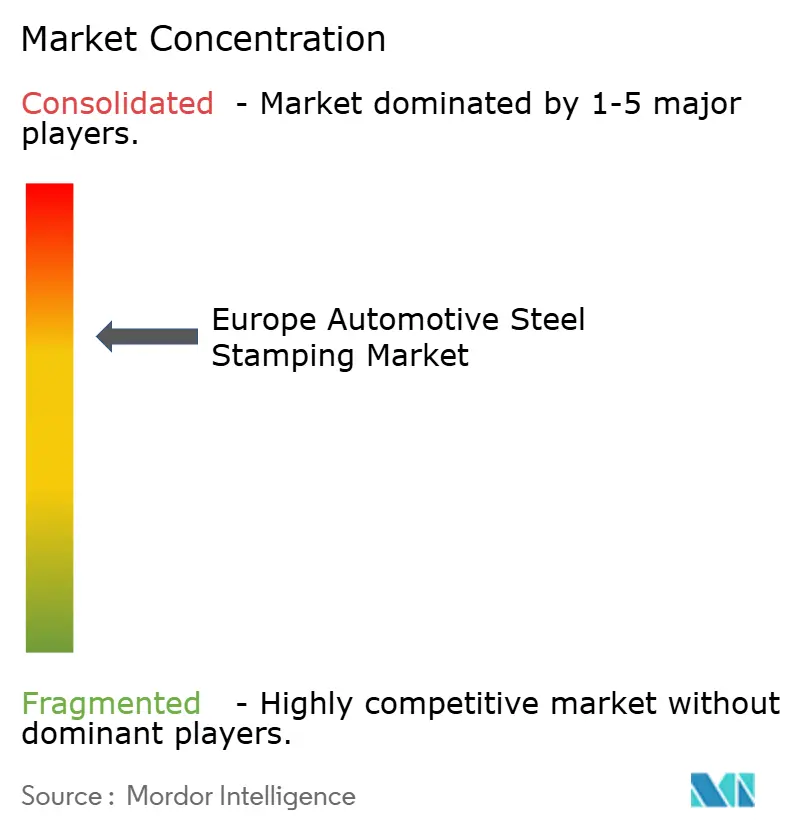
| Market Concentration | Medium |
Major Players *Disclaimer: Major Players sorted in no particular order Image © Mordor Intelligence. Reuse requires attribution under CC BY 4.0. | |
Europe Automotive Steel Stamping Market Analysis by Mordor Intelligence
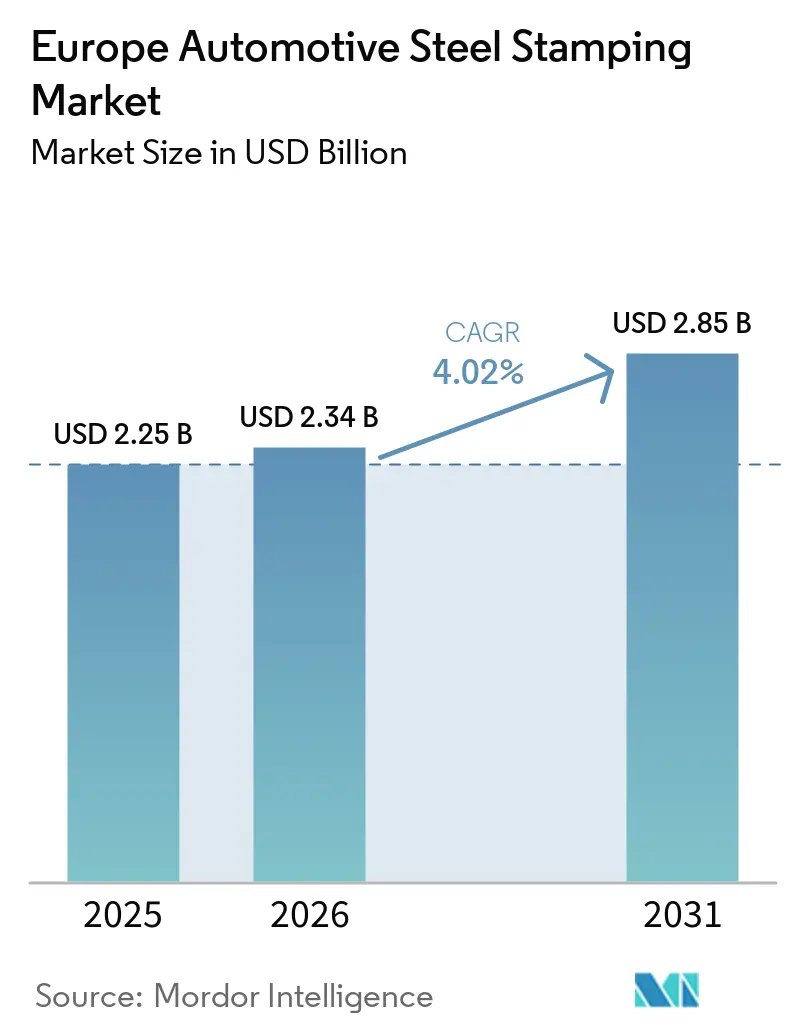
The European automotive steel stamping market size was valued at USD 2.25 billion in 2025, is estimated at USD 2.34 billion in 2026, and is projected to reach USD 2.85 billion by 2031, growing at a CAGR of 4.02% from 2026 to 2031. As battery-electric platforms gain traction, they're altering part geometries and material specifications. This shift has led Tier-1 suppliers to set up hot-stamping lines for ultra-high-strength steels, despite a recent decline in Western European passenger-car output. Poland, with significantly lower labor costs than Germany and its proximity to Central European assembly hubs, is becoming a hotspot for greenfield capacity. Meanwhile, Germany is holding on to its technological edge, exemplified by servo-press joint ventures such as Smart Press Shop, which seamlessly integrate tooling expertise with real-time analytics. In another development, European hot-rolled-coil prices have risen sharply, driven by the Carbon Border Adjustment Mechanism (CBAM). This price hike has tightened conversion margins and accelerated vertical integration in the green-steel supply chain. Furthermore, the rising use of servo-press and laser-blanking technologies is not only reducing die-tryout cycles but also facilitating intricate multi-material body-in-white assemblies. However, the capital expenditure associated with these advancements is nudging smaller stampers towards consolidation or even exit from the market.
Key Report Takeaways
- By technology, blanking captured 36.85% of the revenue share in the European automotive steel stamping market in 2025 and is expanding at a 4.45% CAGR through 2031.
- By process, roll forming accounted for 33.26% of the European automotive steel stamping market size in 2025, whereas hot stamping is forecast to expand at the quickest 5.34% CAGR during 2026-2031.
- By vehicle type, passenger cars commanded 64.15% of demand in 2025 and should grow 4.77% by 2031.
- By propulsion, internal-combustion vehicles retained 74.82% of stamped-component demand in 2025, while electric vehicles are set to achieve the highest 6.04% CAGR over 2026-2031.
- By geography, Germany led with 29.44% market share in 2025, while Poland is poised for the fastest CAGR of 5.68% between 2026 and 2031.
Note: Market size and forecast figures in this report are generated using Mordor Intelligence’s proprietary estimation framework, updated with the latest available data and insights as of January 2026.
Europe Automotive Steel Stamping Market Trends and Insights
Drivers Impact Analysis*
| Driver | (~) % Impact on CAGR Forecast | Geographic Relevance | Impact Timeline |
|---|---|---|---|
| EV Structural Part Demand Surge | +1.2% | Germany, Poland, Sweden | Long term (≥ 4 years) |
| EU CO₂ Norms Driving Lightweighting | +0.8% | Germany, France | Medium term (2-4 years) |
| UHSS Use Enabling Thinner Gauges | +0.7% | Premium OEM hubs | Long term (≥ 4 years) |
| EU Passenger-Car Output Recovery | +0.6% | Italy, Spain, the Czech Republic | Short term (≤ 2 years) |
| Servo-Press and Laser-Blanking Adoption | +0.5% | Western and Eastern Europe | Medium term (2-4 years) |
| OEM–Tier-1 In-House Stamping JVs | +0.4% | Germany, UK, France | Medium term (2-4 years) |
| Source: Mordor Intelligence | |||
Surging EV-Specific Structural Part Demand
Battery-box enclosures and crash-management structures for electric vehicles now rely on advanced technologies. These structures utilize closed-loop servo-press control and feature laser-welded tailored blanks. These blanks skillfully merge high-strength press-hardened steel perimeters with ductile cores. In a notable move, Gestamp highlighted that hot-stamped door rings for battery-electric vehicles contribute significantly to its turnover, aligning with its strategic taxonomy. Meanwhile, Valmet Automotive is making strides in Poland, expanding its Żary site to position the battery-box sub-assembly right next to cell production. Further emphasizing the industry's shift, POSCO's traction-motor lamination plant in Brzeg showcases the eastward migration of stamping capacity, aligning closely with EV supply-chain nodes[1]. However, a word of caution: suppliers without hot-forming capabilities or the crucial ISO 26262 certification may lose market share in the future.
EU CO₂-Emission Norms Pressuring OEM Lightweighting
Fleet-average CO₂ limits translate every kilogram of curb weight into a financial consideration for OEMs. Salzgitter’s Robusal 800 enabled Volkswagen to significantly reduce the mass of a door inner while maintaining crash ratings [2]. Tata Steel’s WarP-AHSS program is piloting warm-stamping techniques to bring zinc-coated high-strength steels into series production while avoiding hydrogen embrittlement. While thinner gauges can lower material costs, they also increase die wear. This challenge requires investments in adaptive binder-force systems, resulting in substantial additional expenses for each servo-press retrofit.
Uptake of Ultra-High-Strength Steels Enabling Thinner Gauges
SSAB's Docol MBR, reduced using hydrogen, enables the production of thinner B-pillars, reducing vehicle weight and potentially saving costs associated with CO₂ fines. ArcelorMittal's Fortiform has significantly reduced hot-stamping cycle time, increasing throughput. Kirchhoff has made a substantial investment in Hungary, introducing servo presses capable of forming silicon-boron grades for Volkswagen's platform. In contrast, older mechanical presses, even those with high tonnage, struggle with these grades, risking edge cracking and emphasizing a significant technology gap.
Recovery of EU Passenger-Car Production
Output has rebounded but remains below the previous peak levels. EUROFER projects only modest growth in the near term. Stellantis, through its Italy Plan, is maintaining operations at domestic plants while shifting focus to hybrid variants, thereby limiting the production of pure internal combustion engine (ICE) models. Germany has seen a slight increase in production, but labor shortages remain a challenge. For instance, Mercedes-Benz experienced delays in ramping up its Bremen EV production due to unfilled skilled-trade positions. To mitigate demand fluctuations, stampers are securing long-term volumes tied to hot-rolled coil (HRC) benchmarks.
Restraints Impact Analysis*
| Restraint | (~) % Impact on CAGR Forecast | Geographic Relevance | Impact Timeline |
|---|---|---|---|
| High Capex and Energy Costs in EU Plants | -0.9% | Germany, Western Europe | Short term (≤ 2 years) |
| Volatility in Flat-Steel Prices | -0.6% | EU suppliers | Short term (≤ 2 years) |
| Skilled-Labor Shortages in Western Europe | -0.5% | Germany, France, UK | Medium term (2-4 years) |
| Competition from Aluminum and Composites | -0.4% | Premium segments | Long term (≥ 4 years) |
| Source: Mordor Intelligence | |||
High Capex and Energy Costs in EU Plants
Installing a hot-stamping line is costly, while industrial electricity prices in Germany remain considerably higher than in Poland. Despite substantial investments in capital expenditures, Gestamp experienced a notable decline in revenue from Western Europe, primarily due to underutilization. CBAM surcharges on incoming tonnes further intensify feedstock inflation. Additionally, for energy-intensive hot stamping, increases in electricity prices result in a proportional increase in conversion costs.
Volatility in Flat-Steel Prices
Hot-rolled-coil price swings within a single quarter have surpassed the adjustment bands set in numerous stamping contracts. This has compelled suppliers to either absorb these fluctuations or revisit pricing mid-cycle. Salzgitter's acquisition of HKM not only consolidates slab supply but also tightens spot liquidity. Given the scarcity of hedging tools, companies are turning to vertical integration, such as tailored-blanking, or diversification strategies. A prime example is CIE's deal with Aludec, which stands as a key defensive move.
*Our forecasts treat driver/restraint impacts as directional, not additive. The impact forecasts reflect baseline growth, mix effects, and variable interactions.
Segment Analysis
By Technology: Versatile Blanking Sustains Leadership
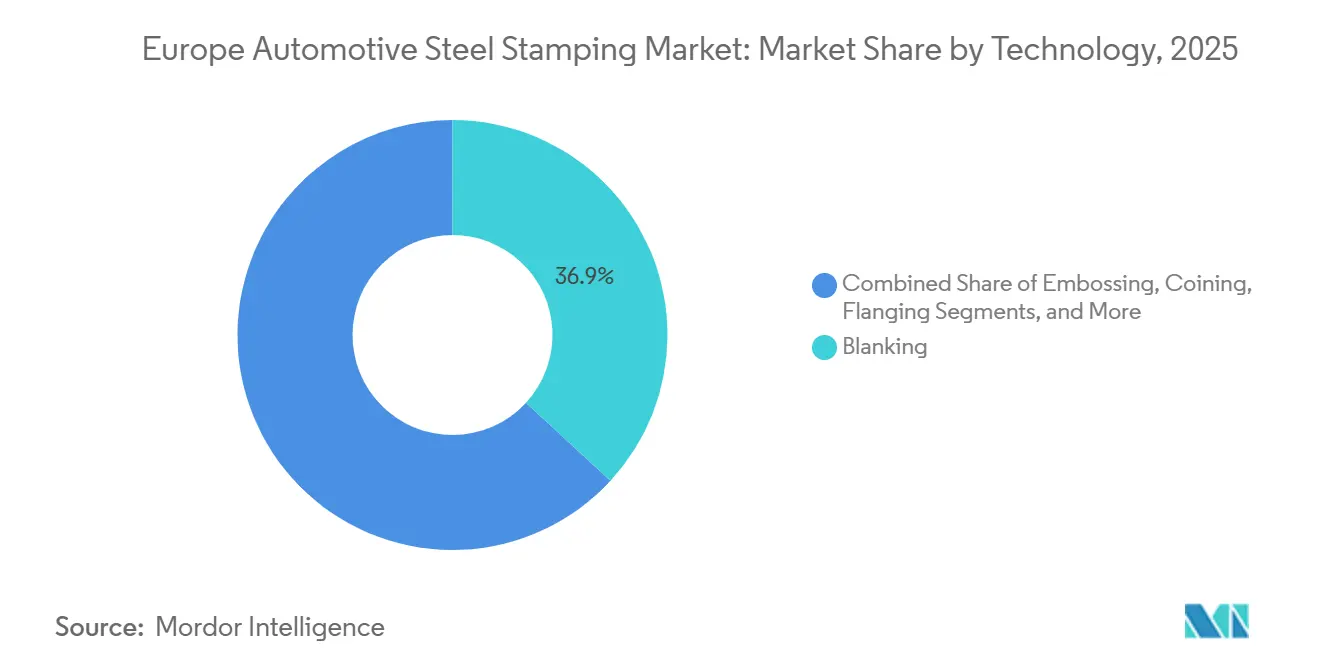
Blanking accounted for 36.85% of Europe's automotive steel stamping market revenue in 2025, expanding at a 4.45% CAGR, as tailored blanks marry AHSS and aluminum into single laser-welded preforms. In Europe, the automotive steel stamping market is reaping the benefits of advancements such as laser blanking, which ensure high-quality edges and minimize scrap. While coining, primarily used for intricate features, captures a modest share, it commands a premium due to its ability to achieve precise tolerances, a feature highly valued in airbag-mount bosses.
Modern servo presses are revolutionizing the process by integrating blanking, drawing, and trimming into a single stroke. This innovation not only reduces factories' physical footprint but also enhances Overall Equipment Effectiveness (OEE). BILSTEIN's laser blanking technology is making waves by eliminating the need for mechanical dies, even for intricate shapes. However, the capital expenditure (capex) associated with this technology poses a challenge for smaller workshops. While hydroforming and warm forming techniques remain specialized due to their longer cycle times, Benteler's CliMore tubes suggest a promising crossover for premium electric vehicle (EV) subframes.

By Process: Hot Stamping Surges on Safety Needs
Hot stamping’s 5.34% CAGR surpasses that of every other process, as OEM crash requirements and battery-box energy-absorption targets of 60 kJ/kg elevate tensile strengths above 1,500 MPa. Europe's automotive steel stamping market share tilts toward suppliers with IP around partial-cooling or induction tempering, a space dominated by Gestamp and Kirchhoff.
Roll forming continues to dominate the market with 33.26% share in 2025, mirroring the overall European automotive steel stamping market. Cold stamping remains the workhorse for door outers and hoods, but faces tapering volumes as ICE output plateaus. Superplastic forming lingers below 1% share, constrained by 20-minute cycles unsuitable for mass production.
By Vehicle Type: Passenger Cars Retain Scale Advantage
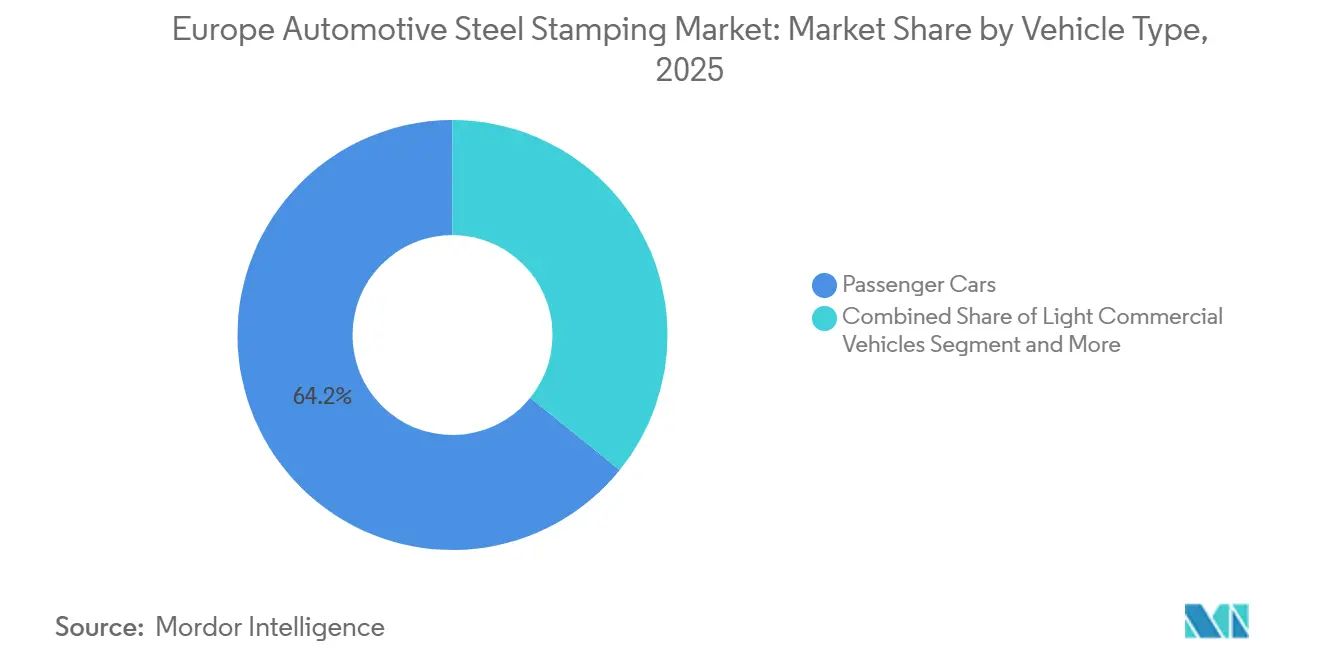
Passenger cars accounted for 64.15% of 2025 demand and should grow 4.77% annually, lifted by premium EV derivatives that carry higher stamped-content value despite lower unit volumes. Light commercial vehicles, rapidly electrifying for last-mile delivery, are experiencing significant growth. This trend is highlighted by Stellantis's e-Ducato and Mercedes's eSprinter, both now incorporating reinforced battery-box floors. While the European automotive steel stamping market for heavy commercial vehicles remains relatively smaller, MAN's launch of an electric-truck cab line in Niepołomice establishes a premium niche for high-tensile cab shells.
Stampers skilled in multi-material joining techniques are achieving higher margins from their work on light and heavy commercial vehicles compared to the more commoditized panels of passenger cars. This capability helps them address the challenges posed by the obsolescence of internal combustion engine tooling.
By Propulsion: ICE Dominates, EVs Accelerate
ICE platforms still accounted for 74.82% of 2025 volume, but the segment’s CAGR signals maturity. Electric vehicles are sprinting at a 6.04% CAGR, pushing suppliers in the European automotive steel stamping market to deliver battery enclosures weighing 40-60 kg per vehicle and reinforced floors capable of withstanding 50 kN side-pole intrusion.
Europe's automotive steel stamping market size for BEV structures benefits from 240-280 kg of stamped steel per vehicle, compared with 180-220 kg on ICE models. Hybrid vehicles create a transitional buffer, sustaining some ICE dies while stampers ramp EV tooling. Flexible servo presses that switch between ICE and EV geometries with sub-5-minute die changeovers mitigate stranded-asset risk.
Geography Analysis
Germany accounted for 29.44% of Europe's automotive steel stamping market in 2025, driven by its dense cluster of press-shop integrators, technology institutes, and high-end vehicle plants. The region benefits from co-location with steel giants capable of supplying AHSS coils within hours. Yet rising electricity prices create urgency to adopt regenerative drive systems on presses. Firms partner with municipal utilities on cogeneration schemes to lower energy bills and shrink Scope 2 emissions. The workforce challenge remains acute, prompting dual-education programs that combine die-design coursework with on-the-job apprenticeships to safeguard knowledge transfer in the European automotive steel stamping market.
Poland enjoys the highest CAGR of 5.68% as Western OEMs relocate engine-housing, side-rail, and closure-panel production to new greenfield facilities. Investors cite lower wages, available industrial land, and EU structural funds as compelling. Domestic suppliers upgrade press sizes to 2,000 tons to service SUV floor assemblies previously shipped from Germany. Universities expand metallurgy and robotics courses, ensuring a steady technician pipeline. Logistics links via Baltic ports streamline coil inflows and panel exports, reinforcing Poland’s role in the European automotive steel stamping market.
France, Spain, and Italy maintain strong stamping demand tied to Stellantis and Renault footprints. Local subsidy schemes accelerate EV adoption, leading to in-house battery-tray stamping lines inside vehicle plants. Spain’s Valencia hub converts older presses to servo drives using retrofit kits that cut energy 30%. Italy leverages specialist toolmakers around Turin to supply dies for complex hot-formed pillars. The UK focuses on premium brands; Jaguar Land Rover’s shift to aluminum closures moderates steel tonnage, yet new Range Rover platforms still specify high-strength side beams. Sweden and the Czech Republic pursue sustainability branding and near-shore reliability, supporting export volumes to neighboring markets. Collectively, these sub-regions contribute stability and localized innovation to the European automotive steel stamping market.
Competitive Landscape
In Europe's automotive steel stamping market, the top suppliers—Gestamp, Benteler, Magna (Cosma), Kirchhoff, and CIE Automotive—command a significant share of revenue, overshadowing numerous regional specialists. Gestamp, with numerous hot-stamping patents, boasts a dominant position. Furthermore, its green-steel agreements with Salzgitter and ThyssenKrupp ensure a steady stream of low-CO₂ coils in the future. Benteler is making strides with its CliMore tubes, which promise a significant reduction in CO₂ emissions. Meanwhile, Magna has strategically opened a plant in Vecsés, Hungary, merging Western European engineering expertise with the cost advantages of Eastern Europe [3].
Asian players like Lingyun Industrial and Press-Kogyo are capitalizing on footprint arbitrage. At the same time, OEMs are tightening their grip: Smart Press Shop and Stellantis-CATL Zaragoza's backward integration strategies are squeezing the margins for independent players. Technology stands at the forefront of this evolution. ANDRITZ Schuler's servo-press retrofits have achieved a notable reduction in springback. At the same time, advancements in laser-blanking have set new standards for edge quality—luxuries that many smaller stampers find hard to afford. Today, certifications such as IATF 16949 and ISO 3834, along with traceable green-steel sourcing, have transitioned from mere differentiators to essential entry requirements. This landscape suggests a bifurcated market: on one side, global Tier-1 consolidators, and on the other, niche local boutiques specializing in short-run or composite-heavy applications.
Europe Automotive Steel Stamping Industry Leaders
-
Gestamp Automoción S.A.
-
Benteler International AG
-
Magna International Inc. (Cosma)
-
Kirchhoff Automotive GmbH
-
CIE Automotive S.A.
- *Disclaimer: Major Players sorted in no particular order
Recent Industry Developments
- February 2026: Salzgitter strengthened its SALCOS program by acquiring thyssenkrupp’s 50% stake in HKM. This acquisition will enable Salzgitter to achieve a consolidated slab output of 6 million tons, further enhancing its position in the steel market.
- April 2025: SEYI-Europe announced it will display a new servo press suited for high-strength steel and aluminum at LAMIERA 2025 in Milan, featuring an in-house drive motor for energy-efficient automotive component production.
Europe Automotive Steel Stamping Market Report Scope
The European automotive steel stamping market report is segmented by technology (blanking, embossing, and more), process (roll forming, hot stamping, and more), vehicle type (passenger cars, light commercial vehicles, and heavy commercial vehicles), propulsion (internal-combustion engine and electric vehicles), and country (Germany, France, and more). The market forecasts are provided in terms of value (USD).
| Blanking |
| Embossing |
| Coining |
| Flanging |
| Bending |
| Other Technologies |
| Roll Forming |
| Hot Stamping |
| Sheet-Metal Forming |
| Metal Fabrication |
| Other Processes |
| Passenger Cars |
| Light Commercial Vehicles |
| Heavy Commercial Vehicles |
| Internal-Combustion Engine (ICE) |
| Electric Vehicles (BEV + PHEV) |
| Germany |
| France |
| United Kingdom |
| Italy |
| Spain |
| Poland |
| Sweden |
| Czech Republic |
| Rest of Europe |
| By Technology | Blanking |
| Embossing | |
| Coining | |
| Flanging | |
| Bending | |
| Other Technologies | |
| By Process | Roll Forming |
| Hot Stamping | |
| Sheet-Metal Forming | |
| Metal Fabrication | |
| Other Processes | |
| By Vehicle Type | Passenger Cars |
| Light Commercial Vehicles | |
| Heavy Commercial Vehicles | |
| By Propulsion | Internal-Combustion Engine (ICE) |
| Electric Vehicles (BEV + PHEV) | |
| By Country | Germany |
| France | |
| United Kingdom | |
| Italy | |
| Spain | |
| Poland | |
| Sweden | |
| Czech Republic | |
| Rest of Europe |
Key Questions Answered in the Report
How large will steel stamping demand for European electric vehicles be by 2031?
Electric-vehicle structures are projected to grow at a 6.04% CAGR, lifting stamped content to 240-280 kg per BEV and pushing the Europe automotive steel stamping market toward USD 2.85 billion by 2031.
Which process is adding capacity fastest?
Hot stamping is expanding at 5.34% a year as OEM crash requirements and battery-box designs call for press-hardened steels over 1,500 MPa.
Why are stampers investing in Eastern Europe?
Plants in Poland, the Czech Republic, and Hungary cut labor and energy costs up to 40% versus Germany and sidestep CBAM-related slab surcharges, supporting a 5.68% CAGR for Polish output.
Why does steel remain competitive against aluminum for EVs?
Battery packs need strong, cost-efficient protection, and ultra-high-strength steel offers the required crash resistance at a lower cost than aluminum.