
Robotic Lawn Mower Market Size and Share
Robotic Lawn Mower Market Analysis by Mordor Intelligence
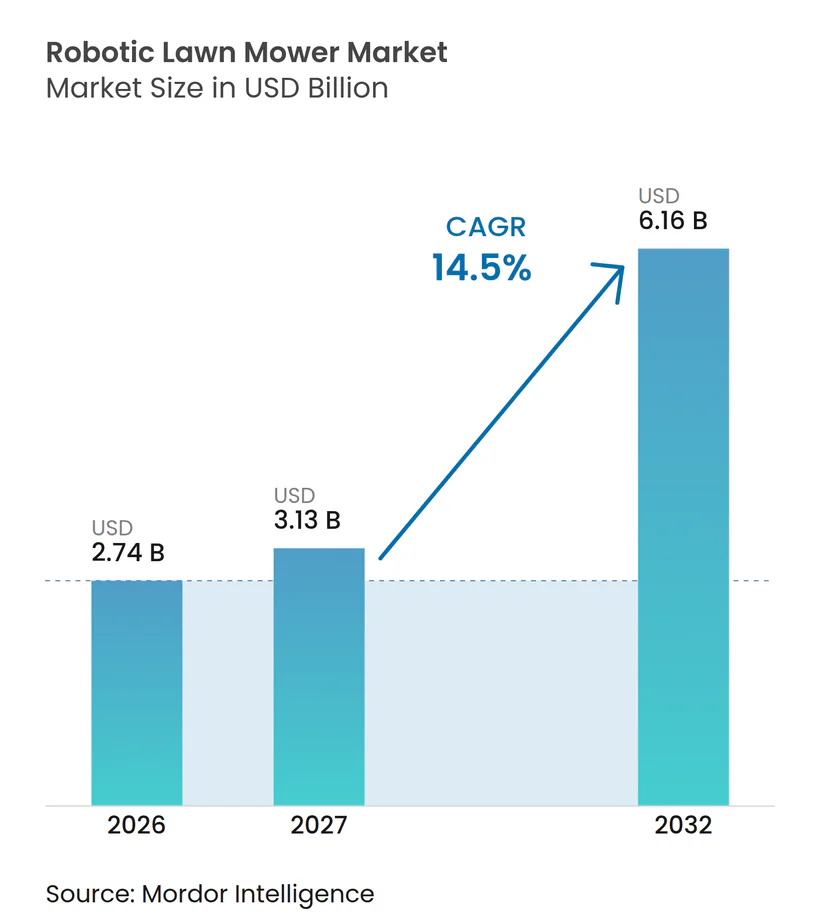
The robotic lawn mower market size is projected to expand from USD 2.74 billion in 2026 and USD 3.13 billion in 2027 to USD 6.16 billion by 2032, registering a CAGR of 14.5% between 2027 and 2032.
Electrification, outsourced lawn care, and labor pressure favor unattended mowing where it can preserve staff time for skilled maintenance. In the United States, retail access reaches residential buyers, while leasing offers operators another route to eligible equipment. Upfront cost can limit adoption, and terrain constraints can leave some cutting work outside the autonomous task. Suppliers combining wire-free positioning and operating support can address both deployment needs and continued machine use. The commercial return depends on repeatable cutting performance and clear responsibility for the work that remains with people.
Key Report Takeaways
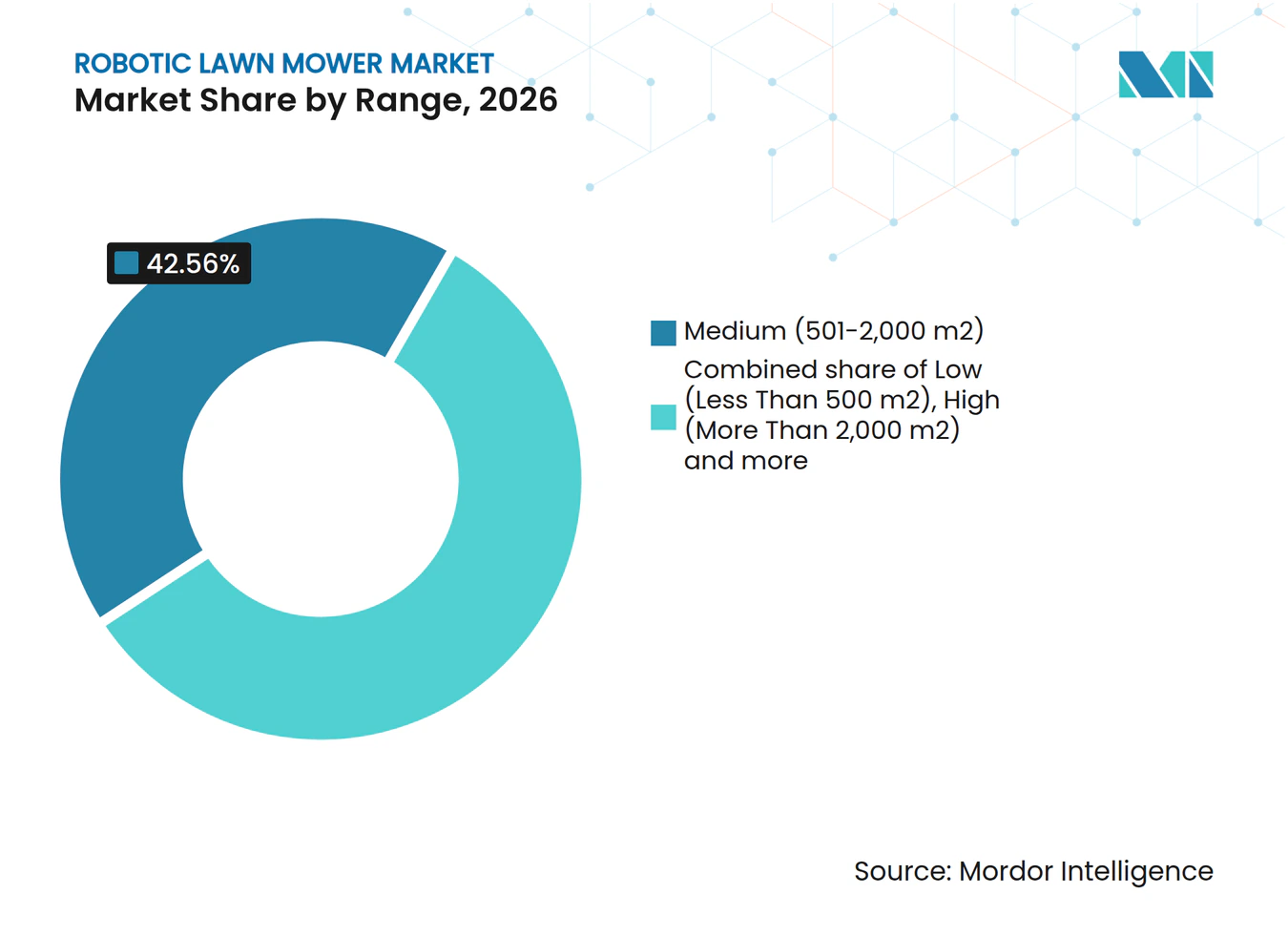
- By range, medium-capacity mowers (501-2,000 square meters) held a 42.56% robotic lawn mower market share in 2026, while high-capacity mowers (above 2,000 square meters) are forecast to grow fastest at a 17.4% CAGR from 2027 to 2032.
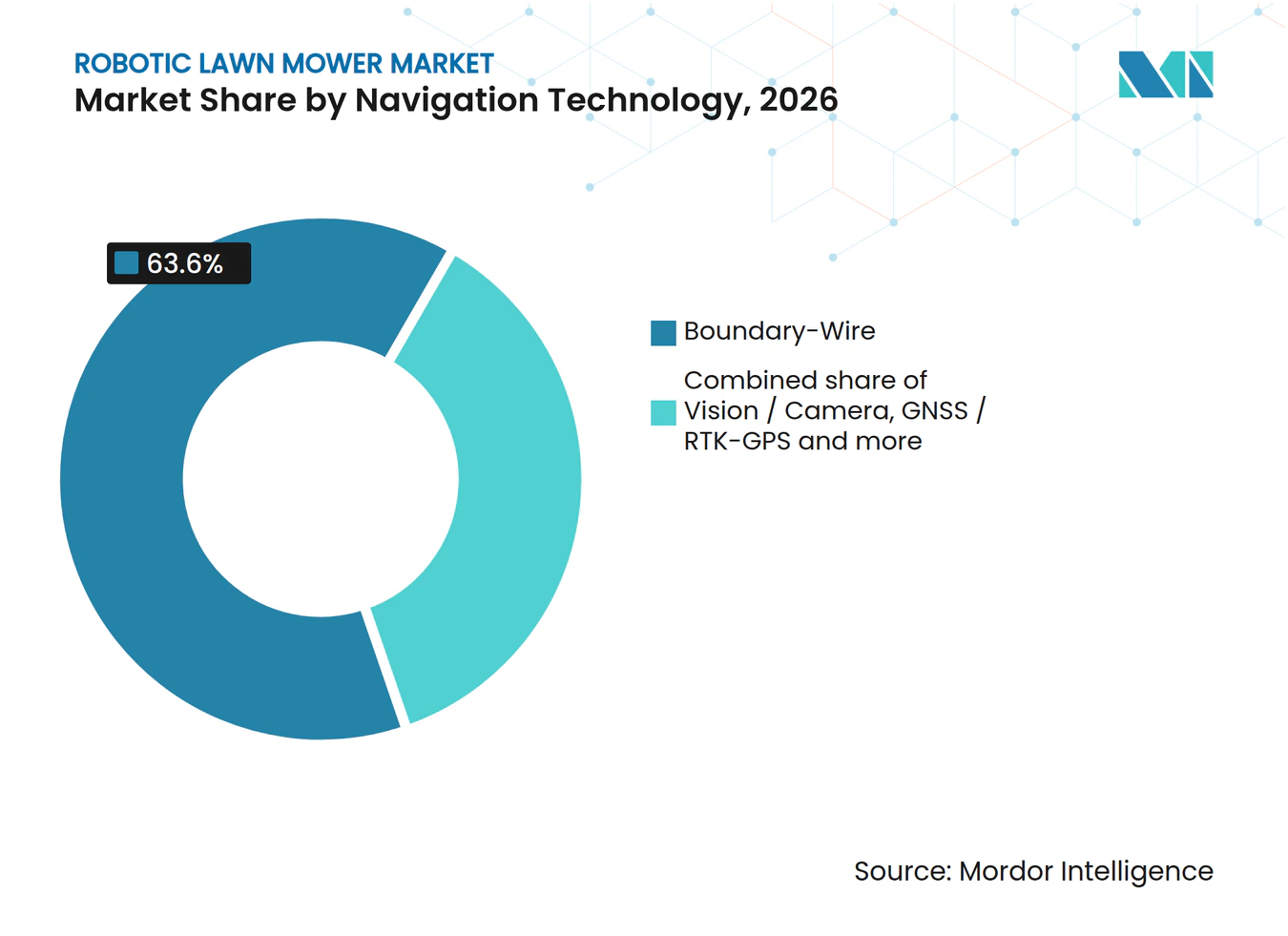
- Navigation technology was led by boundary-wire mowers with a 63.6% share of the robotic lawn mower market size in 2026, whereas vision / camera mowers are forecast to grow fastest at a 19.3% CAGR from 2027 to 2032.
- For end users, residential demand led with a 62.1% share of market revenue in 2026, and commercial users are forecast to be the fastest-growing segment at a 16.9% CAGR from 2027 to 2032.
- Distribution channels were led by offline DIY stores and specialty dealers with a 69.62% share of market revenue in 2026, while online direct sales and marketplaces are forecast to grow fastest at a 17.3% CAGR from 2027 to 2032.
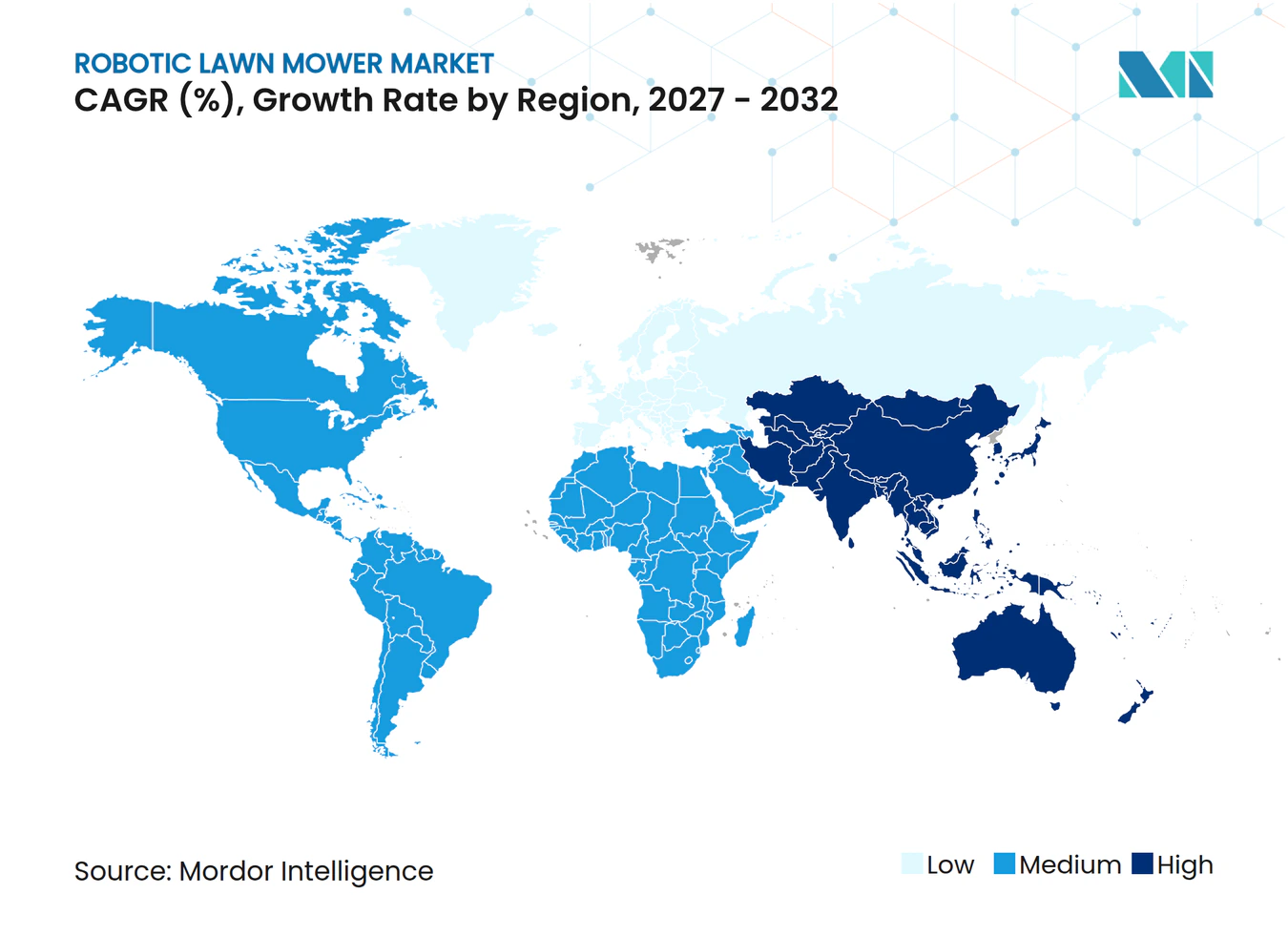
- Geographically, Europe held the largest share of market revenue at 44.47% in 2026, while Asia-Pacific is forecast to grow fastest at a 15.9% CAGR from 2027 to 2032.
Note: Market numbers in this report are based on Mordor Intelligence's proprietary estimation framework, which combines nine months of actuals with Q4 projections for base year 2026.
Market Trends and Insights
Drivers Impact Analysis of Robotic Lawn Mower Market*
| Driver | (~) % Impact on CAGR Forecast | Geographic Relevance | Impact Timeline |
|---|---|---|---|
| Rising Residential Lawn-Care Outsourcing | +4.2% | United States of America | Medium term (2-4 years) |
| Shift Toward Battery-Electric Outdoor Equipment | +3.8% | California and United Kingdom | Medium term (2-4 years) |
| Labor Shortages in Landscaping Services | +4.5% | United States of America | Short term (≤ 2 years) |
| Retailer Push for High-Margin Smart-Home SKUs | +2.9% | United States of America | Short term (≤ 2 years) |
| Advent of Vision-Based, Perimeter-Free Navigation | +2.1% | United States and United Kingdom | Medium term (2-4 years) |
| Original Equipment Manufacturer Subscription Models for Autonomous Mowing | +1.1% | United States of America | Long term (≥ 4 years) |
| Source: Mordor Intelligence | |||
Rising Residential Lawn-Care Outsourcing
Residential outsourcing offers mower suppliers a route to households through lawn-care operators. In September 2025, TruGreen said it served more than 2.3 million residential and commercial customers across all 50 U.S. states through company-owned and franchised locations. GreenPal recorded 238,374 U.S. lawn-care bookings in the 30 days before June 5, 2026, up 6.6% from the prior 30-day period. LawnStarter analyzed more than 2 million mowing jobs completed through its platform across more than 2,000 U.S. cities in 2025. These service relationships give suppliers potential operator customers with recurring cutting work to automate. A provider's decision to add autonomous mowing to several customer routes could turn that service base into a bulk-buyer channel for equipment.
Shift Toward Battery-Electric Outdoor Equipment
Electrification gives autonomous mowing another route into decisions about replacing lawn-maintenance equipment. In the rolling 12 months through September 2025, Husqvarna Group's combined robotics and battery categories accounted for 22% of Group sales, compared with 20% in the prior-year period. California began phasing in zero smog-forming emission standards for new spark-ignition small off-road engines of 25 hp and below in model year 2026, reaching zero by model year 2028. Manufacturers may use emission-reduction credits until used or expired, and owners can continue using and repairing existing CARB-compliant equipment. The sales mix signals product-category weight, while California's rules change the conditions for new engines. For suppliers, the opening is an electric mowing offer that also substitutes for cutting work, without relying on an owner replacement mandate.
Labor Shortages in Landscaping Services
Staffing risk makes repeat mowing work a candidate for automation among commercial landscaping operators. Thrive Analytics surveyed 1,020 U.S. commercial landscape business owners, executives, and senior decision-makers for Aspire from July 14 to 31, 2026. Attracting and retaining skilled workers was a priority for the surveyed operators.[1] In the earlier May 2025 survey of 1,015 U.S. commercial landscape professionals, 54% identified recruiting and retaining staff as a risk to meeting business goals. These pressures strengthen the case for autonomous mowing where it can free an existing crew for additional customer routes without requiring equivalent recruitment.
Retailer Push for High-Margin Smart-Home SKUs
Mainstream retail placement gives robotic mowing a route to households beyond specialist equipment dealers. On February 4, 2026, MAMMOTION reported availability in more than 700 Walmart stores across North America. Greenworks then launched AiMowbot for purchase online and in Walmart stores nationwide in the United States on March 2, 2026. Together, these placements give the retailer competing robotic-mower offerings and let shoppers approach the category through either a store visit or an online purchase. The commercial opening is access to a shared retail audience, with suppliers competing for household adoption within the same shopping channel.
Restraints Impact Analysis of Robotic Lawn Mower Market*
| Restraint | (~) % Impact on CAGR Forecast | Geographic Relevance | Impact Timeline |
|---|---|---|---|
| High Upfront Cost versus Conventional Mowers | -1.8% | France and United States | Medium term (2-4 years) |
| Limited Performance on Uneven and Tall-Grass Terrains | -1.3% | United Kingdom and United States | Long term (≥ 4 years) |
| Cyber-Security and Data-Privacy Concerns | -0.7% | European Union and United Kingdom | Short term (≤ 2 years) |
| Fire-Risk Recalls of Li-ion Garden Equipment | -0.3% | United States of America | Short term (≤ 2 years) |
| Source: Mordor Intelligence | |||
High Upfront Cost versus Conventional Mowers
Purchasing a robotic mower commits funds before any operating savings can offset the equipment cost. STIHL France's 2026 tax-included selling prices for iMOW robotic mowers ranged from EUR 699 to EUR 1,799. Recovering that outlay depends on how much recurring cutting the machine can actually replace. STIHL's listed prices were 33% to 59% below their nonpromotional 2025 levels, easing this burden. Even at the lowest listed price of EUR 699, buyers with little cutting work to automate must recover the full purchase cost from a small amount of replaced mowing.
Limited Performance on Uneven and Tall-Grass Terrains
Severe surface variation can leave mowing work dependent on manual intervention even after a robotic mower is purchased. Honda's April 2026 guidance said tipping or lost grip can cause missed areas, stalls, or stops on uneven ground, while mild garden unevenness is generally manageable by a capable mower.[2] This makes severe ruts and abrupt level changes a limit on how much of a garden's cutting a robotic mower can take over. In January 2026, ECOVACS said GOAT could not effectively cut grass taller than 12 centimeters, which might be treated as an obstacle, and advised trimming below 10 centimeters. For affected properties, surface remediation or preparatory cutting leaves work and cost outside the autonomous mowing task.
*Our forecasts treat driver/restraint impacts as directional, not additive. The impact forecasts reflect baseline growth, mix effects, and variable interactions.
Robotic Lawn Mower Market Segment Analysis
By Range:
Usable Coverage Shapes Equipment SelectionMedium-range mowers (501-2,000 square meters) accounted for a 42.56% share of the robotic lawn mower market size in 2026. In Ibaraki, Japan, PLOW installed a Sunseeker X5 rated for lawns up to 2,000 square meters at Ushiku Chateau's approximately 1,250-square-meter lawn. The medium range spans typical suburban lot sizes, which supports its role as the largest segment. The installation illustrates room to expand the maintained lawn without immediately moving to a higher-capacity class.
High-range mowers (more than 2,000 square meters) are forecast to be the fastest-growing segment at a 17.4% CAGR from 2027 to 2032. At the 2025 AIG Women's Open in Wales, 15 Husqvarna CEORA mowers managed all 18 fairways. The example illustrates how a large mowing requirement can be divided among several autonomous machines while retaining a single course-wide coverage objective. Suppliers in this range are judged on how many machines they can keep productive across the maintained area.



By Navigation Technology:
Perimeter Assets Meet New Positioning OptionsBoundary-wire mowers represented a 63.6% robotic lawn mower market share in 2026, making them the largest segment. The wire turns site preparation into part of the autonomous mowing system, with the working area defined before cutting begins. Its physical boundary does not depend on satellite reception or lighting conditions, supporting operation where those alternatives are less suitable. An established perimeter also retains value when replacing the mower, because switching navigation systems can require changing the site's mowing arrangement.
Vision / camera mowers are forecast to be the fastest-growing segment at a 19.3% CAGR from 2027 to 2032. MOVA reported that Frost & Sullivan ranked it first globally by sales volume of AI binocular robotic lawn mowers, a camera-based subset, from April 2025 through March 2026. The commercial test for visual navigation is how consistently the mower distinguishes its working area during autonomous cutting. GNSS / RTK-GPS offers a different configuration, with MAMMOTION launching iNavi NetRTK for compatible U.S. mowers in April 2026 without a physical RTK base station. For that service-based configuration, eliminating the local station changes what must be deployed on the property without removing the need for positioning support.

By End-User:
Household Ownership Differs from Course OperationsResidential users formed the largest segment, accounting for 62.1% of market revenue in 2026. Homeowners seeking quiet, automated maintenance can value reduced disturbance and freedom from operating the mower for each cut. The residential case rests on the owner's time and lawn-care routine, without requiring a commercial crew's wage savings. The clearest household offer specifies which recurring cuts are automated and which maintenance tasks stay with the owner.
Commercial users are forecast to be the fastest-growing segment at a 16.9% CAGR from 2027 to 2032. In January 2026, Husqvarna Group reported that its robotic mowers were used at more than 1,700 golf courses worldwide. The reported presence spans many separate golf-course sites, giving commercial mowing a distributed operating context. Serving that context calls for support that reaches the course, because equipment availability has to fit the greenkeeping team's maintenance work. Suppliers with local deployment support are positioned to serve that installed footprint.
By Distribution Channel:
Retail Coordination and Digital Storefronts Offer Different RoutesOffline channels, including DIY stores and specialty dealers, formed the largest segment with a 69.62% share of market revenue in 2026. On February 5, 2026, Segway Navimow appointed ELKO Group, an IT and consumer-electronics distributor, as authorized distributor for the mass-retailer channel in Latvia, Estonia, Lithuania, Romania, Bulgaria, Slovenia, and Croatia. This appointment illustrates physical retail reach beyond DIY stores and specialty dealers. For a brand entering several national retail systems, a regional distributor provides a route to stores that complements dealer relationships.
Online channels, including direct sales and marketplaces, are forecast to be the fastest-growing segment at a 17.3% CAGR from 2027 to 2032. Shenzhen Ledong Robotics reported approximately CNY 47.7 million (USD 6.64 million) of robotic lawn-mower revenue through third-party platforms such as Amazon in 2025. Its corresponding 2024 revenue was approximately CNY 8.1 million (USD 1.13 million). The filing describes sales through self-operated marketplace stores, the company's own website, and offline channels in both years. The platform figures therefore capture only part of the producer's online business, since its own-website revenue is reported separately.
Geography Analysis
Europe Robotic Lawn Mower Market
Europe held a 44.47% share of the robotic lawn mower market size in 2026. GFU reported NIQ data showing 110,000 robotic lawn mowers sold in Germany from January through April 2025, up 45% from the same period in 2024. The European Commission opened a 9-month customs-registration window for Chinese-origin electric robot mower imports into the EU from January 24, 2026, enabling retroactive duties only if the legal conditions are met. For importers of covered Chinese-origin mowers, possible retroactive duties add landed-cost risk that this registration measure does not impose on European-built equipment.
Asia-Pacific Robotic Lawn Mower Market
Asia-Pacific is forecast to be the fastest-growing region at a 15.9% CAGR from 2027 to 2032. In September 2026, Inside Golf reported that Woodford Golf Club in Victoria, Australia, saved around 20 labor hours per week after trialing autonomous mowers on its fairways. A weekly time saving gives managers a measure of the staff hours a mowing task returns, alongside the equipment's nominal coverage capacity. For Asia-Pacific suppliers, this creates an entry route through defined turf-maintenance tasks, with further demand tied to whether another site's operating schedule can accommodate autonomous fairway work.
In North America, the Town of Palm Beach, Florida, marked robotic-mower implementation for most mowing at Seaview Park complete in its adopted FY2025-2026 budget. In South America, specialists at a 2026 golf-industry panel said about 90% of Brazil's golf courses sit within residential condominiums, where combustion-equipment noise restricts mowing hours. Saudi Arabia's HS-code-dependent wireless conformity route covers devices with radio transmitters, including combinations with non-radio equipment, creating a conditional entry consideration in the Middle East. In Africa, BroCo Turf reported delivering an FJDynamics MYR 21 autonomous mower and ball picker to South Africa's Fancourt Golf Estate in 2026. The municipal and golf-course examples point toward institutional buyers, while Saudi entry depends first on whether the configured product falls within that wireless route.
Mordor Intelligence provides coverage of the robotic lawn mower market across other key regional markets, including Europe, each with their regulatory frameworks and demand patterns.
Regulatory Framework and Outlook
The comparison covers selected jurisdictions from the perspective of manufacturers selling connected robotic lawn mowers. Machinery rules concern the complete machine, while radio-equipment obligations attach to covered communications configurations and retain their stated exemptions. Manufacturers must account for the responsible certification or commercialization party when choosing a country entry arrangement for covered equipment.
Regulatory Table of Robotic Lawn Mower Market
| Decision factor | United States | Germany | Australia | Brazil | Saudi Arabia | South Africa |
|---|---|---|---|---|---|---|
| Primary authority | Federal Communications Commission | Federal-state market-surveillance authorities | Australian Communications and Media Authority | Anatel | Communications, Space and Technology Commission | Independent Communications Authority of South Africa |
| Key instruments or direction | 47 CFR §15.201 intentional-radiator certification, with specified exceptions | Directive 2006/42/EC, then Regulation (EU) 2023/1230 from January 20, 2027 | Radiocommunications Equipment (General) Rules 2021 for prescribed device standards | Telecom homologation; proposed standard-power outdoor Wi-Fi and frequency coordination at 5.925-6.425 GHz | Telecommunications and Information Technology Bylaw, Article 89 | Electronic Communications Act type approval, subject to exemptions |
| Commercial effect | Certification before marketing covered intentional radiators, subject to exceptions | Design and construction safety requirements, with a framework transition in 2027 | Supply requires compliance with standards prescribed for the device | Manufacturer authorization and certificate-holder responsibility for commercialization | Approval and CST-approved testing for covered devices, at applicant cost | Type approval for covered communications gear, with a locally registered certificate holder |
| Current policy attractiveness | Medium | Medium | Medium | Low | Medium | Low |
| Future direction of policy attractiveness | No change | Hardening | No change | No change | No change | No change |
| Source: Mordor Intelligence | ||||||
For the United States and Australia, Medium reflects defined certification or prescribed-standard duties for covered radio equipment, while No change reflects continuity in those market-access routes. Germany's Medium rating and Hardening direction reflect established machinery obligations followed by the January 20, 2027 framework replacement, which creates a transition task for manufacturers. Brazil's Low rating reflects the certificate holder's commercialization role, while its No change direction retains the general homologation route alongside band-specific outdoor Wi-Fi proposals opened in September 2026. Saudi Arabia's Medium and South Africa's Low reflect, respectively, covered-device testing costs and a local certificate-holder requirement, with No change based on the continuing approval frameworks.
Value Chain Stages
Suppliers can earn recurring revenue after the equipment sale through paid maintenance. In the United States, Husqvarna's 3-year Service Plus program for 500-series Automower and CEORA mowers bundles repairs, preventive maintenance, and blades into a monthly payment. Repairs caused by misuse or abuse are excluded. The exclusion makes the cause of damage commercially important even during a paid service term.
Value Chain Analysis Table of Robotic Lawn Mower Market
| Primary activity | Key participants | Value capture | Bottleneck | Resilience response |
|---|---|---|---|---|
| Equipment production | Equipment producers such as Husqvarna Group and MAMMOTION | Equipment sales | Coordinating mower construction with the complete operating configuration | Keep validation of the complete mower configuration with the producer |
| Retail sale and local commissioning | Retailers such as Walmart; dealers and installers such as Russells Groundcare | Retail and dealer equipment sales | Demonstration and commissioning workload | Assign dedicated staff and schedule deployments |
| Maintenance and consumables | Service-program providers such as Husqvarna | Monthly service-contract payments | Field-service capacity across the contract term | Bundle planned maintenance and blades with defined repair coverage |
| Source: Mordor Intelligence | ||||
In 2025, Thonock Park Golf Club bought 5 Toro Turf Pro 500 mowers from Russells Groundcare, which had assigned 2 employees to demonstrate and install autonomous mowing equipment. This dealer's deployment work shows how local participation can capture equipment revenue at the point where a sale becomes an operating mowing installation. For producers selling through this route, the pace of completed deployments depends on the dealer's capacity to commission equipment.
Competitive Landscape
Market Concentration
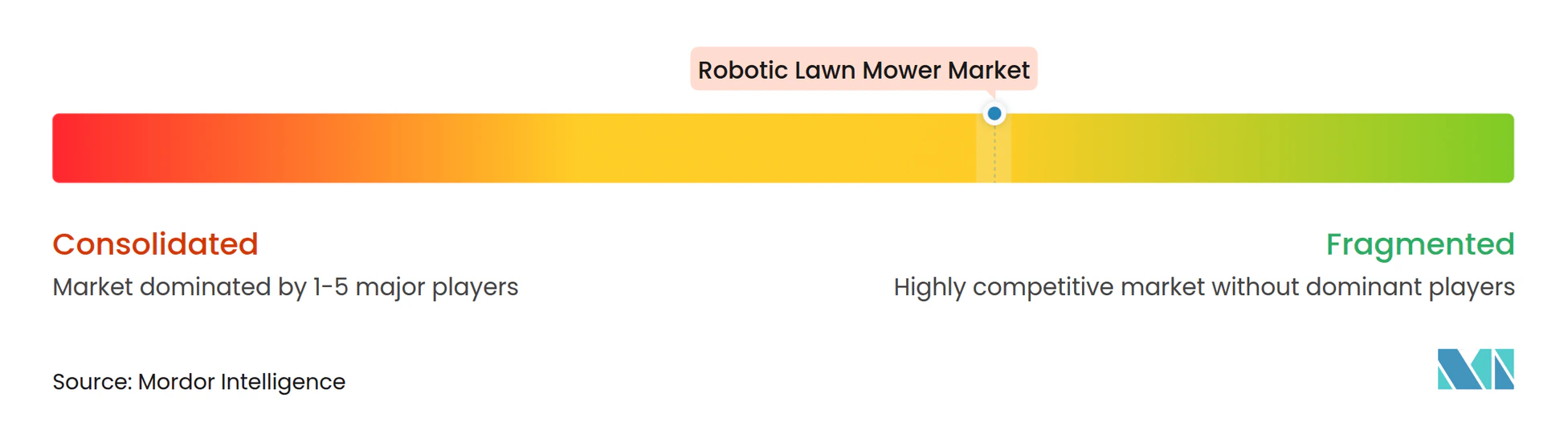
The supplier base is moderately fragmented across established equipment brands and professional and residential price tiers. Husqvarna AB supplies commercial Automower equipment, and ANDREAS STIHL AG & Co. KG participates through its iMOW line. Robert Bosch GmbH serves small lawns through its Power Tools subsidiary in France, while Honda Motor Co., Ltd. supplies Miimo for European residential and professional users. Deere & Company revealed an autonomous battery-electric mower for commercial landscaping at CES in January 2025. In its December 2025 presentation, Husqvarna Group rated the Husqvarna brand first in professional and premium residential robotic mowing but third to fourth in residential mid-range, so its reported position varied by price tier.
STIHL decided in late July 2025 to give its China site future leadership for robotic-mower development and production. On October 8, 2025, Honda Motor Europe announced the wireless Miimo 1500i and 2200i for European sales planned from spring 2026. The announced models would combine network RTK positioning with app-defined mowing zones and remove the need for physical boundary wires. Honda's proposed setup addresses on-site installation work, while the buyer effect of STIHL's organizational change depends on completing the transfer.
In 2025, robotic lawn mowers for residential and professional customers accounted for 17% of Husqvarna Group sales.[3] From January 20, 2027, the EU Machinery Regulation (EU) 2023/1230 requires manufacturers of in-scope machinery to meet essential safety requirements, prepare technical documentation, and complete the relevant conformity assessment before market placement or use. Where a complete mower's category is outside Annex I, the manufacturer must use internal production control for that assessment. Internal assessment retains responsibility with the manufacturer, making production controls relevant to market entry as well as equipment output. A navigation feature can distinguish a mower only within an offer that also clears that machinery-safety baseline.
Robotic Lawn Mower Industry Leaders
-
Husqvarna AB
-
ANDREAS STIHL AG & Co. KG
-
Robert Bosch GmbH
-
Honda Motor Co., Ltd.
-
Deere & Company
- *Disclaimer: Major Players sorted in no particular order
Robotic Lawn Mower Market Companies Covered in this Report
- Husqvarna AB
- ANDREAS STIHL AG & Co. KG
- Honda Motor Co., Ltd.
- Deere & Company
- Robert Bosch GmbH
- Positec Technology Co., Ltd.
- The Toro Company
- Stanley Black & Decker, Inc.
- STIGA S.p.A. (3i Group plc)
- Globe Tools Group Co., Ltd.
- Segway Inc. (Ninebot Ltd.)
- Shenzhen Mammotion Innovation Co., Ltd.
- EcoFlow Technology Inc.
- FJDynamics International Ltd.
- Yamabiko Corporation
Key Opportunities for Market Participants
Opportunities differ between golf-course workflow redesign and compliance-ready connected mower design for the EU market. Before the 2026 British Masters, 7 Husqvarna CEORA mowers maintained The Belfry's Brabazon Course fairways without drivers, freeing greenkeepers for agronomic and detail-focused work. For qualifying products with digital elements placed on the EU market, the Cyber Resilience Act's main cybersecurity requirements apply from December 11, 2027, following Article 14 reporting obligations from September 11, 2026. This supports equipment packages organized around a fairway-maintenance outcome and connected product designs built for the scheduled cybersecurity obligations.
Market Opportunities Table of Robotic Lawn Mower Market
| Opportunity | Why now | Buyer / lead segment | Recommended play | Main barrier | Likely beneficiaries |
|---|---|---|---|---|---|
| Fairway mowing linked to skilled-task allocation | Demonstrated driverless fairway maintenance and greenkeeper task separation | Golf-course operators | Match autonomous cutting coverage to the work retained by greenkeepers | Coordinating fairway coverage with staff reassignment | Commercial mower suppliers such as Husqvarna |
| Supplier-supported robotic fleet packages | A named course used a multi-mower fleet with distinct supplier and greenkeeping roles | Courses seeking support for fleet operation | Combine mower provision with clearly assigned operating responsibilities | Dependence on a defined supplier support arrangement | Fleet-capable suppliers such as Husqvarna |
| EU-ready connected mower portfolios | Staged cybersecurity duties for qualifying products with digital elements | EU buyers of connected robotic mowers | Build applicable security requirements into mower design and development | Demonstrating that the configured product meets applicable duties | Manufacturers supplying qualifying connected mowers |
| Source: Mordor Intelligence | |||||
The strongest near-term opening is a fairway-mowing offer with explicit responsibility for running the fleet. For the 2026 British Masters tournament week, Husqvarna planned to use 15 CEORA mowers for overnight fairway cutting, with its personnel transporting, overseeing, and collecting the machines. The buyer can then judge whether autonomous cutting supports the intended division between routine fairway work and skilled greenkeeping. A contract defining coverage, supplier oversight, and retained staff tasks makes that operating result the basis of the equipment offer.
Recent Industry Developments in Robotic Lawn Mower Market
- Aug 2026: Husqvarna reported that 7 CEORA mowers were maintaining The Belfry's Brabazon Course fairways in preparation for the British Masters, freeing greenkeepers for agronomic and detail-focused work.
- Apr 2026: Husqvarna introduced the Automower 560 EPOS professional robotic mower in the United States for municipalities and facility managers.
- Apr 2026: MAMMOTION launched its cloud-based iNavi NetRTK service for compatible robotic mowers in the United States, enabling positioning without a physical RTK base station.
Robotic Lawn Mower Market Report Scope and Research Methodology
Market Definition and Coverage
Robotic lawn mower market measures annual manufacturer-price revenue from complete robotic lawn mower units sold for autonomous lawn cutting globally. The measured value includes standard software and charging accessories supplied with the unit and classifies each sale by mowing range, navigation technology, end user, distribution channel, and region.
Scope exclusions: Manual and ride-on mowers, non-robotic electric mowers, garden tools that do not perform autonomous mowing, separately sold repair and maintenance services, replacement parts, charging accessories, software and subscriptions, and retail or marketplace resale revenue and channel markups are excluded.
Segments Covered in This Report
- By Range
- Low (Less Than 500 m2)
- Medium (501-2,000 m2)
- High (More Than 2,000 m2)
- By Navigation Technology
- Boundary-Wire
- Vision / Camera
- GNSS / RTK-GPS
- By End-User
- Residential
- Commercial
- By Distribution Channel
- Online (Direct, Marketplaces)
- Offline (DIY Stores, Specialty Dealers)
- By Geography
- North America
- United States
- Canada
- Rest of North America
- Europe
- Germany
- United Kingdom
- France
- Spain
- Italy
- Rest of Europe
- Asia-Pacific
- China
- Japan
- South Korea
- India
- Australia
- New Zealand
- Rest of Asia-Pacific
- South America
- Brazil
- Argentina
- Rest of South America
- Middle East
- United Arab Emirates
- Saudi Arabia
- Iran
- Oman
- Rest of Middle East
- Africa
- South Africa
- Rest of Africa
- North America
Data Sources, Market Sizing, and Validation
Desk Research
Illustrative public sources include Eurostat's Comext database for international trade and linked manufactured-goods context, WIPO PATENTSCOPE for technology development signals, the European Commission's machinery guidance for product rules, and Husqvarna Group's financial reports for company disclosures. These sources help frame supply, technology, regulation, and company activity, while national statistics, customs records, industry associations, peer-reviewed research, and relevant patent records can add market context.
Company filings, investor presentations, reputable press, and product or channel announcements can supplement those public references and help cross-check reported sales, product mix, prices, and route to market. When corporate reports show mower activity only within a broader division, the analyst uses the disclosure as a cross-check rather than as a market total. These named sources are not exhaustive, and further sources inform collection, validation, and clarification.
Primary Interviews and Surveys
The research design seeks perspectives from mower manufacturers, component and navigation specialists, importers, distributors, specialist dealers, online sellers, residential owners, and commercial grounds operators, with executives and functional leaders discussing market direction and managers describing product, sales, and deployment conditions. Interviews or a structured survey can test secondary evidence on shipment movement, manufacturer pricing, navigation adoption, buyer mix, regional demand, and channel shares. Where views or reported figures conflict, the analyst records the difference, checks it against independent company, trade, and market signals, and carries a bounded range until additional evidence resolves the gap.
Distribution of primary research fieldwork respondents
| Company type | Respondent position | Region |
|---|---|---|
| Top tier: 30% | CXOs: 20% | APAC: 35% |
| Mid tier: 45% | Functional/Unit leaders: 35% | EMEA: 34% |
| Smaller Players: 25% | Managers: 45% | Americas: 31% |
Market-Sizing & Forecasting
The model starts with global manufacturer-price revenue from complete robotic mower units and checks that top-down total against selective supplier roll-ups and sampled average selling price times unit volume. Shipment and sales trends indicate the number of units reaching the market, while manufacturer prices by range and navigation type convert those units to revenue and capture product mix. Lawn-area classes, boundary-wire, vision and GNSS adoption, residential and commercial demand, channel mix, regional lawn-care activity, and labor conditions help explain segment and regional shares. Because shared sources often use different classifications, the analyst aligns each observation to the report categories before deriving shares.
For the forecast, scenario analysis projects unit demand and manufacturer price mix using replacement timing, product introductions, wire-free navigation adoption, commercial deployment, and regional demand conditions. The analyst tests each variable and resulting segment path with relevant industry experts, then reconciles material differences with shipment, company, trade, and channel evidence. When a direct supplier or segment input is missing, the analyst uses comparable disclosures and sampled price-volume checks to set a bounded estimate, records the evidence gap, and tests whether the global total and shares remain consistent.
Data Validation & Update Cycle
Analysts triangulate company disclosures, customs and production signals, market publications, channel evidence, and primary research, checking each observation's product boundary, geography, year, unit, and price basis. They investigate unusual movements, reconcile variance against historical trends and independent signals, document the resolution, and conduct successive source, model, and senior analyst reviews before sign-off. Analysts re-contact relevant respondents before sign-off when an unexplained discrepancy remains or a material product, supply, or policy event changes an input. Analysts refresh the model annually, update it between cycles for material events, and complete a fresh review before delivery.
Mordor Intelligence's Robotic Lawn Mower Market Size Measured Against Other Published Estimates
Published estimates can differ in the transactions and products they count and the inputs used to model demand. Robotic lawn mower market measures annual manufacturer-price revenue from complete robotic lawn mower units sold for autonomous lawn cutting globally.
Key Gap Drivers include the study's defined coverage and market-specific modeling choices. The analyst tests each variable and resulting segment path with relevant industry experts, then reconciles material differences with shipment, company, trade, and channel evidence.
Benchmark comparison
| Source | Market Size | Gaps in Research Methodology |
|---|---|---|
| Mordor Intelligence | USD 3.13 B (2027) | |
| Global Consultancy A | USD 2.05 B (2025) | At its 2025 base, this estimate is 34.5% below this report's 2027 value of USD 3.13 B, 2 years later. Its published forecast rate is below this report's outlook, so a slower growth path can contribute to the lower estimate. |
| Global Consultancy B | USD 2.36 B (2025) | At its 2025 base, this estimate is 24.6% below this report's 2027 value of USD 3.13 B, 2 years later. Its published growth path is below this report's outlook, consistent with the lower estimate. |
Mordor Intelligence's analysts triangulate company disclosures, customs and production signals, market publications, channel evidence, and primary research, checking each observation's product boundary, geography, year, unit, and price basis.
Key Questions Answered in the Report
What is the robotic lawn mower market size and growth outlook?
The size is projected at USD 3.13 billion in 2027 and USD 6.16 billion by 2032, with a 14.5% CAGR from 2027 to 2032.
What supports demand for autonomous lawn mowers?
Labor pressure and wider retail access support demand. In February 2026, MAMMOTION reported its mowers were available in more than 700 Walmart stores across North America.
Which lawn-coverage range leads robotic mower revenue?
Medium-range mowers for 501-2,000 square meters held 42.56% of market revenue in 2026.
Which companies are major suppliers of robotic lawn mowers?
Major players include Husqvarna AB, ANDREAS STIHL AG & Co. KG, Robert Bosch GmbH, Honda Motor Co., Ltd., and Deere & Company.
What limits adoption of autonomous lawn mowers?
Upfront cost and severe terrain can constrain adoption. Honda's 2026 guidance said mowers can miss areas, stall, or stop if they tip or lose grip on uneven ground.
Which regions lead revenue and growth for robotic lawn mowers?
Europe held 44.47% of market revenue in 2026, while Asia-Pacific is forecast to grow fastest at a 15.9% CAGR from 2027 to 2032.