
United States Lawn Mowers Market Size and Share
Market Overview
| Study Period | 2021 - 2031 |
|---|---|
| Forecast Data Period | 2026 - 2031 |
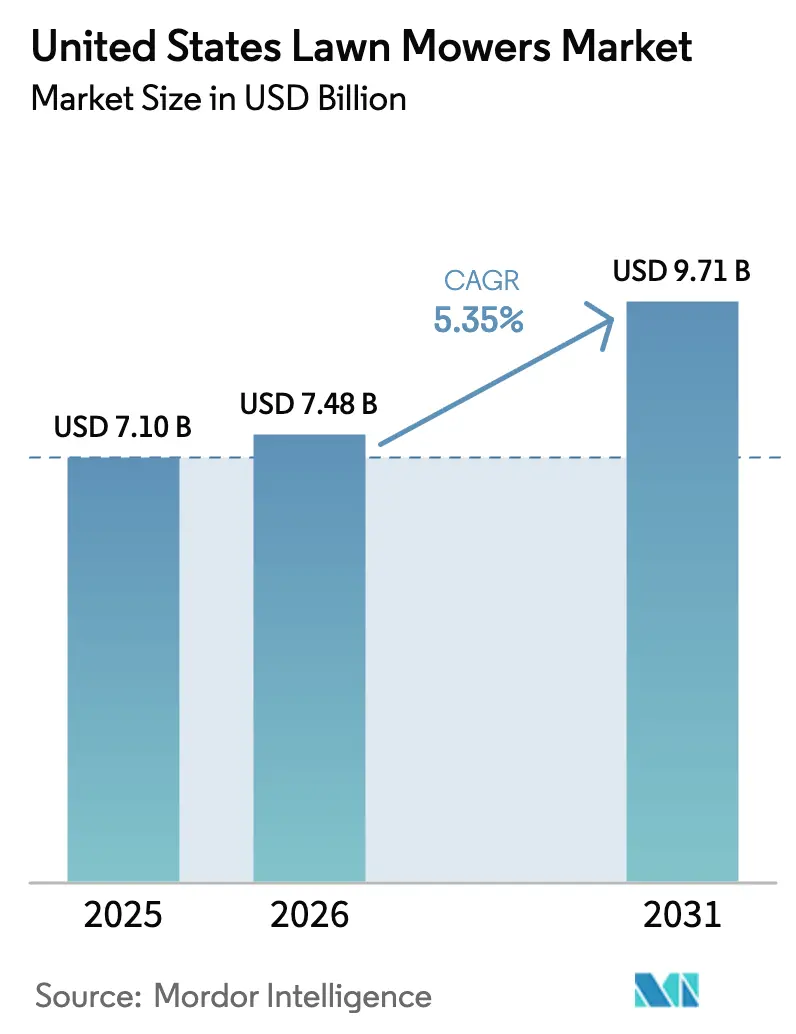
| Base Year Market Size (2025) | USD 7.1 Billion |
| Market Size (2026) | USD 7.48 Billion |
| Market Size (2031) | USD 9.71 Billion |
| Growth Rate (2026 - 2031) | 5.35 % |
| Market Concentration | High |
Major Players *Disclaimer: Major Players sorted in no particular order Image © Mordor Intelligence. Reuse requires attribution under CC BY 4.0. | |
United States Lawn Mowers Market Analysis by Mordor Intelligence
The United States lawn mowers market size was valued at USD 7.1 billion in 2025 and estimated to grow from USD 7.48 billion in 2026 to reach USD 9.71 billion by 2031, at a CAGR of 5.35% during the forecast period (2026-2031). California’s 2024 ban on new gasoline-powered small off-road engines, approved by the Environmental Protection Agency (EPA) in January 2025, forces manufacturers to accelerate investment in battery platforms even though gasoline models still dominated demand in 2024. Lithium-ion pack prices falling below USD 100 per kilowatt-hour during 2024 removes a long-standing cost barrier, allowing battery-electric units to close the total-cost-of-ownership gap with gasoline models within two years of purchase. Professional landscapers coping with a 12% labor vacancy rate are shifting to robotic and zero-turn electric machines that reduce fuel logistics and operator fatigue, while municipalities are piloting subscription fleets that convert one-time equipment purchases into recurring service contracts. Ongoing dealer channel strength and growing direct-to-consumer e-commerce sales illustrate how distribution models are fragmenting as incumbents race to defend share against battery specialists.
Key Report Takeaways
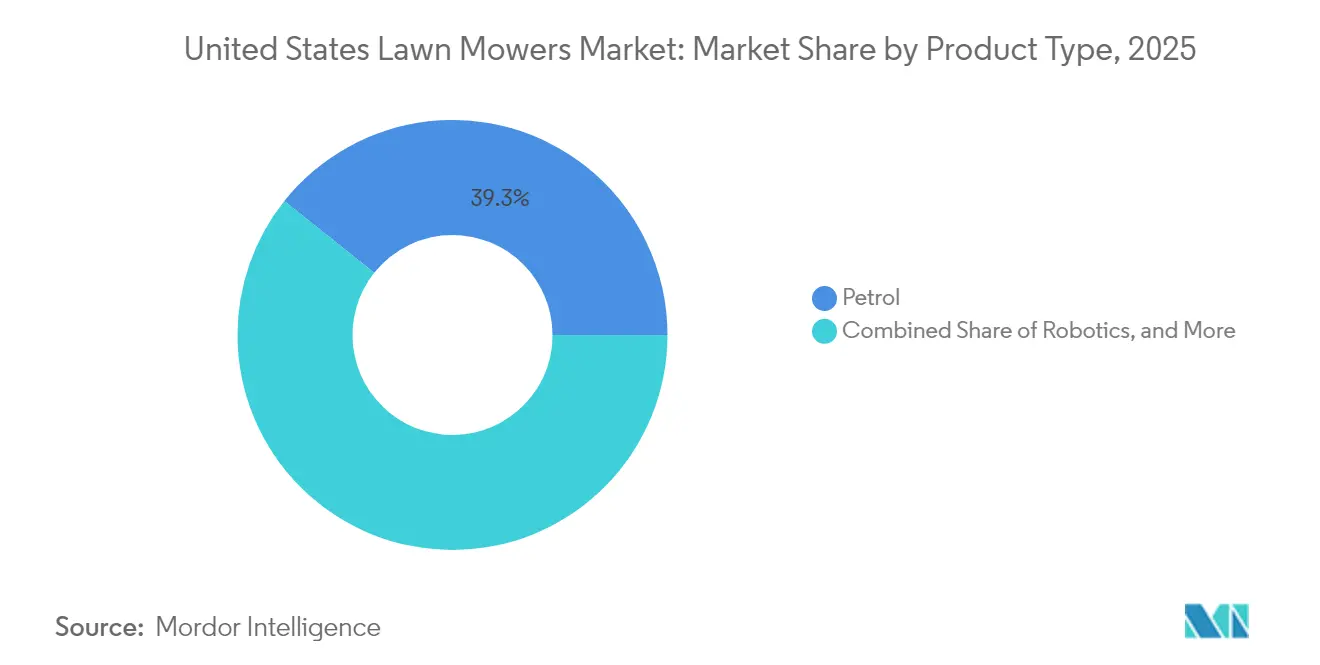
- By product type, petrol holds the largest share, accounting for 39.30% of the United States lawn mowers market size in 2025, whereas robotic are forecast to post the fastest 18.4% CAGR through 2031.
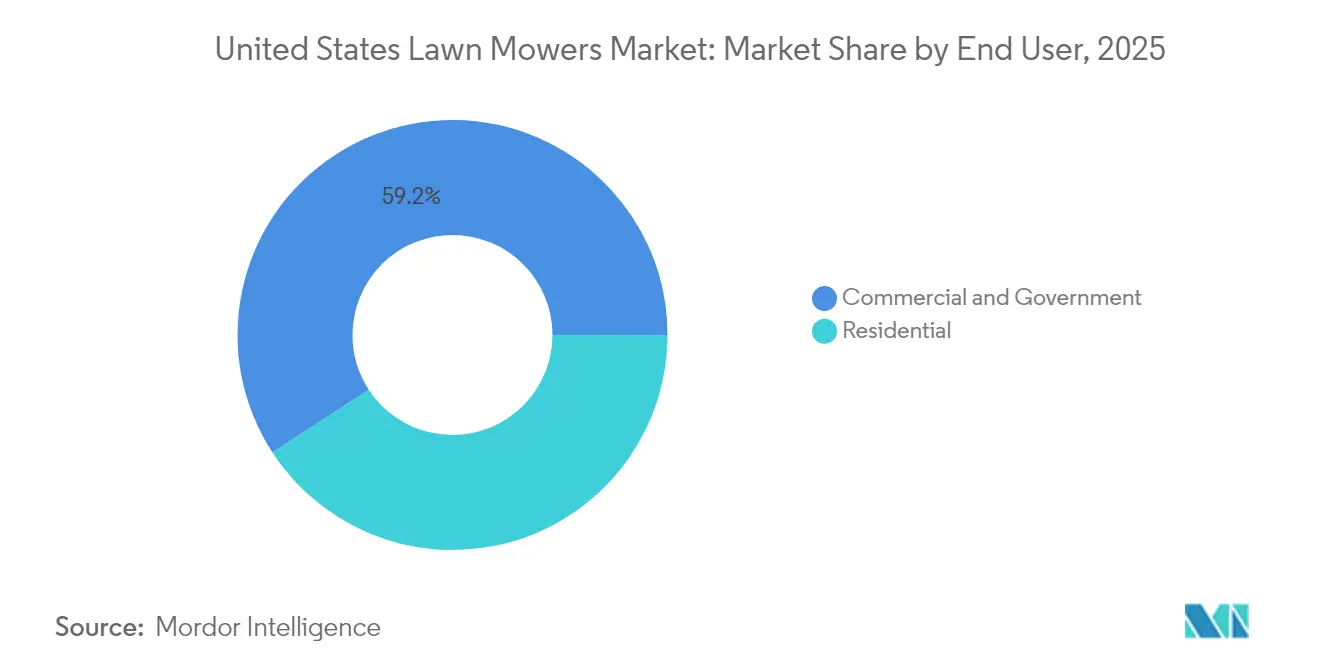
- By end user, commercial buyers captured 59.20% of the United States lawn mower market size in 2025, while residential users are projected to grow at a 5.3% CAGR through 2031.
Note: Market size and forecast figures in this report are generated using Mordor Intelligence’s proprietary estimation framework, updated with the latest available data and insights as of 2026.
United States Lawn Mowers Market Trends and Insights
Drivers Impact Analysis*
| Driver | (~) % Impact on CAGR Forecast | Geographic Relevance | Impact Timeline |
|---|---|---|---|
| Rising demand for landscaped residential yards | +1.2% | National, strongest in the South and the West | Long term (≥ 4 years) |
| State-level bans on new small-off-road gas engines | +1.8% | West and Northeast | Short term (≤ 2 years) |
| Accelerating adoption of battery-powered platforms by major OEMs | +1.4% | National, led by West Coast and the Northeast | Medium term (2-4 years) |
| Rapid cost declines in lithium-ion packs | +0.9% | National | Medium term (2-4 years) |
| Subscription-based autonomous mower fleets for municipalities | +0.5% | Urban municipalities in the West and the Northeast | Long term (≥ 4 years) |
| Turf-analytics platforms boosting mower replacement cycles | +0.3% | Commercial landscaping nationwide | Long term (≥ 4 years) |
| Source: Mordor Intelligence | |||


Rising Demand for Landscaped Residential Yards
Homeownership rates stabilized near 66% in 2024, sustaining baseline demand for lawn maintenance equipment across single-family properties. The strategic implication lies in the shift toward larger-lot suburban development in Sun Belt markets, where median yard sizes exceed 0.25 acres and require ride-on or zero-turn platforms rather than walk-behind units. This geographic skew elevates average selling prices and favors Original Equipment Manufacturer (OEMs) with strong dealer networks in Texas, Florida, and Arizona. Curb appeal remains a key driver of resale value, with landscaped properties commanding premiums of 5% to 10% in competitive housing markets, ensuring replacement cycles continue even during economic uncertainty. The Environmental Protection Agency's (EPA) WaterSense partnership is promoting drought-tolerant turf alternatives, which could reduce mowing frequency in arid regions.
State-Level Bans on New Small Off-Road Gas Engines
In 2024, California's Air Resources Board finalized regulations prohibiting the sale of new gasoline-powered small off-road engines starting with model year 2024 equipment, with full enforcement planned for 2026. In January 2025, the Environmental Protection Agency (EPA) granted California a Clean Air Act waiver, allowing the state to implement stricter standards than those mandated by federal regulations[1]Source: U.S. Environmental Protection Agency, “EPA Grants California Waiver for Small Off-Road Engine Regulations,” epa.gov. This waiver allows other states to adopt California's framework without requiring separate federal approval. States such as Oregon and Washington, as well as several in the Northeast, are considering similar measures. The impact of these regulations is significant. Original Equipment Manufacturers (OEMs) are unlikely to sustain dual production lines due to economic constraints, effectively making California's rules a national standard for equipment sold after 2026. Additionally, compliance extends beyond emissions to noise regulations. Battery-powered mowers, which operate at 60 to 70 decibels compared to over 90 decibels for gasoline models, enable mowing during early-morning and late-evening hours in municipalities with noise restrictions.
Accelerating Adoption of Battery-Powered Platforms by Major OEMs
Deere and Company, The Toro Company, and Husqvarna Group have collectively invested over USD 500 million in battery platform development between 2023 and 2024, as reported in their annual reports and investor presentations. Deere introduced the Z370R electric zero-turn mower in 2024, offering runtime comparable to gas-powered models, capable of mowing up to 2.5 acres per charge for commercial operators. Toro expanded its 60-volt battery product range across both residential and commercial markets, while Husqvarna's CEORA autonomous mower gained popularity in municipal and golf-course applications. This strategic shift underscores the recognition that battery technology has now met the performance requirements for professional use, addressing the primary concerns that previously hindered its adoption. Charging infrastructure remains a challenge, as commercial fleets require 240-volt Level 2 chargers to reduce downtime, and suburban electrical panels often lack the capacity to support multiple simultaneous charges without expensive service upgrades.
Rapid Cost Declines in Lithium-Ion Packs
In 2024, lithium-ion battery pack prices averaged USD 95 per kilowatt-hour, a significant decrease from USD 153 per kilowatt-hour in 2022. This decline was driven by increased manufacturing scale in the automotive industry and advancements in cell chemistry. The cost reduction has directly influenced the economics of lawn mowers. For instance, a 5-kilowatt-hour battery pack used in premium zero-turn mowers cost approximately USD 765 in 2022 but dropped to USD 475 in 2024, reducing the price disparity with gasoline-powered models. Total cost of ownership calculations now favor battery-powered units for commercial operators using equipment for over 500 hours annually. Savings in fuel and maintenance costs offset the higher initial investment within 18 to 24 months. This shift is significant as it transitions purchasing decisions from early adopters to mainstream buyers, who prioritize return on investment over environmental considerations.
Restraints Impact Analysis*
| Restraint | (~) % Impact on CAGR Forecast | Geographic Relevance | Impact Timeline |
|---|---|---|---|
| Shortage of skilled landscaping labor inflating service costs | -0.7% | National, most acute in metropolitan areas | Short term (≤ 2 years) |
| High upfront price of robotic and commercial zero-turn units | -0.9% | Nationwide, weighs on residential and small commercial buyers | Medium term (2-4 years) |
| Grid-capacity limits for large charging depots in suburbs | -0.4% | South and West suburbs with aging transformers | Long term (≥ 4 years) |
| Theft and vandalism risk for unattended robotic mowers | -0.3% | Urban corridors and dense suburbs | Medium term (2-4 years) |
| Source: Mordor Intelligence | |||
Shortage of Skilled Landscaping Labor Inflating Service Costs
The landscaping services market experienced a 12% vacancy rate in 2024, marking the highest level in a decade. This shortage was driven by immigration restrictions and demographic changes that reduced the available workforce. In response, operators increased hourly service rates, which ranged from USD 50 to USD 75 per hour in metropolitan areas, compared to USD 40 to USD 60 in 2022 [2]Source: U.S. Bureau of Labor Statistics, “Landscaping Services Labor Market Analysis,” bls.gov . Rising labor costs have prompted residential customers to shift toward do-it-yourself lawn care, thereby expanding the market for consumer-grade mowers. Professional landscapers face compressed margins as they are unable to fully pass on cost increases to price-sensitive clients. The labor shortage has also heightened interest in autonomous and zero-turn electric mowers, which help reduce operator fatigue and allow a single worker to cover larger areas. Despite this, adoption remains limited due to capital constraints faced by small and mid-sized landscaping firms.
High Upfront Price of Robotic and Commercial Zero-Turn Units
Robotic lawn mowers are priced between USD 1,200 and USD 4,500 for residential models, while commercial-grade autonomous units cost over USD 15,000. In comparison, gasoline push mowers are priced between USD 300 and USD 800, and gas-powered zero-turn models range from USD 3,000 to USD 8,000. This significant price difference limits adoption among cost-conscious homeowners and small landscaping businesses operating with narrow profit margins. Although financing options and leasing programs are becoming available to address affordability, they introduce additional complexity and interest costs, which can discourage buyers unfamiliar with equipment financing. This challenge is particularly pronounced in the residential segment, where discretionary spending on lawn care competes with other home improvement priorities. Additionally, homeowners often focus on upfront costs rather than evaluating the total cost of ownership over multiple years, further hindering adoption.
*Our forecasts treat driver/restraint impacts as directional, not additive. The impact forecasts reflect baseline growth, mix effects, and variable interactions.
Segment Analysis
By Product Type: Robotic Units Gain Commercial Traction
Petrol holds the largest share, accounting for 39.30% of the United States lawn mower market size in 2025, reflecting its entrenched position in residential and small commercial applications. Replacement demand is shifting toward battery-electric alternatives as California's 2024 ban on new gasoline-powered vehicles takes effect. Petrol mowers face the steepest headwinds, as state-level emission bans and noise ordinances erode their value proposition, yet they remain the lowest-cost option for budget-conscious buyers in states without regulatory pressure.
Robotic lawn mowers are forecast to grow at a 18.4% CAGR through 2031, the fastest expansion across all product categories, driven by municipal fleet adoptions and commercial landscaping trials. The robotic lawn mower segment is experiencing remarkable growth, emerging as the fastest-growing category in the market. This impressive growth is driven by rapid technological advancements in artificial intelligence, the Internet of Things (IoT), and machine learning capabilities.


By End User: Commercial Segment Drives Growth
Commercial buyers captured 59.20% of the United States lawn mower market size in 2025. The commercial segment's faster growth reflects structural drivers: landscaping companies operating equipment for more than 500 hours annually achieve total cost of ownership savings with battery-electric units within 18 to 24 months, as the higher upfront costs are offset by fuel and maintenance expenses. Residential buyers, by contrast, prioritize initial purchase price and are slower to adopt premium battery platforms absent regulatory mandates.
Residential users are projected to grow at a 5.3% CAGR through 2031, reflecting the large installed base of single-family homeowners. Their purchasing decisions are increasingly influenced by noise ordinances and emission regulations that favor battery-electric models. Government and municipal buyers represent a smaller but strategically important segment, piloting subscription-based robotic fleets to reduce operating expenses and meet emissions targets without upfront capital outlays.
Geography Analysis
The South region holds the largest share of the United States lawn mower demand in 2025, driven by year-round growing seasons, larger average yard sizes, and high single-family homeownership rates in Texas, Florida, and Georgia. The West region is forecast to grow at the fastest rate from 2026 to 2031, driven by California's 2024 ban on new petrol small off-road engines and state incentive programs that subsidize the purchase of battery-electric equipment.
The Midwest region maintains steady demand, anchored by residential and agricultural applications, while the Northeast faces slower growth due to shorter growing seasons and higher population density, which reduces average yard sizes. California's Air Resources Board regulations, authorized by the Environmental Protection Agency (EPA) in January 2025, effectively set a national standard, as OEMs cannot economically maintain dual production lines for compliant and non-compliant states.
The South's dominance reflects not only climate and yard size but also cultural preferences for landscaped properties as markers of homeownership success, sustaining replacement cycles even during economic uncertainty. The West's regulatory environment is accelerating a structural shift: California's ban, combined with Oregon and Washington's evaluations of similar measures, creates a de facto regional standard that pressures OEMs to prioritize battery platform development over petrol product refreshes.
Regulatory Landscape
In the United States, walk-behind power lawn mowers are governed by the U.S. Consumer Product Safety Commission (CPSC) safety standard in 16 CFR Part 1205, which sets blade-control and guarding requirements and prescribes on-product labeling. Manufacturers and importers must certify compliance via a General Certificate of Conformity (GCC) and retain supporting testing records for at least three years, which elevates the value of documented quality systems for both domestic production and imported SKUs.
On the environmental side, the Environmental Protection Agency (EPA) sets federal requirements for small spark-ignition engines, while California Air Resources Board (CARB) rules are a key reference point for zero-emission transitions in outdoor power equipment. The EPA granting California a Clean Air Act waiver in January 2025 for its small off-road engine program supports state-level moves that tighten emissions and, in practice, steer OEM product roadmaps toward battery-electric and other low-emission platforms for equipment sold into the United States after 2026.
Competitive Landscape
The United States lawn mower market exhibits high concentration, with the top five players including Deere & Company, The Toro Company, Husqvarna AB, Stanley Black & Decker Outdoor (MTD), and American Honda Motor Co., Inc. This oligopoly structure limits price competition but creates strategic vulnerability as smaller battery-specialist brands like Mean Green Products and Greenworks Tools capture commercial fleet contracts by offering lower total cost of ownership and faster charging solutions.
Opportunities exist in the mid-tier battery-electric zero-turn mower segment, priced between USD 5,000 and USD 8,000. This segment remains underserved, as incumbents primarily focus on premium commercial units and entry-level residential models. Emerging disruptors are utilizing direct-to-consumer sales channels to avoid dealer markups and offer competitive pricing. These disruptors often lack the service networks required by professional landscapers for equipment priced at USD 10,000 or more.
Technology adoption within the market is inconsistent. Products like Husqvarna's CEORA autonomous mower and Toro's Lynx turf-management platform highlight the growing importance of connectivity and data analytics as competitive differentiators. Despite this, many OEMs continue to treat these capabilities as aftermarket add-ons rather than integrating them as core product features. Additionally, the EPA's authorization of California's Clean Air Act waiver in January 2025 is accelerating industry changes. OEMs that delayed battery platform development now face a compressed timeline to meet 2026 compliance deadlines, potentially requiring dual production lines to address regulatory requirements.
United States Lawn Mowers Industry Leaders
Deere & Company
The Toro Company
Husqvarna AB
Stanley Black & Decker Outdoor (MTD)
American Honda Motor Co., Inc.
- *Disclaimer: Major Players sorted in no particular order


Market Opportunities and Future Outlook
A key opportunity lies in accelerating the shift from petrol to battery-electric and autonomous mowing in segments where total cost of ownership and labor constraints are most visible, particularly commercial landscaping and municipal fleets. OEM product investments point to where demand is being built: Deere & Company, The Toro Company, and Husqvarna have highlighted expanded battery and technology roadmaps in 2023-2024, while Husqvarna broadened its boundary wire-free robotic mower lineup in 2025 and continued advancing AI vision capabilities for navigation and object detection, supporting wider deployment in complex residential and light-commercial settings.
Distribution and go-to-market execution also create room for gains. Retail placement can change category penetration for robotic and electric mowers quickly, as reflected in 2026 announcements that put wire-free robotic mowers and next-generation robotic lines into major U.S. big-box channels, while dealer-led selling continues to matter for premium zero-turn and professional equipment. At the same time, adoption friction points such as charging capacity for fleet depots and higher upfront prices for robotic and commercial zero-turn models create space for bundled solutions (charger-inclusive packages, fleet financing, leasing, and subscription operating models) that turn compliance-driven electrification into more manageable operating expenditures for contractors and public agencies.
Recent Industry Developments
- July 2026: Honda Power Equipment introduced the all-electric ProZision Autonomous Zero-Turn commercial mower in the United States, targeting professional landscapers and municipal customers with an autonomy-led value proposition. The launch increases competitive pressure in premium commercial mowing, where labor shortages and noise restrictions are pushing buyers toward electric, high-productivity platforms.
- March 2026: Greenworks expanded U.S. availability of its next-generation AiMowbot robotic mower lineup through Walmart, increasing mass-market access to robotic mowing at national scale. Wider retail placement supports category awareness and speeds trial adoption beyond early adopters who previously purchased primarily through specialty channels.
- October 2025: John Deere expanded its residential zero-turn lineup with the Z370RS Electric ZTrak mower featuring EGO 56V ARC Lithium removable batteries developed in collaboration with EGO. Removable battery interoperability reduces ownership friction for homeowners who already use battery outdoor tools and supports dealer-led upsell into higher-priced electric ride-on platforms.


Research Methodology Framework and Report Scope
Market Definition and Coverage
This market covers revenue generated from lawn mower equipment sales in the United States, including both residential and commercial end users and the main power types used for cutting turf.
Scope exclusions: services, installation, routine maintenance, aftermarket parts, and other outdoor power tools are not counted in this market size.
Segmentation Overview
- Product Type
- Manual
- Electric
- Petrol
- Robotics
- Other Product Types
- End User
- Residential
- Commercial or Government
Data Sources, Market Sizing, and Validation
Desk Research
Desk research was used to map the demand pool and to anchor assumptions that can be checked through public data. We typically refer to sources such as the US Census Bureau, US International Trade Commission import and export statistics, Bureau of Labor Statistics price series, and EPA rules and guidance on small engines and emissions.
To translate these signals into a market model, we also review manufacturer annual reports and investor presentations, reputable press coverage on channel and product shifts, and association publications such as OPEI and related standards bodies. In addition, paid subscriptions for company financials and intelligence, news and financials, patent databases, and shipment-level trade data were used selectively to fill gaps in product mix and price positioning. The sources listed here are illustrative, and many other references were also reviewed for data capture, cross-checks, and clarification.
Primary Interviews and Surveys
Primary work focused on validating how unit shipments, average selling prices, and channel mix are moving across the United States, since these are the levers that most directly change revenue. We spoke with participants across manufacturing, distribution, and retail, and with large user groups including commercial buyers, then reconciled differences through follow-up calls when responses did not align.
Distribution of primary research fieldwork respondents
| Company type | Respondent position |
|---|---|
| Top tier: 31% | CXOs: 12% |
| Mid tier: 55% | Functional/Unit leaders: 43% |
| Smaller Players: 14% | Managers: 45% |
Market-Sizing & Forecasting
Market sizing is built using a top-down approach that reconstructs the United States revenue pool from equipment demand indicators and pricing, and then gets pressure-tested using selective bottom-up approximations. On the top-down side, we link mower demand to housing and yard ownership patterns, replacement cycles, and seasonal selling behavior, and then convert these to value using observed price tiers and mix shifts.
To keep the model grounded, inputs tracked closely include the share of walk-behind versus riding units, the pace of battery versus gasoline adoption, retailer and dealer channel share, typical promotional intensity during spring peaks, and the commercial buying share tied to landscaping activity. Bottom-up checks are applied through supplier and channel roll-ups from a sample set, plus sampled ASP times volume calculations, and gaps are handled through conservative interpolation using adjacent product categories and prior-year mix trends.
For forecasting, scenario analysis is used to reflect different adoption paths for battery and robotic models, paired with exponential smoothing on baseline shipment and price series to avoid overreacting to one-off weather or inventory corrections. Assumptions are adjusted only after primary feedback confirms the direction and timing of changes in pricing, availability, and customer preference.
Data Validation & Update Cycle
Outputs are validated through triangulation across independent checks, including shipment signals, reported revenue direction from key participants, and pricing movement visible in public series and channel observations. When a line item shows a jump that cannot be explained by mix, price, or unit movement, it is flagged for review and then reworked, followed by a second analyst review before sign-off.
The report is refreshed annually, and interim updates are made when material events change demand, supply, or regulation assumptions. Before delivery, an analyst completes a fresh update pass so the final model reflects the latest available data and primary feedback.
Mordor Intelligence's United States Lawn Mowers Market Estimate Compared With Other Published Estimates
Published market sizes for US lawn mowers can look far apart because studies do not always count the same products, the same buying groups, or the same price basis. Differences also come from how fast assumptions are refreshed, and whether shipment and price movements are checked with channel participants.
Some estimates lean narrower by focusing on consumer-grade mower demand and manufacturers shipments, or they lean broader by rolling in adjacent outdoor equipment and parts. In Mordor Intelligence's model, the total is limited to lawn mower equipment revenue in the United States across residential and commercial end users, and it does not add services or aftermarket parts into the market value.
Benchmark comparison
| Source | Market Size | Gaps in Research Methodology |
|---|---|---|
| Mordor Intelligence | USD 7.48 B (2026) | |
| Market Study Publisher A | USD 7.10 B (2021) | Uses an older base year and a different price environment, and the estimate is often built from a shipments-led view that can understate later mix-driven ASP growth in battery and robotic models. |
| Industry Study Publisher B | USD 4.90 B (2024) | Primarily focuses on consumer-grade equipment and manufacturers shipments, with commercial turf and related use cases excluded, which compresses the addressable revenue pool versus an end-user revenue view. |
The spread across sources is mainly explained by scope choices (consumer-only versus total end-user revenue), base-year timing, and how pricing and mix changes are carried forward. By keeping inputs tied to observable shipment and price signals and then confirming them with channel checks, the final number stays traceable and repeatable for planning.


Key Questions Answered in the Report
How large is the United States lawn mowers market in 2026?
It is valued at USD 7.48 billion, with a forecast to reach USD 9.71 billion by 2031.
Which product type is growing the fastest?
Robotic mowers lead with a projected 18.4% CAGR through 2031, driven by commercial and municipal pilots.
Why are battery-electric mowers gaining share?
Lithium-ion pack prices below USD 100/kWh and state bans on gasoline engines make battery models cost-competitive within two years of purchase.
What limits rapid electrification for commercial fleets?
Suburban grid capacity constraints and the cost of installing multiple Level 2 chargers slow large-scale fleet rollouts.
Page last updated on:


 Your data is secure and never sold or shared.


