
Real Estate Crowdfunding Market Size and Share
Market Overview
| Study Period | 2020 - 2031 |
|---|---|
| Market Size (2026) | USD 11.95 Billion |
| Market Size (2031) | USD 28.84 Billion |
| Growth Rate (2026 - 2031) | 19.27 % |
| Fastest Growing Market | Asia-Pacific |
| Largest Market | North America |
| Market Concentration | Low |
Major Players *Disclaimer: Major Players sorted in no particular order Image © Mordor Intelligence. Reuse requires attribution under CC BY 4.0. | |
Real Estate Crowdfunding Market Analysis by Mordor Intelligence
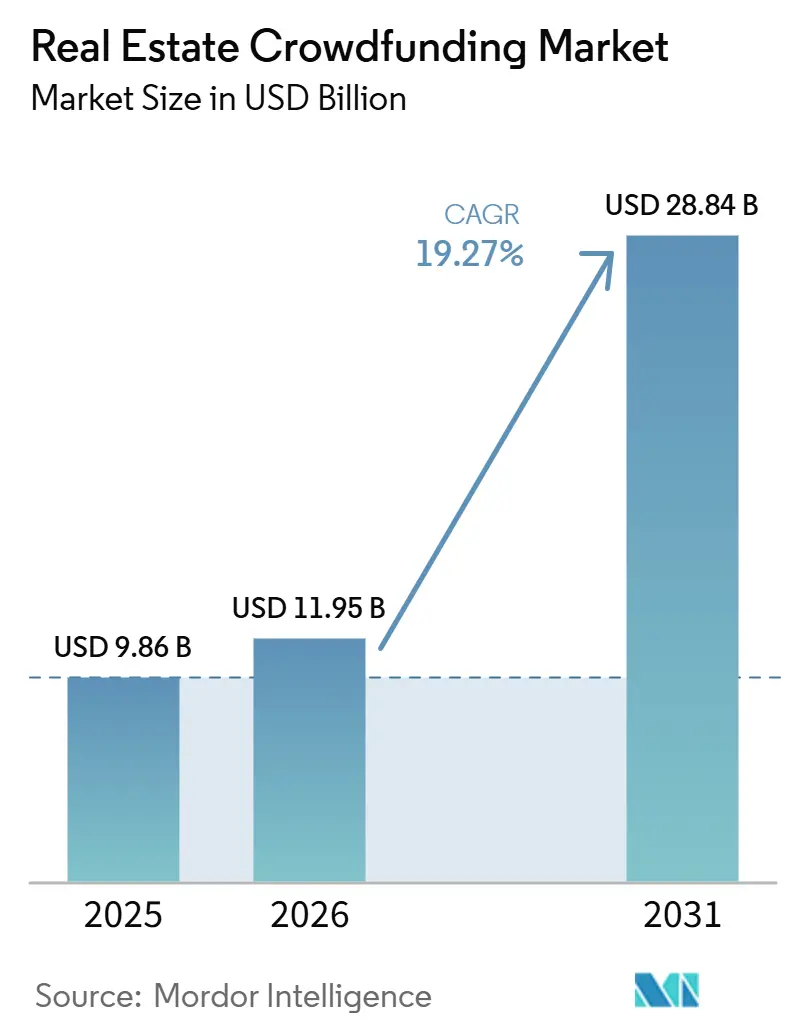
The Real Estate Crowdfunding Market size is projected to be USD 9.86 billion in 2025, USD 11.95 billion in 2026, and reach USD 28.84 billion by 2031, growing at a CAGR of 19.27% from 2026 to 2031.
The real estate crowdfunding market is growing as fractional ownership lowers entry barriers, digital onboarding improves access, and a wider retail base is entering private property investing at thresholds as low as USD 1. The real estate crowdfunding market is also benefiting from reduced bank appetite for higher-risk real estate lending, which is opening more room for alternative funding channels and flexible capital structures in the sponsor community. Tokenization is adding a liquidity layer that traditional platform structures often lacked, and the June 2026 Goldman Sachs partnership with Apex Group and Archax shows that institutional players now view blockchain-based real estate fund structures as a serious capital markets tool. Mobile-first design, AI-assisted property review, and IRA-compatible wrappers are widening the addressable investor pool and making the real estate crowdfunding market more accessible than earlier generations of platforms. Competition in the real estate crowdfunding market is now tightening around underwriting quality, liquidity design, and platform discipline, as investors screen for durability and transparency more than headline yield alone.
Key Report Takeaways
- By investor type, individual investors held 72.31% of the real estate crowdfunding market share in 2025, while institutional investors are projected to grow at a 22.57% CAGR through 2031.
- By instrument type, debt-based crowdfunding accounted for 61.89% of the real estate crowdfunding market share in 2025, while hybrid structures are projected to grow at a 21.82% CAGR through 2031.
- By property type, residential assets accounted for 37.65% of the real estate crowdfunding market share in 2025, while industrial real estate is projected to grow at a 23.49% CAGR through 2031.
- By investment model, deal-by-deal investing held 66.76% of the real estate crowdfunding market share in 2025, while fund-based structures are projected to grow at a 24.02% CAGR through 2031.
- By geography, North America commanded 53.27% of the real estate crowdfunding market share in 2025, while Asia-Pacific is projected to grow at a 24.78% CAGR through 2031.
Note: Market size and forecast figures in this report are generated using Mordor Intelligence’s proprietary estimation framework, updated with the latest available data and insights as of January 2026.
Global Real Estate Crowdfunding Market Trends and Insights
Drivers Impact Analysis*
| Driver | (~) % Impact on CAGR Forecast | Geographic Relevance | Impact Timeline |
|---|---|---|---|
| Growing Access to Fractional Real Estate Ownership | +4.2% | Global | Short term (≤ 2 years) |
| Rising Demand for Passive Income and Portfolio Diversification | +3.5% | Global | Medium term (2-4 years) |
| Regulatory Clarity for Online Investing | +2.8% | North America & EU | Medium term (2-4 years) |
| Rapid Adoption of Mobile-First Investment Experiences | +2.4% | Asia-Pacific core, spill-over to MEA | Short term (≤ 2 years) |
| Cross-Border Compliance Automation Unlocks International Capital | +2.0% | Global, with early gains in Singapore, the UAE, United Kingdom | Medium term (2-4 years) |
| Tokenized Secondary Liquidity for Illiquid Assets | +2.5% | North America & EU | Long term (≥ 4 years) |
| Source: Mordor Intelligence | |||
Growing Access To Fractional Real Estate Ownership
The real estate crowdfunding market is moving closer to mainstream retail investing as minimum ticket sizes have fallen to levels no longer reserved for high-net-worth participants. This shift is changing how sponsors approach capital formation, because a broader investor base can now support offerings that once depended on narrow private placement networks. Between 2016 and 2024, 3,869 offerings under SEC Regulation CF reported USD 1.3 billion in proceeds, and the pace improved after the annual cap was raised to USD 5 million per issuer in 2021[1]Highlights of Regulation Crowdfunding Activity (2016–2024) from the SEC Division of Economic and Risk Analysis – May 2025 | SyndicationAttorneys.com. The March 2026 petition to modernize Regulation CF shows that the regulatory side of access is still evolving and could further widen issuer and investor participation if changes move ahead. Platforms are also combining fractional structures with IRA-compatible wrappers and private real estate formats, helping the real estate crowdfunding market compete more directly with listed REITs and digital wealth products.
Rising Demand for Passive Income and Portfolio Diversification
The real estate crowdfunding market is attracting investors seeking yield, regular distributions, and access to private assets without taking on full property ownership. This demand is visible at the institutional level, where pension funds increased their share of capital committed to non-listed real estate globally to 39% in 2025 from 32% in 2024, the highest level since 2021. The same preference supports the retail side of the real estate crowdfunding market, where income-oriented products are gaining relevance even in tighter credit conditions. Debt-based formats remain well aligned with this demand because they offer clearer cash flow expectations and often sit closer to secured lending structures than pure equity participation. Hybrid structures are also benefiting the real estate crowdfunding market by offering products that meet both income expectations and upside participation without forcing investors into a single return profile.
Tokenized Secondary Liquidity for Illiquid Assets
The real estate crowdfunding market has long faced a fundamental limitation: many investors accept private real estate returns only if they can see a credible exit path before the end of a long hold period. Tokenization addresses that issue by converting property interests into digital units that can be tracked, transferred, and managed under automated compliance rules. In May 2025, MAG and MultiBank Group announced a USD 3 billion tokenization agreement tied to Dubai residential assets, demonstrating that large developers are beginning to use tokenized structures at a meaningful scale[2]UAE Groups Pursues $3B Tokenization Deal | Crowdfund Insider, CROWDFUNDINSIDER . In June 2026, Goldman Sachs worked with Apex Group and Archax on a blockchain-native, tokenized real estate fund, which sent a strong signal to the real estate crowdfunding market that institutional-grade governance can be paired with token-based fund infrastructure. As this model develops, the real estate crowdfunding market is likely to place more weight on liquidity design and transferability in premium offerings than it did in earlier platform cycles.
Rapid Adoption of Mobile-First Investment Experiences
The real estate crowdfunding market is expanding beyond traditional desktop-led investing because mobile-first interfaces reduce friction from account opening through portfolio monitoring. Faster KYC checks, in-app dashboards, and immediate alerts for new offerings help investors act quickly without having to navigate the slower workflows of older wealth platforms. Arrived launched a secondary marketplace for individual rental home shares in November 2025 and said in Q1 2026 that it was distributing more than USD 3.7 million in quarterly investor dividends, while its private credit fund was delivering an annualized yield of 8.1%-8.6%[3]Arrived Q1 2026 Financial Performance | Arrived - Easily Invest in Real Estate, ARRIVED.COM. Fundrise added RealAI in January 2026 and positioned it as a tool built on data from more than 35,000 residential units across USD 7 billion in real estate assets, demonstrating how platform intelligence is becoming part of the user experience rather than a back-office function. This matters especially in Asia-Pacific, where the real estate crowdfunding market is well-positioned to benefit from mobile-led financial behavior among younger, digitally native investor groups.
Restraints Impact Analysis*
| Restraint | (~) % Impact on CAGR Forecast | Geographic Relevance | Impact Timeline |
|---|---|---|---|
| Illiquidity and Weak Secondary Exit Options | -2.2% | Global | Short term (≤ 2 years) |
| Fragmented Securities Rules Across Jurisdictions | -1.5% | Global | Medium term (2-4 years) |
| Cybersecurity, KYC, and Investor Fraud Exposure | -1.3% | Global | Medium term (2-4 years) |
| Dependence on Property Valuation Accuracy and Asset Performance | -1.0% | Asia-Pacific & emerging markets | Long term (≥ 4 years) |
| Source: Mordor Intelligence | |||
Illiquidity and Weak Secondary Exit Options
The real estate crowdfunding market still faces a structural liquidity problem because many offerings lock capital for several years and offer limited or no early-exit options. That restriction narrows the addressable investor base, since retail savers often need more flexibility than private property structures can provide. Under SEC Regulation CF, securities purchased in a crowdfunding transaction generally cannot be resold for 1 year unless a qualified exception applies, creating a clear minimum holding period for many offerings. ome United States platforms tightened redemption terms in early 2026, reinforcing concerns about liquidity expectations during slower property cycles. Until secondary trading, note redemption, or token-based transfers become more common, the real estate crowdfunding market will continue to face a gap between investor demand for flexibility and the operating reality of private real estate.
Fragmented Securities Rules Across Jurisdictions
The real estate crowdfunding market lacks a single global regulatory framework, which raises costs, documentation requirements, and operational complexity for platforms seeking to scale across borders. Europe has made more progress than most regions through the ECSPR structure, but persistent issues around language, AML practices, and differing investor familiarity across member states is still still highlighted[4] Securities Crowdfunding: There Are Over 230 ECSPR Platforms Operating In Europe | Crowdfund Insider. Outside Europe, a platform that wants to operate across the United States, Japan, and Australia must still manage separate disclosure rules, investor protections, and licensing expectations. That burden favors larger incumbents that can invest in legal technology and dedicated compliance teams, while smaller operators face slower expansion and higher operating costs per new geography. The result is that the real estate crowdfunding market can grow internationally, but growth is often uneven and shaped by compliance capability as much as investor demand
*Our forecasts treat driver/restraint impacts as directional, not additive. The impact forecasts reflect baseline growth, mix effects, and variable interactions.
Segment Analysis
By Investor Type: Individual Base Provides Volume, Institutions Set the Terms
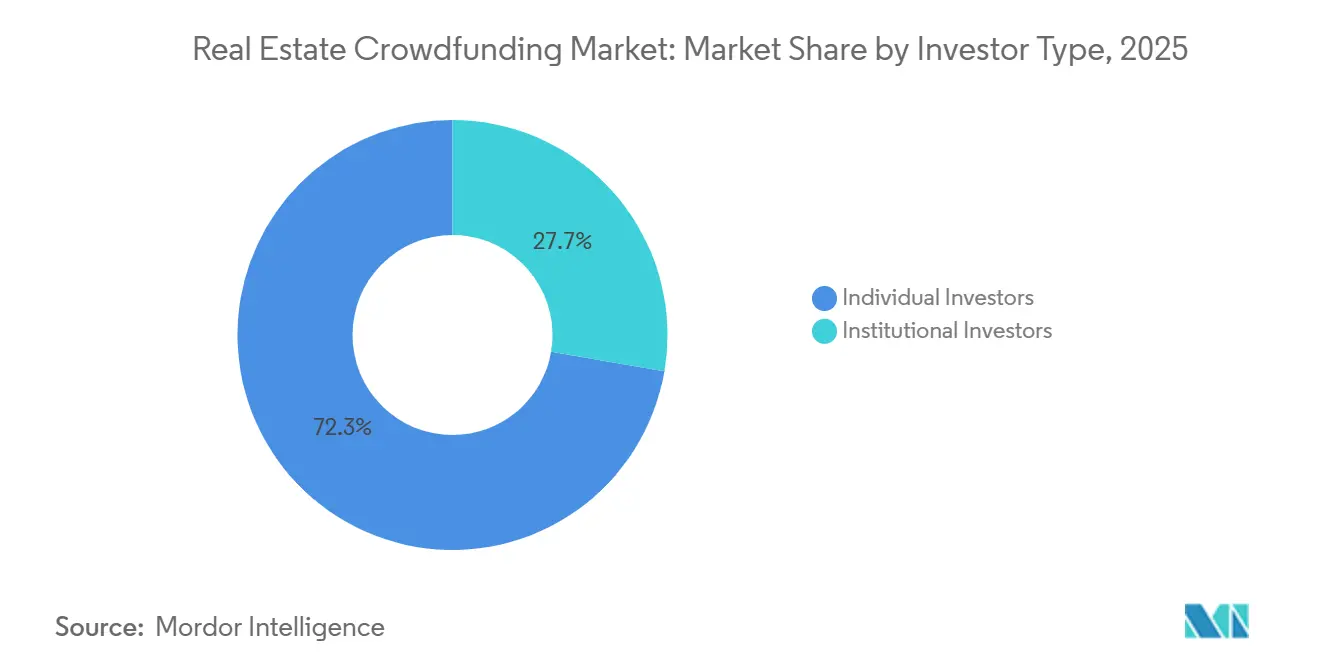
Individual investors held 72.31% of the real estate crowdfunding market in 2025, which kept retail participation as the volume backbone of platform activity. This position was built on low minimums, self-directed onboarding, and a user journey that is easier to scale than most institutional real estate products. The real estate crowdfunding market has used these features to attract participants who want direct access to specific deals without moving through private fund gatekeepers. Retail investors also align with the product logic of many platforms because single-asset offerings, shorter decision cycles, and app-based monitoring work well for self-directed capital. In that sense, the real estate crowdfunding market has expanded not only because property became investable online, but because platform design made it easier for a broad investor base to participate.
Institutional investors, while smaller in 2025, are projected to record the fastest CAGR among investor types at 22.57% through 2026-2031. Their growth reflects rising interest from family offices, endowments, and smaller pension allocators seeking transparent fee structures and more granular asset selection than many commingled vehicles offer. Pension funds raised their global share of non-listed real estate capital to 39% in 2025 from 32% in 2024, which supports the view that larger pools of capital are actively revisiting private real estate exposure. CrowdStreet’s platform rebuild in November 2025 and the launch of Nuveen Private Markets strategies in May 2026 show how leading operators are building access paths that address both retail breadth and institutional expectations. The real estate crowdfunding industry, therefore, serves 2 complementary roles: retail investors provide scale, while institutional capital strengthens quality signaling across the real estate crowdfunding market.
The balance between these groups is shaping product design inside the real estate crowdfunding market. Retail users still prefer clear onboarding, lower minimums, and deal visibility, while institutional users place greater weight on governance, reporting, and sponsor discipline. This does not mean one group is replacing the other. It means the real estate crowdfunding market is becoming more layered, with platforms adapting their deal presentations, due diligence depth, and capital structures to meet different investor needs. That layered model should keep retail participation central even as institutions grow faster during the forecast period.


By Instrument Type: Debt Dominates, Hybrid Structures Capture Emerging Risk Appetite
Debt-based crowdfunding accounted for 61.89% of the real estate crowdfunding market in 2025, making it the largest instrument category by a clear margin. The format works because issuers often prefer predictable servicing obligations over equity dilution, while investors value a clearer return path backed by real asset collateral. The real estate crowdfunding market has also benefited from the fact that debt products are usually easier for first-time private real estate investors to understand than longer-duration equity structures. Typical debt yields of 7%-12% and shorter hold periods of 6-24 months make these products a practical entry point for investors who prioritize income and capital visibility. As a result, debt remains the anchor instrument across a large portion of the real estate crowdfunding market.
Equity-based structures still matter because they offer higher IRR potential at 10%-18%, but they require longer holding periods of 3-7 years and expose investors more directly to project completion and residual value risk. Hybrid crowdfunding is projected to grow at the fastest CAGR of 21.82% through 2026-2031 because it combines income-seeking characteristics with selective upside participation. This matters in the real estate crowdfunding market because investor demand is not moving in only 1 direction. Some investors want secured cash flow, while others want participation in appreciation without taking pure equity risk. Hybrid structures meet both preferences more effectively than a single format can.
The real estate crowdfunding market is also seeing increased support for hybrid products due to changes in the broader lending environment. The alternative real estate lenders in Europe posted a 34% year-on-year rise in commercial real estate loan origination through 2025, as banks reduced exposure following changes to capital requirements. It also noted that European private credit fundraising reached USD 65 billion through Q3 2025, providing hybrid crowdfunding with a stronger pricing and structuring reference point. That backdrop helps explain why the real estate crowdfunding market is not moving away from debt but is instead broadening into more flexible debt-equity combinations. The real estate crowdfunding industry is therefore becoming more differentiated by return structure and risk packaging rather than by simple debt-versus-equity labels.
By Property Type: Residential Anchors Share, Industrial Rewrites the Growth Story
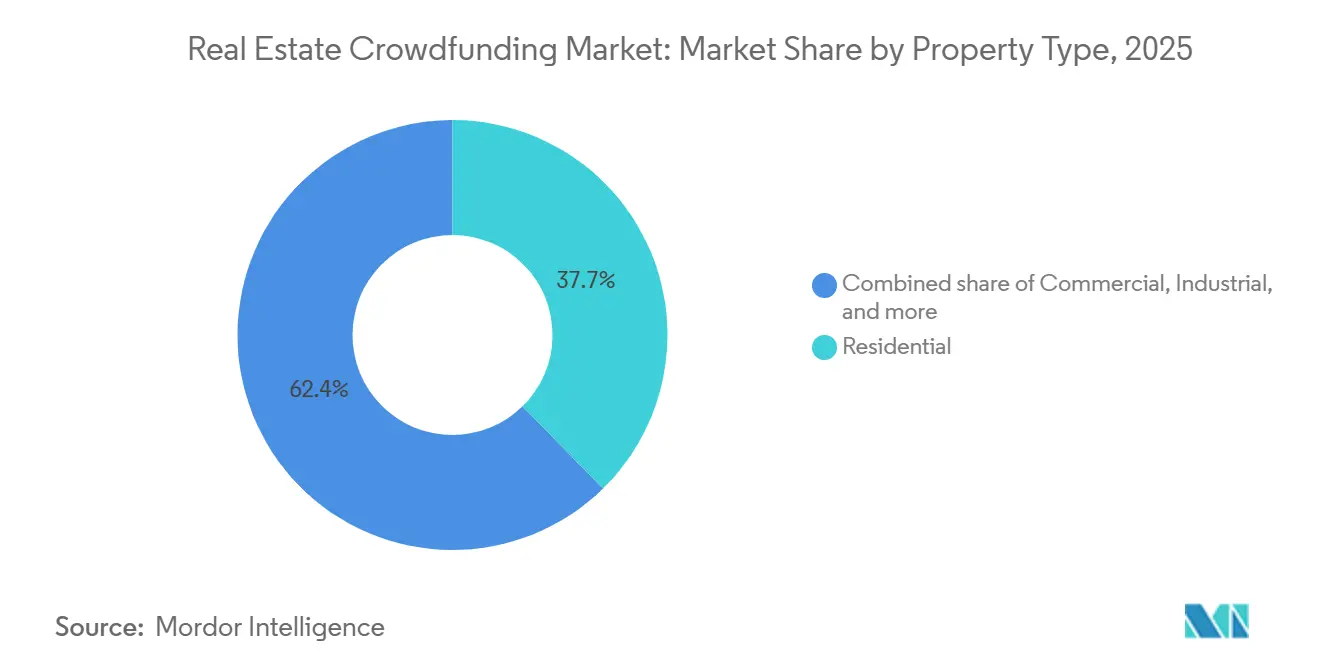
Residential properties retained the largest 2025 share at 37.65% in the real estate crowdfunding market, which reflects the familiarity and broad appeal of housing-related assets among both sponsors and investors. Residential projects are often easier for investors to assess because the use case, tenant demand profile, and financing logic are more familiar than in specialized asset classes. That familiarity has given residential offerings a durable role in the real estate crowdfunding market, especially where smaller investment sizes and self-directed investing matter. Residential assets also align well with fractional structures, as investors can understand the asset narrative without requiring institutional-grade sector knowledge. For these reasons, residential remains the share anchor even as growth leadership shifts elsewhere.
Industrial real estate is forecast to be the fastest-growing property type, with a 23.49% CAGR through 2026-2031, driven by e-commerce logistics demand and the reshoring of supply chains. The smaller logistics and last-mile assets in secondary markets are not always well served by institutional REIT structures, leaving room for the real estate crowdfunding market to intermediate sub-institutional deal sizes. Prologis and GIC formed a USD 1.6 billion joint venture in March 2026 to develop build-to-suit logistics facilities across major United States markets, which supports the broader investment case behind industrial property. EQT Real Estate also closed its Europe Logistics Value Fund V at EUR 3.1 billion (USD 3.6 billion) in April 2026, which further confirmed institutional conviction in the logistics theme. These moves matter to the real estate crowdfunding market because they validate demand for industrial property at the top end while smaller deal pipelines are forming lower in the capital stack.
Commercial real estate remains the second largest property segment, supported by office and retail refinancing needs that continue to require non bank capital. Mixed use and land or special purpose assets still account for a smaller base, but they give sponsors more flexibility when traditional lenders are selective. The real estate crowdfunding market is therefore widening its property mix without losing the stability that residential still provides. It is also becoming more selective, because asset type alone is no longer enough to attract capital without a clear use case, location logic, and sponsor record. That dynamic should keep residential important while industrial continues to reshape the growth profile of the real estate crowdfunding market.
By Investment Model: Deal-By-Deal Holds Scale, Fund Structures Pull New Capital
Deal-by-deal investing accounted for 66.76% of the real estate crowdfunding market in 2025, maintaining its dominance. This structure aligns with the original logic of the real estate crowdfunding market, as investors can select individual assets, geographies, and sponsors rather than committing to a broader pooled strategy. It also appeals to sponsors that want capital for a specific property without setting up a more formal fund vehicle. For experienced users, the model offers control and a direct line of sight into underwriting, asset type, and sponsor strategy. That explains why deal-by-deal structures continue to lead even as the real estate crowdfunding market becomes more diverse.
Fund-based investing is projected to grow at the fastest model CAGR of 24.02% through 2026-2031. Its growth does not suggest that deal-by-deal investing is weakening. It suggests that the real estate crowdfunding market is attracting more investors seeking property exposure but not wanting to evaluate each transaction individually. Fund structures also create a more familiar entry point for investors accustomed to diversified private-market products rather than single-asset positions. This makes the model especially relevant for diversification-oriented users who value exposure over direct deal selection.
Groundfloor said it surpassed USD 40 million in revenue in 2025, with 38.6% year-over-year growth and a nearly 50% rise in loan volume, while also expanding into private credit fund structures. The top 10 real estate funds captured 40% of all capital raised in 2025, providing fund-based crowdfunding with a strong structural reference point within the broader private capital landscape. As a result, the real estate crowdfunding market is starting to mirror the design of larger private fund ecosystems while preserving its lower access threshold. The real estate crowdfunding market now offers investors who want single-asset precision and those who prefer pooled exposure with a lower underwriting burden. That dual model should remain central as fund-based products gather a larger share of incremental demand.
Geography Analysis
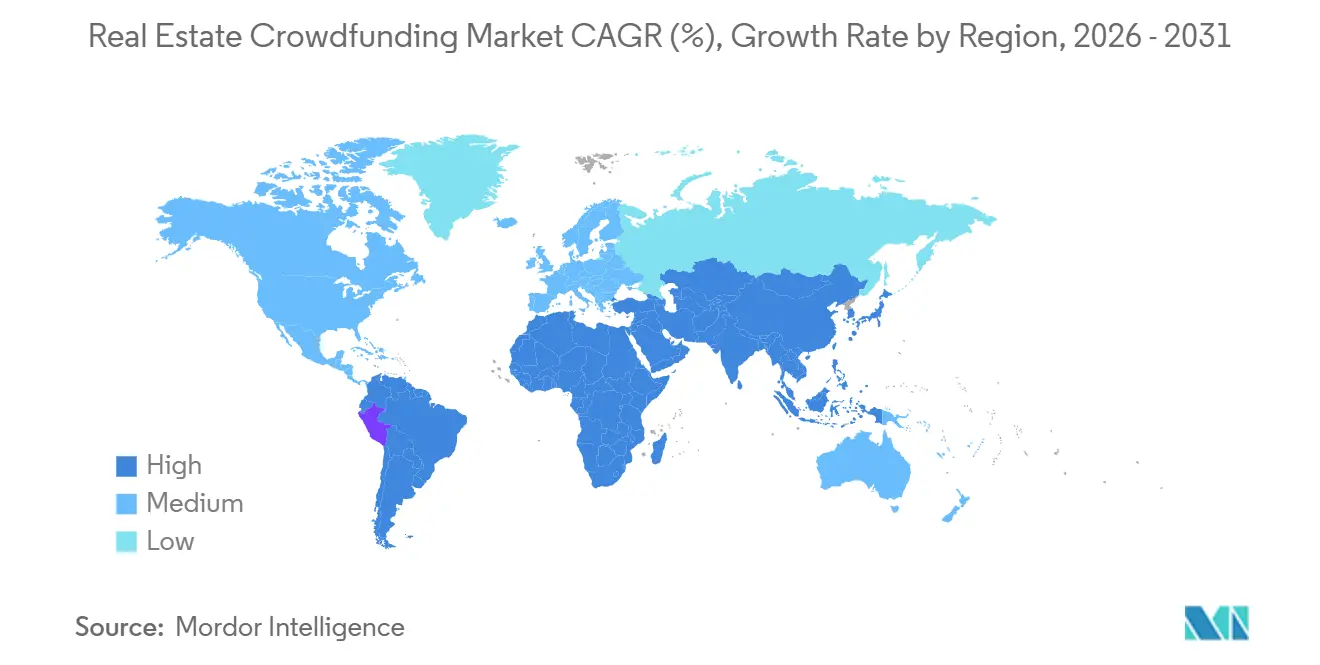
North America held 53.27% of the real estate crowdfunding market in 2025, making it the largest regional contributor. The United States leads because it has the deepest platform ecosystem, the broadest range of accessible property categories, and a large pool of self-directed investors. Canada supports this position through cross-border capital flows into United States deals, while Mexico is beginning to use fractional financing models to address housing-related demand. The March 2026 petition to modernize Regulation CF also shows that the United States regulatory environment remains active and open to further development in issuer and investor participation rules. The real estate crowdfunding market in North America, therefore, benefits from both operating scale and an evolving policy landscape.
Between 2016 and 2024, Regulation CF offerings raised a cumulative USD 1.3 billion, suggesting a funding channel that is still building depth rather than reaching maturity. Asia-Pacific is forecast to be the fastest-growing regional segment of the real estate crowdfunding market at a 24.78% CAGR through 2026-2031. JLL recorded the region’s strongest Q1 commercial real estate investment on record in Spring 2026, and USD 162 billion invested across 9 key Asia-Pacific markets in 2025. China, Japan, India, South Korea, and Australia remain the main contributors, but Southeast Asian markets such as Indonesia, Thailand, Malaysia, Singapore, and Vietnam are gaining momentum, as digital payment behavior is already strong. The real estate crowdfunding market is well aligned with this regional pattern, as mobile-led investing and rising middle-class wealth formation support broader retail participation.
CBRE expected Asia-Pacific GDP growth to remain the strongest globally in 2026, with India, mainland China, and Southeast Asia leading the region even as overall growth moderates from 2025. Europe remains the second-largest regional contributor in the real estate crowdfunding market and the most advanced in dedicated crowdfunding regulation. The ECSPR framework had 237 active platforms that collectively raised EUR 4.25 billion (USD 5 billion), while France alone accounted for EUR 845 million (USD 992.9 million) across 1,004 projects in 2025. The Middle East and Africa are an emerging growth pocket, led by the UAE’s push into regulated tokenized real estate structures, while South America is centered on Brazil and Argentina but remains constrained by regulation and currency volatility. Taken together, these patterns show that the real estate crowdfunding market is global in direction, but still regional in operating structure, regulatory pace, and investor access.

Competitive Landscape
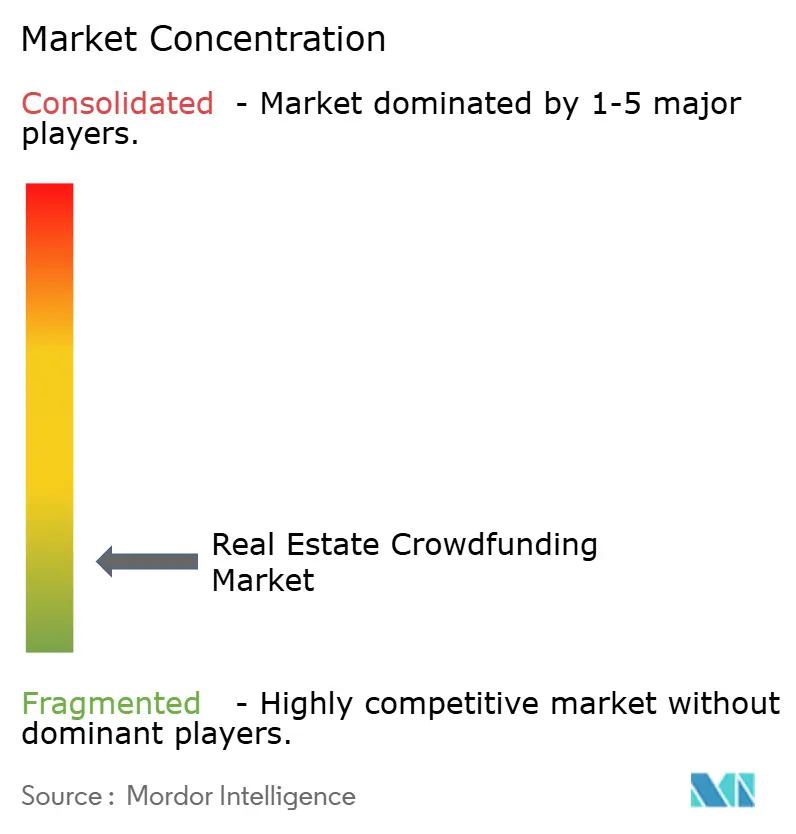
The real estate crowdfunding market is fragmented, with regional platforms competing across different geographies and property segments rather than a single global leader dominating the industry. United States platforms lead North American activity, European Crowdfunding Service Providers Regulation (ECSPR)-licensed operators anchor the European market, while mobile-first platforms are expanding across Asia-Pacific and the Middle East. Competition is increasingly driven by platform capabilities, regulatory compliance, liquidity options, and user experience rather than asset category breadth alone. Leading platforms are also expanding into private credit and other alternative investments to strengthen investor engagement and retention, while regional and niche providers continue to compete through specialised offerings and local market expertise.
Fundrise provides a clear example of this shift. It combined the January 2026 launch of RealAI with a March 2026 publicly listed innovation vehicle on the NYSE, while reporting USD 2.87 billion in assets under management and a 7.94% declared annualized yield on income objective portfolios. CrowdStreet is following a similar path by rebuilding its platform and then launching access to Nuveen Private Markets strategies in May 2026, expanding its offering beyond deal-by-deal commercial real estate. Groundfloor is also broadening its platform reach through private credit products launched in 2026, showing that adjacent credit exposure is becoming part of the competitive playbook. These moves show that the real estate crowdfunding market is being shaped by platforms that can keep investors within a broader private markets environment rather than offering only a narrow set of property deals.
A second layer of competition is forming around infrastructure and liquidity. The real estate crowdfunding market has more white space in industrial assets below institutional deal thresholds, in cross-border vehicles that could aggregate Asian retail capital into Western assets, and in compliance services built for smaller sponsors. Tokenization partners such as Securitize are becoming important because they can support the digital issuance and servicing layer beneath traditional portals, even when they are not the direct investor-facing platform. Platforms that can manage multi-jurisdiction rules with in-house systems should keep a cost advantage over operators that need outside legal work for every product change or geographic move. The real estate crowdfunding market is therefore becoming more competitive, but not in a winner-take-all pattern, because strength still depends on regional position, product structure, and execution discipline.
Real Estate Crowdfunding Industry Leaders
Fundrise, LLC
CrowdStreet, Inc.
RealtyMogul Co.
Groundfloor Finance Inc.
EstateGuru OÜ
- *Disclaimer: Major Players sorted in no particular order

Recent Industry Developments
- June 2026: Goldman Sachs partnered with Apex Group and Archax to launch a blockchain-native tokenized real estate fund using the GS DAP platform, with LRC Group as manager, Ownera facilitating participant connectivity, and Archax as regulated digital securities custodian. The fund is structured for potential future tokenized secondary transferability under institutional governance standards.
- June 2026: Groundfloor launched its SMB Growth Fund, with a subscription window from June 8 to July 10, 2026, marking its debut in the small business finance vertical and offering accredited investors and qualified purchasers institutional-caliber exposure to multi-unit brick-and-mortar operators through a partnership with Homegrown. The launch follows the platform's first Consumer Credit Portfolio, introduced in early 2026.
- May 2026: Groundfloor launched Consumer Credit Portfolio II, targeting a fixed 10.00% annual return with quarterly distributions over a 45-month term. The launch accelerates the platform's private markets diversification strategy beyond real estate and builds on the first Consumer Credit Portfolio product launched earlier in 2026.
- May 2026: CrowdStreet launched access to 2 Nuveen Private Markets strategies, spanning real estate and private capital, expanding its multi-asset platform offering and widening the addressable market for accredited investors beyond commercial real estate deal-by-deal structures


Global Real Estate Crowdfunding Market Report Scope
| Individual Investors |
| Institutional Investors |
| Equity-Based Crowdfunding |
| Debt-Based Crowdfunding |
| Hybrid Crowdfunding |
| Residential |
| Commercial |
| Industrial |
| Mixed-Use |
| Land / Special Purpose |
| Deal-By-Deal Investing |
| Fund-Based Investing |
| North America | United States |
| Canada | |
| Mexico | |
| South America | Brazil |
| Argentina | |
| Rest of South America | |
| Europe | United Kingdom |
| Germany | |
| France | |
| Italy | |
| Spain | |
| Rest of Europe | |
| Asia-Pacific | China |
| Japan | |
| India | |
| South Korea | |
| Australia | |
| Indonesia | |
| Thailand | |
| Malaysia | |
| Singapore | |
| Vietnam | |
| Rest of Asia-Pacific | |
| Middle East and Africa | Saudi Arabia |
| United Arab Emirates | |
| Turkey | |
| South Africa | |
| Egypt | |
| Rest of Middle East and Africa |
| By Investor Type | Individual Investors | |
| Institutional Investors | ||
| By Instrument Type | Equity-Based Crowdfunding | |
| Debt-Based Crowdfunding | ||
| Hybrid Crowdfunding | ||
| By Property Type | Residential | |
| Commercial | ||
| Industrial | ||
| Mixed-Use | ||
| Land / Special Purpose | ||
| By Investment Model | Deal-By-Deal Investing | |
| Fund-Based Investing | ||
| By Geography | North America | United States |
| Canada | ||
| Mexico | ||
| South America | Brazil | |
| Argentina | ||
| Rest of South America | ||
| Europe | United Kingdom | |
| Germany | ||
| France | ||
| Italy | ||
| Spain | ||
| Rest of Europe | ||
| Asia-Pacific | China | |
| Japan | ||
| India | ||
| South Korea | ||
| Australia | ||
| Indonesia | ||
| Thailand | ||
| Malaysia | ||
| Singapore | ||
| Vietnam | ||
| Rest of Asia-Pacific | ||
| Middle East and Africa | Saudi Arabia | |
| United Arab Emirates | ||
| Turkey | ||
| South Africa | ||
| Egypt | ||
| Rest of Middle East and Africa | ||


Key Questions Answered in the Report
What is the current outlook for real estate crowdfunding through 2031?
The real estate crowdfunding market stood at USD 12 billion in 2026 and is forecast to reach USD 28.8 billion by 2031 at a 19.3% CAGR.
Which investor group leads participation in real estate crowdfunding?
Individual investors led with 72.31% share in 2025, while institutional investors are forecast to grow faster at a 22.57% CAGR through 2031.
Why are debt-based structures so important in this space?
Debt-based products held 61.89% share in 2025 because they offer clearer income visibility, shorter holds, and collateral-backed exposure that many investors prefer.
Which property category is growing the fastest in real estate crowdfunding?
Industrial assets are projected to grow at a 23.49% CAGR through 2031, supported by logistics demand, e-commerce activity, and supply chain reshoring.
Which region offers the strongest growth prospects?
Asia-Pacific is forecast to expand at a 24.78% CAGR through 2031, supported by urbanization, digital finance adoption, and rising middle-class wealth.
What is the main risk executives should watch in platform selection?
Liquidity remains the key issue because many positions have long lockups, limited exit options, and redemption constraints that can widen during weaker property cycles.
Page last updated on:





