
Radiographic Testing (RT) Market Size and Share
Market Overview
| Study Period | 2019 - 2030 |
|---|---|
| Market Size (2025) | USD 5.70 Billion |
| Market Size (2030) | USD 8.5 Billion |
| Growth Rate (2025 - 2030) | 8.32 % |
| Fastest Growing Market | Asia Pacific |
| Largest Market | Asia Pacific |
| Market Concentration | Medium |
Major Players *Disclaimer: Major Players sorted in no particular order Image © Mordor Intelligence. Reuse requires attribution under CC BY 4.0. | |

Radiographic Testing (RT) Market Analysis by Mordor Intelligence
The radiographic testing market size reached USD 5.70 billion in 2025 and is projected to reach USD 8.50 billion by 2030, advancing at an 8.32% CAGR. This expansion is underpinned by the widespread replacement of film with digital detectors, growing demand for real-time defect analytics, and the convergence of portable X-ray sources with machine-learning algorithms. Heightened regulatory scrutiny across oil and gas, aerospace, and nuclear power facilities keeps inspection spending resilient even when capital expenditure cycles soften. Rising labor shortages are accelerating the adoption of automated and robotic platforms, while domestic Ir-192 isotope initiatives in the United States are easing gamma radiography supply risks. In parallel, the EU Cyber Resilience Act 2024 compels vendors to harden connected radiographic systems against data breaches, prompting a wave of firmware upgrades across installed fleets.[1]European Parliament and Council, “Regulation on Cybersecurity Requirements for Products with Digital Elements,” europa.eu
Key Report Takeaways
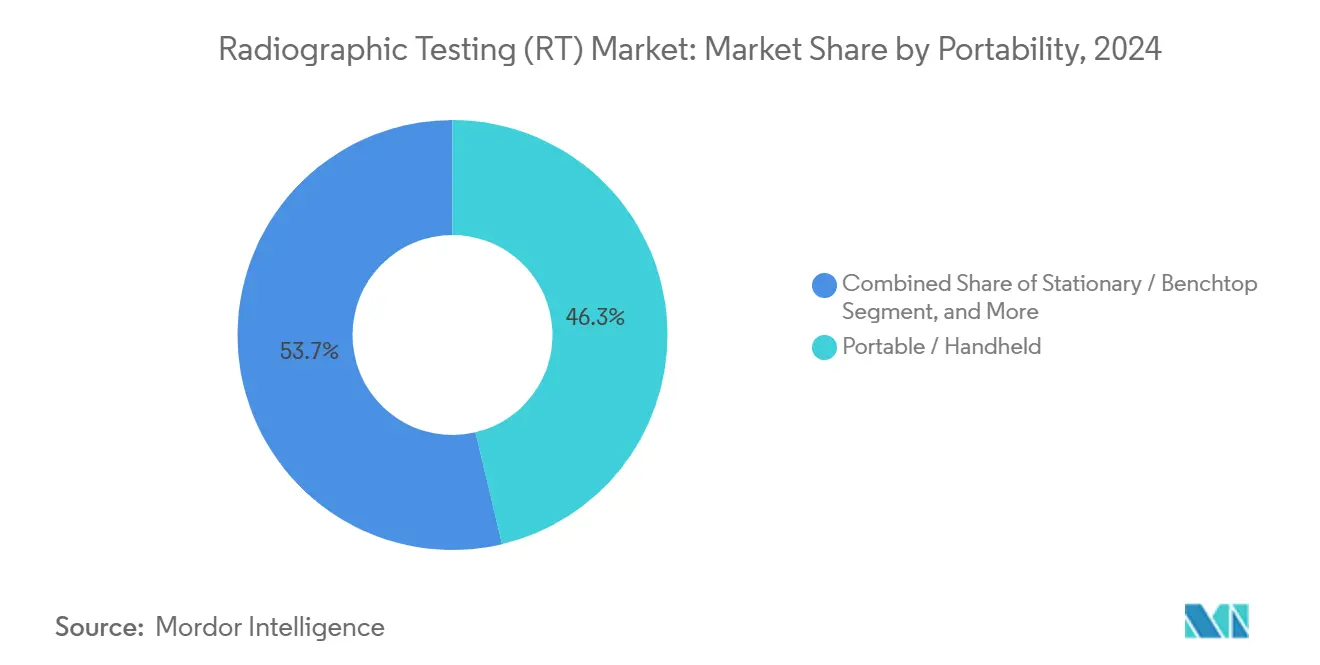
- By portability, portable and handheld systems led with 46.3% revenue share in 2024; automated and robotic solutions are forecast to post a 13.5% CAGR through 2030, the fastest within the segment universe.
- By imaging technique, digital radiography captured 46.1% of the radiographic testing market share in 2024, while computed tomography is projected to expand at a 12.4% CAGR to 2030.
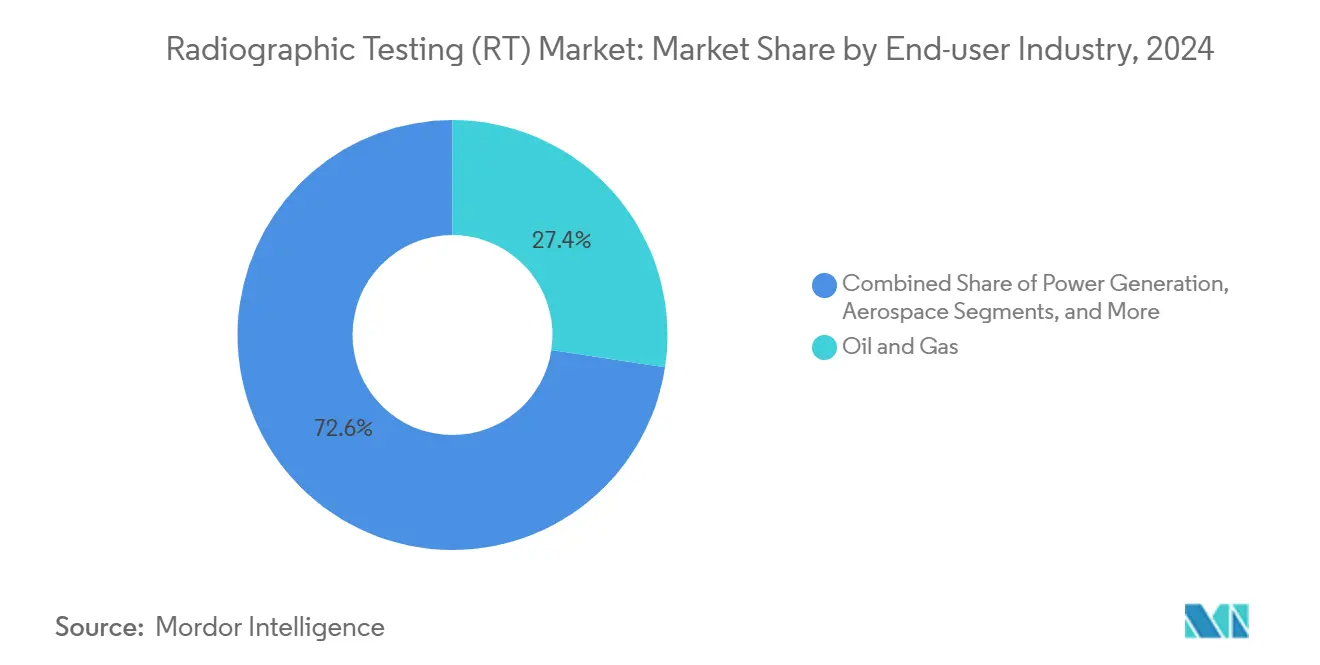
- By end-user industry, oil and gas accounted for 27.4% of spending in 2024; automotive and transportation are advancing at a 12.9% CAGR, driven by electrification and the resulting demand for battery inspections.
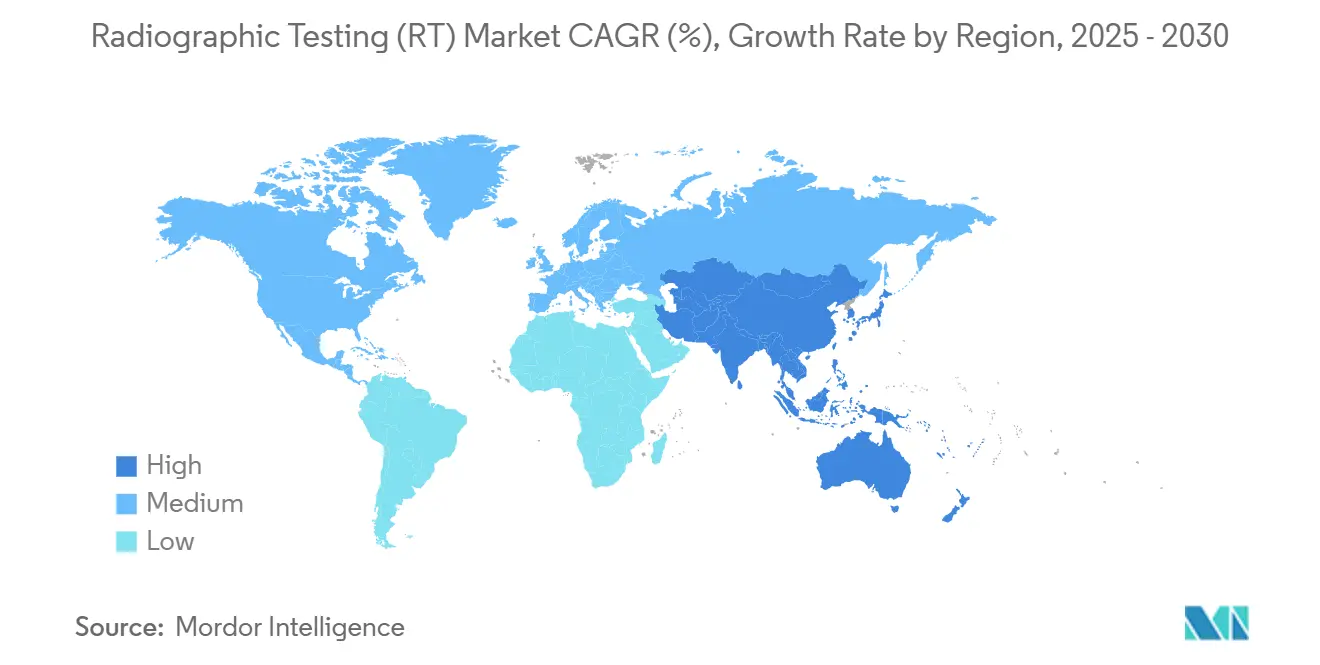
- By geography, the Asia-Pacific region contributed 34.4% of 2024 revenue and is expected to register a 9.5% CAGR, maintaining its leadership position through 2030.
Note: Market size and forecast figures in this report are generated using Mordor Intelligence’s proprietary estimation framework, updated with the latest available data and insights as of January 2026.
Market Trends and Insights
Drivers Impact Analysis of Radiographic Testing (RT) Market*
| Driver | (~) % Impact on CAGR Forecast | Geographic Relevance | Impact Timeline |
|---|---|---|---|
| Shift to digital radiography and analytics-ready image formats | +2.1% | Global, with APAC and North America leading adoption | Medium term (2-4 years) |
| Expanding pipeline-integrity mandates across oil and gas networks | +1.8% | Global, concentrated in North America, the Middle East, and the Asia-Pacific | Long term (≥ 4 years) |
| Aerospace and power-generation safety certification tightening | +1.4% | North America and Europe core, expanding to Asia-Pacific | Long term (≥ 4 years) |
| Public-sector infrastructure stimulus demands weld inspection | +1.2% | Global, with emphasis on emerging markets in APAC and MEA | Medium term (2-4 years) |
| AI-driven automated defect recognition reduces inspection cost | +0.9% | North America and Europe are early adoption, and global expansion | Short term (≤ 2 years) |
| Battery-powered portable X-ray sources enabling remote mining audits | +0.8% | Global, with a concentration in mining-intensive regions | Medium term (2-4 years) |
| Source: Mordor Intelligence | |||
Shift to Digital Radiography and Analytics-Ready Image Formats
Digital detector arrays now produce DICONDE-compliant files that automatically feed into enterprise asset management platforms, reducing inspection cycles by up to 60% compared to film-based workflows. ISO 14096-2024 codified film-digitization rules, letting fleet operators mine legacy images for predictive analytics. Aerospace OEMs place particular value on lifetime data traceability, a prerequisite for component airworthiness certificates. Asset owners also benefit from lower consumable costs as film, chemicals, and darkroom labor become obsolete. These savings, combined with sharper defect detection through algorithmic interpretation, underpin the most potent demand catalyst for digital radiography over the medium term.
Expanding Pipeline-Integrity Mandates Across Oil and Gas Networks
High-profile leaks prompted the U.S. Pipeline and Hazardous Materials Safety Administration to require radiography on all girth welds located in high-consequence areas, as specified in 49 CFR 195.591.[2]Pipeline and Hazardous Materials Safety Administration, “49 CFR 195.591,” phmsa.dot.gov Similar clauses now appear in IOGP subsea guidelines, harmonizing onshore and offshore regimes. Compliance spending encompasses not only new lines but also thousands of kilometers of 1970s-era pipes nearing the end of their life. Inspection budgets have therefore shifted from discretionary to compulsory, embedding stable demand for the radiographic testing market over at least the next decade.
Aerospace and Power-Generation Safety Certification Tightening
The FAA Advisory Circular 65-31B raises skill thresholds for NDT technicians on commercial fleets, while EN 4179 aligns Europe with identical competency rules. Nuclear regulators also mandate three-dimensional computed tomography scans on reactor pressure-vessel welds that were previously cleared using two-dimensional images. As certification bodies codify CT-class acceptance criteria, airlines and utilities are racing to modernize radiographic capabilities. Capital intensity limits new entrants, entrenching technology leaders and driving the radiographic testing market toward higher-value service revenue.
Public-Sector Infrastructure Stimulus Demanding Weld Inspection
The U.S. Infrastructure Investment and Jobs Act allocated USD 550 billion to projects where weld integrity must be documented radiographically, including bridges, tunnels, and transmission towers. Governments in India, Indonesia, and the Gulf are stipulating similar inspection protocols for metro rail and desalination plants. Public procurement requires immutable digital records that withstand audits spanning decades, thereby accelerating the demand for systems with long-term data governance features. Vendors offering cloud-hosted archives, therefore, enjoy a competitive edge.
Restraints Impact Analysis of Radiographic Testing (RT) Market*
| Restraint | (~) % Impact on CAGR Forecast | Geographic Relevance | Impact Timeline |
|---|---|---|---|
| High upfront cost of digital RT systems | -1.6% | Global, with a greater impact in emerging markets | Short term (≤ 2 years) |
| Radiation-safety compliance and skilled-labor shortages | -1.3% | Global, acute in North America and Europe | Medium term (2-4 years) |
| Ir-192 isotope supply-chain volatility | -0.9% | Global, with regional supply concentration risks | Long term (≥ 4 years) |
| Cybersecurity compliance for networked RT equipment | -0.7% | Europe and North America are leading, expanding globally | Short term (≤ 2 years) |
| Source: Mordor Intelligence | |||
High Upfront Cost of Digital RT Systems
Moving from film to digital often requires per-unit investments exceeding USD 500,000, compared to USD 50,000 for legacy setups. Add subscription fees for AI analytics, and the payback period stretches beyond the comfort level of small contractors. Financing gaps are widest in Latin America and parts of Africa, delaying fleet upgrades and capping near-term uptake. To defend share, vendors have introduced equipment-as-a-service contracts that spread cost over multi-year engagements.
Radiation-Safety Compliance and Skilled-Labor Shortages
ASNT SNT-TC-1A 2024 and CP-189 2024 lengthen training cycles, with Level III qualification now demanding more hours of supervised exposure.[3]American Society for Nondestructive Testing, “SNT-TC-1A 2024,” asnt.org Simultaneously, retirements have outpaced new certifications, resulting in a 15% decline in the active talent pool from 2020 to 2024. Higher wages and schedule delays inflate project costs, tempering overall volume growth within the radiographic testing market.
*Our forecasts treat driver/restraint impacts as directional, not additive. The impact forecasts reflect baseline growth, mix effects, and variable interactions.
Radiographic Testing (RT) Market Segment Analysis
By Portability:
Automated Systems Drive Remote Inspection RevolutionPortable and handheld platforms accounted for 46.3% of 2024 revenue, confirming their status as daily workhorses on construction sites and refinery turnarounds. Automated and robotic units, although smaller in base, are charting a 13.5% trajectory that outpaces every other class of portability. Robots equipped with shielded X-ray tubes now inspect reactor internals for eight uninterrupted hours, a task previously spread across multiple shifts due to dose limits. This operational leverage is steering multinationals to rewrite asset integrity protocols around unmanned equipment. As a result, the radiographic testing market is witnessing a subtle yet definitive shift toward capital-intensive autonomous fleets, particularly in nuclear, subsea, and high-temperature environments.
Bench-mounted systems remain indispensable in quality assurance laboratories that require micron-level resolution for research or failure analysis. Unlike their field cousins, these rigs tie directly into plant-wide MES software, feeding statistical process-control dashboards in near real-time. Vendors that bundle API libraries for factory-automation suites are securing sticky renewals, reinforcing a service-led monetization path within the radiographic testing industry.



By Imaging Technique:
Computed Tomography Emerges as Premium SolutionDigital radiography led the way, accounting for 46.1% of the 2024 spend, having crossed the tipping point from early adopter to mainstream. Its ubiquity stems from quick scanning, cloud compatibility, and cost-free economics that sharpen return on investment. Computed tomography is the headliner on growth, advancing at 12.4% as aerospace, defense, and electric-vehicle battery lines seek three-dimensional defect mapping. Real-time radiography is carving a niche in high-throughput automotive presses, where instant go/no-go signals avert scrap accumulation. Film and computed radiography serve residual roles in extreme environments or where spatial resolution must exceed digital detector limits, keeping a modest but enduring slice of the radiographic testing market.
By End-user Industry:
Automotive Electrification Accelerates RT AdoptionOil and gas contributed 27.4% of 2024 revenue, primarily driven by mandatory weld inspections across sprawling transmission networks. Electric-vehicle programs are reshaping demand profiles, pushing automotive and transportation verticals to a 12.9% CAGR through 2030. Battery modules, fashioned from thin aluminum foils, require exceptionally tight tolerances; radiography has become the default non-destructive gatekeeper for detecting electrolyte leaks and internal shorts. Aerospace customers sustain premium CT system orders as turbine blade geometries become increasingly complex, while nuclear utilities prioritize extended lifetime management. Manufacturing and heavy engineering, although steady, benefit from robot-mounted radiography cells that automatically switch between ultrasonic and X-ray modes, reducing the cycle time per casting. Collectively, these shifts maintain the radiographic testing market's diversity across both process and discrete industries.
Geography Analysis
APAC Radiographic Testing (RT) Market
Asia-Pacific generated 34.4% of 2024 turnover and is forecast to log a 9.5% CAGR through 2030, extending its lead as governments pour trillions into transport corridors, LNG terminals, and high-speed rail. China’s Belt and Road energy pipelines embed RT clauses that align with ISO 17636, institutionalizing demand for digital documentation. India’s Smart Cities Mission also mandates weld verification on elevated metro viaducts, resulting in large block orders for battery-powered systems. Southeast Asian refineries in Vietnam and Indonesia have begun swapping Ir-192 with X-ray sources due to delays in isotope imports, which have boosted capital outlays for higher-energy generators.
North America Radiographic Testing (RT) Market
North America remains a technology test bed where cloud analytics and AI-guided defect recognition first scale commercially. The Department of Energy’s investment in domestic Ir-192 production buffers isotope supplies, preserving gamma radiography use cases that digital X-ray cannot economically replace. Meanwhile, the radiographic testing market size for Canadian pipeline retrofits is increasing in response to 2025 Transport Canada regulations that mirror U.S. integrity rules.
EMEA Radiographic Testing (RT) Market
Europe leads the way in premium CT deployments for aerospace, medical devices, and additive manufacturing hubs in Germany, France, and the United Kingdom. The Cyber Resilience Act 2024 now obliges vendors to publish security-by-design attestations, encouraging buyers to opt for platforms with encrypted image pipelines and zero-trust architecture. The Middle East and Africa exhibit uneven penetration; however, mega-projects such as Saudi Arabia’s NEOM and Dubai’s green-hydrogen plants are incorporating radiographic testing into EPC contracts, driving double-digit regional growth for the radiographic testing market.

Competitive Landscape
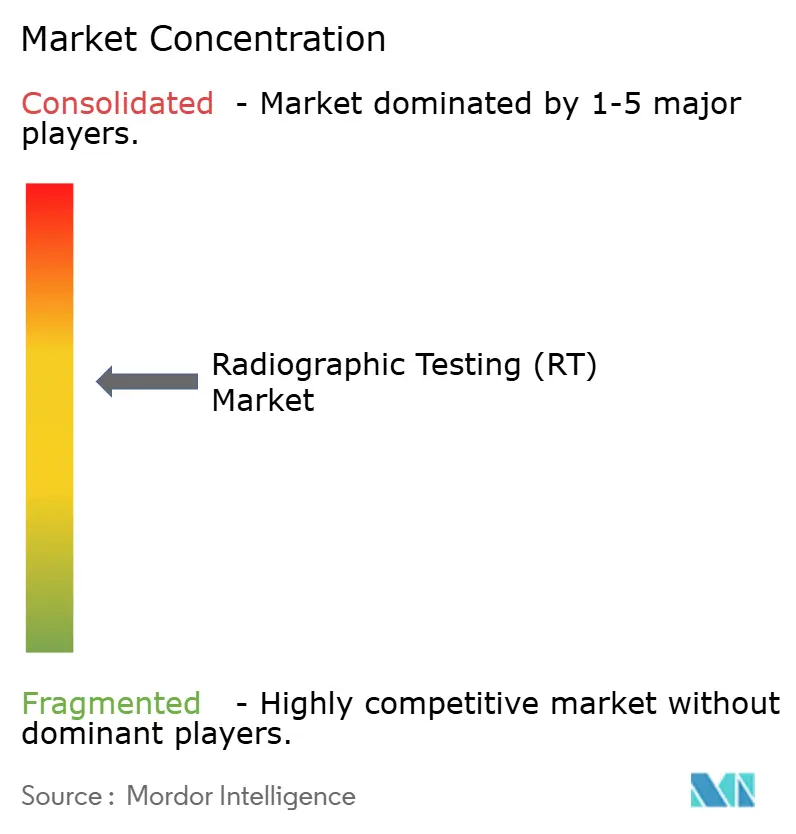
The market is moderately consolidated, with the top five vendors accounting for a significant share of the 2024 revenue. General Electric Waygate Technologies couples X-ray, ultrasound, and visual inspection under the InspectionWorks software umbrella, locking customers into multi-modality workflows. Baker Hughes closed the Altus Intervention buyout in September 2025, merging robotic radiography with wireline services to target deepwater pipeline clients. Fujifilm’s USD 180 million South Carolina expansion triples detector output, protecting supply chains from geopolitical shocks while lowering component lead times.[4]Fujifilm Holdings, “Detector Manufacturing Expansion,” fujifilmholdings.com
Innovation tends to skew toward software, where proprietary neural-network libraries enhance flaw classification accuracy to over 95%. Patent filings for AI-based density gradient analysis increased by 28% year-over-year, indicating a rising stake in intangible assets. The service-as-a-subscription model is gaining traction, converting lump-sum equipment deals into recurring revenue streams. White space remains around composite wind-turbine blades and additive-manufactured rocket engines, where defect taxonomies differ markedly from those of legacy steel welds. New entrants specializing in these niches are attracting venture funding, although scaling beyond mid-single-digit market share has proven difficult against the incumbents’ distribution heft.
Radiographic Testing (RT) Industry Leaders
General Electric Company (Waygate Technologies)
Comet Holding AG (YXLON International)
Nikon Corporation (Nikon Metrology)
Fujifilm Holdings Corporation
Shimadzu Corporation
- *Disclaimer: Major Players sorted in no particular order
Radiographic Testing (RT) Market Companies Covered in this Report
- General Electric Company (Waygate Technologies)
- Comet Holding AG (YXLON International)
- Nikon Corporation (Nikon Metrology)
- Fujifilm Holdings Corporation
- Shimadzu Corporation
- Baker Hughes Company
- Carestream Health Inc.
- North Star Imaging Inc.
- Teledyne Technologies Inc.
- Canon Medical Systems Corporation
- Hamamatsu Photonics K.K.
- PerkinElmer Inc.
- 3DX-RAY Ltd.
- Bosello High Technology Srl
- Dürr NDT GmbH and Co. KG
- Vidisco Ltd.
- VJ Technologies Inc.
- Olympus Corporation
- Vidisco Ltd.
- YXLON International
- Zetec Inc.
- L3Harris Technologies Inc.
- Zeiss Industrial Quality Solutions
- Rigaku Corporation
- Carestream NDT

Recent Industry Developments in Radiographic Testing (RT) Market
- September 2025: Baker Hughes completed its acquisition of Altus Intervention for USD 240 million, adding robotic subsea radiography to its toolkit.
- August 2025: General Electric Waygate Technologies launched the Phoenix CT system with real-time AI defect recognition.
- July 2025: Fujifilm Holdings invested USD 180 million to expand detector manufacturing in South Carolina.
- June 2025: The U.S. Department of Energy awarded QSA Global USD 75 million to restart domestic Ir-192 production.


Global Radiographic Testing (RT) Market Report Scope
| Portable / Handheld |
| Stationary / Benchtop |
| Automated / Robotic |
| Film Radiography |
| Computed Radiography |
| Digital Radiography |
| Computed Tomography |
| Real-Time Radiography |
| Oil and Gas |
| Power Generation |
| Aerospace |
| Defense |
| Automotive and Transportation |
| Manufacturing and Heavy Engineering |
| Construction and Infrastructure |
| Chemical and Petrochemical |
| Marine and Ship Building |
| Electronics and Semiconductor |
| Mining |
| Medical Devices |
| Others |
| North America | United States |
| Canada | |
| Mexico | |
| South America | Brazil |
| Argentina | |
| Rest of South America | |
| Europe | Germany |
| United Kingdom | |
| France | |
| Italy | |
| Spain | |
| Rest of Europe | |
| Asia Pacific | China |
| Japan | |
| India | |
| South Korea | |
| South-East Asia | |
| Rest of Asia Pacific | |
| Middle East | Saudi Arabia |
| United Arab Emirates | |
| Turkey | |
| Rest of Middle East | |
| Africa | South Africa |
| Nigeria | |
| Rest of Africa |
| By Portability | Portable / Handheld | |
| Stationary / Benchtop | ||
| Automated / Robotic | ||
| By Imaging Technique | Film Radiography | |
| Computed Radiography | ||
| Digital Radiography | ||
| Computed Tomography | ||
| Real-Time Radiography | ||
| By End-user Industry | Oil and Gas | |
| Power Generation | ||
| Aerospace | ||
| Defense | ||
| Automotive and Transportation | ||
| Manufacturing and Heavy Engineering | ||
| Construction and Infrastructure | ||
| Chemical and Petrochemical | ||
| Marine and Ship Building | ||
| Electronics and Semiconductor | ||
| Mining | ||
| Medical Devices | ||
| Others | ||
| By Geography | North America | United States |
| Canada | ||
| Mexico | ||
| South America | Brazil | |
| Argentina | ||
| Rest of South America | ||
| Europe | Germany | |
| United Kingdom | ||
| France | ||
| Italy | ||
| Spain | ||
| Rest of Europe | ||
| Asia Pacific | China | |
| Japan | ||
| India | ||
| South Korea | ||
| South-East Asia | ||
| Rest of Asia Pacific | ||
| Middle East | Saudi Arabia | |
| United Arab Emirates | ||
| Turkey | ||
| Rest of Middle East | ||
| Africa | South Africa | |
| Nigeria | ||
| Rest of Africa | ||


Key Questions Answered in the Report
What is the projected value of the radiographic testing market in 2030?
The market is forecast to reach USD 8.5 billion by 2030.
Which region leads in spending on radiographic testing solutions?
The Asia-Pacific region contributed 34.4% of 2024 revenue and is expected to maintain its leadership position through 2030.
Which imaging technique is growing fastest?
Computed tomography is advancing at a 12.4% CAGR due to demand for three-dimensional defect analysis.
Why are automated radiographic systems gaining traction?
Robots mitigate skilled-labor shortages and minimize human radiation exposure while delivering consistent image quality.
How will the U.S. DOE initiative affect gamma radiography?
Domestic Ir-192 production will stabilize the isotope supply, reducing operational disruptions for gamma-based inspections.
What is the main driver behind radiography uptake in electric vehicles?
Battery pack inspection necessitates the non-destructive detection of internal defects in lightweight materials, thereby driving up demand for the automotive industry.
Page last updated on:





