
Industrial Computed Radiography Market Size and Share
Market Overview
| Study Period | 2021 - 2032 |
|---|---|
| Market Size (2027) | USD 498.72 Million |
| Market Size (2032) | USD 671.5 Million |
| Growth Rate (2027 - 2032) | 6.13 % |
| Fastest Growing Market | Asia Pacific |
| Largest Market | Middle East and Africa |
| Market Concentration | Medium |
Major Players *Disclaimer: Major Players sorted in no particular order Image © Mordor Intelligence. Reuse requires attribution under CC BY 4.0. | |
Industrial Computed Radiography Market Analysis by Mordor Intelligence
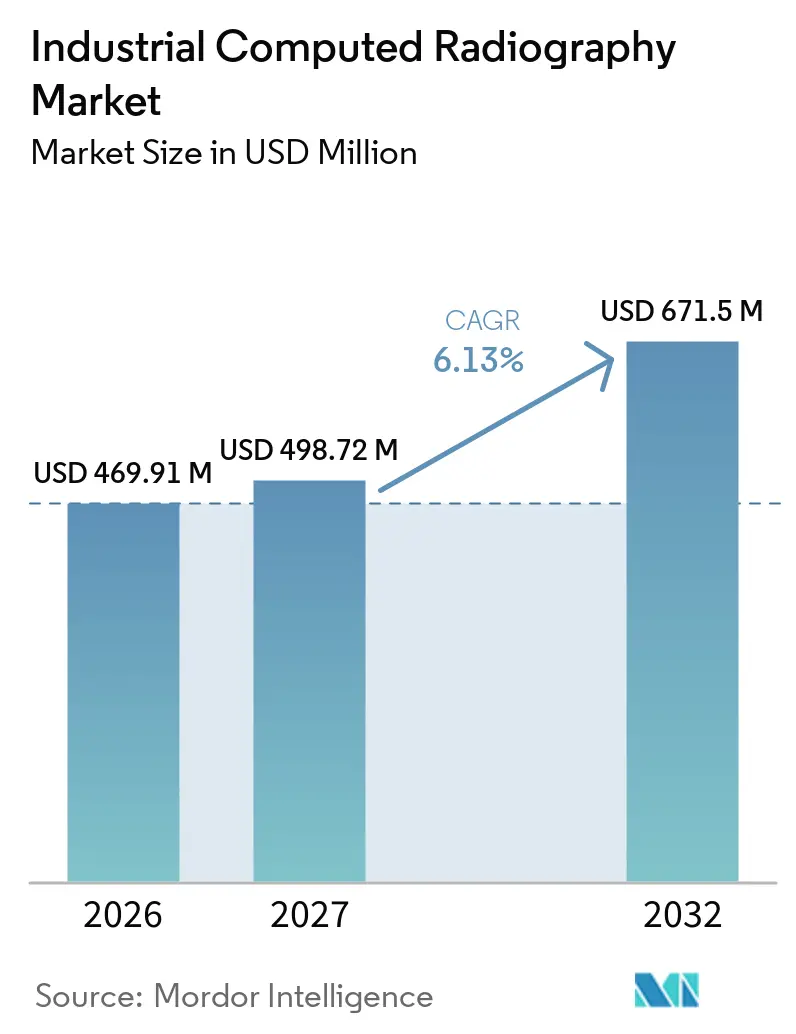
The Industrial Computed Radiography Market size is expected to increase from USD 469.91 million in 2026 to USD 498.72 million in 2027 and reach USD 671.5 million by 2032, growing at a CAGR of 6.13% over 2027-2032.
Field portability, lower capital outlay for small-to-midsize operators, and ongoing upgrades in artificial-intelligence software continue to keep the Industrial computed radiography market resilient even as flat-panel detectors gain attention. Over the forecast window, inspection frequency is rising as regulators tighten pipeline-integrity rules, while aerospace maintenance shops in emerging economies favor computed radiography fleets that deliver faster payback than greenfield flat-panel installations. Portable systems that eliminate the need for darkrooms are helping technicians reach remote pipelines and offshore assets, and AI-driven defect recognition is accelerating inspection throughput, easing the global shortage of certified Level II personnel. Meanwhile, geopolitical ambitions to extend the life of aging energy infrastructure, coupled with additive-manufacturing footprints in automotive and aerospace, create new use cases that expand the addressable Industrial computed radiography market.
Key Report Takeaways
- By imaging plate type, phosphor media led with 46.19% revenue share in 2026, while flexible plates are forecast to expand at a 7.28% CAGR through 2032.
- By technology, indirect computed radiography held 58.73% of the industrial computed radiography market share in 2026, whereas AI-enhanced computed radiography is advancing at a 7.12% CAGR during 2027-2032.
- By end-user, oil and gas accounted for 34.84% of the industrial computed radiography market in 2026, and additive manufacturing is projected to grow at a 6.95% CAGR through 2032.
- By imaging system size, portable CR systems accounted for 40.95% of revenue in 2026 and are forecast to grow at a 6.91% CAGR over the outlook period.
- By service provider, third-party nondestructive-testing firms led with a 48.48% share in 2026, yet OEM inspection centers are the fastest-growing, with a 6.84% CAGR to 2032.
- By geography, Asia Pacific accounted for 32.33% of revenue in 2026, and the Middle East and Africa are forecast to grow at a 7.06% CAGR over the studied period.
Note: Market numbers in this report are based on Mordor Intelligence's proprietary estimation framework, which combines nine months of actuals with Q4 projections for base year 2026.
Market Trends and Insights
Drivers Impact Analysis of Industrial Computed Radiography Market*
| DRIVER | (~) % IMPACT ON CAGR FORECAST | GEOGRAPHIC RELEVANCE | IMPACT TIMELINE |
|---|---|---|---|
| AI-Enabled Defect Recognition Enhancing Inspection Productivity | +1.4% | Global, early uptake in North America and Europe | Medium term (2-4 years) |
| Growing Need for Nondestructive Testing in the Energy Sector | +1.2% | Middle East, North America, Asia-Pacific | Long term (≥ 4 years) |
| Stringent Regulatory Mandates for Pipeline Integrity | +1.0% | North America and Europe, spillover to the Middle East | Long term (≥ 4 years) |
| Shift Toward Digital Imaging and Reduced Radiation Exposure | +0.9% | Global | Medium term (2-4 years) |
| Expansion of Aerospace MRO Activities in Emerging Economies | +0.8% | Asia-Pacific, Middle East, South America | Medium term (2-4 years) |
| Demand for High-Resolution Flexible Imaging Plates for Complex Geometries | +0.7% | Global, focused on aerospace and additive hubs | Short term (≤ 2 years) |
| Source: Mordor Intelligence | |||
AI-Enabled Defect Recognition Enhancing Inspection Productivity
Artificial-intelligence models are transforming computed radiography from a documentation practice into a predictive-quality discipline. Vision-transformer networks trained on additive-manufacturing defect libraries achieved detection accuracies above 95% in March 2026 trials, confirming that deep learning algorithms generalize across alloys and processes.[1] Baker Hughes extended these gains by embedding AI into its Mentor Zoom PTZ camera in February 2026, fusing 3D scans with digital-twin workflows that shrink inspection cycles from days to hours. Small service providers are embracing cloud-deployed analytics that flag anomalies in seconds, cutting human review backlogs and raising asset uptime. The productivity lift is pronounced in aerospace MRO bays where varied joint geometries challenge manual interpretation. As regulatory bodies start accepting machine-learning evidence within audit trails, AI-ready workflows cement a fresh competitive edge for the Industrial computed radiography market.
Growing Need for Nondestructive Testing in the Energy Sector
Aging pipelines, refineries, and pressure vessels are being operated beyond original design life, shifting maintenance from reactive to predictive strategies. The United States now enforces more frequent girth-weld examinations under API 570 and API 1169, while Aramco’s February 2026 partnership with CorrosionRADAR integrates AI corrosion-rate prediction into inspection planning.[2] Similar momentum is visible in Argentina, where the 209-kilometer Duplicar Norte crude line broke ground in January 2026 with radiographic compliance anchored in ASME Section IX weld criteria.[3] These megaprojects funnel persistent capital into portable scanners that reach desert compressor stations and offshore platforms without permanent facilities. As hydrogen blending and carbon-capture pipelines emerge, uncertainty around material compatibility will further intensify inspection demand, underpinning steady expansion of the Industrial computed radiography market.
Stringent Regulatory Mandates for Pipeline Integrity
Regulators are closing loopholes exposed by high-profile leaks. The European Union’s March 2026 tender for NEL’s 56-inch gas line demands metal-loss detection at 0.5-t wall thickness and 30% depth, with 80% probability performance thresholds, elevating high-resolution computed radiography above legacy magnetic-flux tools. In North America, ISO 9712 personnel certification and ISO 17636 image-quality rules push asset owners to retain modalities with proven traceability. Switching detector platforms mid-life risks recertification delays, so operators prefer upgrading existing CR setups with AI rather than migrating entirely to flat panels. This regulatory ratchet shields current fleets and sustains investment across the Industrial computed radiography market.
Shift Toward Digital Imaging and Reduced Radiation Exposure
Computed radiography’s reusable phosphor plates remove chemical processing and film storage headaches, while optimized exposure protocols lower source energies, curbing scatter radiation. Carestream’s July 2025 bendable detector combines plate-like flexibility with instant preview, showing how suppliers blur modality lines. Environmental rules compound the shift; Washington State’s 2025 disposal guidance treats lead-laden film processors as e-waste, inflating their lifecycle cost.[4] Although flat panels are gaining ground, remote sites still value rugged plates that withstand transport knocks. Together, workflow simplification and dose mitigation keep digital computed radiography relevant and sustain churn within the Industrial computed radiography market.
Restraints Impact Analysis of Industrial Computed Radiography Market*
| RESTRAINT | (~) % IMPACT ON CAGR FORECAST | GEOGRAPHIC RELEVANCE | IMPACT TIMELINE |
|---|---|---|---|
| Competition From Flat-Panel Digital Radiography Systems | −0.9% | Global, strongest in North America and Europe | Medium term (2-4 years) |
| High Initial Installation and Calibration Costs | −0.7% | Emerging Asia-Pacific, South America, Africa | Short term (≤ 2 years) |
| Shortage of Skilled Computed Radiography Technicians | −0.5% | North America and Europe | Long term (≥ 4 years) |
| Environmental Concerns Over Phosphor Plate Disposal | −0.3% | Europe, North America, select Asia-Pacific | Medium term (2-4 years) |
| Source: Mordor Intelligence | |||
Competition From Flat-Panel Digital Radiography Systems
Flat-panel detectors deliver instant images and eliminate plate scanning, narrowing the traditional cost gap. Nikon’s VOXLS 20 C 225, launched in December 2025, features dual-source modes that toggle between productivity and resolution, raising competitive pressure in high-volume plants.[5] Falling panel prices are tempting automotive casting lines and battery-cell makers to bypass computed radiography in favor of inline CT systems. Vendors counter with ruggedized plates and AI overlays, but detector economics will squeeze CR margins in fixed labs. Unless portable CR embraces AI-assisted triage at the edge, share erosion could dampen part of the Industrial computed radiography market.
High Initial Installation and Calibration Costs
A portable computed-radiography kit can exceed USD 50,000, and high-throughput fixed lines climb near USD 150,000. Varex Imaging’s CR5100 pairs 10 lp/mm resolution with 60 images per hour throughput, but its premium positioning overshoots the needs for routine pipeline girth-weld inspection. ASTM E2445 calibration using step wedges and line-pair gauges incurs additional labor costs. Emerging-market operators also face import duties and currency swings that elongate payback beyond contract horizons. Leasing mitigates entry cost, yet limits workflow customization. These hurdles slow system refresh rates for cost-sensitive buyers, tempering the overall growth of the Industrial computed radiography market.
*Our forecasts treat driver/restraint impacts as directional, not additive. The impact forecasts reflect baseline growth, mix effects, and variable interactions.
Industrial Computed Radiography Market Segment Analysis
By Imaging Plate Type:
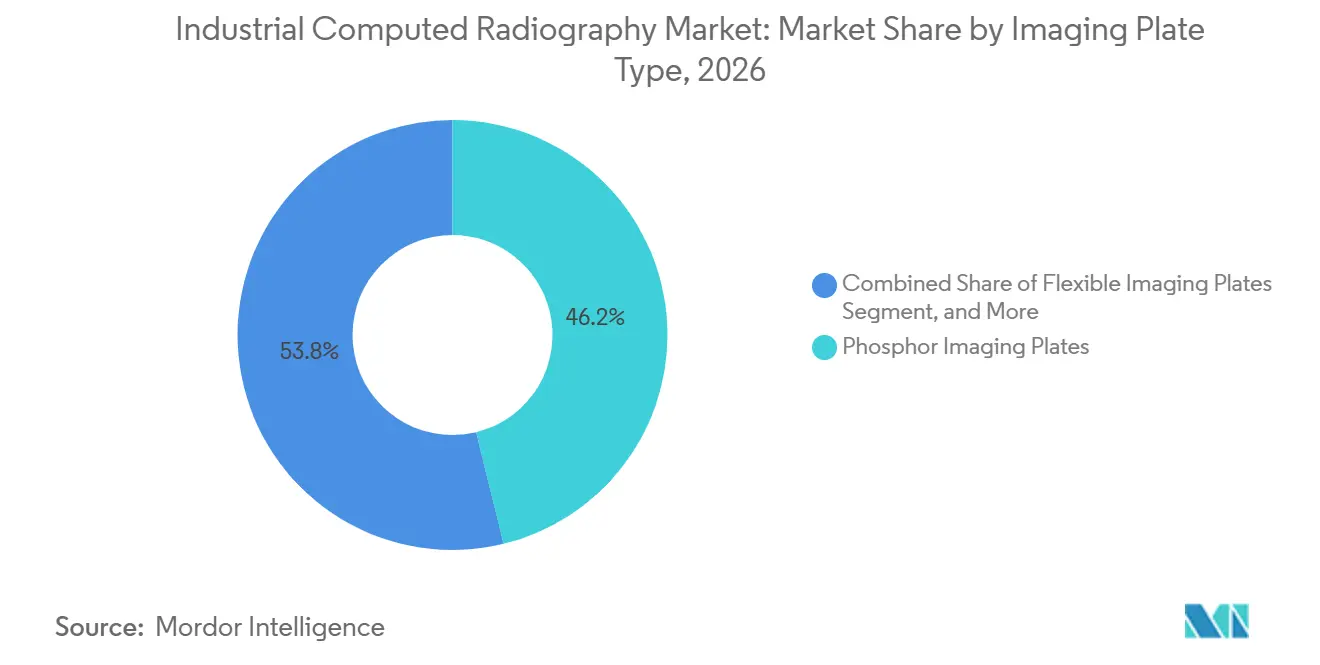
Flexible Plates Advance on Curved ComponentsPhosphor plates accounted for 46.19% of revenue in 2026, anchoring the Industrial computed radiography market in the pipeline and power-plant weld inspection segments. Flexible plates, however, are advancing at a 7.28% annual rate to 2032 as aerospace MRO and additive-manufacturing plants demand media that drapes around turbine blades and lattice structures. iCRco’s plates, which bend to 50 mm radii, let technicians capture single exposures on complex contours, cutting setup time.
Flexible media also resonate with in-situ inspection trends. India’s aerospace maintenance value chain requires downtime-saving imaging that slips between nacelles and spars. Advances in scintillator deposition are closing the resolution gap with rigid phosphor, easing historic trade-offs. Glass plates stay relevant for sub-pixel metrology in nuclear and space hardware, yet remain a niche. As conformability and image quality converge, flexible substrates will continue to chip away at phosphor dominance across the Industrial computed radiography market.

By Technology:
AI Workflows Redefine Value PropositionIndirect computed radiography commanded 58.73% revenue in 2026, cemented by legacy X-ray sources and scanner fleets. The shift toward AI-enhanced computed radiography, projected to grow at a 7.12% CAGR, is recasting labor economics by automating defect triage and report generation. The Industrial computed radiography market size for AI-ready upgrades is likely to accelerate as insurers and regulators start recognizing machine-learning logs as proof of due diligence.
Direct computed radiography removes the scan step but remains costly per plate, while dual-energy options serve specialized material-discrimination tasks in aerospace fan-blade inspection. Still, software is the game-changer: Baker Hughes’ February 2026 launch embeds recognition analytics into field cameras, letting one technician deliver plant-ready assessments. Indirect systems that integrate cloud AI will remain relevant even as capital budgets curb hardware overhauls.
By End-User Industry:
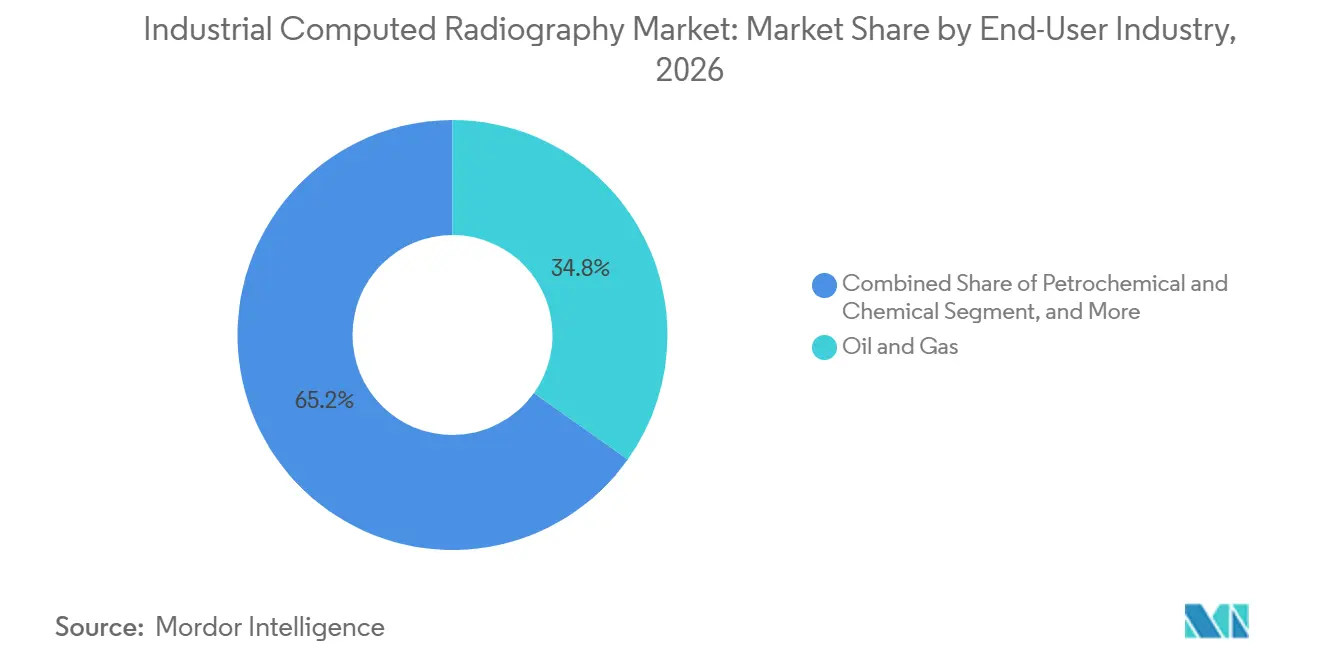
Oil and Gas Dominates, Additive Manufacturing Scales UpOil and gas accounted for 34.84% of the industrial computed radiography market share in 2026 as operators battle corrosion across 3 million mi of U.S. pipelines and similar global networks. In parallel, additive manufacturing is growing at 6.95% on the back of serial production of titanium housings and lattice orthopedic implants. The industrial computed radiography market size tied to petrochemicals remains steady, given ASME code cycles, while aerospace demands sub-100 µm porosity detection, favoring high-resolution plate stacks.
Additive printing’s layer-wise defects require volumetric verification even when in-situ sensors are present. Post-build computed radiography underpins qualification for flight-critical brackets and automotive e-powertrain parts, reinforcing the growth of the Industrial computed radiography market in advanced manufacturing corridors.
By Imaging System Size:
Portable Units Propel Field ProductivityPortable scanners accounted for 40.95% of the Industrial computed radiography market revenue in 2026, propelled by 21 kg units such as Waygate’s CRx25P, which run on rechargeable packs. As LED erase modules shorten cycle times, portable plates approach lab throughput, erasing historic trade-offs.
Fixed labs still dominate automotive casting lines that require conveyor-fed plate changers, whereas mini-CR fills weld-repair niches. High-throughput cells integrated with robotics cater to aerospace machining centers, yet portability’s growth outpaces other formats because service providers win jobs by responding rapidly to unscheduled outages. This dynamic secures a robust long-term pipeline for the Industrial computed radiography market.
By Service Provider Type:
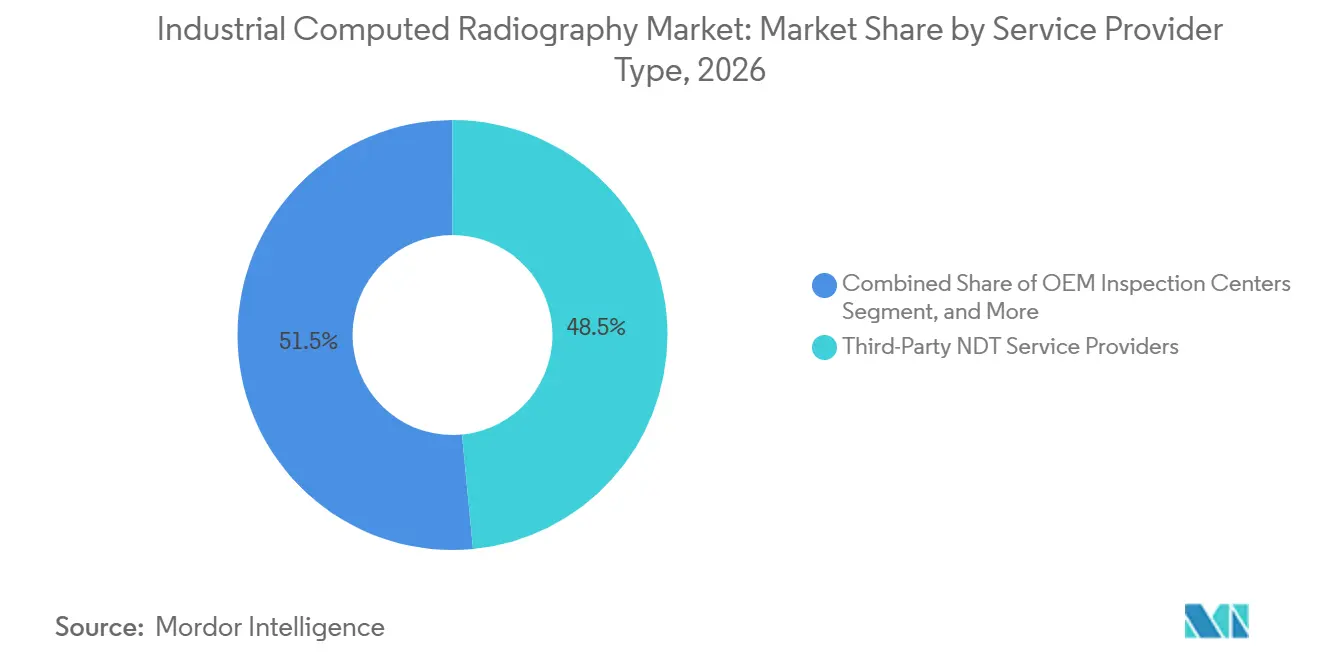
OEM Inspection Centers on the RiseThird-party firms owned 48.48% of 2026 revenue, pooling equipment across clients to maximize utilization. Nonetheless, OEM inspection centers will climb at 6.84% CAGR as aerospace primes internalize data to protect intellectual property. Safran’s Hyderabad nacelle-repair plant underscores this inward turn and signals continued investment in dedicated scanners.
Service providers are countering by layering analytics, digital archiving, and compliance reporting on top of radiography to retain contracts. SISTAC’s March 2026 deal with BW Energy bundles subsea visuals, thickness readings, and weld radiography into a single UWILD scope. Consolidation waves are swelling regional specialists into global networks, providing scale to buy AI software licenses and modern portable units, ultimately broadening the Industrial computed radiography market.
Geography Analysis
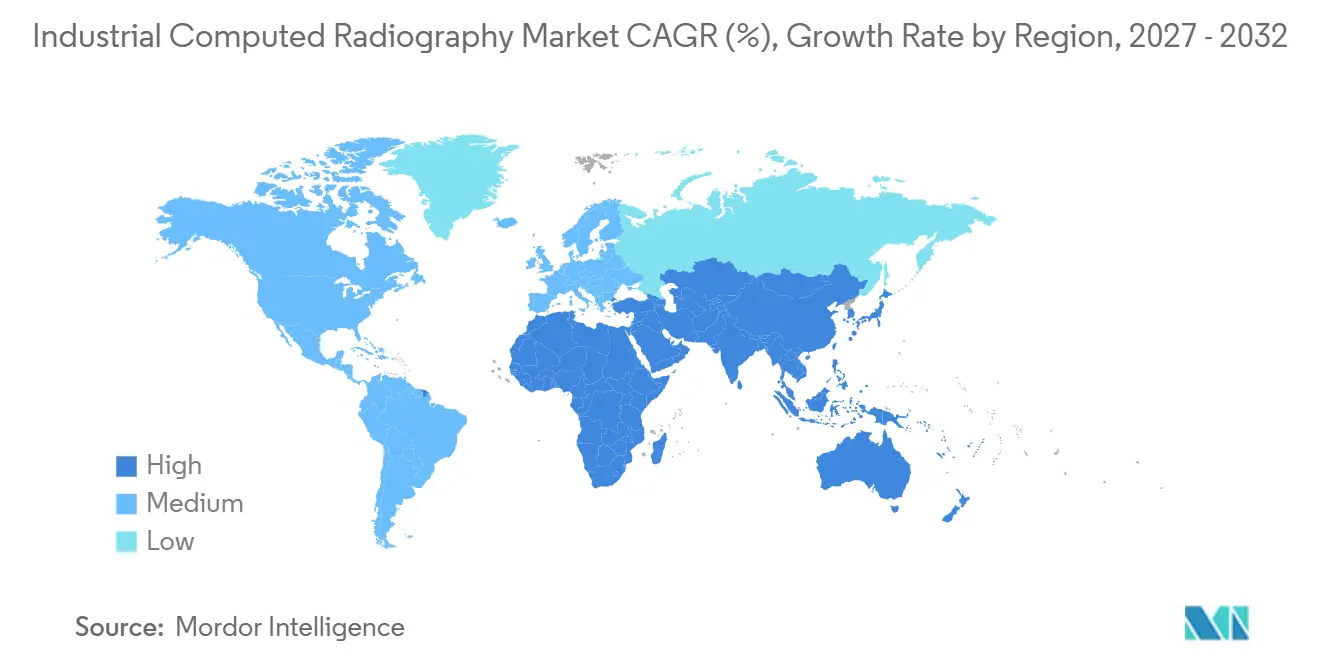
Asia-Pacific held 32.33% of the industrial computed radiography market share in 2026. The region has extensive shipbuilding, petrochemical, and power-generation activity, which creates steady demand for weld inspection. China remains important because of its broad industrial manufacturing base. India is also building new aerospace maintenance capacity and related inspection capabilities. Japan and South Korea sustain high inspection intensity through manufacturing-quality requirements and dense petrochemical and semiconductor ecosystems.
North America remains a major revenue contributor because of its pipeline network and energy construction activity. PHMSA rules and regular integrity requirements support documentation and inspection work on covered pipeline systems. Mistras received a comprehensive NDT services contract for the Woodside Louisiana LNG terminal in December 2025, including radiography and several other inspection services. Europe is defined by high compliance intensity and requirements related to digital radiography, equipment qualification, and material handling. These requirements favor larger certified providers over smaller regional operators. South America has mid-tier demand linked to offshore maintenance and energy infrastructure, with Brazil serving as a regional hub.
The Middle East and Africa is projected to expand at a 7.06% CAGR through 2032. New LNG infrastructure, refinery additions, and pipeline-integrity programs support demand across the region. Saudi Arabia's petrochemical and aviation ambitions are also increasing the need for inspection capacity. Africa has a smaller installed base but is attracting export-oriented manufacturing investment. International oil-company contracting standards and cross-border pipeline agreements encourage the use of certified third-party providers. These conditions create an opening for portable equipment and service fleets in the industrial computed radiography market.
Competitive Landscape
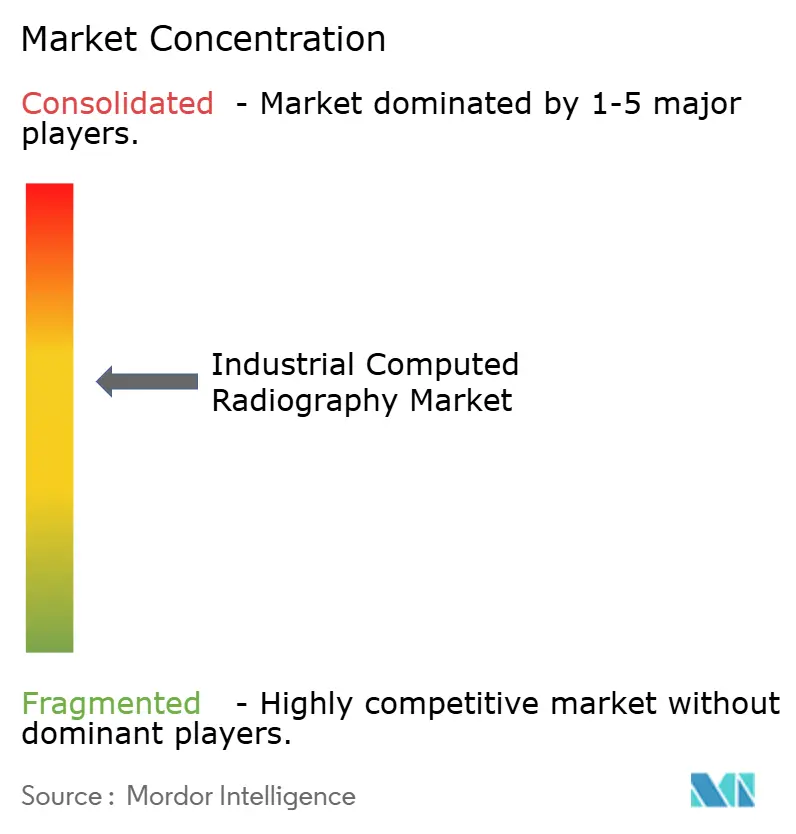
Moderate concentration defines the Industrial computed radiography market. Hardware incumbents Baker Hughes Waygate, Fujifilm, Carestream, Nikon Metrology, and Varex Imaging maintain a significant share, yet nimble AI startups challenge them with cloud-based defect-recognition engines. Baker Hughes’ February 2026 Mentor Zoom PTZ camera layers AI and digital twin links onto legacy optics, protecting its installed base against flat-panel drift. Nikon’s VOXLS 30 Series, revealed in December 2025, integrates granite metrology stages and OPC UA interfaces for robot cells, targeting battery-cell makers that need high-throughput CT.
Strategic patterns pivot on portfolio breadth, service integration, and local support. White-space opportunities lie in ultra-portable AI-equipped systems that offload classification to the edge. Startups such as Deeplify and Dhvani AI retrofit intelligence onto established CR scanners, allowing operators to avoid cap-ex while gaining AI productivity. Compliance frameworks like ASTM E2445 create entry barriers that protect quality-assured vendors while encouraging service bundles that automate reports, a differentiator in auditor-heavy regions.
Regional suppliers in Asia-Pacific and the Middle East compete on localized support and pricing, balancing the power of global brands and enriching the competitive fabric of the Industrial computed radiography market.
Industrial Computed Radiography Industry Leaders
-
Baker Hughes Co. (Waygate Technologies)
-
Fujifilm Corp.
-
Durr NDT GmbH & Co. KG
-
Carestream NDT
-
Nikon Metrology NV
- *Disclaimer: Major Players sorted in no particular order
Industrial Computed Radiography Market Companies Covered in this Report
- Baker Hughes Co. (Waygate Technologies)
- Durr NDT GmbH & Co. KG
- Fujifilm Corp.
- GE Inspection Technologies LLC
- Carestream NDT
- YXLON International GmbH
- Vidisco Ltd.
- Nikon Metrology NV
- Teledyne ICM SA
- Comet Group (D-Tect)
- NDT Global GmbH
- Mistras Group Inc.
- Olympus Corp. (Evident)
- Bluestar Ltd.
- Virtual Media Integration
Recent Industry Developments in Industrial Computed Radiography Market
- April 2026: Baker Hughes' Waygate Technologies and GE Aerospace announced the deployment of automated Menu Directed Inspection (MDI) templates for GEnx-1B and GEnx-2B engine borescope inspections, the latest output of a Joint Technology Development Agreement (JTDA) between the two companies. The templates, loaded onto the Mentor Visual iQ+ video borescope, embed AI-assisted guided workflows for high-pressure turbine blade inspection and support automated 3D measurements, standardizing inspection output across GE Aerospace's installed base of approximately 49,000 commercial aircraft engines.
- March 2026: SISTAC began a 6-to-9-month subsea inspection program for BW Energy on FPSO Cidade de Vitória, deploying the diving support vessel SISTAC Esperança with ROVs for a full UWILD scope in Brazil’s Golfinho field.
- February 2026: Fujifilm invested JPY 5 billion (USD 33.5 million) in Rapidus Corporation to accelerate domestic logic semiconductor production and aims to achieve JPY 500 billion (USD 3.36 billion) in materials revenue by fiscal 2030.
- February 2026: Baker Hughes launched the Mentor Zoom PTZ camera, featuring AI image enhancement, 3D scanning, and digital twin connectivity for remote visual inspection on offshore and petrochemical sites.
Global Industrial Computed Radiography Market Report Scope
The Industrial Computed Radiography Market refers to the worldwide industry focused on the development, production, and deployment of computed radiography (CR) systems that use photostimulable phosphor imaging plates and digital scanning technology to capture, process, and store radiographic images for industrial non-destructive testing (NDT) and inspection applications.
The Industrial Computed Radiography Market Report is Segmented by Imaging Plate Type (Phosphor, Flexible, Glass, and Other Imaging Plate Types), Technology (Direct CR, Indirect CR, Dual Energy CR, and AI-Enhanced CR), End-User (Oil and Gas, Petrochemical, Aerospace, Automotive, Power, and Other End-user Industries), Imaging System Size (Portable, Fixed, Mini-CR, and High-Throughput), Service Provider (In-house, Third-Party, OEM, and Research), and Geography (North America, South America, Europe, Asia-Pacific, and Middle East, Africa). The Market Forecasts are Provided in Value (USD).
Segmentation Overview
| Phosphor Imaging Plates |
| Flexible Imaging Plates |
| Glass Imaging Plates |
| Other Imaging Plate Types |
| Direct Computed Radiography |
| Indirect Computed Radiography |
| Dual Energy Computed Radiography |
| CR With AI Image Enhancement |
| Oil and Gas |
| Petrochemical and Chemical |
| Aerospace and Defense |
| Automotive Manufacturing |
| Power Generation |
| Other End-User Industries |
| Portable CR Systems |
| Fixed CR Systems |
| Mini-CR for Field Inspection |
| High-Throughput CR Systems |
| In-house NDT Departments |
| Third-Party NDT Service Providers |
| OEM Inspection Centers |
| Research and Academic Laboratories |
| North America | United States |
| Canada | |
| Mexico | |
| South America | Brazil |
| Argentina | |
| Rest of South America | |
| Europe | Germany |
| United Kingdom | |
| France | |
| Italy | |
| Spain | |
| Russia | |
| Rest of Europe | |
| Asia-Pacific | China |
| Japan | |
| India | |
| South Korea | |
| Australia and New Zealand | |
| Rest of Asia-Pacific | |
| Middle East | Saudi Arabia |
| United Arab Emirates | |
| Turkey | |
| Rest of Middle East | |
| Africa | South Africa |
| Egypt | |
| Nigeria | |
| Rest of Africa |
| By Imaging Plate Type | Phosphor Imaging Plates | |
| Flexible Imaging Plates | ||
| Glass Imaging Plates | ||
| Other Imaging Plate Types | ||
| By Technology | Direct Computed Radiography | |
| Indirect Computed Radiography | ||
| Dual Energy Computed Radiography | ||
| CR With AI Image Enhancement | ||
| By End-User Industry | Oil and Gas | |
| Petrochemical and Chemical | ||
| Aerospace and Defense | ||
| Automotive Manufacturing | ||
| Power Generation | ||
| Other End-User Industries | ||
| By Imaging System Size | Portable CR Systems | |
| Fixed CR Systems | ||
| Mini-CR for Field Inspection | ||
| High-Throughput CR Systems | ||
| By Service Provider Type | In-house NDT Departments | |
| Third-Party NDT Service Providers | ||
| OEM Inspection Centers | ||
| Research and Academic Laboratories | ||
| By Geography | North America | United States |
| Canada | ||
| Mexico | ||
| South America | Brazil | |
| Argentina | ||
| Rest of South America | ||
| Europe | Germany | |
| United Kingdom | ||
| France | ||
| Italy | ||
| Spain | ||
| Russia | ||
| Rest of Europe | ||
| Asia-Pacific | China | |
| Japan | ||
| India | ||
| South Korea | ||
| Australia and New Zealand | ||
| Rest of Asia-Pacific | ||
| Middle East | Saudi Arabia | |
| United Arab Emirates | ||
| Turkey | ||
| Rest of Middle East | ||
| Africa | South Africa | |
| Egypt | ||
| Nigeria | ||
| Rest of Africa | ||
Key Questions Answered in the Report
What CAGR is forecast for the Industrial computed radiography market between 2027 and 2032?
The market is projected to grow at 6.13% during the 2027-2032 period.
Which imaging system size is expanding fastest?
Portable systems are advancing at a 6.91% CAGR, driven by offshore and remote pipeline deployment.
Why are flexible imaging plates gaining traction?
Their ability to conform to turbine blades and lattice structures reduces setup time and error, fueling a 7.28% growth trajectory.
How is artificial intelligence influencing computed radiography?
AI models now automate crack and porosity detection, lifting inspection productivity, and attracting new investment.
Which region shows the highest growth outlook?
The Middle East leads with a 7.06% CAGR as pipeline and petrochemical megaprojects proliferate.
What is the main competitive threat to computed radiography?
Falling prices of flat-panel digital radiography systems are eroding CR’s cost advantage in high-volume fixed labs.