
Prompt Engineering And Agent Programming Tools Market Size and Share
Market Overview
| Study Period | 2019 - 2030 |
|---|---|
| Market Size (2025) | USD 6.95 Billion |
| Market Size (2030) | USD 40.87 Billion |
| Growth Rate (2025 - 2030) | 42.52 % |
| Fastest Growing Market | Asia Pacific |
| Largest Market | North America |
| Market Concentration | Medium |
Major Players *Disclaimer: Major Players sorted in no particular order Image © Mordor Intelligence. Reuse requires attribution under CC BY 4.0. | |
Prompt Engineering And Agent Programming Tools Market Analysis by Mordor Intelligence
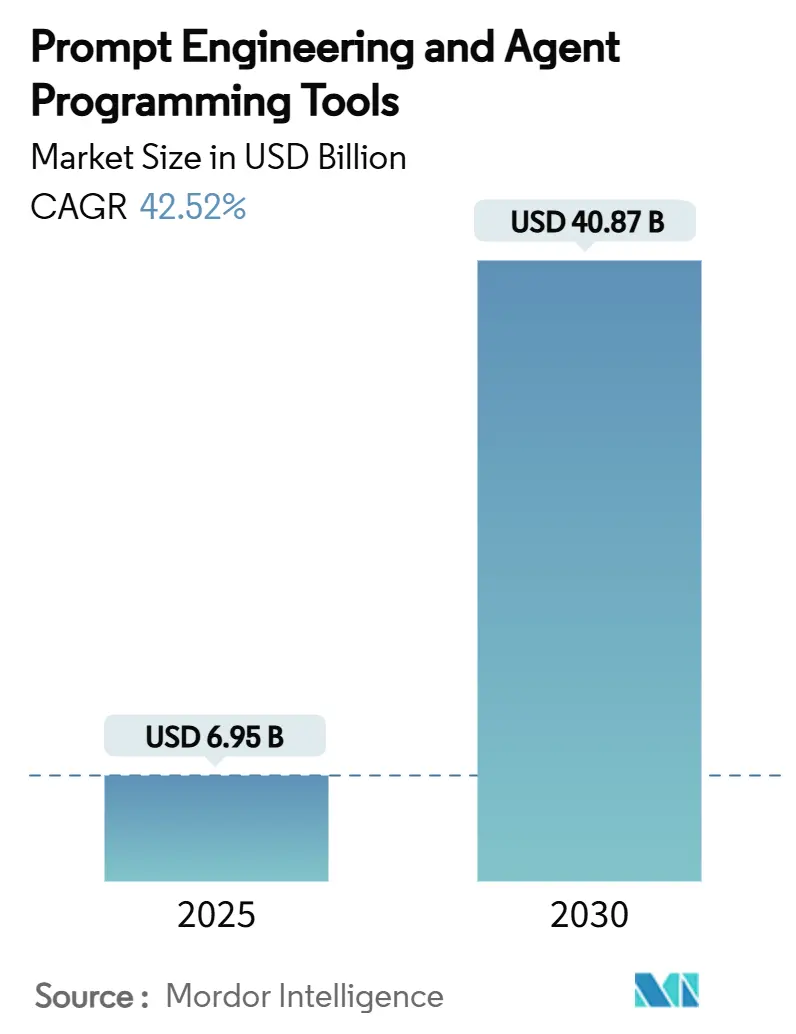
The Prompt Engineering and Agent Programming Tools market size stood at USD 6.95 billion in 2025 and is projected to reach USD 40.87 billion by 2030, expanding to a robust 42.52% CAGR over the forecast period. Momentum stems from enterprises replacing monolithic software with AI-native architectures in which prompt optimization and multi-agent orchestration cut token consumption by as much as 40% while raising output quality. Intensifying venture capital inflows, standardization of cross-vendor agent protocols, and rapid improvements in model context windows all reinforce demand for specialized tooling. Cloud adoption remains pivotal because managed AI platforms shorten iteration cycles and supply immediate scale. Meanwhile, talent scarcity and regulatory scrutiny drive enterprises toward platforms that embed governance, version control and audit trails directly into prompt workflows. Competitive dynamics are fluid as hyperscale cloud providers integrate niche frameworks and specialist start-ups commercialize cutting-edge optimization algorithms.
Key Report Takeaways
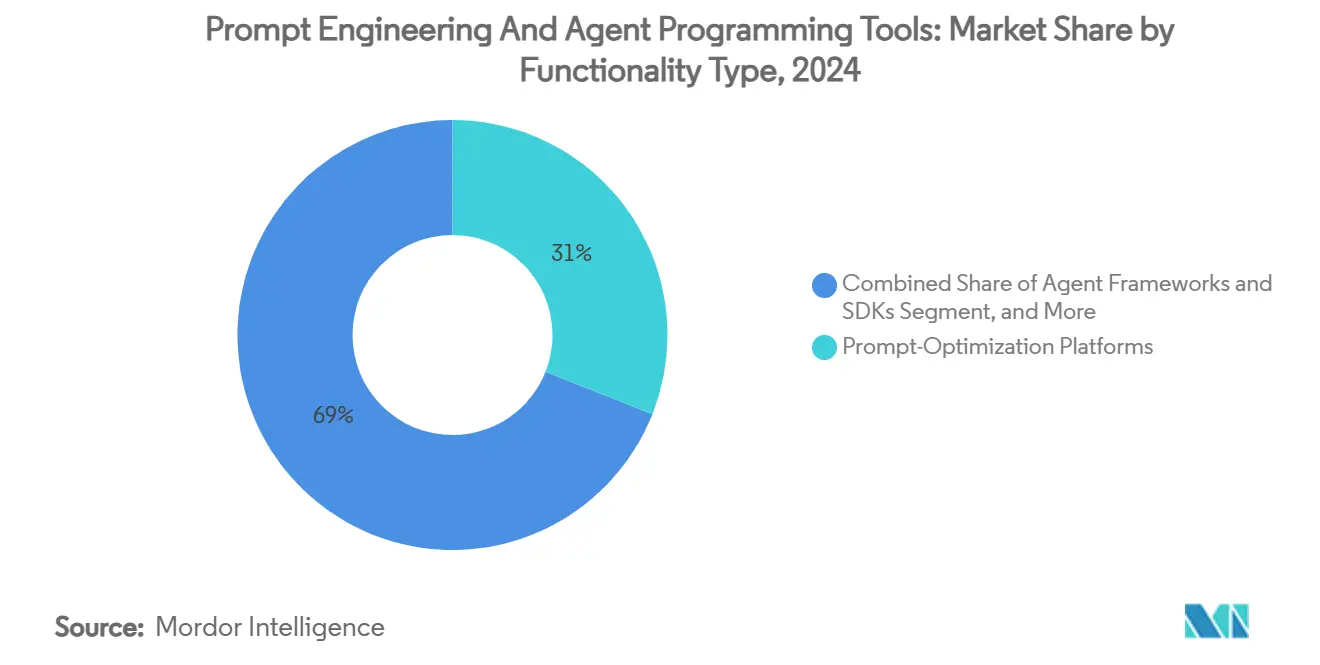
- By functionality, prompt-optimization platforms captured 31.23% of the prompt engineering and agent programming tools market share in 2024; prompt marketplace and repository solutions are advancing at a 44.55% CAGR through 2030.
- By deployment model, cloud-based offerings commanded 66.87% of the prompt engineering and agent programming tools market size in 2024 while maintaining 43.65% CAGR to 2030.
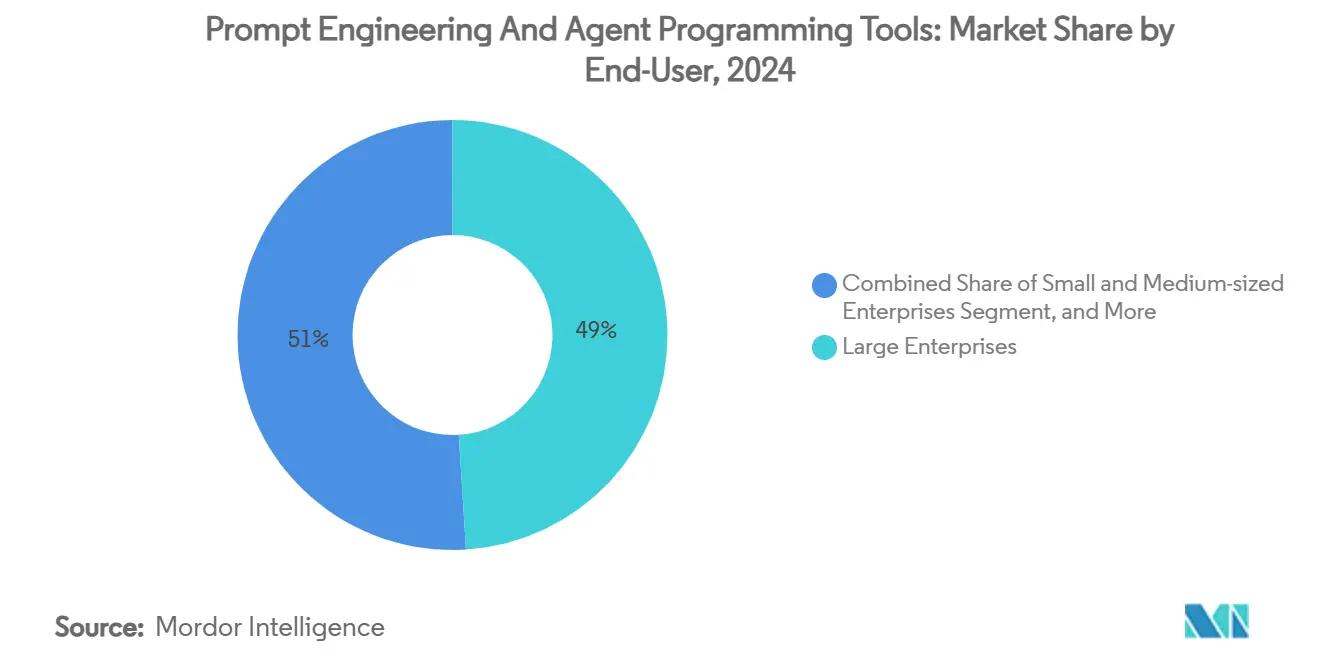
- By end-user, large enterprises held 48.70% share of the prompt engineering and agent programming tools market size in 2024, whereas individual developers and creators are expanding at a 44.80% CAGR.
- By industry vertical, information technology and telecom led with 26.20% revenue share in 2024; retail and e-commerce are projected to grow at 44.10% CAGR to 2030.
- By geography, North America accounted for 40.40% of the prompt engineering and agent programming tools market share in 2024, while Asia-Pacific is forecast to post a 43.98% CAGR.
Global Prompt Engineering And Agent Programming Tools Market Trends and Insights
Drivers Impact Analysis*
| Driver | (~) % Impact on CAGR Forecast | Geographic Relevance | Impact Timeline |
|---|---|---|---|
| Accelerating enterprise integration of generative-AI workflows | +8.2% | Global, with North America and APAC leading adoption | Short term (≤ 2 years) |
| Expansion of open-source LLM ecosystems | +7.5% | Global, particularly strong in Europe and Asia-Pacific | Medium term (2-4 years) |
| Rising demand for prompt-safety and compliance auditing | +6.8% | North America and Europe, expanding to APAC | Medium term (2-4 years) |
| Emergence of synthetic-data agents for automated test generation | +6.1% | Global, with enterprise focus in developed markets | Long term (≥ 4 years) |
| Hardware-level optimizations enabling local agent execution | +5.9% | APAC core, spill-over to North America and Europe | Long term (≥ 4 years) |
| DevSecOps integration of prompt-engineering layers | +5.4% | North America and Europe, gradual APAC adoption | Medium term (2-4 years) |
| Source: Mordor Intelligence | |||
Enterprise Integration of Generative-AI Workflows
Organizations now deploy autonomous multi-agent systems that manage end-to-end business processes rather than isolated chatbots. Domain-specific prompts allow financial services agents to improve fraud-detection accuracy by 35% compared with generic models, thereby lowering investigation costs and accelerating customer onboarding.[1]Anirban Ghoshal, “IBM combines governance and security tools to solve the AI agent oversight crisis,” CSO Online, csoonline.com Outcome-based commercial models— “service as software”—let clients pay for tasks completed by agents, which pushes tool vendors to embed continuous prompt refinement loops. As a result, prompt engineering evolves into a critical enterprise capability integrated with existing DevOps pipelines and monitored for performance and cost in real time.
Expansion of Open-Source LLM Ecosystems
Model-agnostic strategies are gaining ground as companies balance premium proprietary models with rapidly maturing open-source alternatives. Frameworks such as LangChain provide plug-and-play abstraction layers that let developers swap models without rewriting prompt logic.[2]LangChain Documentation Team, “Introduction,” LangChain, langchain.com Organizations report infrastructure savings of up to 60% when non-critical workloads run on open models, spurring investment in prompt marketplaces that curate reuse-ready prompt templates optimized for different architectures.
Rising Demand for Prompt-Safety and Compliance Auditing
Regulators now expect auditable reasoning paths for AI outputs, turning prompt transparency into a compliance imperative. IBM’s integration of watsonx.governance with Guardium AI Security automates penetration testing and agent discovery, enabling enterprises to trace prompt lineage and prove adherence to data-handling requirements. Healthcare providers rely on explainability-enabled prompts to withstand malpractice scrutiny, creating fertile ground for validation tools that flag bias, drift and unauthorized model behavior before agents are promoted to production.
The Emergence of Synthetic-Data Agents for Automated Test Generation
Synthetic data agents can generate edge-case scenarios that are too rare, costly or risky to capture from real-world operations. Pharmaceutical firms utilize these tools to develop diverse clinical trial datasets, significantly reducing the time required for model training. Manufacturing companies simulate equipment-failure events to fuel predictive-maintenance agents, enhancing model robustness across untested operating conditions. The complexity of coordinating multi-domain synthetic data tasks fuels demand for agent-orchestration platforms that harmonize prompt pipelines across departments.
Restraints Impact Analysis*
| Restraint | (~)% Impact on CAGR Forecast | Geographic Relevance | Impact Timeline |
|---|---|---|---|
| Shortage of specialized prompt-engineering talent | -4.2% | Global, particularly acute in North America and Europe | Short term (≤ 2 years) |
| High output-variability reducing repeatability | -3.8% | Global, with enterprise impact in all regions | Medium term (2-4 years) |
| Token-pricing volatility creating budgeting uncertainty | -2.9% | Global, affecting cost-sensitive deployments | Short term (≤ 2 years) |
| IP ambiguity around chain-of-thought prompts | -2.1% | North America and Europe, emerging in APAC | Long term (≥ 4 years) |
| Source: Mordor Intelligence | |||
Shortage of Specialized Prompt-Engineering Talent
Universities have yet to standardize curricula that blend linguistics, domain expertise and model optimization. Enterprises therefore invest 6–12 months in upskilling programmes, delaying large-scale deployments. The shortage is most pronounced in regulated sectors where prompts must reflect complex compliance vocabularies. Automated optimization modules alleviate some pressure but cannot fully replace human creativity needed for multi-agent design, constraining near-term expansion, especially across Europe and North America.
High Output Variability Reducing Repeatability
Stochastic LLM behavior means identical prompts can yield divergent responses, undermining process consistency in areas such as loan underwriting or quality-control inspection. Financial institutions face regulatory risk if risk-assessment agents produce inconsistent outcomes, while manufacturers incur cost overruns from false-positive defect alerts. Enterprises consequently demand validation suites that benchmark variance across model versions, yet these add cost and latency to deployment cycles and reduce the attractiveness of large-scale rollouts.
*Our forecasts treat driver/restraint impacts as directional, not additive. The impact forecasts reflect baseline growth, mix effects, and variable interactions.
Segment Analysis
By Functionality Type: Platforms Drive Specialization
Prompt-optimization platforms captured 31.23% of the prompt engineering and agent programming tools market share in 2024 owing to their ability to translate business objectives into high-performing instructions at scale. The prompt engineering and agent programming tools market size for these platforms will expand rapidly as enterprises embed automated A/B testing, guardrail enforcement and cost analytics within a single interface. Prompt marketplace and repository solutions deliver the highest 44.55% CAGR because they monetize community-generated templates and speed developer onboarding. Agent-framework SDKs, validation toolkits and orchestration engines round out the stack by addressing advanced requirements such as multi-agent state management and compliance reporting.
Enterprises increasingly standardize platform bundles that pair optimization engines with orchestration layers so models, prompts and agents can be versioned together. Vendor consolidation accelerates as hyperscale cloud providers integrate niche frameworks; Microsoft’s unification of AutoGen and Semantic Kernel illustrates the trend toward holistic tool chains.[3]DataHub Research Group, “Platform Ecosystem: LangGraph alternatives (May 2025),” datahub.io Specialized start-ups nonetheless thrive by targeting vertical-specific pain points—healthcare bias detection, telecom network troubleshooting or manufacturing CNC-machine optimization—where generic platforms fall short.



By Deployment Model: Cloud Dominance with Hybrid Adoption
Cloud-based services accounted for 66.87% of the prompt engineering and agent programming tools market size in 2024, underpinned by elastic compute, built-in vector databases and fine-tuning APIs that shorten experimentation cycles. The segment maintains 43.65% CAGR as prompt engineers rely on large-context models that are impractical to host on-premises. Although latency-sensitive and data-sovereignty workloads still necessitate local deployment, enterprises increasingly adopt hybrid architectures that split sensitive prompt crafting on-premises while executing compute-heavy optimization in the cloud.[4]Digital Bricks, “Orchestrating Multi-Agent AI With Semantic Kernel,” digitalbricks.ai
Edge-ready agents capable of running on GPUs integrated into enterprise laptops are emerging, but most remain tethered to cloud inference for complex tasks until hardware advances reduce local memory constraints. As orchestration platforms mature, workload-placement logic will dynamically route prompts to either location based on cost, compliance and performance metrics, further entrenching hybrid as the de-facto model for large organizations.
By End-User: Enterprise Leadership, Creator Acceleration
Large enterprises held 48.70% share of the prompt engineering and agent programming tools market size in 2024, driven by the need to standardize AI pipelines across multiple business units. Governance dashboards, single sign-on and API rate-limit controls are decisive purchasing criteria for this cohort. Conversely, individual developers and creators form the fastest-expanding segments at 44.80% CAGR, propelled by low-code interfaces and monetization avenues within prompt marketplaces. SMEs gravitate toward subscription-based optimization suits that handle model selection, context-window management and guardrail tuning out of the box.
Academic institutes leverage open-source frameworks to automate literature reviews and experiment design, generating spill-over innovations that commercial vendors subsequently produce. This multilayered user landscape fosters continuous feedback loops, keeping tool vendors responsive to both enterprise-grade feature requests and grassroots creativity.
By Industry Vertical: IT Dominance, Retail Surge
Information technology and telecom contributed 26.20% to 2024 revenues as firms embedded agents across software-development lifecycles, network diagnostics and customer service. The prompt engineering and agent programming tools market size for retail and e-commerce will rise fastest, advancing at 44.10% CAGR, as merchants deploy conversational shopping assistants and personalized marketing generators. BFSI institutions rely on prompt-safety modules that enforce explainable risk scoring, whereas healthcare providers integrate domain-specific vocabularies to support diagnostic agents.
Manufacturers adopt predictive-maintenance agents trained on synthetic data that replicate rare breakdown events, lowering downtime costs. Media companies exploit multi-agent content-generation pipelines to localize assets across languages and channels, underscoring the versatility of prompt engineering across creative workflows.
Geography Analysis
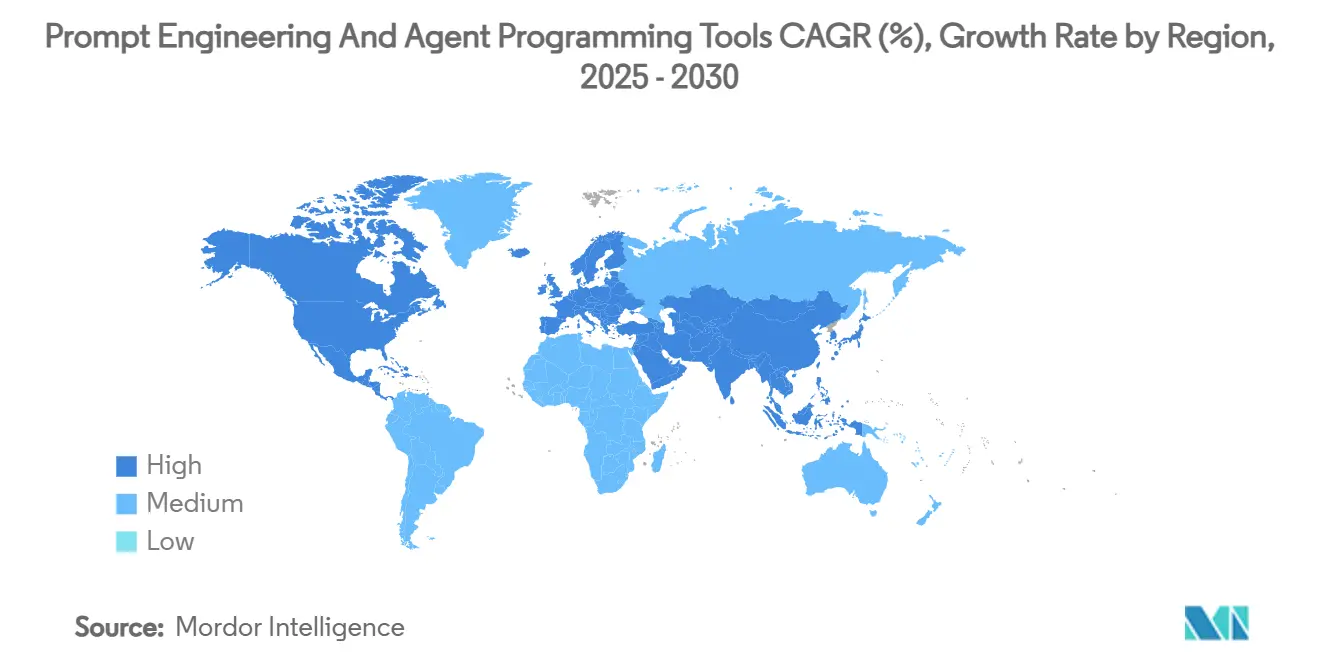
North America led with 40.40% of the prompt engineering and agent programming tools market share in 2024, supported by significant venture funding for generative-AI start-ups during the first half of the year. Mature cloud infrastructure, well-defined intellectual-property frameworks and deep talent pools together sustain high enterprise adoption. Major platform vendors headquartered in the region iterate rapidly, incorporating real-world feedback from Fortune 500 pilot projects to refine optimization algorithms and orchestration features.
Asia-Pacific is projected to record a 43.98% CAGR through 2030, reflecting strong government backing for AI self-sufficiency. Japan's national AI roadmap and India's newly launched IBM Agentic AI Innovation Center highlight efforts to strengthen local capabilities, reduce import dependency, and promote the localization of tools. China’s focus on domestic large-language-model training and Singapore’s smart-city initiatives further widens the addressable base, particularly for edge-optimized agent frameworks supporting local languages.
Europe, Middle East and Africa collectively represent growth corridors shaped by distinct regulatory and infrastructure contexts. The EU’s AI Act emphasizes auditability, accelerating demand for compliance-ready prompt repositories that log lineage and consent metadata. Gulf economies channel sovereign funds into AI to diversify beyond hydrocarbons, creating opportunities for vendors able to address bilingual interfaces and government-scale citizen-service agents. African markets remain nascent but exhibit leapfrog potential as mobile-first initiatives seek lightweight agent toolkits that function under limited bandwidth and device capacity.

Competitive Landscape
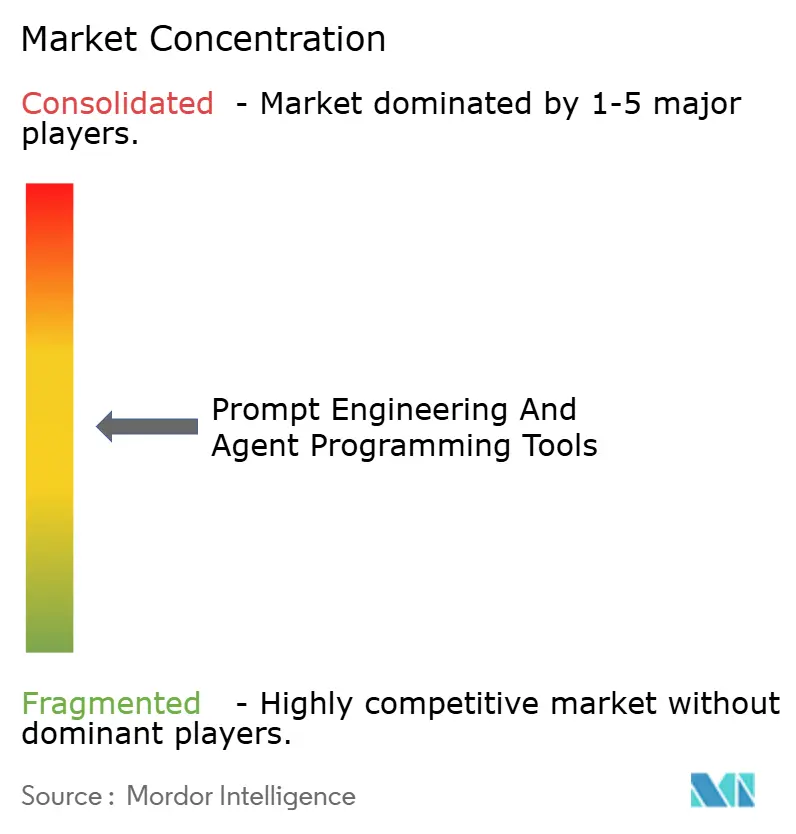
Competition remains moderate with fluid consolidation. Hyperscale providers such as Microsoft, Google and IBM leverage integrated cloud stacks to bundle prompt optimization engines, vector stores and orchestration layers, thereby shortening procurement cycles for large buyers. Start-ups differentiate through proprietary algorithms that automatically rewrite prompts for cost and quality metrics or specialize in domains like healthcare compliance or telecom troubleshooting.
Standardization pressures are mounting. Open protocols such as Agent2Agent and Model Context Protocol enable cross-vendor agent collaboration, forcing toolmakers to prioritize interoperability over lock-in. Patent filings in generative AI rose from 733 families in 2014 to over 14,000 in 2023: Tencent, Baidu and IBM rank among the most active applicants, underlining the strategic race to secure defensible IP positions. Acquisition activity is brisk: Microsoft’s 2025 integration of AutoGen and Semantic Kernel into Azure AI Foundry Agent Service aggregates fragmented frameworks into a unified SDK, signaling that ecosystem control is a key value driver.
Niche vendors sustain relevance by focusing on workflow-specific pain points. Cohere’s Command A model extends 256K context windows to enterprise agents, while Prompt Layer targets observability with granular token-level logging. Emergence AI unveiled an auto-orchestration suite that generates task-specific agents without manual programming, appealing to SMEs seeking quick wins. Market entry barriers remain moderate because open-source libraries lower development hurdles, yet enterprise trust, data-residency assurances and service-level guarantees create moat effects favoring incumbents.
Prompt Engineering And Agent Programming Tools Industry Leaders
OpenAI, L.L.C.
Anthropic PBC
Microsoft Corporation
Google LLC
LangChain Inc.
- *Disclaimer: Major Players sorted in no particular order

Recent Industry Developments
- July 2025: IBM inaugurated the Agentic AI Innovation Center in Bengaluru to co-create autonomous-agent solutions with regional clients and partners.
- June 2025: IBM integrated watsonx.governance with Guardium AI Security, adding automated penetration testing and agent discovery to streamline compliance.
- June 2025: Google secured a patent for automated prompt-improvement technology that analyses and refines user prompts before model execution.
- May 2025: Microsoft introduced Azure AI Foundry Agent Service, merging AutoGen and Semantic Kernel into one SDK for enterprise agent orchestration.
- March 2025: Cohere released Command A, a 111-billion-parameter model featuring 256K context and advanced tool-use skills, tailored for enterprise multi-agent deployments.
- December 2024: Emergence AI launched its Orchestrator platform, enabling real-time generation and management of task-specific agents.


Global Prompt Engineering And Agent Programming Tools Market Report Scope
| Prompt-Optimisation Platforms |
| Agent Frameworks and SDKs |
| Prompt Testing and Validation Tools |
| Prompt Marketplace / Repository |
| Agent-Orchestration Platforms |
| Other Functionality Types |
| Cloud-based |
| On-premises |
| Hybrid |
| Large Enterprises |
| Small and Medium-sized Enterprises (SMEs) |
| Individual Developers / Creators |
| Academic and Research Institutes |
| Information Technology and Telecom |
| Banking, Financial-Services and Insurance (BFSI) |
| Healthcare and Life-Sciences |
| Retail and E-commerce |
| Media and Entertainment |
| Manufacturing |
| Other Industry Verticals |
| North America |
| South America |
| Europe |
| Asia-Pacific (APAC) |
| Middle East |
| Africa |
| By Functionality Type | Prompt-Optimisation Platforms |
| Agent Frameworks and SDKs | |
| Prompt Testing and Validation Tools | |
| Prompt Marketplace / Repository | |
| Agent-Orchestration Platforms | |
| Other Functionality Types | |
| By Deployment Model | Cloud-based |
| On-premises | |
| Hybrid | |
| By End-User | Large Enterprises |
| Small and Medium-sized Enterprises (SMEs) | |
| Individual Developers / Creators | |
| Academic and Research Institutes | |
| By Industry Vertical | Information Technology and Telecom |
| Banking, Financial-Services and Insurance (BFSI) | |
| Healthcare and Life-Sciences | |
| Retail and E-commerce | |
| Media and Entertainment | |
| Manufacturing | |
| Other Industry Verticals | |
| By Geography | North America |
| South America | |
| Europe | |
| Asia-Pacific (APAC) | |
| Middle East | |
| Africa |


Key Questions Answered in the Report
What is the current size of the prompt engineering and agent programming tools market?
The prompt engineering and agent programming tools market size reached USD 6.95 billion in 2025 and is forecast to hit USD 40.87 billion by 2030.
Which functionality segment leads the market?
Prompt-optimization platforms held 31.23% of 2024 revenue, making them the leading functionality segment.
Why are cloud-based deployments dominant?
Cloud services supply elastic compute, pre-trained models and integrated tooling, driving 66.87% 2024 market share and 43.65% CAGR growth.
Which region is growing fastest?
Asia-Pacific shows the highest regional momentum with a projected 43.98% CAGR between 2025 and 2030, boosted by government AI initiatives and new innovation centers.
How severe is the talent shortage in prompt engineering?
The global deficit of skilled prompt engineers is estimated to trim projected CAGR by 4.2%, especially in regulated industries that require domain-specific expertise.
What factors influence tool vendor selection among enterprises?
Key criteria include integrated governance, interoperability with open protocols, cloud-edge flexibility and proven track records in reducing token costs while maintaining output quality.
Page last updated on:





