
AI Code Tools Market Size and Share
AI Code Tools Market Analysis by Mordor Intelligence
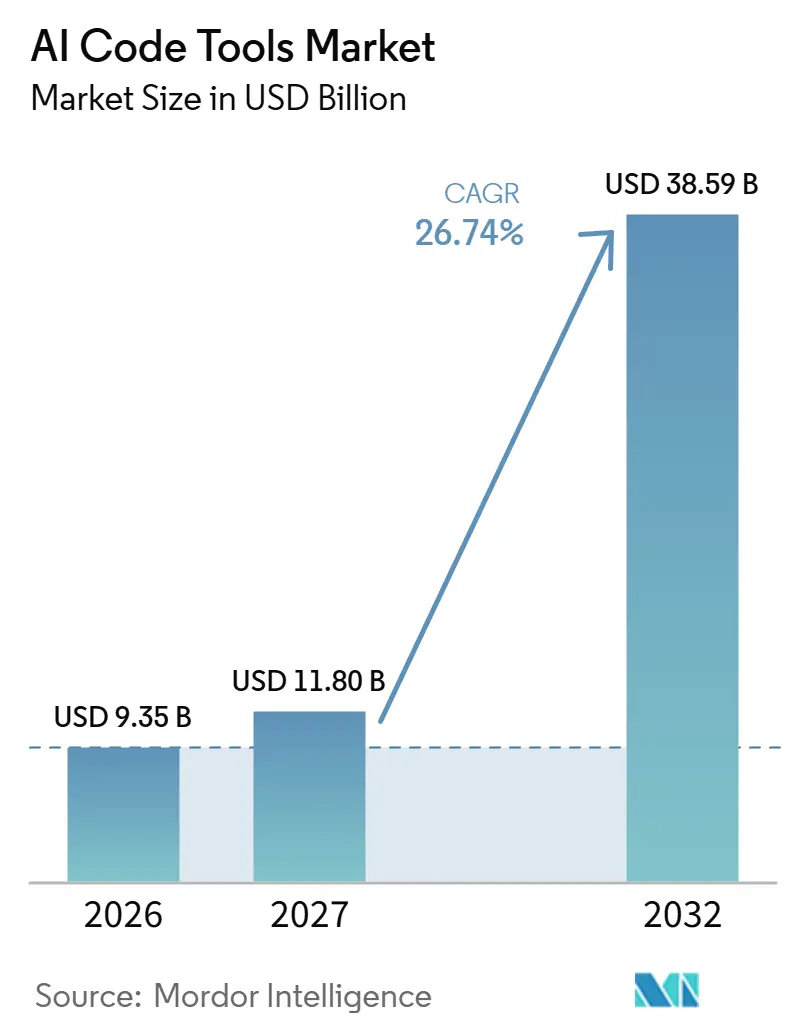
The AI code tools market size is expected to grow from USD 9.35 billion in 2026 to USD 11.8 billion in 2027 and is forecast to reach USD 38.59 billion by 2032 at 26.74% CAGR over 2027-2032.
Better bounded-task performance and IDE plug-ins reduce the effort of delegating development work. In Japan, enterprise engineering use gives suppliers a route from individual access to recurring organizational demand. Suppliers respond with broader task-handling workflows and administrative controls that define how assistance enters the development process. Copyright exposure and security defects add approval and verification work that limits the value of faster code production. A hybrid approach that separates cloud prototyping from protected code execution offers suppliers an expansion route through sensitive workloads alongside broadly accessible assistance.
Key Report Takeaways
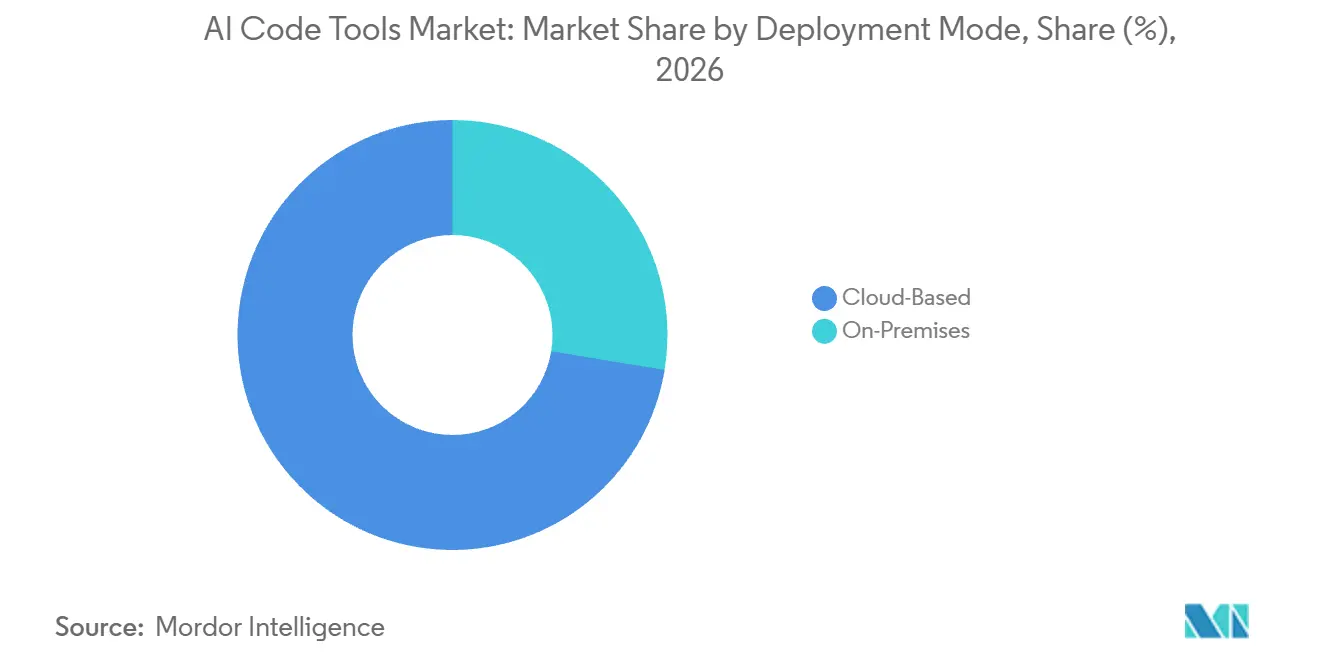
- By deployment mode, cloud-based tools led with a 72.4% AI code tools market share in 2026, while on-premises tools are forecast to grow fastest at a 27.05% CAGR over 2027-2032.
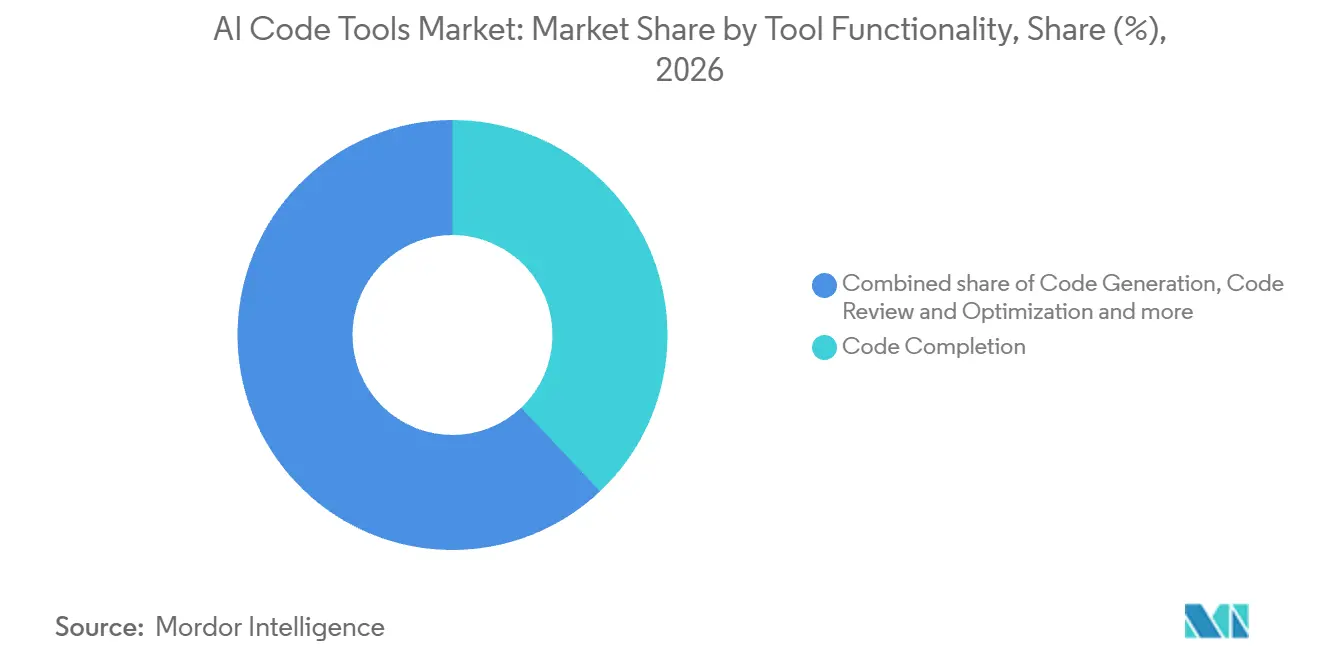
- Across tool functionality, code completion held a 37.96% share of the AI code tools market size in 2026, and code generation is forecast to grow fastest at a 27.5% CAGR over 2027-2032.
- Among end-user industries, IT and telecom accounted for 31.81% of total revenue in 2026, while the healthcare and life sciences segment is forecast to grow fastest at a 27.45% CAGR over 2027-2032.
- By organization size, large enterprises held 59.36% of total revenue in 2026, with small and medium enterprises forecast to grow fastest at a 27.1% CAGR over 2027-2032.
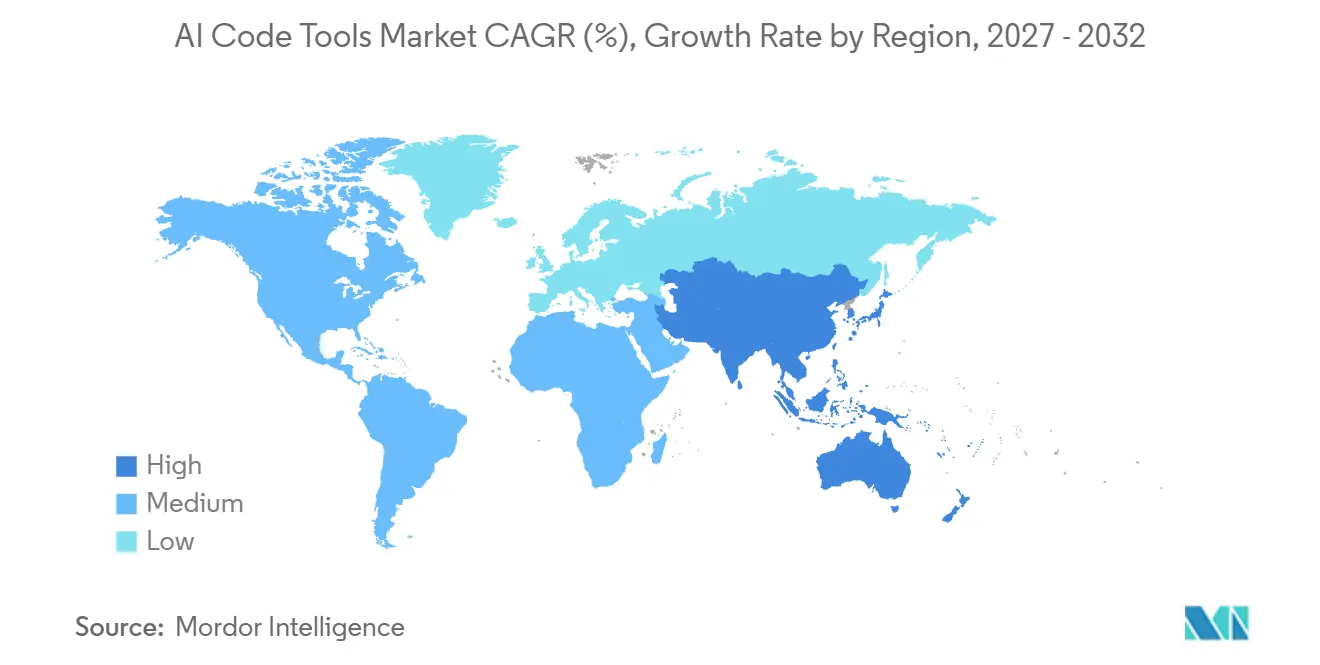
- Geographically, North America led with 41.83% of total revenue in 2026, while Asia-Pacific is forecast to grow fastest at a 27.2% CAGR over 2027-2032.
Note: Market numbers in this report are based on Mordor Intelligence's proprietary estimation framework, which combines nine months of actuals with Q4 projections for base year 2026.
Market Trends and Insights
Drivers Impact Analysis of AI Code Tools Market*
| Driver | (~) % Impact on CAGR Forecast | Geographic Relevance | Impact Timeline |
|---|---|---|---|
| Exploding LLM Accuracy (>90% HumanEval) | +9.8% | North America, Europe, Asia-Pacific | Medium term (2-4 years) |
| Soaring IDE Plug-in Adoption (VS Code, JetBrains) | +8.4% | North America, Europe, Asia-Pacific | Short term (≤ 2 years) |
| Vendor-Bundled Cloud Credits and Free Tiers | +6.6% | North America, Europe, Asia-Pacific | Short term (≤ 2 years) |
| 75% of Enterprise Software Engineers to Use AI Code Assistants by 2028 | +5.5% | North America, Europe, Asia-Pacific | Medium term (2-4 years) |
| Shift to Private or Local Models for IP Control | +2.7% | North America, Europe, Asia-Pacific | Long term (≥ 4 years) |
| Edge-Optimized LLMs Reducing Latency for AR, VR Coding | +0.8% | North America, Europe, Asia-Pacific | Long term (≥ 4 years) |
| Source: Mordor Intelligence | |||
Exploding LLM Accuracy (>90% HumanEval)
More reliable output can make narrowly defined coding tasks suitable for delegation to an assistant. Qwen3-Coder-480B-A35B-Instruct scored 93.9% pass@1 on HumanEval base tests in vLLM’s evaluation record, and vLLM dates the model’s addition to July 23, 2025. The strongest commercial case is for a developer who can state the intended result precisely and decide whether a proposed implementation achieves it. In that setting, improved accuracy reduces the corrective work required before proposed code is useful, increasing the value of assistance for the task. Suppliers need to align delegated work with the performance their service can deliver, so the developer retains a practical basis for accepting the output. A first-attempt benchmark result at that level strengthens the case for trying testable coding tasks, where correction time determines assistance’s commercial value.
Soaring IDE Plug-in Adoption (VS Code, JetBrains)
IDE integration gives coding assistants a distribution route that can carry more substantial work than isolated suggestions. GitHub Copilot’s VS Code extension listing showed 74.78 million installs on October 20, 2026. In May 2025, Microsoft announced agent mode for all VS Code developers and in public preview for JetBrains IDEs, with capabilities to plan and implement high-level coding tasks. This combination links a large extension distribution base with a broader unit of work inside the editor. For suppliers, supporting task delegation across editor settings can expand the service offered through an installed plug-in, creating a reason to compete on workflow coverage as well as distribution reach.
Vendor-Bundled Cloud Credits and Free Tiers
Free access reduces the subscription cost of trying coding assistance, while usage limits define where paid service can become commercially relevant. GitHub offers individual developers Copilot Free with monthly allowances of 2,000 completions and 50 chat requests, including Copilot Edits, excluding users assigned Business or Enterprise seats. Amazon Web Services offers Amazon Q Developer Free Tier with 50 monthly chat interactions for Q&A and agentic coding, a limit that began August 1, 2025. These allowances enable bounded use without committing to a recurring subscription, widening access for developers whose initial workload fits the limits. For a developer needing more than 50 monthly chat requests or interactions, paid access becomes relevant to continuing that workload.
75% of Enterprise Software Engineers to Use AI Code Assistants by 2028
Enterprise adoption expands the potential paid user base across engineering teams. GitLab’s 2026 survey of 1,528 developers and technology buyers across 6 countries found that 91% of surveyed organizations had 2 or more AI coding tools in active use.[1] GitHub bills organizations for assigned Copilot seats and usage beyond included AI-credit pools, while code completions and next-edit suggestions remain unlimited on paid plans. Extending paid access increases billable seats, with consumption revenue possible above the included pool. In the same survey, 43% of respondents said their organization could not reliably distinguish AI-generated code from human-written code in its codebase. That gap makes traceability part of the paid deployment proposition, connecting wider assistant access with organizational control.
Restraints Impact Analysis of AI Code Tools Market*
| Restraint | (~) % Impact on CAGR Forecast | Geographic Relevance | Impact Timeline |
|---|---|---|---|
| IP and Copyright Liability Concerns | -2.2% | North America, Europe, Asia-Pacific | Medium term (2-4 years) |
| Model Hallucination and Security-Bug Risk | -2.7% | North America, Europe, Asia-Pacific | Short term (≤ 2 years) |
| Rising GPU or ASIC Shortages for On-Prem Clusters | -1.4% | Japan, North America | Short term (≤ 2 years) |
| Developer-Skill Erosion (Prompt-Engineer Paradox) | -0.8% | North America, Europe, Asia-Pacific | Long term (≥ 4 years) |
| Source: Mordor Intelligence | |||
IP and Copyright Liability Concerns
Copyright exposure makes permission to use generated code a separate decision from whether that code functions. JetBrains’ 2025 survey of developers who work in the C language found that they cited security and intellectual property concerns as leading company adoption blockers for AI coding agents. For companies whose engineers write C, unresolved responsibility for claims can add legal review to the technical work needed before adoption. GitHub’s March 2026 Generative AI Services Terms extend third-party claim defense to services and outputs only when the customer’s agreement provides that defense. Because that protection is contract-dependent, checking the agreement’s defense clause can add a review step before these buyers authorize wider use.
Model Hallucination and Security-Bug Risk
Security defects limit the amount of generated code that a development team can responsibly accept without additional verification. Veracode’s 2026 study found that roughly 44% of tested AI code-generation tasks introduced a known vulnerability.[2] That result makes validation effort central to the commercial value of assistance, since faster generation alone cannot establish whether an implementation is safe. On July 14, 2026, GitHub announced a public-preview Copilot app command that scanned in-flight changes for common vulnerabilities and suggested fixes. For teams considering wider deployment, the remaining burden is to verify proposed changes and corrections, which can reduce the labor savings available to justify additional tool spending.
*Our forecasts treat driver/restraint impacts as directional, not additive. The impact forecasts reflect baseline growth, mix effects, and variable interactions.
AI Code Tools Market Segment Analysis
By Deployment Mode:
Cloud Scale and Controlled ExecutionCloud-based tools accounted for a 72.4% share of the AI code tools market size in 2026. Microsoft reported 50 million GitHub Copilot users in July 2026 across the cloud-based service’s surfaces. For the largest segment, a user base of that scale gives the supplier a broad operating relationship with developers through a shared service. For buyers, the economic choice centers on obtaining coding assistance through that service rather than taking responsibility for its execution environment. A rival cloud service has to win developers from a platform with that established user base.
On-premises tools are forecast to be the fastest-growing segment, at a 27.05% CAGR over 2027-2032. Mistral AI reported in June 2025 that Abanca had deployed Mistral Code at scale for development teams, with core banking code kept on premises in a hybrid configuration. The arrangement lets developers prototype in the cloud while core banking code stays inside the bank’s own infrastructure, tying local deployment to the sensitivity of that code. This makes deployment responsibility part of the purchase decision, because the buyer must weigh local control against the effort of operating that environment. The hybrid split gives suppliers a route to serve protected banking workloads without requiring the bank to move cloud prototyping on premises.

By Tool Functionality:
Daily Completion and Expanding Code GenerationCode completion represented a 37.96% AI code tools market share in 2026. On October 23, 2025, GitHub described completion as Copilot’s most widely used feature, helping millions of developers every day. The largest segment’s daily use gives completion a commercial foundation in recurring assistance within an established development routine. For a supplier, the important consequence is that the feature can remain relevant through repeated coding activity without requiring a developer to delegate an entire task. Daily editor suggestions set the comparison a competing completion tool must beat.
Code generation is forecast to be the fastest-growing segment, with a 27.5% CAGR over 2027-2032. JetBrains reported that workplace adoption of Codex among surveyed professional developers worldwide rose from 3% in January 2026 to 16% in May to July 2026. Codex is a coding agent that helps professionals write code, so its rise shows how quickly one code-writing product entered professional workplaces. This gives generation suppliers a route into professional development through an agent that takes on code-writing work. The roughly fivefold change within those months makes the pace of workplace uptake a competitive consideration beyond simply offering a code-writing capability.
By End-User Industry:
Telecom Operating Scale and Healthcare StandardizationIT and telecom was the largest segment, accounting for 31.81% of total revenue in 2026. NTT DOCOMO reported 3,674 GitHub Copilot Business users as of November 17, 2025, with about 1,000 active each working day. The group also reported adopting about 25% of roughly 30,000 daily code suggestions during the month preceding November 26, 2025. A large suggestion volume paired with selective acceptance makes the developer’s decision to use a proposal central to the tool’s value. For a supplier selling into telecom engineering, accepted suggestions provide a more useful measure of developer uptake than suggestion volume alone.
Healthcare and life sciences is forecast to be the fastest-growing segment, at a 27.45% CAGR over 2027-2032. Pearl Health supplies tools, intelligence, and support for primary care providers and healthcare organizations engaged in value-based care. In June 2025, it decided to standardize its engineers on Claude Code while allowing Cursor Pro for those preferring an IDE-driven experience. Pearl said tool proliferation had impeded shared practices and confused new hires about which tools to choose. Pearl’s defined default concentrates competition on becoming the company’s standard tool, while its Cursor option preserves a separate route for IDE-based assistance.
By Organization Size:
Enterprise Coverage and Smaller-Team ProductivityLarge enterprises were the largest segment, with 59.36% of total revenue in 2026. JetBrains’ January 2026 survey found that 40% of developers at companies with more than 5,000 employees used GitHub Copilot at work. This establishes a substantial developer population within very large employers, making organizational coverage a meaningful commercial proposition. For a supplier, serving that population requires a product relationship that can extend beyond the first individual user without losing a clear basis for deployment. Expansion within these surveyed employers would depend on reaching developers outside Copilot’s reported workplace user base.
Small and medium enterprises are forecast to be the fastest-growing segment, with a 27.1% CAGR over 2027-2032. In Sonar’s October 2025 survey, 73% of respondents at businesses with fewer than 200 employees reported Copilot use by themselves, their team, or their company for software development tasks during the preceding year. Developers in that company-size group estimated an average 39% increase in personal productivity due to AI coding tools during the same fieldwork. The combination gives smaller employers both a reported-use base and a perceived benefit to build on when extending assistance within a development team. The commercial opportunity at small employers is to convert this reported-use base into sustained paid access.
Geography Analysis
North America AI Code Tools Market
North America accounted for 41.83% of the AI code tools market size in 2026 and was the largest region. JetBrains reported that 47% of surveyed professional developers in the United States used Claude Code at work in May to July 2026. That workplace audience gives suppliers a commercial foundation in professional development activity through an established form of assistance. For a competing product, the relevant comparison extends beyond access to an agent to the role it takes within a developer’s workflow. A competing service has to sit beside or displace a tool already in workplace use.
Asia-Pacific AI Code Tools Market
Asia-Pacific is forecast to be the fastest-growing region, with a 27.2% CAGR over 2027-2032. On February 26, 2026, Japan’s TKC announced it had begun a company-wide GitHub Copilot adoption project aimed at making AI use standard for all engineers. The company-wide scope places the adoption decision at the engineering-organization level, with potential demand extending across the workforce named in the project. Turning that mandate into day-to-day use by every engineer is the supplier’s delivery challenge, beyond securing the project start.
Europe includes operator-led coding-assistant use, illustrated by Portugal’s NOS, which reported in June 2025 that it had implemented GitHub Copilot for code generation. In South America, more than 450 unique Localiza&Co users per week used GitHub Copilot in March 2026 in the company’s development workflow across its South American operations. In the Middle East and Africa, e& UAE reported in March 2025 that it had enabled hundreds of developers to use GitHub Copilot for coding, testing, and documentation. All 3 buyers are telecommunications or mobility operators, so these reported deployments show coding assistants entering engineering teams inside operating businesses. Each of the 3 deployments used GitHub Copilot, so GitHub is the supplier common to these examples across the 3 regions.
Regulatory Framework and Outlook
Selected jurisdictions are compared from the perspective of suppliers providing AI coding tools to enterprise developers. Applicable duties depend on whether a service reaches the public, the system and operator category, or the processing of personal data. Deployment configuration is commercially important because a supplier must establish which framework reaches its service before organizing the associated compliance work.
Regulatory Table of AI Code Tools Market
| Decision factor | Canada | Germany | China | Brazil |
|---|---|---|---|---|
| Primary authority | Office of the Privacy Commissioner of Canada and participating provincial offices | Federal Network Agency, coordinating with other competent authorities | CAC and other responsible departments | ANPD |
| Key instruments or direction | Private-sector privacy laws and recommended federal amendments | EU AI Act and national implementing law, KI-MIG | Public-facing generative AI measures and July 2026 internet-service consultation draft | LGPD application to AI and ongoing ANPD interpretive work |
| Commercial effect | Assess personal-data use and mitigation against applicable statutory tests | Map system category and operator role to phased duties | Distinguish public services from excluded nonpublic enterprise applications | Assess data-protection rights and governance in AI training and use |
| Current policy attractiveness | Medium | Medium | Medium | Medium |
| Future direction of policy attractiveness | No change | No change | No change | No change |
| Source: Mordor Intelligence | ||||
Canada’s Medium rating reflects May 2026 findings applying statutory tests and mitigation conditions to OpenAI’s use of ChatGPT user data, including other privacy issues, while No change reflects February 2026 amendment recommendations that propose rather than enact duties. Germany’s Medium rating reflects the Federal Network Agency’s coordinating enforcement role under the KI-MIG, effective July 29, 2026, while No change reflects that transparency duties from August 2, 2026 and specified high-risk provisions in 2027 and 2028 depend on system category and operator role, preserving classification-based assessment rather than imposing uniform new conditions on coding-tool suppliers. China’s Medium rating reflects the boundary between public-facing services within China and excluded nonpublic enterprise use, while No change reflects that the July 2026 internet-service consultation proposed revisions rather than amending that GenAI Measures boundary. Brazil’s Medium rating and No change outlook reflect the ANPD’s September 2026 work interpreting existing LGPD rights and governance for AI training and use, without creating final new duties.
Value Chain Stages
The value chain compares model supply, coding-tool commercialization, and delivery into developer workflows. Anthropic earns upstream API revenue through input and output token charges, with additional usage charges for some server-side tools. This creates an economic distinction between supplying model computation and selling the application that a developer uses. A tool supplier’s commercial task is to package that variable consumption into a service whose charging basis matches recurring development activity.
Value Chain Analysis Table of AI Code Tools Market
| Primary activity | Key participants | Value capture | Bottleneck | Resilience response |
|---|---|---|---|---|
| Supply model inference | Model API providers such as Anthropic | Input and output token fees, plus some server-side tool charges | Controlling metered consumption per task | Set task-level consumption limits and route bounded requests |
| Package coding assistance | Coding-tool suppliers such as GitHub and Amazon Web Services | GitHub granted-seat subscriptions and Amazon Q Developer Pro user subscriptions | Matching recurring license commitments to actual use | Reassign access as team activity changes |
| Deliver assistance in developer workflows | IDE and agent-access providers such as JetBrains | Optional JetBrains AI credits billed at public API rates | Coordinating alternative provider credentials and funding paths | Maintain authorized funding choices under a common access policy |
| Source: Mordor Intelligence | ||||
Value capture can occur at several layers of the same development workflow, making the charging unit as significant as the interface. GitHub charges for granted seats, while JetBrains permits existing provider subscriptions or API keys as alternatives to its own credits. That flexibility can leave the workflow provider responsible for access while another supplier receives the model payment. Future bargaining power will therefore depend partly on who controls repeated developer use and partly on who bears the associated consumption cost.
Competitive Landscape
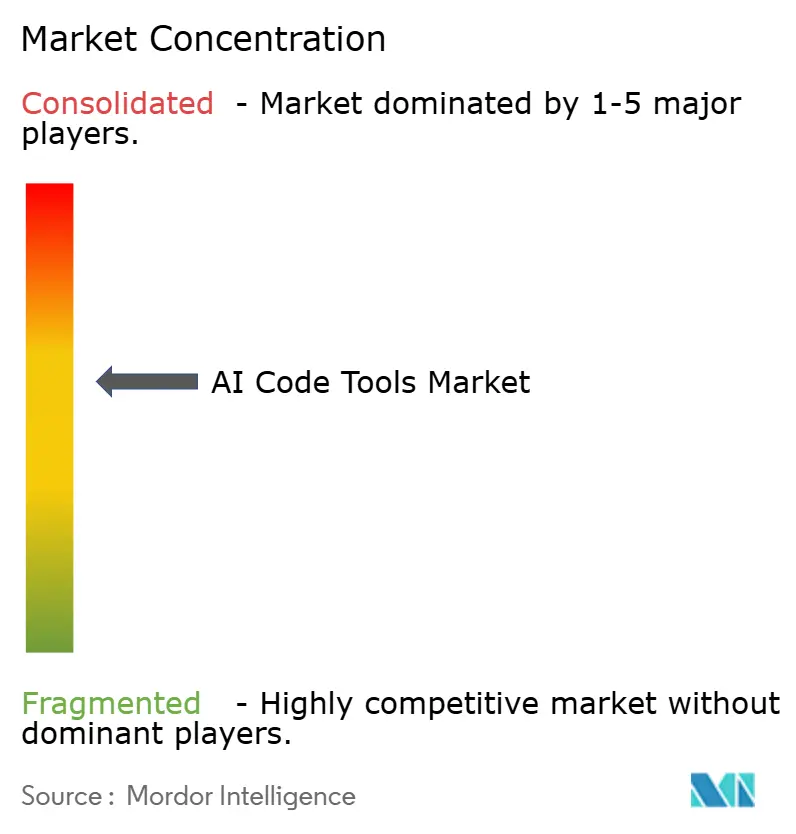
Competition is anchored by large platform suppliers, with room for specialists that can differentiate how developers delegate and review work. Microsoft Corporation is the parent of GitHub, Inc., which supplies Copilot and its coding agent. Amazon.com, Inc. (Amazon Web Services, Inc.) supplies Amazon Q Developer, Google LLC provides Gemini Code Assist, and OpenAI OpCo, LLC supplies Codex. In Microsoft’s fiscal 2026 fourth quarter, GitHub Copilot revenue accelerated over 60% quarter over quarter. The acceleration accompanied usage-based billing, Business and Enterprise seat growth, and significant consumption revenue, so rivals face a supplier earning from both seats and metered usage.
Regional processing controls give suppliers a way to differentiate enterprise assistance through a specific, administratively enforceable deployment choice. On April 13, 2026, GitHub announced US and EU Copilot data residency, covering inference processing and associated data within a designated geography.[3] Enterprise and organization administrators must explicitly enable the policy, which is off by default and restricts the organization to suitable models. For regulated engineering buyers, administrator-enabled restrictions link coding assistance to a controllable processing boundary, giving suppliers a concrete basis for differentiation when serving enterprises that need to govern how assistance is deployed.
Product continuity is another competitive variable when an enterprise has embedded assistance into its engineering process. On April 30, 2026, AWS announced that Amazon Q Developer IDE plugins and paid subscriptions would end support on April 30, 2027, with a transition to Kiro. The sunset excludes Q Developer in the AWS Management Console, marketing and documentation websites, Console Mobile App, and Slack and Microsoft Teams chat apps. For regulated buyers, the administrator-enabled US and EU processing boundaries described above also provide a concrete basis for assessing a replacement. The 12-month transition to Kiro gives affected IDE-plugin and paid-subscription customers a defined decision window in which rival suppliers can compete for their coding workloads.
AI Code Tools Industry Leaders
-
Microsoft Corporation
-
GitHub, Inc.
-
Amazon.com, Inc. (Amazon Web Services, Inc.)
-
Google LLC
-
OpenAI OpCo, LLC
- *Disclaimer: Major Players sorted in no particular order
AI Code Tools Market Companies Covered in this Report
- GitHub, Inc.
- Amazon.com, Inc. (Amazon Web Services, Inc.)
- Google LLC
- Microsoft Corporation
- International Business Machines Corporation
- JetBrains s.r.o.
- Tabnine Ltd.
- Sourcegraph, Inc.
- OpenAI OpCo, LLC
- Anthropic, PBC
- Meta Platforms, Inc.
- Hangzhou DeepSeek Artificial Intelligence Co., Ltd.
- Alibaba Cloud Computing Co., Ltd.
- Tencent Cloud Computing (Beijing) Co., Ltd.
- Replit, Inc.
- Anysphere, Inc.
- Magic AI, Inc.
- Qodo, Inc.
- Phind, Inc.
- Salesforce, Inc.
- Harness Inc.
- CodeRabbit, Inc.
- Cohere Inc.
- BigCode Project (ServiceNow and Hugging Face)
Key Opportunities for Market Participants
The opportunities compare ways to turn frequent agent use into services that an engineering organization can support consistently. JetBrains’ survey of more than 15,000 professional developers found that 90% used coding agents at work at least weekly in May to July 2026, including local or remote cloud agents. That recurring activity supports opportunities in administering and delivering assistance across an engineering organization. Supporting a common team workflow across local and cloud execution creates a potential service proposition alongside the agent itself.
Market Opportunities Table of AI Code Tools Market
| Opportunity | Why now | Buyer / lead segment | Recommended play | Main barrier | Likely beneficiaries |
|---|---|---|---|---|---|
| Team administration for coding agents | Established weekly workplace use in the 2026 professional-developer survey | Enterprise engineering teams | Package access administration with team deployment | Assigning oversight as use expands | Coding-tool vendors and enterprise integration providers |
| Joined local and remote coding workflows | The surveyed usage base includes both local and remote cloud agents | Professional development teams | Support a consistent handoff between local work and delegated tasks | Coordinating responsibility across execution settings | IDE and agent-workflow suppliers |
| Governed coding assistance for financial services | Barclays announced developer-adoption targets extending into 2027 | Bank software-engineering teams | Offer staged adoption with defined deployment authority | Enterprise AI governance across a regulated organization | Anthropic and enterprise deployment providers |
| Source: Mordor Intelligence | |||||
JetBrains’ 2026 survey found that Claude Code workplace use among professional developers worldwide rose from 18% in January to about 39% in May to July 2026. On October 1, 2026, Barclays said it expected Claude Code adoption to reach 50% of its developer population by year-end 2026 and a majority of its software engineers in 2027. Anthropic described disciplined governance as a requirement for integrating AI across a large, highly regulated organization. Together, expanding developer use and the bank’s stated rollout ambition point to an opening for suppliers that pair agent access with defined organizational authority over deployment.
Recent Industry Developments in AI Code Tools Market
- Jul 2026: Microsoft reported that GitHub Copilot had 50 million users and that GitHub Copilot revenue accelerated over 60% quarter over quarter in its fiscal 2026 fourth quarter.
- Jul 2026: GitHub announced a Copilot app security-review command in public preview that scanned in-flight code changes for common vulnerabilities and suggested fixes.
- Apr 2026: AWS announced that Amazon Q Developer IDE plugins and paid subscriptions would end support on April 30, 2027, with a transition to Kiro. Q Developer in the AWS Management Console, marketing and documentation websites, Console Mobile App, and Slack and Microsoft Teams chat apps was outside the planned sunset.
AI Code Tools Market Report Scope and Research Methodology
Market Definition and Coverage
The AI code tools market covers software products that use artificial intelligence to assist software development through code completion, code generation, code review and optimization, automated testing, security and compliance assistance, and documentation and commenting. Globally, its value is annual spending on paid AI code tools delivered through cloud-based or on-premises deployment.
Scope exclusions: General-purpose foundation models and model APIs sold separately from an AI code tool, cloud computing, GPU and other infrastructure sold separately, developer labor, consulting and custom software development services, conventional IDEs and development software without an AI code-tool product, and finished software applications created with AI code tools are excluded.
Segments Covered in This Report
- By Deployment Mode
- Cloud-Based
- On-Premises
- By Tool Functionality
- Code Completion
- Code Generation
- Code Review and Optimization
- Automated Testing
- Security and Compliance Assistants
- Documentation and Commenting
- By End-User Industry
- IT and Telecom
- BFSI
- Healthcare and Life Sciences
- Retail and E-Commerce
- Media and Entertainment
- Government and Public Sector
- Others End-User Industry
- By Organization Size
- Large Enterprises
- Small and Medium Enterprises
- By Geography
- North America
- United States
- Canada
- Mexico
- Europe
- Germany
- United Kingdom
- France
- Italy
- Spain
- Rest of Europe
- Asia-Pacific
- China
- Japan
- India
- South Korea
- Australia
- Rest of Asia-Pacific
- South America
- Brazil
- Argentina
- Rest of South America
- Middle East and Africa
- Middle East
- Saudi Arabia
- United Arab Emirates
- Rest of Middle East
- Africa
- South Africa
- Egypt
- Rest of Africa
- Middle East
- North America
Data Sources, Market Sizing, and Validation
Desk Research
Public evidence such as the Stack Overflow Developer Survey, GitHub's Octoverse, the OECD's synthesis of controlled and field studies, and GitLab's Harris Poll research can inform adoption, developer activity, workflow use, and productivity assumptions. These sources describe different populations and measures, so the analyst uses them to frame market drivers and cross-check assumptions rather than treating any one adoption or productivity measure as market revenue.
Company filings, annual reports, investor materials, public product and pricing documentation, and reputable technology and financial press can supplement public adoption evidence with product scope, pricing, customer disclosures, and changes in commercial models. These sources are illustrative rather than exhaustive, and further sources inform collection, validation and clarification.
Primary Interviews and Surveys
Structured interviews and a short survey would target software-tool company executives, product and sales leaders, channel participants, and software procurement or engineering leaders across global regions. Respondents would help test secondary evidence on paid adoption, deployment choices, pricing, and tool functions, while clarifying gaps such as bundled revenue and the distinction between software subscriptions and model or hosting charges. Conflicting evidence would be triangulated against public disclosures and sampled paid-seat and price observations, with unresolved gaps carried as ranges or scenario assumptions.
Distribution of primary research fieldwork respondents
| Company type | Respondent position | Region |
|---|---|---|
| Top tier: 35% | CXOs: 20% | APAC: 36% |
| Mid tier: 40% | Functional/Unit leaders: 35% | EMEA: 29% |
| Smaller Players: 25% | Managers: 45% | Americas: 35% |
Market-Sizing & Forecasting
The estimate starts top-down with global paid revenue for software tools that perform the defined development functions, assigning only identifiable tool revenue from bundles and counting each sale once. Selective bottom-up checks multiply sampled paid seats or user accounts by public or reported annual prices and reconcile those amounts with vendor disclosures. The model tracks developer and organization adoption, paid-seat conversion, average paid price and usage mix, tool-function adoption, and cloud versus on-premises deployment, using disclosures and survey signals to inform each input and build segment shares from attributable paid-tool revenue or deployment evidence. Scenario analysis carries these drivers forward under different adoption, monetization, and deployment paths, with separate assumptions for end-user industries, organization sizes, and global regions. Expert interviews can test variable choices and forecast plausibility, while sparse or conflicting observations are handled as ranges and checked against the selective bottom-up estimates.
Data Validation & Update Cycle
When independent market signals diverge, analysts align their periods and coverage before resolving the variance. Analysts triangulate vendor revenue disclosures, pricing and seat indicators, developer adoption evidence, and sampled seat-times-price checks, then investigate outliers, currency or period mismatches, duplicate sales, and material variance between independent signals before sign-off. A second review checks market boundaries, segment shares, and calculations, with re-contact triggered by unresolved bundle attribution, conflicting price or seat evidence, or a material product or policy change. The dataset is refreshed annually, reviewed between cycles after material market events, and given a fresh pre-delivery review.
Mordor Intelligence's Artificial Intelligence Code Tools Market Sizing Compared With Other Published Estimates
Published estimates can differ in the transactions and products they count and the inputs used to model demand. The AI code tools market covers software products that use artificial intelligence to assist software development through code completion, code generation, code review and optimization, automated testing, security and compliance assistance, and documentation and commenting.
Key Gap Drivers include the study's defined coverage and market-specific modeling choices. The model tracks developer and organization adoption, paid-seat conversion, average paid price and usage mix, tool-function adoption, and cloud versus on-premises deployment, using disclosures and survey signals to inform each input and build segment shares from attributable paid-tool revenue or deployment evidence.
Benchmark comparison
| Source | Market Size | Gaps in Research Methodology |
|---|---|---|
| Mordor Intelligence | USD 11.8 B (2027) | |
| Global Research Publisher A | USD 9.8 B (2026) | At its 2026 base, this estimate is 16.9% below this report's 2027 value of USD 11.8 B, 1 year later. The 2026 estimate precedes the report's 2027 measurement year in a market forecast to expand, and its scope also counts service offerings alongside tools. |
| Global Research Publisher B | USD 9.8 B (2026) | At its 2026 base, this estimate is 16.9% below this report's 2027 value of USD 11.8 B, 1 year later. The 2026 estimate precedes the report's 2027 measurement year, and its stated scope also includes AI app builders and non-developer users. |
Mordor Intelligence's analysts triangulate vendor revenue disclosures, pricing and seat indicators, developer adoption evidence, and sampled seat-times-price checks, then investigate outliers, currency or period mismatches, duplicate sales, and material variance between independent signals before sign-off.
Key Questions Answered in the Report
What is the AI code tools market size outlook?
The size is expected to grow from USD 9.35 billion in 2026 to USD 11.8 billion in 2027 and reach USD 38.59 billion by 2032, with a 26.74% CAGR over 2027-2032.
What is encouraging adoption of AI coding assistants?
Free access lowers the cost of trying assistance. Copilot Free offers individual developers monthly allowances of 2,000 completions and 50 chat requests, including Copilot Edits, excluding users assigned Business or Enterprise seats.
Which coding-tool functionality is the largest segment?
Code completion held 37.96% of total revenue in 2026.
Which suppliers are prominent in AI coding tools?
Microsoft Corporation, its GitHub, Inc. subsidiary, Amazon.com, Inc. (Amazon Web Services, Inc.), Google LLC, and OpenAI OpCo, LLC are major players.
What limits the value of automated code generation?
Verification adds work before generated code can be accepted. Veracode’s 2026 study found that roughly 44% of tested AI code-generation tasks introduced a known vulnerability.
Which region leads AI coding tools by revenue?
North America held 41.83% of total revenue in 2026. Asia-Pacific is forecast to grow fastest at a 27.2% CAGR over 2027-2032.