
Portugal Management Consulting Services Market Size and Share
Market Overview
| Study Period | 2019 - 2030 |
|---|---|
| Forecast Data Period | 2025 - 2030 |
| Historical Data Period | 2019 - 2023 |
| Market Size (2025) | USD 1.66 Billion |
| Market Size (2030) | USD 2.15 Billion |
| Growth Rate (2025 - 2030) | 5.35 % |
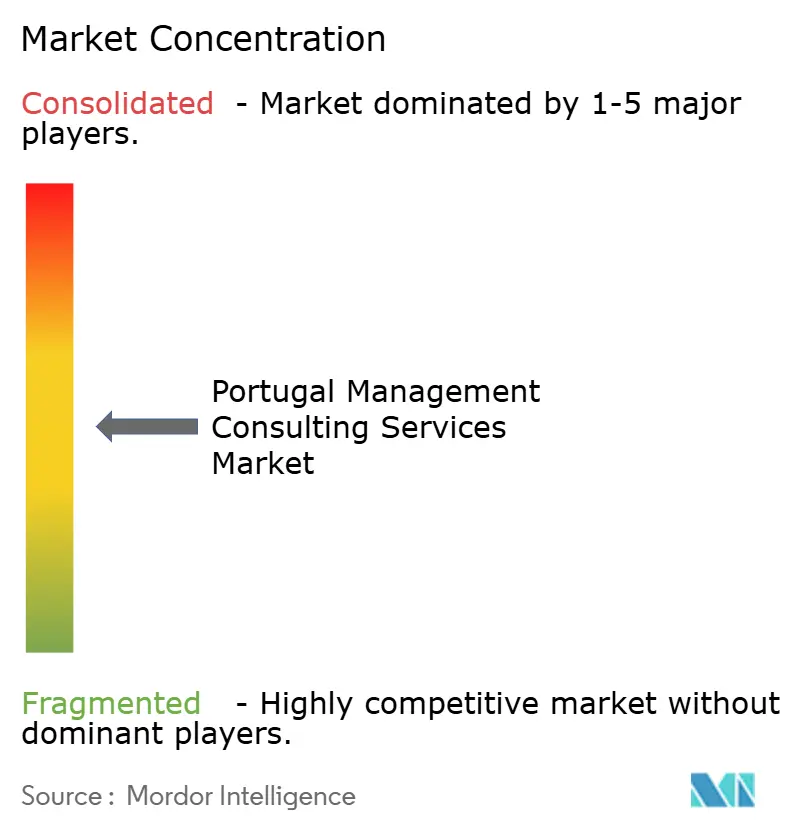
| Market Concentration | Medium |
Major Players *Disclaimer: Major Players sorted in no particular order Image © Mordor Intelligence. Reuse requires attribution under CC BY 4.0. | |
Portugal Management Consulting Services Market Analysis by Mordor Intelligence
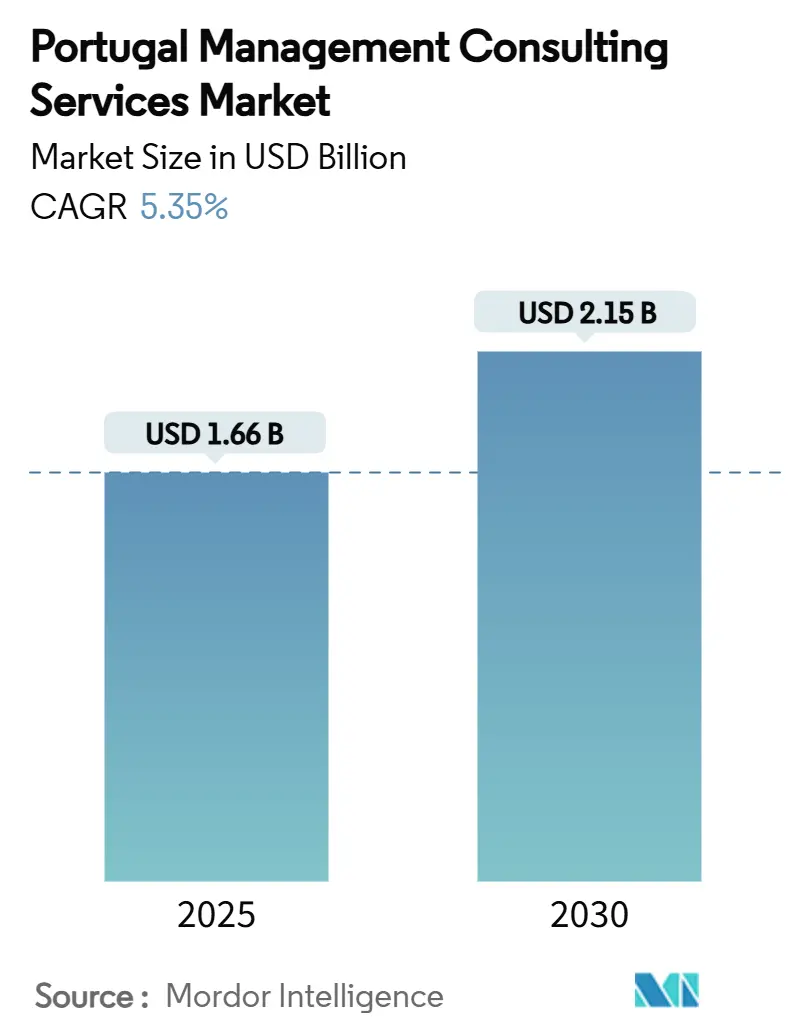
The Portugal management consulting services market is valued at USD 1.66 billion in 2025 and is projected to reach USD 2.15 billion by 2030, reflecting a 5.35% CAGR and underlining the market size growth momentum. Strong EU-funded digital-transition programs, Portugal’s appeal as a near-shoring destination, and large capital projects in batteries and aerospace continue to expand consulting opportunities, while talent retention challenges and price competition from niche firms apply counter-pressure. Investment fueled by the EUR 13.9 billion (USD 16.25 billion) Recovery and Resilience Plan, coupled with INCoDe 2030 digital-skills initiatives, sustains demand for technology, operations, and ESG-focused advisory services. Growing foreign direct investment, notably CALB’s EUR 2 billion (USD 2.34 billion) battery plant and Lufthansa Technik’s maintenance facility, further raises the profile of the Portugal management consulting services market, especially for implementation and integration projects. At the same time, remote-delivery capabilities gain traction as Gigabit connectivity rolls out nationwide, enabling firms to serve SMEs more cost-effectively.
Key Report Takeaways
- By organization size, large enterprises held 74.3% revenue share of the Portugal management consulting services market in 2024, whereas SMEs are advancing at a 5.49% CAGR through 2030.
- By service type, operations consulting commanded 31.4% of the Portugal management consulting services market share in 2024, while technology consulting is projected to expand at a 5.52% CAGR through 2030.
- By delivery model, on-site consulting retained 65.7% share of the Portugal management consulting services market size in 2024, whereas remote and virtual consulting is rising at a 5.66% CAGR through 2030.
- By end-user industry, financial services captured 25.4% of the Portugal management consulting services market in 2024; healthcare is forecast to post the fastest 5.41% CAGR through 2030.
Portugal Management Consulting Services Market Trends and Insights
Drivers Impact Analysis*
| Driver | (~) % Impact on CAGR Forecast | Geographic Relevance | Impact Timeline |
|---|---|---|---|
| Surge in EU-funded digital-transition programs | +1.2% | National, concentrated in Lisbon and Porto tech hubs | Medium term (2-4 years) |
| Near-shoring of knowledge services to Portugal | +0.9% | National, with spillover to Northern Portugal industrial zones | Long term (≥ 4 years) |
| Corporate sustainability and ESG compliance mandates | +0.8% | National, emphasis on large enterprises in Lisbon financial district | Short term (≤ 2 years) |
| Post-pandemic hybrid-work optimisation demand | +0.6% | National, concentrated in urban centers | Short term (≤ 2 years) |
| AI-enabled productivity leap for Portuguese SMEs | +0.7% | National, early adoption in technology corridors | Medium term (2-4 years) |
| Accelerated M&A integration after golden-visa wind-down | +0.5% | National, concentrated in financial services sector | Short term (≤ 2 years) |
| Source: Mordor Intelligence | |||
Surge in EU-funded digital-transition programs
Portugal’s Recovery and Resilience Plan allocates EUR 13.9 billion (USD 16.25 billion) to digital modernization through 2026, driving large public-sector projects that require system integration, change management, and cybersecurity consulting. LabX innovation centres and TicAPP competency initiatives expand digital skills in ministries, boosting multi-year advisory engagements for process re-engineering and service design. The European Digital Innovation Hubs position the country as a delivery base for AI and cloud rollouts across Southern Europe, widening the Portugal management consulting services market opportunity set.[1]Public-sector clients increasingly bundle technology advisory with governance optimisation, lifting demand for multidisciplinary teams. As a result, technology consulting revenues are forecast to outpace overall market growth, propelling firms with deep digital portfolios.
Near-shoring of knowledge services to Portugal
Northern European corporations select Portugal for culturally aligned, EU-compliant service centres, stimulated by competitive labour costs and improved ICT infrastructure. ICT exports now account for 4.1% of GDP, revealing rising sophistication that demands advanced organisational-design and operating-model advice. Investment announcements such as Lufthansa Technik’s 700-job aerospace facility exemplify complex integration scopes for operations and HR consultants. Two-way traders show higher productivity yet require optimisation of global delivery workflow, a specialty addressed by the Portugal management consulting services market. Over the long term, steady near-shoring inflows are expected to anchor recurring transformation workstreams for both global and local consultancies.
Corporate sustainability and ESG compliance mandates
Implementation of the Corporate Sustainability Reporting Directive and EU Taxonomy obliges thousands of Portuguese entities to redesign disclosure processes, spurring advisory demand for data strategy and impact measurement. [2] Decree-Law 24/2024 expands environmental-invoice obligations beginning January 2025, necessitating ERP customisation and audit reviews that consultants deliver. Renewable-energy targets requiring 93% clean electricity by 2030 heighten strategic planning needs for utilities and large energy users. The CMVM tightens oversight on climate and governance reporting, pushing financial institutions to engage specialised ESG teams for scenario analysis. Consequently, sustainability advisory is forecast to contribute a rising share of the Portugal management consulting services industry’s fee pool through the medium term.
AI-enabled productivity leap for Portuguese SMEs
Government-backed platforms such as Portugal Exporta AI aim to double the exporter base, highlighting the imperative for AI-driven market-entry analytics and sales automation consulting. More than 800 SME executives have enrolled in digital-transition training, signalling readiness to invest in tailored AI roadmaps. The European Digital Innovation Hubs supply vouchers and testing environments, yet SMEs rely on external advisors to translate pilots into scalable deployments. Studies show micro-firms lack structured digital strategies, opening revenue streams for consultants who package capability-building with rapid ROI deliverables. This trend elevates technology advisory margins and penetrates regional markets beyond Lisbon and Porto, reinforcing the growth trajectory of the Portugal management consulting services market.
Restraints Impact Analysis*
| Restraint | (~) % Impact on CAGR Forecast | Geographic Relevance | Impact Timeline |
|---|---|---|---|
| Talent drain of mid-level consultants to global hubs | -0.8% | National, concentrated in Lisbon and Porto metropolitan areas | Long term (≥ 4 years) |
| Slow decision-making in state-owned enterprises | -0.6% | National, emphasis on public sector and utilities | Medium term (2-4 years) |
| Price compression from boutique digital specialists | -0.4% | National, concentrated in technology consulting segments | Short term (≤ 2 years) |
| Shrinking M&A deal values signal consolidation pressure | -0.5% | National, cross-industry | Short term (≤ 2 years) |
| Source: Mordor Intelligence | |||
Talent drain of mid-level consultants to global hubs
An estimated 850,000 Portuguese aged 15-39 work abroad, thinning the domestic pool of experienced consultants and inflating project staffing costs. Although the IRS Jovem program grants multi-year tax exemptions, wage differentials with Germany and Belgium remain sizable, limiting repatriation incentives. Consulting firms increasingly adopt offshore talent strategies yet face integration hurdles that can prolong delivery timelines. Youth unemployment at 22% exposes mismatches between academic outputs and market needs, forcing firms to invest heavily in reskilling programs. Over the long term, persistent outbound migration may cap the attainable growth rate of the Portugal management consulting services market.
Slow decision-making in state-owned enterprises
Public-sector reform agendas such as Campus XXI aim to streamline inter-ministerial collaboration, but entrenched bureaucratic layers stretch procurement cycles and dilute project margins.[3] Studies reveal weak anticipatory-innovation capacity, with delivery gaps between policy ambition and execution. Justice-sector digitalisation shows lengthy tender evaluations that hinder cash-flow visibility for vendors. Complex bidding documents like DGADR’s IT-platform contract raise compliance overhead, especially for smaller advisory boutiques. These factors temper near-term consulting growth in sectors where the state controls critical infrastructure.
*Our forecasts treat driver/restraint impacts as directional, not additive. The impact forecasts reflect baseline growth, mix effects, and variable interactions.
Segment Analysis
By Organization Size: SMEs accelerate adoption of digital advisory
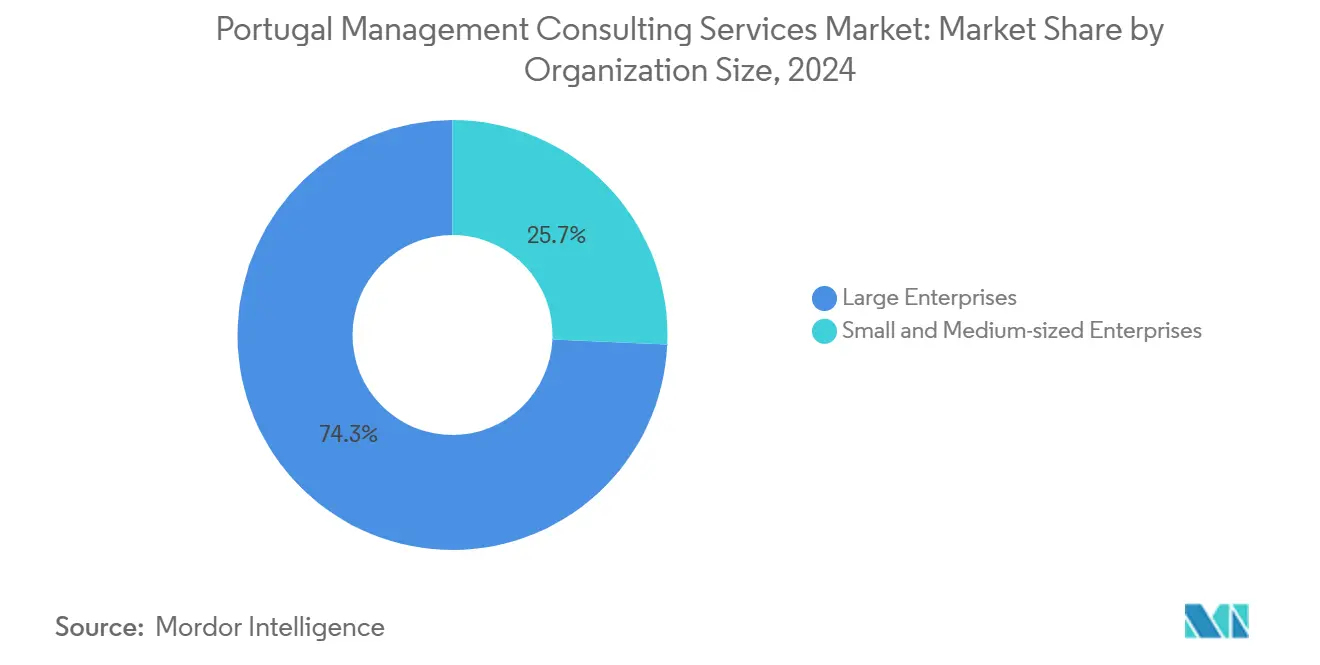
Large enterprises dominated the Portugal management consulting services market size with 74.3% revenue share in 2024, reflecting deep IT budgets and regulatory-driven transformation mandates in banking and telecom. Yet SMEs, which form 99.9% of Portuguese companies, are projected to grow consulting spend at a 5.49% CAGR to 2030 as subsidy programs lower the cost of professional services. Government funding of EUR 18 million (USD 21.04 million) under Portugal 2030 covers 50% of eligible SME digital projects, propelling demand for operational optimisation and sustainability frameworks. The European Digital Innovation Hubs complement this momentum by offering technical vouchers that external consultants convert into recurring engagements.
SME projects increasingly prioritise AI chatbots, e-commerce integration, and ESG reporting, opening a pipeline of quick-turn assignments that diversify revenue for mid-tier firms. The OECD notes persistent adoption gaps in cloud and advanced analytics, positioning advisors as critical enablers of competitiveness. Meanwhile, large enterprises continue to contract multi-year, large-ticket engagements encompassing ERP roll-outs and workforce-planning exercises. These long projects anchor baseline billings and stabilise market cash flows for leading providers within the Portugal management consulting services market.
By Service Type: Technology consulting outpaces traditional offerings
Operations consulting retained 31.4% Portugal management consulting services market share in 2024, driven by process-improvement mandates across manufacturing and logistics. Nonetheless, technology consulting is expected to record the highest 5.52% CAGR through 2030, buoyed by INCoDe 2030 targets and pervasive cloud-migration agendas. Digital innovation centres and public grant schemes foster demand for cybersecurity, data governance, and AI solution design, areas where global IT-services majors and local boutiques compete intensely.
Strategy advisory benefits from steady near-shoring inflows that require market-entry blueprints and location analyses. HR consulting rides a parallel wave as firms grapple with hybrid-work models and talent scarcity. Sustainability advisory also gains ground, catalysed by CSRD compliance deadlines and the drive toward 93% renewable electricity, both of which feed into ESG-linked operating-model redesigns. Together, these shifts signal diverse growth pockets within the Portugal management consulting services industry that reward firms with multi-disciplinary talent.
By Delivery Model: Remote consulting gathers pace
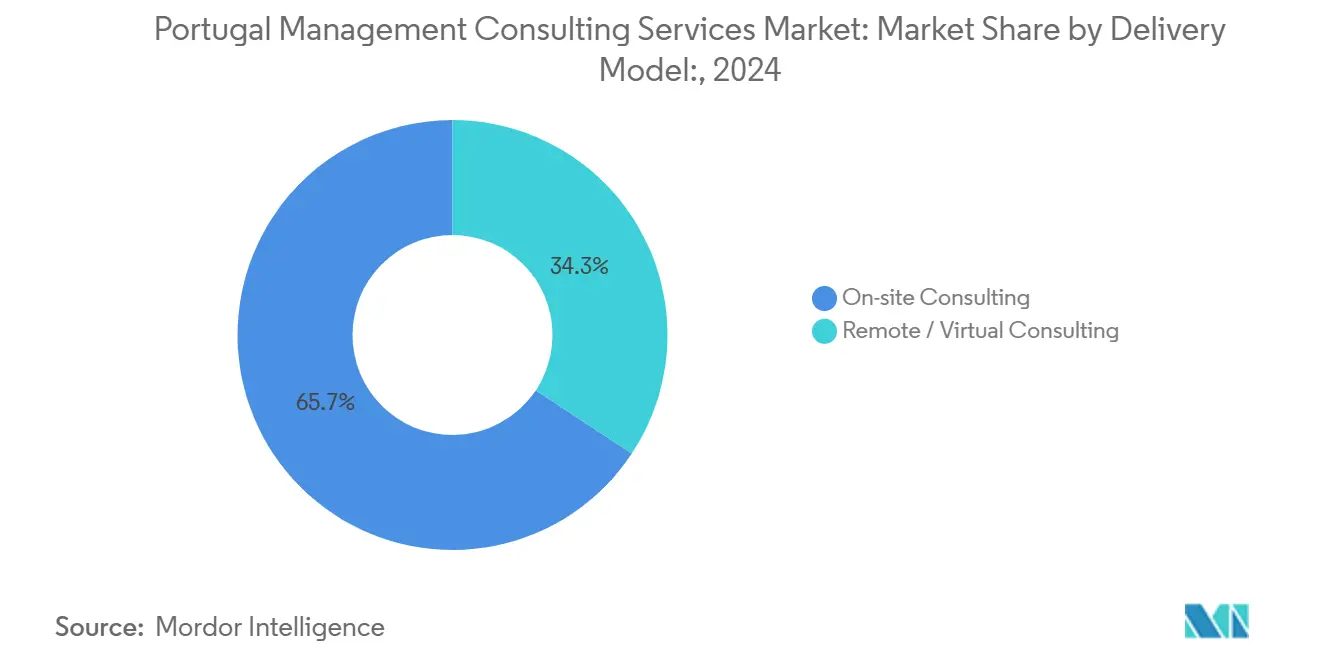
On-site engagements accounted for 65.7% of the Portugal management consulting services market size in 2024 because complex implementations in manufacturing and energy still demand physical presence. Yet remote and virtual consulting is forecast to rise at 5.66% CAGR, enabled by the National Connectivity Strategy that targets Gigabit coverage for every household by 2030. Firms increasingly deploy hybrid teams that operate virtually during diagnostic phases and switch to on-site mode for critical integration milestones. This blended model trims travel costs and accelerates project cycles, enhancing value for mid-cap clients.
SMEs in peripheral regions now access specialist expertise through secure collaboration platforms, expanding the addressable market for Lisbon-based advisors. Public-sector digital-service design workshops often run fully online, supporting carbon-reduction targets and spurring demand for facilitation tools. As bandwidth improves and clients adopt zero-trust security frameworks, remote delivery is set to deepen its share of the Portugal management consulting services market.
By End-user Industry: Healthcare offers fastest lane for advisory spend
Financial services held 25.4% of the Portugal management consulting services market in 2024, reflecting regulatory-heavy digital-banking and risk-modelling priorities. Healthcare, however, is projected to register a 5.41% CAGR through 2030, driven by electronic-health-record rollouts, telemedicine platforms, and Lean hospital management programs. Recovery and Resilience Plan allocations earmarked for health-system modernisation compel hospitals to engage consultants for workflow redesign and cybersecurity architecture.
Manufacturing sees renewed advisory demand due to CALB’s battery megaproject and textile-sector export expansion, creating supply-chain optimisation mandates. Energy and utilities clients seek transition roadmaps to meet 2030 renewable targets, fuelling cross-disciplinary engagements in asset-strategy and stakeholder reporting. Government ministries spearhead administration digitalisation and require extensive change-management support, whereas tourism-rich regions such as Algarve turn to consultants to enhance digital guest experiences. Collectively, these verticals diversify revenue streams for participants in the Portugal management consulting services market.
Geography Analysis
Lisbon remains the epicentre of the Portugal management consulting services market, propelled by the concentration of financial institutions, headquarters of SOEs, and large EU-funded transformation projects valued at EUR 13.9 billion (USD 16.25 billion). Campus XXI, LabX, and other capital-region initiatives sustain multi-year advisory pipelines focused on public-sector efficiency and citizen-service re-design.
Porto serves as a technology and manufacturing node, underpinned by Lufthansa Technik’s aerospace facility that necessitates implementation and training consultancy across operations, HR, and compliance domains. Northern Portugal’s textile cluster contributes EUR 6 billion (USD 7.01 billion) in exports and employs 126,940 workers, spawning continuous demand for supply-chain optimisation and sustainability services. The growing network of near-shore IT centres in Braga and Aveiro further stimulates technology-consulting requirements, solidifying regional contributions to the Portugal management consulting services market size.
Central and Southern regions gain prominence through renewable-energy and mining ecosystem projects that attract advisory mandates in permitting, social-impact assessment, and workforce development. Sines, home to CALB’s EUR 2 billion (USD 2.34 billion) battery plant, exemplifies greenfield investment workloads that enhance the national spread of consulting contracts. Algarve’s hospitality-driven economy engages consultants in digital-guest-experience and ESG certification programs supported by Portugal 2030 funds. Collectively, these dynamics extend the Portugal management consulting services market beyond its traditional urban cores.
Competitive Landscape
The Portugal management consulting services market exhibits moderate fragmentation as Big Four firms, global strategy houses, and IT-services majors battle specialised local players for share. Deloitte, PwC, EY, and KPMG leverage audit relationships to secure multi-service mandates, while McKinsey, BCG, and Bain target enterprise-wide transformations in banking and telecoms. Accenture, IBM Consulting, and Capgemini exploit EU-funded digital budgets, positioning their near-shore delivery centres as regional hubs.
Firms respond by investing in proprietary data assets, partnering with SaaS vendors, and recruiting diaspora professionals through flexible-work packages. As renewable-energy projects and supply-chain decarbonisation accelerate, consultancies with deep sector know-how are likely to capture premium engagements. Overall, strategic positioning around AI, ESG, and near-shore delivery will differentiate leaders in the Portugal management consulting services market.
Portugal Management Consulting Services Industry Leaders
-
Deloitte Touche Tohmatsu Limited
-
PricewaterhouseCoopers International Limited
-
Ernst & Young Global Limited
-
KPMG International Limited (Cooperative)
-
Accenture plc
- *Disclaimer: Major Players sorted in no particular order
Recent Industry Developments
- May 2025: Draycott completed a EUR 490 million (USD 572.74 million) acquisition of Verescence, the largest deal ever led by a Portuguese private-equity firm, underscoring growing local M&A sophistication.
- January 2025: The Portuguese M&A market generated EUR 12.6 billion (USD 14.73 billion) in 2024, maintaining strong integration-consulting demand.
- December 2024: Lufthansa Technik confirmed a multi-million-euro aerospace maintenance facility in Santa Maria da Feira, creating more than 700 jobs.
- July 2024: Autoestradas do Douro Litoral was sold to Igneo Infrastructure Partners for over EUR 400 million (USD 467.54 million), highlighting infrastructure-transaction opportunities.
Portugal Management Consulting Services Market Report Scope
| Large Enterprises |
| Small and Medium-sized Enterprises |
| Strategy Consulting |
| Operations Consulting |
| HR Consulting |
| Technology Consulting |
| Other Service Types |
| On-site Consulting |
| Remote / Virtual Consulting |
| IT and Telecommunications |
| Healthcare and Life Sciences |
| Financial Services (BFSI) |
| Manufacturing and Industrial |
| Energy and Utilities |
| Government and Public Sector |
| Real Estate and Construction |
| Retail and Consumer Goods |
| Media, Entertainment and Sports |
| Hospitality and Travel |
| Other Industries |
| By Organization Size | Large Enterprises |
| Small and Medium-sized Enterprises | |
| By Service Type | Strategy Consulting |
| Operations Consulting | |
| HR Consulting | |
| Technology Consulting | |
| Other Service Types | |
| By Delivery Model | On-site Consulting |
| Remote / Virtual Consulting | |
| By End-user Industry | IT and Telecommunications |
| Healthcare and Life Sciences | |
| Financial Services (BFSI) | |
| Manufacturing and Industrial | |
| Energy and Utilities | |
| Government and Public Sector | |
| Real Estate and Construction | |
| Retail and Consumer Goods | |
| Media, Entertainment and Sports | |
| Hospitality and Travel | |
| Other Industries |
Key Questions Answered in the Report
What is the current size of the Portugal management consulting services market?
The market stands at USD 1.66 billion in 2025 and is projected to reach USD 2.15 billion by 2030 at a 5.35% CAGR.
Which segment is expanding the fastest within the Portugal management consulting services market?
Technology consulting is forecast to post the highest 5.52% CAGR through 2030, reflecting widespread digital-transition funding.
Why is healthcare a major growth vertical for consulting firms in Portugal?
Recovery and Resilience Plan investments in electronic records, telemedicine, and Lean hospital programs fuel a 5.41% CAGR for healthcare consulting.
How is talent drain affecting the Portugal management consulting services industry?
Around 850,000 skilled Portuguese professionals work abroad, tightening the mid-level talent pool and potentially tempering long-term growth.
What impact do EU sustainability regulations have on consulting demand?
Implementation of the CSRD and environmental-invoice mandates requires companies to overhaul reporting systems, driving sustained ESG-related advisory engagements.
Are remote consulting services gaining traction in Portugal?
Yes, remote and virtual consulting is growing at a 5.66% CAGR, enabled by national Gigabit-connectivity targets and client acceptance of hybrid delivery models.