
Brazil Management Consulting Services Market Size and Share
Market Overview
| Study Period | 2020 - 2031 |
|---|---|
| Forecast Data Period | 2026 - 2031 |
| Base Year Market Size (2025) | USD 7.44 Billion |
| Market Size (2026) | USD 7.72 Billion |
| Market Size (2031) | USD 9.29 Billion |
| Growth Rate (2026 - 2031) | 3.78 % |
| Market Concentration | Medium |
Major Players *Disclaimer: Major Players sorted in no particular order Image © Mordor Intelligence. Reuse requires attribution under CC BY 4.0. | |
Brazil Management Consulting Services Market Analysis by Mordor Intelligence
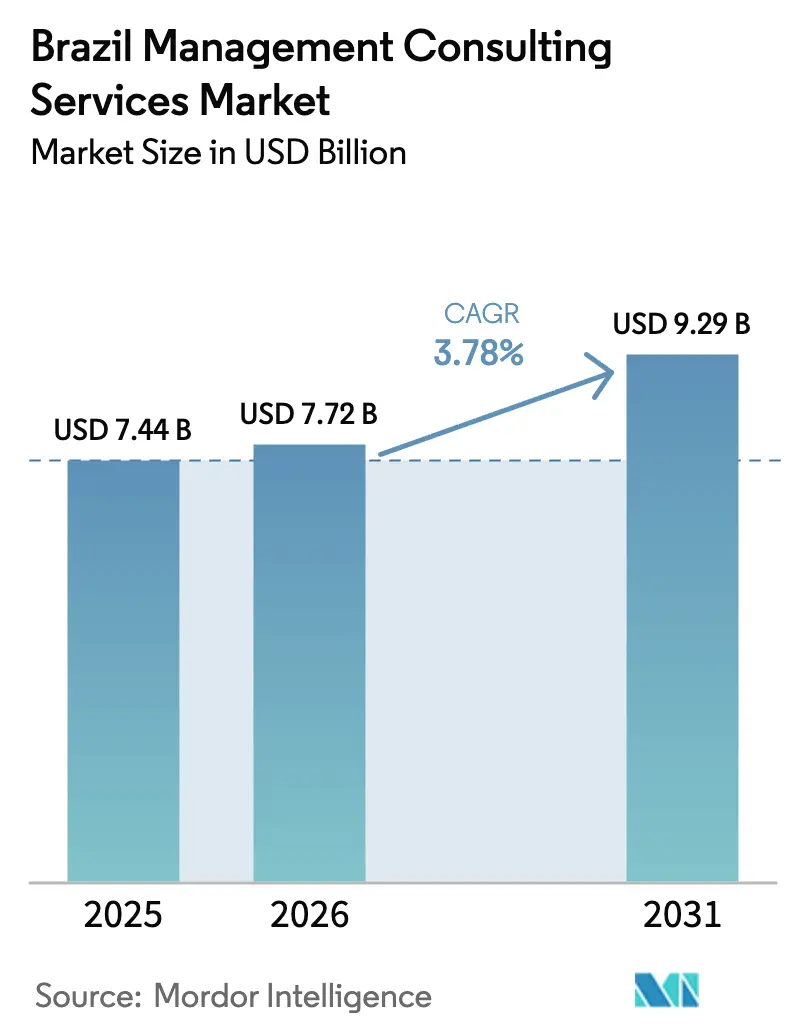
The Brazil management consulting services market size was valued at USD 7.44 billion in 2025 and estimated to grow from USD 7.72 billion in 2026 to reach USD 9.29 billion by 2031, at a CAGR of 3.78% during the forecast period (2026-2031). Robust regulatory activity by the Central Bank, sustained infrastructure concessions, and a streamlined public-procurement regime continue to shape growth prospects. Mandatory virtual-asset service provider (VASP) licensing, Banking-as-a-Service (BaaS) guidelines, and Piloto Drex distributed-ledger pilots heighten compliance needs in the financial core. Parallel ESG disclosure rules, green-hydrogen megaprojects, and the country’s COP30 hosting obligations create widening advisory avenues across energy, industry, and public administration. Consulting firms that marry domain depth with digital-delivery agility are securing long-cycle mandates, while localized mid-tier specialists leverage transparent e-bidding to win project-based engagements. Significant headroom still exists in small-enterprise adoption, where simplified procurement and instant-payment rails unlock advisory affordability for regional clients.
Key Report Takeaways
- By organization size, large enterprises held 70.88% of Brazil management consulting services market share in 2025, while small and medium-sized enterprises are forecast to advance at a 4.52% CAGR between 2026-2031.
- By service type, operations consulting accounted for 35.96% of the Brazil management consulting services market size in 2025, while technology consulting is projected to register the fastest 6.28% CAGR through 2031.
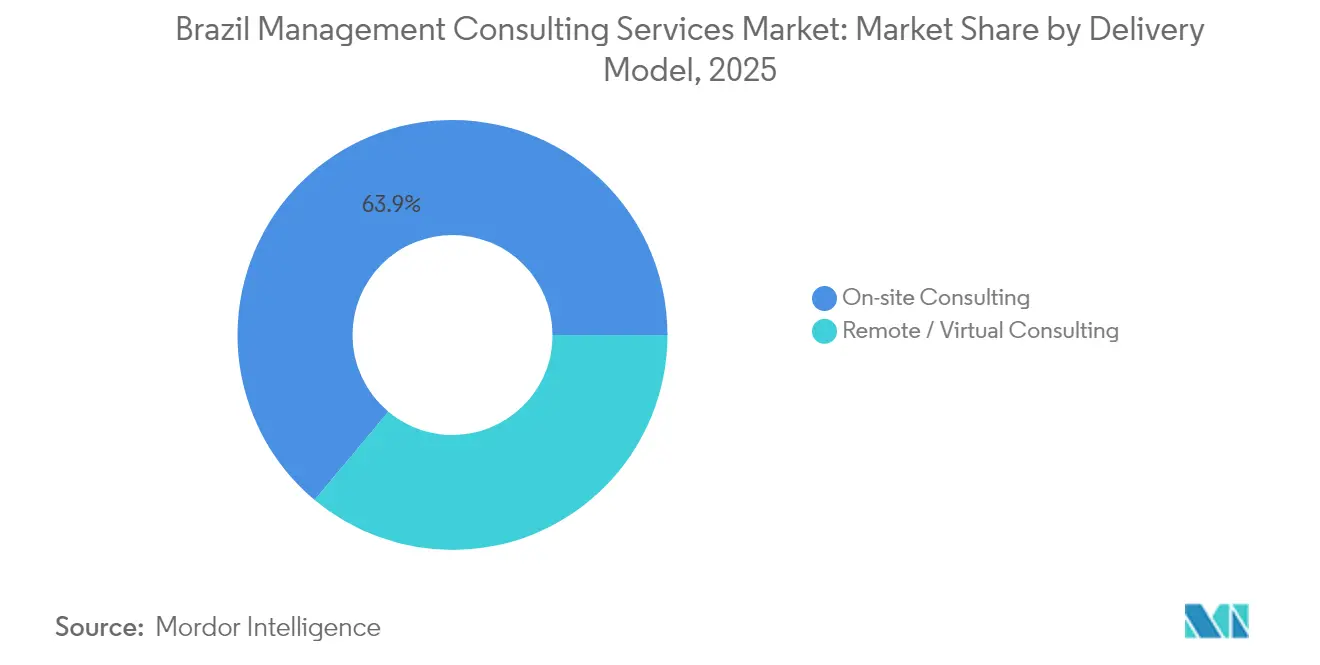
- By delivery model, on-site consulting retained 63.92% share of the Brazil management consulting services market size in 2025, while remote consulting is set to grow at a 4.12% CAGR over the same horizon.
- By end-user, financial services commanded 24.31% of the Brazil management consulting services market share in 2025, whereas healthcare and life sciences exhibit the highest 10.55% CAGR from 2026-2031.
Note: Market size and forecast figures in this report are generated using Mordor Intelligence’s proprietary estimation framework, updated with the latest available data and insights as of 2026.
Brazil Management Consulting Services Market Trends and Insights
Drivers Impact Analysis*
| Driver | (~) % Impact on CAGR Forecast | Geographic Relevance | Impact Timeline |
|---|---|---|---|
| Accelerating digital-transformation budgets | +1.2% | National; São Paulo, Rio de Janeiro, Brasília | Medium term (2-4 years) |
| Post-pandemic hybrid-work norms | +0.8% | National metros | Short term (≤ 2 years) |
| Regulatory push for ESG compliance | +1.0% | National; early uptake in finance and mining | Long term (≥ 4 years) |
| Expanding tech-startup ecosystem | +0.6% | São Paulo, Belo Horizonte, Florianópolis | Medium term (2-4 years) |
| Green-hydrogen mega-projects | +0.4% | Northeastern industrial corridors | Long term (≥ 4 years) |
| Source: Mordor Intelligence | |||
Accelerating Digital-Transformation Budgets in Large Brazilian Enterprises
Piloto Drex allocates 13 smart-contract use cases that necessitate distributed-ledger integration and cybersecurity hardening, prompting urgent systems-design and change-management engagements for tier-one banks. Union procurement digitalization through the PNCP intensifies demand for platform-interoperability mapping and workflow re-engineering across ministries. [1]Governo do Brasil, “Nova Lei de Licitações,” Gov.br Continuous BaaS rulemaking obliges incumbents to recalibrate partner governance, risk controls, and customer experience roadmaps. Advisory pipelines further expand as industrial majors deploy asset-tracking, remote-maintenance, and supply-chain visibility solutions to meet carbon-traceability mandates. Competitors that unify regulatory awareness with low-code configuration skills capture multi-year transformation retainer contracts.
Post-Pandemic Hybrid-Work Norms Boosting Demand for Remote Consulting
The nationwide Pix instant-payment network de-risks remote billing and reconciliations, enabling consultancies to extend coverage beyond metropolitan centers. PNCP user-journeys sanction digital submissions and virtual clarification hearings, validating off-site delivery for diligence, market-sizing, and process-mapping mandates. Cross-border fintechs such as FacilitaPay obtained Central Bank clearance for fully online payment orchestration, illustrating the compliance playbooks remote advisors must build for clients entering export corridors. Hybrid engagement cadences yield productivity gains for public-sector programs that previously depended on co-located workshops, while cloud-hosted collaboration suites accelerate iterative policy drafting. As regulatory consultations migrate to video-first channels, remote expertise transitions from contingency to core feature in Brazil management consulting services market contracts.
Regulatory Push for ESG Compliance Consulting Across Industries
Public Consultation 100/2024 mandates climate-risk taxonomies, Scope-3 emission tracking, and board-level oversight, compelling financial intermediaries to design data-governance blueprints and scenario-analysis models under advisory supervision. COP30 visibility multiplies ESG stakeholder scrutiny, positioning consultants as verification partners for renewable-energy sourcing, biodiversity metrics, and social-inclusion scorecards. [2]World Business Council for Sustainable Development, “WBCSD and CEBDS Join Forces to Deliver Business Impact on the Road to COP30,” wbcsd.org Banks must embed deforestation clauses into agribusiness portfolios, requiring third-party diligence frameworks. Instruction Normative 5 adds life-cycle assessment and waste-reduction criteria in federal tenders, raising the bar for supplier evaluation toolkits. Firms that cross-train strategy and sustainability units secure bundled mandates spanning disclosure alignment, green-bond structuring, and operating-model transitions.
Surge in Brazilian Tech-Startup Ecosystem Requiring Scale-Up Advisory
Minimum-capital thresholds of BRL 1 million to BRL 3 million for VASPs heighten the strategic imperative for compliance swim-lanes, investor communications, and phased license sequencing. Sandbox proposals under discussion would award iterative exemptions, opening demand for roadmap design and regulator interface coaching. PNCP harmonization encourages GovTech ventures to bid for modular microservices, prompting consulting assistance in proposal architecture and post-award performance-monitoring dashboards. United Nations Development Programme frameworks for digital platform diagnostics showcase external grant funding that startups tap with advisory guidance. As seed-stage entities pivot from product to scale, fractional CFO, go-to-market, and controls-build outsourcing collectively enlarge the Brazil management consulting services market client base.
Restraints Impact Analysis*
| Restraint | (~) % Impact on CAGR Forecast | Geographic Relevance | Impact Timeline |
|---|---|---|---|
| Macroeconomic volatility | -1.1% | National; cyclical sectors | Short term (≤ 2 years) |
| Talent attrition & wage inflation | -0.7% | Major metros | Medium term (2-4 years) |
| Culture-fit challenges for global firms | -0.5% | São Paulo, Rio de Janeiro, interior markets | Long term (≥ 4 years) |
| Source: Mordor Intelligence | |||
Macroeconomic Volatility Curbing Discretionary Consulting Spend
IMF projections see GDP deceleration and tighter fiscal stances, which compress ministry and SOE budgets for non-essential advisory scoping. New bidding laws amplify cost-efficiency scoring, forcing firms to sharpen value narratives and absorb margin pressure. Central Bank priority lists emphasize regulatory essentials over exploratory pilots, narrowing near-term opportunity funnels outside mandatory compliance. Delayed PPP closings and financing hesitations elongate sales cycles in transport, energy, and social-infrastructure tranches. Nevertheless, statutory obligations under VASP and ESG rules sustain a resilient baseline for the Brazil management consulting services market during economic lulls.
Talent Attrition and Wage Inflation Squeezing Consulting Profit Pools
Government digital squads and fintech scale-ups aggressively recruit blockchain, data-science, and sustainability specialists, pushing wage benchmarks upward. The Central-Bank VASP rulebook heightens the scarcity premium on distributed-ledger talent BCB.GOV.BR. COP30 planning committees compete for environmental consultants, inflating remuneration for ESG expertise. The Ministry of Management directly hires technical specialists for Union-property audits, intensifying private-public talent competition. [3]Ministério da Gestão, “Seleção de Consultoria Técnica para Imóveis da União,” gov.br PNCP scoring matrices reward bidder teams with verifiable certifications, adding training costs for consultancies.
*Our forecasts treat driver/restraint impacts as directional, not additive. The impact forecasts reflect baseline growth, mix effects, and variable interactions.
Segment Analysis
By Organization Size: Regulatory Complexity Sustains Large-Enterprise Dominance
Large enterprises represented 70.88% of the Brazil management consulting services market size in 2025 as mandatory VASP licensing and Piloto Drex onboarding demanded sophisticated compliance roadmaps. Advisory intensity deepens as these corporates build governance layers for BaaS partnerships and climate-risk disclosures. Within this cohort, cross-border banks, stock-exchange operators, and diversified conglomerates renew multi-year master-service agreements encompassing technology stack modernization and enterprise-wide cost-takeout. Large-cap industrials tap operations specialists to align plant-level emissions with COP30 benchmarks. Parallel board-education programs on fiduciary ESG duties further anchor retainer volumes.
Small- and medium-sized enterprises constitute the fastest-expanding slice, growing at 4.52% CAGR through 2031. Simplified PNCP templates, online tutorial repositories, and bid-bond waivers lower entry fences, enabling SMEs to procure short-cycle advisory on process mapping, regulatory filing, and digital marketing. Regional fintechs, ag-techs, and GovTechs prioritize modular compliance toolkits and investor-readiness packs, creating recurring micro-engagements for agile consultancies. As credit cooperatives and community banks scale under open-finance reform, the Brazil management consulting services market widens beyond legacy tier-one corporate dependency, though large-enterprise wallets will still dictate revenue share.




By Service Type: Technology Consulting Outpaces as Digital Mandates Multiply
Operations consulting retained 35.96% share of the Brazil management consulting services market size in 2025, anchored by concession-asset optimization, throughput debottlenecking, and supply-chain resilience. Highway, rail, and port auctions trigger feasibility studies, value-engineering, and maintenance-regime overhauls. Energy transition adds refinery revamps and grid digitalization to the backlog.
Technology consulting exhibits the highest 6.28% CAGR, fueled by distributed-ledger pilots, open-banking API hardening, cloud-migration roadmaps, and cybersecurity compliance audits. Ministries commission interoperability diagnostics to interlink legacy ERPs with PNCP workflows, while state treasuries solicit data analytics blueprints for revenue assurance. Accordingly, “Brazil management consulting services industry” players retool hiring toward software architects, DevSecOps squads, and AI ethics officers.
Strategy consulting remains integral where public-sector entities craft five-year transformation plans aligning fiscal anchors with green-growth pledges. HR and change-management advisory underpins massive reskilling programs tied to hybrid work and diversity quotas. Collectively, service-line cross-pollination cements bundled engagements that upscale fee density per client.
By Delivery Model: Remote Uptake Gains Institutional Legitimacy
On-site delivery still comprised 63.92% of 2025 engagement value as critical-path infrastructure audits, stakeholder workshops, and regulatory inspections favored physical presence. However, video-first consultations, digital whiteboards, and cloud sandboxes gained executive sponsorship during pandemic-era restrictions, seeding 4.12% CAGR in virtual-consulting bookings. The Central Bank’s choice to conduct BaaS and VASP hearings through streamed sessions validated remote protocols within formal rule-drafting processes.
Pix instant-settlement capability alleviates historic pain points in mileage reimbursement, per diem controls, and milestone payments. Instruction Normative 5 embeds documentation-digitization into procurement gates, normalizing e-signatures and secure-file vaults. These shifts lower operating costs, unlock nationwide talent pools, and drive price-competitive offerings, thereby enlarging the addressable demand for the Brazil management consulting services market outside megacities.
By End-User Industry: Financial Sector Retains Lead While Healthcare Accelerates
Financial services captured 24.31% of 2025 spend, given sweeping Central-Bank rulemaking and Piloto Drex sandbox expansion. Banks hire consultants to overhaul core banking, risk models, and customer-journey orchestration. Insurers engage actuaries and data scientists for IFRS 17 rollouts and telematics-enabled products. Capital markets operators refine trade surveillance algorithms under heightened market abuse scrutiny.
Healthcare and life sciences is projected to clock the briskest 10.55% CAGR. Water-irrigation labs, telemedicine reimbursements, and union-hospital asset audits translate into engineering, process, and compliance assignments. The impending COP30 spotlights health-impact assessments, antimicrobial-resistance monitoring, and pharma waste-disposal audits, accelerating sectoral advisory outlays. Manufacturing, energy, and public administration clients round out the opportunity matrix through hydrogen plant studies, decarbonization blueprints, and digital service design sprints, collectively expanding the Brazil management consulting services market footprint.
Geography Analysis
Brasília anchors demand via Central-Bank, Treasury, and planning-ministry mandates that steer nationwide regulation and digital-government architecture. Engagements often bundle policy design, IT blueprinting, and capacity-building, locking in multi-phase scopes. São Paulo and Rio de Janeiro sustain the densest private-sector pipelines, spanning capital-market reforms, ESG assurance, and mobility megaprojects. The two metros also house fintech clusters that attract cross-border partnership advisory.
Mato Grosso’s BRL 7.66 billion highway concessions ignite corridor-logistics optimisation studies and asset-management system rollouts. Northeastern states emerge as hydrogen hubs as wind-solar hybrids feed electrolyzers, birthing techno-economic advisory cells. Amazonian municipalities commission sustainability and biodiversity consults tied to carbon-credit methodologies. Interior markets widen through PNCP-enabled digital tenders, granting consultancies from any postcode equal visibility into federal, state, and municipal RFPs. Consequently, the Brazil management consulting services market balances its historic coastal skew with a rising inland share.
Competitive Landscape
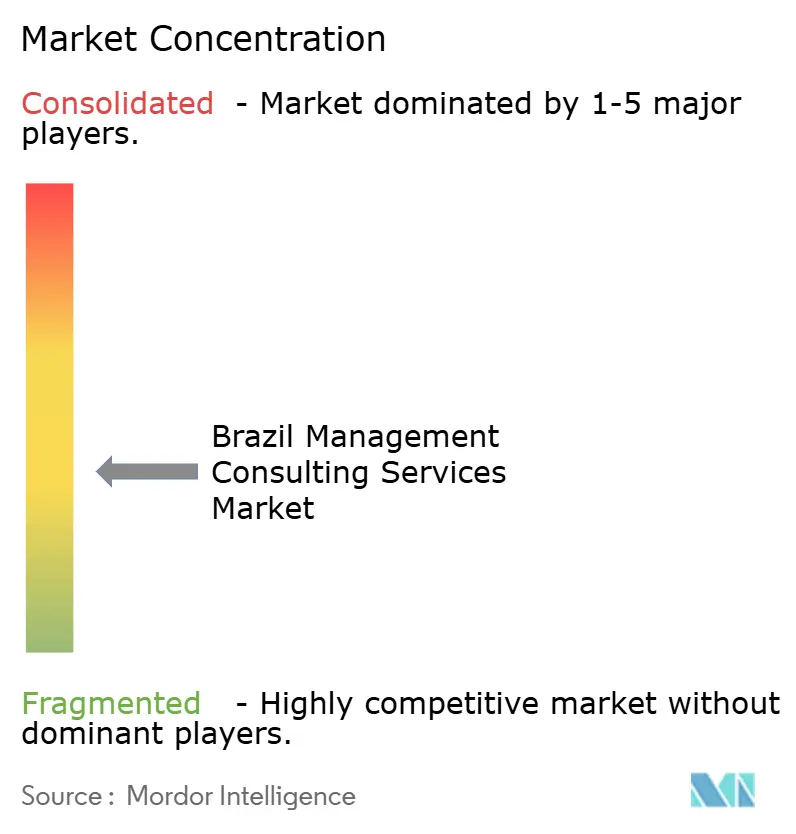
Market structure remains moderately fragmented: no single firm commands more than 10% of fee revenue. Big Four affiliates leverage audit relationships to cross-sell compliance bundles, while global strategy houses chase transformation mandates at top-tier banks and SOEs. Domestic boutiques excel in regulatory interpretation, court-filing navigation, and culturally attuned change-management, outmaneuvering multinationals in mid-cap pursuits. Cloud hyperscalers enter via advisory-led migration programs, blurring lines between technology vendors and consultancies.
Competitive levers now center on credential depth in VASP licensing, BaaS rollout, ESG reporting, and hydrogen project management. Firms that certify ISO 27001, obtain Central-Bank sandbox recognitions, or secure UN sustainable-procurement badges enjoy RFP scoring advantages. Pricing pressure from transparent PNCP scorecards rewards lean operating models and tool-aided delivery. The Brazil management consulting services market, therefore, rewards specialization, proof-of-execution, and digital operating leverage more than sheer headcount scale.
Brazil Management Consulting Services Industry Leaders
Accenture plc
McKinsey & Company Inc.
Boston Consulting Group Ltd.
Bain & Company Inc.
Deloitte Touche Tohmatsu Ltd.
- *Disclaimer: Major Players sorted in no particular order

Recent Industry Developments
- February 2025: Central Bank published phase-one Piloto Drex report, detailing interoperability premises and compliance checkpoints.
- February 2025: Central Bank extended public-consultation deadlines on BaaS and VASP rules, prolonging advisory drafting cycles.
- January 2025: Central Bank opened Consultation 117/2025 on financial-institution naming standards, triggering brand-strategy assignments.
- November 2024: Public Consultations 109 & 110 outlined three-tier VASP framework with R$ 1 million–R$ 3 million capital floors.


Brazil Management Consulting Services Market Report Scope
| Large Enterprises |
| Small and Medium-sized Enterprises |
| Strategy Consulting |
| Operations Consulting |
| HR Consulting |
| Technology Consulting |
| Other Service Types |
| On-site Consulting |
| Remote / Virtual Consulting |
| IT and Telecommunications |
| Healthcare and Life Sciences |
| Financial Services (BFSI) |
| Manufacturing and Industrial |
| Energy and Utilities |
| Government and Public Sector |
| Real Estate and Construction |
| Retail and Consumer Goods |
| Media, Entertainment and Sports |
| Hospitality and Travel |
| Other End-user Industries |
| By Organization Size | Large Enterprises |
| Small and Medium-sized Enterprises | |
| By Service Type | Strategy Consulting |
| Operations Consulting | |
| HR Consulting | |
| Technology Consulting | |
| Other Service Types | |
| By Delivery Model | On-site Consulting |
| Remote / Virtual Consulting | |
| By End-user Industry | IT and Telecommunications |
| Healthcare and Life Sciences | |
| Financial Services (BFSI) | |
| Manufacturing and Industrial | |
| Energy and Utilities | |
| Government and Public Sector | |
| Real Estate and Construction | |
| Retail and Consumer Goods | |
| Media, Entertainment and Sports | |
| Hospitality and Travel | |
| Other End-user Industries |


Key Questions Answered in the Report
What is the projected revenue of the Brazil management consulting services market in 2031?
The market is forecast to reach USD 9.29 billion by 2031 under a 3.78% CAGR.
Which client segment is expanding the quickest?
Small and medium-sized enterprises are growing at a 4.52% CAGR on the back of simplified e-procurement rules.
Why is technology consulting outpacing other service lines?
Distributed-ledger pilots, open-banking mandates, and cloud-migration programs are driving a 6.28% CAGR in technology advisory spend.
Which region is emerging for green-hydrogen consulting?
Northeastern industrial corridors are attracting hydrogen projects that require specialized operations consulting.
How are remote-consulting engagements being paid?
The Pix instant-payment system enables secure real-time settlements, reducing logistical friction for virtual advisory contracts.
What factor most influences firm selection in public tenders?
Technical expertise and cost-efficiency scores now outweigh legacy relationships due to transparent PNCP evaluation criteria.
Page last updated on:


 Your data is secure and never sold or shared.


