
Polyvinylidene Chloride (PVDC) Coated Films Market Size and Share
Market Overview
| Study Period | 2021 - 2031 |
|---|---|
| Market Size (2026) | USD 1.58 Billion |
| Market Size (2031) | USD 1.84 Billion |
| Growth Rate (2026 - 2031) | 3.04 % |
| Fastest Growing Market | South America |
| Largest Market | Asia Pacific |
| Market Concentration | Medium |
Major Players *Disclaimer: Major Players sorted in no particular order Image © Mordor Intelligence. Reuse requires attribution under CC BY 4.0. | |
Polyvinylidene Chloride (PVDC) Coated Films Market Analysis by Mordor Intelligence
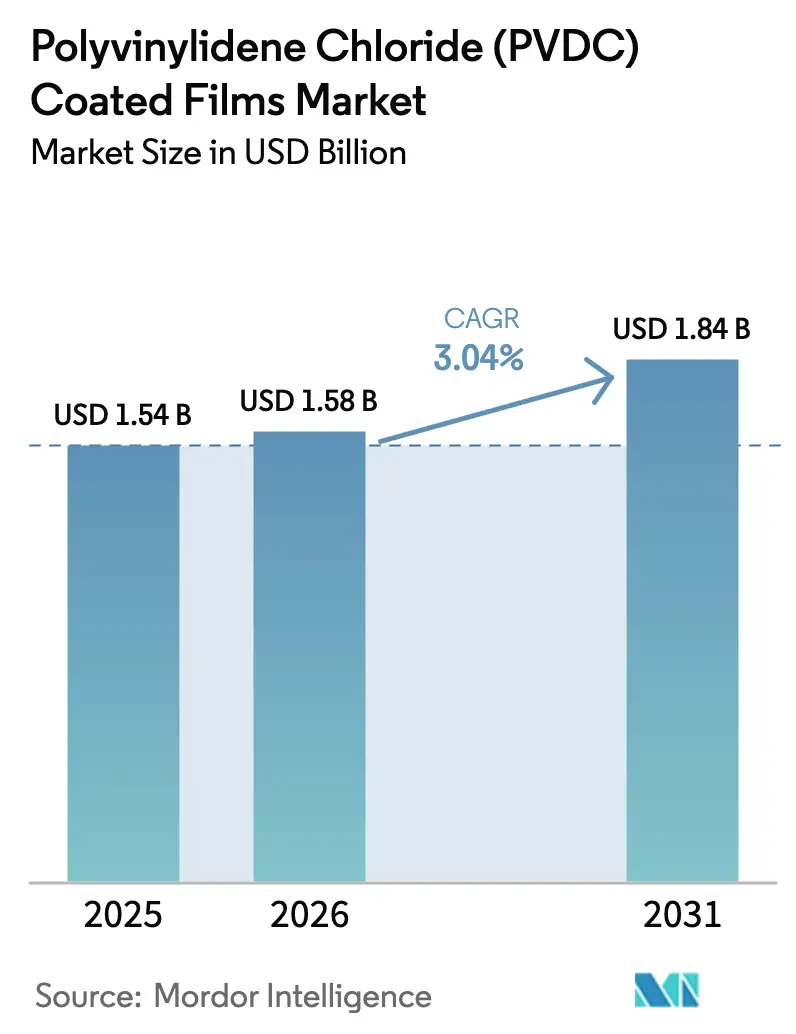
The Polyvinylidene Chloride Coated Films Market size was valued at USD 1.54 billion in 2025 and is estimated to grow from USD 1.58 billion in 2026 to reach USD 1.84 billion by 2031, at a CAGR of 3.04% during the forecast period (2026-2031). This steady climb reflects persistent demand from food brands that require oxygen- and moisture-tight packs for chilled meat, cheese, and ready-to-eat meals, as well as pharmaceutical companies that rely on blister formats to safeguard moisture-sensitive active ingredients. Growth is tempered by expanding adoption of recyclable mono-material EVOH and polyolefin structures that help brand owners satisfy circular-economy targets. Producers are also wrestling with higher vinylidene-chloride (VDC) feedstock costs as European chlor-alkali plants decarbonize, raising the appeal of lighter-coat PVDC grades that reduce resin use. Meanwhile, trial success in mechanically recycling PE/PVDC multilayers suggests that end-of-life objections may soften if waste handlers accept these films into polyethylene streams.
Key Report Takeaways
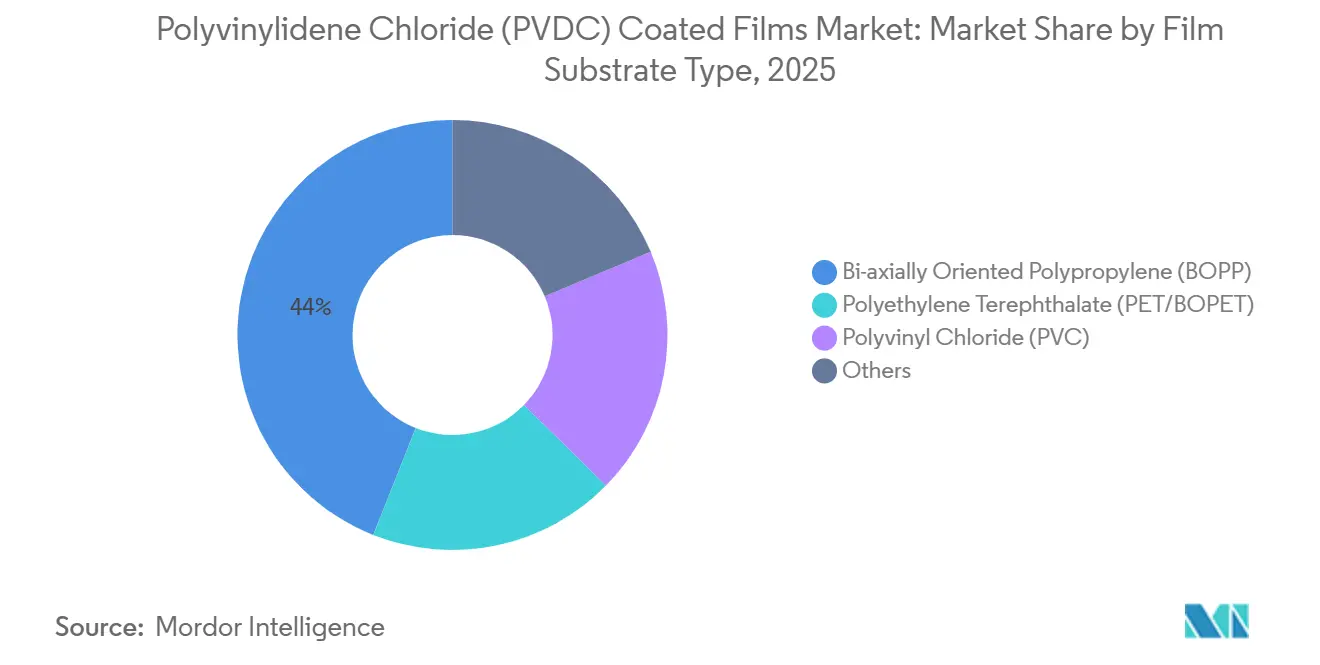
- By film substrate, bi-axially oriented polypropylene (BOPP) led with 44% of the PVDC-coated films market share in 2025. Polyvinyl chloride (PVC) is forecast to expand at a 3.67% CAGR through 2031.
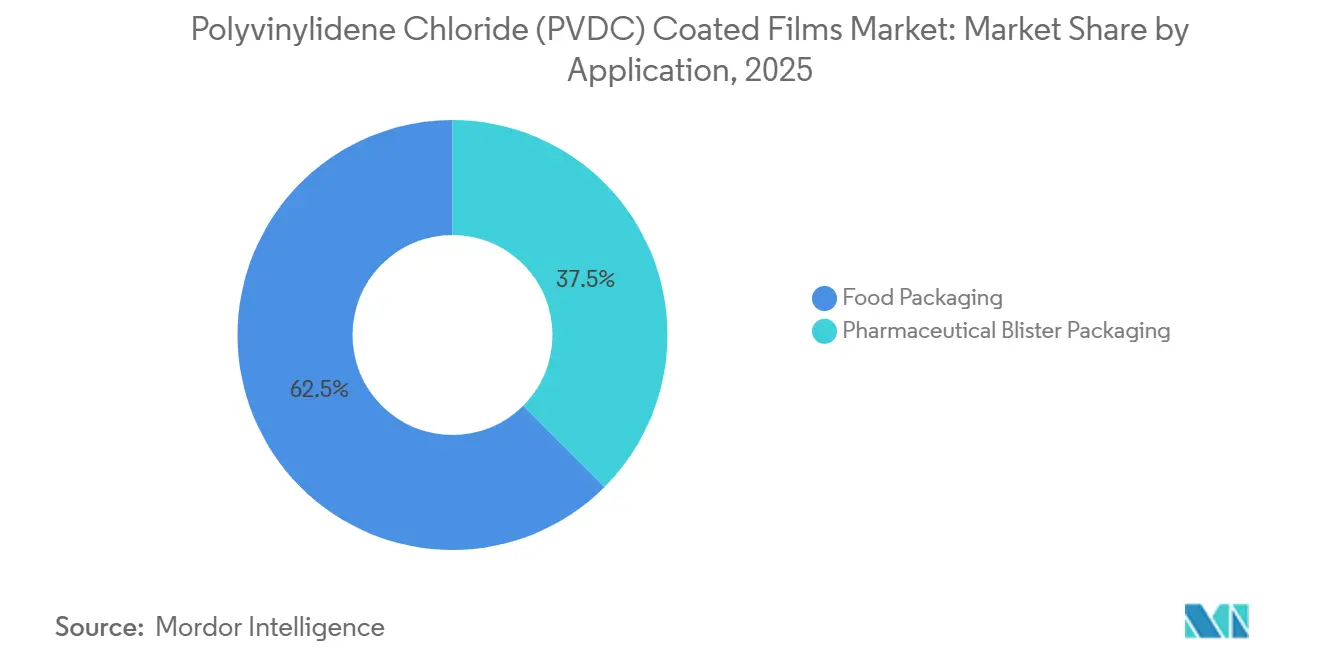
- By application, food packaging accounted for 62.50% of demand in 2025. Pharmaceutical blister packaging is advancing at a 4.38% CAGR through 2031.
- By geography, Asia-Pacific captured 41.38% revenue in 2025, while South America records the fastest regional CAGR of 3.57% to 2031.
Note: Market size and forecast figures in this report are generated using Mordor Intelligence’s proprietary estimation framework, updated with the latest available data and insights as of January 2026.
Market Trends and Insights
Drivers Impact Analysis of Polyvinylidene Chloride (PVDC) Coated Films Market*
| Drivers | (~) % Impact on CAGR Forecast | Geographic Relevance | Impact Timeline |
|---|---|---|---|
| Processed and Ready-to-Eat Food Boom | +1.2% | Global, with strongest uptake in Asia-Pacific urban centers and North America convenience retail | Medium term (2-4 years) |
| Pharmaceutical Blister‐Pack Adoption Surge | +0.9% | Europe, North America, and India (generic-drug export hubs) | Long term (≥ 4 years) |
| Superior Gas- and Moisture-Barrier Performance | +0.7% | Global, particularly critical in tropical/humid climates (Southeast Asia, South America, Middle East) | Short term (≤ 2 years) |
| Shift to Ultra-Thin (less than 15 µm) PVDC Coatings | +0.5% | Europe and North America, driven by lightweighting mandates and plastic-tax minimization | Medium term (2-4 years) |
| Emergence of PFAS-Free Fluorine-Free PVDC Grades | +0.4% | North America and European Union, in response to FDA and EFSA food-contact restrictions | Long term (≥ 4 years) |
| Source: Mordor Intelligence | |||
Processed and Ready-to-Eat Food Boom
As urban incomes rise and lifestyles grow busier, there's a heightened demand for portion-controlled, shelf-stable meals. These meals need to remain fresh for an extended period during chilled distribution. PVDC-coated BOPP and PET films facilitate modified-atmosphere packaging, effectively curbing lipid oxidation and microbial spoilage. In response to surging orders from ready-meal brands in India and the Middle East, UFlex is ramping up production of barrier film in Karnataka. Brand owners are now opting for thinner coatings over traditional designs, achieving cost reductions while maintaining shelf life. While compliance with FDA 21 CFR 177.1980 and EU 10/2011 is essential, converters can gain a competitive advantage by certifying pasteurization durability at high temperatures.
Pharmaceutical Blister-Pack Adoption Surge
Producers of generic drugs in India and Eastern Europe are shifting from strip packs to thermoformed PVC/PVDC blisters. This move is to meet the ICH Q1A moisture-barrier criteria for active pharmaceutical ingredients (APIs) like aspirin and antibiotics. PVC laminated with PVDC ensures a longer shelf life even in Zone IVb climates. Despite undergoing a Chapter 11 restructuring, Klöckner Pentaplast is doubling down on investments in pharmaceutical-grade PVC/PVDC. The company is keenly aware of the premium margins associated with ultra-high-barrier grades, which are essential for biologics. The European Medicines Agency's guidance on package-integrity testing has solidified PVDC's significance in the industry. This is especially true given that alternative ceramic-oxide coatings don't have robust long-term field data backing their efficacy.
Superior Gas and Moisture Barrier Performance
PVDC's crystalline VDC-MA structure offers oxygen permeability that's significantly lower than EVOH, especially under high humidity. This advantage is particularly beneficial in regions like Southeast Asia, South America, and the Middle East, where humidity levels frequently surpass 70%. Comparative trials show chilled beef in PVDC-coated BOPP maintains color stability longer than in EVOH laminates under 4 °C storage[1]. High-shrink PVDC grades help sausage casings modulate CO₂ and O₂ exchange, while ultra-low-WVTR formulations protect dried fruit from moisture pickup during monsoon warehousing.
Shift to Ultra-Thin (less than 15 µm) PVDC Coatings
In Europe, plastic-tax penalties and demand-weighted fees in the UK are pushing converters to reduce coat weight. Syensqo’s Diofan Ultra736 is facilitating thinner dry coatings by boosting emulsion solids and minimizing pinhole risks. New lines in Europe are now commonly equipped with inline gravimetric sensors and closed-loop tension control, ensuring coat-weight variations remain within ±3 g/m².
Restraints Impact Analysis of Polyvinylidene Chloride (PVDC) Coated Films Market*
| Restraints | (~) % Impact on CAGR Forecast | Geographic Relevance | Impact Timeline |
|---|---|---|---|
| Competition from EVOH and Metallized Barriers | -0.8% | Europe and North America, where recyclability and RecyClass certification drive material selection | Medium term (2-4 years) |
| End-of-Life/Chlorine-based Recycling Concerns | -0.6% | European Union (PPWR mandates), United Kingdom, and select United States states with advanced EPR frameworks | Long term (≥ 4 years) |
| VDC-Monomer Supply Volatility Amid Chlor-Alkali Decarbonisation | -0.4% | Global, with acute pressure in Europe due to energy-intensive electrolysis and carbon-border-adjustment mechanisms | Short term (≤ 2 years) |
| Source: Mordor Intelligence | |||
Competition from EVOH and Metallized Barriers
Nine-layer blown EVOH films commissioned by Coveris in the United Kingdom provide sub-1 cm³/m²/day OTR in dry conditions and can be recycled within polyethylene waste streams[2]. Falling EVOH resin prices and rising VDC costs are shrinking PVDC’s historical cost edge, particularly in dry-goods packaging where absolute humidity is low. Metallized PET and AlOx-coated films additionally appeal to snack-food brands that demand a light barrier, although opacity restricts their use for fresh meat.
End-of-Life / Chlorine-Based Recycling Concerns
PVDC’s chlorine content raises worries about hydrochloric acid release during incineration and contamination of polyolefin recycle streams. The EU Packaging and Packaging Waste Regulation requires practical recyclability by 2030, placing PVDC multilayers under scrutiny. Syensqo’s 2025 mechanical-recycling breakthrough shows PE/PVDC films can be reprocessed at 220 °C without stabilizers, yet municipal acceptance is inconsistent and converters must still pay national plastic taxes in Germany and France.
*Our forecasts treat driver/restraint impacts as directional, not additive. The impact forecasts reflect baseline growth, mix effects, and variable interactions.
Polyvinylidene Chloride (PVDC) Coated Films Market Segment Analysis
By Film Substrate Type:
BOPP Dominance Driven by Cost and MachinabilityBOPP claimed a 44% share of the PVDC-coated films market in 2025, reflecting its low resin cost and high run speeds on rotogravure coaters. Many converters adeptly process 20 µm BOPP bases at high speeds, achieving the tensile strength essential for bone-in meat packaging. BOPET, catering to premium trays subjected to mild pasteurization, commands a notable price premium. While PVC holds only a modest volume share, it will log the fastest 3.67% CAGR because of blister demand. The market size for PVDC-coated films linked to polyvinyl chloride is set to rise in the coming years. Additionally, specialty niches like polyamide sausage casings and PLA stand-up pouches contribute to the “others” category.
BOPP’s lead faces challenges from recyclable mono-PP lidding, achieving low OTR without the need for PVDC. Should upcoming scale-up trials prove successful, downgauged mono-PP might threaten BOPP’s market share in PVDC-coated films by decade's end. However, any transition depends on converters confirming barrier stability at high relative humidity, a benchmark currently favoring PVDC structures.

By Application:
Food Packaging Volume Versus Pharmaceutical GrowthFood accounted for 62.5% of segment revenue in 2025, with chilled meats leading the charge, necessitating an OTR of less than 5 cm³/m²/day. Retailers appreciate PVDC's clarity, allowing shoppers to verify meat color—an edge that metallized and ceramic-oxide films lack. Yet, with a growing focus on RecyClass certification, dry-goods brands are increasingly leaning towards EVOH.
Pharmaceutical blister packs, while smaller, are rising at a 4.38% CAGR through 2031. The market for PVDC-coated films in blister formats is driven by India's expanding generic-drug exports and the introduction of moisture-sensitive biologics in the United States and Europe. Drug manufacturers, seeking a three-year shelf life, are gravitating towards ultra-high-barrier PVDC grades, which are priced higher than standard laminates, due to their OTR requirement.
Geography Analysis
APAC Polyvinylidene Chloride (PVDC) Coated Films Market
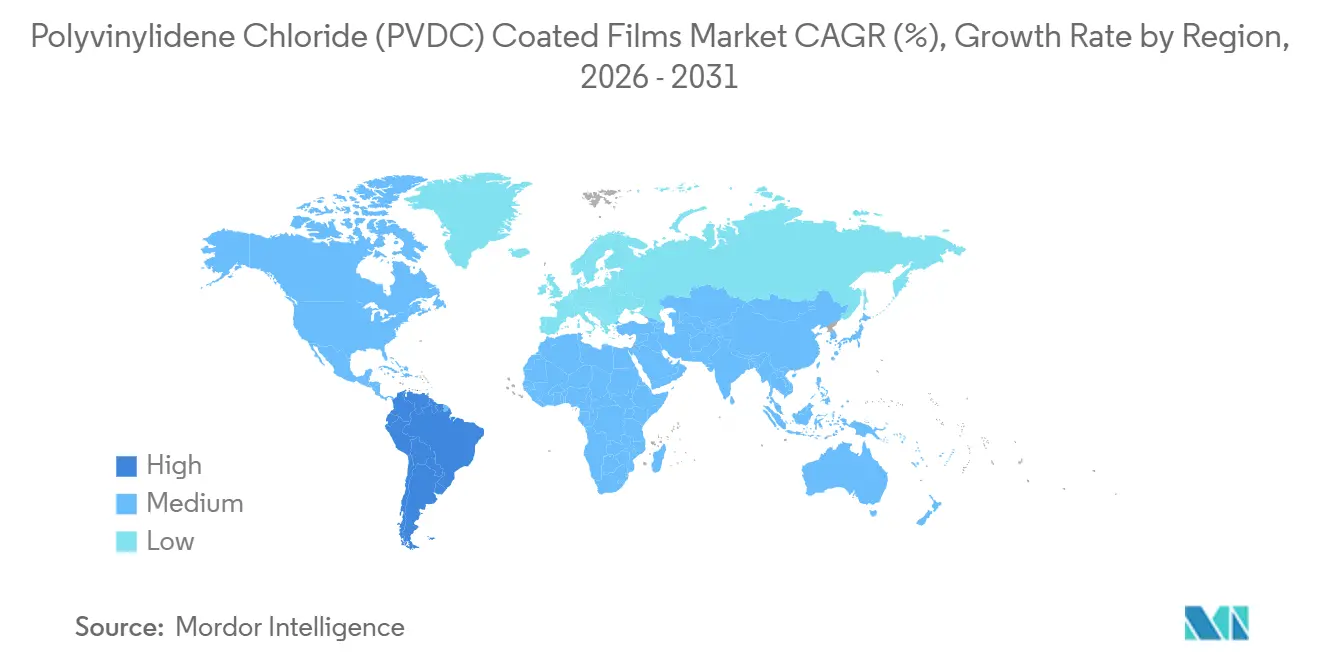
Asia-Pacific held 41.38% of the PVDC-coated films market revenue in 2025 on the back of India’s and China’s integrated film capacity and strong retail modernization. Jindal Poly Films and Cosmo Films run in-house PVDC coating that lets them tweak barrier properties to local humidity and distribution conditions. Rising blister exports from India to regulated markets further underpin demand.
South America Polyvinylidene Chloride (PVDC) Coated Films Market
South America, led by Brazil and Argentina, posts the fastest 3.57% regional CAGR to 2031. As supermarket penetration rises, converters upgrade from waxed wraps to PVDC high-barrier films that extend refrigerated shelf life. Domestic regulations are less stringent on recyclability, giving PVDC a window of opportunity even as European brand owners tighten specifications.
EMEA and North America Polyvinylidene Chloride (PVDC) Coated Films Market
North America balances strong blister-pack growth with early extended-producer-responsibility (EPR) moves in California and Maine that penalize non-recyclable formats. Syensqo’s recycling breakthrough could mitigate these fees if sortation systems accept PE/PVDC multilayers. Europe presents the stiffest challenge: the Packaging and Packaging Waste Regulation demands recyclability at scale by 2030 and levies plastic taxes on non-recyclables. Some municipal systems have begun to trial the Syensqo protocol, but acceptance is far from uniform. The Middle East and Africa remain small yet rising, with Saudi Arabia’s premium dairy segment and South Africa’s pharmaceutical imports driving niche demand.
Value Chain Analysis
The PVDC-coated film value chain begins upstream with vinylidene chloride (VDC) chemistry and PVDC resin or latex supply, which is relatively concentrated and exposed to chlor-alkali and energy-cost dynamics. Material suppliers such as Syensqo (Ixan PVDC) and Asahi Kasei provide PVDC dispersions and resins formulated for barrier performance and compliance, while base-film substrates (BOPP, BOPET, and PVC) are sourced from large polymer-film producers. VDC-based input availability and pricing, along with food-contact and pharma packaging qualification requirements, act as key bottlenecks that affect lead times and margin pass-through across regions.
Midstream, specialty coaters and integrated film producers apply thin PVDC layers to substrates using high-speed coating lines, then slit, laminate, and convert into structures designed for specific end uses, including food packs that need clarity and a high-humidity barrier and pharmaceutical blisters that need consistent moisture protection across stability conditions. Downstream, packaging converters, blister packers, and brand owners set performance targets (OTR/WVTR, sealability, and heat resistance) and increasingly add end-of-life constraints, including compatibility with PE/PP recycling streams and national packaging fees. These requirements can redirect procurement toward downgauged PVDC coatings or alternative barrier systems. Distribution typically runs through direct contracts with large food and pharma converters, while regional players also serve smaller customers via local warehouses and technical service for qualification and line-trial support.
Competitive Landscape
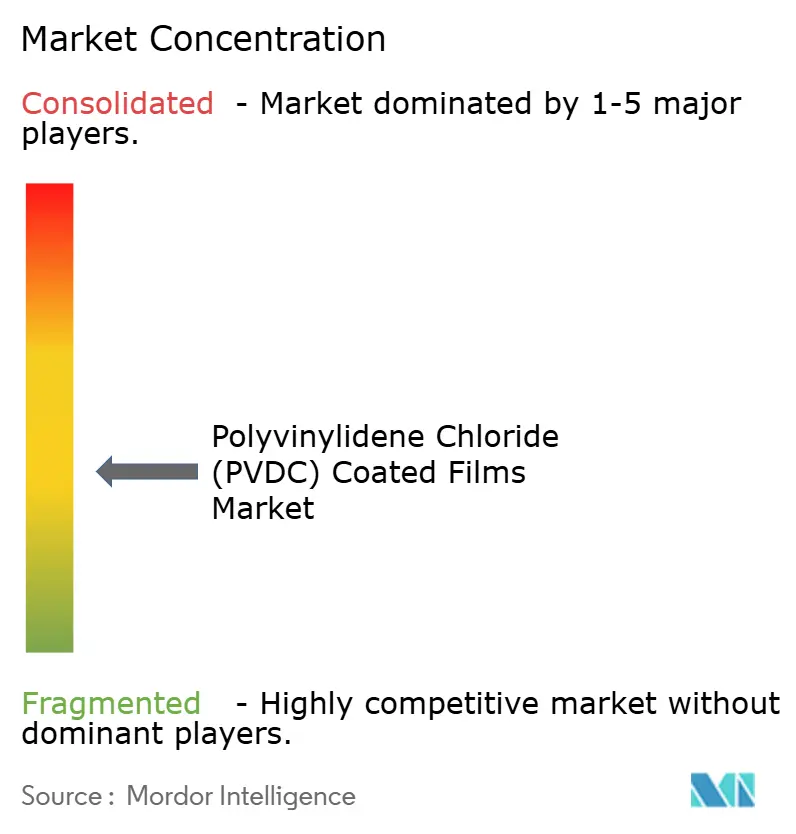
The polyvinylidene chloride (PVDC) coated films market is moderately fragmented. Regional converters compete by offering substrate variety and short lead times. Many maintain parallel EVOH lines to pivot when VDC pricing spikes. Disruptors push ceramic-oxide-coated PET that matches PVDC’s OTR in dry climates and flows into PET recycle streams, attracting snack and coffee brands focusing on light and oxygen barrier. Yet PVDC retains a defensible niche in humid markets and in medical packs where multi-year barrier data trump recyclability.
Polyvinylidene Chloride (PVDC) Coated Films Industry Leaders
-
CCL Industries
-
KUREHA CORPORATION
-
UNITIKA LTD
-
Jindal Poly Films Limited
-
Klöckner Pentaplast
- *Disclaimer: Major Players sorted in no particular order
Polyvinylidene Chloride (PVDC) Coated Films Market Companies Covered in this Report
- ACG
- Asahi Kasei Corporation
- Bilcare Limited
- Caprihans India Limited
- CCL Industries
- Cosmo Films
- Glenroy Inc.
- Huawei Pharma Foil Packaging
- Jindal Poly Films Limited
- Kaveri Metallising & Coating Ind. Private Limited
- Klöckner Pentaplast
- KUREHA CORPORATION
- Liveo Research
- Perlen Packaging
- POLINAS
- Polyplex
- Qingdao Kingchuan Packaging
- RMCL
- Solvay
- Tekni-Plex Inc.
- Tipack Group
- Transparent Paper Ltd.
- UNITIKA LTD
- Valtec Italia SRL
- Vibac Group S.p.a.
Market Opportunities and Future Outlook
Opportunities center on preserving PVDC use in applications where humidity-stable barrier performance and long-term field data carry more weight than mono-material recyclability, while reducing end-of-life objections through design and qualification changes. Pharmaceutical blister packaging is a key anchor for PVDC-coated structures because stability protocols and moisture-barrier requirements continue to support PVC/PVDC adoption for moisture-sensitive products, which creates room for ultra-high-barrier grades, tighter process-control offerings, and qualification support that lowers changeover risk for drug makers and blister converters. In food packaging, PVDC-coated BOPP and PET continue to fit chilled and humid distribution profiles, where barrier performance is less penalized by relative humidity than in some alternative structures, supporting demand for lightweight ultra-thin PVDC coatings that reduce resin use without sacrificing shelf-life outcomes.
The most actionable pathway is improving circularity compatibility without forcing immediate full-material substitution. Syensqo reported mechanical-recycling trials for PE/PVDC multilayers that were validated to EN 13430, which gives converters a technical route to keep PVDC in high-barrier food structures while working within polyethylene recycling streams where acceptance is being tested. In parallel, Europe-focused portfolios are being adjusted through downgauging and strippable or removable barrier-layer concepts to align with tightening packaging recyclability requirements, creating openings for suppliers that can provide validated structures, defined processing windows, and compliance documentation for both food-contact and pharma-grade use.
Recent Industry Developments in Polyvinylidene Chloride (PVDC) Coated Films Market
- April 2026: Kureha Corporation completed the merger of Kureha Setsubi K.K. into the company. The move consolidates internal capabilities that support its polymer and film operations, including PVDC film manufacturing, and can streamline maintenance and engineering support for specialty film production.
- May 2025: Syensqo announced successful mechanical-recycling trials for multilayer food films containing Ixan PVDC (PE/EVA/Ixan PVDC/EVA/PE), validated by CSI (IMQ group) under EN 13430. The result provides converters with a practical technical reference for keeping high-barrier PVDC in structures while addressing recyclability objections in polyethylene recycling streams.
- March 2024: Kureha Corporation announced a strategic withdrawal from the heat-shrink multilayer film business in its food packaging segment to focus on core operations, including PVDC film produced using in-house raw materials. This portfolio shift concentrates resources on higher value barrier film capabilities and clarifies supply priorities for customers relying on PVDC-based performance.
Polyvinylidene Chloride (PVDC) Coated Films Market Report Scope and Research Methodology
Market Definition and Coverage
This market covers revenue generated from PVDC-coated films used as high barrier packaging materials, where a thin PVDC layer is coated onto a base film and sold into packaging supply chains.
Scope exclusions: The sizing excludes uncoated base films, PVDC resin sales, and non-PVDC barrier coatings even if they target similar packaging needs.
Segments Covered in This Report
- By Film Substrate Type
- Bi-axially Oriented Polypropylene (BOPP)
- Polyethylene Terephthalate (PET/BOPET)
- Polyvinyl Chloride (PVC)
- Others (Polyethylene, polyamide,PLA, Cellulosics etc.)
- By Application
- Food Packaging
- Pharmaceutical Blister Packaging
- By Geography
- Asia-Pacific
- China
- India
- Japan
- South Korea
- Rest of Asia-Pacific
- North America
- United States
- Canada
- Mexico
- Europe
- Germany
- United Kingdom
- France
- Italy
- Rest of Europe
- South America
- Brazil
- Argentina
- Rest of South America
- Middle-East and Africa
- Saudi Arabia
- South Africa
- Rest of Middle-East and Africa
- Asia-Pacific
Data Sources, Market Sizing, and Validation
Desk Research
Desk research is used to build the base structure of the model and to avoid missing adjacent packaging substitutions that can distort assumptions. We relied on public sources such as the US International Trade Commission data, UN Comtrade, the US Census Bureau, and Eurostat to understand packaging-film trade flows and broad polymer film movement.
To make the demand-side story realistic, we also reviewed sources such as the US Food and Drug Administration packaging contact guidance, European Commission chemical and packaging rules, and peer-reviewed journal articles on barrier coatings and shelf-life performance. Company annual reports, investor presentations, and trade association websites helped validate capacity additions, plant locations, and end-use intensity shifts. We also used select paid subscriptions for company financials and patent databases to cross-check timelines and technology direction. These are illustrative sources, and many other public references were also used for data collection, validation, and clarification checks.
Primary Interviews and Surveys
Primary work focused on converting technical film discussions into market numbers that can be modeled, including coated film pricing logic, average coating weights, and practical substitution limits in food and blister packaging. We spoke with a mix of film converters, coating specialists, packaging buyers, and downstream stakeholders across APAC, EMEA, and the Americas, so gaps from desk research could be filled and assumptions could be confirmed before finalizing totals.
Distribution of primary research fieldwork respondents
| Company type | Respondent position | Region |
|---|---|---|
| Top tier: 37% | CXOs: 19% | APAC: 46% |
| Mid tier: 41% | Functional/Unit leaders: 25% | EMEA: 33% |
| Smaller Players: 22% | Managers: 56% | Americas: 21% |
Market-Sizing & Forecasting
Market sizing is built using a top-down approach where packaging demand pools are reconstructed from end-use packaging activity and converted into coated film consumption using practical intensity factors. Once the demand base is formed, it is translated into revenue using price bands that reflect film substrate choices and the PVDC coating requirement.
The model uses market fingerprints that can be checked in a repeatable way, including pharmaceutical blister pack output trends, processed and packaged food volumes, barrier performance requirements tied to shelf-life and moisture transmission, substrate mix shifts (such as BOPP versus PET-based structures), and region-level packaging production growth. When these signals moved in different directions, assumptions were tightened until they matched what interview respondents see in quoting and procurement.
Forecasting is done using scenario analysis supported by a simple multivariate regression layer, where key drivers like packaged food growth, pharma unit volumes, and packaging regulation pressure are tracked and projected. Results are then corroborated with selective bottom-up approximations, such as sampled price times volume checks from converter capacity and utilization discussions, followed by channel checks to catch gaps where data is thin in smaller countries.
Data Validation & Update Cycle
Validation is carried out by triangulating model outputs against independent signals like trade movement, converter expansion announcements, and packaging production indicators, and then checking whether implied pricing stays within realistic bands. Outliers are reviewed in multiple steps, and if a region or application shows an unusual jump, respondents are re-contacted to confirm whether it is a real shift or a timing effect.
The report is refreshed annually, and interim updates are triggered when material events occur, such as new coating lines, regulatory changes impacting PVDC use, or sharp feedstock and energy cost swings that alter film pricing. Before delivery, a final review pass is completed so the latest public updates and interview learnings are reflected in the numbers clients receive.
Mordor Intelligence's Polyvinylidene Chloride Pvdc Coated Films Market Sizing Compared With Other Published Estimates
Published market sizes for PVDC-coated films can vary because the boundaries are not always set the same way, and small changes in what gets counted can move the final number. Differences usually come from how firms treat the coating-versus-film revenue line, which end uses are included, and which year is treated as the main sizing point.
By tracking coating-specific demand signals and refreshing pricing bands by substrate, Mordor Intelligence keeps the model tied to PVDC-coated film revenue only, rather than mixing in broader barrier film totals or adjacent coating chemistries. Gaps also show up when some sources use 2024 as the base year with shipment-led scaling, while others anchor later years and apply different currency timing and conversion rules.
Benchmark comparison
| Source | Market Size | Gaps in Research Methodology |
|---|---|---|
| Mordor Intelligence | USD 1.58 B (2026) | |
| Global Consultancy A | USD 2.12 B (2024) | Uses an earlier base year and often groups PVDC-coated films within wider barrier packaging film demand, which can pull in non-PVDC barrier structures and lift totals through broader application mapping. |
| Industry Data Publisher B | USD 2.86 B (2024) | Leans on shipment and output framing and then converts to revenue, which can overstate value when coating levels, film thickness mix, and region price dispersion are not normalized consistently across applications. |
The spread in values is largely explained by base-year selection and how strictly PVDC-coated film revenue is separated from neighboring barrier materials and volume-led conversions. Our approach stays traceable because the inputs can be followed from demand drivers to coating intensity and then to pricing, which makes the steps easier to repeat and audit.
Key Questions Answered in the Report
What is the current value of the PVDC-coated films market?
It stands at USD 1.58 billion in 2026 and is forecast to reach USD 1.84 billion by 2031, registering a CAGR of 3.04%.
Which end-use segment is growing fastest for PVDC-based films?
Pharmaceutical blister packaging is advancing at a 4.38% CAGR through 2031, outpacing food applications.
Which region adds capacity most aggressively?
Asia-Pacific, led by India and China, continues to commission new PVDC coating lines to meet domestic and export demand.
What technology threatens PVDC in food packs?
Nine-layer EVOH films and ceramic-oxide-coated PET are gaining share where recyclability outweighs absolute barrier strength.
Which substrate currently dominates?
BOPP holds 44% of the global share because of cost advantages and high-speed coatability.