
Cling Films Market Size and Share
Market Overview
| Study Period | 2021 - 2031 |
|---|---|
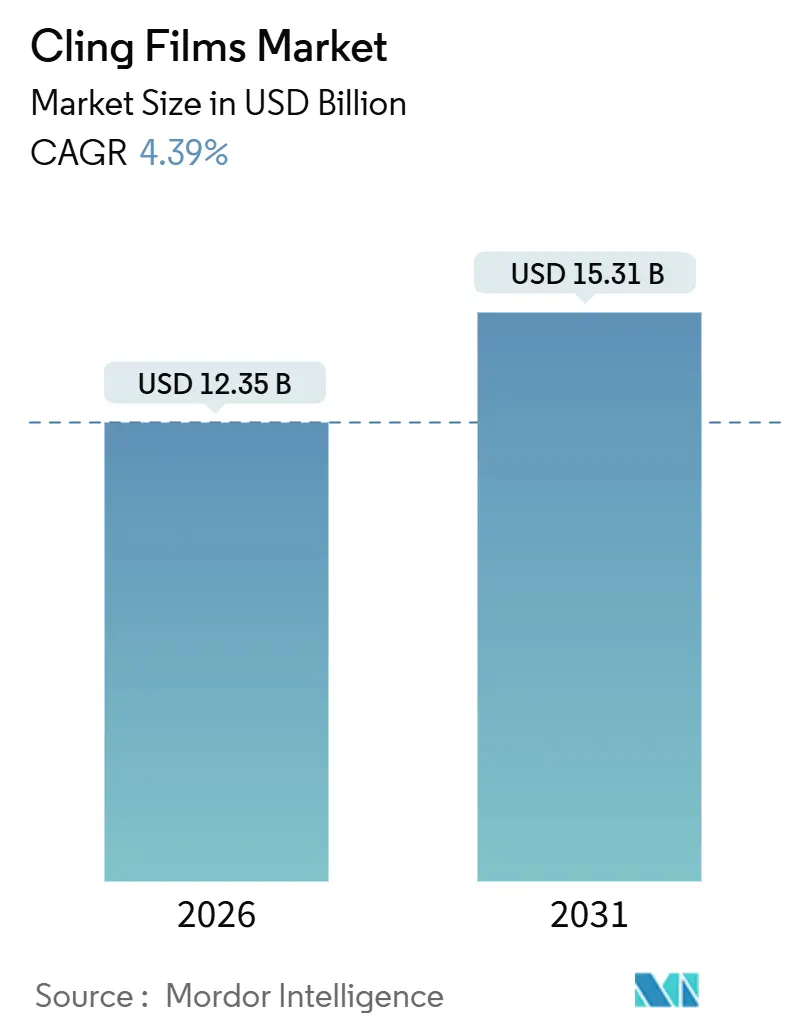
| Market Size (2026) | USD 12.35 Billion |
| Market Size (2031) | USD 15.31 Billion |
| Growth Rate (2026 - 2031) | 4.39 % |
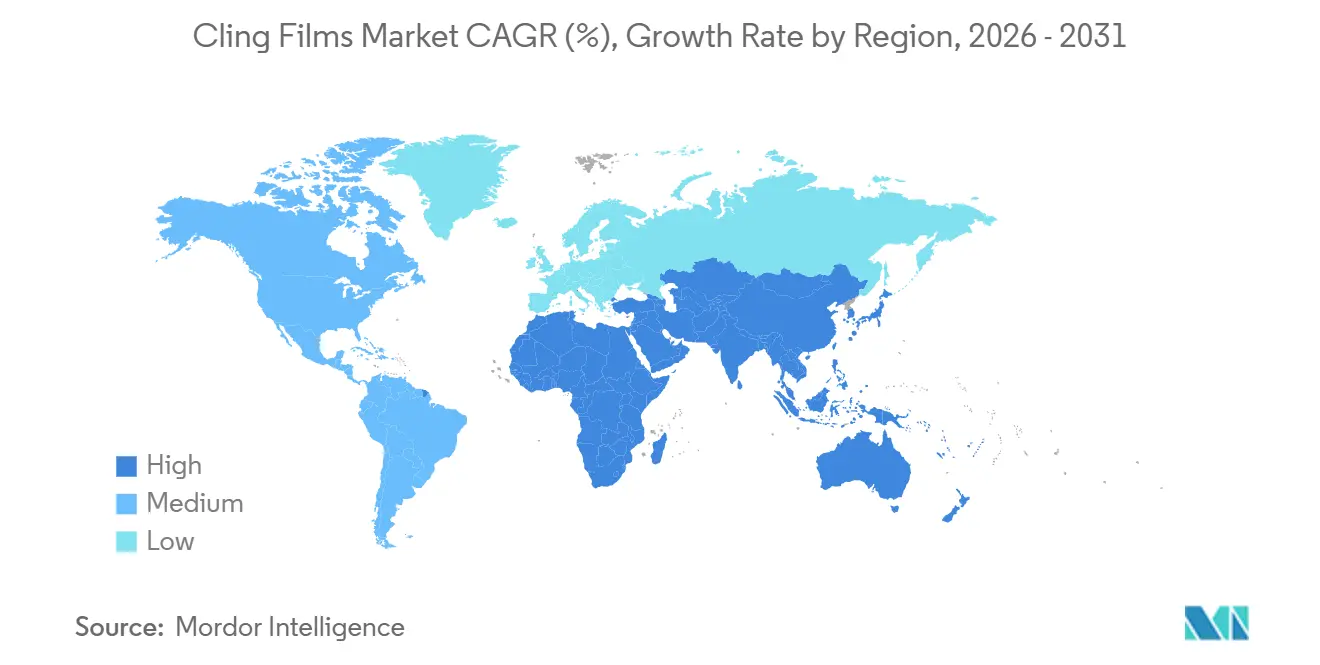
| Fastest Growing Market | Asia Pacific |
| Largest Market | Europe |
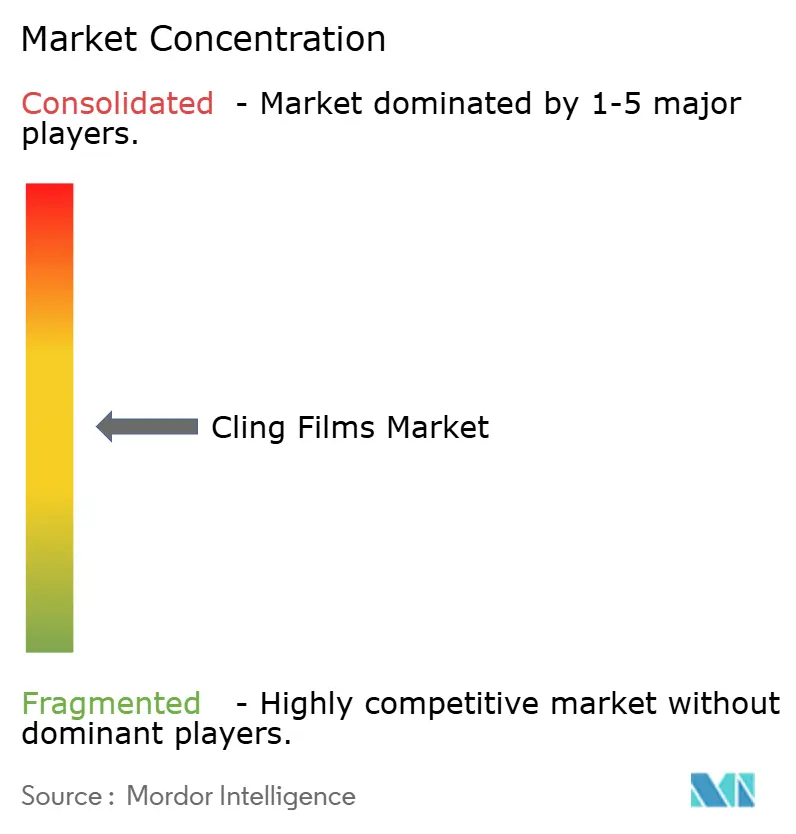
| Market Concentration | Medium |
Major Players *Disclaimer: Major Players sorted in no particular order Image © Mordor Intelligence. Reuse requires attribution under CC BY 4.0. | |
Cling Films Market Analysis by Mordor Intelligence
The Cling Films Market size is estimated at USD 12.35 billion in 2026, and is expected to reach USD 15.31 billion by 2031, at a CAGR of 4.39% during the forecast period (2026-2031). Strong demand from e-commerce grocery channels, healthcare sterile-packaging mandates, and regulatory pressure on single-use plastics are converging to keep volume growth steady despite price volatility. Polyethylene grades, especially bio-based PE, are winning share because they comply with Extended Producer Responsibility rules in Europe and several North American states, while cast-film technology is capturing most new capacity as automation spreads across food retail and fulfillment centers. Food processors remain the dominant buyers, yet hospital procurement teams are raising specifications that only high-clarity, corona-treated films can meet, signaling a sustainable premium segment. Competitive dynamics show moderate concentration; the top five suppliers control around 40% of installed output, but regional converters still find space in high-barrier and ultra-thin niches.
Key Report Takeaways
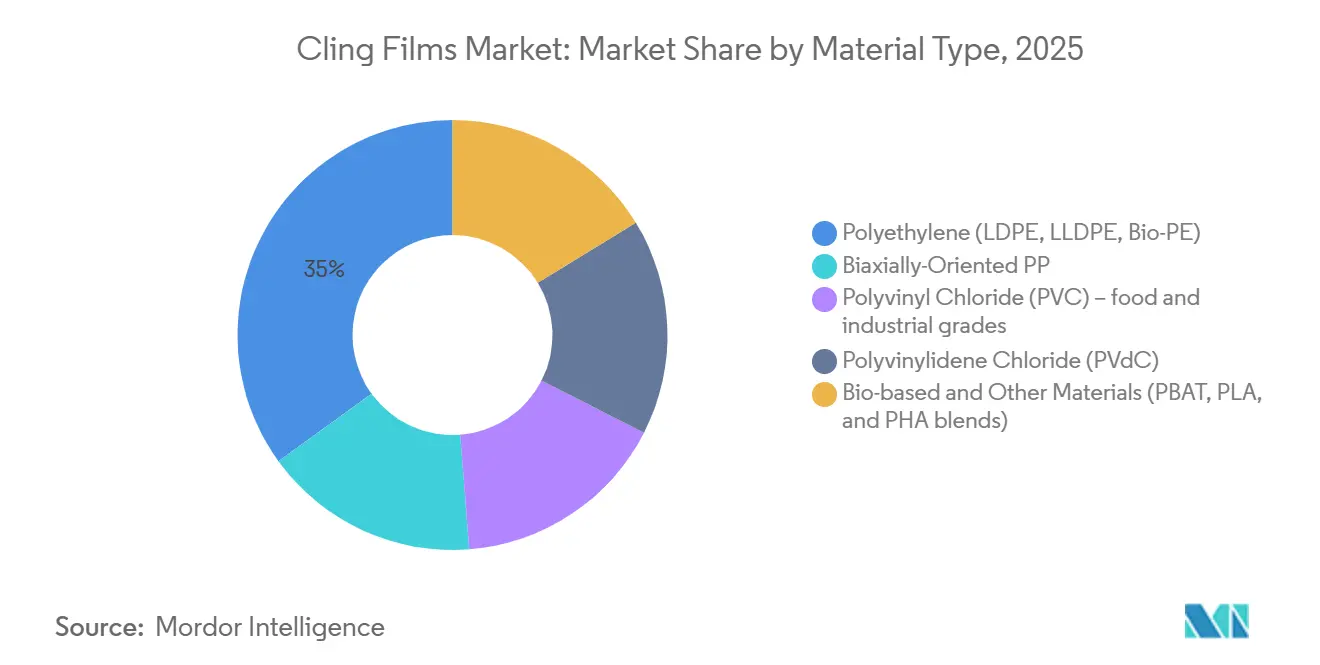
- By material type, polyethylene held 34.98% of 2025 revenue and is forecast to post a 5.08% CAGR through 2031.
- By form, cast films accounted for 75.67% of the 2025 volume and are on track for a 4.49% CAGR to 2031.
- By end-user industry, food applications captured 44.98% of 2025 demand and lead with a 4.78% outlook to 2031.
- By geography, Europe led with 34.36% of 2025 revenue, while Asia-Pacific is the fastest-growing region at 4.73% through 2031.
Note: Market size and forecast figures in this report are generated using Mordor Intelligence’s proprietary estimation framework, updated with the latest available data and insights as of January 2026.
Market Trends and Insights
Drivers Impact Analysis of Cling Films Market*
| Driver | (~) % Impact on CAGR Forecast | Geographic Relevance | Impact Timeline |
|---|---|---|---|
| Growing food industry and packaged-food penetration | +1.2% | Global, with concentration in Asia-Pacific urban centers and North American meal-kit hubs | Medium term (2-4 years) |
| Expanding healthcare packaging demand | +0.8% | North America and Europe, spillover to Middle East private hospital networks | Long term (≥ 4 years) |
| Rapid supermarket roll-out in emerging economies | +1.0% | Asia-Pacific core (China, India, ASEAN), early gains in Middle East and Africa | Short term (≤ 2 years) |
| Integration of antimicrobial and barrier nanocoatings | +0.7% | Global, led by North America and European premium segments | Medium term (2-4 years) |
| Surge in online grocery and meal-kit delivery | +0.9% | North America, Western Europe, urban Asia-Pacific markets | Short term (≤ 2 years) |
| Source: Mordor Intelligence | |||


Growing Food Industry and Packaged-Food Penetration
China’s supermarket density rose from 1.2 stores per 10,000 residents in 2020 to an estimated 2.1 in 2025, lifting demand for transparent oxygen-barrier wraps that protect produce during multi-day cold-chain transit. Leading meat processors trimmed LLDPE gauges from 12 µm to 9 µm after inline tension control, cut wrinkling, and saved 18-22% resin per pack. North American bakery chains are shifting from wax paper to micro-perforated films that vent 300-500 g/m²/day of moisture vapor, curbing mold in artisan bread displays. Meal-kit providers favor phthalate-free LDPE films certified under FDA 21 CFR 177.1520 to secure seven-day refrigerated shelf life.[1]U.S. Food and Drug Administration, “21 CFR 177.1520: Olefin Polymers,” fda.gov Together, these trends reposition cling wrap from a commodity to a branding tool, especially for premium organic labels where clarity signals freshness.
Expanding Healthcare Packaging Demand
Updated Association for the Advancement of Medical Instrumentation guidance sets peel-strength windows between 200 and 400 g-force per 25 mm, a range consistently met only by cast films treated to 42-46 dynes/cm.[2]Association for the Advancement of Medical Instrumentation, “TIR 109 Guidance on Peel Strength,” aami.org Device makers are switching from paper-plastic pouches to all-plastic wraps to minimize fiber particulate in cleanrooms. PVdC-coated cling films cut oxygen ingress to below 1 cm³/m²/day, extending the shelf life of moisture-sensitive APIs by up to 40% in cold-chain transit. The European Medicines Agency’s 2025 tamper-evidence rule for parenteral drugs is accelerating demand for heat-sealable wraps with holographic features. Aging populations and rising surgical volumes in Gulf states strengthen long-term volume visibility for ISO 15378-qualified producers.
Rapid Supermarket Roll-Out in Emerging Economies
India commissioned roughly 1,200 new supermarkets and hypermarkets in 2025, a 14% year-on-year leap that forces produce suppliers to adopt cling-wrapped trays meeting standardized display requirements. Vietnam’s organized retail share climbed to 35% in 2025, up from 28% two years earlier, prompting Southeast Asian converters to import European cast-film lines sized for 300 mm rolls compatible with automatic wrapping stations. Saudi Arabia’s Vision 2030 cold-chain hubs need films that keep seals intact at ambient temperatures above 45°C. As wet markets cede ground to air-conditioned stores, demand pivots to anti-fog films that preserve visibility on chilled shelves, creating a technological hurdle for smaller domestic producers.
Integration of Antimicrobial and Barrier Nanocoatings
Silver-ion films extend microbial thresholds in fresh meat by three to five days under USDA standards, curbing spoilage below 10⁵ CFU/g. Zinc-oxide wraps applied to dairy products achieve a 99.7% Listeria reduction after 72 h at refrigeration temperatures. Nanoclay-dispersion structures push oxygen transmission below 5 cm³/m²/day, allowing salad processors to eliminate nitrogen flushing and cut packaging costs by around 13%. EFSA cleared titanium-dioxide nanoparticles for food-contact use in 2024, yet some member states keep interim bans pending migration data, tilting the advantage toward multinational converters with robust regulatory teams. Players that scale nanocoatings at >300 m/min line speed stand to capture premium slots in high-margin fresh-food supply chains.
Restraints Impact Analysis of Cling Films Market*
| Restraint | (~) % Impact on CAGR Forecast | Geographic Relevance | Impact Timeline |
|---|---|---|---|
| Low resistance to extreme temperatures | -0.5% | Global, acute in frozen-food and industrial cold-chain applications | Medium term (2-4 years) |
| Tightening global single-use-plastic regulation | -0.9% | Europe and North America core, spillover to Asia-Pacific coastal cities | Long term (≥ 4 years) |
| Consumer shift to reusable silicone and beeswax wraps | -0.3% | North America and Western Europe premium organic segments | Short term (≤ 2 years) |
| Source: Mordor Intelligence | |||
Low Resistance to Extreme Temperatures
Standard LDPE and LLDPE films turn brittle below –18°C, causing seal failure rates above 8% on frozen-seafood pallets compared with under 2% for stretch hoods. High-temperature use is limited because films soften above 60°C, excluding hot-fill soups and sauces that make up a USD 8 billion flexible-packaging niche. Metallocene-PE grades stay tough to –30°C but cost 25-35% more than commodity LDPE, restricting uptake to pharmaceutical cargoes. Flex-modifying additives such as polyisobutylene can migrate to food-contact surfaces, complicating FDA and EFSA extraction tests, so converters face trade-offs between performance and compliance.
Tightening Global Single-Use-Plastic Regulation and Consumer Shift to Reusables
The EU Single-Use Plastics Directive requires 30% recycled content in food-contact films by 2030. France and Germany now impose fees of EUR 0.08-0.12 per kg on non-recyclable films, lifting PVdC costs by 20% and accelerating the pivot to mono-material PE. California’s SB 54 mandates 65% recyclability or compostability in single-use plastic packaging by 2032, pushing producers toward PBAT or PLA blends. A Deloitte survey showed 42% of the United States households tried silicone wraps in 2025, up from 28% in 2023, underscoring perception risks even though these reusables still hold below 2% share in food-wrap volume. The result is a bifurcated landscape where commodity petro-PE endures a margin squeeze while compostable grades command price premiums but require heavy capital upgrades.
*Our forecasts treat driver/restraint impacts as directional, not additive. The impact forecasts reflect baseline growth, mix effects, and variable interactions.
Cling Films Market Segment Analysis
By Material Type:
Bio-PE Fuels Polyethylene LeadershipPolyethylene accounted for 34.98% of 2025 revenue and is expected to expand at a 5.08% CAGR, adding significant weight to the cling films market size through 2031. Bio-PE derived from sugarcane ethanol slots directly into existing extrusion lines, avoids phthalates, and satisfies European recycled-content mandates, making it the fastest-adopted resin among large food brands. LDPE remains favored for hand-wrap because its inherent cling eliminates supplemental tackifiers, while LLDPE’s 40-50 MPa tensile strength cuts breaks on high-speed flow-wrap equipment. PVC is shrinking in Europe owing to dioxin and phthalate concerns, but PVdC-coated film still owns a thin yet defensible niche in vacuum-packed meat exports that need oxygen transmission under 2 cm³/m²/day.
Compostable polymers continue to widen choice yet remain a small slice of the cling film market. PBAT-PLA blends certified under EN 13432 are gaining listings with municipal organics programs, while PHA grades tout marine biodegradability but sell at a 3-4× premium to fossil PE. BOPP addresses twist-wrap candy niches where stiffness matters over cling. Overall, material selection is sorting into three tiers: commodity PE for cost-sensitive packs, bio-PE for mainstream sustainability programs, and fully compostable blends for jurisdictions that subsidize separate collection, a hierarchy that should keep polyethylene dominant in cling films industry revenues for most of the decade.


By Form:
Cast Films Strengthen Automation AdvantageCast films claimed 75.67% of 2025 volume and are forecast at a 4.49% CAGR, adding incremental tonnage that will reinforce their 2031 cling films market share lead. Gauge uniformity within ±3% is essential for robotic pick-and-place systems populating grocery fulfillment hubs, and chill-roll quenching yields haze below 5%, critical for premium meat displays. Inline corona treatment integrates label-ready surfaces at full line speed, avoiding offline passes that inflate cost for blown-film competitors.
Blown films still serve hand-wrap food-service outlets that value puncture resistance and higher natural cling, yet their share is stable rather than growing. Multilayer blown towers outfitted with real-time thickness gauging cost upward of USD 5 million each, so many regional converters delay upgrades, eroding their relative quality proposition. Automation’s rise across meal-kit assembly and supermarket deli counters thus cements cast extrusion as the workhorse technology anchoring the future cling films market.
By End-User Industry:
Food Holds the Largest ShareFood uses absorbed 44.98% of the 2025 demand and are pacing a 4.78% trajectory, bolstering the cling films market size in absolute terms. Fresh-produce packers choose ultra-clear wraps that limit moisture loss and exhibit anti-fog properties for chilled displays. Meat processors deploy 8-µm films embedded with oxygen scavengers to gain 4-6 days extra shelf life, directly lowering shrink. Dairy makers favor micro-perforated wraps that vent carbon dioxide from ripening cheese without admitting oxygen, keeping mold counts low.
Healthcare packaging shows the steepest percentage growth, albeit off a smaller base, as hospitals enforce ISO 11607 sterile-barrier requirements. Pharmaceutical blisters are gradually migrating from foil to transparent PVdC-coated films that still block moisture yet aid tablet identification. Industrial unitization and consumer goods are mature but vulnerable to substitution from stretch hoods and shrink sleeves. Overall, fresh food and healthcare will dictate material development, with oxygen barrier, seal integrity, and migration-free additives topping converter R&D agendas in the cling films industry.

Geography Analysis
Europe Cling Films Market
Europe led with 34.36% revenue in 2025, underpinned by decades-old flexible-packaging infrastructure, strict Framework Regulation (EC) No 1935/2004, and consumer penchant for pre-packed produce. Germany and the United Kingdom post the highest per-capita consumption, yet volume headwinds are arising as retailers experiment with reusable silicone wraps in deli counters. France’s 2024 EPR fees of EUR 0.10 per kg on non-recyclable films have accelerated bio-based adoption, while Italy’s focus on antimicrobial coatings for export mozzarella and prosciutto offers a differentiated edge. Nordic pilots of flexible-film deposit schemes signal future circular-economy shifts, though current recycling streams still sideline flexible PE.
APAC Cling Films Market
Asia-Pacific is the fastest-growing region, clocking a 4.73% CAGR that will gradually close the gap with Europe in the overall cling films market size. China doubled supermarket density between 2020 and 2025, a shift requiring barrier wraps capable of surviving multi-day domestic cold chains. India’s addition of 1,200 supermarkets in 2025 spurs uptake of cling-wrapped trays and drives new cast-line installs. Japan refines technology leadership with 6-µm metallocene-PE films, and South Korea’s 20% recycled-content rule for 2027 compels investment in advanced sorting capacity. ASEAN markets, buoyed by Japanese and Korean convenience-store investments, import European machinery to standardize roll widths for automated deli stations.
The Americas and MEA Cling Films Market
In North America, the United States’ growth is tied to online grocery and meal-kit firms that demand portion-controlled, automation-ready wraps. Canada’s patchwork provincial EPR rules complicate nationwide launches, yet bilingual packs remain a stable niche. Mexico attracts near-shoring cast-film projects valued at more than USD 50 million over 2024-2025, securing supply into US produce corridors. Brazil heads South America, but cold-chain gaps outside major metros cap upside, while Saudi Arabia’s heat-resistant film requirements and South Africa’s split between organized and informal retail shape early-stage opportunities across the Middle East and Africa. Collectively, regional dynamics keep the cling films market in a multi-polar growth mode, with Asia-Pacific delivering volume, Europe pushing regulation, and North America innovating technology.

Regulatory Landscape
In Europe, Regulation (EU) 2025/40 on packaging and packaging waste (PPWR) entered into force on 11 February 2025 and applies generally from 12 August 2026, tightening rules relevant to cling films used as packaging through recyclability, labeling, and other compliance requirements. The PPWR also requires the European Commission to adopt implementing acts by 12 August 2026 to set harmonized labels and specifications linked to recycling requirements, which affects how converters substantiate claims and format on-pack information across EU markets. Alongside this, the EU Single-Use Plastics Directive 2019/904 requires Member States to deliver a measurable quantitative reduction in consumption of specified single-use plastic products by 2026 compared with 2022, increasing retailer and brand pressure to down-gauge and move away from hard-to-recycle structures. In the United States, food-contact cling films must comply with FDA requirements such as 21 CFR 177.1520 for olefin polymers, or be supported by a Food Contact Notification (FCN) for the intended conditions of use, keeping material selection, additive packages, and supplier documentation central to market access.
Value Chain Analysis
The cling films value chain begins with upstream feedstocks and resin production for LDPE, LLDPE, PP, PVC, PVdC, and emerging bio-based or compostable polymers, including bio-PE and PBAT-PLA blends. Resin supply economics remain closely tied to petrochemical feedstock costs for conventional polymers, while bio-based inputs add certification and traceability requirements that are increasingly used to support food-retail sustainability programs and EPR-related reporting. Midstream, film producers convert resins into cast and blown films and then add steps such as multilayer co-extrusion, surface treatment (including corona), and functional coatings to meet clarity, seal, and barrier targets specified by food processors and healthcare packaging users. Downstream channels include distributors and food-service suppliers, retail and private-label programs, and B2B contracts with processors and hospital procurement teams. As regulations tighten and automation expands, the chain is shifting toward closer collaboration between resin suppliers, converters, and machinery providers to validate downgauged, mono-material structures and to sustain consistent roll quality for high-speed wrapping and fulfillment operations.
Competitive Landscape
The Cling Films market is moderately concentrated. Amcor’s 2024 bio-PE joint venture with Braskem is locked in 50,000 t/y resin supply, enabling renewable-content claims that resonate with supermarket house brands. Sealed Air and Reynolds have installed machine-vision gauge-inspection systems that cut scrap below 2%, safeguarding margins on large e-commerce contracts. Mondi’s work with BASF on PBAT-PLA blends illustrates how compostable films are migrating from pilot to commercial scale pending EN 13432 certification. Backward integration into bio-resins and strategic alliances with nanotechnology firms dominate the forward strategy. Several majors explore vertical moves into recycling, eyeing food-grade rPE to meet 2030 recycled-content mandates.
Cling Films Industry Leaders
Amcor plc
Sigma Plastics Group
Jindal Poly Films Limited
Reynolds Consumer Products
NAN YA PLASTICS CORPORATION
- *Disclaimer: Major Players sorted in no particular order
Cling Films Market Companies Covered in this Report
- 3M
- Amcor plc
- Anchor Packaging LLC
- CL Industries India
- Hipac SpA
- IPG
- Jindal Films
- Mitsubishi Chemical Group Corporation.
- Mondi
- NAN YA PLASTICS CORPORATION
- Novamont SpA
- Paragon Films
- Polifilm
- Qingdao Kingchuan Packaging
- Reynolds Consumer Products
- Sealed Air
- Sigma Plastics Group
- Sphere
- Technovaa Plastic Industries
- Wrapmaster
- Zhengzhou Eming Aluminium Industry Co., Ltd.

Market Opportunities and Future Outlook
One clear whitespace is automation-ready, high-performance cast PE structures that use less material while meeting tighter recyclability and labeling expectations in Europe once PPWR application begins from 12 August 2026. Because cast films already lead by volume in the market, the more immediate opportunities cluster around ultra-thin gauges with tighter thickness control, high-clarity surfaces, and treatments that support reliable sealing and also maintain print or label adhesion for branded fresh-food and e-commerce grocery applications. Bio-based and compostable options are also expanding, but near-term commercialization still hinges on barrier performance against moisture and oils for real-world fresh-food use. Development signals already cited in the market include Toyobo’s April 2026 announcement of a 100% plant-based Polyethylene Furanoate (PEF) film, with samples available in June 2026 for industrial testing, and academic work reported in April 2026 by the University of Maryland using AI to optimize biodegradable cling-film formulations based on cellulose, gelatin, and chitosan. Together, these efforts support a practical pipeline for converters and brand owners looking for alternatives to conventional cling films while retaining food protection and shelf-life performance.
Recent Industry Developments in Cling Films Market
- July 2026: Amcor announced the expansion of a packaging facility in China, adding manufacturing footprint closer to large regional food and consumer-packaging demand centers. The move strengthens in-region supply resilience and shortens lead times for film-based packaging formats that require consistent quality and compliance documentation.
- July 2025: Sigma Plastics Group announced a USD 39 million expansion at its Midland, Georgia plant to increase stretch film capacity, part of a broader US Southeast capacity buildout. The project strengthens regional supply resilience for pallet wrap and supports near-term demand from consumer-packaged goods and e-commerce channels.
- May 2025: JPFL Films (Jindal Poly Films Limited) announced capex of more than INR 700 crore to set up new BOPP, PET, and CPP film lines in Nashik, Maharashtra, targeting over 115,000 tonnes of annual capacity addition over 2-3 years. The build-out supports broader flexible-film availability in Asia and improves cost competitiveness and scale for regional converters supplying food and consumer packaging.


Cling Films Market Report Scope and Research Methodology
Market Definition and Coverage
For this study, the cling films market covers revenue from plastic cling and stretch wrap films sold for wrapping and protecting products, mainly in food handling, retail, and industrial packaging, across major global regions.
Scope exclusions: We exclude rigid packaging, reusable containers, and non-film wrapping formats such as paper and aluminum foils when they are not sold as cling film products.
Segments Covered in This Report
- Material Type
- Polyethylene (LDPE, LLDPE, Bio-PE)
- Biaxially-Oriented PP
- Polyvinyl Chloride (PVC) – food & industrial grades
- Polyvinylidene Chloride (PVdC)
- Bio-based & Other Materials (PBAT, PLA, PHA blends)
- Form
- Cast Cling Film
- Blown Cling Film
- End-user Industry
- Food
- Healthcare
- Consumer Goods
- Industrial
- Other End-user Industries
- Geography
- Asia-Pacific
- China
- India
- Japan
- South Korea
- ASEAN Countries
- Rest of Asia-Pacific
- North America
- United States
- Canada
- Mexico
- Europe
- Germany
- United Kingdom
- France
- Italy
- Russia
- NORDIC Countries
- Rest of Europe
- South America
- Brazil
- Argentina
- Rest of South America
- Middle East and Africa
- Saudi Arabia
- South Africa
- Rest of Middle East and Africa
- Asia-Pacific
Data Sources, Market Sizing, and Validation
Desk Research
Desk research started by mapping how cling films are produced, traded, and consumed so the model uses realistic demand signals rather than only company claims. We relied on public sources such as UN Comtrade trade statistics, the US International Trade Commission data tools, Eurostat, and national statistics offices that publish plastics and packaging related indicators.
To connect value with physical movement, we also reviewed polymer and packaging information from groups such as PlasticsEurope and the American Chemistry Council, plus open technical papers and patents that describe material substitution and gauge downtrend. Company annual reports, investor presentations, and credible press coverage were used to understand capacity changes and pricing commentary, and paid subscriptions for company financials and shipment-level import-export records were used only where they helped confirm directional volumes and supplier footprints. The sources listed here are illustrative, and we checked many other public references to collect, validate, and clarify data points.
Primary Interviews and Surveys
Primary work was used to sanity check volumes, typical price bands, and how fast customers shift between PVC and polyethylene based films, especially across foodservice, retail, and industrial users. We spoke with a mix of film producers, converters, distributors, and large end users across APAC, EMEA, and the Americas, so gaps in public data could be filled with practical assumptions and then cross verified.
Distribution of primary research fieldwork respondents
| Company type | Respondent position | Region |
|---|---|---|
| Top tier: 36% | CXOs: 12% | APAC: 40% |
| Mid tier: 45% | Functional/Unit leaders: 35% | EMEA: 33% |
| Smaller Players: 19% | Managers: 53% | Americas: 27% |
Market-Sizing & Forecasting
Sizing was built using a top-down approach where packaging demand pools were reconstructed from plastics film usage signals, trade flows, and food packaging activity by region, and then converted into value using observed price ranges for cling films. We checked the totals with selective bottom-up approximations using sampled supplier revenue splits, channel checks, and a simple volume times ASP cross check. This helped adjust for categories that are hard to separate in public statistics.
Key inputs used in the model included resin spread movements (polyethylene versus PVC), packaging film import-export mix, foodservice and retail packaging throughput trends, typical film thickness and gauge downshifting, and the share of cast versus blown film processing in major regions. When data was missing at a country level, we used proxy ratios from nearby markets with similar packaging intensity and validated those assumptions through interviews.
For forecasting, scenario analysis was used around resin price cycles, substitution pace toward polyethylene based films, and regulatory pressure on materials, and then the final path was smoothed using time series logic so the year-to-year curve stays consistent with industry operating reality. The forecast is expressed in nominal USD, and currency conversion timing is kept consistent across regions to avoid false growth caused only by FX swings.
Data Validation & Update Cycle
Validation focused on checking whether the market value implied by the model aligned with independent signals such as polymer demand, packaging output indicators, and trade movements, and then tracing any large variance back to a specific input assumption. If an anomaly was found, the related inputs were reviewed again, and the relevant interviewee set was re contacted to confirm whether a real market shift had occurred or a data boundary was mixed.
Before publication, the model is reviewed in steps, first for calculation accuracy and then for logic consistency across regions and use cases. Reports are refreshed annually, and interim updates are triggered when major events occur, such as material regulation changes or sharp resin price resets. A final pre delivery pass is done so clients receive the latest available view at the time of access.
Mordor Intelligence's Cling Films Market Size Compared With Other Published Estimates
Published market sizes for cling films often look far apart because the timing of currency conversion, the way average selling prices are updated, and the year chosen as the current estimate can each move the total noticeably. Differences also appear when some sources treat stretch wrap and household wrap as the same bucket, or when they mix broader packaging films into a cling film label.
In our checks, the biggest drivers were whether prices were carried forward using resin linked movements versus flat inflation, and whether the scope includes only cling films used for wrapping or also adjacent packaging films used in transport and bundling. A refresh led approach also matters because the market is sensitive to resin swings and regional FX changes, so by re validating the ASP bands and FX timing during annual refresh cycles, Mordor Intelligence keeps the 2026 value tied to what buyers and sellers actually transact around that year.
Benchmark comparison
| Source | Market Size | Gaps in Research Methodology |
|---|---|---|
| Mordor Intelligence | USD 12.35 B (2026) | |
| Global Consultancy A | USD 6.43 B (2024) | Uses an earlier base year and a smaller value pool, and the scope appears closer to consumer and food wrap uses, which can leave out industrial and broader regional channel value. |
| Industry Publisher B | USD 1.98 B (2024) | Tends to apply a tighter product boundary and shorter horizon, and the value can be pulled down when thinner gauge films are priced using conservative ASPs without re checking regional mix shifts. |
The spread in published values mainly comes from scope boundary and the year used for current sizing, and those choices then flow through ASP and FX handling. When the scope is clearly stated, inputs are tied to observable demand indicators, and price bands are refreshed with real market feedback, the final number becomes easier to reproduce and explain.


Key Questions Answered in the Report
What is the current global cling films market size?
What is the current global cling films market size?
How fast is the cling films market expected to grow?
How fast is the cling films market expected to grow?
Which material leads sales within cling wrap?
Which material leads sales within cling wrap?
Which end-use segment drives most demand?
Which end-use segment drives most demand?
Page last updated on:


 Your data is secure and never sold or shared.


