
Polymer Binder Market Size and Share
Market Overview
| Study Period | 2020 - 2031 |
|---|---|
| Market Size (2026) | USD 39.84 Billion |
| Market Size (2031) | USD 49.36 Billion |
| Growth Rate (2026 - 2031) | 4.38 % |
| Fastest Growing Market | Asia Pacific |
| Largest Market | Asia Pacific |
| Market Concentration | Low |
Major Players *Disclaimer: Major Players sorted in no particular order Image © Mordor Intelligence. Reuse requires attribution under CC BY 4.0. | |
Polymer Binder Market Analysis by Mordor Intelligence
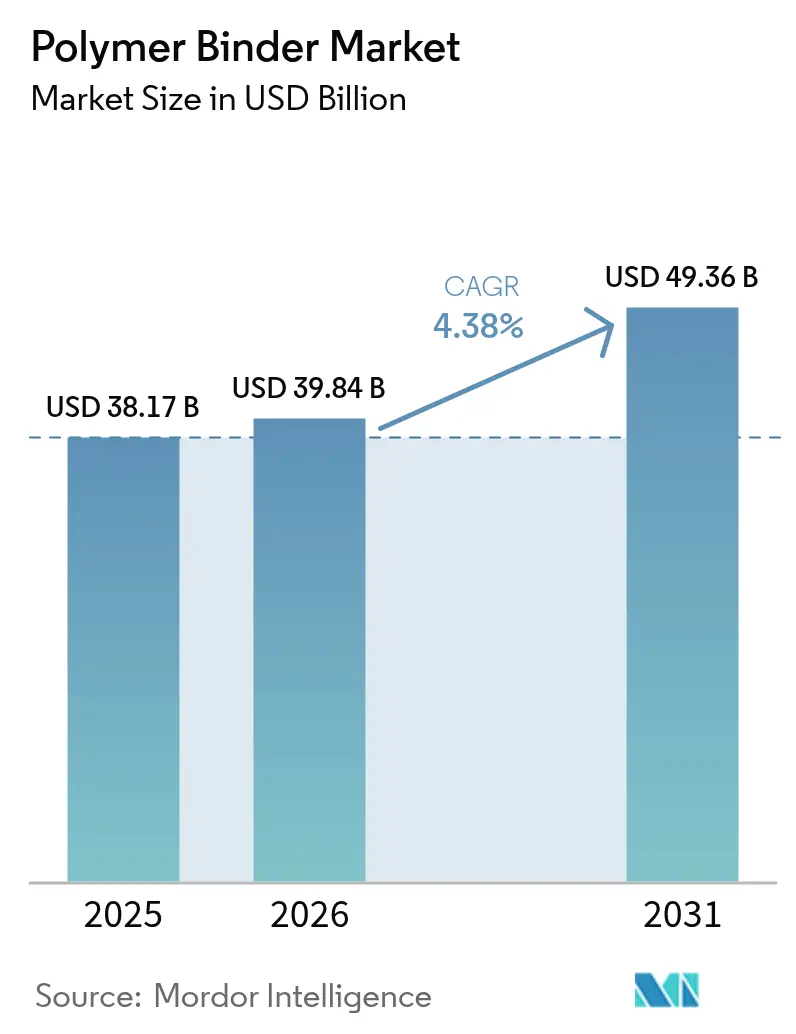
Polymer Binder Market size in 2026 is estimated at USD 39.84 billion, growing from 2025 value of USD 38.17 billion with 2031 projections showing USD 49.36 billion, growing at 4.38% CAGR over 2026-2031. Architectural and industrial coatings continue to anchor consumption, yet battery electrodes, powder-bed additive manufacturing, and circular-economy packaging are carving measurable new volumes that compensate for declines in legacy paper and carpet uses. Liquid, water-borne formulations have moved into the mainstream as regulations in North America, Europe, and parts of Asia restrict solvent emissions, prompting chemistry innovations that preserve adhesion while cutting VOCs. Vinyl acetate continues to outperform competing chemistries thanks to its wide formulation window, price competitiveness, and compatibility with low-VOC systems, while bio-attributed grades now in pilot scale promise lower carbon footprints. Competitive pressure is increasingly expressed through sustainability pledges, regional capacity additions, and technical alliances that safeguard intellectual property in emerging battery and 3D printing applications.
Key Report Takeaways
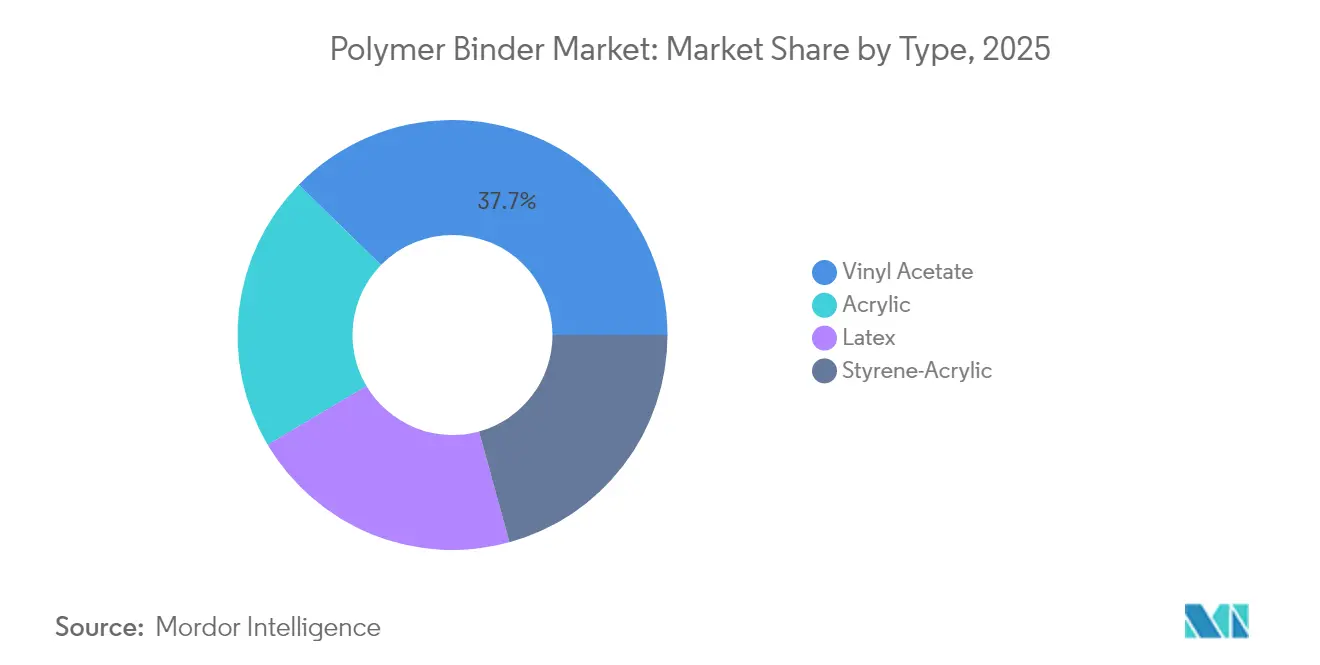
- By type, vinyl acetate led with 37.68% share of the polymer binder market in 2025 and is expected to expand at 5.83% CAGR to 2031.
- By form, liquid grades held 64.10% of 2025 revenue and are advancing at a 5.14% CAGR as producers shift further toward waterborne systems.
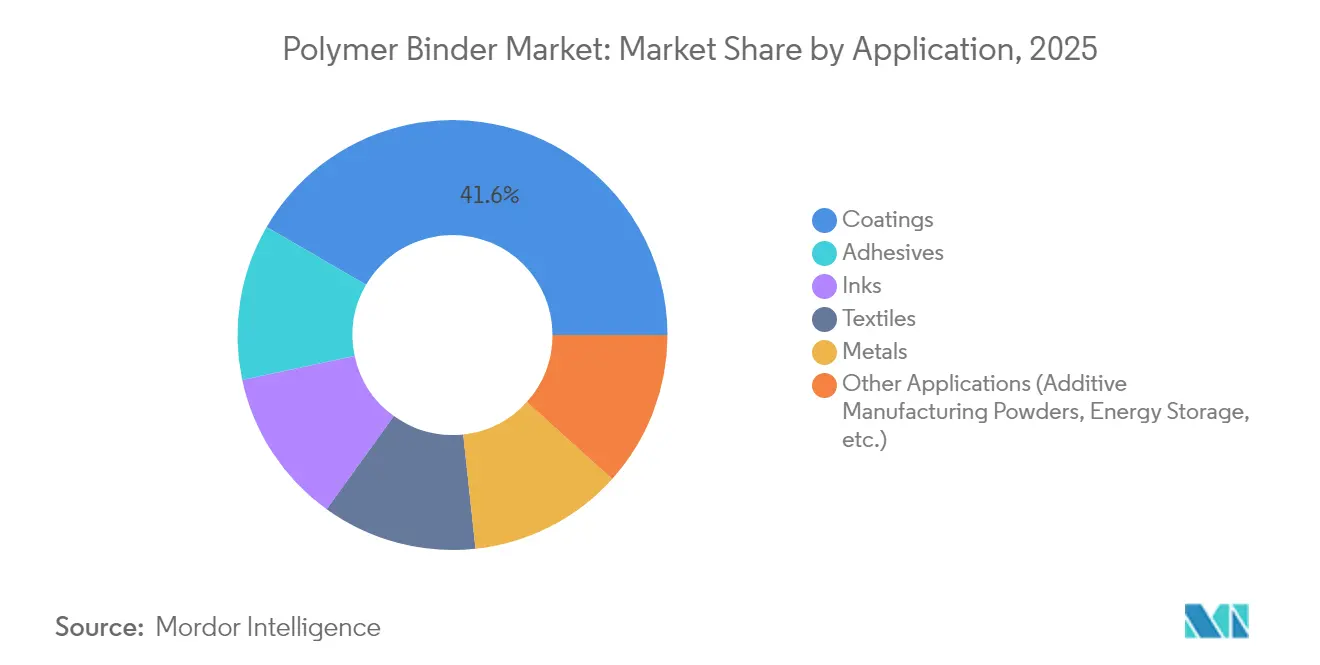
- By application, coatings commanded 41.62% revenue share of the polymer binder market in 2025, whereas the “Other Applications” cluster is projected to accelerate at 5.98% CAGR through 2031.
- By geography, Asia-Pacific accounted for 54.20% of 2025 demand and is forecast to grow fastest at 5.19% CAGR, reflecting simultaneous construction and battery manufacturing upswings.
Note: Market size and forecast figures in this report are generated using Mordor Intelligence’s proprietary estimation framework, updated with the latest available data and insights as of 2026.
Market Trends and Insights
Drivers Impact Analysis of Polymer Binder Market*
| Drivers | (~) % Impact on CAGR Forecast | Geographic Relevance | Impact Timeline |
|---|---|---|---|
| Surging demand from architectural and industrial coatings | +1.2% | Global with APAC leading | Medium term (2-4 years) |
| Rapid shift toward waterborne low-VOC formulations | +0.8% | North America and EU first adopters, APAC following | Short term (≤ 2 years) |
| Rising adoption of polymer binders in Li-ion battery electrodes | +0.6% | APAC core with spillover to North America | Long term (≥ 4 years) |
| Expanding use in powder-bed additive manufacturing | +0.4% | North America and EU innovation hubs | Long term (≥ 4 years) |
| Bio-based binder Research and Development for circular-economy compliance | +0.3% | EU leading, North America following | Long term (≥ 4 years) |
| Source: Mordor Intelligence | |||
Surging Demand from Architectural and Industrial Coatings
Urbanization, infrastructure renewal, and higher performance expectations in harsh climates push coating formulators to specify advanced polymer binders that deliver durability, stain resistance, and color retention under tropical humidity or severe winter freeze–thaw cycles. Waterborne emulsions claimed almost two-thirds of new architectural coating formulations 2025, a milestone reflecting stricter emissions rules and end-user preferences for low-odor products. Industrial facilities are adopting high-solids epoxy-acrylic hybrids to extend maintenance intervals on bridges, pipelines, and rolling stock, drawing on binder chemistries that withstand chemical immersion and thermal shock. Premium exterior paints integrate self-crosslinking vinyl acetate systems that reduce coalescent demand, trimming VOC emissions without compromising film integrity. The upgrading trend is particularly visible in China, India, and Indonesia, where mass housing programs combine with rising disposable income to lift expectations for façade longevity. Multinational coatings groups localize supply chains, anchoring regional demand for reliable binder raw materials.
Rapid Shift Toward Waterborne Low-VOC Formulations
Regulators now push VOC limits well below 50 g/L in building coatings, turning legacy solvent-borne systems into niche products within two years in California and several EU states. Binder producers responded with acrylic and vinyl acrylic emulsions capable of forming hard, chemical-resistant films at room temperature while keeping VOC well under 5 g/L. For instance, Dow’s ML-520 acrylic binder achieves exterior durability ratings comparable with long-standing solvent-borne alkyds[1]Dow, “MULTILOBE ML-520 Acrylic Binder,” dow.com. Architects and health-conscious homeowners accelerated adoption by specifying zero-odor paints for schools and hospitals, creating a pull effect that spreads beyond regulated regions. Equipment suppliers also adapted; spray-gun manufacturers launched tips optimized for low-viscosity water-borne paints, reducing overspray and easing the switch for contractors. Asian construction markets are following quickly as export-oriented coating companies align formulations to meet EU eco-labels. The resulting demand surge for water-compatible binders has shortened order cycles, forcing some suppliers to run plants near capacity.
Rising Adoption of Polymer Binders in Li-Ion Battery Electrodes
Electrification of mobility reshaped the customer base for binder producers by introducing gigafactories that consume specialty grades at volumes unseen five years ago. Cathode and anode coatings require binders that tolerate high voltages, withstand hundreds of charge cycles, and maintain adhesion on aluminum and copper foils after exposure to electrolyte solvents. Chinese and South Korean cell makers have issued multi-year procurement contracts to secure reliable quality, rewarding suppliers that can document metal-ion purity below 50 ppm and particle size under 500 nm. Celanese broadened its portfolio with flexible polyamide binders tailored to thermal management layers inside battery packs.
Expanding Use in Powder-Bed Additive Manufacturing Processes
Powder-bed fusion printers for aerospace, dental, and high-performance automotive parts need polymer binders that flow smoothly at room temperature yet fuse rapidly when hit by laser or electron beams. Rheology, thermal decomposition curve, and off-gas profile must align with machine parameters to avoid warping or voids. Research teams at North American universities published studies using multifunctional acrylic-urethane binders to reach tensile strengths above 75 MPa in carbon-fiber reinforced prints[2]MDPI, “Performance of Multifunctional Acrylic-Urethane Binders in Additive Manufacturing,” mdpi.com . Chemical companies responded by introducing narrowly distributed powder binders with antistatic coatings that minimize agglomeration during storage in humid climates. Early adopters report 15% faster build rates after binder optimization, validating the value proposition despite higher raw-material cost. Government-funded aerospace projects in the United States and Germany further stimulate demand by specifying additive manufacturing for satellite components, cementing a technological beachhead that feedstocks suppliers will scale over the decade.
Restraints Impact Analysis of Polymer Binder Market*
| Restraints | (~) % Impact on CAGR Forecast | Geographic Relevance | Impact Timeline |
|---|---|---|---|
| Structural decline in paper and carpet manufacturing | -0.7% | North America and EU | Medium term (2-4 years) |
| Volatility in key monomer feedstock prices | -0.5% | Global with APAC exposure | Short term (≤ 2 years) |
| Tightening PFAS-related regulations on fluoropolymer binders | -0.3% | North America and EU leading | Medium term (2-4 years) |
| Source: Mordor Intelligence | |||
Structural Decline in Paper and Carpet Manufacturing
Digitalization keeps shrinking demand for graphic printing papers, eliminating once-steady volumes for starch-vinyl acetate copolymer binders used in surface sizing. Carpet demand in residential remodeling is also waning in favor of luxury vinyl tile and laminate flooring that use different adhesive chemistries, undercutting latex binder sales in North America and Western Europe. Packaging paper and tissue segments still grow, yet they require higher wet-strength additives and bio-based binders that command different formulation balances, forcing producers to redesign lines. International Paper announced its merger with DS Smith, positions fiber-based packaging to serve e-commerce, creating pockets of opportunity for new aqueous binders. The net effect on total polymer binder volume is modestly negative because emerging grades have higher unit value but lower wet pickup rates, resulting in smaller tonnage. Regional mills idled since 2023 are unlikely to restart, cementing the structural shift.
Volatility in Key Monomer Feedstock Prices
Acetic acid, butyl acrylate, and styrene prices have swung 30% in six-month intervals since 2024 as refinery outages, shipping congestion, and geopolitical tensions disrupted supply. Smaller binder producers lacking backward integration absorb cost spikes that erode margins and restrict capital for innovation. Asian formulators face added currency risks when spot cargoes are priced in USD, compelling them to hedge or shorten quotation validity. Some multinationals diversified via long-term bio-route contracts, locking in feedstock derived from sugarcane ethanol or tall-oil fractions, thereby smoothing cost curves. The approach requires certification under ISCC PLUS or comparable mass-balance schemes to satisfy eco-label auditors, adding administrative overhead. Despite these efforts, sustained price turbulence still delays customer price lists and complicates budgeting for paint and adhesive manufacturers.
*Our forecasts treat driver/restraint impacts as directional, not additive. The impact forecasts reflect baseline growth, mix effects, and variable interactions.
Polymer Binder Market Segment Analysis
By Type:
Vinyl Acetate Sustains Leadership Through Versatility and Regulatory FitVinyl acetate held 37.68% of the polymer binder market in 2025 and is forecast to record a 5.83% CAGR through 2031, underscoring its adaptability to water-borne, low-VOC paints and to emerging battery slurries that demand stable colloidal dispersions. Complementary chemistries such as pure acrylics dominate premium topcoat formulations requiring chalking resistance, while styrene-acrylics serve economical interior paints and select paper saturations. Recent bio-attributed pilot batches demonstrate that vinyl acetate can incorporate fermentative acetic acid without altering polymer performance, aligning the matrix with Scope 3 decarbonization targets.
Continued research into self-crosslinking technology is sharpening vinyl acetate’s competitive edge by boosting block resistance and early water resistance in exterior paints, features once reserved for pure acrylics. The incorporation of reactive surfactants improves scrub durability while lowering free surfactant migration, an attribute that enhances stain resistance on interior walls.



By Form:
Liquid Grades Preserve Dominance as Water-Borne Shift AcceleratesLiquid dispersions accounted for 64.10% of polymer binder market size in 2025 and are projected to post a 5.14% CAGR to 2031 as formulators worldwide replace solvent-borne systems with water-thin alternatives. Their ease of pumping, blending, and filtration on existing paint lines removes costly process changes, enabling small and midsize coaters to comply with VOC caps within tight budgets. High-solids liquids are penetrating industrial maintenance coatings, offering low flash points and expedited cure times compared with traditional two-component epoxies. Powder binders retain relevance in additive manufacturing and select textile finishes that demand extended shelf life without refrigeration, yet supply remains constrained to specialized plants with stringent particle morphology controls.
By Application:
Coatings Anchor Revenue while Emerging uses Propel Incremental GrowthCoatings maintained 41.62% of the 2025 demand in the polymer binder market as households, infrastructure managers, and OEM finishers prioritized aesthetics and protection. The segment’s volume scale underwrites feeder plant economics, yet its growth rate trails the 5.98% CAGR predicted for “Other Applications,” a bucket encompassing batteries, 3D printing, and specialty filtration. Adhesives remain a steady mid-growth niche, leveraging vinyl acetate–ethylene copolymers that offer high green-bond strength in carton sealing and parquet installation. Textile finishing uses continue migrating toward Asia, combining with functional apparel exports to maintain respectable tonnage despite competition from mechanically bonded nonwovens.
Geography Analysis
APAC Polymer Binder Market
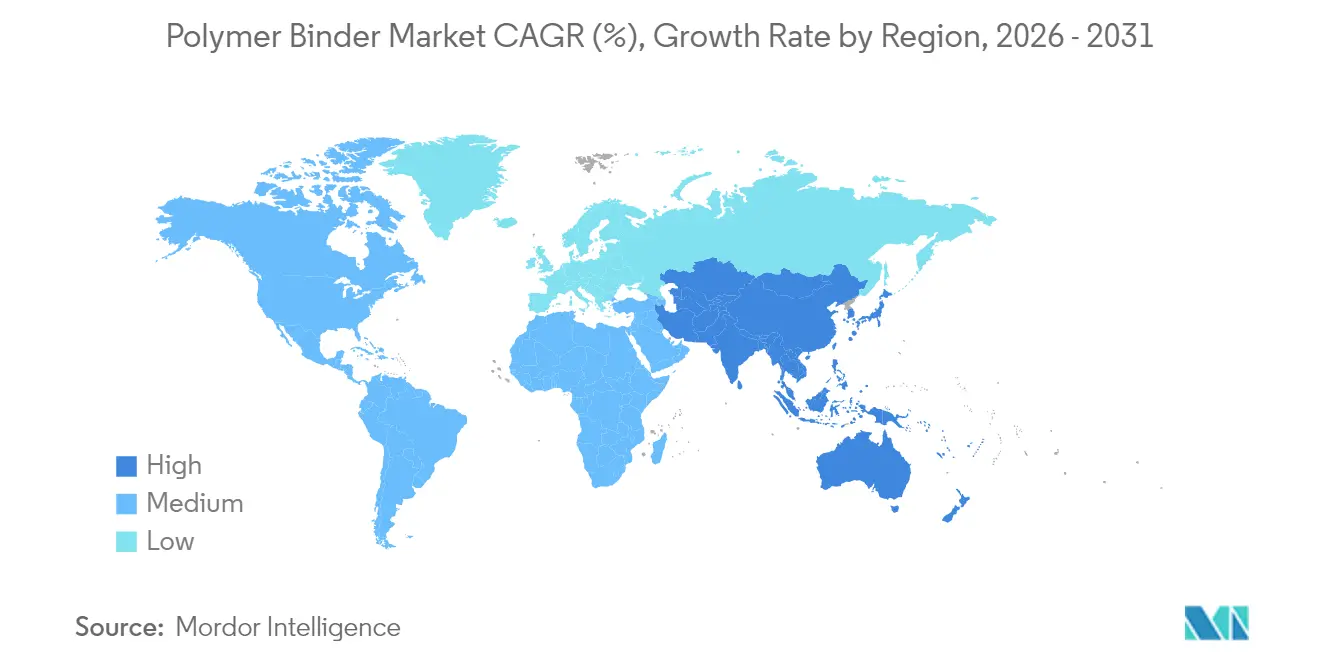
Asia-Pacific delivered 54.20% of 2025 revenue and is forecast to outpace all regions with a 5.19% CAGR, cementing its dual role as volume leader and growth engine. China’s megacity expansions and refurbishment of older apartment blocks sustain a massive need for exterior wall coatings that rely on versatile vinyl acetate binders. At the same time, the country’s battery manufacturers are commissioning cathode-active material lines at a record pace, each requiring dedicated binder supply streams with rigorous impurity thresholds.
North America and Europe Polymer Binder Market
North America exhibits mature, replacement-driven demand dynamics tempered by regulation-led formulation shifts. State agencies in the United States push VOC thresholds lower than federal baselines, while Canadian building codes now reference embodied-carbon targets. Europe upholds its role as a regulatory bellwether, compelling early adoption of fluorine-free, waterborne acrylic and silicone-hybrid binders. PFAS proposals add urgency, prompting formulators to clear inventories and secure alternative chemistries.

Regulatory Landscape
Regulation is tightening around emissions, microplastics, and fluoropolymer chemistries, which is accelerating the shift from solvent-borne binders toward water-borne and alternative binder systems across coatings, adhesives, and related end uses. In the European Union, Regulation (EU) 2023/2055 on synthetic polymer microparticles adds new compliance duties tied to preventing environmental release, including an October 2026 deadline for suppliers to provide instructions for use and disposal for products containing covered microparticles.
In the United States, air-emissions compliance remains a plant-level driver for investment in controls and monitoring. In March 2026, the US Environmental Protection Agency finalized amendments to NESHAP for Polyether Polyols Production that revise MACT requirements for items such as storage vessels and equipment leaks, reinforcing expectations for tighter hazardous air pollutant control at relevant chemical sites. Separately, trade policy uncertainty adds cost risk for imported inputs and intermediates, with the US Trade Representative outlining a July 24, 2026 transition from a 10% temporary Section 122 tariff to a tiered Section 301 tariff structure affecting certain imports from China.
Value Chain Analysis
The polymer binder value chain starts with upstream feedstocks and intermediates such as petrochemical-derived monomers (for example, vinyl acetate, acrylics, styrene derivatives) alongside emerging bio-attributed routes that require third-party chain-of-custody schemes (for example, ISCC PLUS) to satisfy downstream eco-label and procurement requirements. Binder manufacturers polymerize and convert these inputs into emulsions/latices, solutions, powders, and high-solids grades, and then provide formulation support and quality documentation to downstream customers. Coatings and adhesives producers are the largest pull-through channel by volume, while batteries and additive manufacturing create higher-specification demand that increases qualification burdens (purity, particle size control, rheology) and strengthens supplier stickiness.
Midstream operations include blending, stabilization packages, packaging (drums, IBCs, bulk), and temperature-controlled or contamination-controlled storage and transport, which helps maintain dispersion stability and consistent application performance. Distribution typically runs through regional networks to reduce lead times and buffer volatility in monomer pricing, which has shown sharp swings since 2024 in key inputs such as acetic acid, butyl acrylate, and styrene. To reduce exposure, larger suppliers increasingly emphasize backward integration and long-term supply arrangements, while downstream OEMs and formulators prioritize suppliers that can provide consistent quality, regulatory documentation, and sustainability attributes at scale.
Competitive Landscape
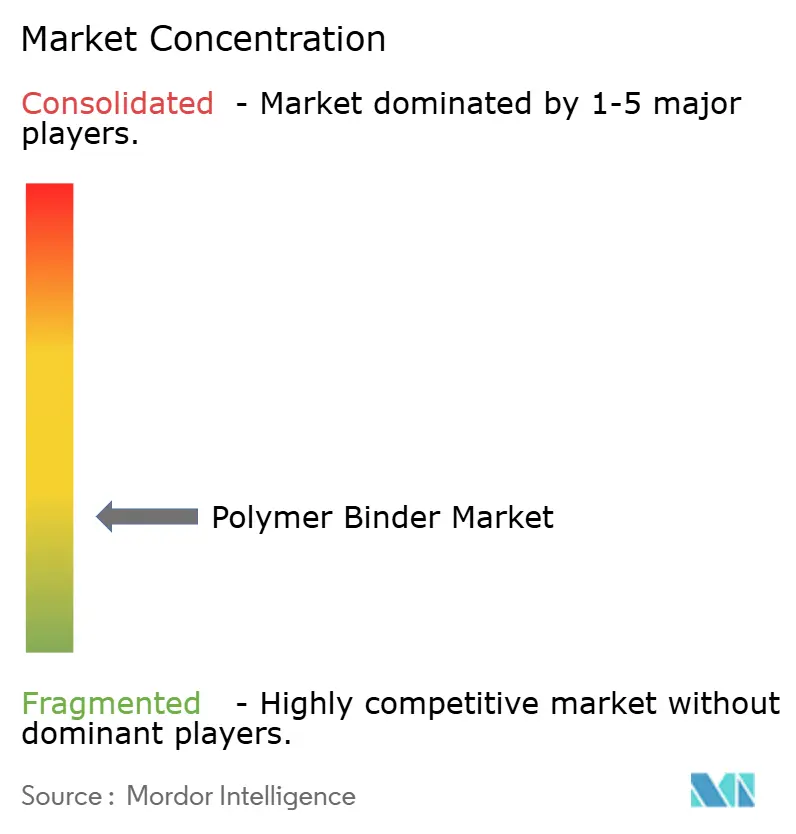
The market is highly fragmented. Competition in the polymer binder market centers on a mix of scale, regional depth, and technology breadth. Strategic capacity expansions align with regional and end-use hotspots. Sustainability now drives differentiation as much as technical performance. Companies quantify cradle-to-gate greenhouse-gas intensity and broadcast reductions achieved through renewable electricity, carbon capture, and bio-feedstock adoption. Customers align purchasing policies accordingly, introducing internal scoring matrices that favor suppliers with third-party verified life-cycle assessments.
Polymer Binder Industry Leaders
Dow
Celanese Corporation
Arkema
Wacker Chemie AG
BASF
- *Disclaimer: Major Players sorted in no particular order
Polymer Binder Market Companies Covered in this Report
- AkzoNobel N.V.
- Arkema
- Ashland
- BASF
- Celanese Corporation
- Covestro AG
- DCC (Dairen Chemical Corp.)
- Dow
- Eastman Chemical Company
- Evonik Industries AG
- H.B. Fuller Co.
- Solvay
- Synthomer Plc
- The Lubrizol Corporation
- Toagosei Co., Ltd.
- Trinseo
- Wacker Chemie AG

Market Opportunities and Future Outlook
The most visible whitespace sits in high-performance, low-emission binder systems where regulatory pressure and new end-use requirements intersect. In building and industrial coatings, tightening VOC limits in parts of North America and Europe reinforces demand for water-borne emulsions and self-crosslinking systems that meet performance targets without solvent-heavy coalescents. That shift creates room for suppliers that can deliver very low-VOC formulations (including sub-5 g/L binder-enabled systems referenced by the market) while maintaining exterior durability and early water resistance.
Energy storage is expanding the addressable binder set beyond conventional PVDF/NMP processing, with company launches and public R&D roadmaps supporting solvent-free or aqueous pathways. In June 2026, BASF introduced Oppanol N PLUS, a polyisobutene-based binder positioned for next-generation EV batteries including sulfide-based solid-state batteries, explicitly designed to remove NMP solvent use and replace conventional PVDF binders in targeted applications. In parallel, the Battery 2030+ roadmap highlights binder innovation themes such as self-healing and mechanically adaptive binders for long-life cells, aligning with ongoing industry work on silicon-anode binder architectures (branched and cross-linked hybrids) to manage large volume expansion during cycling. Taken together, these signals point to opportunities for polymer binder suppliers that can combine electrochemical stability, adhesion, and manufacturability with verified sustainability attributes and scalable quality control.
Recent Industry Developments in Polymer Binder Market
- July 2026: Arkema commissioned a 15% capacity expansion for PVDF binder production at its Kentucky plant to support battery manufacturing demand. The added output improves supply availability for fluoropolymer binders used in electrode processing and reinforces Arkema's positioning in specialized battery-grade materials, where qualification cycles can lock in long-term customer relationships.
- June 2026: BASF introduced Oppanol N PLUS, a polyisobutene-based binder designed for next-generation EV batteries, including sulfide-based solid-state batteries. The product targets a shift away from conventional PVDF binder and NMP solvent processing, expanding BASF's footprint in higher-performance battery binder formulations and solvent-reduction pathways.
- December 2024: Arkema finalized the acquisition of Dow Inc.'s flexible packaging laminating adhesives business. The transaction broadened Arkema's adhesives portfolio and downstream access in packaging applications, which can pull through demand for compatible binder chemistries and support formulation platform integration across customer accounts.


Polymer Binder Market Report Scope and Research Methodology
Market Definition and Coverage
The polymer binder market, for this study, covers polymer materials sold as binders that enable adhesion and film formation in end uses like coatings, adhesives, textiles, inks, and related industrial applications, measured as revenue from binder sales across regions.
Scope exclusions: downstream finished products where the binder is already embedded (for example, packaged paints, finished adhesives, or printed goods) are excluded, and application labor and equipment value are not counted.
Segments Covered in This Report
- By Type
- Vinyl Acetate
- Acrylic
- Styrene-Acrylic
- Latex
- By Form
- Powder
- Liquids
- High-Solids
- By Application
- Coatings
- Adhesives
- Textiles
- Inks
- Metals
- Other Applications (Additive Manufacturing Powders, Energy Storage, etc.)
- By Geography
- Asia-Pacific
- China
- Japan
- India
- South Korea
- ASEAN Countries
- Rest of Asia-Pacific
- North America
- United States
- Canada
- Mexico
- Europe
- Germany
- United Kingdom
- France
- Italy
- Spain
- Russia
- NORDIC Countries
- Rest of Europe
- South America
- Brazil
- Argentina
- Rest of South America
- Middle-East and Africa
- Saudi Arabia
- South Africa
- Rest of Middle-East and Africa
- Asia-Pacific
Data Sources, Market Sizing, and Validation
Desk Research
Desk work started with mapping the demand pool and supply context for binder-consuming industries, then linking how binder chemistry choices shift with regulation and end-market output. Public sources were used to anchor the model, including US Census Bureau construction and manufacturing series, USGS minerals data that often tracks building and coatings-related activity, Eurostat industrial production indicators, and UN Comtrade trade flows for relevant polymer and chemical categories.
We also reviewed information disclosed by producers and large end users through annual reports, investor presentations, sustainability reports, and product technical datasheets, which helped confirm typical binder forms and the practical pull from formulators and procurement teams. To close remaining gaps, we used a few paid-data subscriptions for company financials and intelligence, patent databases to track technology direction, and an import and export shipment-level database to directionally check trade-linked volumes. The sources listed here are illustrative, and many other public documents and datasets were also referenced for collection, cross-checking, and clarification.
Primary Interviews and Surveys
Primary work focused on confirming what buyers actually procure as a binder versus adjacent additives, and how pricing and mix changes show up across coatings, adhesives, textiles, inks, and metals use cases. We spoke with a mix of raw material suppliers, formulators, distributors, and procurement or plant teams, and then compared inputs across APAC, EMEA, and the Americas to reduce reliance on one region's purchasing patterns.
Distribution of primary research fieldwork respondents
| Company type | Respondent position | Region |
|---|---|---|
| Top tier: 27% | CXOs: 13% | APAC: 47% |
| Mid tier: 55% | Functional/Unit leaders: 38% | EMEA: 32% |
| Smaller Players: 18% | Managers: 49% | Americas: 21% |
Market-Sizing & Forecasting
Sizing was built using a top-down approach where coatings, adhesives, textiles, inks, and metals activity indicators were used to reconstruct binder demand pools by region. Those regional pools were translated into value using application-level binder intensity and realized price ranges.
Totals were then corroborated with selective bottom-up approximations, such as rolling up a sampled set of supplier revenues by binder lines, checking channel mix with distributor inputs, and stress-testing implied volumes against trade signals. Key model inputs were treated as variables with visible market movement, including construction output and renovation cycles, industrial production indices, waterborne versus solvent-based adoption (often influenced by VOC-related rules), shifts in resin types used for performance and cost, and oil-linked feedstock price direction that tends to influence binder ASPs. Forecasting relied mainly on scenario analysis, where base, conservative, and faster-adoption cases were tied to end-market growth and expected mix shifts, as discussed consistently in interviews. Where bottom-up data was incomplete for smaller producers, we used peer benchmarking by region and application, then re-checked the implied share against expert feedback before finalizing the market curve.
Data Validation & Update Cycle
Outputs were checked through several passes, starting with unit and logic checks at the application and region level, then variance checks versus independent signals like trade direction, end-market production trends, and observed price movements. When a number moved outside a reasonable range, assumptions were revisited, and the relevant experts were re-contacted to confirm whether it reflected a real market shift or an input correction.
Before sign-off, a second analyst review is completed to keep calculation steps, conversion logic, and assumptions consistent across the historical period and forecast. The report is refreshed annually, and interim updates are made when material events occur (for example, regulation changes, major capacity moves, or sharp feedstock swings). Right before delivery, we do a final sweep of key inputs so clients receive a current view.
Mordor Intelligence's Polymer Binder Market Size Versus Other Published Estimates
It is common to see different market sizes for polymer binders because published studies do not always count the same binder chemistries, forms, and end uses. They also differ in how they time prices and currency conversion assumptions, and some studies pick different base years, which changes the reported current market number.
By tracking binder form mix, end-use consumption signals, and annual pricing refresh logic, Mordor Intelligence keeps the model centered on binder revenues linked to coatings, adhesives, textiles, inks, and metals demand, rather than expanding into finished product value or broader polymer categories. The main gaps usually come from scope choices such as whether polyurethane and polyester binders are included, how waterborne adoption is projected, and whether ASPs are escalated using feedstock-driven ranges versus a flat inflation factor.
Benchmark comparison
| Source | Market Size | Gaps in Research Methodology |
|---|---|---|
| Mordor Intelligence | USD 39.84 B (2026) | |
| Global Research Publisher A | USD 37.10 B (2024) | Uses a different base year and growth window, and the current value is presented earlier in the cycle, which can understate later mix-driven ASP uplift from waterborne adoption and resin shifts. |
| Global Industry Report B | USD 42.50 B (2023) | May treat the market more broadly by folding in additional binder chemistries and adjacent polymer uses, and it can also reflect a higher price point year, which lifts the value even if volumes are similar. |
The table shows that the spread can be traced mainly to year selection and what is counted as a binder versus an adjacent polymer category. When scope boundaries stay tight and inputs like end-market output, mix shift, and price timing are explicitly checked, the resulting market size is easier to trace, explain, and update consistently.


Key Questions Answered in the Report
What is the current polymer binder market size and its projected growth?
The market is valued at USD 39.84 billion in 2026 and is set to reach USD 49.36 billion by 2031, advancing at a 4.38% CAGR
Which application leads demand in the polymer binder market?
Architectural and industrial coatings together secured 41.62% of 2025 revenue, maintaining the largest share owing to ongoing construction and maintenance activity
Why is vinyl acetate important to the polymer binder industry?
Vinyl acetate combines strong adhesion, low-VOC compatibility, and cost efficiency, enabling it to cover conventional coatings while penetrating new battery electrode formulations, and it achieves a 5.83% CAGR outlook
Which region is expanding fastest in the polymer binder market?
Asia-Pacific leads both in volume and growth, posting a 5.19% CAGR to 2031 as China, India, and Southeast Asia invest in construction, battery plants, and manufacturing hubs
Page last updated on:


 Your data is secure and never sold or shared.


