
Redispersible Polymer Powder Market Size and Share
Market Overview
| Study Period | 2020 - 2031 |
|---|---|
| Market Size (2026) | USD 1.97 Billion |
| Market Size (2031) | USD 2.59 Billion |
| Growth Rate (2026 - 2031) | 5.60 % |
| Fastest Growing Market | Asia Pacific |
| Largest Market | Asia Pacific |
| Market Concentration | Medium |
Major Players *Disclaimer: Major Players sorted in no particular order Image © Mordor Intelligence. Reuse requires attribution under CC BY 4.0. | |
Redispersible Polymer Powder Market Analysis by Mordor Intelligence
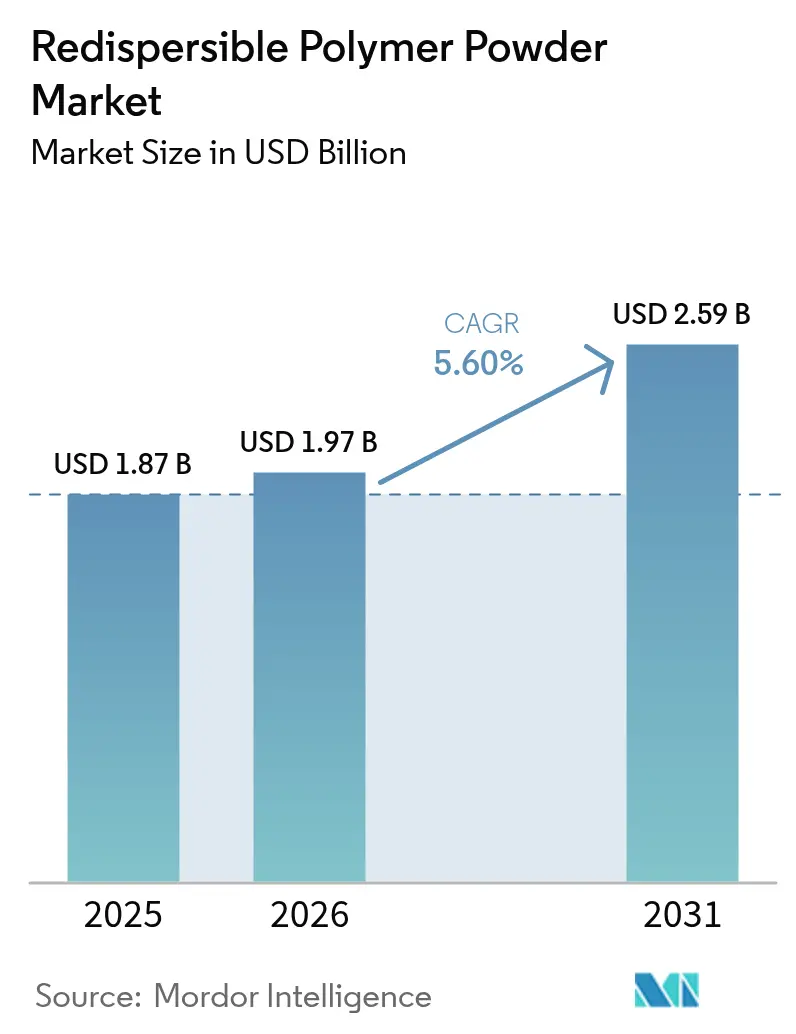
The Redispersible Polymer Powder Market size was valued at USD 1.87 billion in 2025 and estimated to grow from USD 1.97 billion in 2026 to reach USD 2.59 billion by 2031, at a CAGR of 5.60% during the forecast period (2026-2031). A steady preference for high-performance dry-mortar additives is raising demand as policymakers push for durable and energy-efficient buildings. Expanding infrastructure spending across emerging economies adds a strong volume base, while renovation programs in Europe and North America redirect product innovation toward low-VOC and bio-based grades. Volatile vinyl acetate monomer prices after 2024 compressed margins, yet vertical integration by leading producers helped to stabilize supply. Technology upgrades in spray-drying, along with polymer powders tailored for 3D-printed concrete, are widening the practical scope of the redispersible polymer powder market.
Key Report Takeaways
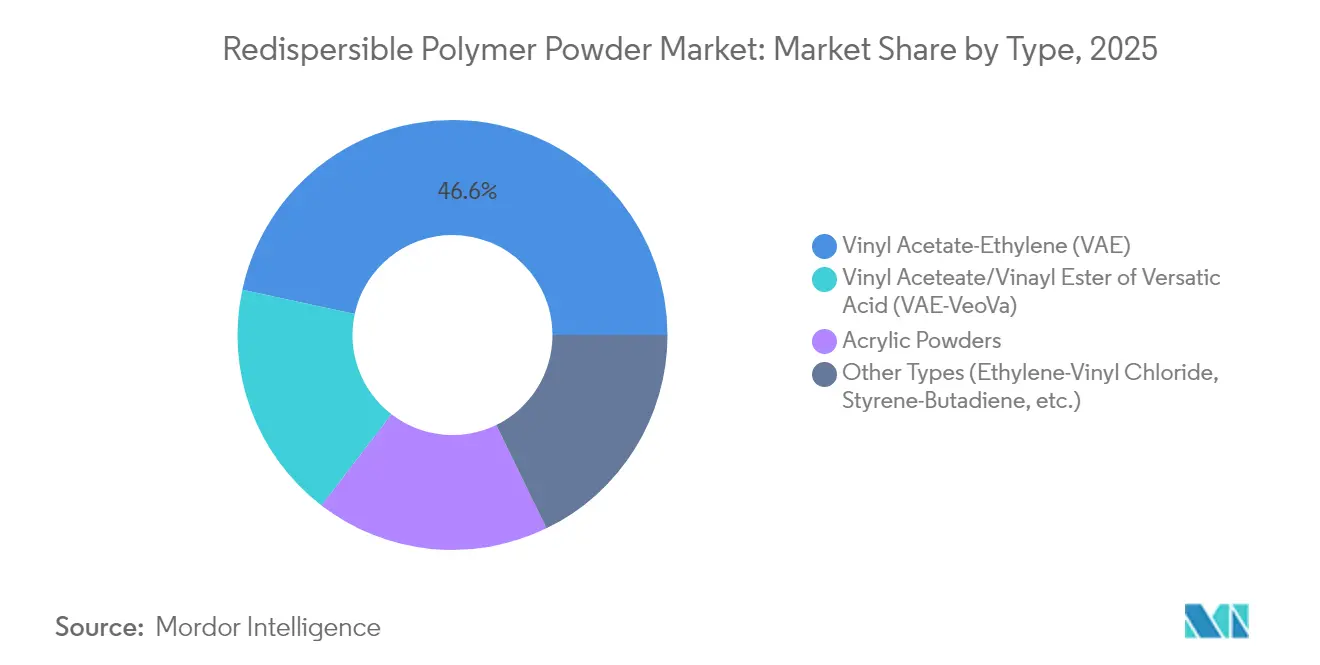
- By product type, Vinyl Acetate-Ethylene led with 46.62% of redispersible polymer powder market share in 2025 while Vinyl Acetate/Vinyl Ester of Versatic Acid is forecast to expand at a 6.08% CAGR through 2031.
- By application, tile adhesives accounted for 37.74% of the redispersible polymer powder market size in 2025; other applications, including External Thermal Insulation Composite Systems, are advancing at a 6.52% CAGR to 2031.
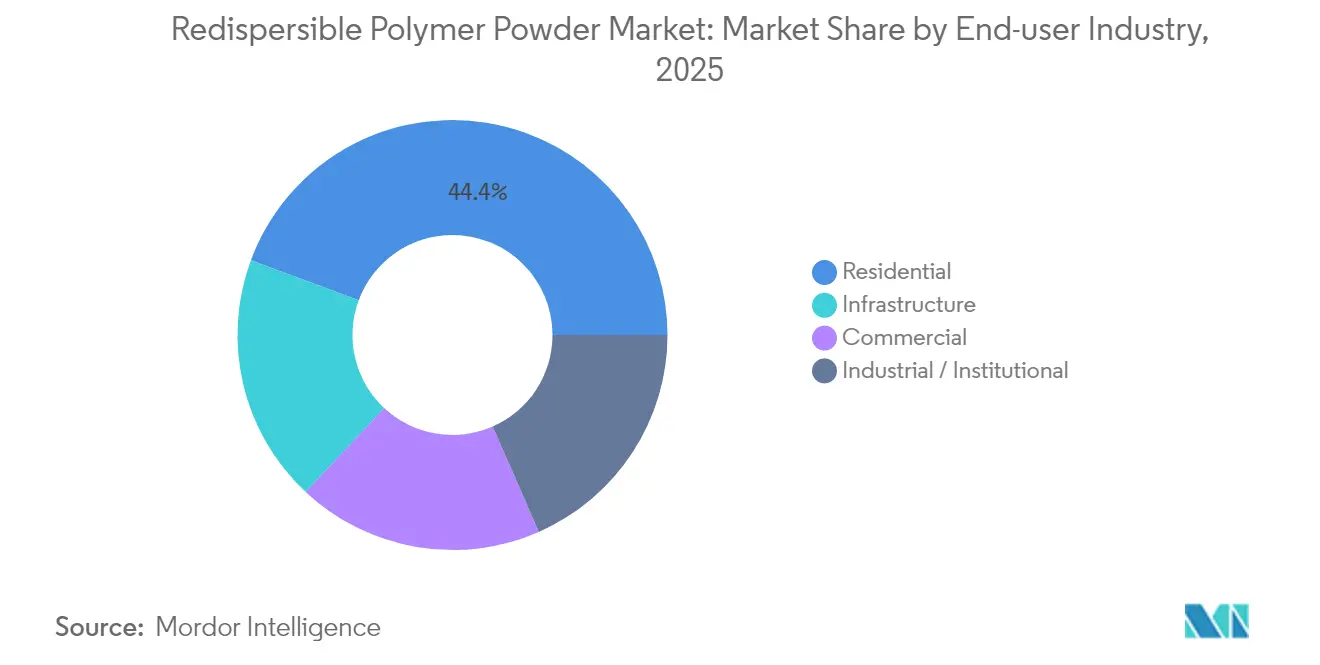
- By end-user industry, residential construction held 44.35% revenue in 2025 while infrastructure projects record the highest projected CAGR at 5.98% through 2031.
- By geography, Asia-Pacific commanded 45.55% of global demand in 2025 and is moving ahead at a 5.84% CAGR.
Note: Market size and forecast figures in this report are generated using Mordor Intelligence’s proprietary estimation framework, updated with the latest available data and insights as of 2026.
Market Trends and Insights
Drivers Impact Analysis of Redispersible Polymer Powder Market*
| Driver | (~) % Impact on CAGR Forecast | Geographic Relevance | Impact Timeline |
|---|---|---|---|
| Construction boom in emerging economies | +1.8% | Asia-Pacific core | Long term (≥ 4 years) |
| Rapid shift to ready-mix dry-mortar systems | +1.2% | Global | Medium term (2-4 years) |
| Renovation-led demand for high-performance tile adhesives | +0.9% | Europe and North America | Medium term (2-4 years) |
| Government energy-efficient building codes | +0.7% | North America and EU | Long term (≥ 4 years) |
| 3D-printed concrete adopting polymer binders | +0.4% | North America and Europe | Long term (≥ 4 years) |
| Source: Mordor Intelligence | |||
Construction Boom in Emerging Economies
Infrastructure expansion in Asia-Pacific underpins long-term growth as China’s carbon-neutrality roadmap and India’s housing drive collectively deliver more than 60% of regional consumption. BASF allocated USD 10 billion to its Zhanjiang Verbund site, ensuring renewable-powered production of construction polymers. India’s construction chemicals revenue touched INR 20,000 crore in 2025, and Master Builders Solutions set a turnover target of INR 500 crore by 2028. Saudi Arabia’s NEOM project earmarked SAR 1.3 billion for robotics-enabled building, which highlights a preference for specialty binders capable of supporting automated assembly. Such multi-year public programs guarantee visibility for the redispersible polymer powder market far beyond routine housing cycles.
Rapid Shift to Ready-Mix Dry-Mortar Systems
Factory-produced mortars cut job-site labor and minimize mixing inconsistencies, accelerating the worldwide transition from traditional batching to standardized formulations. Early adoption in Germany and France has proven the pathway for universal quality standards, and similar policy moves emerge in large U.S. metropolitan areas. Wacker introduced its VINNAPAS eco range to deliver bio-balanced VAE powders designed for automated silos and pumps. Ready-mix growth improves dosing accuracy, allowing contractors to meet stricter tile adhesive shear strength requirements. As skilled labor shortages worsen, automated dosing becomes a cost-avoidance strategy that further enlarges the redispersible polymer powder market.
Renovation-Led Demand for High-Performance Tile Adhesives
Energy-retrofit schemes across Europe stimulate premium tile adhesive sales as homeowners swap small tiles for large-format ceramic or stone. Scientific testing confirmed superior bond strength for ceramic finishes in north-facing facades, reinforcing the need for customized polymer-modified adhesives. North American remodelers echo this trend, and cellulose ether suppliers report an uptick in synergy requests for improved open time and slip resistance. The willingness to pay for reliable adhesion encourages manufacturers to launch higher-margin VAE-VeoVa blends. Renovation therefore lifts the redispersible polymer powder market beyond purely new-build demand.
Government Energy-Efficient Building Codes
The U.S. Department of Energy set aside USD 240 million in grants to help states update codes that cut operational energy use[1]U.S. Department of Energy, “DOE Announces $240 Million for Adoption of Energy-Efficient Building Codes,” iratracker.org. Federal buildings must phase out fossil fuels by 2030, giving procurement officers a mandate to select low-embodied-carbon construction chemicals. The General Services Administration added minimum recycled-content thresholds that create pull for bio-based polymer powders. Similar code upgrades in Canada and selective Asian economies indicate that compliance-driven material choice will keep pushing the redispersible polymer powder market toward eco-formulations.
Restraints Impact Analysis of Redispersible Polymer Powder Market*
| Restraint | (~) % Impact on CAGR Forecast | Geographic Relevance | Impact Timeline |
|---|---|---|---|
| Volatility in vinyl-acetate monomer prices | -1.4% | Global | Short term (≤ 2 years) |
| Stricter VOC limits on protective colloids | -0.6% | North America and Europe | Long term (≥ 4 years) |
| Technical complexity in spray-drying | -0.8% | Global | Medium term (2-4 years) |
| Source: Mordor Intelligence | |||
Volatility in Vinyl-Acetate Monomer and Ethylene Prices
Feedstock spikes since 2024 forced BASF and Celanese to raise prices for several acetate derivatives. Celanese responded with a 1.3 million-ton acetic-acid unit in Texas and a 70 kt VAE debottleneck in Nanjing to capture scale economies. Larger groups with backward integration hedge risks, yet small firms lacking long-term contracts face margin compression, amplifying consolidation inside the redispersible polymer powder industry.
Stricter VOC Limits on Protective Colloids
The U.S. Environmental Protection Agency amended aerosol-coating standards in January 2025, signalling wider scrutiny of construction chemical emissions[2]Environmental Protection Agency, “VOC Emission Standards for Aerosol Coatings,” federalregister.gov. Michigan and Colorado tightened VOC caps for building materials, while South Coast AQMD Rule 1113 lowered permissible solvent content in concrete coatings. Manufacturers now pivot to bio-sourced colloids or powder-based stabilizers, which raise production costs and extend formulation cycles.
*Our forecasts treat driver/restraint impacts as directional, not additive. The impact forecasts reflect baseline growth, mix effects, and variable interactions.
Redispersible Polymer Powder Market Segment Analysis
By Type:
VAE Dominance Faces Premium ChallengeVAE controlled 46.62% of redispersible polymer powder market share in 2025 owing to its competitive cost and broad utility across tile adhesives, renders, and self-leveling compounds . Demand concentration allows economies of scale that underpin current price leadership. An uptick in premium construction jobs, however, is accelerating the adoption of VAE-VeoVa grades that grow at a 6.08% CAGR. Formulators prefer VAE-VeoVa for exterior insulation systems where alkaline resistance and flexibility are critical under climate stress. Acrylic powders sustain a niche in UV-exposed facades, whereas ethylene-vinyl-chloride blends serve industrial coatings that need chemical endurance.
Growth prospects hinge on producers’ capacity to maintain steady spray-drying consistency. Wacker’s renewable resource-based range targets carbon-footprint reductions without dampening shear strength. Celanese debuted Vinyl Acetate ECO-B with certified bio-content, catering to builders seeking verifiable sustainability claims. The redispersible polymer powder market thus shows dual momentum: volume security in VAE and margin growth in specialty subtypes.



By Application:
Tile Adhesives Lead Infrastructure SurgeTile adhesives captured 37.74% of redispersible polymer powder market size in 2025 due to booming renovation projects across the EU and escalating property upgrades in Chinese megacities. Larger format tiles need higher tensile adhesion and extended open time, driving polymer loadings up to 4% of total mortar weight. External Thermal Insulation Composite Systems rise at a 6.52% CAGR as regulators link façade insulation performance to heating emissions. Polymer powders that withstand freeze-thaw cycling gain priority in Nordic and Alpine regions.
Other emerging outlets such as self-leveling underlayment, concrete repair kits, and pumpable renders broaden the addressable base. Scientific findings on comparative adhesion underscore the preference for polymer-modified mortars on vulnerable facades. Grout and mortar additive segments stay resilient, underpinned by demand for colorfast and crack-resistant finishes in hospitality and retail refurbishments.
By End-user Industry:
Residential Stability Meets Infrastructure GrowthResidential building generated 44.35% of global consumption in 2025 following sustained housing schemes in India and low-interest refinancing in the United States. Energy-retrofit subsidies in Germany further intensified demand for polymer-enhanced adhesives that improve indoor air quality and insulation. Infrastructure represents the fastest expansion at 5.98% CAGR as national programs finance climate-resilient highways, water systems, and mass-transit corridors. Contractors opt for high-flexibility grouts and repair mortars counted on to survive mechanical vibration and thermal shock in bridges and tunnels.
Commercial and industrial users form a stable mid-base, ordering bespoke polymer powders for flooring systems, clean-room finishes, and chemical containment slabs. Cross-segment opportunities arise when residential façade products retrofit government buildings that also need to meet net-zero mandates. Hence, end-user diversity fortifies the redispersible polymer powder market against downturns in any single construction vertical.
Geography Analysis
APAC Redispersible Polymer Powder Market
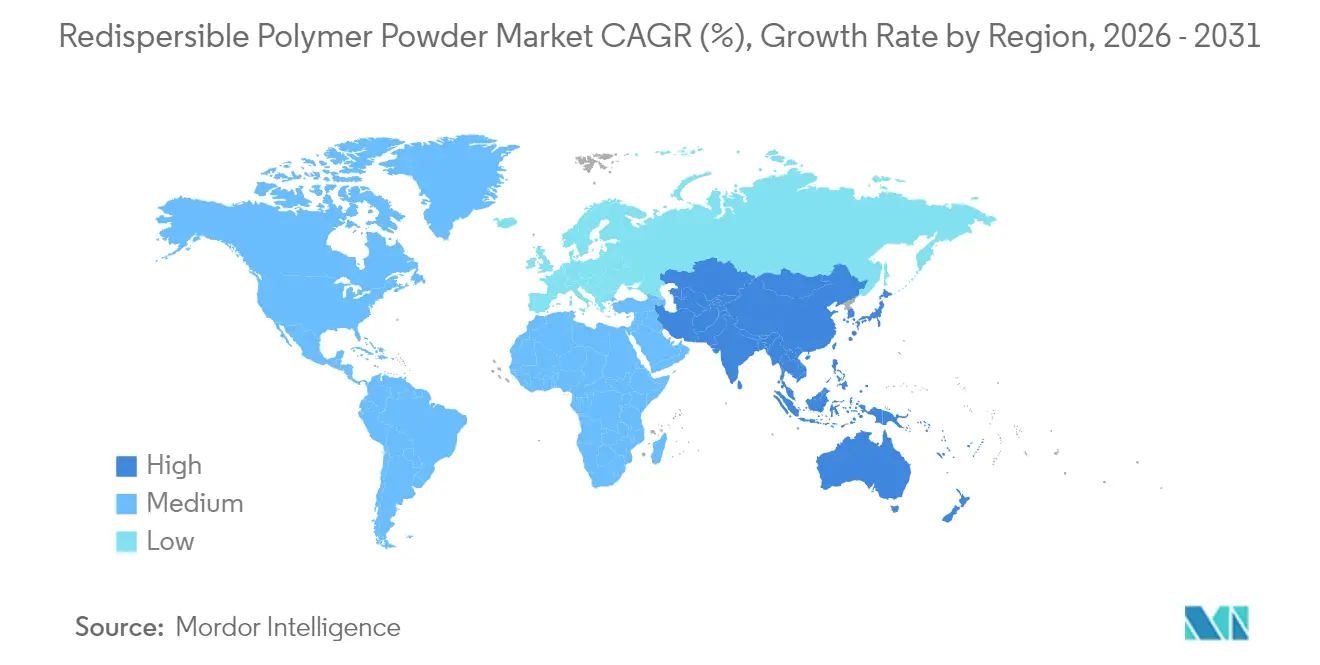
Asia-Pacific dominates the redispersible polymer powder market, recording 45.55% of global volume in 2025 and sustaining the fastest 5.84% CAGR. Government stimulus for rail, highway, and affordable housing projects amplifies baseline usage, while Chinese carbon-neutral targets encourage eco-certified polymer grades. Producers that localize capacity, as Sika did with twin plants in China and Indonesia, secure customs and freight benefits while ensuring supply reliability. The result is a structural tilt in global demand toward the region.
North America and Europe Redispersible Polymer Powder Market
North America and Europe preserve share through stringent energy-performance regulations and large renovation stock. The U.S. DOE grant pool of USD 240 million elevates state adoption of advanced codes and steers builders toward polymer solutions that cut thermal bridging. EU directives on embodied-carbon reporting accelerate adoption of bio-based VAE-VeoVa powders. Mature distribution networks in both regions enable just-in-time delivery of customized grades, which explains robust margins even though absolute growth trails Asia-Pacific.
South America and MEA Redispersible Polymer Powder Market
South America and Middle-East and Africa add a growth flank as megacities overhaul transport corridors and climate-proof coastal infrastructure. Saudi Arabia’s SAR 1.3 billion robotics-based NEOM agenda sets procurement protocols that favor high-durability binders. Brazil channels infrastructure stimulus toward sewer and road rehabilitation, spurring polymer demand in repair mortars. Local supply gaps invite joint ventures with global players that transfer technology while leveraging indigenous raw materials.

Value Chain Analysis
The value chain begins with petrochemical and acetyl feedstocks (ethylene, acetic acid, and vinyl acetate monomer), which are polymerized into latex (commonly VAE or acrylic) and then converted into redispersible polymer powder through spray drying. Protective colloids (notably polyvinyl alcohol) and anti-caking additives are critical intermediate inputs, because they affect redispersibility, storage stability, and VOC-related compliance performance in dry-mix systems.
Integrated producers that secure upstream monomers and run emulsion-to-powder assets manage volatility better than toll or standalone spray-drying operators, particularly after the post-2024 vinyl acetate monomer price swings cited in the market context. Downstream, the chain runs through construction chemical formulators and dry-mix mortar producers, and then to distribution through building-material channels. In China, procurement is shifting toward direct mill-to-distributor models that reduce intermediaries, while tightening commercial terms for smaller traders. Manufacturing footprints concentrate around major construction chemicals hubs (notably China and Germany), where proximity to petrochemical infrastructure and export logistics supports cost and lead-time control.
Competitive Landscape
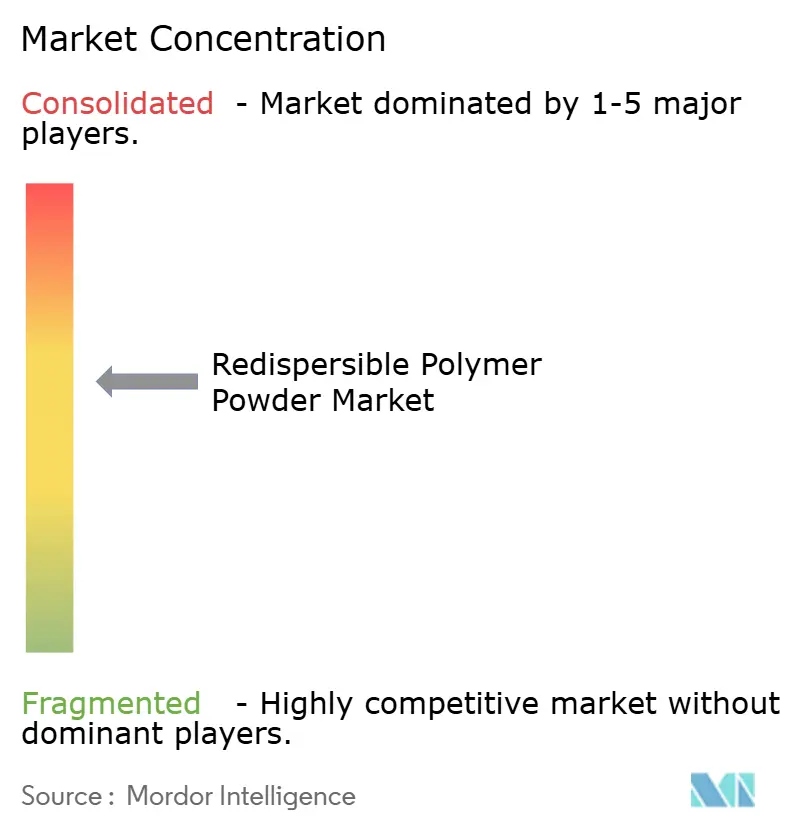
The redispersible polymer powder market remains moderately concentrated. BASF, Wacker Chemie, and Dow leverage integrated feedstocks and worldwide technical centers to retain pricing power. BASF’s USD 10 billion Zhanjiang Verbund reinforces bulk capacity paired with renewable energy, while Wacker’s Nanjing upgrade added a reactor and spray dryer focused on VAE expansion. Dow channeled capital into Thailand’s propylene glycol line to secure upstream flexibility.
Celanese expanded its acetyl chain by scaling acetic-acid capacity in Texas and Nanjing to neutralize vinyl acetate volatility. Sustainability leadership surfaces through bio-based certifications and low-carbon supply chains—critical differentiators as public buyers tighten embodied-carbon specifications. Smaller regional firms confront rising compliance costs and technology demands—a dynamic that sparks mergers, such as JSC Pigment’s 2025 launch in Russia to insource domestic demand.
White-space competition now shifts to 3D-printing and automated masonry where bespoke polymer blends deliver shape stability. Early adopters collaborate with additive manufacturing start-ups, positioning incumbents for premium niches while reinforcing overall share in the redispersible polymer powder market.
Redispersible Polymer Powder Industry Leaders
Wacker Chemie AG
Celanese Corporation
BASF SE
Dow Inc.
Synthomer plc
- *Disclaimer: Major Players sorted in no particular order
Redispersible Polymer Powder Market Companies Covered in this Report
- Acquos
- ADA FINE CHEMICALS CO.,LTD
- Anhui Elite Industrial Co.,ltd
- Ashland
- BASF SE
- Bosson Union Tech(Beijing) Co.,Ltd
- Celanese Corporation
- Celotech Chemical Co., Ltd.
- DCC (Dairen Chemical Corporation)
- Dezhou Tengda Construction New Materials Co. , Ltd.
- Dow Inc.
- Hebei Derek Chemical Limited
- Hexion Inc.
- JSC Pigment
- Organik Kimya.
- Oscrete Construction Products
- Sakshi Chem Sciences Pvt. Ltd.
- SIDLEY CHEMICAL CO.,LTD.
- Synthomer plc
- Vinavil S.p.A.
- Wacker Chemie AG

Market Opportunities and Future Outlook
Product and channel whitespace is opening around low-emission and sustainability-linked formulations for dry-mix mortar systems used in tile adhesives and ETICS, as building-code and public-procurement requirements increasingly reference durability and emissions performance. Wacker Chemie AG continued commercialization of its VINNAPAS eco range, and the February 2025 launch of Synthomer plc's Revacryl redispersible polymer powder line aimed at low-VOC applications points to ongoing supplier investment in differentiated grades, rather than commodity-only positioning.
Regional opportunity is anchored in capacity and technical-service localization, which helps shorten lead times and support formulation qualification under local construction practices. Wacker completed an April 2025 expansion at Burghausen, Germany, adding 20,000 metric tons per year of redispersible polymer powder capacity for construction uses such as tile adhesives and ETICS, strengthening supply coverage for renovation-heavy European demand. Supplier and formulator collaborations that tailor powders for climate and application needs, including BASF's December 2024 partnership in India to optimize formulations for tropical EIFS, also indicate a pathway for premiumization based on field-tested performance rather than only polymer type selection.
Recent Industry Developments in Redispersible Polymer Powder Market
- June 2026: Wacker Chemie AG implemented a price increase of up to 15% for multiple polymer products, including redispersible polymer powders, from its European and American manufacturing bases effective June 1, 2026. The change reflected continued cost pressure in key end markets and reinforced the role of large suppliers in resetting reference pricing for dry-mix mortar value chains.
- May 2025: Wacker Chemie AG raised prices by up to 5% for its emulsion and redispersible polymer powder products produced in Europe and the United States effective May 1, 2025. The adjustment linked to higher raw-material and logistics costs, affecting formulation economics for tile adhesives and ETICS producers working on short contract cycles.
- September 2024: BASF SE had a patent application published (US20240301272A1) covering water-dispersible polymer powder compositions for cementing in subterranean formations using styrene-butadiene polymers. The disclosure highlights continued R and D into specialized powder chemistries that can broaden redispersible powder use beyond mainstream construction mortars into performance-critical cementing applications.


Redispersible Polymer Powder Market Report Scope and Research Methodology
Market Definition and Coverage
This market covers dry redispersible polymer powders used as performance additives in cementitious and gypsum-based mixes, where the powder re-disperses in water during mixing and supports bonding, flexibility, and workability across building and renovation applications.
Scope exclusions: the sizing excludes liquid polymer dispersions sold in bulk, and it also excludes downstream dry-mix mortar value beyond the polymer powder itself.
Segments Covered in This Report
- By Type
- Vinyl Acetate-Ethylene (VAE)
- Vinyl Aceteate/Vinyl Ester of Versatic Acid (VAE-VeoVa)
- Acrylic Powders
- Other Types (Ethylene-Vinyl Chloride, Styrene-Butadiene, etc.)
- By Application
- Plasters and Renders
- Tile Adhesives
- Grouts
- Mortar Additives
- Other Applications (External Thermal Insulation Composite Systems (ETICS), etc.)
- By End-user Industry
- Residential
- Commercial
- Industrial / Institutional
- Infrastructure
- By Geography
- Asia-Pacific
- China
- Japan
- India
- South Korea
- ASEAN Countries
- Rest of Asia-Pacific
- North America
- United States
- Canada
- Mexico
- Europe
- Germany
- United Kingdom
- France
- Italy
- Spain
- Russia
- NORDIC Countries
- Rest of Europe
- South America
- Brazil
- Argentina
- Rest of South America
- Middle East and Africa
- Saudi Arabia
- South Africa
- Rest of Middle East and Africa
- Asia-Pacific
Data Sources, Market Sizing, and Validation
Desk Research
Desk work was used to pin down the demand pool and to keep assumptions realistic by tracking construction activity and raw material cost signals that influence powder pricing. Public sources were reviewed, such as construction output and permits data from national statistical offices, trade and customs statistics for polymer and chemical intermediates, building code and renovation policy notes from government portals, and technical papers in peer-reviewed construction materials journals.
To avoid overstating demand, we also checked dry-mix mortar penetration cues and application trends through association publications and reputable industry press. On the supply side, we used company filings and investor presentations to cross-check production and shipment context. In a few cases, paid subscriptions were used only for company financials, patent landscaping, and shipment-level import-export views where public series were not detailed enough. The sources listed here are illustrative, and additional public documents were also used for cross-checks and clarification.
Primary Interviews and Surveys
Primary work focused on pricing logic, application mix, and regional demand pacing, since these are the areas where public information is usually thin. We spoke with a spread of producers, distributors, dry-mix formulators, and construction material buyers across the main consuming regions so that key assumptions could be pressure-tested, and then adjusted, before the final numbers were locked.
Distribution of primary research fieldwork respondents
| Company type | Respondent position | Region |
|---|---|---|
| Top tier: 34% | CXOs: 12% | APAC: 43% |
| Mid tier: 50% | Functional/Unit leaders: 43% | EMEA: 31% |
| Smaller Players: 16% | Managers: 45% | Americas: 26% |
Market-Sizing & Forecasting
Sizing starts from a top-down build where construction activity and dry-mix mortar adoption are translated into an addressable demand pool for polymer-modified systems, then filtered into redispersible powder usage rates by application. In practice, the model is anchored on measurable fingerprints, including regional construction output and renovation intensity, tile adhesive and plaster consumption tendencies, typical polymer dosage ranges in mortar recipes, and price direction linked to vinyl acetate and ethylene-linked feedstock costs.
After forming the demand pool, we corroborate it with selective bottom-up checks, such as sampled average selling price bands for common powder grades multiplied by estimated volumes tied to dry-mix production clusters, followed by distributor and formulator channel checks. Where inputs are missing in smaller countries, we handle gaps using proxy indicators like cement consumption growth, urban housing starts, and import dependence, then normalize those signals back to regional totals.
For forecasting, we use scenario analysis around a base case because construction cycles, renovation programs, and raw material volatility can shift pricing and mix within a short period. Growth paths are adjusted using expert consensus on expected dry-mix penetration, green building and low-VOC formulation shifts, and the speed at which external insulation systems and tile setting demand expand in each region.
Data Validation & Update Cycle
Outputs are validated through multiple checks so the final number is not driven by a single data series or one interview viewpoint. We compare the modeled totals against independent signals like regional construction spending trends, trade flows for relevant polymer intermediates where applicable, and observed price ranges discussed by buyers and formulators. Outliers are reviewed and corrected with follow-up calls when needed.
Before sign-off, the model is reviewed step-by-step, with assumptions checked for internal consistency across regions, applications, and pricing. Reports are refreshed annually, and if a material event occurs, such as a sharp feedstock price move, a capacity change, or a construction slowdown, interim updates are triggered. Right before delivery, we do a final pass so clients receive the latest aligned view.
Mordor Intelligence's Redispersible Polymer Powder Market Estimate Compared With Other Published Estimates
Published market sizes for redispersible polymer powder can look far apart, even when the topic name is the same, because the counting boundary and the price and volume assumptions are not consistent across sources. Differences usually show up in what is included as the product, how regional prices are converted to USD, and whether construction-cycle slowdowns are treated as temporary or structural.
Import-export signals for polymer intermediates, combined with application-level demand checks from dry-mix formulators, are the evidence used to keep Mordor Intelligence tied to the addressable powder consumption pool instead of broader construction additives that sit next to it. The spread in outside numbers often comes from folding in liquid dispersions, counting finished dry-mix mortar value, or applying a single global ASP that ignores big regional price gaps and grade mix shifts.
Benchmark comparison
| Source | Market Size | Gaps in Research Methodology |
|---|---|---|
| Mordor Intelligence | USD 1.97 B (2026) | |
| Global Consultancy A | USD 2.26 B (2025) | Uses a different base year and commonly applies broad construction-chemicals pricing assumptions, which can lift totals if adjacent binders or mortar value are partially included and if USD conversion timing is not aligned. |
| Market Publisher B | USD 0.11 B (2024) | Likely reflects a narrower scope or partial application coverage, where only select grades or end uses are counted, which can understate the total when large-volume tile adhesive and render use is not fully captured. |
Looking across the table, the main takeaway is that scope boundaries and pricing logic explain most of the gap, not a disagreement that demand exists. By keeping the counted product limited to powder sales and by grounding volumes in construction-led usage indicators, the final figure stays traceable to clear steps that can be repeated and rechecked.


Key Questions Answered in the Report
What is the current value of the redispersible polymer powder market?
The redispersible polymer powder market size stood at USD 1.97 billion in 2026 and is projected to reach USD 2.59 billion by 2031.
Which product type has the largest share?
Vinyl Acetate-Ethylene accounts for 46.62% of market share, making it the most widely used grade.
Why is Asia-Pacific growing faster than other regions?
Asia-Pacific benefits from large infrastructure programs in China and India, coupled with localized production investments that shorten supply chains and cut costs.
How do energy-efficient building codes influence demand?
Stricter codes oblige builders to use materials that enhance thermal performance and reduce embodied carbon, thereby increasing adoption of high-performance polymer powders formulated with bio-based or low-VOC components.
What is driving adoption of polymer powders in 3D-printed concrete?
Additive manufacturing relies on precise rheology and rapid film formation, properties delivered by tailored polymer powders that ensure shape stability and long-term durability.
Page last updated on:


 Your data is secure and never sold or shared.


