
Viscose Staple Fiber Market Size and Share
Market Overview
| Study Period | 2020 - 2031 |
|---|---|
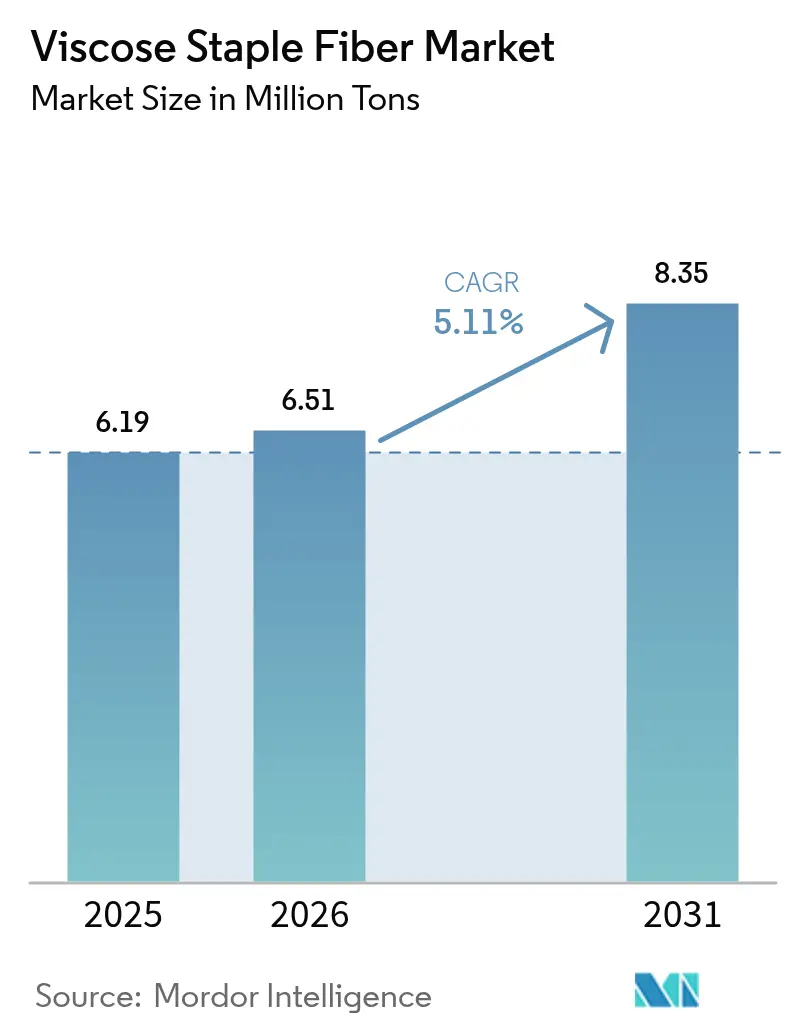
| Market Volume (2026) | 6.51 Million tons |
| Market Volume (2031) | 8.35 Million tons |
| Growth Rate (2026 - 2031) | 5.11 % |
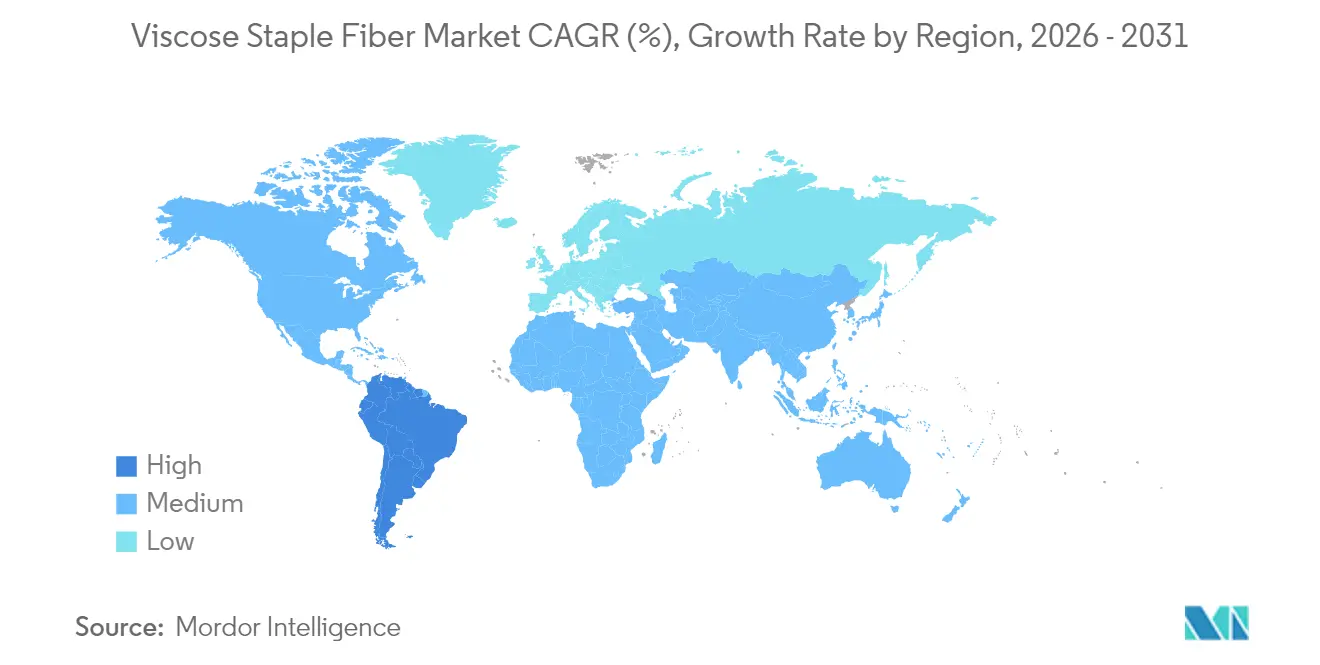
| Fastest Growing Market | South America |
| Largest Market | Asia Pacific |
| Market Concentration | Medium |
Major Players *Disclaimer: Major Players sorted in no particular order Image © Mordor Intelligence. Reuse requires attribution under CC BY 4.0. | |
Viscose Staple Fiber Market Analysis by Mordor Intelligence
The Viscose Staple Fiber Market size in 2026 is estimated at 6.51 million tons, growing from 2025 value of 6.19 million tons with 2031 projections showing 8.35 million tons, growing at 5.11% CAGR over 2026-2031. This growth trajectory reflects the sector’s ability to navigate dissolving-pulp price swings, capitalize on cotton volatility, and align with fast-fashion supply timelines. The viscose staple fibre market benefits from integrated Asian supply chains that pair proximate pulp sources with large spinning capacities, giving regional producers a structural cost edge. Demand resilience also stems from increased specialty fiber adoption in medical and hygiene products that offset cyclical apparel spending shifts. Intensifying sustainability mandates in North America and Europe reward closed-loop technologies, nudging premium buyers toward suppliers with certified low-emission operations.
Key Report Takeaways
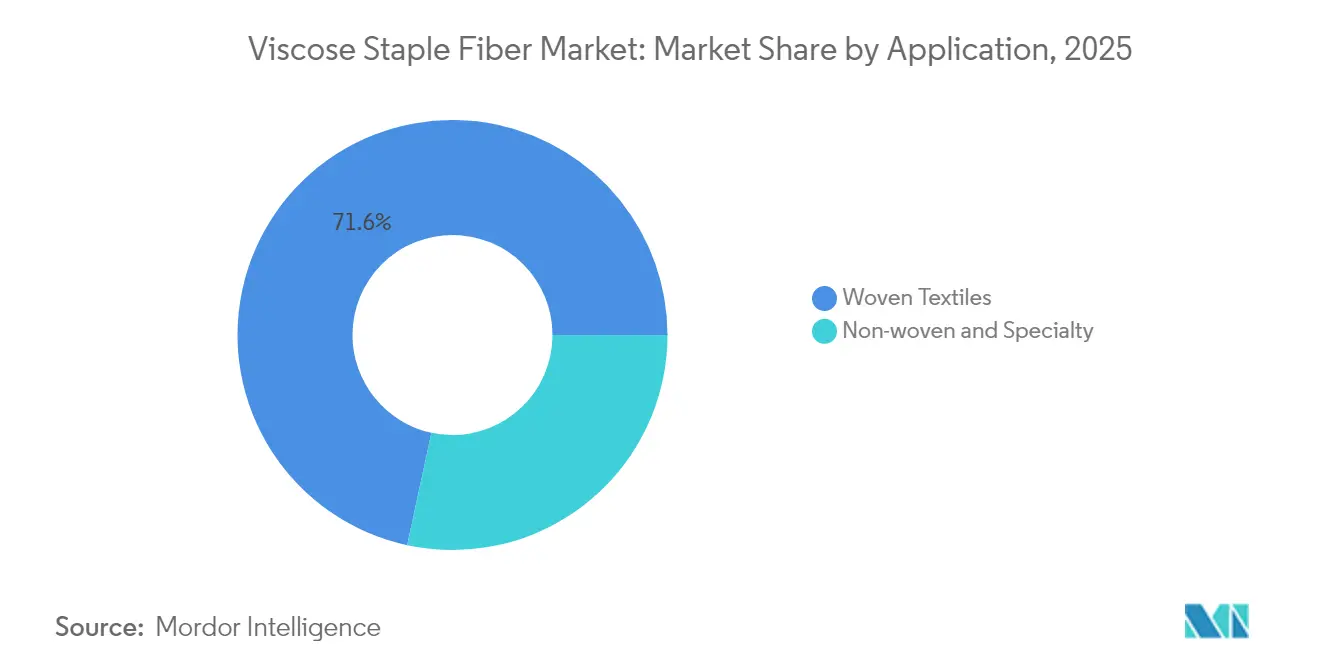
- By application, woven textiles led with 71.62% of the viscose staple fibre market share in 2025; non-woven and specialty applications are advancing at a 6.26% CAGR through 2031.
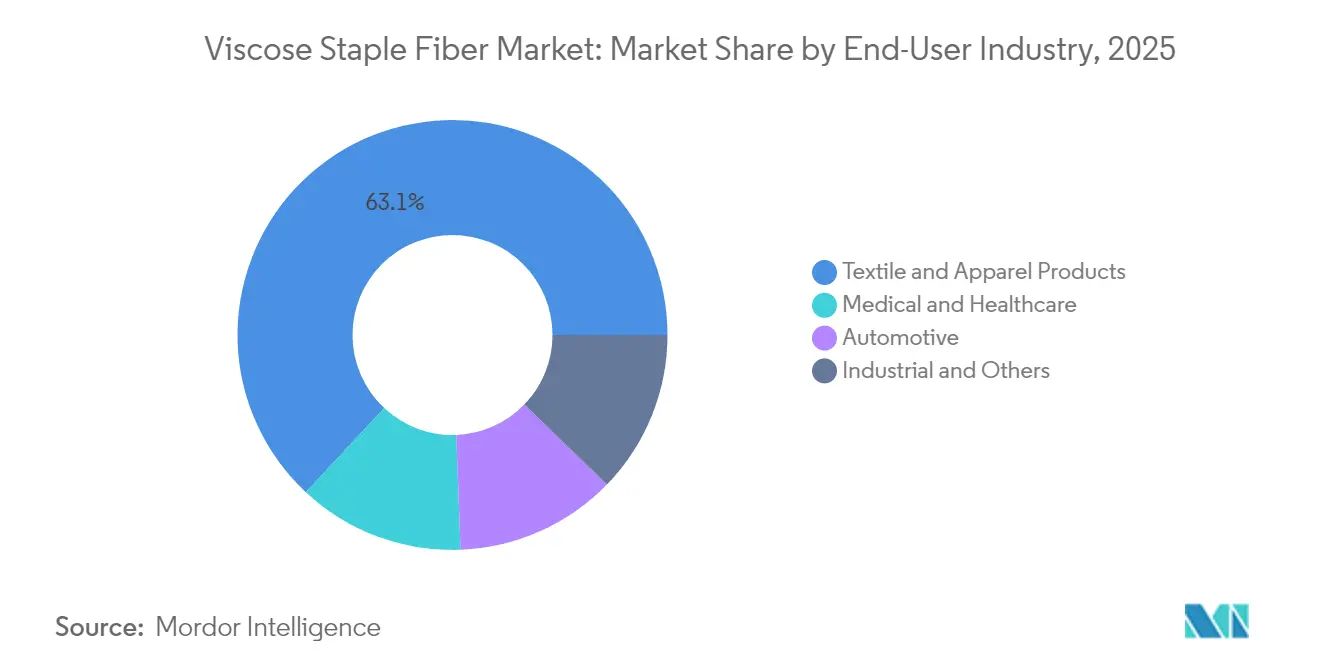
- By end-user industry, textile and apparel products held 63.05% of the viscose staple fibre market share in 2025, while medical and healthcare are projected to grow at a 6.79% CAGR through 2031.
- By geography, Asia-Pacific accounted for a 52.10% share of the viscose staple fibre market size in 2025, and South America is set to expand at a 6.12% CAGR to 2031.
Note: Market size and forecast figures in this report are generated using Mordor Intelligence’s proprietary estimation framework, updated with the latest available data and insights as of 2026.
Market Trends and Insights
Drivers Impact Analysis of Viscose Staple Fiber Market*
| Driver | (~) % Impact on CAGR Forecast | Geographic Relevance | Impact Timeline |
|---|---|---|---|
| Growing demand for apparel and clothing | +1.8% | Global, APAC core | Medium term (2-4 years) |
| Cotton-price volatility favouring viscose | +1.2% | Global, price-sensitive markets | Short term (≤ 2 years) |
| Expansion of fast-fashion manufacturing in the Asia-Pacific | +0.9% | APAC, Southeast Asia spill-over | Medium term (2-4 years) |
| Surge in hygiene and wipes non-wovens blending | +0.7% | North America and EU lead | Long term (≥ 4 years) |
| Textile-to-pulp recycling enabling circular feedstock | +0.5% | EU and North America early, APAC scaling | Long term (≥ 4 years) |
| Source: Mordor Intelligence | |||
Growing Demand for Apparel and Clothing
Global apparel consumption is still climbing, and viscose continues to win share from both cotton and synthetics. Retailers favor the fiber’s moisture management, drape, and dye uptake that help deliver premium aesthetics at mid-tier price points. Fast-fashion chains leverage viscose to replicate natural-fiber looks inside compressed design-to-shelf cycles. Limited U.S. spinning capacity redirected incremental volumes toward Asian mills, underscoring regional supply imbalances. Consumers newly focused on comfort and affordability increasingly choose viscose-rich blends, sustaining baseline demand even as discretionary spending ebbs.
Cotton-Price Volatility Favouring Viscose
Cotton prices swung sharply during 2024. Such volatility complicates seasonal cost planning and pushes mills toward the relative stability of wood-based viscose staple fibre market contracts. Concurrent dissolving-pulp price relief has widened viscose’s cost advantage, encouraging mills to lock in longer-term supply. Weather risks, land-use competition, and policy shifts continue to inject uncertainty into cotton supply, strengthening viscose’s hedge role in fiber portfolios.
Expansion of Fast-Fashion Manufacturing in the Asia-Pacific
Asia-Pacific’s fast-fashion network now couples design hubs, fabric mills, and garment factories within tightly integrated clusters that can ship new styles in weeks. Investments like Syre’s upcoming textile-to-textile recycling plant in Vietnam illustrate capital inflows that deepen the region’s vertical breadth[1]Syre, “Syre Raises USD 100 Million Series A,” syre.com. China’s Xinjiang smart-spinning complex, backed by CNY 2 billion, enhances local throughput and automation efficiency. These capabilities cement APAC’s primacy in the viscose staple fibre market by shortening lead times and concentrating capacity close to feedstock sources.
Surge in Hygiene and Wipes Non-Wovens Blending
Rising consumer demand for plastic-free personal-care products accelerates viscose substitution in wipes, diapers, and feminine-care pads. Lenzing’s LENZING Lyocell Dry fiber achieves a water contact angle above 100° after one hour, enabling hydrophobic acquisition layers that rival polypropylene[2]Lenzing, “Lenzing Expands LENZING™ Lyocell Dry Fiber Portfolio,” lenzing.com. EU Single-Use Plastics rules and North American retailer packaging targets boost acceptance of biodegradable cellulosic fibers. Medical textile makers also prize viscose for its inherent softness and microbial resistance, supporting growth in specialized wound dressings and surgical drapes.
Restraints Impact Analysis of Viscose Staple Fiber Market*
| Restraint | (~) % Impact on CAGR Forecast | Geographic Relevance | Impact Timeline |
|---|---|---|---|
| Intensifying competition from synthetics | -0.8% | Global, price-sensitive segments | Medium term (2-4 years) |
| Stricter CS₂ emission regulations | -0.6% | EU and North America lead | Long term (≥ 4 years) |
| Dissolving pulp supply bottlenecks | -0.4% | Global, regional variance | Short term (≤ 2 years) |
| Source: Mordor Intelligence | |||
Intensifying Competition from Synthetics
Polyester and spandex producers discount aggressively to defend mass-market shares, and recycled PET yarns now carry sustainability labels that challenge viscose’s natural image. The spandex segment is growing, reflecting synthetics’ ability to tap niche performance niches. Established hydrocarbon feedstock chains lend price stability that resonates with value retailers, although environmental scrutiny of microplastics tempers the advantage.
Stricter CS₂ Emission Regulations
EU Best Available Techniques for sulfur emissions oblige viscose mills to install closed-loop systems or risk market exclusion. Birla Cellulose’s compliance blueprint demonstrates the capex burden required to align with the upcoming norms. Smaller standalone mills face disproportionate costs that could trigger capacity rationalization, especially in regions adopting EU-linked environmental trade standards.
*Our forecasts treat driver/restraint impacts as directional, not additive. The impact forecasts reflect baseline growth, mix effects, and variable interactions.
Viscose Staple Fiber Market Segment Analysis
By Application:
Woven Textiles Anchor Volumes While Specialty Segments AccelerateThe woven textiles segment accounted for 71.62% of the viscose staple fiber market volume in 2025, reflecting entrenched apparel and home-textile processing capacity across the Asia-Pacific. Strong drape, breathability, and vibrant dye profiles keep viscose woven fabrics central to shirts, dresses, and bed linens. Although overall apparel demand normalizes, cost-conscious brands still specify viscose blends to manage ticket prices and maintain premium aesthetics.
Although smaller today, specialty non-woven uses post a 6.26% CAGR as hygiene and medical grades gain traction. Hydrophobic viscose innovations allow diaper acquisition layers and fem-care topsheets once dominated by polypropylene. Medical device firms adopt viscose for absorbent wound pads and single-use surgical covers where biodegradability and skin compatibility outweigh slightly higher costs. Over the forecast horizon, non-wovens’ faster growth gradually chips away at woven’s share but does not displace its volumetric leadership.



By End-User Industry:
Healthcare Growth Outpaces Traditional Apparel DominanceTextile and apparel retained 63.05% of the viscose staple fiber market share in 2025, buoyed by fast-fashion reorder cycles and value-tier brand expansions. Integrated Asian clusters supply mass-market retailers in compressed lead times, reinforcing viscose as a fixture of global apparel sourcing matrices.
Conversely, medical and healthcare demand expands at 6.79% CAGR as hospitals and wound-care brands seek fibers meeting stringent purity and biocompatibility benchmarks. Aging populations in the U.S., EU, and Japan, alongside rising care standards in emerging regions, raise volumes of disposable medical drapes, gauzes, and hygiene wipes that rely on high-purity viscose. Producers targeting this niche secure higher margins through specialty grade certifications, partially insulating revenue from apparel’s cyclical swings.
Geography Analysis
APAC Viscose Staple Fiber Market
Asia-Pacific commanded 52.10% of global volume in 2025, anchored by China’s integrated pulp-to-fiber complexes and deep downstream weaving and garment industries. Domestic viscose output tops the global capacity, providing local converters with predictable access to fiber and enabling aggressive export pricing. Southeast Asian nations such as Indonesia and Vietnam add incremental scale, with Vietnam’s planned recycling facilities signaling a shift toward circular supply within the bloc. Robust logistics corridors and government support for textile hubs sustain APAC’s primacy through 2031.
South America Viscose Staple Fiber Market
While representing a smaller base, South America delivers the fastest regional CAGR at 6.12% through 2031. Brazil’s expanding knitwear mills and improved intra-regional trade pacts underpin capacity additions. Rising disposable income prompts domestic substitution of cotton with viscose in value apparel segments. Although still dependent on imported pulp and fiber, local stakeholders explore joint ventures to reduce freight costs and hedge currency volatility.
North America and Europe Viscose Staple Fiber Market
North America and Europe display mature, steady demand profiles, yet their regulatory environment wields outsized influence on global production standards. EU carbon and emission rules compel mills worldwide to invest in scrubbers, solvent recovery, and certified sustainable forestry. North American brand sustainability scorecards increasingly mandate traceability for pulp origin and closed-loop processing. These expectations elevate the competitive standing of technologically advanced mills even if absolute consumption grows modestly.

Regulatory Landscape
Regulation affecting viscose staple fiber increasingly centers on chemical, emissions, and traceability requirements in key import markets. In the European Union, the EU Strategy for Sustainable and Circular Textiles is tightening expectations around chemical transparency and product information. Wood-based input scrutiny has also intensified under the EU Deforestation Regulation (EUDR), with a December 2025 compliance deadline for large companies conducting due diligence on relevant wood-derived products used in MMCF supply chains.
Environmental compliance requirements also build through manufacturing standards and reporting frameworks that cascade to suppliers. EU BAT-aligned expectations on sulfur-related emissions and process controls continue to raise the bar for viscose operations. The ZDHC MMCF module process, including the Calendar Year 2025 submission window closing in June 2026, is used by brands and mills to standardize performance disclosure and chemical management. In the United States, textile wastewater compliance obligations remain tied to federal effluent limitation guidelines such as 40 CFR Part 410, keeping water treatment documentation central for mills supplying regulated end-use chains.
Value Chain Analysis
The viscose staple fiber value chain begins with dissolving pulp, primarily wood-based (with some cotton-linter and recycled cellulosic inputs), and key process chemicals such as sodium hydroxide and carbon disulfide. It then moves through fiber production, including viscose dope preparation, spinning, washing, and finishing, before reaching downstream spinning, weaving/knitting, and nonwoven conversion. Asia-Pacific stays the main manufacturing hub, supported by proximity between pulp sourcing, large-scale viscose fiber assets, and dense downstream textile clusters that support fast lead times for apparel as well as hygiene and medical nonwovens.
Operational compliance and sustainability verification have become core flow gates across the chain, shaping both cost and market access. Producers are moving toward closed-loop systems that recover sodium hydroxide and carbon disulfide to meet EU BAT-driven expectations and tighter environmental oversight in major producing countries. This shifts emissions and wastewater management into a screening barrier for smaller standalone mills. Industry coordination bodies and brand-used frameworks, including ZDHC MMCF guidance and China-focused technical standard setting through sector associations, add another layer of requirements that influences purchasing decisions, supplier qualification, and the ability to sell into Europe and North America.
Competitive Landscape
The viscose staple fibre industry is moderately fragmented, with integrated producers using scale and technology to sustain leadership. Asian incumbents continue expanding; Sinopec Yizheng’s 3 million t PTA complex in Jiangsu strengthens upstream integration for regional viscose yarn producers. Competitive intensity increasingly hinges on sustainability credentials rather than pure tonnage. Mills demonstrating low CS₂ emissions, FSC-certified wood sourcing, and recycled feedstock capacities enjoy preferential access to European and North American brands. Conversely, smaller standalone facilities without solvent-recovery upgrades face margin compression or potential shutdowns as regulatory thresholds tighten.
Viscose Staple Fiber Industry Leaders
Lenzing AG
Grasim Industries Limited (Aditya Birla Group)
Sateri
Tangshan Sanyou Xingda Chemical Fiber CO.,Ltd
Xinjiang Zhongtai Group
- *Disclaimer: Major Players sorted in no particular order

Viscose Staple Fiber Market Companies Covered in this Report
- Acelon Chemicals & Fiber Corporation
- Asia Pacific Rayon Limited
- Century Rayon
- Fulida Group Holding Co., Ltd
- Grasim Industries Limited (Aditya Birla Group)
- Jilin Chemical Fibre Group
- Kelheim Fibres GmbH
- Lenzing AG
- Nanjing Chemical Fibre
- Sateri
- Shandong Helon Textile Sci. & Tech. Co., Ltd.
- Tangshan Sanyou Xingda Chemical Fiber CO.,Ltd
- Xinjiang Zhongtai Group
- Yibin Hiest Fibre Limited Corporation

Market Opportunities and Future Outlook
Premium cellulosic fibers and verified cleaner production pathways represent the clearest whitespace as buyers tighten material and chemical requirements, particularly for exports into Europe and North America. 2026 producer actions point to where capacity and process investment are going: Grasim Industries announced fresh investment of INR 3,094 crore to expand lyocell capacity at Harihar (Karnataka), shifting more capacity toward higher-value man-made cellulosics aligned with brand sustainability scorecards. Sateri-linked activity in China also includes new lyocell production starting in Yutai (Shandong), along with additional project contracting for a large lyocell phase in Changzhou. Together, these moves reinforce a market structure in which integrated players can use scale, new lines, and upgraded processes to compete on compliance and performance rather than commodity tonnage alone.
Circular and traceable feedstock adoption forms a second opportunity lane tied to regulatory due diligence and standardized reporting. The December 2025 EUDR deadline makes wood-origin verification legally consequential for EU-facing supply chains, and ZDHC MMCF reporting milestones in 2026 give mills and converters a practical route to show chemical management and process performance to global brands. As a result, certified wood sourcing, documented chain-of-custody practices, and textile-to-pulp recycling initiatives referenced in the market context gain more commercial weight, especially for hygiene and medical nonwovens where buyers seek consistent purity, audited production controls, and reliable supply continuity.
Recent Industry Developments in Viscose Staple Fiber Market
- May 2026: Lenzing AG reported a positive net result in Q1 2026 and a significant increase in free cash flow, reflecting improved operating performance after a challenging 2025. The update reinforced management focus on pricing discipline and cost programs, which influences supply reliability and contract positioning for downstream textile and nonwoven customers.
- March 2026: Sateri completed commissioning of its Yutai lyocell line in Shandong, achieving 150,000 tonnes of annual capacity and entering commercial production. The move expands available high-value, lower-impact cellulosics that compete with viscose staple fiber in apparel and nonwovens, strengthening Sateri's position in sustainable fibers.
- February 2024: Tangshan Sanyou Xingda Chemical Fiber Co., Ltd had three viscose staple fiber plants pass the EU BAT audit again, confirming compliance with top-tier environmental standards. Continued audit success supports access to EU-facing supply chains where buyers increasingly screen viscose suppliers for emissions controls and cleaner production credentials.


Viscose Staple Fiber Market Report Scope and Research Methodology
Market Definition and Coverage
This market covers viscose staple fiber (VSF) demand and supply as a regenerated cellulose staple fiber used across textile, apparel, and nonwoven end uses, measured as the volume traded and consumed over the study period.
Scope exclusions: We exclude filament yarn formats and other wood-based fibers (such as modal or lyocell) unless they are explicitly sold as VSF.
Segments Covered in This Report
- By Application
- Woven Textiles
- Non-woven and Specialty
- By End-user Industry
- Textile and Apparel Products
- Medical and Healthcare
- Automotive
- Industrial and Others
- By Geography
- Asia-Pacific
- China
- India
- Japan
- South Korea
- Rest of Asia-Pacific
- North America
- United States
- Canada
- Mexico
- Europe
- Germany
- United Kingdom
- France
- Italy
- Russia
- Rest of Europe
- South America
- Brazil
- Argentina
- Rest of South America
- Middle-East and Africa
- Saudi Arabia
- South Africa
- Rest of Middle-East and Africa
- Asia-Pacific
Data Sources, Market Sizing, and Validation
Desk Research
Desk work starts by mapping the VSF value chain from dissolving pulp supply through fiber production and downstream textile and nonwoven consumption. To keep assumptions grounded, we refer to public datasets and technical references such as UN Comtrade trade statistics, national customs and statistical agencies, the Food and Agriculture Organization for forestry and pulp context, and peer reviewed textile and fiber science journals.
We also review annual reports, investor presentations, sustainability disclosures, and reputable industry press to track capacity changes, line utilization, and product mix shifts (for example, regular versus specialty grades). Where needed, we use paid subscriptions focused on company financials and intelligence, patent databases, and shipment level import export databases to cross-check announcements against observed trade flow patterns. The sources listed here are illustrative only, and many other public and paid references were used to collect, validate, and clarify data points.
Primary Interviews and Surveys
Primary inputs are collected through expert interviews and structured surveys with producers, traders, downstream spinners, and large buyers, so the volume story can be linked to real order behavior and substitution trends. For a global market like VSF, we cover APAC heavy corridors alongside EMEA and the Americas, then use these discussions to confirm utilization, grade mix, and pricing direction before finalizing assumptions.
Distribution of primary research fieldwork respondents
| Company type | Respondent position | Region |
|---|---|---|
| Top tier: 35% | CXOs: 13% | APAC: 47% |
| Mid tier: 51% | Functional/Unit leaders: 29% | EMEA: 33% |
| Smaller Players: 14% | Managers: 58% | Americas: 20% |
Market-Sizing & Forecasting
The model is built using top-down logic where production, trade, and apparent consumption are reconstructed by region, and then adjusted for inventory swings and known capacity additions. We then corroborate the totals with selective bottom-up checks, such as sampling announced plant capacities, applying realistic utilization ranges, and sanity-checking implied volume against sampled demand from spinners and nonwoven converters.
Inputs that matter for VSF include dissolving pulp availability and pricing direction, commissioned and idled VSF capacity, utilization rates by region, import export flows of VSF, substitution signals versus cotton and polyester in key blends, and the share shift between woven textiles and nonwoven or specialty uses. For forecasting, we use scenario analysis supported by simple time-series smoothing of the most stable variables (for example, capacity and trade flows), then adjust the demand side using interview-based expectations on textile output and sustainability-led switching. Where bottom-up gaps exist for smaller producers or fragmented trade corridors, we apply ranges and then narrow them using regional trade data and consistency checks against total fiber demand.
Data Validation & Update Cycle
Outputs are validated through triangulation across independent signals, including regional trade balances, capacity announcements, and the implied utilization levels that result from the model. When numbers look unusual, we trace the variance back to a specific input, then review it again by another analyst before sign-off.
Reports are refreshed annually, and interim updates are triggered when material events occur, such as major plant shutdowns, new lines starting up, or sudden tariff and trade rule changes that shift flows. Before delivery, we do a final check to ensure the latest public updates and interview learnings are reflected in the market totals and forecast path.
Mordor Intelligence's Viscose Staple Fiber Market Size Compared With Other Published Estimates
Published VSF market sizes often do not match because firms pick different units, year markers, and product coverage, then apply their own price and demand assumptions on top of that. The spread also reflects whether the estimate is built as a fiber volume model or as a revenue model that mixes multiple regenerated fiber categories.
The main gap comes from unit choice and scope mixing, where Mordor Intelligence keeps the headline market sizing in tons for viscose staple fiber only, instead of converting to a revenue number that can unintentionally fold in adjacent regenerated cellulose products or blended yarn value.
Benchmark comparison
| Source | Market Size | Gaps in Research Methodology |
|---|---|---|
| Mordor Intelligence | USD 6.51 M (2026) | |
| Industry Publisher A | USD 28.92 B (2026) | Reported as revenue in USD, which typically depends on assumed ASP progression and can expand scope if adjacent regenerated fibers or downstream yarn value are included. |
| Industry Publisher B | USD 15.25 B (2024) | Different base year and a revenue lens, which can shift totals based on currency timing, regional price mix, and whether volumes are inferred from demand statements rather than trade and capacity checks. |
The table shows that the biggest differences come from measuring VSF as volume versus revenue and from how closely the estimate is kept to a VSF fiber-only scope. By keeping assumptions traceable to capacity, utilization, and trade flow signals, the sizing steps stay repeatable and easier to audit when conditions change.


Key Questions Answered in the Report
What is the projected global volume for viscose staple fibre by 2031?
Global demand is forecast to reach 8.35 million tons by 2031, expanding at a 5.11% CAGR from 2026 to 2031.
Which region currently dominates viscose staple fibre consumption?
Asia-Pacific leads with 52.10% of global volume from integrated pulp-to-garment supply chains.
Why are hygiene non-wovens a high-growth outlet for viscose?
Regulatory pressure against single-use plastics and innovations like hydrophobic Lyocell Dry fibers are boosting adoption in wipes and diapers.
How do dissolving pulp price movements influence fiber economics?
A slide from USD 740 to USD 590 per ton in 2024 lowered input costs, strengthening viscose staple fibre margins relative to cotton.
What sustainability measures differentiate leading viscose producers?
Technologies that capture and recycle CS₂, use certified wood sources, and incorporate textile-waste feedstock secure preferential access to brands and regulators.
Page last updated on:


 Your data is secure and never sold or shared.


