
Podcasting Market Size and Share
Market Overview
| Study Period | 2020 - 2031 |
|---|---|
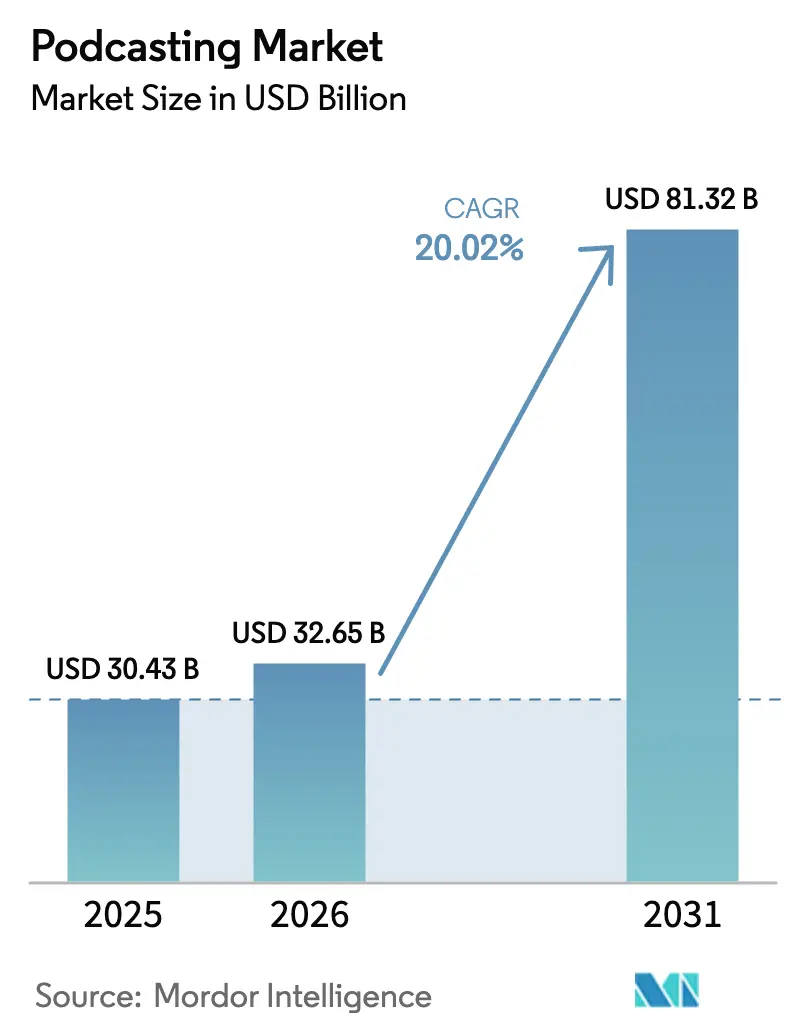
| Market Size (2026) | USD 32.65 Billion |
| Market Size (2031) | USD 81.32 Billion |
| Growth Rate (2026 - 2031) | 20.02 % |
| Fastest Growing Market | Asia Pacific |
| Largest Market | North America |
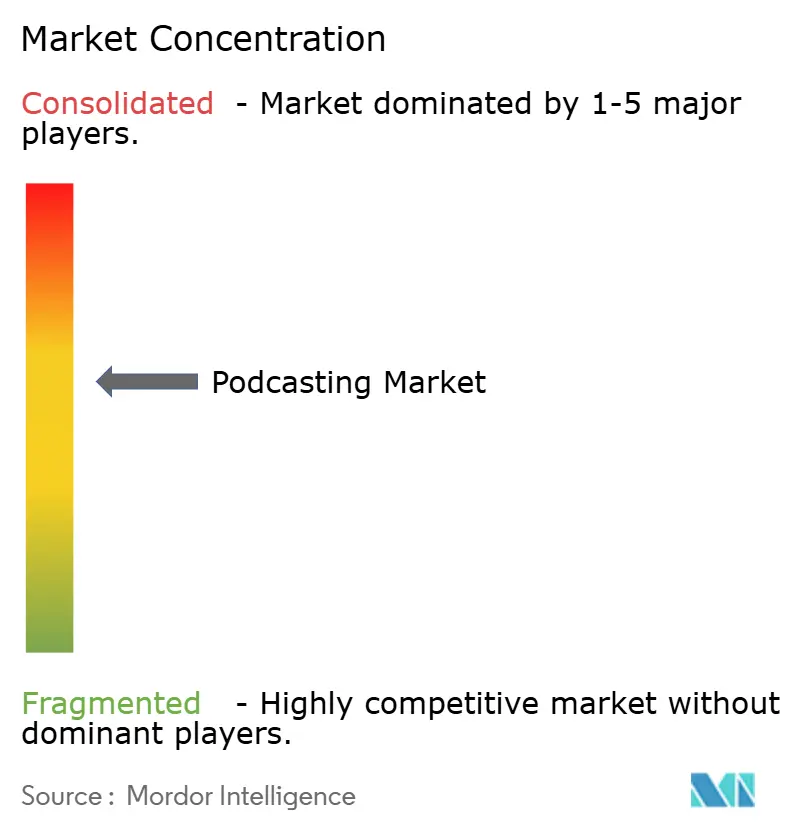
| Market Concentration | Medium |
Major Players *Disclaimer: Major Players sorted in no particular order Image © Mordor Intelligence. Reuse requires attribution under CC BY 4.0. | |
Podcasting Market Analysis by Mordor Intelligence
The podcasting market size is projected to expand from USD 30.43 billion in 2025 and USD 32.65 billion in 2026 to USD 81.32 billion by 2031, registering a CAGR of 20.02% between 2026-2031. Robust growth reflects the migration of linear-television dollars into video podcasts, the rapid rollout of programmatic audio infrastructure, and the deepening integration of podcasts into smart-speaker and connected-TV ecosystems. Platform economics are shifting in favor of creators who deliver both audio and video, because higher video CPMs lift overall revenue per episode and diversify distribution risk. Advertiser demand is also rising as dynamic ad-insertion tools let brands target listeners by geography, device, and daypart while still preserving host-read authenticity. On the supply side, greater compression efficiency and cloud editing tools reduce production costs, encouraging more creators to launch serialized shows that keep audiences engaged across seasons.
Key Report Takeaways
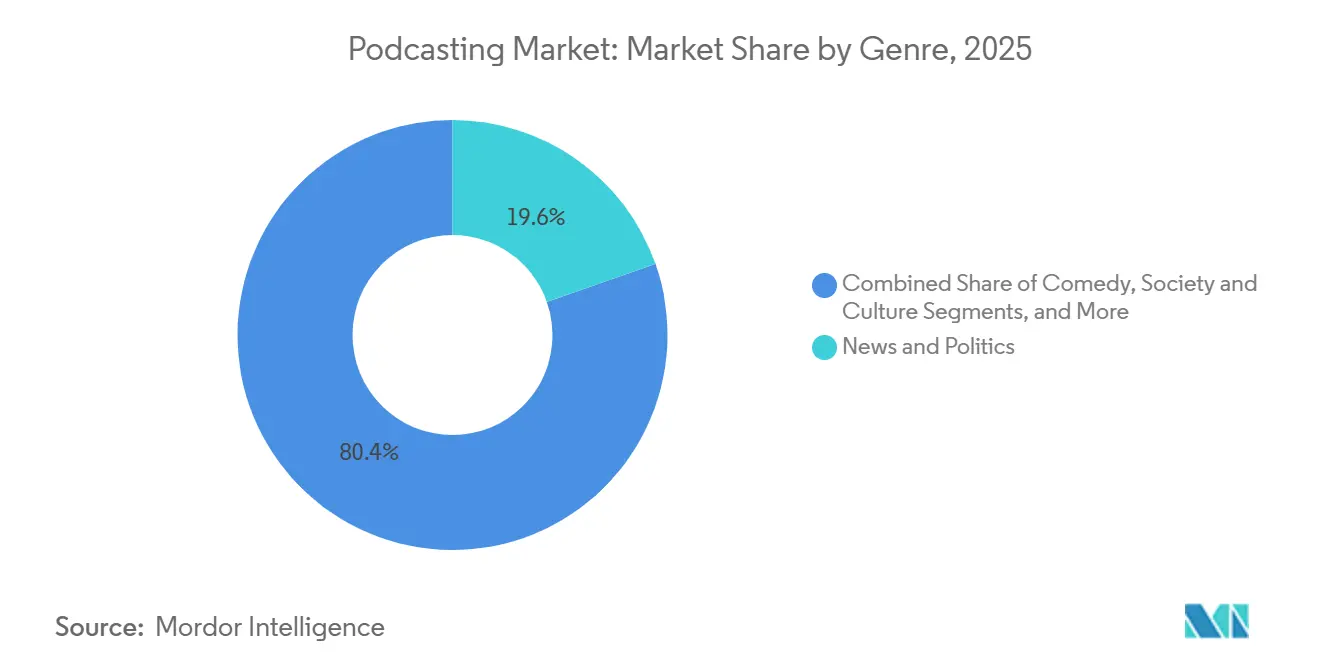
- By genre, News and Politics led with 19.63% revenue share in 2025, while True Crime is advancing at a 20.62% CAGR through 2031.
- By format, Interview shows held 33.57% of the podcasting market share in 2025, whereas Narrative and Storytelling formats are projected to grow at a 20.88% CAGR to 2031.
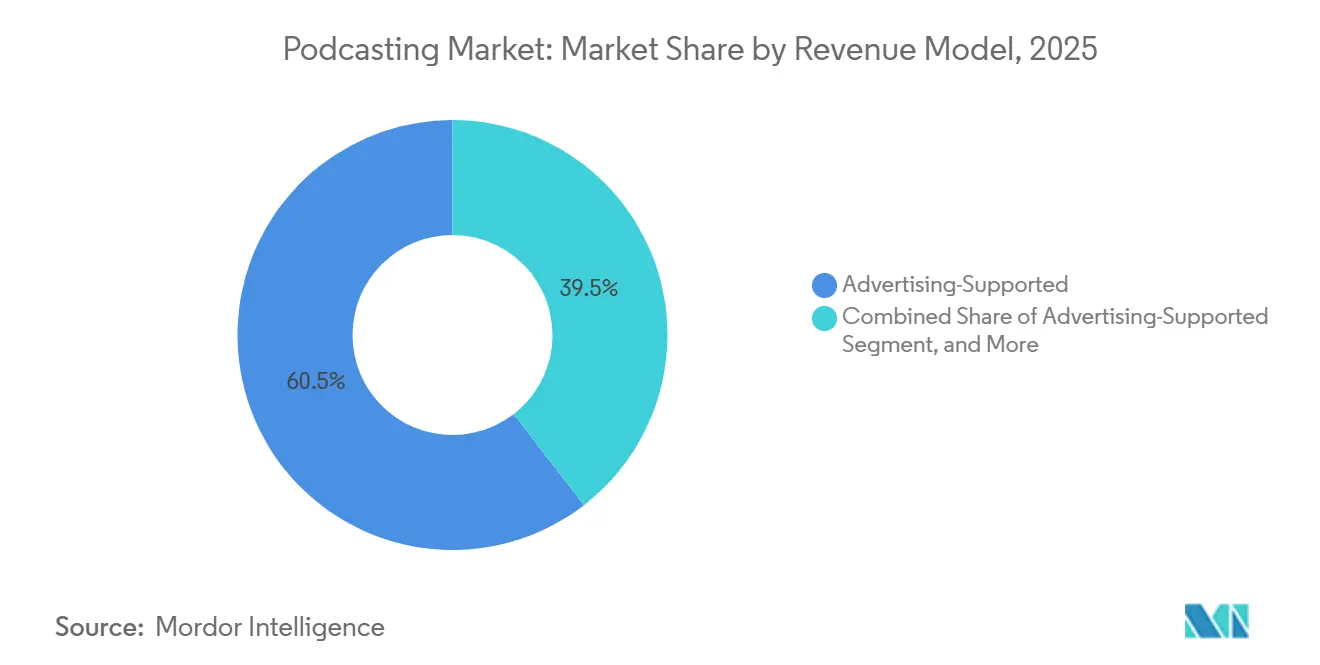
- By revenue model, advertising accounted for 60.47% of the podcasting market size in 2025, yet subscriptions are forecast to expand at a 20.41% CAGR over 2026-2031.
- By device, smartphones captured 62.71% of listening hours in 2025, but smart speakers are set to rise at a 21.02% CAGR through 2031.
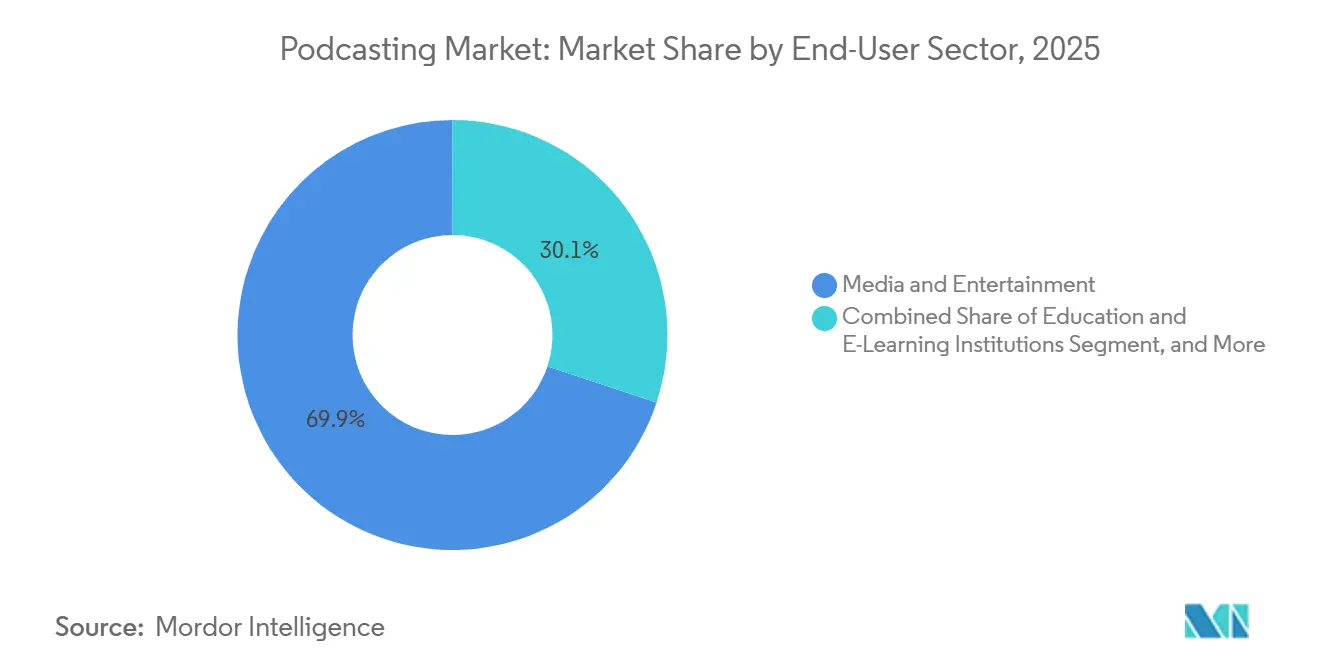
- By end-user sector, consumer media and entertainment commanded 69.91% share of the podcasting market size in 2025, while corporations and enterprises are scaling at a 21.09% CAGR until 2031.
- By geography, North America held 45.61% of 2025 revenue, whereas Asia-Pacific is the fastest-growing region at 21.25% CAGR to 2031.
Note: Market size and forecast figures in this report are generated using Mordor Intelligence’s proprietary estimation framework, updated with the latest available data and insights as of January 2026.
Global Podcasting Market Trends and Insights
Drivers Impact Analysis*
| Driver | (~) % Impact on CAGR Forecast | Geographic Relevance | Impact Timeline |
|---|---|---|---|
| Growing Monetization of Video Podcasts on YouTube and Connected-TV Platforms | +4.2% | Global, with concentration in North America and Europe | Medium term (2-4 years) |
| Programmatic Audio Ad Buying Penetration Exceeding 35 Percent in North America | +3.8% | North America, expanding to Europe and Asia-Pacific | Short term (≤ 2 years) |
| Rising Adoption of Smart Speakers in Gen Z Households, Especially United States and United Kingdom | +2.9% | North America and Europe, early adoption in urban Asia-Pacific | Medium term (2-4 years) |
| Corporate Communications Pivot to Branded Podcasts in Asia-Pacific Multinationals | +2.6% | Asia-Pacific core, spillover to Middle East and South America | Long term (≥ 4 years) |
| Surging Demand for Local-Language Podcasts Across South America | +2.4% | South America, with Brazil and Argentina leading | Medium term (2-4 years) |
| Sub-30 MB Mobile Episode Compression Improving Reach in Emerging Asia | +1.9% | Asia-Pacific emerging markets, parts of Africa | Long term (≥ 4 years) |
| Source: Mordor Intelligence | |||
Growing Monetization of Video Podcasts on YouTube and Connected-TV Platforms
Video podcasts are siphoning brand budgets away from broadcast television as advertisers follow younger viewers online. High-definition filming now costs a fraction of studio television, letting creators capture CPMs near USD 35, almost double traditional audio rates.[1]Interactive Advertising Bureau, “2024 Podcast Advertising Revenue Report,” iab.com Roku and Amazon Fire TV report double-digit growth in podcast viewing hours, proving that living-room audiences treat long-form episodes like niche cable channels. Creators benefit from dual monetization because the same content streams as audio on Spotify and Apple Podcasts while adding pre-roll and mid-roll video inventory on YouTube. As more hosts record in 16:9 formats, the podcasting market deepens its competition with YouTube long-form entertainment without abandoning RSS-based distribution.
Programmatic Audio Ad Buying Penetration Exceeding 35 Percent in North America
Automated ad buying simplifies podcast placement for brand managers used to display and search campaigns.[2]SiriusXM Holdings Inc., “Q4 2024 Earnings Call Transcript,” investor.siriusxm.com Demand-side and supply-side platforms now stitch podcast inventory into omnichannel dashboards, letting agencies optimize frequency in real time. Dynamic ad insertion pins messages to listener profiles, boosting conversion rates compared with evergreen host-read spots. Independent creators tap self-service marketplaces on Acast and Megaphone, which democratize premium ad demand previously reserved for the top 10. As Europe enforces GDPR-compliant targeting and Asia-Pacific rolls out similar exchanges, global programmatic share is set to climb beyond North America’s benchmark, lifting overall podcasting market revenue.
Rising Adoption of Smart Speakers in Gen Z Households
Smart speakers integrate podcasts into ambient daily life, replacing radio during cooking, cleaning, and bedtime routines. Voice commands lower the friction of discovery, so listeners sample more shows and spend longer in each session. Amazon reports that Alexa podcast requests climbed 41% during 2024, boosted by cross-promotions inside Amazon Music.[3]Amazon.com Inc., “2024 Devices and Services Report,” amazon.com Because smart speakers often occupy communal spaces, they expose non-listeners to podcasts, indirectly growing the addressable audience. Hardware makers bundle podcast access with music subscriptions, blurring service boundaries and reinforcing ecosystem stickiness that supports premium pricing.
Corporate Communications Pivot to Branded Podcasts in Asia-Pacific Multinationals
Enterprises deploy podcasts to cut through email fatigue and social-media clutter while offering leadership a human voice. In Japan, more than half of Nikkei 225 companies now run regular podcast series featuring C-suite hosts who discuss ESG agendas. India’s technology majors follow suit, framing recruitment and innovation stories for prospective employees. Branded shows enjoy high listen-through rates, averaging 68%, compared with low open rates for newsletters. Because production costs remain far below those of video, corporate podcasts promise a positive ROI, especially when repurposed across intranets, LinkedIn, and investor calls.
Restraints Impact Analysis*
| Restraint | (~) % Impact on CAGR Forecast | Geographic Relevance | Impact Timeline |
|---|---|---|---|
| Heightened Content Moderation Costs Amid Misinformation Regulations in Europe | -2.1% | Europe, with spillover to United Kingdom post-Brexit | Short term (≤ 2 years) |
| Low In-Car Internet Penetration Limiting Listenership in Africa | -1.8% | Sub-Saharan Africa, parts of North Africa | Long term (≥ 4 years) |
| Fragmented Rights Management for Cross-Border Podcast Licensing | -1.5% | Global, acute in Europe and Asia-Pacific | Medium term (2-4 years) |
| Apple and Spotify Store Commission Structures Squeezing Independent Creators | -1.3% | Global, most impactful in North America and Europe | Short term (≤ 2 years) |
| Source: Mordor Intelligence | |||
Heightened Content Moderation Costs Amid Misinformation Regulations in Europe
The Digital Services Act and the European Media Freedom Act force platforms to hire reviewers, deploy AI filters, and issue transparency reports, adding annual compliance costs between EUR 50,000 and 200,000 (USD 53,000-212,000) for mid-size hosts. Small providers struggle to absorb these expenses, prompting exits or mergers that shrink creator choice. Extraterritorial provisions mean even non-EU firms must appoint legal representatives, deterring cross-border expansion. Creators respond by self-censoring controversial topics that risk takedown, which could dilute content diversity. The result is slower European revenue growth compared with other developed regions.
Low In-Car Internet Penetration Limiting Listenership in Africa
Only 18% of Sub-Saharan vehicles feature connected infotainment, compared with 67% in North America. Commute-time listening drives 42% of podcast hours in mature markets, so limited in-car access constrains African consumption. Mobile data remains expensive-USD 2.78 per gigabyte in Nigeria-curbing streaming during long journeys. Offline downloads help urban elites but fail to scale among rural populations. Low listenership, in turn, discourages advertisers and local creators, reinforcing the connectivity gap.
*Our forecasts treat driver/restraint impacts as directional, not additive. The impact forecasts reflect baseline growth, mix effects, and variable interactions.
Segment Analysis
By Genre: Serial True Crime Accelerates Engagement
True Crime captured the zeitgeist with deeply serialized narratives that transform casual listeners into binge cohorts and premium subscribers. The segment’s 20.62% CAGR reflects growing studio investment in multi-season investigations and courtroom dramas, often spun off into documentaries or book deals. CPMs averaging USD 42 validate advertiser appetite for hyper-engaged audiences. While News and Politics retains the largest slice of the podcasting market share, audience growth there is flattening as partisanship fragments habitual listening. Comedy, Sports, and Society content remain vibrant but face fiercer competition from short-form video platforms.
Advertisers like fintech apps and direct-to-consumer brands prioritize True Crime due to high completion rates and female-skewing demographics. Studios such as Wondery and Parcast release international localizations, supporting multilanguage growth in South America and Europe. Meanwhile, documentary-style narrative techniques spill into Business, Technology, and Health genres, raising overall production standards across the podcasting market. The diversification of storytelling styles is broadening reach beyond early-adopter segments and stabilizing lifetime value for creators.



By Format: Narrative Production Rivals Streaming Drama
Narrative and Storytelling show advances at a 20.88% CAGR, overtaking the interview format in listener growth. Investments in writers’ rooms, foley artists, and licensed scores elevate production values to near-audiobook quality. Advertisers reward the reduced ad-skipping with mid-roll CPM uplifts above 25%, reinforcing the format’s premium positioning. Interview podcasts still dominate output volume because of low setup costs and the ease of weekly releases, supporting stable advertiser inventory for the broader podcasting market.
Hybrid formats blend live panels with scripted narrative arcs, a structure popular on YouTube where visual cues amplify engagement. Solo monologues cater to thought leaders offering master-class-style insight, while conversational panel shows leverage audience chat on live streams to surface user-generated questions. Across every format, creators increasingly capture 4K video simultaneously with audio, maximizing distribution across podcast apps, YouTube, and connected-TV channels.
By Revenue Model: Subscriptions Stabilize Cash Flow
Advertising remains the primary income stream, but subscription models are climbing at a 20.41% CAGR as creators chase predictable earnings and ad-free audience experiences. Apple Podcasts Subscriptions and Patreon tiers let fans unlock bonus episodes, early access, and merchandise discounts. Conversion rates between 3-8% of free listeners support steady cash flow, buffering creators from CPM swings driven by macro marketing cycles.
Crowdfunding and donation platforms suit hobbyist shows and non-profits that value community support over scale. Corporate-sponsored series bypass traditional monetization entirely because brands finance production in exchange for editorial control and brand integration, a model gaining traction in Asia-Pacific enterprise communications. In total, the widening revenue mix diversifies risk and underpins the sustained expansion of the podcasting market.
By Device: Smart Speakers Amplify Ambient Listening
Smart speakers record the fastest expansion at 21.02% CAGR as voice assistants guide listeners through discovery and playback. Alexa and Google Assistant surface podcast recommendations alongside weather updates and smart-home commands. Episode requests during cooking, cleaning, and bedtime routines account for more than half of smart-speaker podcast usage, complementing commute-time listening on smartphones.
Smartphones still dominate with 62.71% share, yet growth decelerates as penetration peaks in developed markets. Connected-TV streaming introduces a lean-back experience that repackages long-form episodes into evening entertainment, boosting ad inventory diversity. Wearables support niche scenarios such as fitness tracking, where short motivational shows deliver high-engagement sessions and funnel users toward premium subscription tiers.
By End-User Sector: Enterprises Embrace Audio Storytelling
Corporations and enterprises lead growth at 21.09% CAGR, using internal and external podcasts to convey strategy, upskill employees, and nurture brand authority. High listen-through rates and low production costs persuade leadership teams to allocate budget formerly reserved for town-hall videos. Consumer media and entertainment still anchor demand, yet engagement plateaus as content libraries saturate listener time budgets.
Educational institutions adopt podcasts as asynchronous learning aids, embedding episodes into curricula for language and professional-development courses. Non-profit and government organizations deploy series for public health messaging and civic education, capitalizing on the intimacy of voice to build trust. This end-user diversification shields the podcasting market from cyclical advertising downturns and spreads growth across multiple funding models.
Geography Analysis
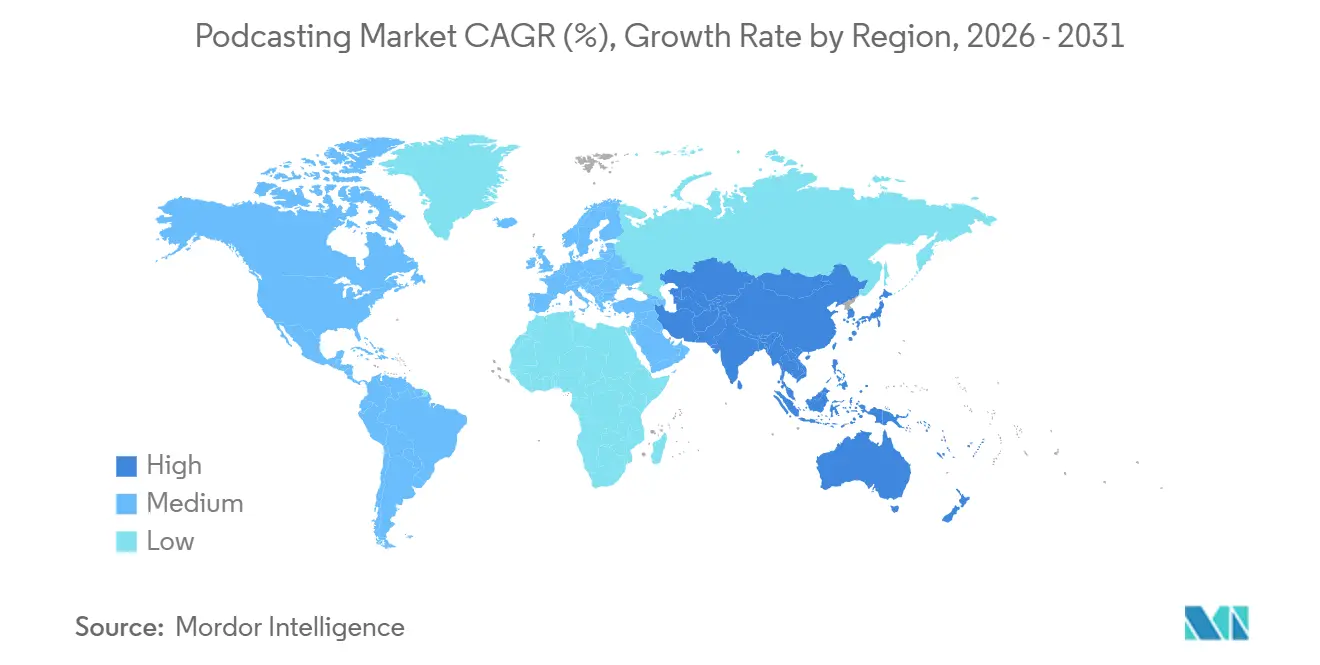
North America generated 45.61% of 2025 revenue, buoyed by programmatic audio, which accounts for over one-third of digital ad budgets and funnels them into podcast inventory. The United States remains the epicenter thanks to a large advertiser base and mature DSP-SSP infrastructure. Canada and Mexico add bilingual growth, leveraging English-Spanish and English-French content to extend campaign reach. High smart-speaker adoption embeds podcasts into household routines, lifting average listening hours per user and supporting premium CPMs.
Asia-Pacific posts the highest regional CAGR at 21.25% through 2031. Japan’s corporates spearhead branded podcasts featuring executive hosts, while India and China spread adoption via technology workforces and commuter-friendly short-episode formats. Ximalaya’s 280 million monthly users in China showcase the potential of hybrid audiobook-podcast platforms. In Southeast Asia, mobile bandwidth constraints are mitigated by sub-30 MB episode compression, expanding reach into secondary cities and rural districts with affordable data plans.
Europe is growing more slowly due to the compliance burden of the Digital Services Act, which increases operating costs for mid-size hosts. Germany leads consumption in true crime and investigative journalism, whereas the United Kingdom excels in comedy and panel formats. South America witnesses a language-led boom as Spanish and Portuguese series triple output in Brazil and Argentina. Middle East markets like the United Arab Emirates pilot government-backed podcast incubators, yet adoption concentrates in urban areas with high smartphone usage. Africa trails because only 18% of vehicles have in-car connectivity and mobile data prices remain high, limiting the daypart that elsewhere fuels sustained listening.

Competitive Landscape
Apple, Spotify, and Amazon anchor distribution by bundling podcasts into ubiquitous hardware and subscription ecosystems. Apple ships its Podcasts app on more than two billion active devices, ensuring default discovery for new listeners. Spotify invested over USD 1 billion in exclusive series and hosting technologies, integrating Anchor and Megaphone to capture the full value chain from creation to monetization. Amazon leverages Prime benefits to stream Wondery titles inside Audible and Amazon Music, turning podcasts into subscriber retention tools.
Independent platforms remain relevant because creators seek flexible revenue splits and brand-safe environments. Acast extends white-label hosting and dynamic ad-insertion services globally, entering India and Brazil in 2024 with localized sales teams. Libsyn’s grants to emerging podcasters diversify content genres and cultivate loyalty among underrepresented voices. Technology competition focuses on AI personalization, automatic translation, and voice cloning that localize ads without re-recording, as seen in Spotify’s multilingual pilot launched in 2024.
Regulation shapes rivalry, especially in Europe where adherence to transparency requirements becomes a selling point for enterprise clients. Smaller hosts lacking compliance budgets partner with or sell to larger networks, modestly consolidating the podcasting market while still leaving room for niche-focused entrants. Overall, market power is diffused across distribution giants, production studios, monetization intermediaries, and analytics vendors, all racing to lock in creator communities and advertiser budgets.
Podcasting Industry Leaders
Audible ( Amazon.com Inc.)
Apple Inc.
Google LLC
Storytel AB
Spotify AB
- *Disclaimer: Major Players sorted in no particular order

Recent Industry Developments
- February 2026: Spotify announced the expansion of its AI-powered voice translation feature to 12 additional languages, including Mandarin, Hindi, and Arabic, enabling creators to reach international audiences without re-recording episodes.
- February 2026: Apple integrated spatial audio support for podcasts across Apple Podcasts and Apple Music, leveraging its AirPods Pro and AirPods Max hardware ecosystem to differentiate the listening experience.
- February 2025: Spotify announced a multi-year partnership with Joe Rogan to extend "The Joe Rogan Experience" exclusively on its platform through 2028, reportedly valued at USD 250 million.
- January 2025: Apple launched Podcasts Connect 2.0, a redesigned creator dashboard that integrates real-time analytics, subscription management, and direct listener messaging features.


Global Podcasting Market Report Scope
A podcast is an audio (and sometimes video) medium for creative content. Podcast creators upload podcast episodes, which are downloaded by listeners and listened to on their mobile devices or computers.
The Podcasting Market Report is Segmented by Genre (News and Politics, Comedy, Society and Culture, True Crime, Sports, Education, Health and Wellness, Technology, Business and Finance, and Arts and Entertainment), Format (Interview, Conversational/Panel, Solo Monologue, Narrative/Storytelling, and Hybrid/Experimental), Revenue Model (Advertising-Supported, Subscription-Based, Crowdfunding and Donations, Branded and Corporate-Sponsored), Device/Access Point (Smartphones, Computers and Laptops, Smart Speakers, Connected TVs, In-Car Infotainment Systems, and Wearables), End-User Sector (Consumer Media and Entertainment, Education and E-Learning Institutions, Corporations and Enterprises, and Non-Profit and Government Organizations), and Geography (North America, South America, Europe, Asia-Pacific, Middle East, and Africa). The Market Forecasts are Provided in Terms of Value (USD).
| News and Politics |
| Comedy |
| Society and Culture |
| True Crime |
| Sports |
| Education |
| Health and Wellness |
| Technology |
| Business and Finance |
| Arts and Entertainment |
| Interview |
| Conversational / Panel |
| Solo Monologue |
| Narrative / Storytelling |
| Hybrid / Experimental |
| Advertising-Supported |
| Subscription-Based |
| Crowdfunding and Donations |
| Branded and Corporate-Sponsored |
| Smartphones |
| Computers and Laptops |
| Smart Speakers |
| Connected TVs |
| In-Car Infotainment Systems |
| Wearables |
| Consumer Media and Entertainment |
| Education and E-Learning Institutions |
| Corporations and Enterprises |
| Non-Profit and Government Organizations |
| North America | United States |
| Canada | |
| Mexico | |
| South America | Brazil |
| Argentina | |
| Rest of South America | |
| Europe | Germany |
| United Kingdom | |
| France | |
| Italy | |
| Spain | |
| Rest of Europe | |
| Asia-Pacific | China |
| Japan | |
| South Korea | |
| India | |
| Australia | |
| New Zealand | |
| Rest of Asia-Pacific | |
| Middle East | United Arab Emirates |
| Saudi Arabia | |
| Rest of Middle East | |
| Africa | South Africa |
| Rest of Africa |
| By Genre | News and Politics | |
| Comedy | ||
| Society and Culture | ||
| True Crime | ||
| Sports | ||
| Education | ||
| Health and Wellness | ||
| Technology | ||
| Business and Finance | ||
| Arts and Entertainment | ||
| By Format | Interview | |
| Conversational / Panel | ||
| Solo Monologue | ||
| Narrative / Storytelling | ||
| Hybrid / Experimental | ||
| By Revenue Model | Advertising-Supported | |
| Subscription-Based | ||
| Crowdfunding and Donations | ||
| Branded and Corporate-Sponsored | ||
| By Device / Access Point | Smartphones | |
| Computers and Laptops | ||
| Smart Speakers | ||
| Connected TVs | ||
| In-Car Infotainment Systems | ||
| Wearables | ||
| By End-User Sector | Consumer Media and Entertainment | |
| Education and E-Learning Institutions | ||
| Corporations and Enterprises | ||
| Non-Profit and Government Organizations | ||
| By Geography | North America | United States |
| Canada | ||
| Mexico | ||
| South America | Brazil | |
| Argentina | ||
| Rest of South America | ||
| Europe | Germany | |
| United Kingdom | ||
| France | ||
| Italy | ||
| Spain | ||
| Rest of Europe | ||
| Asia-Pacific | China | |
| Japan | ||
| South Korea | ||
| India | ||
| Australia | ||
| New Zealand | ||
| Rest of Asia-Pacific | ||
| Middle East | United Arab Emirates | |
| Saudi Arabia | ||
| Rest of Middle East | ||
| Africa | South Africa | |
| Rest of Africa | ||


Key Questions Answered in the Report
What is the projected value of the global podcasting market in 2031?
The sector is forecast to reach USD 81.32 billion by 2031, expanding at a 20.02% CAGR over 2026-2031.
Which podcast genre is growing fastest over the next five years?
True crime is advancing at a 20.62% CAGR through 2031, outpacing all other genres.
How quickly are smart speakers boosting podcast listening?
Listening via smart speakers is set to rise at a 21.02% CAGR through 2031 as voice-activated devices embed shows into daily home routines.
Why are enterprises investing in branded podcasts?
Corporations and enterprises see 21.09% CAGR growth because podcasts offer high listen-through rates and cost less to produce than video, making them efficient for internal and external communications.
Which region will contribute the most incremental growth by 2031?
Asia-Pacific is expected to deliver the fastest regional expansion at 21.25% CAGR, driven by corporate adoption in Japan, India, and China.
Page last updated on:





