
Passenger Car Seat Market Size and Share
Market Overview
| Study Period | 2019 - 2031 |
|---|---|
| Market Size (2026) | USD 48.97 Billion |
| Market Size (2031) | USD 56.25 Billion |
| Growth Rate (2026 - 2031) | 2.81 % |
| Fastest Growing Market | Asia Pacific |
| Largest Market | Asia Pacific |
| Market Concentration | Medium |
Major Players
*Disclaimer: Major Players sorted in no particular order Image © Mordor Intelligence. Reuse requires attribution under CC BY 4.0. |
|
Passenger Car Seat Market Analysis by Mordor Intelligence
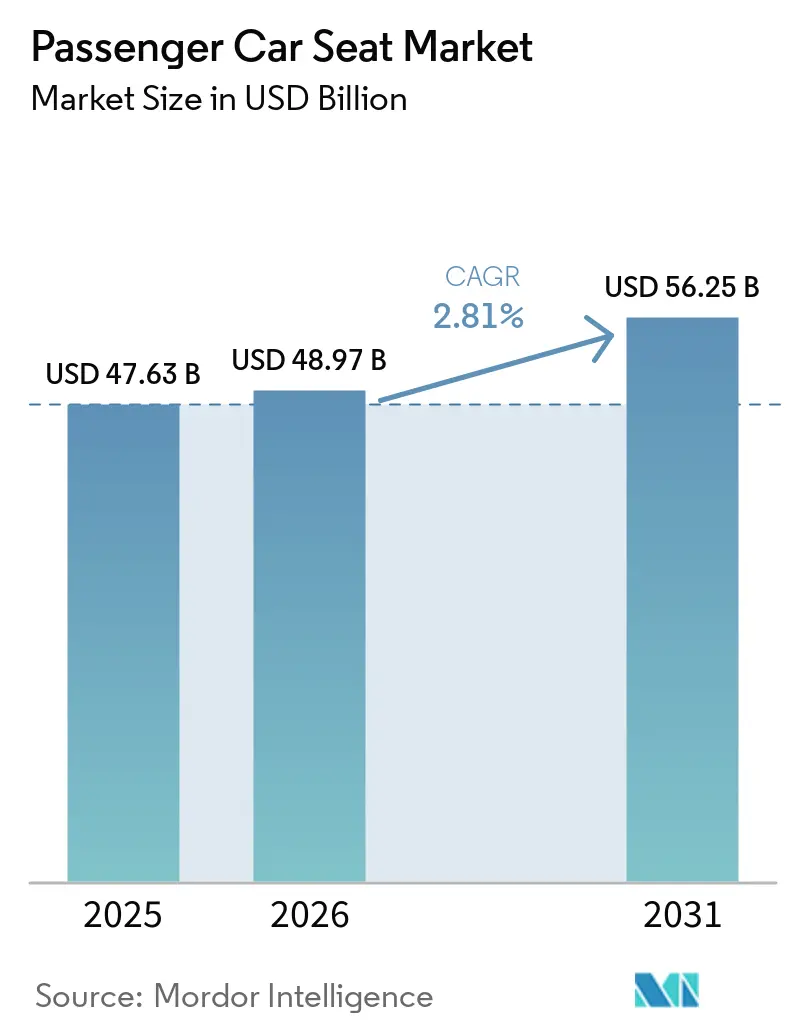
The passenger car seat market size was valued at USD 47.63 billion in 2025 and is estimated to grow from USD 48.97 billion in 2026 to reach USD 56.25 billion by 2031, at a CAGR of 2.81% during the forecast period (2026-2031). Healthy growth in the seating systems market highlights the evolution from basic structures to advanced technology platforms offering features such as thermal comfort, biometric monitoring, and over-the-air updates. Macro forces reshaping the market include regulatory tightening around occupant protection, material sustainability mandates, and the integration of health-monitoring sensors into seat structures. Euro NCAP introduced 2026 protocols requiring adaptive restraints and child presence detection, compelling tier-1 suppliers to embed radar and camera-based occupant monitoring directly into seat frames.
Key Report Takeaways
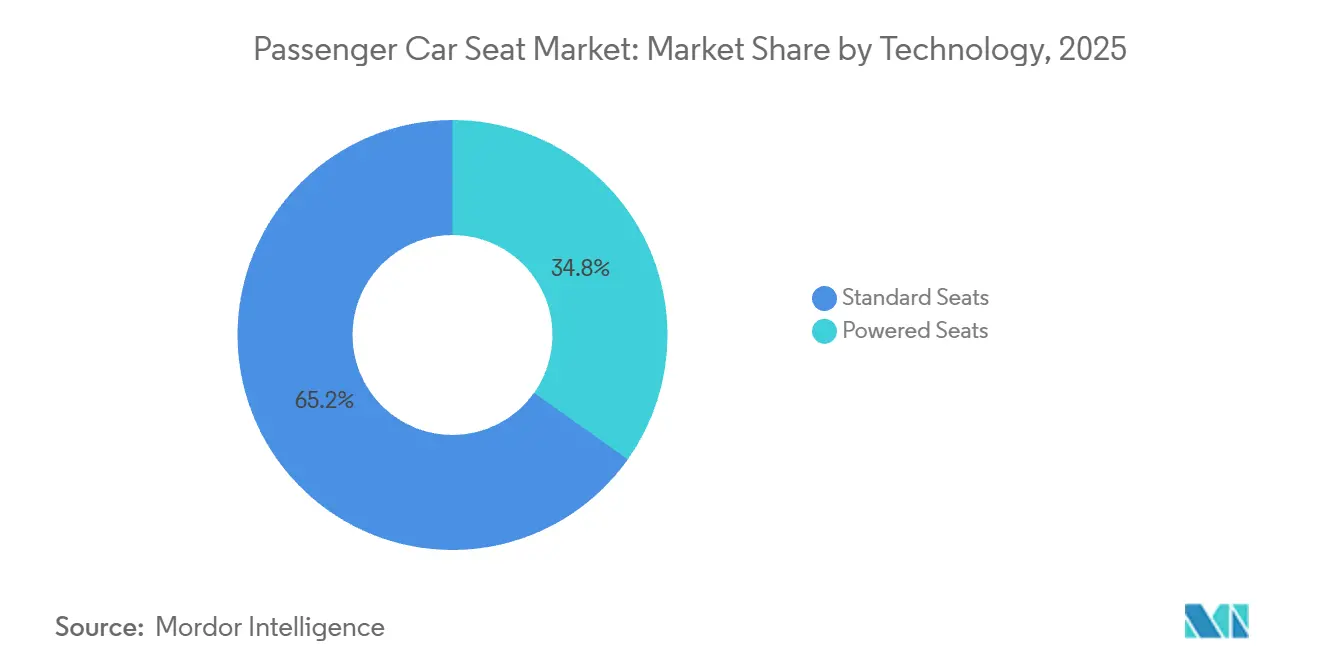
- By technology, standard seats led the passenger car seat market with a 65.18% share in 2025, whereas powered seats are forecasted to expand at a 4.54% CAGR during the forecast period (2026-2031).
- By seat type, bucket seats captured 60.21% of the passenger car seat market share in 2025, while the bucket-seat segment is poised for a 4.79% CAGR during the forecast period (2026-2031).
- By trim material, fabric accounted for 49.14% of the passenger car seat market share in 2025, whereas synthetic leather is expected to grow the fastest at 5.71% CAGR during the forecast period (2026-2031).
- By component, armrests held 22.76% of the passenger car seat market share in 2025; pneumatic massage systems are projected to register the highest 7.29% CAGR during the forecast period (2026-2031).
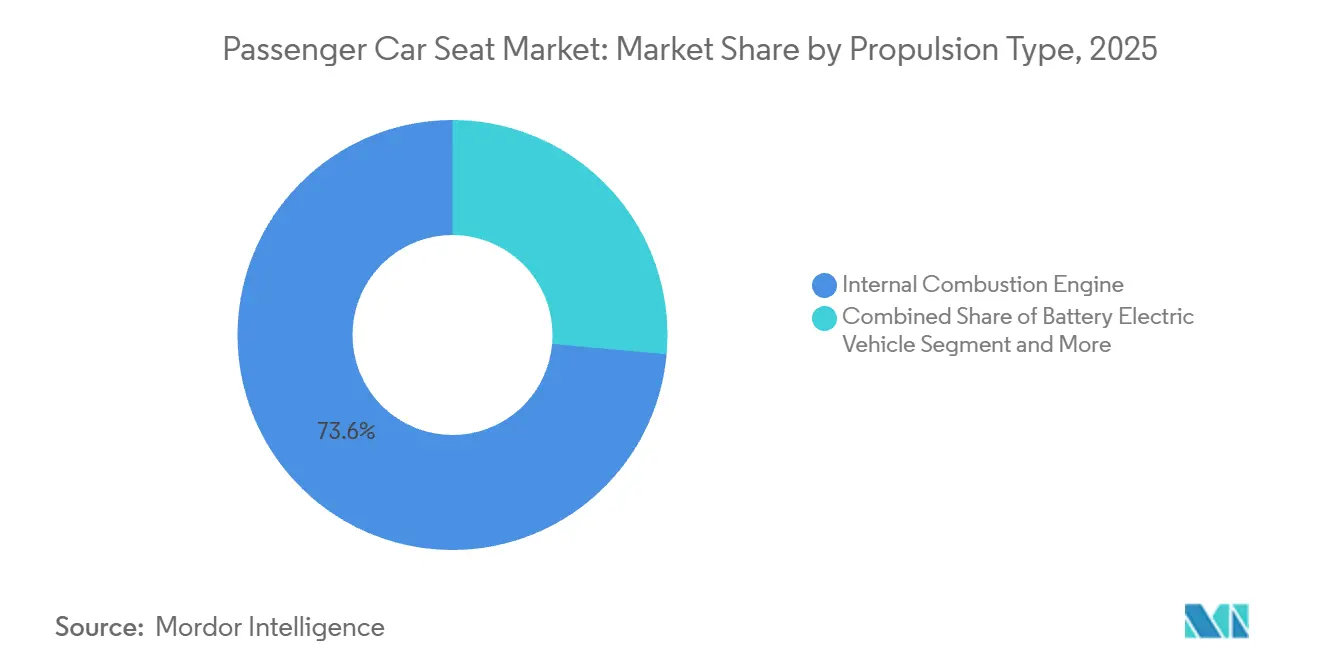
- By propulsion type, internal-combustion vehicles supplied 73.57% of the passenger car seat market share in 2025, yet battery-electric vehicle seats will rise at a transformative 19.18% CAGR during the forecast period (2026-2031).
- By vehicle type, sport utility vehicles (SUVs) commanded 42.62% of the passenger car seat market share in 2025, and remain the fastest-growing category with a 6.02% CAGR during the forecast period (2026-2031).
- By geography, Asia-Pacific dominated the passenger car seat market, with 48.42% of the share in 2025, and is forecasted to grow at a 3.37% CAGR during the forecast period (2026-2031).
Note: Market size and forecast figures in this report are generated using Mordor Intelligence’s proprietary estimation framework, updated with the latest available data and insights as of January 2026.
Market Trends and Insights
Drivers Impact Analysis of Passenger Car Seat Market*
| Driver | (~) % Impact on CAGR Forecast | Geographic Relevance | Impact Timeline |
|---|---|---|---|
| Comfort and Powered-Seat Adoption | +1.2% | Global, led by North America and Europe | Medium term (2-4 years) |
| EV-Driven Seat Architecture | +0.8% | Asia-Pacific core, spill-over to Europe and North America | Long term (≥ 4 years) |
| Health-Monitoring Sensor Seats | +0.6% | North America and Europe, expanding to Asia-Pacific | Long term (≥ 4 years) |
| Integration of Airbags and Seat-Belts | +0.5% | Global, with regional compliance variations | Short term (≤ 2 years) |
| Sustainable/Vegan Upholstery | +0.4% | Europe-led, expanding globally | Medium term (2-4 years) |
| OTA Feature-on-Demand | +0.3% | North America and Europe early adopters | Long term (≥ 4 years) |
| Source: Mordor Intelligence | |||
Premium Comfort and Powered-Seat Adoption
Automakers are embedding massage, heating, ventilation, and zero-gravity recline into mid-tier models to differentiate interiors and unlock recurring software revenue. Adient launched a mechanical massage solution in July 2025 for GAC-Trumpchi's PHEV M8, combining 3D kneading modules with flexible safety structures and OTA update capability, targeting fatigue relief in three-row configurations[1]"Adient launches mechanical massage seating innovation," Adient, investors.adient.com.. Hyundai Transys unveiled its Circular Mobility System in January 2026, featuring modular seats with BASF Elastollan TPU that enable recyclability and supercritical-fluid foaming for weight reduction. FORVIA's Transformer Seat, showcased at Auto Shanghai 2025, uses algorithm-driven adjustments to create zero-gravity postures, positioning comfort as a software-defined feature rather than a fixed hardware specification. This trend is accelerating OEM adoption of seat-as-a-service models, where buyers pay monthly fees to unlock massage modes or adjust firmness via an app, creating annuity-like revenue streams for suppliers and automakers.
EV-Driven Seat-Architecture Redesign
Battery electric platforms eliminate the need for transmission tunnels, provide flat floors, and place greater emphasis on weight reduction requirements. Battery packaging beneath the floor is forcing seat designers to rethink frame geometry, weight distribution, and thermal integration. Magna's Cell-to-Seat concept integrates battery cells directly into the seat structure, freeing up to 20% more cabin volume and improving crash-energy absorption. FORVIA’s newly established manufacturing facility in Thailand has been specifically designed to produce lightweight frames and integrated electronics intended for regional electric vehicle exports. These developments highlight how suppliers are strategically repositioning their production capacities to align with the electrification strategies outlined by original equipment manufacturers (OEMs).[2]“FORVIA and BYD Open New Seat Assembly Plant in Thailand,” FORVIA, forvia.comThe facility's focus on advanced lightweight materials and embedded electronic systems underscores the growing importance of innovation and efficiency in meeting the evolving demands of the electric vehicle market.
Health-Monitoring Sensor Seats
Occupant vital-sign tracking is migrating from concept to production as Euro NCAP's 2026 protocols mandate driver monitoring and child presence detection. Continental's Invisible Biometrics Sensing Display, developed with trinamiX, embeds a 1.5-megapixel near-infrared camera and eye-safe laser dot projector behind the dashboard OLED, deriving heart rate from laser-dot reflections and computing 3D distance maps to optimize airbag deployment and verify seat-belt fastening. A 2025 Nature study showed capacitive ECG accuracy that rivals clinical devices, validating automotive use cases[3]Daowen Zhang et al., “Research on Restraint Strategies for Rearward-Reclined Occupants in a Frontal Rigid Barrier Crash,” Nature, nature.com. FORVIA's All-in-One seat integrates respiration monitoring and posture detection, enabling the vehicle to trigger Minimum Risk Maneuvers if a medical emergency is detected.
Safety-Regulation Integration of Airbags and Seat Belts
Governments are implementing stricter regulations that require seats to include advanced restraints and occupant-status sensors. New standards in the United States mandate the inclusion of rear-seat belt reminders by 2027, which has prompted immediate redesigns of hardware to ensure compliance. Suppliers are now integrating features such as buckle sensors, weight mats, and side-impact airbags directly into seat frames, resulting in an increase in the electronics content of these systems. Although these regulatory mandates lead to higher costs, they also establish a technological advantage for large-scale manufacturers with significant validation capabilities and resources. Over time, these compliant systems are anticipated to evolve into global standards, facilitating the harmonization of specifications across different regions and markets. This alignment is expected to streamline production processes and reduce complexities associated with regional variations in regulatory requirements.
Restraints Impact Analysis of Passenger Car Seat Market*
| Restraint | (~) % Impact on CAGR Forecast | Geographic Relevance | Impact Timeline |
|---|---|---|---|
| High Cost and Weight | -0.7% | Global, acute in cost-sensitive segments | Short term (≤ 2 years) |
| Raw-Material Price Volatility | -0.5% | Global, with regional supply chain variations | Medium term (2-4 years) |
| Cyber-Security and Privacy Risks | -0.3% | North America and Europe regulatory focus | Medium term (2-4 years) |
| Longer Replacement Cycles | -0.2% | Global, affecting aftermarket demand | Long term (≥ 4 years) |
| Source: Mordor Intelligence | |||
High Cost and Weight of Advanced Systems
Integrating massage, occupant monitoring, and adaptive safety into seat structures adds USD 200 to USD 500 per unit, pricing advanced features out of volume segments where bill-of-materials (BOM) targets are tightly controlled. Adient's ModuGo platform claims a 36.3% assembly-efficiency gain and 72% reduction in production-line length, yet the upfront tooling investment and engineering complexity limit adoption to high-volume programs with multi-year amortization horizons. The Automotive Seating Innovation 2025 conference in Munich highlighted that fully sustainable seats—using bio-based foams, vegan trim, and recycled frames—currently cost 4 to 5 times more than conventional designs, creating a barrier for OEMs targeting sub-USD 30,000 price points. Powered-seat mechanisms add 8 to 12 kilograms per unit, eroding EV range by an estimated 0.5% to 1.0% and forcing suppliers to invest in lightweight actuators and carbon-composite frames to offset the penalty.
Raw-Material Price Volatility
Steel, aluminum, copper, and polyurethane feedstocks account for 60% to 70% of seat BOM, exposing suppliers to commodity-price swings that compress margins when OEM contracts lock in annual price reductions. General Motors disclosed USD 1.0 billion to USD 1.5 billion in extra costs for 2026 tied to copper, aluminum, and semiconductor price increases, forcing tier-1 seat makers to absorb input inflation or renegotiate contracts mid-term. Polyurethane foam, derived from petrochemical feedstocks, remains vulnerable to crude-oil price fluctuations, prompting Magna to launch EcoSphere bio-based foam with 20% renewable content to diversify sourcing and mitigate fossil-fuel exposure. The shift to bio-attributed and recycled materials—while addressing sustainability mandates—introduces new cost structures and supply-chain dependencies, as renewable feedstocks often command price premiums and face agricultural-yield variability.
*Our forecasts treat driver/restraint impacts as directional, not additive. The impact forecasts reflect baseline growth, mix effects, and variable interactions.
Passenger Car Seat Market Segment Analysis
By Technology – Standard Seats Maintain Volume Advantage While Powered Features Accelerate
In 2025, standard seats accounted for 65.18% of the passenger car seat market, driven by affordability and ease of repair. Their prominence persists in cost-sensitive regions, public fleet acquisitions, and entry-level trims, where basic adjustability meets functional requirements. Large-scale manufacturing minimizes unit costs, while ongoing improvements, such as lighter frames and thinner foam pads, maintain profit margins despite commodity price fluctuations. Standard designs also support modular upgrades, enabling OEMs to incorporate features like heaters, cushions, or sensors without requiring a complete redesign.
Powered seats, with a 4.54% CAGR during 2026-2031, enhance cabin functionality through memory profiles, lumbar massage, and rapid warming. Streamlined motor assemblies and integrated electronic control units reduce costs, facilitating adoption beyond luxury segments. As software-driven architectures advance, powered modules are shipped firmware-ready, allowing future upgrades that increase lifetime value. This positions powered seats to narrow the volume gap post-2030, particularly in SUVs, where their value aligns with higher price points.


By Seat Type – Bucket Seats Propel Ergonomics and Wellness
In 2025, bucket seat configurations accounted for 60.21% of the passenger car seat market share due to their ergonomic contouring, lateral support, and compatibility with integrated airbags. These designs incorporate ventilated cushions, active bolsters, and biometric sensors with minimal platform intrusion. Sports and performance vehicles primarily utilize these features, while mainstream crossovers increasingly adopt them to improve ride quality and brand perception. Integrated air vents reduce cushion humidity, addressing comfort and hygiene requirements.
The bucket seats segment is projected to grow at a 4.79% CAGR during the forecast period (2026-2031), driven by OEMs focusing on wellness features to mitigate fatigue during commutes. Bench seats remain prevalent in commercial vans and compact cars in emerging markets, prioritizing passenger capacity and cost efficiency. Hybrid designs with sculpted contours on two-thirds of a bench combine versatility and ergonomics, catering to family vehicles while maintaining affordability.
By Trim Material – Synthetic Leather Rises on Sustainability Credentials
In 2025, fabric accounted for 49.14% of the passenger car seat market share, driven by cost-effectiveness and breathability. Nano-coated weaves enhanced stain resistance, improving durability compared to coated surfaces. Fleet buyers preferred fabric seats for easy replacement. The expansion of ride-sharing services increased hygiene demands, addressed by antimicrobial fabrics. Customizable colors and patterns maintained the fabric's appeal among younger consumers.
Synthetic leather is projected to grow at a CAGR of 5.71% from 2026 to 2031, supported by vegan preferences and circular-economy goals. Water-borne polyurethane and recycled polyester backings reduced carbon footprints and VOC emissions, enabling OEMs to highlight ESG achievements. Luxury brands explored bio-based polymers, replicating grain textures and offering recyclability. Genuine leather faced declining procurement volumes due to animal-welfare activism, rising tanning costs, and stricter chromium discharge regulations, limiting its use to ultra-premium segments.
By Component – Armrests Retain Scale, Massage Systems Capture Growth
In 2025, armrests accounted for 22.76% of the passenger car seat market share, driven by their universal application across segments. Features such as storage bays, charge ports, and haptic control pads enhance their functionality, supporting incremental pricing. Height adjusters now incorporate biometric optimization, automatically adapting to occupant anthropometry. Suppliers are introducing aluminum-reinforced swing-down arms for second-row SUVs, which fold into child cup-holders, highlighting how minor innovations sustain market relevance.
Pneumatic massage systems are projected to grow at a 7.29% CAGR from 2026 to 2031, the highest among all components, as wellness features transition from luxury to mainstream. These systems employ compact pneumatic bladders and silent micro-valves to deliver shiatsu patterns previously limited to premium vehicles. With biometric data supporting well-being benefits, insurers may incentivize adoption, positioning massage units as safety features rather than luxury additions.
By Propulsion Type – ICE Volume Persists as BEV Growth Redefines Design Rules
In 2025, internal combustion vehicles accounted for 73.57% of the passenger car seat market share, linking the market to established manufacturing bases and financial structures. These vehicles are expected to decline gradually, maintaining a strong service and replacement ecosystem. ICE platforms utilize mature supplier tooling, offering diverse seat variants in size and features. Hybrid electric vehicles are experiencing moderate growth, while fuel cell electric vehicles remain a niche with specialized requirements.
Battery-electric vehicle seats are projected to grow at a 19.18% CAGR from 2026 to 2031. These seats focus on lighter frames, thinner cushions, and recyclable trims to offset battery weight. The absence of drivetrain vibrations increases the emphasis on NVH-damping foams and acoustic membranes. Seats also integrate high-voltage cabling for rear-HVAC modules, requiring collaboration between seat manufacturers and e-powertrain engineers. Plug-in hybrid electric vehicles benefit from dual powertrains but face challenges in seat system integration due to complexity.

By Vehicle Type – SUVs Cement Leadership Through Premium Content
In 2025, SUVs accounted for 42.62% of the passenger car seat market share and are projected to register a 6.02% CAGR from 2026 to 2031. This growth is attributed to consumer preferences for elevated ride heights, versatile interiors, and premium features. Three-row configurations increase seat count per vehicle, driving volume growth. Features such as captain's chairs, ventilated cushions, and phone-based memory settings are becoming standard in SUVs, solidifying their market dominance.
Sedans in mature markets act as platforms for advanced comfort technologies, showcasing seat ergonomics and cushioning. Hatchbacks remain relevant in densely populated areas due to their compact size and practical rear access, supporting cost-effective seating solutions. MPVs are evolving to meet ride-hailing fleet demands with quick-release seat tracks for flexible layouts in shared mobility models.
Geography Analysis
APAC Passenger Car Seat Market
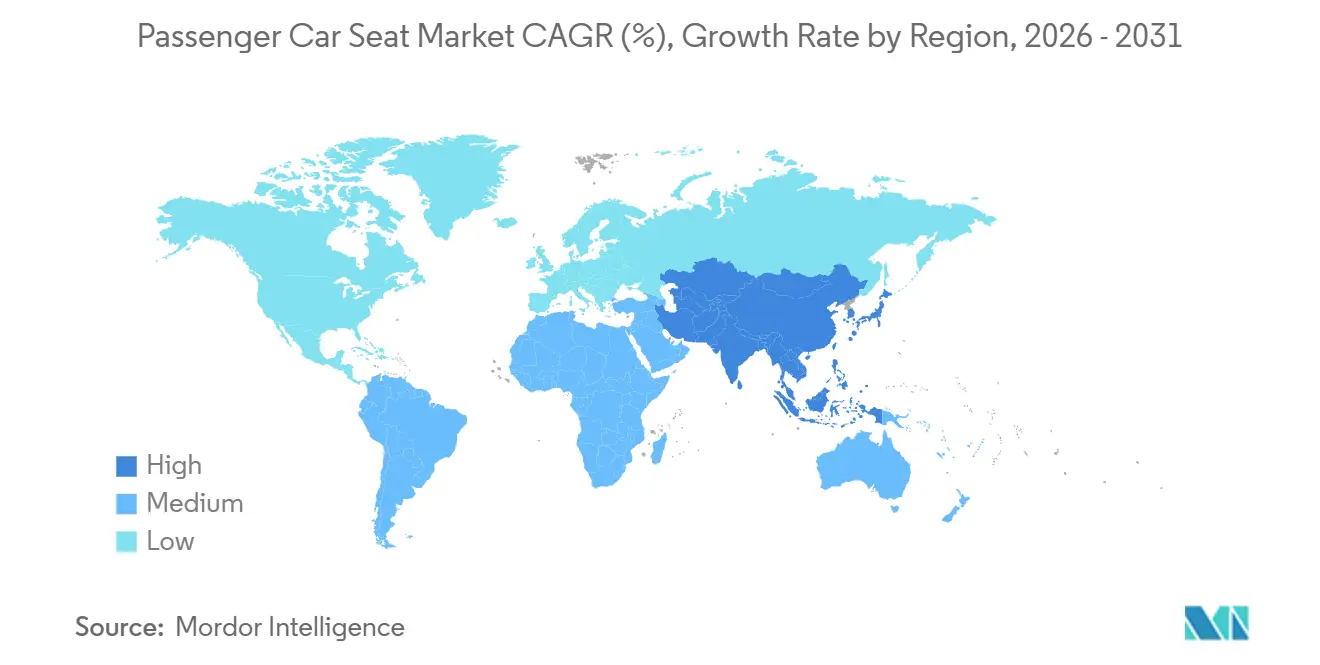
In 2025, the Asia-Pacific region accounted for 48.42% of the passenger car seat market share and is projected to grow at a 3.37% CAGR from 2026 to 2031. China's focus on electric vehicles is driving demand for lightweight, software-enabled seating. Southeast Asian governments are attracting foreign investments through tax incentives and tariff-free export corridors. FORVIA's Thailand facility highlights the region's role as a production and innovation center. Japanese tier-one suppliers utilize regional trade agreements to transport aluminum frames tariff-free, maintaining cost competitiveness despite fluctuating commodity prices.
North America Passenger Car Seat Market
North America benefits from high transaction prices to incorporate premium features like seat-based biometric monitoring. Potential tariff regulations on metals create cost uncertainties, prompting suppliers to localize content and diversify stamping partnerships. Stricter U.S. safety regulations, including rear-seat belt reminders, are accelerating the adoption of buckle-status sensors and child-presence detection algorithms. These requirements increase electronics content per seat and favor suppliers with embedded software expertise.
EMEA and South America Passenger Car Seat Market
Europe focuses on sustainability by enforcing life-cycle assessments and recycled-material thresholds, boosting synthetic leather adoption. Premium OEMs in Germany and Sweden are introducing swivel and lounge seat configurations, anticipating broader adoption with regulatory clarity on autonomous interiors. EU grants for net-zero supply chains support pilot projects recycling seat foam into binder-free acoustic pads, advancing circular economy goals. Emerging markets in the Middle East, Africa, and South America are expanding local assembly plants, currently demanding cost-effective standard seats but showing potential for powered variants as disposable incomes rise.

Competitive Landscape
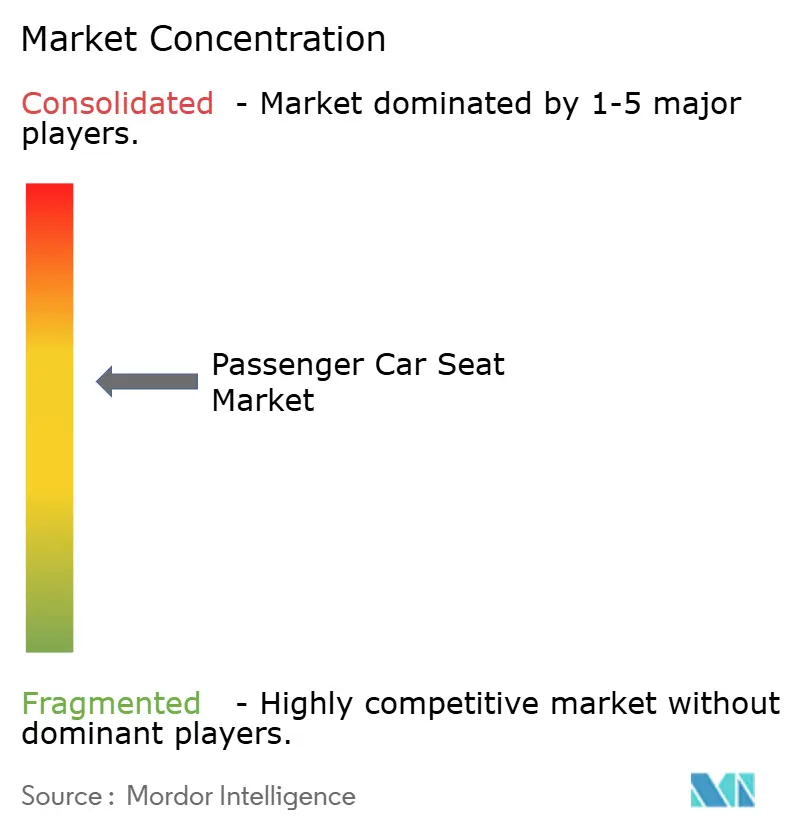
The passenger car seat market exhibits moderate concentration, creating an oligopolistic structure that enables coordinated technology investments while maintaining competitive dynamics. Adient, Lear, and FORVIA leverage multi-regional footprints and co-located engineering centers within major OEM facilities, enabling early engagement in platform development. Their long-term supply agreements provide volume visibility that justifies sustained R&D outlays in smart textiles and lightweight frames.
Competitive intensity is rising as OEMs demand annual price reductions (typically 2% to 3%) while raw-material costs surge; General Motors disclosed USD 1.0 billion to USD 1.5 billion in extra costs for 2026 tied to copper, aluminum, and semiconductors, forcing suppliers to absorb inflation or exit low-margin programs. Strategy patterns center on modular platforms, vertical integration, and software-defined features: Adient's ModuTec reduces assembly time from minutes to seconds by building modules offline, enabling higher automation and lower floor-space requirements.
Emerging disruptors include Chinese suppliers (Ningbo Jifeng, Yanfeng) that undercut Western tier-1 pricing by 20% to 30% while meeting domestic-content mandates, and material innovators such as INEOS Inovyn, whose BIOVYN bio-attributed PVC cuts lifecycle emissions by over 70% and appeals to OEMs under Scope 3 scrutiny. Collaborative innovation shapes the mid-tier supplier segment. Joint ventures with material specialists bring bio-based polyurethane and recycled yarns into mainstream production, while alliances with health-tech startups embed medical-grade sensors able to detect early fatigue signs. As seating evolves toward service-enabled revenue, software talent and cloud infrastructure become competitive differentiators. Despite consolidation forces, regional champions retain relevance by offering localized design, faster engineering turnaround, and familiarity with domestic regulations, especially in India, Indonesia, and Brazil.
Passenger Car Seat Industry Leaders
-
Adient plc
-
Lear Corporation
-
Faurecia (FORVIA)
-
Toyota Boshoku
-
Magna International
- *Disclaimer: Major Players sorted in no particular order
Passenger Car Seat Market Companies Covered in this Report
- Adient plc
- Toyota Boshoku
- NHK Spring
- Grammer AG
- Brose Group
- Martur Fompak
- Lear Corporation
- Magna International
- Hyundai Transys
- Tachi-S
- Continental AG
- Katzkin Leather
- Fisher and Company
- Faurecia (FORVIA)
- TS Tech
- AISIN Corporation
- Ningbo Jifeng

Recent Industry Developments in Passenger Car Seat Market
- April 2026: Adient introduced ProForce Massage Flow, a platform-based mechanical car-seat massage system targeting lower-back fatigue, scheduled for two Chinese OEM models. The system features spring-mounted installation for broad seat-frame compatibility, two-head and four-head quick-install modules, and multi-stage collapsible safety-reset mechanisms, integrating with lumbar support, ventilation, and heating functions.
- April 2026: Magna International launched EcoSphere bio-based foam incorporating 20% renewable content from soy and castor oil, targeting OEMs that require third-party-verified sustainability claims and aiming to reduce lifecycle emissions.
- January 2026: Adient announced ModuTec, a modular seat-design and assembly solution that reduces seat assembly time from minutes to seconds by building seat modules offline and sequencing them into the main just-in-time line, enabling higher automation, lower costs, and reduced factory floor space.
- July 2025: Adient launched a mechanical massage seating innovation debuting in GAC-Trumpchi's PHEV M8, featuring a 3D mechanical massage module simulating professional kneading techniques with a flexible protruding structure for collision safety and a rapid pressure relief valve.


Global Passenger Car Seat Market Report Scope
The passenger car seat market is segmented by technology, seat type, trim material, component, propulsion type, vehicle type, and geography. By technology, the market is segmented into standard seats and powered seats. By seat type, the market is segmented into bucket seats and bench seats. By trim material, the market is segmented into fabric, genuine leather, and synthetic leather. By component, the market is segmented into armrests, seat frames and structures, recliners, pneumatic systems, headrests, seat tracks, seat belts, height adjusters, side/curtain airbags, and other components. By propulsion type, the market is segmented into internal combustion engine (ICE) vehicles, battery electric vehicles (BEVs), hybrid electric vehicles (HEVs), plug-in hybrid electric vehicles (PHEVs), and fuel cell electric vehicles (FCEVs). By vehicle type, the market is segmented into hatchbacks, sedans, sport-utility vehicles (SUVs), and multi-purpose vehicles (MPVs). By geography, the market is segmented into North America, South America, Europe, Asia-Pacific, and the Middle East and Africa.
| Standard Seats |
| Powered Seats |
| Bucket Seats |
| Bench Seats |
| Fabric |
| Genuine Leather |
| Synthetic Leather |
| Armrest |
| Seat Frame and Structure |
| Recliner |
| Pneumatic System |
| Headrest |
| Seat Track |
| Seat Belt |
| Height Adjuster |
| Side/Curtain Airbag |
| Others |
| Internal Combustion Engine |
| Battery Electric Vehicle (BEV) |
| Hybrid Electric Vehicle (HEV) |
| Plug-In Hybrid Electric Vehicle (PHEV) |
| Fuel Cell Electric Vehicle (FCEV) |
| Hatchbacks |
| Sedans |
| Sport-Utility Vehicles (SUVs) |
| Multi-Purpose Vehicles (MPVs) |
| North America | United States |
| Canada | |
| Rest of North America | |
| South America | Brazil |
| Argentina | |
| Rest of South America | |
| Europe | United Kingdom |
| Germany | |
| France | |
| Italy | |
| Spain | |
| Rest of Europe | |
| Asia-Pacific | China |
| India | |
| Japan | |
| South Korea | |
| Rest of Asia-Pacific | |
| Middle East and Africa | United Arab Emirates |
| Saudi Arabia | |
| Turkey | |
| Egypt | |
| South Africa | |
| Rest of Middle East and Africa |
| By Technology | Standard Seats | |
| Powered Seats | ||
| By Seat Type | Bucket Seats | |
| Bench Seats | ||
| By Trim Material | Fabric | |
| Genuine Leather | ||
| Synthetic Leather | ||
| By Component | Armrest | |
| Seat Frame and Structure | ||
| Recliner | ||
| Pneumatic System | ||
| Headrest | ||
| Seat Track | ||
| Seat Belt | ||
| Height Adjuster | ||
| Side/Curtain Airbag | ||
| Others | ||
| By Propulsion Type | Internal Combustion Engine | |
| Battery Electric Vehicle (BEV) | ||
| Hybrid Electric Vehicle (HEV) | ||
| Plug-In Hybrid Electric Vehicle (PHEV) | ||
| Fuel Cell Electric Vehicle (FCEV) | ||
| By Vehicle Type | Hatchbacks | |
| Sedans | ||
| Sport-Utility Vehicles (SUVs) | ||
| Multi-Purpose Vehicles (MPVs) | ||
| By Geography | North America | United States |
| Canada | ||
| Rest of North America | ||
| South America | Brazil | |
| Argentina | ||
| Rest of South America | ||
| Europe | United Kingdom | |
| Germany | ||
| France | ||
| Italy | ||
| Spain | ||
| Rest of Europe | ||
| Asia-Pacific | China | |
| India | ||
| Japan | ||
| South Korea | ||
| Rest of Asia-Pacific | ||
| Middle East and Africa | United Arab Emirates | |
| Saudi Arabia | ||
| Turkey | ||
| Egypt | ||
| South Africa | ||
| Rest of Middle East and Africa | ||


Key Questions Answered in the Report
How big is the passenger car seat market in 2025?
The passenger car seat market size is USD 47.63 billion in 2025.
What CAGR is forecast for passenger car seat sales through 2031?
Global revenue is projected to advance at a 2.81% CAGR from 2026 to 2031.
Which region leads seat demand today?
Asia-Pacific holds 48.42% of global revenue and remains the fastest-growing geography through 2031.
What segment shows the highest growth rate?
Seats designed for battery-electric vehicles rise at a 19.18% CAGR, far above the market average.
Which material is gaining share fastest?
Synthetic leather posts a 5.71% CAGR thanks to sustainability goals and vegan consumer demand.
Page last updated on:





