
Rail Seats Market Size and Share
Market Overview
| Study Period | 2020 - 2031 |
|---|---|
| Market Size (2026) | USD 2.58 Billion |
| Market Size (2031) | USD 3.35 Billion |
| Growth Rate (2026 - 2031) | 5.34 % |
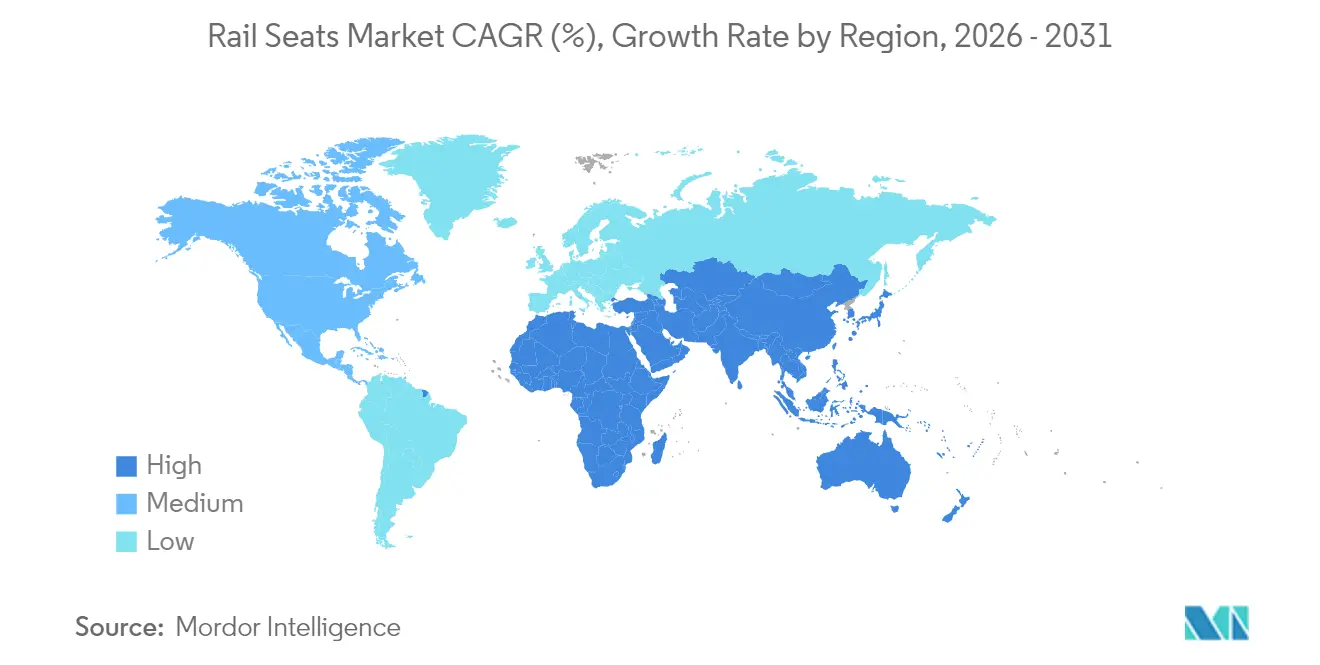
| Fastest Growing Market | Middle East and Africa |
| Largest Market | Asia Pacific |
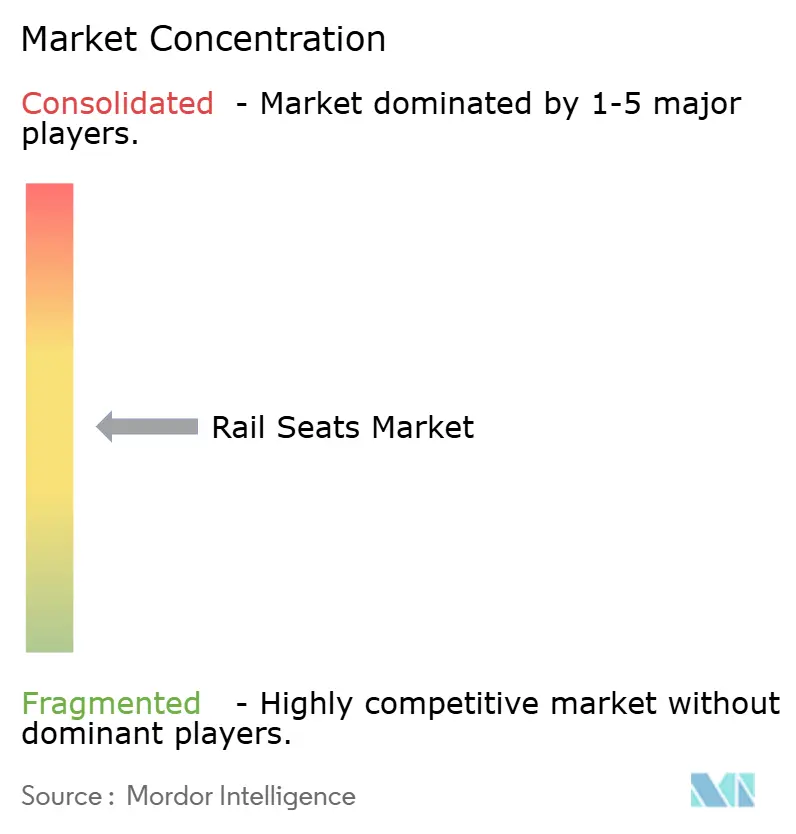
| Market Concentration | Medium |
Major Players *Disclaimer: Major Players sorted in no particular order Image © Mordor Intelligence. Reuse requires attribution under CC BY 4.0. | |
Rail Seats Market Analysis by Mordor Intelligence
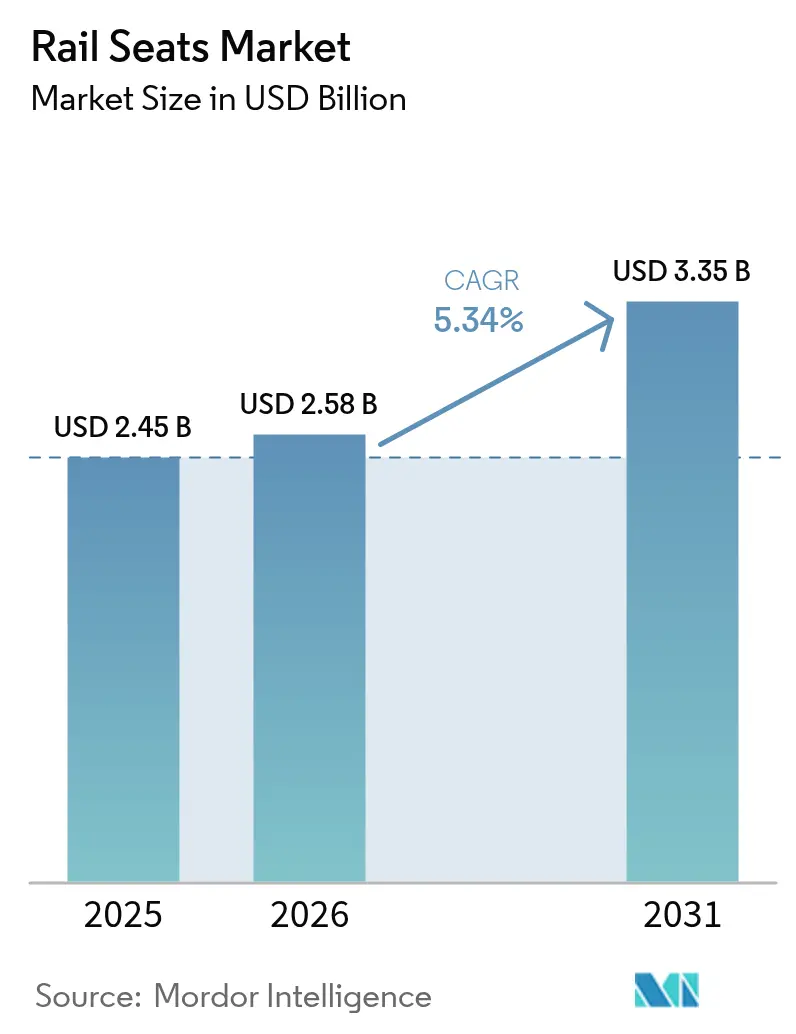
The Rail Seats market size is expected to grow from USD 2.45 billion in 2025 to USD 2.58 billion in 2026 and is forecast to reach USD 3.35 billion by 2031 at 5.34% CAGR over 2026-2031. This train seat market size expansion reflects the momentum of high-speed rail investments, rolling-stock modernization, and a global pivot toward passenger-centric standards. Governments in Asia-Pacific, Europe, and the Gulf continue to allocate multi-year budgets to new corridors and refurbishment programs, anchoring long-term order pipelines. Operators are simultaneously contending with strict fire-safety rules and volatile input prices, which accelerate the shift toward lightweight composites, antimicrobial surfaces, and modular layouts. Competitive dynamics remain moderate as European incumbents defend share with advanced material science while regional suppliers leverage cost advantages and local-content policies.
Key Report Takeaways
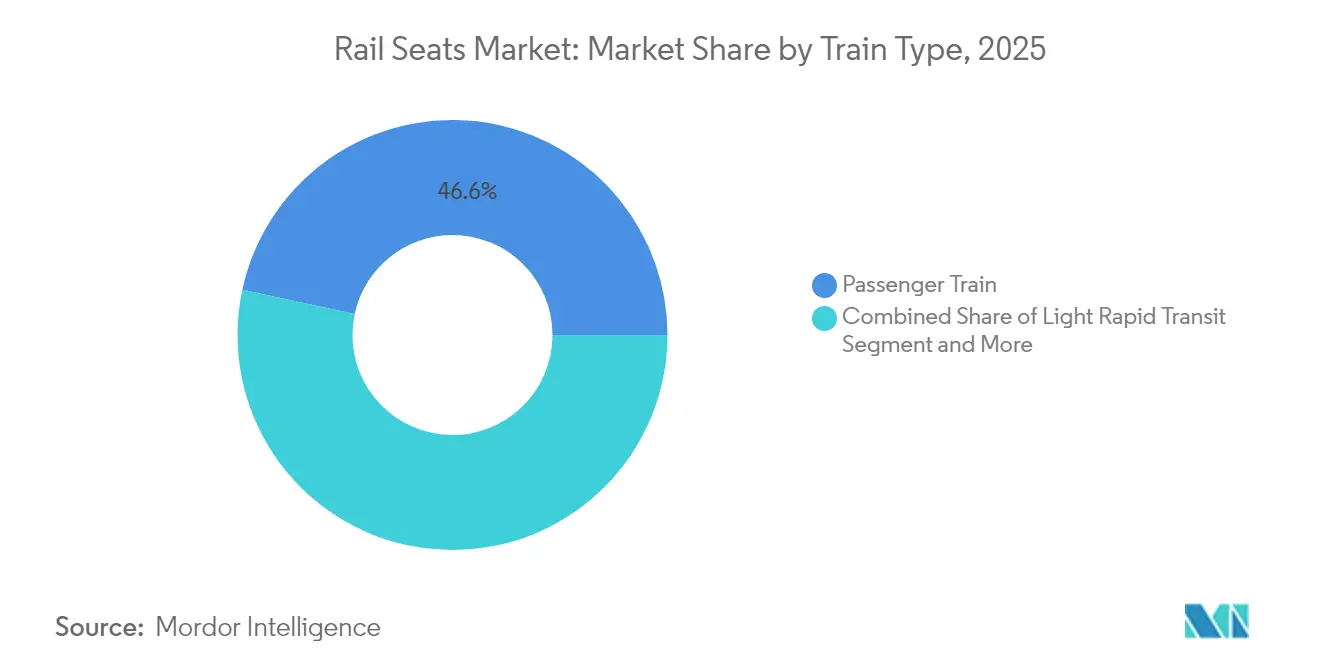
- By train type, passenger trains held 46.62% of the train seats market share in 2025, while the high-speed segment is projected to advance at a 5.46% CAGR by 2031.
- By material, fabric upholstery captured 50.74% of the train seats market share in 2025, whereas composites are forecast to grow at a 5.49% CAGR by 2031.
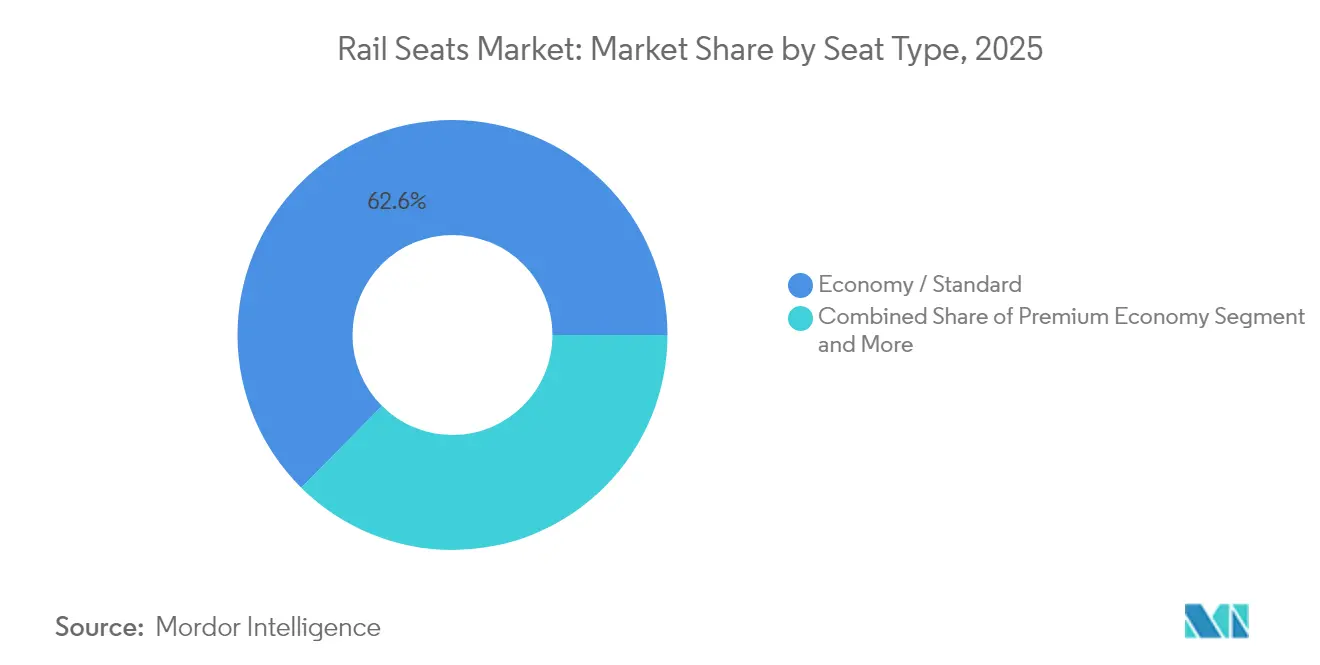
- By seat type, economy/standard configurations commanded 62.58% of the train seats market share in 2025, whereas premium-economy seating is forecast to grow at a 5.40% CAGR by 2031.
- By sales channel, OEM deliveries controlled 72.45% of the train seats market share in 2025; aftermarket replacement is progressing at a 5.52% CAGR by 2031.
- By region, Asia-Pacific commanded a 37.25% of the train seats market share in 2025; the Middle East and Africa are set to expand at a 5.44% CAGR by 2031.
Note: Market size and forecast figures in this report are generated using Mordor Intelligence’s proprietary estimation framework, updated with the latest available data and insights as of 2026.
Market Trends and Insights
Drivers Impact Analysis of Rail Seats Market*
| Driver | (~) % Impact on CAGR Forecast | Geographic Relevance | Impact Timeline |
|---|---|---|---|
| Expansion Of High-Speed Rail Corridors | +1.2% | Asia Pacific core, spill-over to MEA and Europe | Long term (≥ 4 years) |
| Fleet Refurbishment Programs | +0.9% | North America and EU | Medium term (2-4 years) |
| Passenger-Comfort Driven Seat Upgrades | +0.7% | Global | Short term (≤ 2 years) |
| Adoption Of Antimicrobial | +0.6% | Global, with early gains in Asia Pacific, Europe | Medium term (2-4 years) |
| Light-Weight Modular Seat Designs | +0.5% | EU, North America, Asia Pacific leading markets | Long term (≥ 4 years) |
| Smart-Sensor Enabled Predictive-Maintenance Seats | +0.4% | North America and EU, expanding to Asia Pacific | Long term (≥ 4 years) |
| Source: Mordor Intelligence | |||
Expansion of High-Speed Rail Corridors
High-speed rail construction elevates seating specifications because higher velocities magnify vibration, noise, and passenger-fatigue risks that legacy seats cannot mitigate. China’s CR450 and Morocco’s Al Boraq extensions require advanced damping foams, all-composite shells, and integrated head-impact zones. Operators quickly realize that ridership growth correlates with seat ergonomics, prompting retrofits across classic intercity fleets. Switzerland’s project pipeline and the Brightline West order for Siemens Velaro trainsets confirm that even mature markets view premium seating as a competitive lever against aviation. Vendors can certify to multiple national technical standards and secure multi-country contracts, anchoring backlog visibility for the train seats market [1].
Fleet Refurbishment Programs in Mature Markets
Operators in Europe and North America extend fleet lifecycles by replacing interior modules rather than ordering new rolling stock. Deutsche Bahn’s ICE3 upgrade, Alstom’s CrossCountry Voyager program, and SNCF’s double-deck EMU projects allocate more than half of interior budgets to seating. The strategy lowers capital intensity by two-fifths versus new builds while achieving parallel gains in Net Promoter Scores. The aftermarket, therefore, emerges as a structurally resilient revenue stream that grows counter-cyclically to new-train procurement, underpinning the long-run trajectory of the train seats market [2].
Passenger-Comfort Driven Seat Upgrades
Post-pandemic travelers prioritize spaciousness, personal device support, and hygienic contact surfaces. India’s Vande Bharat coaches demonstrate a two-fifths fare uplift primarily driven by rotating seats with enhanced cushioning. Urban operators like Denmark’s DSB deploy IoT sensors in seat cushions to visualize real-time occupancy and nudge passengers toward evenly distributed loading. Competitive pressure sharpens as airlines transplant premium-economy service concepts to rail, compelling operators to differentiate through seat ergonomics rather than timetabling alone.
Adoption of Antimicrobial & Low-VOC Seat Materials
Regulators and passengers demand low-toxicity interiors after heightened health awareness. Surface-treatment specialists, such as Microban and BioCote, integrate their products into seat fabrics and armrest polymers, thereby limiting microbial growth during extended service intervals. EN 45545-2 requires multi-stage flame, smoke, and toxicity tests for each seat sub-component, increasing certification costs for each material formulation. Vendors with material-science depth can meet health and flame-retardancy thresholds, reinforcing their competitive moat in the evolving train seat market.
Restraints Impact Analysis of Rail Seats Market*
| Restraint | (~) % Impact on CAGR Forecast | Geographic Relevance | Impact Timeline |
|---|---|---|---|
| Stringent Fire-Safety | -0.8% | Global, particularly stringent in EU | Short term (≤ 2 years) |
| Raw-Material Price Volatility | -0.6% | Global | Medium term (2-4 years) |
| Specialty Silicone and Recycled-Fabric Supply Gaps | -0.3% | North America and EU, expanding to Asia Pacific | Medium term (2-4 years) |
| Seat-Footprint Conflict | -0.2% | Global, acute in high-density urban transit | Short term (≤ 2 years) |
| Source: Mordor Intelligence | |||
Stringent Fire-Safety & Toxicity Certification Costs
EN 45545-2 mandates multi-stage flame, smoke, and toxicity tests for each seat sub-component, raising the cost by an exceptional price per material recipe. Small and mid-tier suppliers struggle to amortize these expenses, slowing innovation cycles and favoring incumbents with deep R&D budgets. The requirement to recertify after minor formulation tweaks further constrains the speed at which bio-based or recycled materials can enter revenue service. Consequently, certification complexity is a structural headwind that dampens near-term growth in the train seats market.
Raw-Material Price Volatility (PU Foam, Metals)
Prices of toluene di-isocyanate (TDI) and methylene di-isocyanate (MDI) for polyurethane foams jump in tandem with petrochemical feedstock costs. At the same time, aluminum and steel fluctuate with global trade policy and capacity shutdowns. Manufacturers locked into multi-year supply agreements face margin compression or contentious price-escalation clauses with rail operators. The economics are more challenging for aftermarket contracts where operators expect stable pricing. Rising feedstock costs can prompt deferments of significant refurbishment projects, tempering short-term order volumes in the train seats market.
*Our forecasts treat driver/restraint impacts as directional, not additive. The impact forecasts reflect baseline growth, mix effects, and variable interactions.
Rail Seats Market Segment Analysis
By Train Type:
High-Speed Segments Drive Premium DemandPassenger trains preserved 46.62% of the train seats market share in 2025, while High-speed services generated the fastest 5.46% CAGR from 2026 to 2031. Operators on new 300 km/h+ corridors often specify composite shells, cold-cure foams, and integrated infotainment that lift average selling prices by one-third. The more dynamic growth trajectory mirrors a multi-continent infrastructure pipeline spanning China, Saudi Arabia, and California. Light rail and metro projects contribute stable unit volumes, yet their lower ASPs dilute revenue share.
Innovation increasingly blurs rigid train-type boundaries. Deutsche Bahn’s IdeasTrain concept trials movable bulkheads and swiveling clusters that allow the same rolling stock to toggle between commuter and long-distance service, illustrating how modularity disrupts legacy seat-specification silos. Vendors who engineer seats to meet high-speed and commuter load cases gain design-reuse collaborations that compress time-to-market and reinforce profitability in the train seats market.

By Material:
Composites Accelerate Amid Sustainability PushFabric upholstery maintained 50.74% of the train seats market share in 2025, yet composite assemblies are tracking a 5.49% CAGR as operators seek double-digit weight savings. Carbon-fiber reinforced plastics and advanced thermoplastic laminates achieve fire-safety compliance without heavy intumescent coatings, trimming vehicle mass by up to 40 kg per car. Metal frames remain vital for crash-energy absorption but now incorporate hollow extrusions and friction-stir welds to cut density.
Supply chains adapt as tier-one seat manufacturers co-locate autoclave and thermo-forming capacity near rolling-stock plants to minimize logistics emissions. Fabric vendors respond with recycled yarn and antimicrobial finishes but concede volume to composite shells in premium cabins. The irreversible lean toward composites positions material science as a competitive differentiator in the train seat market.
By Seat Type:
Premium Economy Emerges as Growth LeaderEconomy configurations covered 62.58% of the train seats market share in 2025, yet premium-economy formats record a 5.40% CAGR because moderate upgrades in pitch, recline, and cushion geometry unlock fare premiums. Business and first-class remain niche in unit terms but anchor the highest margins, often commanding ASP multiples of 4–5 versus standard seats.
Airline service concepts seep into rail interior design, with privacy wings, personal charging docks, and wireless-charging armrests redefining passenger expectations for long-distance journeys. Fold-down and bench layouts dominate metros where peak-hour throughput overrides individual comfort. Nevertheless, even urban systems test padded, wipe-clean inserts to elevate user experience, illustrating the widening scope for differentiated products across the train seats market.
By Sales Channel:
Aftermarket Gains Momentum Through Fleet AgingOEM deliveries accounted for 72.45% of the train seat market share in 2025, but the 5.52% CAGR in the aftermarket reflects accelerating seat replacement cycles for 15- to 20-year-old fleets in Europe and North America. Refurbishment programs can upgrade many seats per car at two-thirds the capital expenditure (capex) of buying new rolling stock, while renewing the cabin aesthetic.
Knorr-Bremse’s aftermarket revenue share in rail systems underscores the scale achievable for suppliers that bundle seats with door, brake, and HVAC part packages. Interoperable mounting interfaces and adjustable plinths enable swift swap-outs, allowing for overnight depot operations that minimize service disruptions. The channel shift solidifies the aftermarket as a structural pillar of the train seat market.
Geography Analysis
APAC Rail Seats Market
Asia-Pacific led with 37.25% of the train seats market share in 2025, underpinned by China’s huge high-speed network expansion and India’s Vande Bharat fleet ramp-up. Domestic suppliers such as CRRC and Tata Steel win contracts by aligning with government localization mandates while integrating imported damping foams and flame-retardant fabrics. Japan maintains a premium niche through Shinkansen ergonomics and quality, and South Korea’s urban smart-metro programs adopt sensor-equipped seats for passenger flow optimization across Seoul’s network. These dynamics secure Asia-Pacific’s status as the train seat market's anchor growth engine.
MEA Rail Seats Market
The Middle East & Africa region records the fastest 5.44% CAGR from 2026 to 2031 as cross-border Gulf Cooperation Council rail corridors take shape. Saudi Arabia’s Dream of the Desert luxury concept train and the UAE’s Etihad Rail Phase 2 orders catalyze demand for leather-trimmed business-class pods and modular café arrangements. Egypt’s 41-unit Siemens Velaro order illustrates the pivot toward accessible, high-capacity interior layouts featuring foam-core side supports and wheelchair bays. In Sub-Saharan Africa, durability and low maintenance rank above aesthetics, steering purchasing criteria toward powder-coated steel frames and replaceable PVC pads, a nuance critical to capturing share in the train seats market .
Europe and North America Rail Seats Market
Europe and North America emphasize refurbishment and alignment with sustainability. Operators retrofit interiors to meet EN 45545 fire codes, ADA accessibility requirements, and corporate carbon targets without raising fleet counts. Programs such as Deutsche Bahn’s ICE3 and Amtrak’s Airo Agility orders elevate aftermarket seat volumes, sustaining capacity utilization among European seat producers. Switzerland’s forthcoming high-speed links will layer brand-new rolling stock demand atop the region’s refurbishment baseline, ensuring steady opportunity flow for the train seats market.
Regulatory Landscape
Rail seat specifications are shaped by safety, fire-performance, and accessibility rules that vary by region but converge on verifiable test compliance. In Europe, EN 45545-2 (including the 2020 edition with A1:2023 updates) governs fire behavior requirements for materials and components, and EN 16989:2018 provides test methods and requirements for complete passenger seats. This pushes OEMs and seat suppliers to qualify upholstery, foam, and shell constructions as a system rather than as standalone parts. Globally, ISO/TR 5914:2024 provides a benchmark for interior passive safety in heavy rail, reinforcing design practices around injury mitigation and crash-energy management.
In the United States, 49 CFR 238.233 (FRA) defines passenger seating requirements focused on secure attachment and performance under defined crash and acceleration conditions. As a result, it influences anchorage design and validation documentation for both OEM and retrofit programs. Trade policy can further affect cost and sourcing decisions for seat structures and subcomponents classified as automotive parts. In March 2026, the US Department of Commerce opened an April 2026 inclusions window under Section 232 for automobile parts, creating an administrative pathway for duty coverage adjustments that suppliers track when planning North America-focused supply chains.
Value Chain Analysis
The rail seats value chain is organized around rolling stock OEMs and major refurbishers that act as system integrators, supported by Tier 1 interior module suppliers, specialist seat OEMs, and a multi-tier base of materials and subcomponent providers. Upstream inputs include polyurethane foams and additives (including flame-retardant and low-VOC chemistries), fire-resistant textiles and coatings, metals for frames and brackets, and composites for shells and lightweight structures. Compliance-driven development (including EN 45545-2 and EN 16989 in Europe, and FRA requirements in the United States) increases the importance of early supplier qualification, documentation control, and repeatable test performance across material lots.
Midstream, seat manufacturers combine industrial design and engineering (ergonomics, crash-energy management, and modularity) with fabrication (metal forming and welding, composite processing, and upholstery) and final assembly into seat sets tailored to train type and class. Value capture is shifting toward full interior integration and design-to-cost programs rather than simple build-to-print manufacturing. In India-linked localization activity, Kineco Group secured a multi-year contract in May 2026 to design and manufacture interior systems, including seating-related modular components, for 100 Vande Bharat sleeper trains. Downstream, OEM supply ties to new-build platforms, while aftermarket activity ties to depot retrofits and fleet life-extension programs, where installation speed, interchangeability of mountings, and parts availability drive repeat orders.
Competitive Landscape
Global competition is moderately concentrated. European specialists Grammer AG, Kiel Group, and Compin Fainsa command roughly one-third of global turnover while defending intellectual property in energy-absorbing foams, composite shells, and quick-release anchoring mechanisms. Asian producers, including Jiangsu Fangda and Faiveley Transport (China), leverage labor cost advantages and state procurement preferences to penetrate domestic high-speed orders, gradually scaling quality levels to meet export standards.
Technology integration shapes positioning. Grammer’s smart-cushion sensor suite and Kiel’s antimicrobial vinyl lines illustrate how suppliers bundle value-added features that lift ASPs and create data-monetization streams. Partnerships proliferate between seat OEMs and material companies developing bio-based polyurethanes or halogen-free FR additives to stay ahead of evolving regulations. M&A activity targets specialist composites shops to secure in-house laminate capacity and shorten design cycles, reflecting the strategic importance of material depth in the train seats market.
White space remains in emerging regions, where local manufacturers lack fire-safety certification expertise and durable lightweight know-how. Joint ventures form as incumbent European brands seek tariff-free access and offset obligations, while regional firms desire technology transfer. Suppliers proficient in circular design principles are poised to capture future tenders that require end-of-life recycling plans, an emerging criterion in the train seats market.
Rail Seats Industry Leaders
-
Grammer AG
-
Seats Incorporated
-
Harita Seating System Limited
-
Sears Manufacturing Company
-
Kiel Group
- *Disclaimer: Major Players sorted in no particular order
Rail Seats Market Companies Covered in this Report
- Grammer AG
- Kiel Group
- Saira Seats Ltd.
- Seats Incorporated
- Camira Fabrics
- Lantal Textiles AG
- Harita Seating Systems Ltd.
- Compin Fainsa
- Transcal Ltd.
- Fenix Group LLC
- Freedman Seating Co.
- FISA Italiana
- Shanghai Railteco Equipment
- Gatso Rail Interiors
- Vossloh Kiepe Seating
- ELeather Group
- Rescroft Ltd.
- Kustom Seating Solutions
- USSC Group
- Shenyang Hanghai Seating
Market Opportunities and Future Outlook
Sustainability-linked materials and circular design are creating whitespace in rail seating, especially where operators must reconcile strict fire behavior compliance with reduced reliance on conventional foam and additives. In April 2026, Great Western Railway commenced in-service testing of the EcoSeat, a 100% recyclable, foam-free, pocket spring-based rail seat developed by Spinks and Quantum Seating. The trial, funded by a GBP 250,000 grant from the UK Department for Transport and Innovate UK, gives suppliers a practical route to differentiate on recyclability, serviceability, and end-of-life handling, while staying within Europe’s fire-safety framework.
Capacity additions and new formulations that combine fire performance with alternative feedstocks also support near-term procurement. In April 2026, Scottish Leather Group opened a 75,000 sq. ft. facility in Glasgow to manufacture BioPRO, a protein-based, molded, naturally fire-resistant seat foam certified to EN 45545-2 (R21) for rail applications. With scaled industrial supply emerging for rail-qualified bio-based cushioning, attention is shifting toward modular and convertible seating concepts (including sleeper and long-distance flexibility). Those deployments favor platform-based seat architectures that can be refreshed through the aftermarket without full vehicle replacement.
Recent Industry Developments in Rail Seats Market
- July 2026: Sears Seating opened a new manufacturing facility, Sears Manufacturing Iberia, S.L., near Madrid, Spain, expanding its European production footprint. The added capacity strengthens regional supply responsiveness for OEM and retrofit programs while reducing lead-time exposure tied to cross-border logistics. Establishing a dedicated Spanish operation also supports localization requirements and tender competitiveness across European rail and transit customers.
- April 2026: Great Western Railway commenced real-world testing of the EcoSeat, a 100% recyclable, foam-free, pocket spring-based rail seat developed by Spinks and Quantum Seating with UK Department for Transport and Innovate UK grant support. In-service validation on a live network accelerates procurement confidence in circular seat designs that still need to meet demanding fire and durability expectations. The trial also increases competitive pressure on incumbent foam-based designs by demonstrating an alternative architecture at operational scale.
- September 2024: Siemens delivered 41 Velaro EGY high-speed trainsets to Egypt, each fitted with 479 seats and two wheelchair spaces. The delivery highlights how large fleet introductions embed accessibility and capacity requirements into baseline seat specifications, influencing demand for certified mounting systems and compliant interior layouts. It also underscores the pull from major corridor investments in the Middle East and Africa for high-volume seating packages tied to new rolling stock platforms.
Rail Seats Market Report Scope and Research Methodology
Market Definition and Coverage
For this study, the market covers revenues earned from seats used in rail passenger vehicles, including seats supplied to new railcars and seats replaced during refurbishment or repair. The value captures the seat system as sold into rail applications, across major passenger rail formats and regions.
Scope exclusions: We exclude non-rail seating (buses, aviation, marine) and general interior fit-out items that are not sold as rail seat products.
Segments Covered in This Report
- By Train Type
- Passenger Train
- High-Speed Train
- Light Rapid Transit
- Monorail
- Tram
- By Material
- Metal Frames
- Fabric Upholstery
- Leather Upholstery
- Composites & Others
- By Seat Type
- Economy / Standard
- Premium Economy
- Business / First
- Fold-down / Bench
- By Sales Channel
- OEM Supply
- Aftermarket Replacement
- By Geography
- North America
- United States
- Canada
- Mexico
- South America
- Brazil
- Argentina
- Rest of South America
- Europe
- Germany
- France
- United Kingdom
- Italy
- Russia
- Rest of Europe
- Asia Pacific
- China
- Japan
- India
- South Korea
- Rest of Asia Pacific
- Middle East and Africa
- Saudi Arabia
- UAE
- Turkey
- South Africa
- Egypt
- Nigeria
- Rest of Middle East and Africa
- North America
Data Sources, Market Sizing, and Validation
Desk Research
Desk research started with public rail activity signals that can explain why seat demand moves up or down year to year. We reviewed sources such as national transport ministries and rail regulators for fleet plans, and then used international rail bodies and standards groups for safety and accessibility requirements that affect seat design, approval, and replacement timing.
To anchor the model, we also pulled publicly available procurement notices and contract award summaries, customs and trade statistics for relevant seat materials and components, and government budget documents that track rail capex and rolling stock programs. Company annual reports, investor presentations, and product catalogs were used to understand seat positioning, price bands, and aftermarket exposure, and then cross-checked with a paid subscription for company financials and a separate paid subscription that tracks tenders where relevant. These sources are illustrative, and many other references were used for data collection, validation, and clarification during the research process.
Primary Interviews and Surveys
Primary work focused on filling the gaps that public data usually leaves open, especially mix of OEM versus refurbishment demand, typical seat counts per railcar, and how pricing changes with materials and compliance needs. We spoke with a balanced set of stakeholders across the value chain, and coverage was kept global so regional procurement cycles and currency effects were not missed.
Distribution of primary research fieldwork respondents
| Company type | Respondent position | Region |
|---|---|---|
| Top tier: 25% | CXOs: 12% | APAC: 42% |
| Mid tier: 55% | Functional/Unit leaders: 32% | EMEA: 32% |
| Smaller Players: 20% | Managers: 56% | Americas: 26% |
Market-Sizing & Forecasting
The core model is built using a top-down and bottom-up approach, where rail fleet expansion and refurbishment intensity are translated into a seat demand pool, and then converted to value using average selling prices in current USD. To keep the totals realistic, we corroborated the outcome with selective bottom-up checks such as sampled seat-per-car assumptions, program-level order references, and supplier-side revenue sanity checks, which are then used to adjust outliers.
Inputs that were tracked include new rolling stock deliveries, refurbishment cycles and mid-life overhauls, average seats per railcar by train category, OEM versus aftermarket split patterns, material-driven price differences (for example, frame and upholstery choices), and the timing of safety or accessibility upgrades that trigger replacement. Forecasting was run using scenario analysis since rail procurement often moves in waves, and the scenarios were aligned to expert views on project pipelines, fleet renewal funding, and likely price progression.
Where bottom-up signals were incomplete, gaps were handled through peer benchmarks from comparable train programs and by applying conservative utilization assumptions for smaller markets, followed by re-checks with interview feedback before finalizing the series.
Data Validation & Update Cycle
Validation was done in layers, starting with checks that the model outputs move in the same direction as independent rail activity indicators, and that regional shares match known procurement centers. When a country or train type showed an unusual jump, the inputs were re-checked, the price logic was stress-tested, and interviews were revisited if the variance could not be explained by a clear program start or refurbishment wave.
Before sign-off, outputs go through multi-step analyst review so assumptions, unit conversions, and currency handling are consistent across the dataset. The report is refreshed annually, and interim updates are made when material events occur, such as large fleet orders, major refurbishment tenders, or sudden cost shifts. Right before delivery, a fresh pass is completed so clients receive the most up-to-date view.
Mordor Intelligence's Rail Seats Market Sizing Compared With Other Published Estimates
Published market values for rail seats can look far apart because the year used for sizing, the split between OEM supply and refurbishment demand, and the way pricing is converted into USD are not handled in the same way. In this topic, even small differences in seat-per-car assumptions or what counts as a seat system versus interior components can shift the total.
A practical gap driver is refresh timing and how average selling prices are rolled forward when materials, compliance features, and order mix change, and then currency conversion is applied at the same point in the model. By updating ASP and exchange-rate timing checks around major procurement cycles and refurbishment tenders, the 2026 value stays aligned to current ordering patterns, which explains why the level differs in Mordor Intelligence.
Benchmark comparison
| Source | Market Size | Gaps in Research Methodology |
|---|---|---|
| Mordor Intelligence | USD 2.58 B (2026) | |
| Industry Data Publisher A | USD 2.80 B (2024) | Uses an earlier reference year and appears to apply a broad passenger seating definition across rail modes without clearly separating refurbishment timing and OEM delivery cycles, which can inflate near-term value when large projects are announced. |
| Newswire Summary B | USD 1.37 B (2022) | Based on an older base year and may treat pricing more conservatively with slower ASP progression, and the total can stay lower if replacement volumes and mid-life overhaul programs are undercounted or lagged in the series. |
Across the three figures, differences mostly come from the sizing year and the way price and replacement activity are updated, not from a disagreement that seats are growing with rail investment. By aligning demand to fleet deliveries and refurbishment cadence, and then converting value with consistent pricing steps, we keep the estimate traceable to inputs that can be reviewed and repeated.
Key Questions Answered in the Report
What is the current global value of the train seats market?
It stands at USD 2.58 billion in 2026, with a forecast of USD 3.35 billion by 2031.
Which region leads to the demand for train seating solutions?
Asia-Pacific holds 37.25% of revenue, powered by China’s and India’s network expansions.
Why are composite seats gaining traction?
They deliver up to 40% weight savings and comply with strict fire-safety rules, supporting net-zero goals.
How fast is the aftermarket segment growing?
Aftermarket seat replacement is advancing at a 5.52% CAGR through 2031 as fleets age.
What regulation most affects seat material choices?
EN 45545-2 dictates flame, smoke, and toxicity thresholds, driving material R&D and certification costs.
Which seat class shows the highest growth rate?
Premium economy formats are expanding at a 5.40% CAGR due to strong passenger willingness to pay for extra comfort.