
Egypt Mineral Processing Equipment Market Size and Share
Market Overview
| Study Period | 2019 - 2031 |
|---|---|
| Forecast Data Period | 2026 - 2031 |
| Base Year Market Size (2025) | USD 0.11 Billion |
| Market Size (2026) | USD 0.12 Billion |
| Market Size (2031) | USD 0.16 Billion |
| Growth Rate (2026 - 2031) | 6.54 % |
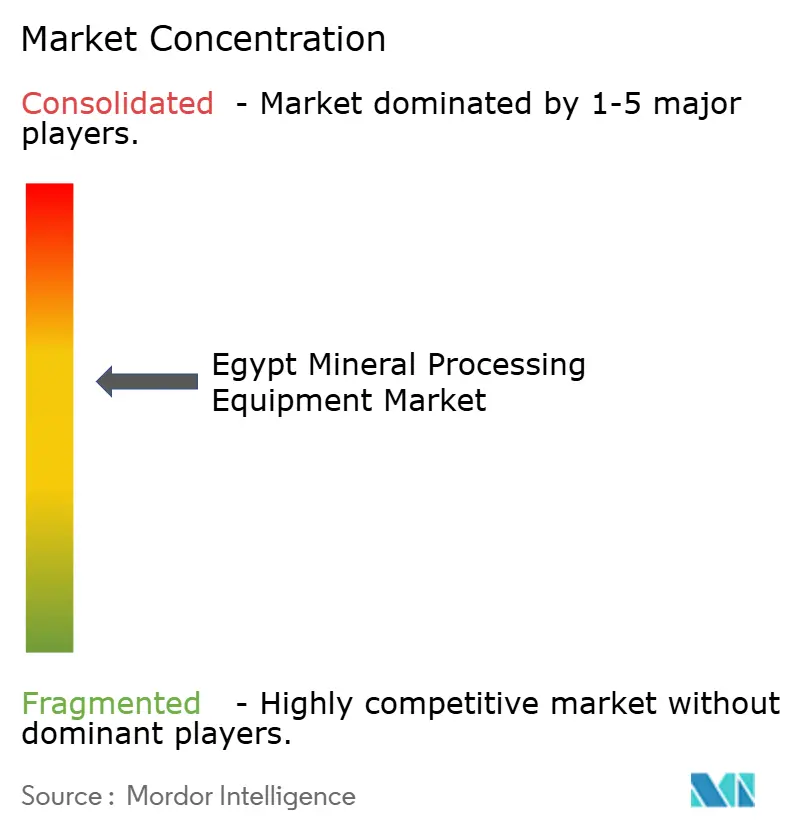
| Market Concentration | Medium |
Major Players
*Disclaimer: Major Players sorted in no particular order Image © Mordor Intelligence. Reuse requires attribution under CC BY 4.0. |
|
Egypt Mineral Processing Equipment Market Analysis by Mordor Intelligence
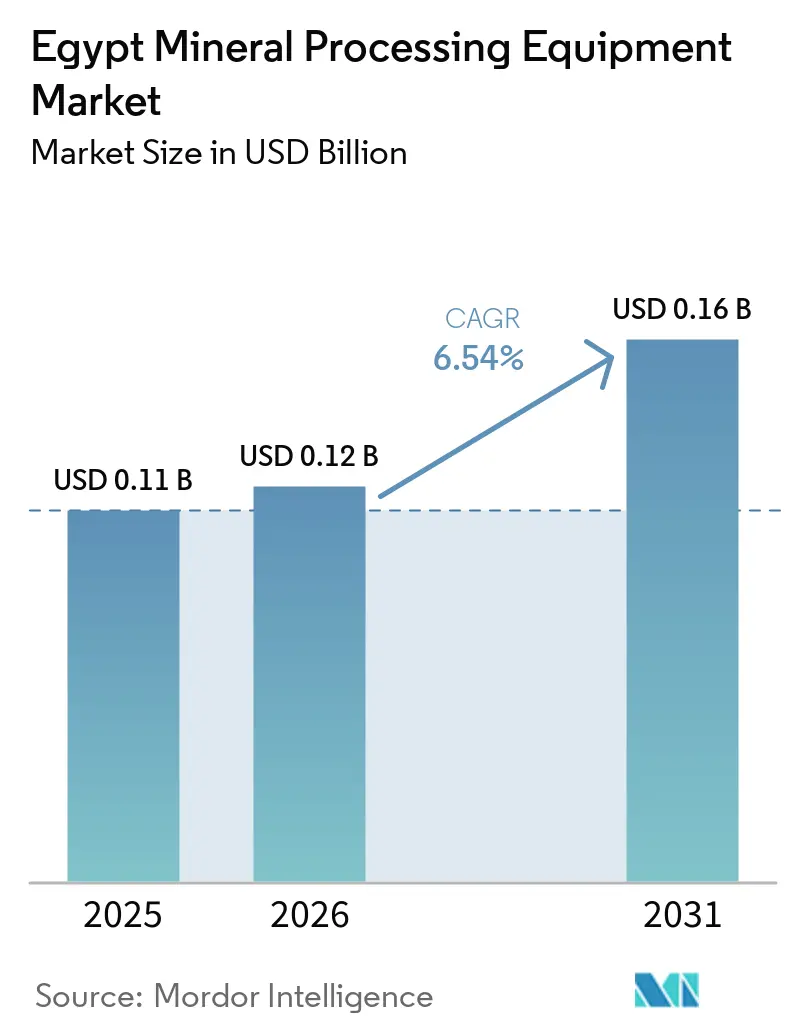
The Egypt mineral processing equipment market size was valued at USD 0.11 billion in 2025, is estimated at USD 0.12 billion in 2026, and is projected to grow to USD 0.16 billion by 2031, growing at a CAGR of 6.54% over 2026-2031. This trajectory underscores the country’s decision to add value to domestic minerals rather than export raw ore, a strategy formalized by Presidential Decree 87/2025, which updated Mining Law 198/2014[1]"Egypt Revamps Mining Law for Economic Growth, Investment," EOG, egyptoil-gas.com. Local-content mandates in the law are moving procurement away from pure imports toward Egyptian assembly partnerships. As a result, global original equipment manufacturers (OEMs) are establishing joint ventures, and domestic fabricators are scaling up to supply crushers, mills, and conveyors that comply with the new rules. The Egyptian mineral processing equipment market also benefits from a construction boom around New Valley’s phosphate complex and a wave of automation spending. At the same time, forex shortages and grid instability remain headwinds.
Key Report Takeaways
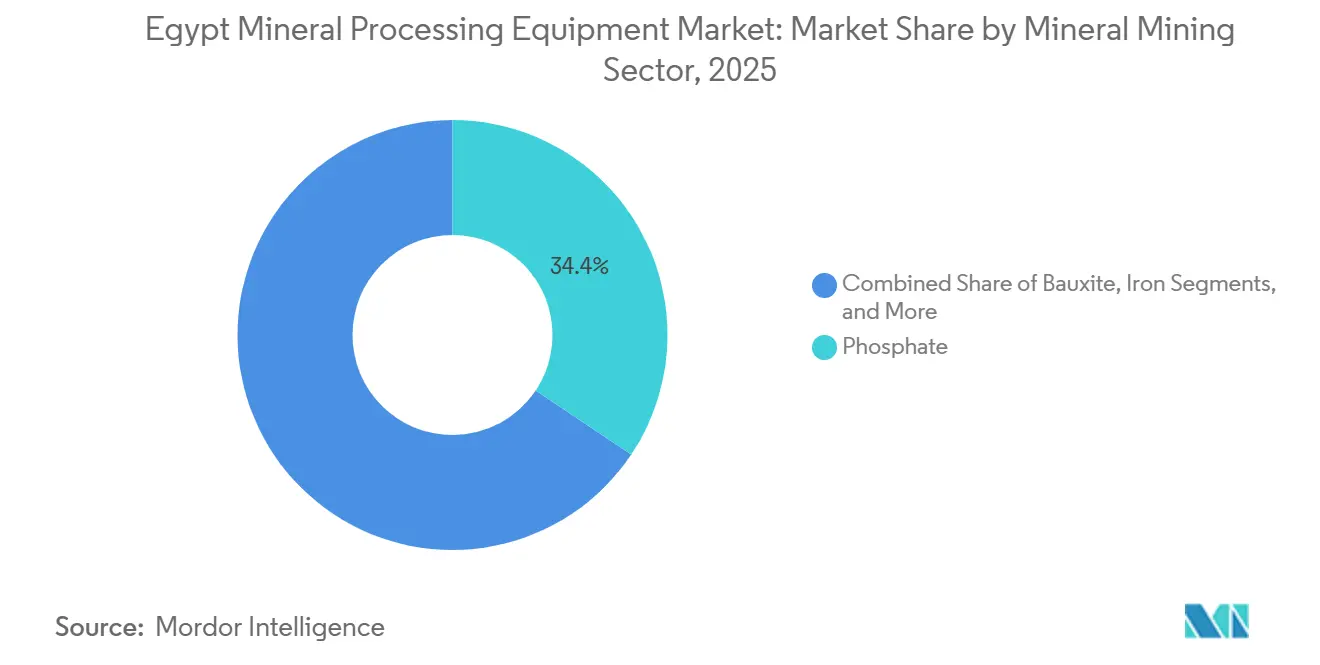
- By mineral mining sector, phosphate processing led the Egyptian mineral processing equipment market with 34.37% share in 2025, while lithium extraction is projected to expand at a 6.75% CAGR through 2031.
- By equipment type, crushers accounted for a 29.98% share of the Egyptian mineral processing equipment market in 2025, whereas mills & screens are forecast to grow at a 6.69% CAGR through 2031.
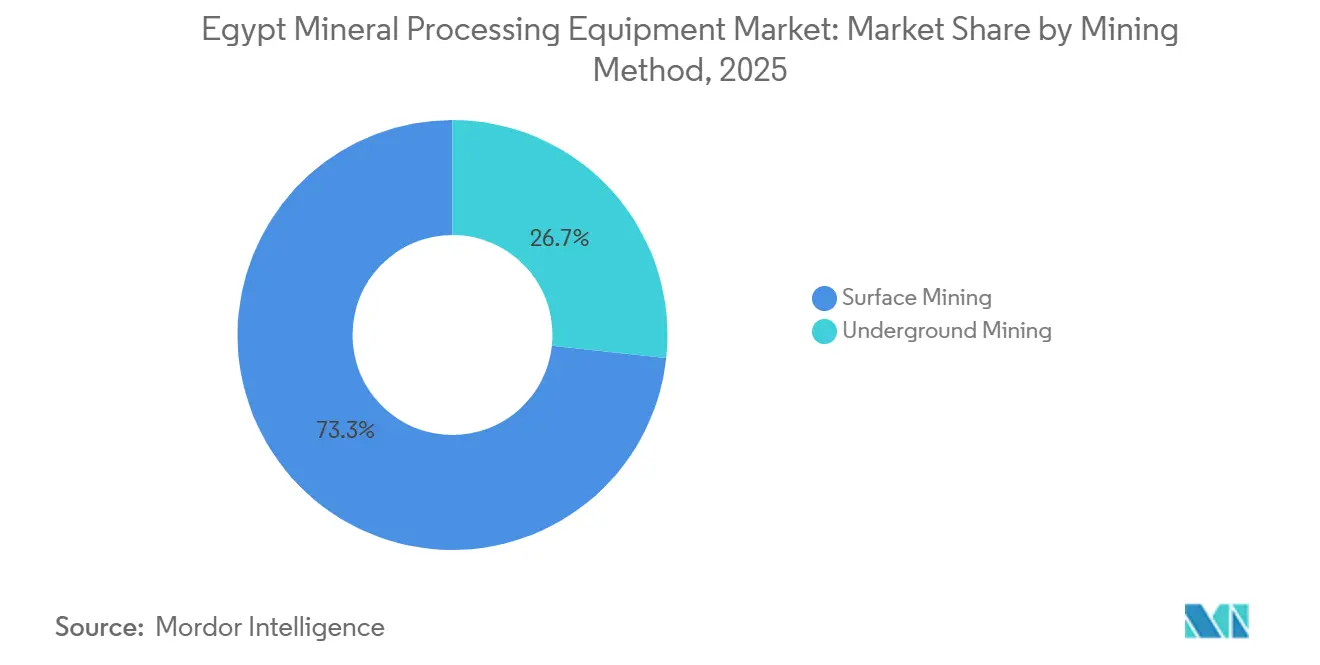
- By mining method, surface mining accounted for 73.29% of the Egyptian mineral processing equipment market share in 2025, while underground mining is advancing at a 6.67% CAGR through 2031.
- By automation level, semi-automated systems captured 49.78% of the Egyptian mineral processing equipment market share in 2025, and fully automated platforms are set to rise at a 6.85% CAGR through 2031.
Note: Market size and forecast figures in this report are generated using Mordor Intelligence’s proprietary estimation framework, updated with the latest available data and insights as of January 2026.
Proportional positioning is established by comparing country level and regional contributions against the global total, including that of Egypt. The mineral processing equipment market share in our global report expresses these relative weights.
Egypt Mineral Processing Equipment Market Trends and Insights
Drivers Impact Analysis*
| Driver | (~) % Impact on CAGR Forecast | Geographic Relevance | Impact Timeline |
|---|---|---|---|
| Fast-Tracking of Abu Tartour Phosphate Downstream Complex | 1.8% | New Valley Governorate, with logistics spill-over to Red Sea ports | Medium term (2-4 years) |
| Growing Domestic Gold-Ore Throughput | 1.5% | Eastern Desert (Marsa Alam, Quseir), expanding to Aswan | Short term (≤ 2 years) |
| CAPEX Race Among "Green Gold" Refiners | 1.2% | Red Sea Economic Zone (Ain Sokhna, Safaga) | Medium term (2-4 years) |
| National Hydrogen-Steel Roadmap | 0.9% | Suez, Alexandria, Aswan iron-ore belts | Long term (≥ 4 years) |
| Mandatory Local-Content Policy | 0.7% | National, with early compliance in Cairo, Alexandria industrial clusters | Short term (≤ 2 years) |
| Carbon-Credit Revenue-Sharing Pilots | 0.4% | Pilot sites in Qena, Aswan phosphate operations | Long term (≥ 4 years) |
| Source: Mordor Intelligence | |||
Fast-Tracking of USD 1.2 Billion Abu Tartour Phosphate Downstream Complex
Construction began in early 2026 and has accelerated demand for modular crushers, mills, and flotation cells capable of handling large volumes of phosphate rock. OEMs with local fabrication ties gain an advantage because the project must meet local-content thresholds spelled out in Presidential Decree 87/2025. Modular designs that can traverse weight-restricted desert roads are preferred, and energy-efficient comminution technologies are necessary because the complex draws power from a single 220 kV substation.
Growing Domestic Gold-Ore Throughput at Sukari & Other New Mines
After AngloGold Ashanti acquired Centamin, the Sukari mine embarked on an ambitious expansion phase, which required installing additional SAG mills and carbon-in-leach tanks to enhance its processing capacity. In 2025, the issuance of new exploration licenses encouraged junior miners to utilize portable crushers, enabling them to efficiently test ore grades in the field. Furthermore, stricter environmental regulations now mandate the use of closed-loop water circuits, emphasizing sustainable practices and driving increased demand for advanced tailings management equipment.
CAPEX Race Among Gulf-Funded "Green Gold" Refiners in Red Sea Zone
New copper, zinc, and rare-earth projects along the Red Sea coast are receiving significant backing from Gulf sovereign wealth funds, reflecting their commitment to fostering sustainable industrial growth. These plants are not only prioritizing energy-efficient crushers, such as high-pressure grinding rolls, but are also emphasizing adherence to ISO 14001 sustainability standards. This approach underscores a growing demand for vendors who can demonstrate low carbon intensity throughout their supply chains, paving the way for collaborative efforts toward a greener future.
National Hydrogen-Steel Roadmap Boosting Demand for High-Grade Iron-Ore Processing
Egypt’s decarbonization roadmap calls for higher-grade iron ore pellets suitable for direct reduction to iron [2]Vadim Kolisnichenko, "Egypt supports decarbonization of the steel industry," GMK Center, gmk. center. To meet high Fe purity requirements, iron ore mines must install magnetic separators and flotation columns, driving orders for specialty beneficiation equipment. Government concessional finance for projects co-located with planned green hydrogen electrolyzers further concentrates future demand along the Gulf of Suez coast.
Restraints Impact Analysis*
| Restraint | (~) % Impact on CAGR Forecast | Geographic Relevance | Impact Timeline |
|---|---|---|---|
| Foreign-Currency Shortage Delaying L/Cs | -1.4% | National, acute in import-dependent regions | Short term (≤ 2 years) |
| Chronic Grid Instability Outside Cairo–Suez Industrial Corridor | -0.9% | Remote mining areas, Eastern Desert | Medium term (2-4 years) |
| Volatile Phosphate Export Taxes Reducing Investment Certainty | -0.8% | Upper Egypt, Western Desert phosphate zones | Medium term (2-4 years) |
| Water-Scarcity Regulations Limiting Wet-Processing Permits | -0.6% | Upper Egypt, desert mining areas | Long term (≥ 4 years) |
| Source: Mordor Intelligence | |||
Foreign-Currency Shortage Delaying L/Cs for Imported Heavy Equipment
Letters of credit for imported machinery experienced delays of up to six months in 2025, pushing buyers toward supplier financing or euro-denominated contracts. Mid-tier operators reverted to refurbished equipment, increasing variability in performance and boosting demand for local maintenance skills. Egypt’s reserves improved by year-end 2025 but remain under pressure, prompting build-operate-transfer arrangements to become more common.
Chronic Grid Instability Outside Cairo–Suez Industrial Corridor
Mining districts beyond the Cairo-Suez corridor are experiencing persistent power outages, creating significant operational challenges. To address these issues, operators are increasingly relying on diesel generators and battery energy-storage systems. While these solutions help maintain operations, they are increasing project capital expenditures (CAPEX) and prompting companies to adopt equipment with ride-through drives to mitigate disruptions. Unfortunately, planned transmission upgrades are focused on urban centers, leaving mining companies to independently fund and implement reliability solutions to ensure an uninterrupted power supply in the medium term.
*Our forecasts treat driver/restraint impacts as directional, not additive. The impact forecasts reflect baseline growth, mix effects, and variable interactions.
Segment Analysis
By Mineral Mining Sector: Phosphate Dominates, Lithium Emerges
Phosphate processing captured 34.37% of the Egyptian mineral processing equipment market size in 2025, reflecting Egypt’s fertilizer integration drive that Abu Tartour now anchors. Concentrate upgrades require multi-stage crushing, grinding, and flotation, ensuring sustained demand across the Egyptian mineral processing equipment market. Gold ranks second and remains in growth mode because deeper exploration targets underground extensions. Iron and bauxite generate more modest equipment orders, but the dynamics may shift once the hydrogen-steel roadmap spurs higher-grade iron ore beneficiation.
Lithium extraction is the fastest-growing segment, with a 6.75% CAGR anticipated through 2031. Pilot plants are testing dense-media separation flowsheets for pegmatite ores, and the Ministry of Petroleum and Mineral Resources is preparing fast-tracked permits for critical minerals. Successful pilots could redirect equipment capital toward specialty crushers and flotation cells tailored for spodumene, adding diversity to the Egyptian mineral processing equipment market.



By Equipment Type: Crushers Lead, Mills Gain Traction
Crushers accounted for 29.98% of the Egyptian mineral processing equipment market size in 2025, reflecting their status as the first point of material breakage in every flowsheet. OEMs differentiate through wear-part metallurgy and automation features that adjust gap settings in real time, reducing downtime during abrasive cycles. Local fabrication partnerships are becoming decisive because Presidential Decree 87/2025 rewards Egyptian content, and crushers offer heavy-steel assemblies well-suited to domestic manufacturing. Success in this category often hinges on the breadth of service centers capable of quickly resurfacing jaws and cones, an attribute that global brands reinforce through technician training programs. As crushers set the pace for plant throughput, procurement teams seldom compromise on reliability, giving incumbents with proven references a persistent edge.
Mills & screens are forecast to expand at a 6.69% CAGR, outpacing crushers as operators pursue finer grind sizes that improve metal recovery. Suppliers respond with energy-efficient designs that integrate variable-speed drives and media optimization software, positioning mills as a lever for operating-cost reduction. Screen manufacturers focus on high-open-area panels that extend maintenance intervals, aligning with customers' push for higher uptime. End-users appreciate modular mill-screen combinations that shorten erection time, a vital factor at desert sites where logistics are complex.
By Mining Method: Surface Rules but Underground Accelerates
Surface mining commanded 73.29% of the Egyptian mineral processing equipment market size in 2025, driven by Egypt’s numerous near-surface phosphate and iron-ore deposits that favor open-pit extraction. Contractors prize large primary crushers and mobile conveyors that can be relocated as benches advance, and suppliers with proven track records in desert climates dominate tender shortlists. Surface operations also align with Egypt’s infrastructure reality, where haul roads and grid access are easier to develop above ground. Training programs for haulage and blasting crews are well established, giving open-pit projects a smoother ramp-up path than their underground peers. These advantages sustain surface mining’s leading role even as deeper resources are mapped.
Underground mining is projected to rise at a 6.67% CAGR, propelled by deeper gold lodes at Sukari and emerging projects in the Hamash district. The shift prompts demand for slim-profile crushers, battery-electric loaders, and paste-fill plants that address ventilation and safety challenges. Engineering firms active in underground development emphasize early integration of processing equipment into mine design to avoid costly retrofits later. Automation gains additional weight underground because personnel access is limited and risk management is paramount.
By Automation Level: Semi-Automated Prevails, Full Autonomy Advances
Semi-automated systems captured 49.78% of the Egyptian mineral processing equipment market size in 2025, balancing capital budgets with measurable productivity gains. Operators adopt sensor packages that regulate crusher gaps and conveyor speeds, tools that lift throughput without heavy IT overhead. Maintenance crews value semi-automation because it retains the ability to manually override during power fluctuations, a practical consideration in remote regions. OEMs bundle training modules that upskill technicians in calibration and data interpretation, fostering user confidence in partial autonomy. The segment’s popularity also stems from smoother regulatory acceptance, as inspectors see human oversight preserved in critical decision loops.
Fully automated platforms are expected to climb at a 6.85% CAGR through 2031, driven by rising labor costs and early success stories such as autonomous haulage pilots at Sukari. Vendors embed edge computing hardware into crushers and mills, enabling real-time analytics even when 5G coverage is patchy. Continuous operation without shift changes appeals to mine planners seeking to maximize asset utilization, while predictive maintenance algorithms reduce unplanned downtime. Cybersecurity certification is emerging as a differentiator, with mining companies insisting on encrypted control protocols before approving purchases.
Geography Analysis
The Eastern Desert, anchored by Sukari and a string of exploration prospects, is the epicenter of demand for gold-related equipment. Suppliers with service hubs in Safaga or Hurghada gain a logistics edge because the region lies far from Cairo yet near Red Sea ports. Environmental compliance standards require dust suppression and water recycling, propelling demand for specialized pumps and liners.
New Valley and Red Sea governorates form a phosphate corridor centered on Abu Tartour. Dry-crushing and electrostatic-separation technologies have become attractive due to water scarcity, and the proximity to Red Sea lanes trims shipping times for exported fertilizers. Infrastructure still revolves around desert highways, so OEMs favor skid-mounted or containerized modules adaptable to weight limits.
The Suez Canal Economic Zone is attracting Gulf-funded refineries that target low-carbon metals. Reliable grid power, free-zone customs, and deepwater berths lower the landed cost of high-value processing equipment. This cluster offers OEMs a foothold in advanced crushers and mills designed for copper, zinc, and rare-earth concentrates, adding yet another layer of opportunity in the Egyptian mineral processing equipment market.
Mordor Intelligence examines the mineral processing equipment market across diverse other regional markets as well, offering granular country-level perspectives for Morocco, South Africa, Brazil, Saudi Arabia, Australia, China, Canada, Germany, and France and more.
Competitive Landscape
The Egyptian mineral processing equipment market is moderately concentrated. The top five OEMs—FLSmidth, Metso Outotec, Sandvik, Weir, and Komatsu —hold sufficient market share to set technology benchmarks but leave room for regional challengers. Compliance with the 2024 local-content rule shapes strategic moves: Metso Outotec signed a supply agreement for Abu Tartour, specifying Egyptian-fabricated structural steel, while FLSmidth launched a joint venture in Alexandria to assemble modular high-pressure grinding rolls.
White-space niches include battery-electric underground equipment, paste-backfill systems, and real-time ore sorting. Mid-sized innovators with specialized products are entering the market through distribution pacts with local engineering firms, helping them meet ISO 9001 tender requirements. Service capability is equally crucial; OEMs that stock wear parts in Cairo and Port Said enjoy higher renewal rates for maintenance contracts.
Egypt’s Ministry of Trade and Industry will introduce a verification framework in 2026, obliging suppliers to document Egyptian value added. Players already embedded in local joint ventures are well-positioned, whereas pure importers may face certification delays. Aftermarket competition is likely to intensify as expanded local manufacturing lowers part lead times and enables price competition against imported spares.
Egypt Mineral Processing Equipment Industry Leaders
-
FLSmidth A/S
-
Metso Outotec
-
Sandvik AB
-
The Weir Group PLC
-
Komatsu Ltd.
- *Disclaimer: Major Players sorted in no particular order

Recent Industry Developments
- August 2026: Egypt announced plans to increase exploration and production activities by around 20% during 2026 through new contractual models designed to shorten well-drilling timelines and accelerate exploration programs and their results.
- October 2025: Badr El Din Petroleum Company unveils Egypt’s first domestically manufactured 17.5-inch drill bit, exemplifying rising local-content capability.
- May 2025: AD Ports Group signed a 50-year concession with the Suez Canal Economic Zone to build the 20 km² KEZAD East Port Said industrial and logistics park, committing USD 120 million to Phase 1 for quays, warehouses, and utilities.


Egypt Mineral Processing Equipment Market Report Scope
The Egyptian Mineral Processing Equipment market is segmented by mineral mining sector, equipment type, mining method, and automation level. By Mineral Mining Sector, the market is segmented into Bauxite, Iron, Lithium, Phosphate, Gold, and Others. By Equipment Type, the market is segmented into Crushers, Feeders, Conveyors, Drills & Breakers, Mills & Screens, Pumps & Valves, and Others. By Mining Method, the market is segmented into Surface Mining and Underground Mining. By Automation Level, the market is segmented into Manual, Semi-Automated, and Fully Automated. Market forecasts are typically provided in terms of Value (USD) and Volume (Units).
| Bauxite |
| Iron |
| Lithium |
| Phosphate |
| Gold |
| Others |
| Crushers |
| Feeders |
| Conveyors |
| Drills & Breakers |
| Mills & Screens |
| Pumps & Valves |
| Others |
| Surface Mining |
| Underground Mining |
| Manual |
| Semi-Automated |
| Fully Automated |
| By Mineral Mining Sector | Bauxite |
| Iron | |
| Lithium | |
| Phosphate | |
| Gold | |
| Others | |
| By Equipment Type | Crushers |
| Feeders | |
| Conveyors | |
| Drills & Breakers | |
| Mills & Screens | |
| Pumps & Valves | |
| Others | |
| By Mining Method | Surface Mining |
| Underground Mining | |
| By Automation Level | Manual |
| Semi-Automated | |
| Fully Automated |


Key Questions Answered in the Report
What is the forecast size of the Egypt mineral processing equipment market by 2031?
The Egypt mineral processing equipment market size is projected to reach USD 0.16 billion by 2031.
Which mineral segment currently commands the largest share of equipment demand?
Phosphate processing leads the market with 34.37% share in 2025, benefiting from the Abu Tartour downstream complex.
Which equipment category is expected to grow the fastest?
Mills & screens are forecasted to rise at a 6.69% CAGR as operators chase finer grind sizes for improved recovery.
Why are fully automated systems gaining ground in Egypt?
Rising labor costs and technology pilots at mines such as Sukari support a 6.85% CAGR for fully automated platforms through 2031.
Page last updated on:


 Your data is secure and never sold or shared.


