
Oilfield Power Generation Market Size and Share
Market Overview
| Study Period | 2021 - 2031 |
|---|---|
| Forecast Data Period | 2026 - 2031 |
| Historical Data Period | 2021 - 2024 |
| Growth Rate | 1.62 % |
| Fastest Growing Market | North America |
| Largest Market | Middle-East and Africa |
| Market Concentration | Low |
Major Players *Disclaimer: Major Players sorted in no particular order Image © Mordor Intelligence. Reuse requires attribution under CC BY 4.0. | |
Oilfield Power Generation Market Analysis by Mordor Intelligence
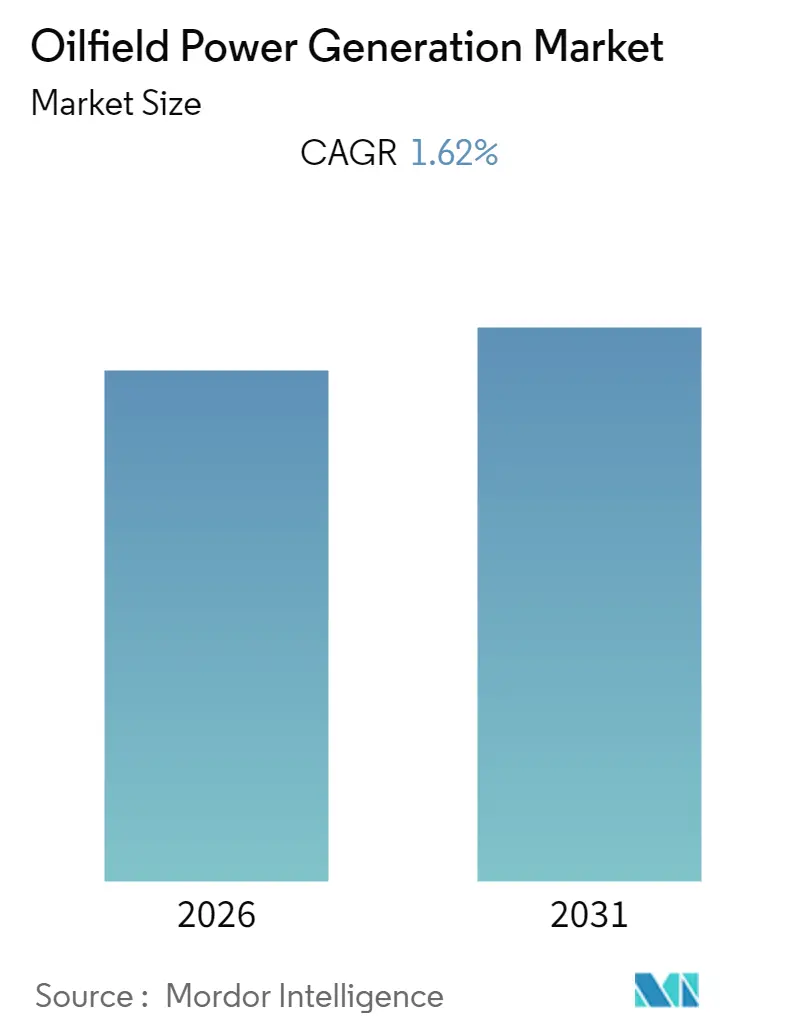
The Oilfield Power Generation Market size is expected to register a CAGR of 1.62% during the forecast period (2026-2031).
- The onshore segment is expected to be the largest segment in the oilfield power generation market during the forecast period due to increasing annual production and activities. In 2019 the increase in natural gas production was about 3.3%.
- The new technologies, such as hybrid generators that are more efficient and emit fewer greenhouse gases, are expected to create several opportunities for the oilfield power generation market.
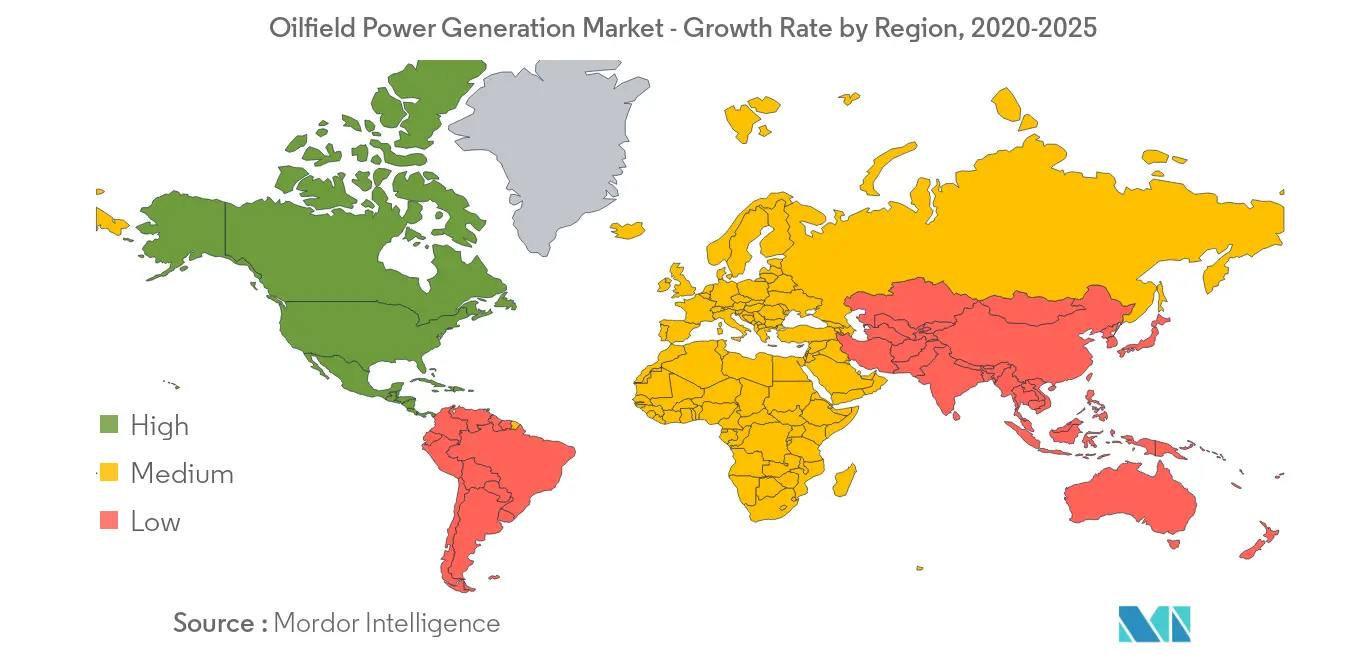
- Due to its rapidly growing upstream industry, North America is likely going to be the fastest-growing market for the oilfield power generation during the forecast period. In 2019 the region produced 6.6% more crude oil than the previous year, which is likely to impact the oilfield power generation market positively.
Note: Market size and forecast figures in this report are generated using Mordor Intelligence’s proprietary estimation framework, updated with the latest available data and insights as of 2026.
Market Trends and Insights
Onshore Segment Expected to Dominate the Market
- Oil field operations typically operate away from traditional infrastructure, making it impossible for reliable access to electricity. A lack of existing roadways and communication lines makes it nearly impossible to manage effectively. More commonly, these locations typically lack any access to power. To modernize and add these components, oil field operators would be forced to invest significantly. And, as a result, it is simply not financially feasible. For the above reason, the oilfield power generation methods come in hand, which is more reliable and cost-effective. Companies use various equipment such as diesel and natural gas generators.
- The increasing number of wells at new fields and their exploration require the drilling of several new wells, which require power generation units at every site for the smooth going of the work, decreasing the non-productive time of the site.
- Moreover, the low investment cost in onshore field development than offshore is attracting more investment in onshore, thus driving the oilfield power generation market during the forecast period.
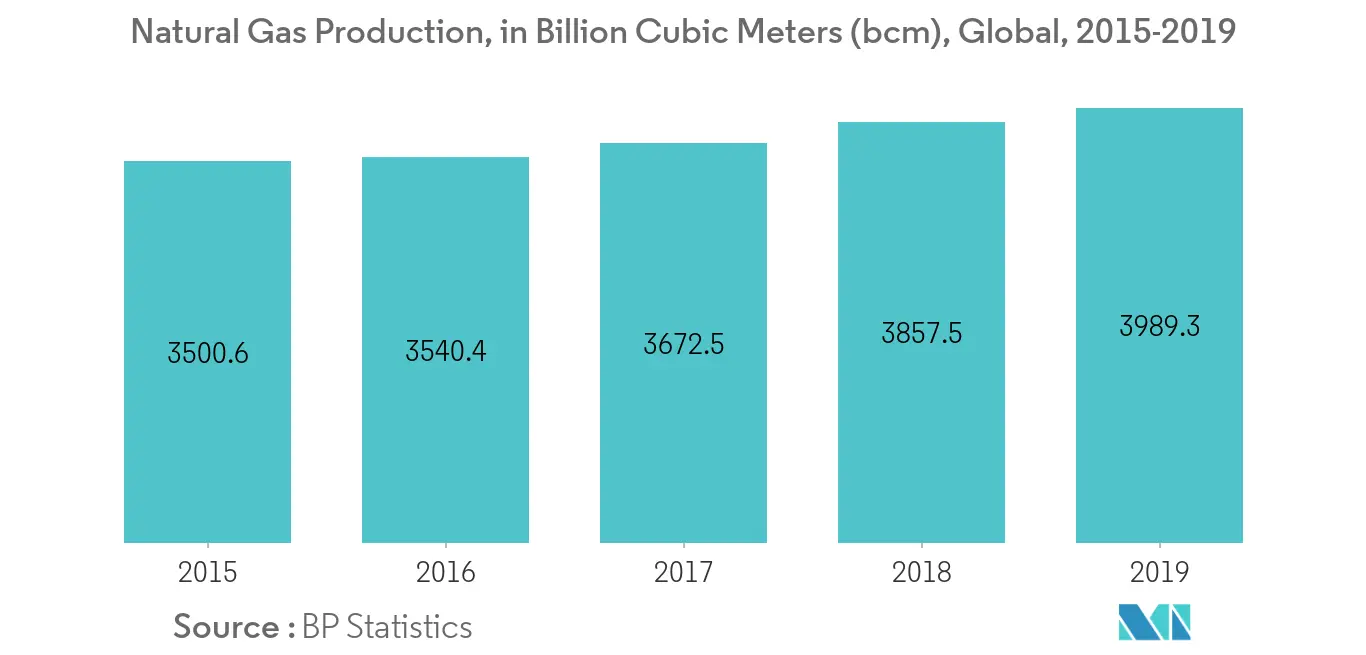
- In 2019, the global natural gas production was 3989.3 billion cubic meters (bcm), higher than the world's production in 2018, 3857.5 bcm. Moreover, in 2019, about 23.3% of the electricity generated worldwide was from natural gas. The increasing demand and production of natural gas over the world are likely to positively impact the more oilfield activities, which is expected to drive the oilfield power generation market.
- In recent years several new oil and gas fields were discovered in the world, in 2019, a new oil field was found in Khuzestan province of Iran, which is expected to have over 50 billion barrels of oil. The development of such newly discovered fields is expected to impact the oilfield power generation market positively.
- Hence, owing to the above points, onshore is likely going to be the largest segment for the oilfield power generation market during the forecast period.
North America Expected to Dominate the Market
- North America, due to its rapid increase in crude oil and natural gas production in the world, held a significant share in the market. In 2019, North America produced is approximately 24.9% of the global crude oil production.
- Countries in North America have planned to decrease their carbon signature by using cleaner fuel such as natural gas from which the carbon emissions are less. Natural gas energy in the countries in North America already surpassed coal-based power and is likely to take over the energy sector, thus reducing greenhouse gas emissions.
- As of 2019, North America's crude oil production was 1116.5 million tonnes (MT), which was higher than the region produced in 2018, 1042.2 million tonnes (MT). The increase in crude oil production over the year exhibits the need for power generation units in the oilfields to support day to day activities.
- Moreover, the region is suffering heavily from the COVID-19 situation but is expected to regain its inertia slowly after. Oil and gas hold a significant share in North America's economy. With the increasing exploration and production operations offshore by the United States and Mexico, it is likely to drive the oilfield power generation market.
- Hence, due to the above points, North America is expected to be the fastest-growing market for the oilfield power generation during the forecast period.
Regulatory Landscape
Regulation affecting oilfield power generation is increasingly linked to air emissions controls for both upstream operations and on-site fossil generation. In the European Union, Regulation (EU) 2024/1787 entered into force in August 2024 and set measurement, reporting, and verification requirements for methane emissions across the energy sector. This is pushing operators toward tighter leak detection and repair (LDAR) programs and equipment choices that reduce venting and flaring where on-site power is fueled by associated gas.
Policy direction varies across regions and is reshaping compliance priorities for equipment and operating modes. In the United States, EPA activity in 2025 included a proposal to repeal greenhouse gas emissions standards for fossil fuel-fired power plants under Clean Air Act Section 111, while methane-focused compliance for oil and gas sources continues to influence monitoring and abatement practices. Separately, intergovernmental guidance such as the IEA Global Methane Tracker 2026 highlights LDAR, electrification of methane-emitting equipment, and vapor recovery-related measures as cost-effective abatement pathways, reinforcing demand for lower-emission field power configurations in jurisdictions and buyer channels that formalize methane-intensity expectations.
Value Chain Analysis
The value chain starts with prime mover and alternator OEMs, including diesel and natural gas gensets, gas turbines, and reciprocating gas engines. Packagers and EPCs then integrate controls, switchgear, fuel conditioning, and emissions equipment into skid-mounted or containerized units for onshore and offshore sites. Technology and service providers supply energy management systems, remote monitoring, and maintenance programs, while fuel supply and logistics (diesel delivery, pipeline/CNG/LNG, and associated gas conditioning) influence run-cost and uptime in remote basins. Recent project activity in North America also points to expansion of larger distributed power blocks around oil and gas demand centers, including the 452 MW Pecos Power Plant in Texas using multiple reciprocating gas engines with an associated O&M agreement.
Further downstream, oil and gas operators and oilfield service contractors procure rental fleets or owned assets and operate them as standalone units or as part of microgrids. These microgrids increasingly blend gas generation with batteries and advanced controls to manage variable drilling and completion loads. Procurement scale and long-lead sourcing are also reflected in framework purchasing, such as ProPetro’s PROPWR strategic framework agreement with Caterpillar to purchase up to 2.1 GW of generation assets (April 2026), and in multi-year turbine supply arrangements such as those between Kodiak Gas Services and Baker Hughes (July 2026). Overall, these moves indicate that procurement scale, service coverage, and integration capabilities (controls, power quality, and hybridization) are becoming differentiators beyond the genset itself.
Competitive Landscape
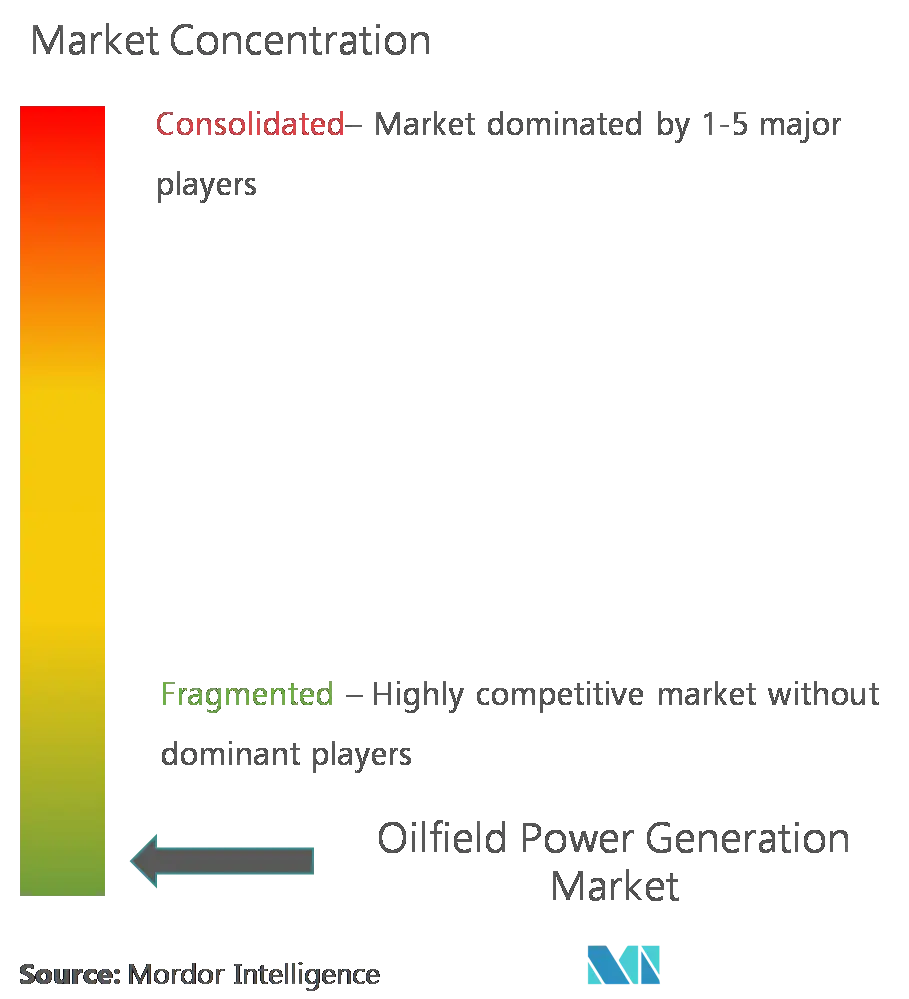
The oilfield power generation market is fragmented. Some of the key players in this market include Atlas Copco SA, Caterpillar Inc, Doosan Corporation, Mitsubishi Heavy Industries Engine & Turbocharger Ltd, and Generac Holdings Inc.
Oilfield Power Generation Industry Leaders
-
Atlas Copco
-
Caterpillar Inc
-
Doosan Corporation
-
Mitsubishi Heavy Industries Engine & Turbocharger Ltd
-
Generac Holdings Inc
- *Disclaimer: Major Players sorted in no particular order
Oilfield Power Generation Market Companies Covered in this Report
- Atlas Copco SA
- Caterpillar Inc.
- Cummins Inc.
- Doosan Corporation
- Generac Holdings Inc.
- Kirloskar Oil Engines Limited
- Kohler Co
- Mitsubishi Heavy Industries Engine & Turbocharger Ltd?
- MTU Onsite Energy
Market Opportunities and Future Outlook
Opportunities are focused on replacing diesel-heavy field power with natural gas, dual-fuel, and hybrid architectures that reduce fuel logistics complexity and improve emissions profiles while supporting increasingly electrified rigs, artificial lift, and compression. The commercial pull for modular power blocks and microgrids is visible in large distributed capacity additions in key basins, including the 452 MW Pecos Power Plant partnership announced by Mercuria Americas and Continental Resources (March 2026) and the subsequent engine-based plant order with an O&M agreement (June 2026). Together, these items point to a shift from purely mobile units toward basin-scale power solutions that still serve upstream operations.
Another opportunity sits at the intersection of upstream power and new high-load users that colocate near gas supply, including data-center-related demand. This is driving procurement and capacity expansions among power providers active in energy infrastructure, including Solaris Energy Infrastructure’s 900 MW capacity expansion and new growth capital financing (June 2026), which signals continued investment in scalable generation capacity where associated gas and field electrification economics align. Industry frameworks such as IOGP electrification tools, along with methane-intensity requirements in parts of the global supply chain, are reinforcing demand for integrated solutions, including energy management controls, battery storage for ride-through, and gas conditioning to enable higher substitution rates away from diesel in remote and onshore oilfield operations.
Recent Industry Developments in Oilfield Power Generation Market
- April 2026: Generac Holdings Inc. completed the acquisition of Enercon. The acquisition strengthens Generac’s vertical integration in large megawatt backup power solutions, supporting packaged offerings where control systems, power electronics, and service coverage can be bundled with generator supply for remote and industrial customers including upstream sites.
- March 2025: Caterpillar Oil and Gas launched the Caterpillar Gas Mechanical System, an integrated solution for pressure pumping applications using 100% natural gas. It combined the G3520 engine with a mechanical transmission package to streamline frac powertrain deployment and reduce dependence on diesel logistics at high-load sites.
- February 2025: Caterpillar Oil and Gas introduced the Cat Dynamic Gas Blending Gen 2 Kit, rated at 1 MW and designed to displace a large share of diesel with natural gas on Tier 2 engines. The product supports operators seeking to cut run-cost and emissions while keeping existing diesel asset bases in service through dual-fuel conversion.
Oilfield Power Generation Market Report Scope and Research Methodology
Market Definition and Coverage
This market covers the equipment and systems used to generate electric power at oilfield sites to run drilling, completion, and production operations, including temporary and longer-duration site power in onshore and offshore locations.
Scope exclusions: We exclude grid generation and transmission assets, and we also exclude power demand that is not directly tied to upstream oilfield operations.
Segments Covered in This Report
- Source
- Diesel
- Natural Gas
- Others
- Area of Generation
- Onshore
- Offshore
- Geography
- North America
- Europe
- Asia-Pacific
- South America
- Middle-East and Africa
Data Sources, Market Sizing, and Validation
Desk Research
Desk research starts with building the operating picture for oilfield activity and the typical need for captive power at remote sites. We used public sources such as the EIA, the IEA, OPEC, and the US Bureau of Labor Statistics to understand energy mix, fuel availability, and cost drivers that affect diesel and gas generation decisions in the field.
To connect upstream activity to power demand, we also reviewed sources such as Baker Hughes rig counts, offshore project updates from regulators and port authorities where available, and safety or emissions guidance published by agencies. Company filings, investor presentations, and credible trade press were used to cross-check product positioning, typical duty cycles, and servicing patterns. For directional technology shifts, we used a paid subscription for company financials and a patent database selectively. These examples are not exhaustive, and we also referenced other public and paid sources for data collection, validation, and clarification.
Primary Interviews and Surveys
Primary interviews were used to confirm how power packages are selected in real projects, how fuel switching happens between diesel and natural gas, and how offshore constraints change sizing. We spoke with a mix of equipment suppliers, service contractors, EPC participants, and oilfield operators so that assumptions on utilization, rental versus owned equipment, and replacement timing could be corrected before finalizing the model.
Distribution of primary research fieldwork respondents
| Company type | Respondent position | Region |
|---|---|---|
| Top tier: 34% | CXOs: 14% | APAC: 45% |
| Mid tier: 52% | Functional/Unit leaders: 32% | EMEA: 35% |
| Smaller Players: 14% | Managers: 54% | Americas: 20% |
Market-Sizing & Forecasting
Sizing was built using a top-down and bottom-up logic, where upstream activity signals were first translated into a demand pool for site power, and then the totals were checked against supplier and project reality. In the top-down build, rig counts, well work intensity, and offshore project timelines were used to reconstruct how many active sites typically require prime or continuous power, and what capacity ranges are commonly installed.
To keep the model practical, we focused on a short list of inputs that can be explained and rechecked, such as diesel versus gas availability near the field, typical generator sizing per rig or per producing site, utilization hours, and replacement or overhaul cycles in harsh environments. We tracked fuel price trends and emissions expectations as well, since they influence the choice of gas units, dual-fuel setups, or hybridized systems in certain basins.
Forecasts were developed using scenario analysis anchored on oilfield activity outlooks, followed by expert adjustment to reflect project delays, equipment lead times, and local fuel infrastructure buildout. Results were then corroborated with selective bottom-up approximations, such as sampled average selling prices by capacity band multiplied by implied unit demand, plus channel checks on rental penetration where direct sales disclosures were limited. Where bottom-up inputs had gaps, we used conservative ranges and then narrowed them using interview feedback and consistency checks across regions.
Data Validation & Update Cycle
Validation is done through triangulation across independent signals, and we look for mismatches that would not make operational sense, such as power demand rising when activity indicators soften in the same basin. Outliers are reviewed in multiple steps, starting with an analyst check on assumptions and units, followed by a second review that tests sensitivity to fuel mix, utilization, and offshore project timing.
If a major variance is found, respondents are re-contacted to confirm whether the shift is structural (for example, gas infrastructure coming online) or temporary (for example, a short drilling pause). Reports are refreshed annually, and interim updates are made when material events occur, followed by a final pre-delivery pass so clients receive the latest updated view.
Mordor Intelligence's Oilfield Power Generation Market Estimate Compared With Other Published Estimates
Published market sizes for oilfield power generation can vary because the counted spend is not always the same, and the inputs used to convert activity into power demand differ from one publisher to another. Differences usually come from what gets included as oilfield power, which year is treated as the anchor, and how fuel mix and utilization assumptions are updated.
Some external estimates expand the scope into broader oil and gas power needs, and they may also fold in rental-only service revenue or adjacent industrial site power. In Mordor Intelligence's model, the total is limited to power generation used at upstream oilfield sites, with diesel and natural gas sources mapped to onshore and offshore activity signals and then cross-checked through interviews for realistic run-hours and capacity ranges.
Benchmark comparison
| Source | Market Size | Gaps in Research Methodology |
|---|---|---|
| Mordor Intelligence | USD 11.05 B (2025) | |
| Trade Journal A | USD 15.66 B (2024) | Uses a broader oil and gas site-power framing and blends in hybrid power system spend without clearly separating oilfield-only demand, which can lift the total when activity indicators are not explicitly tied to installed run-hours. |
| Regional Consultancy B | USD 10.72 B (2024) | Applies a narrower demand pool and a conservative utilization assumption for captive generation, and it can also undercount offshore packages where procurement is bundled into project costs and not cleanly tracked as power generation. |
The main takeaway is that scope and utilization logic drive most of the spread, more than small differences in growth rates. By keeping the demand pool tied to upstream site activity and validating practical run-hour and fuel-mix assumptions through primary checks, the estimate remains traceable to repeatable steps and clear inputs.
Key Questions Answered in the Report
What is the current Oilfield Power Generation Market size?
The Oilfield Power Generation Market is projected to register a CAGR of 1.62% during the forecast period (2026-2031)
Who are the key players in Oilfield Power Generation Market?
Atlas Copco, Caterpillar Inc, Doosan Corporation, Mitsubishi Heavy Industries Engine & Turbocharger Ltd and Generac Holdings Inc are the major companies operating in the Oilfield Power Generation Market.
Which is the fastest growing region in Oilfield Power Generation Market?
North America is estimated to grow at the highest CAGR over the forecast period (2026-2031).
Which region has the biggest share in Oilfield Power Generation Market?
In 2025, the Middle-East and Africa accounts for the largest market share in Oilfield Power Generation Market.
What years does this Oilfield Power Generation Market cover?
The report covers the Oilfield Power Generation Market historical market size for years: 2020, 2021, 2022, 2023, 2024 and 2025. The report also forecasts the Oilfield Power Generation Market size for years: 2026, 2027, 2028, 2029, 2030 and 2031.