
Market Overview
| Study Period | 2021 - 2031 |
|---|---|
| Forecast Data Period | 2026 - 2031 |
| Base Year Market Size (2025) | USD 8.04 Billion |
| Market Size (2026) | USD 8.38 Billion |
| Market Size (2031) | USD 11.44 Billion |
| Growth Rate (2026 - 2031) | 6.42 % |
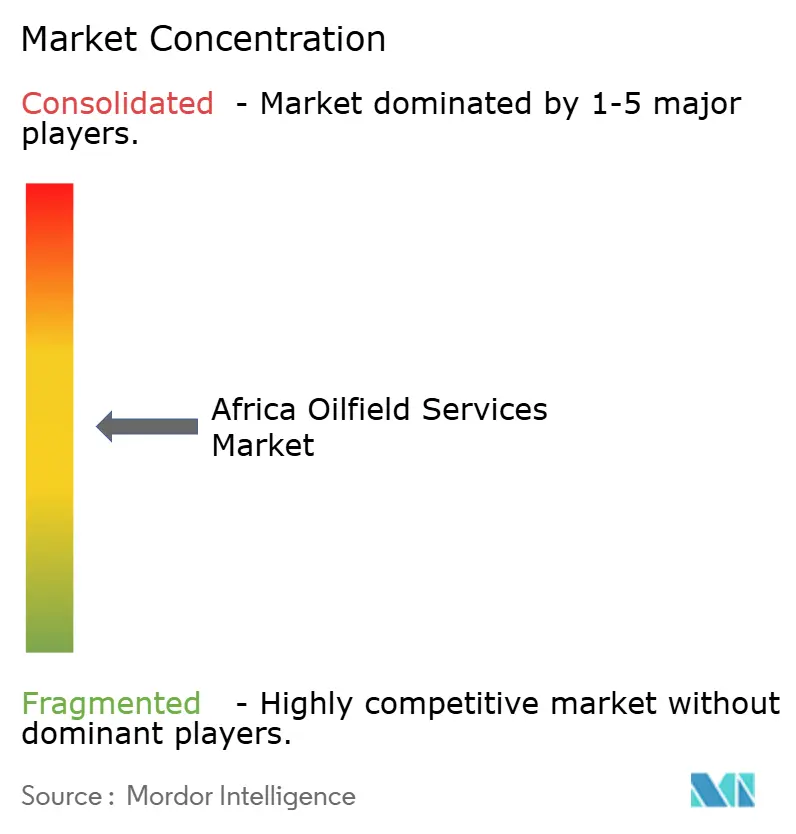
| Market Concentration | Medium |
Major Players *Disclaimer: Major Players sorted in no particular order Image © Mordor Intelligence. Reuse requires attribution under CC BY 4.0. | |
Africa Oilfield Services Market Analysis by Mordor Intelligence
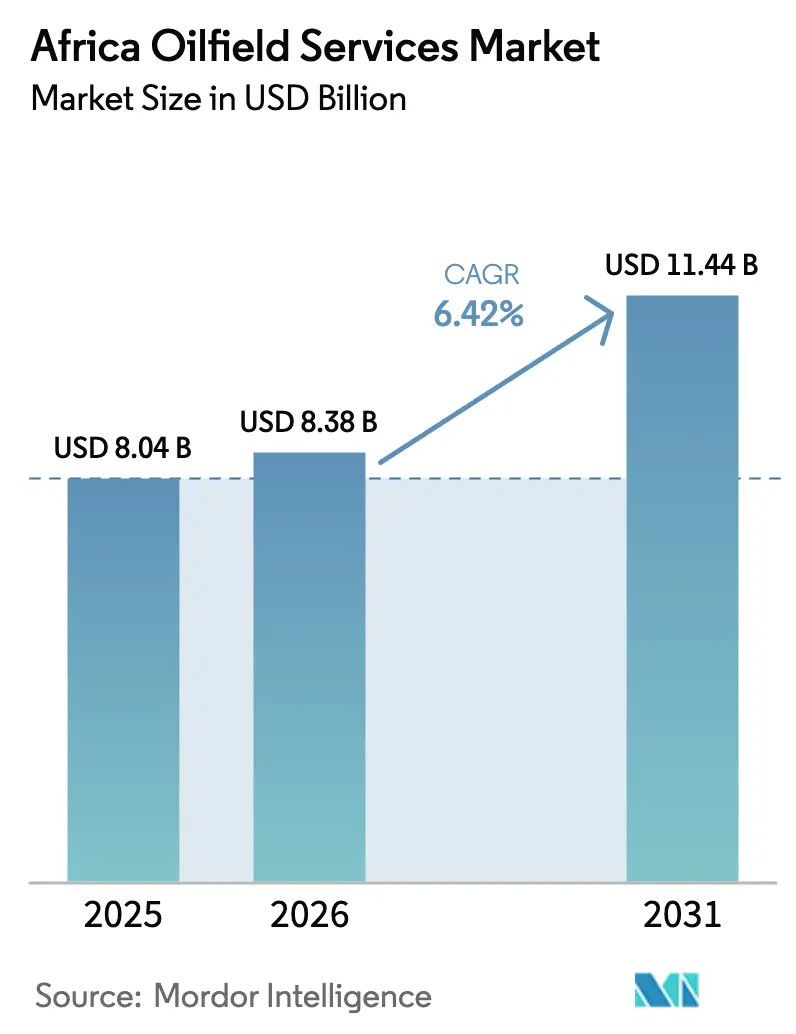
The Africa Oilfield Services Market size is projected to expand from USD 8.04 billion in 2025 and USD 8.38 billion in 2026 to USD 11.44 billion by 2031, registering a CAGR of 6.42% between 2026 to 2031.
Shifting capital toward deep-water prospects in West Africa and gas monetization schemes in East Africa is sustaining double-digit growth in offshore spending, while mature onshore producers lean on enhanced oil recovery programs to stem decline. Indigenous contractors are expanding rapidly under stricter local-content mandates, yet multinationals still dominate high-complexity services such as directional drilling and subsea installation. Digital-twin platforms and remote-operations centers are trimming non-productive time, improving rig utilization, and narrowing the cost spread between conventional and unconventional wells. Security risks in the Niger Delta and Cabo Delgado continue to raise lifting costs, but improved oil prices above USD 80 per barrel are unlocking long-deferred drilling budgets, supporting an upcycle for the Africa oilfield services market through at least 2028.
Key Report Takeaways
- By service type, drilling captured 43.2% of the Africa oilfield services market share in 2025, and is forecast to expand at a 6.8% CAGR through 2031.
- By location, onshore operations held 76.9% of the Africa oilfield services market size in 2025, whereas offshore work is projected to grow at an 8.4% CAGR to 2031.
- By well type, conventional wells accounted for 73.5% of the Africa oilfield services market share in 2025; unconventional activity is rising at a 7.9% CAGR through 2031.
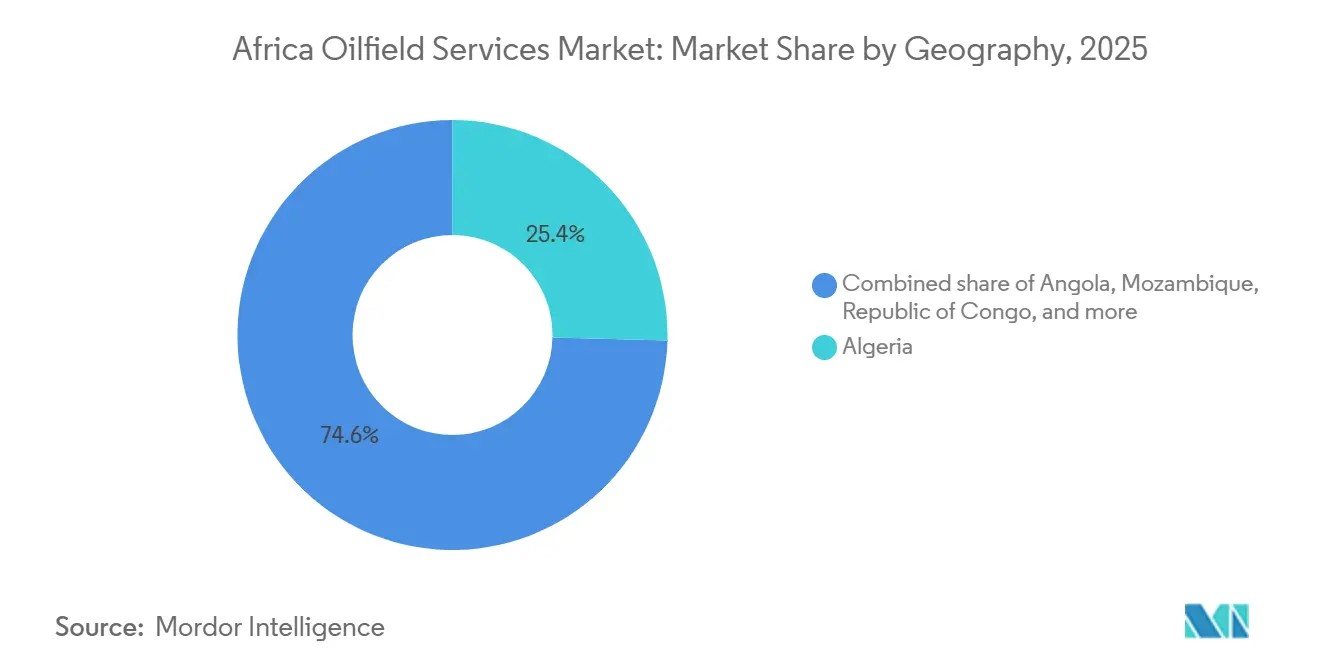
- By geography, Algeria led with 25.4% revenue share in 2025, while Mozambique is advancing at the highest 9.5% CAGR through 2031.
Note: Market size and forecast figures in this report are generated using Mordor Intelligence’s proprietary estimation framework, updated with the latest available data and insights as of January 2026.
Market Trends and Insights
Drivers Impact Analysis of Africa Oilfield Services Market*
| Driver | (~) % Impact on CAGR Forecast | Geographic Relevance | Impact Timeline |
|---|---|---|---|
| Rising deep-water exploration campaigns | +1.2% | Nigeria, Angola, Ghana, Equatorial Guinea | Medium term (2-4 years) |
| Recovery in oil prices boosting CAPEX | +1.5% | Algeria, Nigeria, Angola | Short term (≤ 2 years) |
| Demand for enhanced-oil-recovery | +0.8% | Algeria, Nigeria, Angola | Long term (≥ 4 years) |
| Local-content mandates | +0.9% | Nigeria, Angola, Ghana, Mozambique | Medium term (2-4 years) |
| Adoption of remote ops & digital twins | +0.6% | Nigeria, Angola, Egypt, Algeria | Medium term (2-4 years) |
| Surge in FLNG infrastructure | +1.1% | Mozambique, Nigeria, Senegal, Mauritania | Long term (≥ 4 years) |
| Source: Mordor Intelligence | |||
Rising Deep-Water Exploration Campaigns in West Africa
Operators are steering a larger slice of exploration budgets toward pre-salt and ultra-deep-water acreage that offers multi-billion-barrel potential, underpinning premium day rates for seventh-generation drillships. Shell’s USD 5 billion sanction of Bonga North in late 2024 mobilized subsea tree, riser, and dynamic-positioning packages that will keep contractors busy through 2028.[1] Angola’s Azule Energy followed with a USD 1.2 billion award to TechnipFMC for Block 15/06 in early 2025, validating integrated EPC models that bundle drilling, completion, and installation.[2] Ghana’s Pecan field, already producing 40,000 bpd, is tendering a fourth development well, sustaining demand for jack-ups and cementing services. Concentrated activity gives specialized contractors like Transocean and Valaris pricing power, with day rates topping USD 400,000, while land-focused firms endure margin compression. The deep-water pivot is therefore a primary growth vector for the Africa oilfield services market over the medium term.
Recovery in Oil Prices Boosting CAPEX by NOCs & IOCs
Brent prices above USD 80 in 2025 restored economic viability for projects shelved during the 2020 downturn. Sonatrach earmarked USD 50 billion for upstream work through 2028, granting Schlumberger a five-year integrated-services contract covering 12 concessions.[3] Nigeria’s NNPC secured USD 3 billion in financing to rehabilitate 21 marginal fields, an initiative expected to lift production by 200,000 bpd by 2027, thereby expanding opportunities for workover rigs and coiled-tubing units. Angola reopened licensing for eight offshore blocks in 2024; bids from TotalEnergies, Equinor, and Chevron depend on prices staying above USD 75 to justify high front-end costs. Although price volatility remains a risk, multiyear service contracts locked in during the current upcycle give the Africa oilfield services market a revenue floor through the short term.
Demand for Enhanced-Oil-Recovery in Mature Onshore Fields
Half-century-old Saharan and Niger Delta fields are entering tertiary phases, necessitating polymer flooding, carbon dioxide injection, and thermal stimulation. Sonatrach’s pilot CO₂-EOR in Hassi Messaoud injects 500,000 tons annually to raise recovery from 30% to 42%, potentially unlocking USD 2 billion in future injection equipment orders. Nigeria’s joint-venture operators are evaluating water-alternating-gas schemes but remain hampered by community disputes that keep EOR penetration below 15% of feasible reserves. Baker Hughes captured a USD 180 million artificial-lift package in Angola aimed at extending nine concessions by a decade. Sustained crude prices and ready access to low-cost CO₂ dictate project economics, positioning Algeria and Angola at the forefront of EOR adoption across the Africa oilfield services market.
Local-Content Mandates Spurring Indigenous Service Firms
Revised regulations now require up to 50% domestic participation for onshore drilling in Nigeria and 40% subcontracting for subsea work in Angola. Oando Energy Services won a USD 450 million, three-year contract in 2025 to supply drilling fluids and wellhead equipment for 40 wells, a record award for a Nigerian contractor. Saipem formed a joint venture with Sonasurf to fabricate flexible pipeline spools in Luanda, meeting Angola’s Presidential Directive 4/2024 while retaining engineering control. Ghana’s local-content matrix pushed Tullow’s Jubilee expenditure to 62% domestic in 2024, up from 48% in 2020. These rules fragment the value chain, lowering blended margins for global integrators but enlarging the addressable market for indigenous entrants, a dynamic that will keep the Africa oilfield services market competitive.
Restraints Impact Analysis of Africa Oilfield Services Market*
| Restraints | (~) % Impact on CAGR Forecast | Geographic Relevance | Impact Timeline |
|---|---|---|---|
| Political instability & security risks | -1.3% | Nigeria, Libya, Mozambique | Short term (≤ 2 years) |
| Regulatory uncertainty & slow licensing | -0.7% | Angola, Nigeria, Libya | Medium term (2-4 years) |
| Investor decarbonization pressure | -1.1% | Nigeria, Angola | Long term (≥ 4 years) |
| Skilled-labor shortage | -0.5% | Nigeria, Angola, Ghana | Medium term (2-4 years) |
| Source: Mordor Intelligence | |||
Political Instability & Security Risks in Key Basins
Pipeline sabotage in Nigeria’s Niger Delta adds USD 8 to USD 12 per barrel to lifting costs, and Shell divested its onshore stake for USD 2.4 billion in early 2025 to avoid community disputes and flaring penalties.[4] Cabo Delgado insurgent attacks totaled 47 in 2024, and TotalEnergies’ onshore LNG rebuild depends on a still-fragile security cordon. Libya’s rival factions forced three production shutdowns in 2024, driving drillers to demand advance payments or sovereign guarantees. These security premiums erode margins and nudge capital toward stable jurisdictions, moderating the near-term revenue trajectory of the Africa oilfield services market.
Investor Decarbonization Pressure Curbing Financing
Fourteen of the twenty largest project-finance banks now restrict funding for high-flaring exploration projects. TotalEnergies’ East African Crude Oil Pipeline faced a nine-month financing delay in 2024 after shareholder backlash, raising the project’s weighted-average cost of capital by 120 basis points. Shell’s Nigerian divestments were also driven by activist scrutiny over annual spill costs exceeding USD 400 million. In contrast, Eni raised USD 4.7 billion for Coral Sul’s second train in 2025, signaling investor appetite for gas-aligned, lower-carbon assets. This bifurcation creates a two-speed Africa oilfield services market, where oil-prone exploration faces capital rationing while gas infrastructure secures funding.
*Our forecasts treat driver/restraint impacts as directional, not additive. The impact forecasts reflect baseline growth, mix effects, and variable interactions.
Africa Oilfield Services Market Segment Analysis
By Service Type:
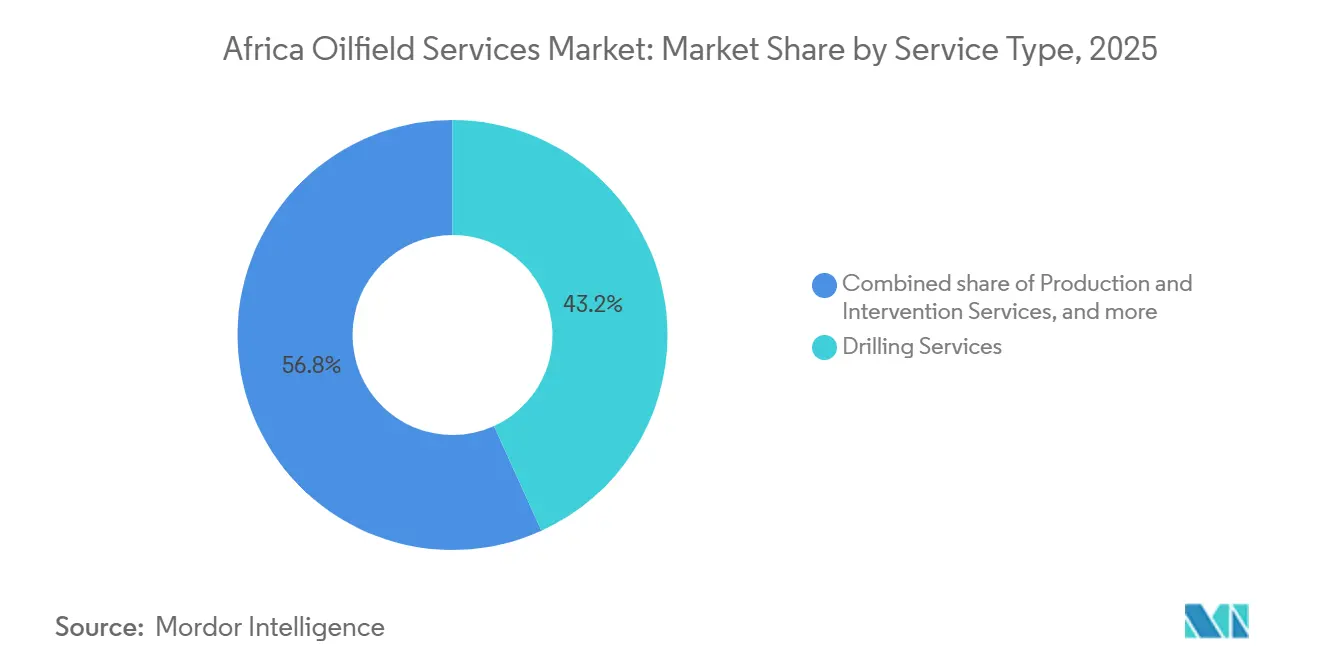
Drilling Anchors Revenue, Completion LagsDrilling held 43.2% of the Africa oilfield services market share in 2025, propelled by multi-well deep-water programs in Angola and Nigeria. The segment is expected to advance at 6.8% through 2031, with Sonatrach slated to drill 120 exploration and appraisal wells and Azule Energy restarting Block 15/06 campaigns. Completion services captured about 28% of revenue but lag in growth because multi-stage hydraulic fracturing remains limited to Algeria’s tight-gas plays. Production-optimization services such as artificial lift are gaining traction: Baker Hughes installed 34% more units in Angola during 2025, illustrating rising demand for life-extension tools. Decommissioning, though still niche, is emerging as a high-margin play after Subsea 7’s USD 320 million Escravos contract, emphasizing widening opportunities beyond drilling.
While drilling retains volume leadership, automation, remote steering, and dual-activity rigs are narrowing the cost gap with ancillary services. As contractors upgrade fleets and integrate digital workflows, EBITDA margins for drilling could converge with completion by decade-end, preserving the segment’s centrality to the Africa oilfield services market.

By Location:
Onshore Scale Meets Offshore MomentumOnshore operations generated 76.9% of the Africa oilfield services market size in 2025, anchored by Algeria’s Saharan giants and Nigeria’s Niger Delta. Offshore revenue, though just 23.1%, is expanding at an 8.4% CAGR, outstripping onshore’s 5.7%. Ultra-deep campaigns below 2,000 m water depth require high-spec drillships like Transocean’s Deepwater Asgard, delivered to Angola under a USD 540 million contract. Onshore faces structural headwinds, security, aging rigs, and lower contractor returns, yet remains indispensable for NOC output targets. Offshore’s share is set to reach 28% by 2031, fueled by pre-salt discoveries and FLNG tie-backs, but absolute onshore spend will still rise in line with Algeria’s gas push and Nigeria’s marginal-field revival.
The diverging growth paths mean service providers must balance land-rig fleets for volume with deepwater assets for margin. Firms that straddle both arenas will be best positioned to capture the Africa oilfield services market’s blended growth.
By Well Type:
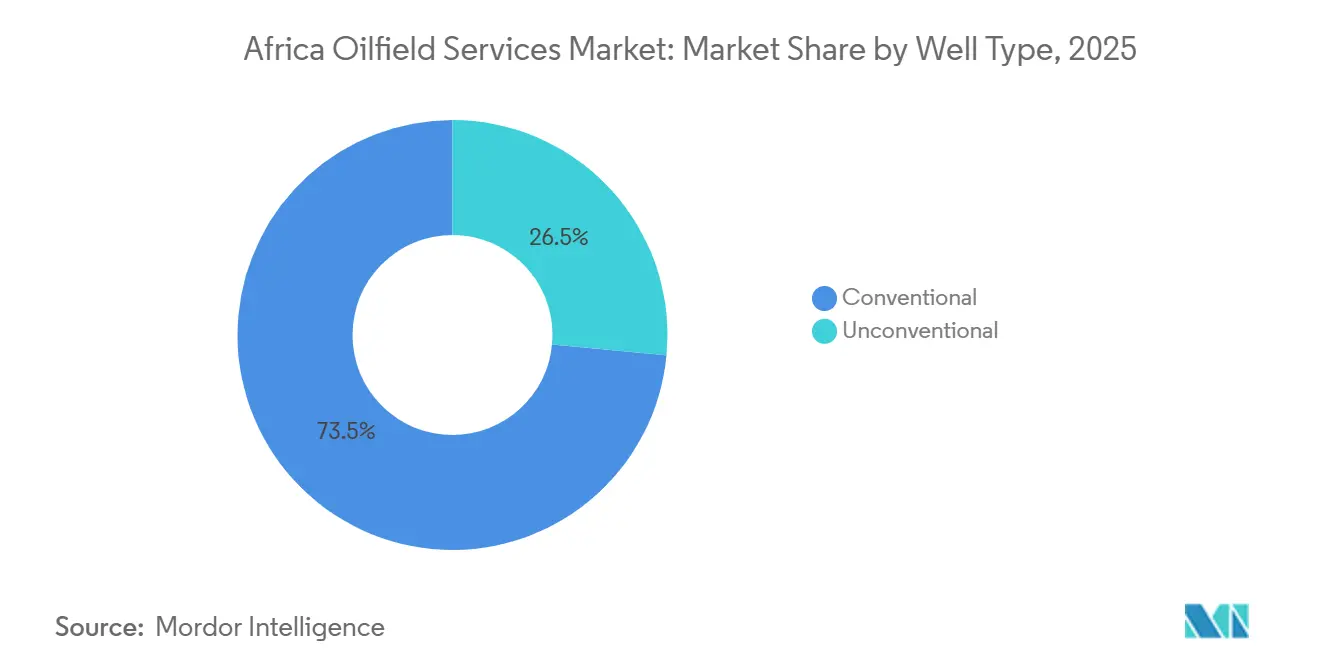
Conventional Dominance, Unconventional UpsideConventional wells accounted for 73.5% of the Africa oilfield services market size in 2025, reflecting superior reservoir quality in the Niger Delta and Saharan basins. Unconventional activity - tight gas, shale, and coal-bed methane - is rising at a 7.9% CAGR through 2031 and is poised for further upside as Algeria commercializes Timimoun and Ahnet. Halliburton’s USD 680 million fracturing award for 42 horizontals in Timimoun exemplifies the emerging demand profile. Cost parity is improving; pad drilling and zipper fracs cut per-well expenses by 23% between 2023 and 2025. Still, conventional wells remain cheaper and less technically demanding, ensuring their numerical dominance through 2031. The well-type mix could shift to 68% conventional and 32% unconventional by 2031, supplying a broader technology runway for pressure-pumping fleets within the Africa oilfield services market.
Geography Analysis
Africa Oilfield Services Market
Algeria secured 25.4% of Africa's oilfield services market revenue in 2025, driven by Sonatrach's USD 12 billion upstream budget and integrated project awards to Schlumberger and Weatherford. Mozambique, the fastest-growing geography at 9.5% CAGR, benefits from Coral Sul's expansion and Mozambique LNG's restart, which together require 14 subsea wells, 180 km of flowlines, and two FPSO units. Nigeria, contributing 22%, lags continental growth due to Niger Delta unrest and Shell's asset divestments, though NNPC's marginal-field program offers upside.
North and West Africa Oilfield Services Market
Angola's 18% share rests on Azule Energy's Block-15/06 spending and renewed licensing. Egypt accounts for 12%, sustained by Eni's Zohr and BP's West Nile Delta programs that keep 32 land rigs and six jack-ups active. Ghana's Jubilee and TEN complexes supply 5% of revenue but face plateauing output absent discoveries. Libya fluctuates between 4% and 6%, contingent on cease-fire durability, while Senegal, Gabon, Equatorial Guinea, and Congo form an 8% "Rest of Africa" cluster highlighted by Woodside's Sangomar first oil in mid-2024.
North, West and East Africa Oilfield Services Market
North Africa offers scale but runs regulatory inertia; West Africa promises high-margin deep-water work tempered by security risk; East Africa blends frontier gas potential with insurgent threats. Portfolio diversification across these blocs helps operators hedge geopolitical volatility, yet the center of gravity is tilting toward Algeria and Mozambique as gas monetization and transition alignment reshape capital flows in the Africa oilfield services market.
Regulatory Landscape
Africa's oilfield services market operates under a country-by-country licensing, HSE, and local-content regime, with upstream regulators including the Nigerian Upstream Petroleum Regulatory Commission (NUPRC) and the Petroleum Commission of Ghana shaping contractor qualification, reporting, and compliance expectations. In Nigeria, the 2024 Presidential Directive on Local Content Compliance tightened verification of genuine in-country capacity for service providers, which raised bid-eligibility requirements and increased audit and documentation needs across drilling, completion, and production services.
Beyond national rules, industry bodies are also working to align frameworks to reduce fragmentation during multi-country execution. The African Petroleum Producers Organization (APPO) has been advancing Pan-African standardization efforts (including work toward a Pan-African Hydrocarbons Standard), and in July 2026 APPO and the African Refiners and Distributors Association (ARDA) established a joint technical committee to harmonize frameworks and specifications, supporting cross-border project delivery and vendor qualification across multiple jurisdictions.
Competitive Landscape
The Africa oilfield services market shows moderate concentration: the top five players commanded roughly 48% of 2025 revenue, led by Schlumberger, Halliburton, and Baker Hughes. Schlumberger’s USD 2.1 billion, five-year Sonatrach deal underscores an integrated-project-management strategy that bundles drilling, wireline, and stimulation under performance incentives. Halliburton and Baker Hughes are vying for a technological edge; Halliburton’s iCruise rotary-steerable and Baker Hughes’ Leucipa automation each slash non-productive time by up to 20%. Weatherford, TechnipFMC, and Subsea 7 round out the top tier, excelling in wireline, subsea, and decommissioning niches.
Local-content rules are allowing indigenous entrants like Seplat Energy and Oando Energy Services to vertically integrate and undercut multinationals by up to 18% in onshore work. Saipem’s flexible-pipe JV with Sonasurf and TechnipFMC’s fabrication plans in Nigeria illustrate hybrid models that satisfy compliance without surrendering engineering control. White-space opportunities in carbon-capture wells, geothermal drilling, and decommissioning widen the competitive canvas, promising new revenue pools even as traditional margins compress.
Going forward, multinational integrators will dominate deep-water and high-tech segments, while domestic firms take larger slices of land-rig, logistics, and low-complexity services. The result is a two-tier Africa oilfield services market that stays contestable, innovative, and regionally diverse.
Africa Oilfield Services Industry Leaders
-
Schlumberger Limited
-
Weatherford International Plc
-
Baker Hughes Company
-
Halliburton Company
-
TechnipFMC plc
- *Disclaimer: Major Players sorted in no particular order
Africa Oilfield Services Market Companies Covered in this Report
- Schlumberger Limited
- Halliburton Company
- Baker Hughes Company
- Weatherford International plc
- TechnipFMC plc
- Transocean Ltd
- Valaris plc (formerly ENSCO)
- Nabors Industries Ltd
- Petrofac Ltd
- Saipem SpA
- China Oilfield Services Ltd (COSL)
- BW Offshore Ltd
- Dolphin Drilling AS
- Expro Group Holdings
- CGG SA
- Seplat Energy Plc
- Oando Energy Services Ltd
- Tullow Oil plc
- Subsea 7 SA
- Borr Drilling Ltd
Market Opportunities and Future Outlook
Offshore tie-backs, cross-block developments, and gas processing and LNG-linked infrastructure are creating multi-year service demand across subsea, completions, rotating equipment services, and integrated project delivery. In Angola, Eni and Azule Energy declared FID in June 2026 for the Greater PAJ project (Blocks 31 and 31/21), a cross-block development built around 17 wells and an FPSO concept that broadens the scope for drilling, subsea systems, well completions, and brownfield integration services. In Mozambique, the Coral North Floating LNG value chain is progressing with an EPCI award (June 2026) to a consortium led by Technip Energies, which supports demand for subsea installation, flowlines, marine logistics, and specialized commissioning capabilities.
Near-field exploration and incremental developments also sustain offshore service intensity where infrastructure is already in place. TotalEnergies announced a discovery on the Moho license offshore the Republic of Congo in April 2026, presented as a tie-back to existing facilities, which typically brings forward demand for subsea tie-in engineering, installation, and intervention work. At the same time, tighter local-content enforcement and regional standardization initiatives led by bodies such as APPO are creating space for in-country manufacturing, maintenance, and digital operations hubs, especially in West and Southern Africa where operators and contractors are building compliant supply chains and remote support capacity.
Recent Industry Developments in Africa Oilfield Services Market
- July 2026: Baker Hughes signed a 13-year service agreement with Nigeria LNG to support the Train 7 expansion at Bonny Island, Nigeria. The contract focuses on long-term equipment services that extend the installed base and increase service intensity for gas infrastructure, supporting lifecycle maintenance, reliability, and digital support capabilities in the country.
- June 2026: Baker Hughes was awarded a contract by Azule Energy to provide subsea production systems for the Greater PAJ development in Angola, including deepwater horizontal tree systems and associated control and intervention equipment. The award expands competitive activity in high-spec offshore subsea hardware and positions suppliers for follow-on installation, testing, and intervention work tied to Angola's deepwater buildout.
- November 2024: Baker Hughes expanded its Namibian presence with new liquid mud plant, cement bulk, and multi-modal facilities. The buildout strengthens in-country logistics and drilling-fluid and cementing readiness, supporting faster mobilization and better service continuity for offshore and onshore campaigns in Namibia and nearby basins.
Africa Oilfield Services Market Report Scope and Research Methodology
Market Definition and Coverage
This market is defined as revenue earned from oilfield services used to plan, drill, complete, and maintain oil and gas wells across Africa, covering both onshore and offshore activity where services are contracted and delivered.
Scope exclusions: We exclude upstream operator capex that is not paid out to service providers, along with pure equipment manufacturing revenue that is not sold as part of a service contract.
Segments Covered in This Report
- By Service Type
- Drilling Services
- Completion Services (Cementing, Hydraulic Fracturing)
- Production and Intervention Services
- Other Services (OSV, seismic, decomm., aviation)
- By Location
- Onshore
- Offshore
- By Well Type
- Conventional
- Unconventional
- By Geography
- Nigeria
- Angola
- Algeria
- Egypt
- Libya
- Republic of Congo
- Ghana
- Mozambique
- Rest of Africa
Data Sources, Market Sizing, and Validation
Desk Research
Desk research was used to build the factual base for activity levels and spend direction in Africa before any assumptions were taken into the model. We relied on public datasets and official publications such as OPEC and national petroleum regulator releases, EIA and IEA statistics, IMF and World Bank macro series, UN Comtrade trade data, and select peer reviewed technical papers on drilling and completion performance.
Along with these, we reviewed annual reports, investor presentations, and press releases from active operators and service providers to understand work program priorities, contract pipelines, and typical service mixes by basin. For hard-to-track items like service intensity by well type and drilling cadence by country, we also referenced paid subscriptions that compile company financials and news, and a shipment-level import and export database for selected equipment-linked service indicators. The desk sources listed here are illustrative only, and other public and paid sources were also checked for data collection, validation, and clarification.
Primary Interviews and Surveys
Primary work was used to pressure-test the desk assumptions and then translate activity signals into realistic service spending in Africa. We spoke with a mix of service contractors, supply chain and procurement teams, field operations staff, and independent experts, and we distributed discussions across key producing and developing areas so gaps in one country could be cross-checked against others.
Inputs from these interviews helped validate service bundling practices, typical contract durations, day-rate and pricing reset behavior, and how quickly offshore work scopes translate into billed revenue, which tightened our market totals.
Distribution of primary research fieldwork respondents
| Company type | Respondent position |
|---|---|
| Top tier: 30% | CXOs: 16% |
| Mid tier: 53% | Functional/Unit leaders: 40% |
| Smaller Players: 17% | Managers: 44% |
Market-Sizing & Forecasting
The core sizing used a top-down build that reconstructs Africa oilfield services spend from country-level upstream activity, then allocates it into service revenue pools based on observed service intensity differences between onshore and offshore programs. To keep the totals grounded, we corroborated results with selective bottom-up approximations, including sampled contract values, implied revenue per active rig, and spot checks of service pricing against estimated service volumes, followed by adjustments when the two views did not align.
Key inputs in the model included active rig counts and well counts, upstream capex direction by country, offshore project sanctioning and development timelines, average service intensity per well by well type (conventional versus unconventional), and pricing movement for high-impact service lines like drilling support and well intervention. Forecasts were run using scenario analysis that linked activity variables to oil price and investment cycles, and then consensus ranges from interviews were applied to expected utilization and pricing recovery paths.
Where a clean country datapoint was missing, we filled gaps using basin analogs and regional shares anchored to production and capex signals, then normalized results so the implied spend stayed within plausible operator budgets.
Data Validation & Update Cycle
Validation was done in layers so the final number did not depend on one dataset or one assumption. We compared outputs against independent signals such as production trends, capex announcements, licensing rounds, and major contract awards, then investigated variances that looked inconsistent with local activity realities.
Before sign-off, the model is reviewed in steps by analysts who re-check units, currency treatment, and year alignment, and interview call-backs are triggered when a key assumption shifts or when a large variance appears. The report is refreshed annually, with interim updates when material events occur, and a final pre-delivery pass is completed so clients receive the latest updated view.
Mordor Intelligence's Africa Oil Field Services Market Market Size Versus Other Published Estimates
Published market sizes for Africa oilfield services can differ even when they look like they cover the same region, since each publisher draws its own boundaries for what counts as a service, which years are treated as the current base, and how pricing is rolled forward.
Contract award signals and offshore project sanctioning timelines are used as checks on Mordor Intelligence's billed service revenue timing, which is why our 2025 value does not automatically expand to include adjacent upstream spending that is not paid to service contractors.
Benchmark comparison
| Source | Market Size | Gaps in Research Methodology |
|---|---|---|
| Mordor Intelligence | USD 8.04 B (2025) | |
| Industry Publisher A | USD 11.61 B (2024) | Uses an earlier base year and appears to include a broader spend bucket that can blend operator upstream outlays with service revenue, which lifts the reported total even before forecasting assumptions are applied. |
| Trade Publisher B | USD 5.97 B (2024) | Anchors the market closer to a narrower set of service lines and a more conservative activity-to-revenue conversion, which can undercount offshore-led work that is contracted but recognized over longer project cycles. |
The comparison mainly shows that year selection, the exact service revenue boundary, and how offshore work is timed into revenue are the practical drivers of the spread. By keeping the model tied to observable activity and contract cues, and then cross-checking totals with simple bottom-up math, the estimate stays traceable to clear steps that can be repeated and audited.
Key Questions Answered in the Report
What is the current value of the Africa oilfield services market?
The Africa oilfield services market size stood at USD 8.38 billion in 2026 and is set to reach USD 11.44 billion by 2031.
Which segment generates the largest revenue?
Drilling services lead the revenue table with 43.2% market share in 2025, driven by deep-water campaigns in Nigeria and Angola.
Which country is growing fastest for service demand?
Mozambique shows the highest growth, expanding at a 9.5% CAGR thanks to Coral Sul and Mozambique LNG developments.
How are local-content rules affecting competition?
Stricter rules in Nigeria and Angola are channeling low-complexity services to indigenous contractors, lowering entry barriers while pushing multinationals toward high-tech offshore work.
What technology trends are cutting drilling costs?
Remote-operations centers, digital-twin platforms, and automated steering systems are reducing non-productive time by up to 20% and improving rig efficiency.
How does political risk influence investment decisions?
Security issues in the Niger Delta, Cabo Delgado, and Libya add costs and uncertainty, steering capital toward more stable basins such as Algeria and Egypt.