
Oil and Gas Turbomachinery Market Size and Share
Market Overview
| Study Period | 2021 - 2031 |
|---|---|
| Market Size (2026) | USD 13.71 Billion |
| Market Size (2031) | USD 17.12 Billion |
| Growth Rate (2026 - 2031) | 4.54 % |
| Fastest Growing Market | Asia-Pacific |
| Largest Market | Middle East and Africa |
| Market Concentration | Medium |
Major Players *Disclaimer: Major Players sorted in no particular order Image © Mordor Intelligence. Reuse requires attribution under CC BY 4.0. | |
Oil and Gas Turbomachinery Market Analysis by Mordor Intelligence
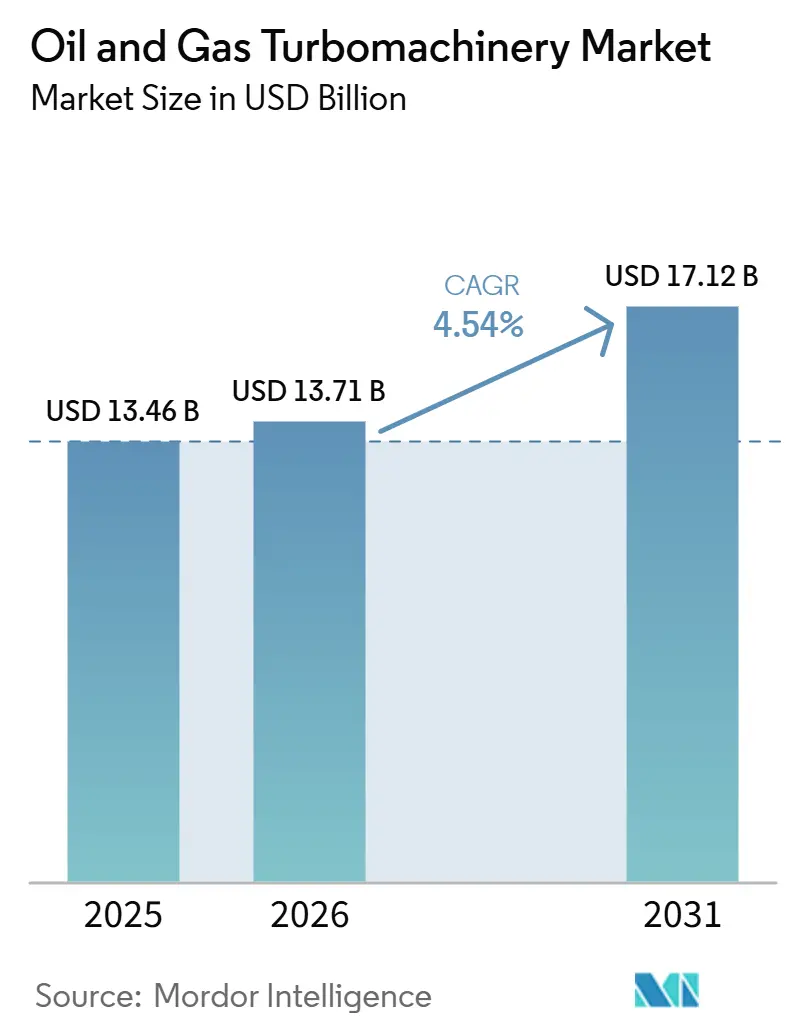
The oil and gas turbomachinery market size is projected to expand from USD 13.46 billion in 2025 and USD 13.71 billion in 2026 to USD 17.12 billion by 2031, registering a CAGR of 4.54% between 2026 and 2031. The oil and gas turbomachinery market is being supported by liquefied natural gas (LNG) export projects, where each new train requires multiple compressor packages and turbine drivers, and Baker Hughes continues to win equipment orders tied to this buildout. The oil and gas turbomachinery market is also benefiting from retrofit demand because operators are replacing older compression fleets to improve efficiency and reduce emissions, as shown by The Williams Companies, Inc. and GE Vernova upgrade activity. Competition in the oil and gas turbomachinery market is being shaped by long-term service agreements, digital monitoring, and predictive maintenance tools that tie installed equipment to multi-year service revenue. The oil and gas turbomachinery market is also opening new pockets of demand in hydrogen-ready systems and CO2 compression, where product qualification and metallurgy limit the number of capable suppliers. At the same time, permitting delays and long lead items such as forged rotors and dry gas seals continue to slow procurement timing in the oil and gas turbomachinery market.
Key Report Takeaways
- By deployment, onshore led with 72.5% revenue share in 2025, while offshore is forecast to expand at a 5.1% CAGR through 2031.
- By industry, midstream held 39.8% revenue share in 2025 and is expected to grow CAGR at 5.6% through 2031.
- By type, gas compressors accounted for 34.6% revenue share in 2025 and are projected to advance at a 5.9% CAGR through 2031.
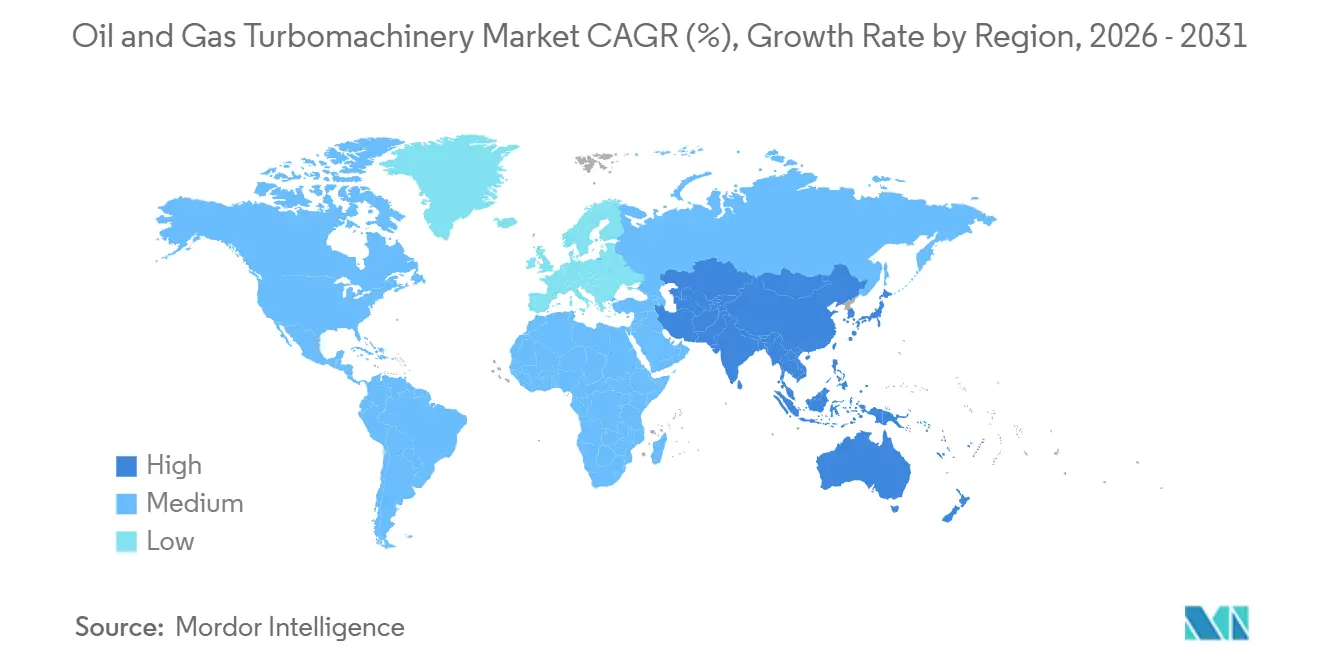
- By geography, the Middle East and Africa held 31.7% revenue share in 2025, while the Asia-Pacific is projected to grow at a 6.5% CAGR through 2031.
Note: Market size and forecast figures in this report are generated using Mordor Intelligence’s proprietary estimation framework, updated with the latest available data and insights as of January 2026.
Market Trends and Insights
Drivers Impact Analysis of Oil and Gas Turbomachinery Market*
| Driver | (~) % Impact on CAGR Forecast | Geographic Relevance | Impact Timeline |
|---|---|---|---|
| LNG Liquefaction and Export Capacity Expansion | +1.3% | Global, North America, Middle East, Africa | Short term (≤ 2 years) |
| Aging Installed Base Retrofits and Efficiency Upgrades | +0.9% | Global | Medium term (2-4 years) |
| Digital Condition Monitoring and Predictive Maintenance | +0.7% | Global, with North America and Europe leading adoption | Medium term (2-4 years) |
| High Reliability Demand in Offshore and Ultra-Deepwater | +0.6% | North Sea, Gulf of Mexico, Asia-Pacific, Brazil | Long term (≥ 4 years) |
| Carbon Capture and CO2 Compression Buildout | +0.5% | Europe leading, Asia-Pacific and Middle East emerging | Long term (≥ 4 years) |
| Hydrogen-Ready Turbine and Compressor Development | +0.4% | Europe and North America, with early adoption in the Middle East | Long term (≥ 4 years) |
| Source: Mordor Intelligence | |||
LNG Liquefaction and Export Capacity Expansion
The oil and gas turbomachinery market is closely tied to LNG construction because each export train uses multiple refrigerant compressor sets, turbine drivers, and utility compression packages. Baker Hughes’ Commonwealth LNG award covered 6 LM9000 aeroderivative gas turbines paired with centrifugal compressors for the 9.5 Million Tons Per Annum (MTPA) facility in Louisiana, and the LM9000 delivers more than 73 MW at 44% efficiency. Baker Hughes also extended a 13-year service agreement with Nigeria LNG (NLNG) for Train 7, which raises total NLNG capacity from 22 MTPA to 30 MTPA through 4 heavy-duty gas turbines and associated centrifugal compressors [1]. These projects show why the oil and gas turbomachinery market continues to favor suppliers with proven LNG train references and packaged equipment capability. They also show a clear move toward high-efficiency aeroderivative platforms in new projects, which narrows the qualified supplier base. As more repeat train designs are ordered, Original Equipment Manufacturers (OEMs) with an established LNG platform are likely to hold an advantage in the oil and gas turbomachinery market.
Aging Installed Base Retrofits and Efficiency Upgrades
A large share of the installed fleet in the oil and gas turbomachinery market was commissioned decades ago and now faces replacement or upgrade decisions. Operators are moving ahead with retrofit programs to improve emissions performance and station efficiency rather than waiting for full greenfield cycles. The Williams Companies, Inc. replaced 112 compression units, including 92 completions in 2024, and reported a 60% reduction in methane intensity at retrofitted stations. GE Vernova introduced its AGP XPAND upgrade for the 9E.03 fleet, which boosts output by up to 7% and improves efficiency by 1% without a major outage extension. This pattern matters because the oil and gas turbomachinery market is increasingly monetizing the installed base through staged upgrades, control changes, and service work. In tighter capital environments, these programs give operators measurable gains without the cost and timing of a full equipment replacement cycle.
Digital Condition Monitoring and Predictive Maintenance
The oil and gas turbomachinery market is shifting from time-based maintenance toward condition-based monitoring across critical rotating assets. Murphy Oil deployed 46 predictive models across 2 deepwater Gulf of Mexico platforms and achieved early failure detection windows of 100 to 121 days before breakdown events on turbines, gas compressors, pumps, and glycol systems. ADNOC Offshore also implemented Bosch Digital Twin Industries’ asset performance management system for compressors, turbines, pumps, and heat exchangers to improve real-time health monitoring and detect material fatigue earlier. These deployments show that digital tools are now part of core operating practice in the oil and gas turbomachinery market, not side projects. The strongest value comes from avoiding unplanned downtime and reducing maintenance waste on high-value units. The same SPE work also showed that incomplete maintenance records, not weak algorithms, were the main limit on prediction quality, which makes data discipline a competitive issue for OEM service platforms [2].
High Reliability Demand in Offshore and Ultra-Deepwater
The offshore side of the oil and gas turbomachinery market is defined by reliability targets that are stricter than those seen in most onshore settings. Ultra-deepwater installations often need 96% to 98% availability across 5- to 10-year intervals between major maintenance windows. That requirement is pushing operators toward compact and highly integrated systems, including active magnetic bearing designs that remove lube oil systems and reduce auxiliary complexity. Research published on a 25 MW gas turbine-driven centrifugal compressor for Chinese offshore platforms confirmed that skid-mounted frames, vibration isolation, and integrated controls can meet production-scale offshore duty [3]. This raises the technical bar in the oil and gas turbomachinery market because offshore equipment must balance footprint, weight, and uptime at the same time. It also favors OEMs with a proven offshore service network and a certified product history for FPSO and subsea-linked operations.
Restraints Impact Analysis of Oil and Gas Turbomachinery Market*
| Restraint | (~) % Impact on CAGR Forecast | Geographic Relevance | Impact Timeline |
|---|---|---|---|
| High Capital Intensity and Long Payback Cycles | -0.9% | Global | Medium term (2-4 years) |
| Permitting Delays and Decarbonization-Driven Project Uncertainty | -0.6% | Europe and North America primarily | Medium term (2-4 years) |
| Specialized Forgings, Bearings, and Seal Supply Constraints | -0.5% | Global | Short term (≤ 2 years) |
| Legacy Control System Integration and Cybersecurity Concerns | -0.4% | Global | Long term (≥ 4 years) |
| Source: Mordor Intelligence | |||
High Capital Intensity and Long Payback Cycles
The oil and gas turbomachinery market faces a clear restraint because LNG and major gas processing units require very high upfront equipment spending. Individual compressor trains at large LNG sites can cost USD 50 million to USD 150 million, depending on size and configuration. Greenfield installations often carry payback periods of 4 to 8 years under normal gas price assumptions. The problem becomes larger when rotor forgings, dry gas seals, and custom packages push delivery schedules to 24 to 36 months. That means financing decisions must be made well before site construction is fully underway in the oil and gas turbomachinery market. If gas price expectations or borrowing conditions change during that period, project sponsors can face a much harder approval path.
Permitting Delays and Decarbonization-Driven Project Uncertainty
The oil and gas turbomachinery market is also slowed by project timing risk linked to permits and changing decarbonization rules. LNG export permitting in the United States entered a more uncertain phase in 2024 and 2025, which delayed some final investment decisions and reduced order clarity for OEMs. In Europe, operators face a mixed incentive structure because they still need gas infrastructure reliability while also managing policies that could shorten the useful life of some assets. This has changed contract behavior in the oil and gas turbomachinery market, with sponsors seeking more modular delivery schedules and more flexibility in equipment release timing. Those changes add coordination work across OEMs, engineering, procurement, and construction (EPC) firms, and operators. They also introduce cost premiums that were less common under older turnkey procurement models.
*Our forecasts treat driver/restraint impacts as directional, not additive. The impact forecasts reflect baseline growth, mix effects, and variable interactions.
Oil and Gas Turbomachinery Market Segment Analysis
By Deployment:
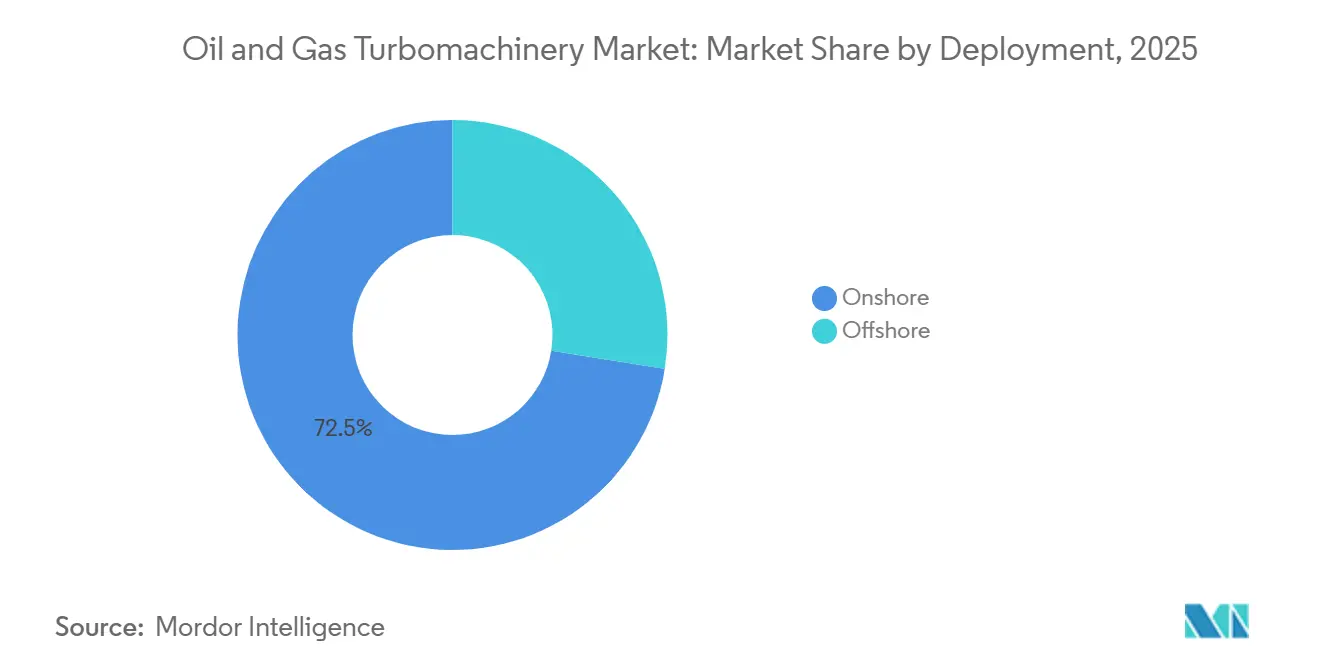
Offshore Growth Reshapes Technology RequirementsOnshore represented 72.5% of the oil and gas turbomachinery market share in 2025, while offshore is forecast to expand at a 5.1% CAGR through 2031. This large onshore base reflects the concentration of pipeline compressor stations, LNG liquefaction trains, and gas processing plants on land. The offshore segment is smaller, but it is drawing more attention in the oil and gas turbomachinery market as deepwater activity expands in Brazil, the Gulf of Mexico, the North Sea, and parts of Southeast Asia. Offshore equipment must deliver the same core performance in much tighter layouts, with stronger demands on weight, vibration control, and reliability.
A 25 MW offshore gas turbine-driven centrifugal compressor design for Chinese platforms showed that skid-mounted systems with integrated controls are suitable for production duty in marine environments [4]. That matters because the offshore side of the oil and gas turbomachinery market cannot rely on the same maintenance logic used in easier onshore conditions. Availability targets of 96% to 98% across 5- to 10-year intervals leave little room for support system failures. This is why magnetic bearing adoption, integrated packaging, and long-term service support are becoming more central in offshore procurement. It also explains why qualified offshore OEMs hold a stronger position than newer entrants in this part of the oil and gas turbomachinery market.

By Industry:
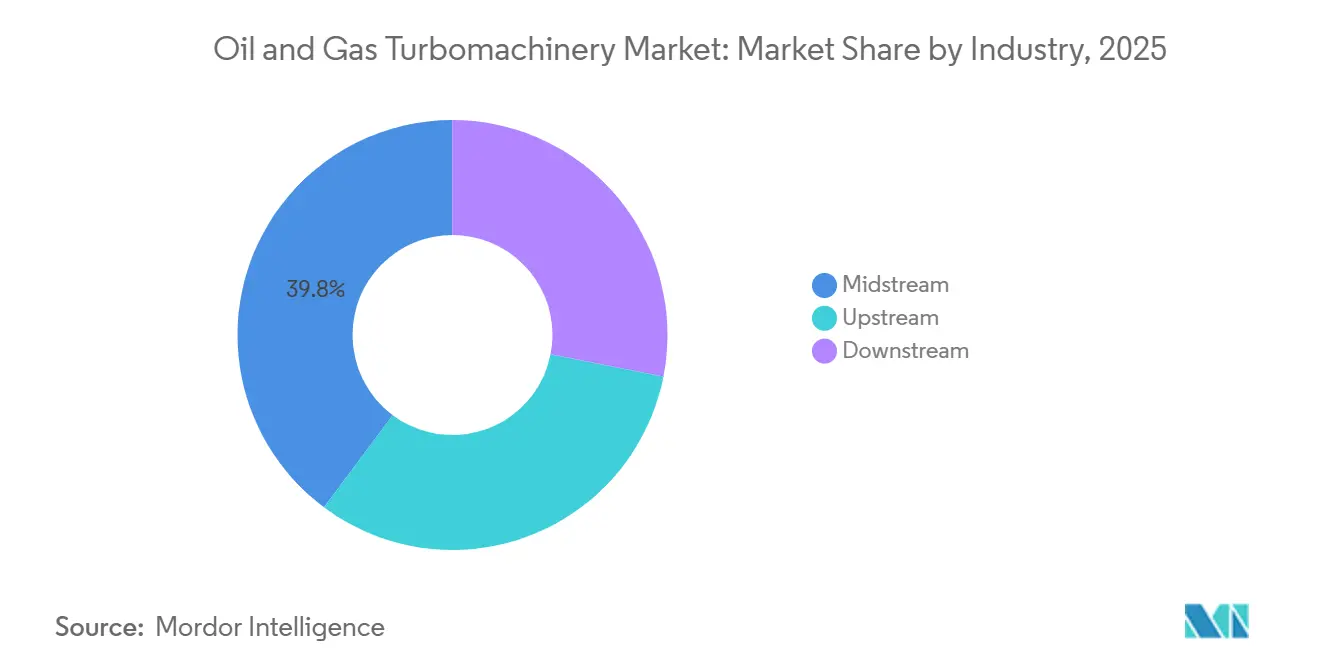
Midstream's Dual Dominance Underpins Market MomentumMidstream accounted for 39.8% share of the oil and gas turbomachinery market size in 2025 and is projected to advance at a 5.6% CAGR through 2031. This is a notable position because the same segment holds both the largest current share and the fastest growth rate in the oil and gas turbomachinery market. The main reason is that LNG liquefaction, gas gathering, and transmission all sit inside midstream investment cycles and all require heavy compression capacity. Midstream demand is also steadier than many other areas because operators must expand capacity, replace older fleets, and improve emissions performance at the same time. The Williams replacement program shows how midstream retrofit spending can remain active even when developers are selective on greenfield budgets.
Upstream demand remains important in the oil and gas turbomachinery industry because compact units are needed at wellheads, gas lift systems, and produced water reinjection sites. These applications place a premium on power density and footprint control, especially where operating space is limited. Downstream adds a durable but slower-moving layer of demand through refinery pumps, steam turbines, hydroprocessing feed units, and cracked gas compression systems. Replacement activity in the downstream tends to arrive in project waves tied to fuel quality, efficiency, and plant upgrade programs rather than in a steady pattern. That makes midstream the most dependable center of the oil and gas turbomachinery market, even while upstream and downstream remain important demand pools.
By Type:
Gas Compressors as the Market's Defining SegmentGas compressors held 34.6% of the oil and gas turbomachinery market size in 2025 and are projected to expand at 5.9% CAGR through 2031. This double lead reflects the role of compressors across LNG refrigeration, subsea boosting, pipeline transport, and new CO2 handling applications. In the oil and gas turbomachinery market, compressor demand is not tied to a single project type, which makes it broader than most other equipment classes. Baker Hughes continues to supply turbine-driven centrifugal compressor systems for LNG developments, while Everllence is building a position in CO2 compression projects tied to large-scale carbon capture.
Gas and steam turbines remain the second major equipment group because they drive LNG compressor trains, gas transmission stations, and cogeneration units. GE Vernova’s order for 5 H-class gas turbines for the 3 GW Qurayyah expansion shows that advanced turbine demand remains closely tied to gas-linked infrastructure in the broader oil and gas turbomachinery market. Pumps provide a more stable baseline through crude transfer, seawater injection, and lift applications, where demand usually follows field activity levels. The other equipment category, including turboexpanders and axial blowers, is growing more gradually as operators seek better energy recovery and process optimization in gas handling trains. This mix keeps compressors at the center of the oil and gas turbomachinery market, while turbines and pumps continue to support a broad installed base.
Geography Analysis
MEA Oil and Gas Turbomachinery Market
The Middle East and Africa held 31.7% of the oil and gas turbomachinery market share in 2025, making it the largest regional demand center. The region’s lead is being sustained by large gas-linked investments from national operators and by the scale of LNG, power, and compression projects moving into execution. Baker Hughes secured work for Qatar’s North Field West project that includes 6 Frame 9 gas turbines and 12 centrifugal compressors for 2 LNG mega trains, along with 3 Frame 6 gas turbines for integrated power packages. GE Vernova also won an order for 5 H-class gas turbines for the Qurayyah Independent Power Producer (IPP) Expansion in Saudi Arabia, which supports a 3 GW combined cycle plant with provision for a future carbon capture unit. In Africa, Nigeria LNG Train 7 continues to reinforce the oil and gas turbomachinery market through expansion from 22 MTPA to 30 MTPA and a 13-year service agreement that deepens aftermarket demand.
APAC and North America Oil and Gas Turbomachinery Market
Asia-Pacific is projected to deliver the fastest growth in the oil and gas turbomachinery market size, with a 6.5% CAGR from 2026 to 2031. The region’s growth rests on rising natural gas demand, refinery and petrochemical additions, LNG terminal activity, and offshore platform investment. The International Energy Agency identifies Asia-Pacific as the largest and fastest-growing contributor to global gas demand growth, which supports continued equipment demand across import, processing, and transport systems. In China, offshore localization efforts are becoming more visible, and the 25 MW compressor unit study showed that domestic development of offshore packages is moving beyond concept work. India’s coastal belt is also supporting procurement through refinery expansions and LNG infrastructure, while North America remains a strong market because of Gulf Coast LNG construction and the start of LNG Canada exports from Kitimat in mid-2025.
Europe and South America Oil and Gas Turbomachinery Market
Europe does not lead the oil and gas turbomachinery market by share, but it is creating fresh demand through carbon capture compression and a large service base in mature fields. Everllence’s work on the UK East Coast Cluster and Stockholm Exergi’s BECCS project shows that carbon capture and storage (CCS)-linked turbomachinery orders are now commercial and not only conceptual. South America remains centered on Brazil, where Petrobras-linked offshore growth supports a large service and equipment opportunity in floating production, storage and offloading (FPSO) heavy operations. Argentina’s Vaca Muerta adds an emerging onshore compressor demand stream, but it remains smaller than Brazil’s offshore base in the current oil and gas turbomachinery market.
Competitive Landscape
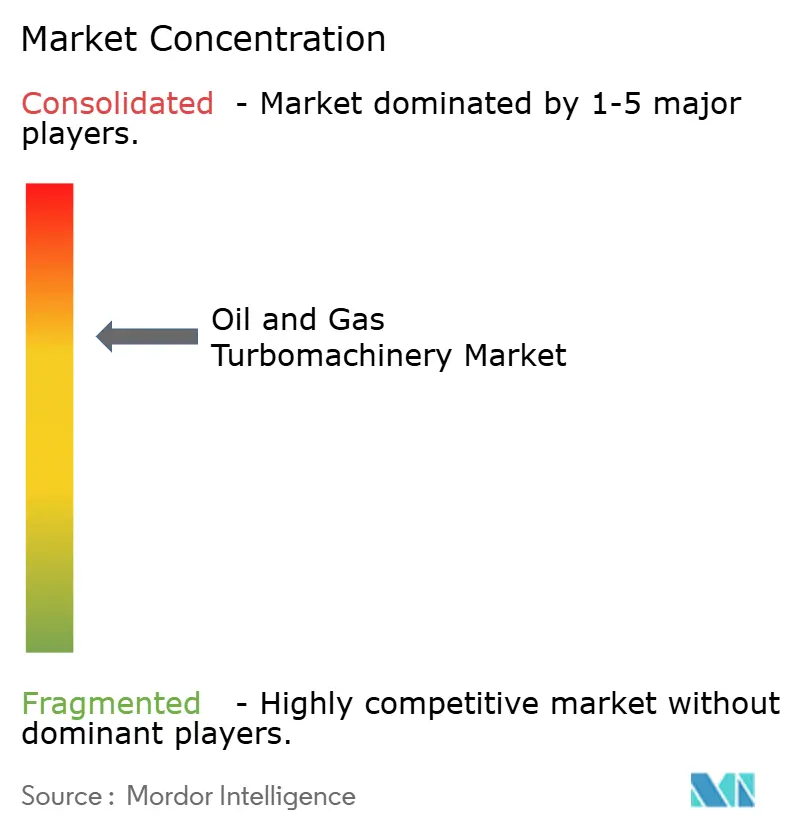
The oil and gas turbomachinery market is moderately concentrated because a limited group of integrated OEMs controls the highest value LNG and large frame turbine packages, while many smaller companies remain active in pumps, single train compressors, and service work. Baker Hughes, GE Vernova, Siemens Energy, and Mitsubishi Heavy Industries are the most visible names in large-train and heavy-duty applications, where qualification history, engineering depth, and long service commitments matter most. In this part of the oil and gas turbomachinery market, customers are not only buying machines, but they are also buying technical risk reduction, spare parts access and long-run operating support. That is why long-term service agreements are becoming a stronger competitive tool than one-time equipment pricing. Baker Hughes’ 13-year Nigeria LNG agreement and its Petrobras-linked service support model show how OEMs are binding installed fleets to digital diagnostics and remote monitoring over long periods.
Another important shift in the oil and gas turbomachinery market is the rise of protected niches where only a few suppliers can execute on a scale. CO2 compression is one of those niches because dense phase duty requires specialized compressor designs and materials. Everllence’s selection for the UK East Coast Cluster and its Thailand Carbon Capture and Storage (CCS) award show that early execution references are already becoming a barrier to entry. Hydrogen readiness is also moving from concept to procurement language, and the FLEX4H2 project illustrates how public funding is helping OEMs push turbine capability toward higher hydrogen blends.
The oil and gas turbomachinery market is also seeing a regional competitive shift as Chinese suppliers build domestic capability in offshore and onshore rotating equipment. Localization matters most in state-linked procurement, where domestic supply chains can gain an advantage in cost, policy support, and lead times. At the same time, companies such as Ingersoll Rand and Atlas Copco remain more exposed to smaller frame industrial duties than to large LNG and gas transmission tenders. GE Vernova’s Qurayyah turbine order and AGP XPAND upgrade launch show how leading OEMs are defending their position through both new unit sales and installed base optimization. This keeps the oil and gas turbomachinery market competitive in breadth, even though the top tier remains hard to challenge in the most complex packages.
Oil and Gas Turbomachinery Industry Leaders
-
Siemens AG
-
Everllence SE
-
General Electric Company
-
Caterpillar Inc.
-
Sulzer Ltd.
- *Disclaimer: Major Players sorted in no particular order
Oil and Gas Turbomachinery Market Companies Covered in this Report
- General Electric Company
- Siemens AG
- Sulzer Ltd
- Air Products and Chemicals, Inc.
- Everllence SE
- Caterpillar Inc.
- Elliott Group Ltd.
- Atlas Copco AB
- Kobe Steel Ltd
- Galileo Technologies S.A.
- Baker Hughes Company
- Mitsubishi Heavy Industries Ltd.
- Howden Group Limited
- Hanwha Power Systems Co., Ltd.
- Rolls-Royce Holdings plc
- Ansaldo Energia S.p.A.
- Nanjing Turbine & Electric Machinery (Group) Co., Ltd.
- Solar Turbines Incorporated
- IHI Corporation
- Ingersoll Rand Inc.
Recent Industry Developments in Oil and Gas Turbomachinery Market
- June 2026: Baker Hughes extends a 13-year long-term service agreement with Nigeria LNG Limited to support turbomachinery on Train 7, which increases NLNG's total LNG production capacity from 22 to 30 MTPA. The agreement covers 4 heavy-duty gas turbines and associated centrifugal compressors, supported by Baker Hughes' iCenter™ Cordant™ digital services for remote monitoring and diagnostics.
- March 2026: ST LNG LLC selected Baker Hughes as technology provider for its proposed 8.4 MTPA offshore LNG export terminal near Matagorda, Texas, supplying 2 LM6000PF gas turbine-driven centrifugal compressor trains and 3 NovaLT™16 generator packages for the project's first 2.1 MTPA phase.
- December 2025: Baker Hughes received a Full Notice to Proceed from Technip Energies for Commonwealth LNG's 9.5 MTPA export facility in Cameron, Louisiana, covering 6 LM9000 aeroderivative gas turbines paired with refrigerant centrifugal compressors, marking a significant commitment of Baker Hughes' aeroderivative LNG platform to the U.S. Gulf Coast buildout.
- October 2025: Baker Hughes secured a Bechtel contract to supply primary liquefaction equipment for Sempra Infrastructure's Port Arthur LNG Phase 2 project, including 4 Frame 7 gas turbines and 8 centrifugal compressors supporting 13 MTPA of nameplate capacity.
Global Oil and Gas Turbomachinery Market Report Scope
Oil and gas turbomachinery refers to high-speed rotating equipment used across the oil and gas value chain to compress, pump, expand, or generate power for hydrocarbon production, processing, transportation, and liquefaction. It includes gas turbines, steam turbines, compressors, expanders, and turbochargers deployed across upstream, midstream, and downstream operations. These machines are used in applications such as gas compression, LNG production, pipeline transportation, refining, and petrochemical processing, enabling reliable, energy-efficient, and continuous operation while improving process performance, operational efficiency, and overall plant productivity.
The oil and gas turbomachinery market is segmented by deployment, industry, type, and geography. By deployment, the market is segmented into onshore and offshore. By industry, the market is segmented into upstream, midstream, and downstream. By type, the market is segmented into gas and steam turbines, gas compressors, pumps, and other types. The report also covers the market size and forecasts for the global oil and gas turbomachinery market across 21 countries in key regions. For each segment, the market sizing and forecasts have been provided on the basis of value (USD).
Segmentation Overview
| Onshore |
| Offshore |
| Upstream |
| Midstream |
| Downstream |
| Gas And Steam Turbine |
| Gas Compressor |
| Pump |
| Other Types |
| North America | United States |
| Canada | |
| Mexico | |
| Europe | Germany |
| United Kingdom | |
| France | |
| Italy | |
| Rest of Europe | |
| Asia-Pacific | China |
| India | |
| Japan | |
| South Korea | |
| Australia | |
| Rest of Asia-Pacific | |
| South America | Brazil |
| Argentina | |
| Rest of South America | |
| Middle East and Africa | Saudi Arabia |
| United Arab Emirates | |
| Qatar | |
| Turkey | |
| South Africa | |
| Nigeria | |
| Egypt | |
| Rest of Middle East and Africa |
| By Deployment | Onshore | |
| Offshore | ||
| By Industry | Upstream | |
| Midstream | ||
| Downstream | ||
| By Type | Gas And Steam Turbine | |
| Gas Compressor | ||
| Pump | ||
| Other Types | ||
| By Geography | North America | United States |
| Canada | ||
| Mexico | ||
| Europe | Germany | |
| United Kingdom | ||
| France | ||
| Italy | ||
| Rest of Europe | ||
| Asia-Pacific | China | |
| India | ||
| Japan | ||
| South Korea | ||
| Australia | ||
| Rest of Asia-Pacific | ||
| South America | Brazil | |
| Argentina | ||
| Rest of South America | ||
| Middle East and Africa | Saudi Arabia | |
| United Arab Emirates | ||
| Qatar | ||
| Turkey | ||
| South Africa | ||
| Nigeria | ||
| Egypt | ||
| Rest of Middle East and Africa | ||
Key Questions Answered in the Report
What is the 2031 outlook for oil and gas turbomachinery?
The sector is projected to reach USD 17.12 billion by 2031 from USD 13.71 billion in 2026, with a forecast CAGR of 4.54%. Growth is being supported by LNG expansion, retrofit demand, and digital service adoption.
Which equipment type is leading demand through the forecast period?
Gas compressors lead the current mix with 34.6% share in 2025 and also post the fastest growth at 5.9% CAGR through 2031. Their role across LNG, pipelines, subsea systems, and CO2 handling keeps them central to demand.
Why is offshore activity drawing more attention now?
Offshore is smaller than onshore, but it is forecast to grow at 5.1% CAGR through 2031. Deepwater projects need compact, highly reliable equipment and long service support, which raises the value of qualified offshore OEMs.
Which region leads current demand and which one is growing fastest?
Middle East and Africa led with 31.7% share in 2025, while Asia-Pacific is forecast to grow fastest at 6.5% CAGR. The first is driven by large gas and LNG projects, while the second is supported by gas demand growth and infrastructure additions.
How are major OEMs competing for long term advantage?
Leading suppliers are pairing equipment sales with long-term service agreements, digital diagnostics, and upgrade programs. Baker Hughes, GE Vernova, and Everllence are using service contracts, turbine upgrades, and Carbon Capture and Storage (CCS) project references to strengthen their position.