
North Macedonia Telecom MNO Market Size and Share
Market Overview
| Study Period | 2019 - 2030 |
|---|---|
| Forecast Data Period | 2025 - 2030 |
| Historical Data Period | 2019 - 2023 |
| Market Size (2025) | USD 174.70 Million |
| Market Size (2030) | USD 203.90 Million |
| Growth Rate (2025 - 2030) | 3.14 % |
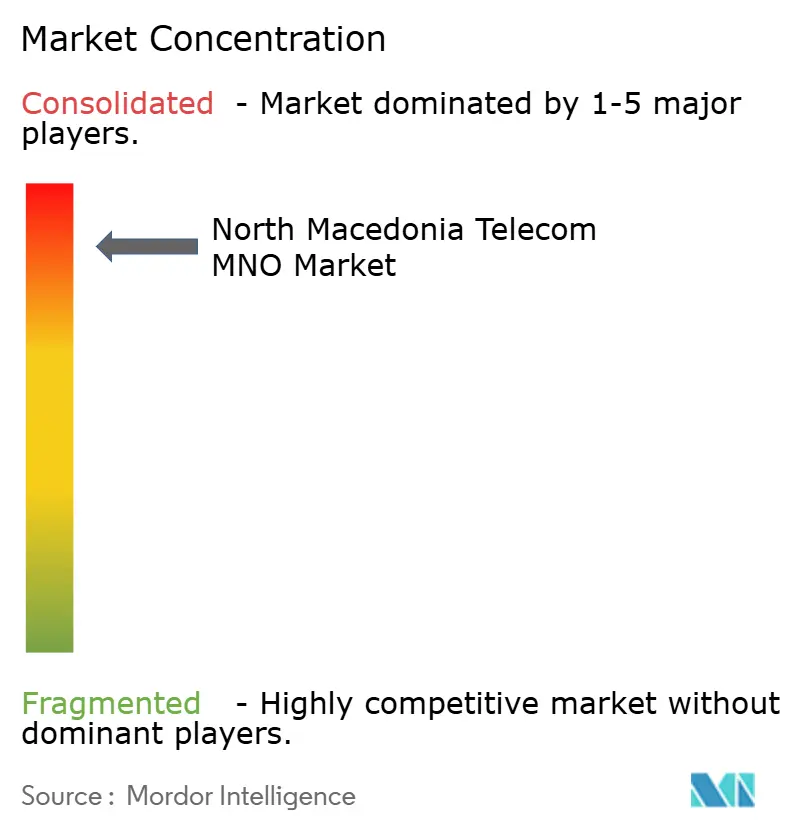
| Market Concentration | High |
Major Players *Disclaimer: Major Players sorted in no particular order Image © Mordor Intelligence. Reuse requires attribution under CC BY 4.0. | |
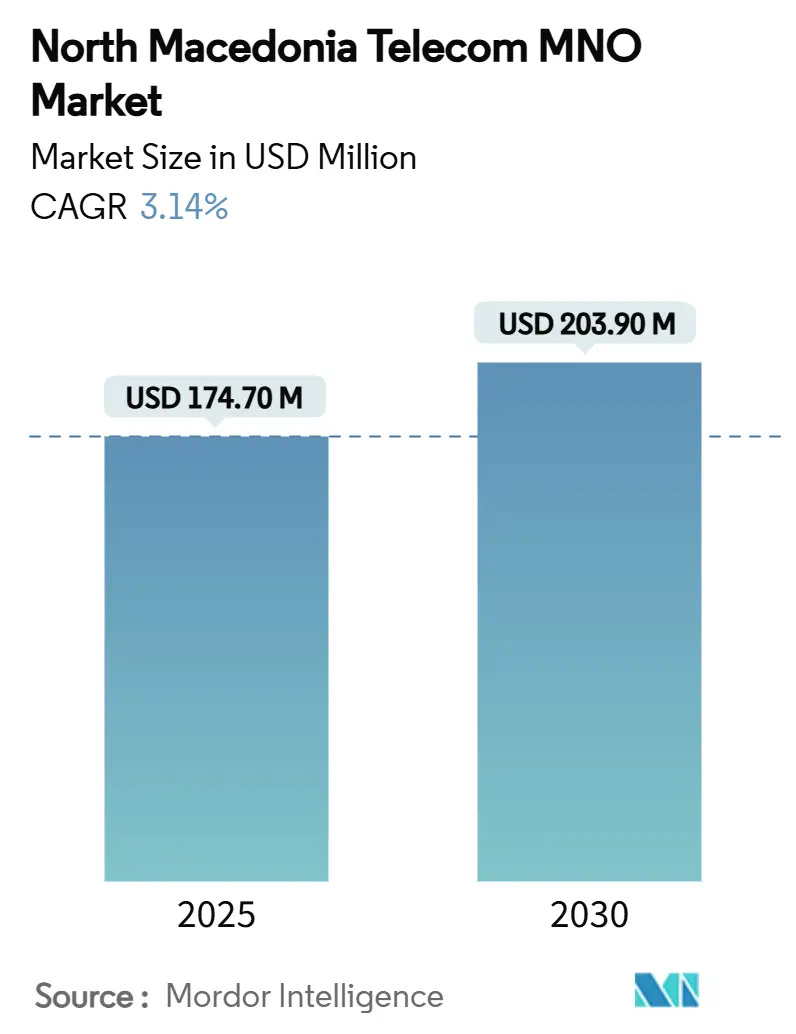
North Macedonia Telecom MNO Market Analysis by Mordor Intelligence
The North Macedonia Telecom MNO Market size is estimated at USD 174.70 million in 2025, and is expected to reach USD 203.90 million by 2030, at a CAGR of 3.14% during the forecast period (2025-2030).
Gradual 5G roll-outs, EU-backed fiber corridors, and rising enterprise digitization anchor the medium-term upswing. Data services already generate nearly half of industry revenue, while voice still contributes more than one-third, thanks to VoLTE migration that keeps legacy traffic profitable. Enterprise accounts are growing faster than consumer accounts as cloud adoption and SD-WAN take hold among domestic businesses. Competitive intensity remains high but rational, with Makedonski Telekom and A1 Makedonija focusing on network quality and private 5G solutions rather than price discounts. Government support for digital transformation and zero-roaming rules across the Western Balkans add further stimulus.
Key Report Takeaways
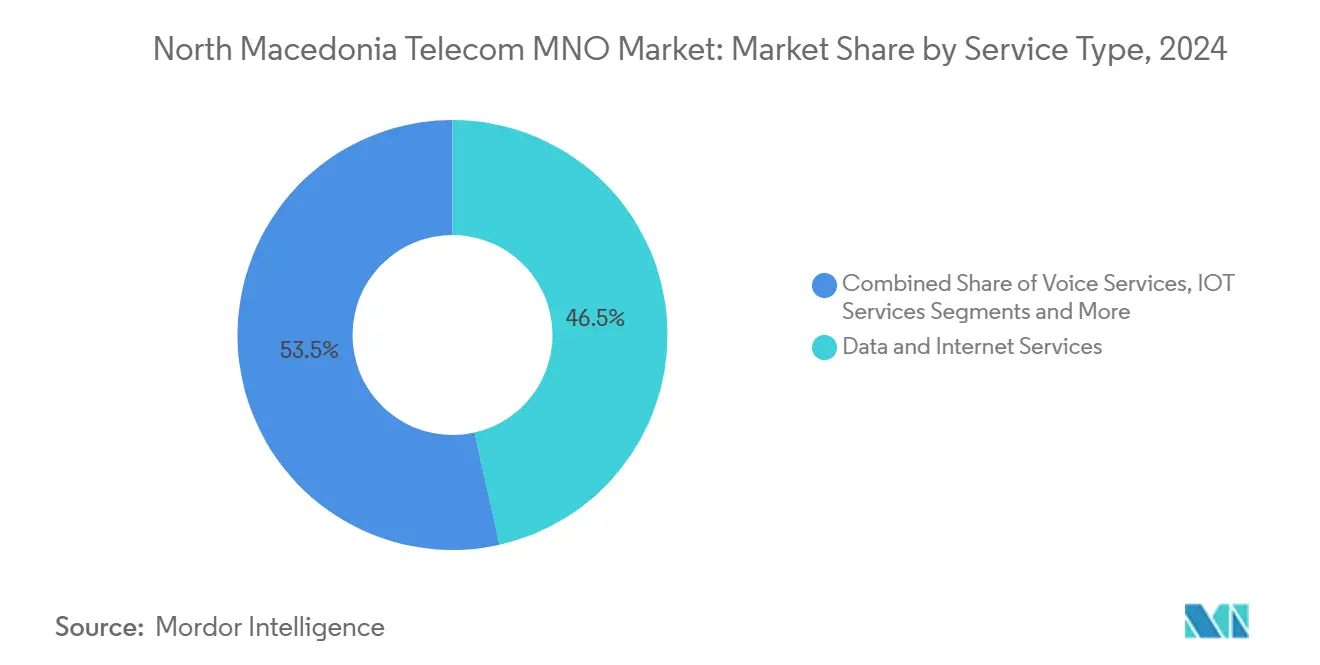
- By service type, data services captured 46.5% of the North Macedonia telecom market share in 2024, while IoT services are advancing at a 3.40% CAGR through 2030.
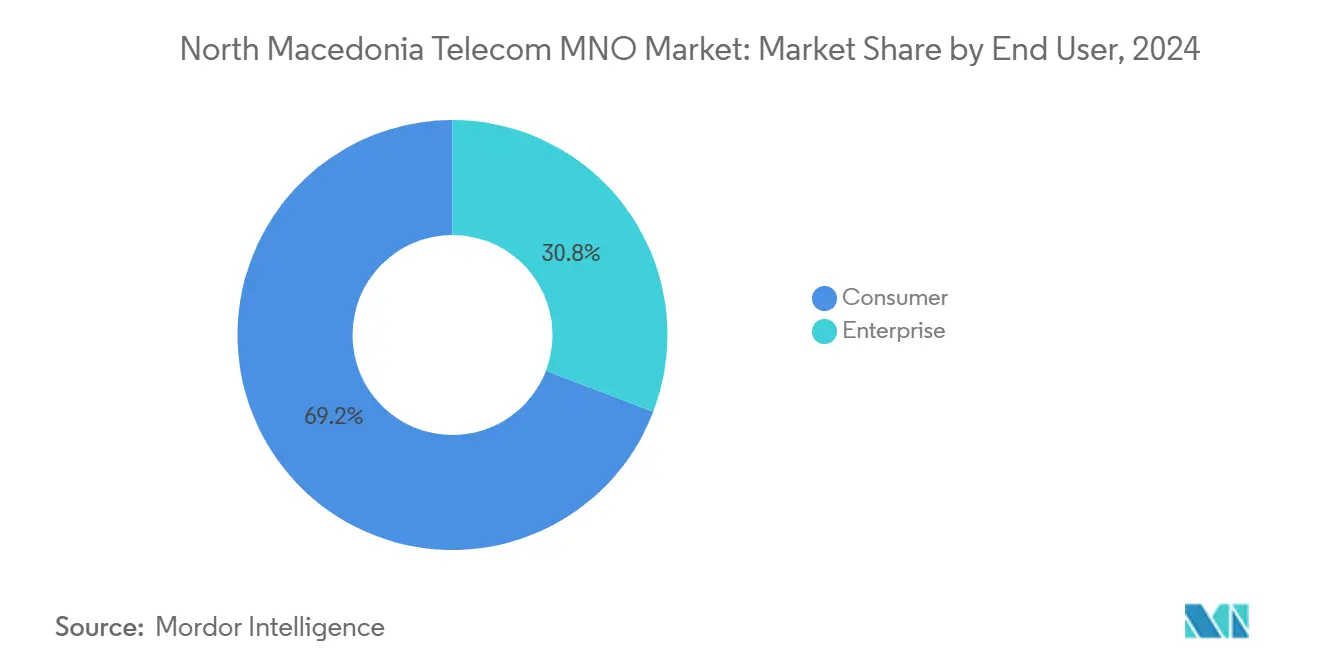
- By end user, consumer services held 66.3% of the North Macedonia telecom market share in 2024, whereas the enterprise segment is forecast to grow at a 3.27% CAGR to 2030.
North Macedonia Telecom MNO Market Trends and Insights
Drivers Impact Analysis*
| Driver | (~) % Impact on CAGR Forecast | Geographic Relevance | Impact Timeline |
|---|---|---|---|
| Rapid 5G Population Coverage Expansion | +0.8% | National, concentrated in Skopje, Bitola, Kumanovo | Medium term (2-4 years) |
| Growth of Fixed-Wireless Access for Rural Broadband | +0.5% | Rural areas, secondary cities | Long term (≥ 4 years) |
| Enterprise Digital-Transformation (Cloud/SD-WAN) Demand | +0.7% | National, enterprise-focused urban centers | Medium term (2-4 years) |
| EU-Funded Fiber Backbone Roll-outs | +0.4% | National infrastructure corridors | Long term (≥ 4 years) |
| Rising Mobile Data Consumption per Capita | +0.6% | National, youth demographic concentration | Short term (≤ 2 years) |
| Under-penetrated IoT Connections in Logistics and Utilities | +0.3% | Industrial zones, utility infrastructure | Long term (≥ 4 years) |
| Source: Mordor Intelligence | |||
Rapid 5G population coverage expansion
Commercial 5G became available in 2022, and by early 2024 Makedonski Telekom had blanketed 26 cities, creating an early-mover edge in both consumer premium plans and low-latency enterprise use cases.[1]SAMENA Council, “Makedonski Telekom Expands 5G,” samena.orgNetwork vendor standardization with Deutsche Telekom’s wider European footprint compresses deployment costs and accelerates feature introduction. Enterprises trialing private slices for manufacturing and logistics confirm near-term monetization potential. Faster throughput also underpins rising ARPU among heavy data users, partially offsetting OTT erosion. Competitive response from A1 Makedonija is speeding nationwide coverage targets, turning network quality into the primary battlefield.
Growth of fixed-wireless access for rural broadband
Fixed-wireless access (FWA) leverages existing mobile towers to deliver home broadband where terrain makes fiber uneconomic. Pilot projects in mountainous Polog and Eastern regions have already connected schools and clinics at one-third of fiber capex levels.[2]Deutsche Telekom, “Sustainability Report 2024,” telekom.comThe availability of 3.5 GHz spectrum supports gigabit-class FWA once 5G Standalone is activated. Government digital-inclusion subsidies defray customer premise equipment costs, accelerating take-up. Successful FWA adoption is expected to boost rural smartphone penetration, enlarge the addressable base for streaming services, and unlock IoT applications in precision agriculture.
Enterprise digital-transformation (cloud/SD-WAN) demand
Domestic corporations are shifting workloads to regional cloud hubs in Frankfurt and Vienna, requiring guaranteed latency links and managed SD-WAN overlays. Service providers bundle connectivity with security and analytics, yielding margins that are 250 basis-points above retail mobile averages. Deutsche Telekom subsidiary T-Systems has expanded local staff for hybrid-cloud advisory, while A1 Makedonija positions its data centers as disaster-recovery nodes for Balkan multinationals. The uptake of remote work tools since 2024 further entrenches demand for symmetric broadband and SLA-backed VPNs, cementing enterprise as the fastest-growing revenue pillar.
EU-funded fiber backbone roll-outs
The EU Growth Plan allocates EUR 6 billion for Western Balkan infrastructure, and North Macedonia has earmarked 9% for wholesale fiber rings that interlink Skopje with border crossings to Greece and Serbia. Operators receive subsidized duct access, trimming payback periods below four years. Wholesale dark-fiber tariffs are falling, enabling alternative ISPs to launch symmetric 1 Gbps offers that spur retail competition. Fiber depth also future-proofs backhaul for dense 5G small-cell grids, ensuring long-run cost efficiency.
Restraints Impact Analysis*
| Restraint | % Impact on CAGR Forecast | Geographic Relevance | Impact Timeline |
|---|---|---|---|
| Population Decline and Aging Demographics | -0.4% | National, rural areas disproportionately affected | Long term (≥ 4 years) |
| ARPU Compression from OTT Voice and Messaging | -0.6% | National, youth demographic concentration | Short term (≤ 2 years) |
| High Wholesale Spectrum Fees vs. GDP per Capita | -0.3% | National regulatory framework | Medium term (2-4 years) |
| Limited Domestic Content Driving Pay-TV Cord Cutting | -0.2% | Urban areas, younger demographics | Medium term (2-4 years) |
| Source: Mordor Intelligence | |||
Population Decline and Aging Demographics
Out-migration toward EU labor markets and low birth rates shrink the subscriber pool, particularly in rural municipalities. The World Bank estimates a net population drop of nearly 1.1% between 2024 and 2030. Older households generate lower data traffic, complicating monetization of 5G and streaming bundles. Operators respond by pivoting to enterprise revenues and by introducing senior-friendly voice-only tariffs that stabilize churn. Long-term sustainability nevertheless hinges on capturing higher-value services per user rather than absolute subscriber growth.
ARPU compression from OTT voice and messaging
Widespread 4G coverage and a 92% internet-user ratio accelerate migration to free messaging platforms, slashing outgoing SMS volumes by double digits in 2024. Bundled unlimited data offers further decouple usage from spend, forcing carriers to rely on premium add-ons such as gaming passes and cyber-security suites. Successful new-revenue initiatives remain limited in scale, keeping blended mobile ARPU on a downward slope. Maintaining investment capacity therefore requires rigorous cost optimization and network-sharing where feasible.
*Our forecasts treat driver/restraint impacts as directional, not additive. The impact forecasts reflect baseline growth, mix effects, and variable interactions.
Segment Analysis
By Service Type: Data Services Drive Market Evolution
Data services led the North Macedonia telecom market in 2024 with a 46.5% revenue share and are forecast to sustain a 3.10% CAGR, buoyed by streaming, gaming, and cloud-connect demand. The widespread availability of 4G LTE, covering 99.9% of the population, underpins mass-market mobile broadband adoption. Early 5G non-standalone launches in fifteen urban zones have already delivered average downlink speeds above 450 Mbps, inviting uptake of UHD video and AR education content. Fixed broadband remains competitive as EU-subsidized FTTH passes grow, driving multi-play bundles that lift customer lifetime value. The North Macedonia telecom market size for data services will approach USD 96 million by 2030, ensuring operators prioritize spectrum refarming for capacity. IoT traffic remains small today but is scaling quickly as utility AMI deployments reach 280,000 endpoints.
Voice services, despite OTT erosion, still account for 37.1% of 2024 revenue. The category’s 3.30% CAGR is rooted in VoLTE migration that halves per-minute cost and enables HD voice upsell. Wholesale inbound roaming also recovers as the zero-roaming zone expands to EU-plus partners. Pricing innovation through unlimited on-net bundles retains older subscribers averse to app-based calling. Consequently, voice continues to contribute essential cash flow for ongoing 5G investments within the broader North Macedonia telecom market.



By End-user: Enterprise Segment Accelerates Digital Adoption
Enterprise customers generated 30.8% of revenue in 2024 and are expanding at a 3.27% CAGR, outstripping consumer growth as businesses migrate workloads to cloud and adopt SD-WAN. Government e-procurement reform has mandated digital signatures for all bids over EUR 10,000, boosting demand for managed security. Multinational manufacturers rely on private 5G for autonomous guided vehicles inside warehouses near Skopje airport, highlighting premium connectivity readiness. The North Macedonia telecom market size attributable to enterprise services is on track to exceed USD 66 million by 2030, aided by cross-border Ethernet services for near-shoring operations.
Consumer accounts remain the bulk at 66.3% but slow to a 3.08% CAGR as SIM saturation tops 139%. Growth hinges on upselling higher mobile-data allowances and bundling MagentaTV, which attracted 18,000 subscribers within five months of launch.[3]Digital TV News, “MediaKind Powers MagentaTV Launch,” digitaltvnews.netGamified loyalty apps and zero-roaming zones sustain usage during travel, partly offsetting stagnant domestic traffic.
Geography Analysis
Regional revenue still skews toward Skopje, which delivers 54% of the North Macedonia telecom market size thanks to dense enterprise clusters and early 5G coverage. Bitola and Kumanovo follow, where industrial zones host FDI-backed factories demanding reliable connectivity. Western border towns benefit from roaming inflows tied to tourism and cross-border workers, helping stabilize local ARPU.
The Vardar and Eastern statistical regions lag on both fiber and 5G coverage, prompting targeted FWA roll-outs to raise digital inclusion. EU-financed backbone links traversing Štip and Kavadarci will shortly feed new aggregation nodes, trimming round-trip latency to cloud data centers in Budapest. This backhaul capability is forecast to lift regional data usage by 14% annually between 2025 and 2030.
Cross-border corridors to Greece and Serbia gain strategic importance as operators bundle wholesale services to multinational logistics firms. Harmonized spectrum refarming with neighboring markets streamlines handset certification and encourages device OEMs to preload Macedonian language packs, fostering ecosystem development. These factors collectively ensure balanced nationwide growth within the North Macedonia telecom market.
Competitive Landscape
Makedonski Telekom and A1 Makedonija jointly capture about 94% of mobile subscriptions, reflecting a highly concentrated structure. Both leverage parent-company synergies for vendor procurement and roaming agreements. Makedonski Telekom capitalizes on Deutsche Telekom’s pan-European 5G blueprint to accelerate Standalone core deployment, while A1 Makedonija taps A1 Group’s centralized OSS to shorten time-to-market for new tariffs.
Infrastructure rivalry is evident in fiber homes-passed targets: Makedonski pledged an extra 120,000 FTTH connections by end-2025; A1 counters with hybrid-fiber-coax upgrades to DOCSIS 4.0 for symmetrical gigabit speeds. The battle extends into enterprise ICT, where T-Systems offers cloud migration consulting and A1 Solutions delivers managed SD-WAN to regional banks.
Despite competition, cost pressures encourage cooperation. The pair share passive tower assets across 400 rural sites and jointly trial open RAN radios to diversify vendor risk. Network-sharing saves an estimated USD 4 million annually, which is redirected to rural 5G expansion. Start-ups in IoT analytics and e-health increasingly partner with both incumbents, signalling a maturing ecosystem surrounding the North Macedonia telecom market.
North Macedonia Telecom MNO Industry Leaders
Makedonski Telekom AD
A1 Makedonija DOOEL
- *Disclaimer: Major Players sorted in no particular order

Recent Industry Developments
- March 2025: Deutsche Telekom reported Q1 2025 revenue of EUR 29.8 billion, a 6.5% year-on-year increase, citing strong European 5G uptake.
- February 2025: Deutsche Telekom posted record 2024 revenue of EUR 115.8 billion and free cash flow of EUR 19.2 billion, reinforcing its capacity to fund Macedonian network upgrades.
- November 2024: Magyar Telekom announced 13.8% Q3 2024 revenue growth across Central and Eastern Europe, benefiting operations in North Macedonia.
- September 2024: Makedonski Telekom introduced MagentaTV on MediaKind’s cloud platform, enhancing its content aggregation strategy.


North Macedonia Telecom MNO Market Report Scope
| Voice Services |
| Data and Internet Services |
| Messaging Services |
| IoT and M2M Services |
| OTT and PayTV Services |
| Other Services (VAS, Roaming and International Services, Enterprise and Wholesale Services, etc.) |
| Enterprises |
| Consumer |
| Service Type | Voice Services |
| Data and Internet Services | |
| Messaging Services | |
| IoT and M2M Services | |
| OTT and PayTV Services | |
| Other Services (VAS, Roaming and International Services, Enterprise and Wholesale Services, etc.) | |
| End-user | Enterprises |
| Consumer |


Key Questions Answered in the Report
What is the current value of the North Macedonia telecom market?
The market generated USD 171.0 million in 2024 and is projected to reach USD 203.9 million by 2030.
How fast is the North Macedonia telecom market growing?
It is expanding at a 3.14% CAGR over the 2025-2030 period, driven mainly by 5G, fiber, and enterprise digital-transformation demand.
Which service type holds the largest North Macedonia telecom market share?
Data services led with 46.5% share in 2024, reflecting rising mobile and fixed broadband usage.
Why are enterprise revenues important for operators?
Enterprise services grow at 3.27% CAGR, outpacing consumer growth because businesses need SD-WAN, cloud connectivity, and private 5G solutions.
Page last updated on:





