
Serbia Telecom MNO Market Size and Share
Market Overview
| Study Period | 2019 - 2030 |
|---|---|
| Forecast Data Period | 2025 - 2030 |
| Historical Data Period | 2019 - 2023 |
| Market Size (2025) | USD 3 Billion |
| Market Size (2030) | USD 4.20 Billion |
| Growth Rate (2025 - 2030) | 6.64 % |
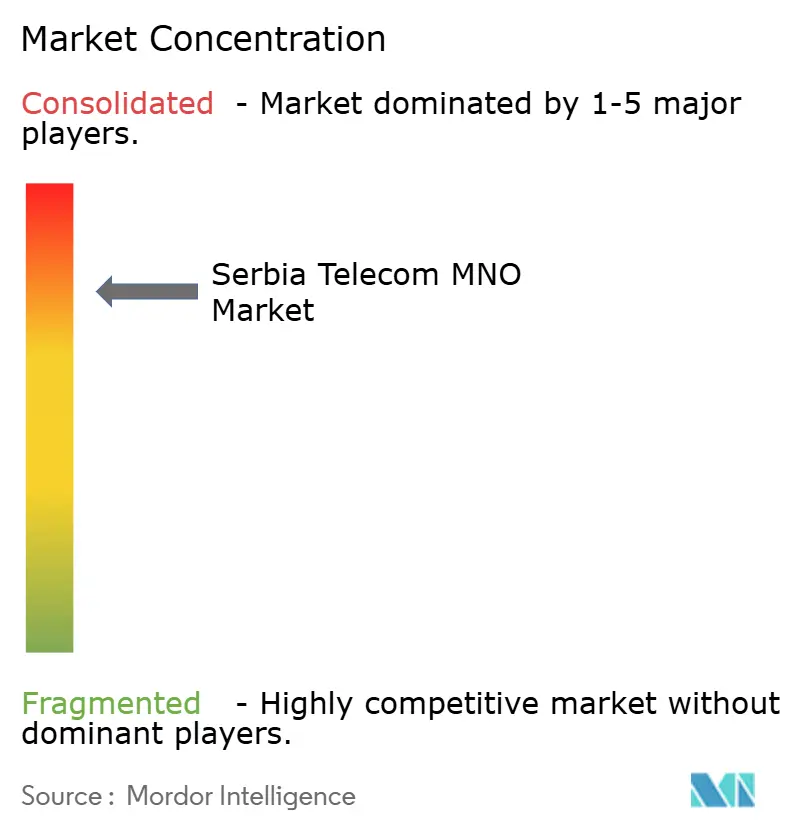
| Market Concentration | High |
Major Players *Disclaimer: Major Players sorted in no particular order Image © Mordor Intelligence. Reuse requires attribution under CC BY 4.0. | |
Serbia Telecom MNO Market Analysis by Mordor Intelligence
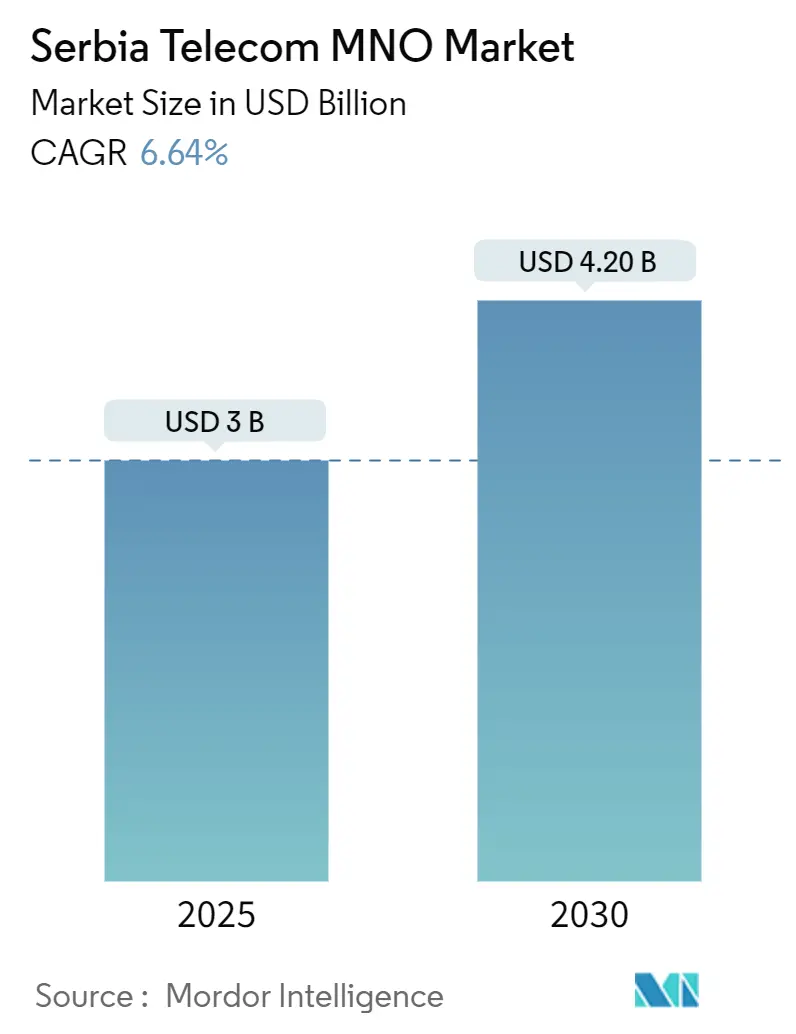
The Serbian Telecom MNO Market size is estimated at USD 3 billion in 2025, and is expected to reach USD 4.20 billion by 2030, at a CAGR of 6.64% during the forecast period (2025-2030). In terms of subscriber volume, the market is expected to grow from 9.17 million subscribers in 2025 to 11.43 million subscribers by 2030, at a CAGR of 4.51% during the forecast period (2025-2030). This growth is driven by Serbia’s emergence as a digital gateway for the Balkans, an outlook underpinned by government-financed fiber rollouts, the upcoming 5G spectrum auction, and resilient demand from enterprises for high-capacity mobile broadband. Rising mobile data usage, premium pricing on tiered plans, and network modernization programs are translating into higher blended ARPU, while cross-border roaming agreements within the Western Balkans sustain incremental volume. Competitive differentiation hinges on service bundling, with Pay-TV and OTT partnerships enhancing customer lifetime value and mitigating churn. Operators are simultaneously tightening their energy-efficiency roadmaps because energy outlays can absorb up to 5% of revenue, a significant line item following recent electricity price volatility. [1]OECD, “Western Balkans Competitiveness Outlook 2024: Serbia,” oecd.org
Key Report Takeaways
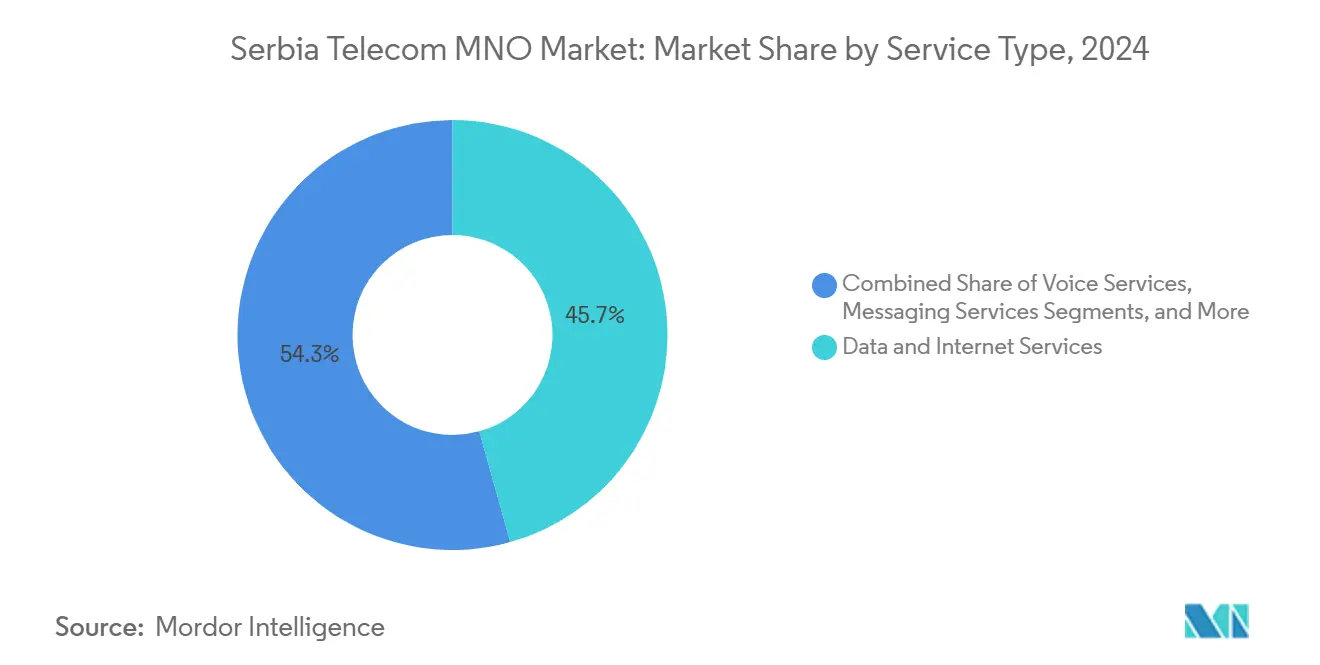
- By service type, data and internet services led with a 45.67% Serbian telecom MNO market share in 2024, whereas OTT and PayTV Services are forecast to register the fastest 7.02% CAGR to 2030.
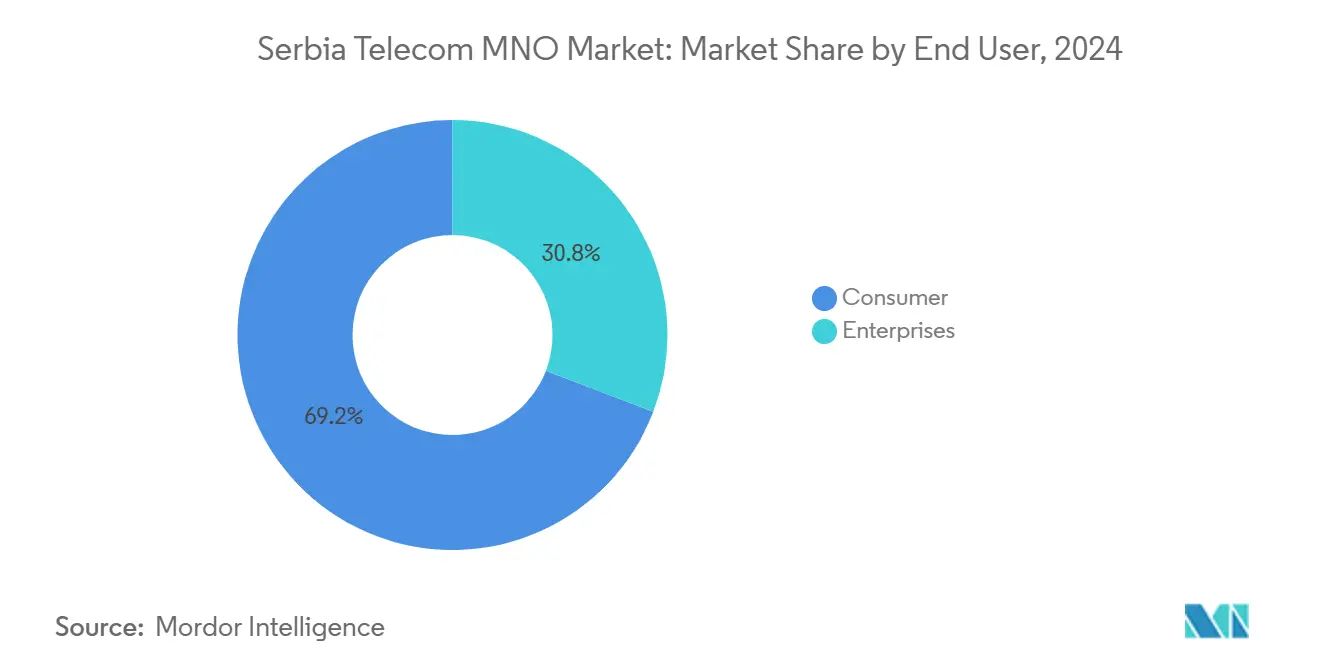
- By end user, consumer accounts for 69.19% of the Serbian telecom MNO market share in 2024, while Enterprise is poised for the highest 6.98% CAGR through 2030.
Serbia Telecom MNO Market Trends and Insights
Drivers Impact Analysis*
| Driver | (~) % Impact on CAGR Forecast | Geographic Relevance | Impact Timeline |
|---|---|---|---|
| Rising Mobile-data ARPU Post-5G Launch | +1.2% | National, with early gains in Belgrade, Novi Sad, Niš | Medium term (2-4 years) |
| Enterprise Digital-transformation Spending Surge | +0.9% | National, concentrated in Belgrade and industrial centers | Short term (≤ 2 years) |
| Government Gigabit-society Targets and Rural Fiber Subsidies | +0.8% | National, prioritizing rural and underserved areas | Long term (≥ 4 years) |
| Balkan OTT Video Partnerships Boosting PayTV Bundling | +0.6% | Regional Balkans, strongest in urban Serbia | Medium term (2-4 years) |
| EU Net-Zero Drive Accelerating Smart-meter IoT Connectivity | +0.4% | National, aligned with EU energy directives | Long term (≥ 4 years) |
| Gaming-cloud Latency SLAs as New B2B Revenue Lever | +0.3% | National, focused on enterprise and gaming hubs | Medium term (2-4 years) |
| Source: Mordor Intelligence | |||
Rising Mobile-data ARPU Post-5G Launch
The 2025 spectrum auction is scheduled to unlock nationwide 5G roll-out by early 2026, a milestone expected to push mobile-data ARPU 25-35% higher within two years of launch. [2]CMS Law, “5G Regulation and Law in Serbia,” cms.law Operators gain a late-mover advantage by importing proven European use cases, reducing early-deployment missteps, and compressing payback periods. Telekom Srbija’s EUR 150 million (USD 167.8 million) All-IP upgrade forms the transport backbone for seamless 5G radio integration. Industrial manufacturing and logistics verticals are booked as anchor tenants for ultra-low-latency slices, while bundled 5G fixed-wireless access promises new revenue in suburban Belgrade estates. Complementary public funding of high-speed backhaul reduces capex risk, enabling aggressive monetization of premium tiers once coverage thresholds are met.
Enterprise Digital-Transformation Spending Surge
ICT exports expanded from EUR 375 million (USD 455.8 million) in 2014 to EUR 3.6 billion (USD 4.2 billion) in 2025, and the government’s target is EUR 10 billion by 2027, translating into sustained bandwidth demand for cloud, IoT, and cybersecurity services. Foreign investors deploying Industry 4.0 lines in automotive and electronics require deterministic connectivity inside factories and across supply chains. The Tier 3+ State Data Center in Kragujevac supplies sovereign cloud onshore, adding use-case diversity for edge networking workloads. [3]U.S. Department of Commerce, “Serbia – Digital Economy,” trade.gov Operators are moving beyond transport pipes toward managed service stacks that bundle connectivity, SD-WAN, and security in one SLA, a margin-accretive path that lifts the Serbia telecom MNO market size.
Government Gigabit-Society Targets and Rural Fiber Subsidies
A EUR 500 million public-private program aims for universal gigabit coverage by end-2025, with 80% of rural homes already fiber-passed. Subsidized trenching lowers cost per home-passed and guarantees minimum revenue through service contracts. World Bank’s Balkans Digital Highway, which co-locates fiber in power-grid rights-of-way, further compresses capex. [4]World Bank Group, “Balkans Digital Highway Initiative,” worldbank.org Private operators align by accelerating XGS-PON builds and open-access wholesale models, ensuring rapid uptake once subsidies taper. The policy framework anchors long-duration cash flows that feed directly into Serbia telecom MNO market growth.
Balkan OTT Video Partnerships Boosting Pay-TV Bundling
Content tie-ups such as Telekom Srbija, Arena Sport’s NBA deal, and A1 Serbia’s launch of SkyShowtime amplify stickiness through sport and premium Hollywood libraries. Bundled quad-play packages grow average revenue per household while lowering churn, evidenced by Yettel Serbia topping 90,000 multi-play homes in 2024. Regional licensing lets operators amortize content costs across Balkan footprints, preserving margins. Seamless roaming under the Western Balkans agreement adds out-of-home viewing without additional data fees, reinforcing customer loyalty and increasing the Serbia telecom MNO market’s overall service value proposition.
Restraints Impact Analysis*
| Restraint | (~) % Impact on CAGR Forecast | Geographic Relevance | Impact Timeline |
|---|---|---|---|
| Spectrum-auction Delays and 5G Launch Push-outs | -0.8% | National, affecting all operators equally | Short term (≤ 2 years) |
| High Network-energy Costs Amid Volatile Electricity Prices | -0.6% | National, with higher impact in rural areas | Medium term (2-4 years) |
| Consumer Price-sensitivity Capping Premium-plan Uptake | -0.4% | National, concentrated in lower-income segments | Short term (≤ 2 years) |
| Municipal Trench-permit Bottlenecks for Fiber Rollout | -0.3% | Local, varying by municipality and region | Medium term (2-4 years) |
| Source: Mordor Intelligence | |||
Spectrum-Auction Delays and 5G Launch Push-Outs
Serbia missed the original 2021 5G timeline, leaving a conspicuous “coverage hole” on Europe’s 5G map. Operators had to sink incremental capex into 4G densification to handle traffic growth, eroding capital productivity. Enterprises postponed automation projects or adopted private-network workarounds, diverting potential revenue from the Serbia telecom MNO market. Although licenses valid until 2047 provide a long runway, the delay forfeited the 20–30% enterprise ARPU uplift captured by early movers in neighboring states.
High Network-Energy Costs Amid Volatile Electricity Prices
Energy outlays absorb up to 5% of operator revenue, and electricity-price spikes since 2024 have compressed EBITDA margins, especially for rural cell sites that rely on diesel backup. Operators can cut 15 to 30% of consumption via RAN sleep-mode algorithms and hybrid-energy solutions, yet initial investments weigh on free cash flow. Compliance with net-zero pathways mandates low-carbon power sourcing, forcing renegotiation of power-purchase agreements under uncertain spot-price trajectories. Until visibility stabilizes, energy expense remains a drag on Serbia telecom MNO market CAGR.
*Our forecasts treat driver/restraint impacts as directional, not additive. The impact forecasts reflect baseline growth, mix effects, and variable interactions.
Segment Analysis
By Service Type: Data and Internet Services Drive Market Evolution
Data and Internet Services commanded a 45.67% share of the Serbia telecom MNO market in 2024, mirroring consumers’ shift from voice to data-centric usage patterns. According to GSMA, the segment’s heft is reinforced by average monthly mobile-data consumption that is projected to rise to near 50 GB per connection by 2030, fueled by 4K streaming, social video, and cloud-gaming traffic. Operators turbo-charge throughput through massive-MIMO upgrades and refarmed mid-band spectrum, extracting incremental capacity ahead of 5G activation. Fixed-mobile convergence packages bundling gigabit fiber and unlimited mobile data consolidate household spending under a single brand, lifting the Serbia telecom MNO market size and limiting cannibalization from over-the-top substitutes.
OTT and PayTV Services hold smaller absolute revenue, yet post the highest 7.02% CAGR, reflecting a maturing bundling playbook where curated content acts as the emotional hook. Operators negotiate regional rights for premium sport and blockbuster catalogs, amortizing fees across Serbia, Bosnia, Montenegro, and North Macedonia footprints. Voice and Messaging remain relevant for corporate PBX trunks, fraud-monitoring codes, and emerging rich-communication-services campaigns. IoT and M2M connectivity accelerates as utilities deploy smart meters, manufacturers pilot automated guided vehicles, and cities roll out camera networks. Collectively, these use cases elevate blended ARPU and diversify the Serbia telecom MNO market revenue stack beyond consumer handsets.



By End User: Enterprise Segment Accelerates Digital Adoption
The Consumer segment represented 69.19% of Serbia telecom MNO market share in 2024, owing to near-ubiquitous smartphone penetration and aggressive rural fiber rollout. However, incremental growth moderates as subscriber saturation approaches 140% penetration. Operators pivot to value-based segmentation that rewards longer tenure and higher-tier plan adoption while preserving affordability for price-sensitive households. Targeted micro-upsell campaigns leverage usage analytics to nudge subscribers toward premium data allotments, video add-ons, and gaming passes, protecting the Serbia telecom MNO market size against substitution risk.
Enterprise revenue streams are projected to expand at a 6.98% CAGR from 2025 to 2030, the fastest among end-user groups. Multinationals locating design centers in Belgrade and Novi Sad contract multi-site connectivity, private cloud peering, and cyberdefense services, each with higher margin profiles than commodity voice. Domestic SMEs adopt software-defined WAN and unified-communications-as-a-service bundles via opex subscriptions, minimizing upfront hardware outlays. Operators exploit 5G network slicing to deliver factory-floor latency service-level agreements, opening a premium corridor that lifts the Serbia telecom MNO market share of enterprise wallets. Deep consulting engagements become the stickiness lever, positioning telcos as transformation partners rather than bit-pipe providers.
Geography Analysis
Serbia’s central Balkan position and EU accession ambitions make nationwide connectivity a policy imperative. Belgrade alone accounts for more than one-third of the Serbia telecom MNO market size, anchored by a dense cluster of finance, IT, and media industries that demand symmetrical gigabit links and enterprise-grade mobile coverage. Novi Sad follows as the northern tech corridor, hosting gaming and agritech start-ups that test low-latency 5G edge workloads. Niš and Kragujevac emerge as secondary enterprise nodes due to logistics corridors intersecting pan-European highways. Additionally, increasing household coverage converts immediately to incremental data traffic once promotional free-install windows lapse, supporting revenue resilience for the Serbia telecom MNO market.
Cross-border synergies amplify domestic fundamentals. The Western Balkans roaming-like-at-home agreement slashed retail data rates among Albania, Bosnia and Herzegovina, Kosovo, Montenegro, North Macedonia, and Serbia in 2024, stimulating usage when citizens travel for trade or tourism. Operators seize the opportunity to design single-tariff regional bundles, smoothing seasonality and enlarging the effective addressable base. Simultaneously, the World Bank’s Balkans Digital Highway Initiative, which piggybacks fiber on transmission-grid easements, delivers new backbone routes that harden redundancy and cut latency for over-the-top providers. Improved resilience supports content-delivery-network localization, reinforcing Serbia’s strategic posture as a regional interconnection hub and enriching the Serbia telecom MNO market’s enterprise proposition.
Preparations for EXPO 2027 accelerate metropolitan deployments. Government stipulations mandate 10 Gbps backhaul to principal venues and 99.999% network availability during the event window, forcing operators to pre-invest in small-cell grids, millimeter-wave pilots, and intelligent transport systems. These assets remain post-event, allowing capacity headroom for years and driving long-tail monetization through smart-city services. Edge data centers constructed to offload traffic during peak exhibit days morph into managed-hosting sites for fintech and media clients, giving the Serbia telecom MNO market another anchor tenant class. Altogether, geography-specific catalysts converge to safeguard long-term traffic growth while broadening the distribution of economic benefits across urban and rural landscapes.
Competitive Landscape
The Serbia telecom MNO market is an oligopoly where Telekom Srbija (mts), Yettel Serbia, and A1 Serbia collectively control a major market share of mobile subscriptions. Telekom Srbija consolidates leadership by leveraging state backing, the 940.75/1000 NET CHECK score that confirmed best-in-class coverage. Yettel’s strategic pivot accelerated after Etisalat acquired over 50% of a controlling stake, importing Middle-East 5G expertise and fresh capital for greenfield small cells. A1 Serbia positions as the challenger brand focused on entertainment-rich bundles, demonstrated by its SkyShowtime launch and XGS-PON fiber blitz that bypasses legacy copper bottlenecks.
Network-sharing and asset-light strategies gain traction. Yettel and A1 co-locate on those masts to shrink rollout time for 5G mid-band layers, freeing capital for edge-compute platforms. Operators also trial open-RAN elements with European vendors to diversify supply chains and mitigate geopolitical risk associated with single-vendor dependencies. Beyond radio networks, competitive thrust migrates to service-stack depth: Telekom Srbija’s Arena Sport long-term NBA rights ensure exclusive courtside content, whereas A1 leans into cloud gaming experiments targeting Serbia’s 1.5 million gamer cohort.
Pricing discipline remains visible; each MNO raised entry-level tariffs just once since 2022 despite inflationary pressures, aiming to protect volume while recouping investment via upsell. Differential strategies surface in enterprise. Telekom Srbija pitches turnkey IoT bundles, Yettel leverages Etisalat’s cybersecurity portfolio, and A1 pilots private 5G campus networks for automotive suppliers near Kragujevac. Collective actions keep churn below 1.5% monthly, underscoring a rational competitive climate that sustains profitability for further infrastructure build-outs and undergirds steady growth in the Serbia telecom MNO market.
Serbia Telecom MNO Industry Leaders
Yettel Serbia
A1 Serbia
mts (Telekom Srbija)
- *Disclaimer: Major Players sorted in no particular order

Recent Industry Developments
- February 2025: United Group agreed to sell its Serbian telecommunications assets, including SBB doo Belgrade and Eon TV International Ltd, for EUR 1.5 billion (USD 1.5 billion) in a refocus on EU markets.
- November 2024: A1 Serbia launched SkyShowtime streaming service, broadening its OTT portfolio.
- October 2024: Etisalat completed the EUR 2.15 billion (USD 2.33 billion) acquisition of over 50% of Yettel Serbia from PPF Group.
- January 2024: Actis-led consortium closed the purchase of Telekom Srbija’s macro-tower portfolio, unlocking new capital for network upgrades.


Serbia Telecom MNO Market Report Scope
| Voice Services |
| Data and Internet Services |
| Messaging Services |
| IoT and M2M Services |
| OTT and PayTV Services |
| Other Services (VAS, Roaming and International Services, Enterprise and Wholesale Services, etc.) |
| Enterprises |
| Consumer |
| Service Type | Voice Services |
| Data and Internet Services | |
| Messaging Services | |
| IoT and M2M Services | |
| OTT and PayTV Services | |
| Other Services (VAS, Roaming and International Services, Enterprise and Wholesale Services, etc.) | |
| End-user | Enterprises |
| Consumer |


Key Questions Answered in the Report
What is the current size of the Serbia telecom MNO market?
The Serbia telecom MNO market size reached USD 3 billion in 2025 and is forecast to hit USD 4.2 billion by 2030.
Which service type leads revenue today?
Data and Internet Services hold the top spot with a 45.67% market share in 2024.
How fast is the enterprise segment growing?
Enterprise revenue is projected to record a 6.98% CAGR between 2025 and 2030.
When will 5G become commercially available in Serbia?
Licenses are expected to be awarded by mid-2025, enabling nationwide 5G launch in early 2026.
Why are energy costs a concern for Serbian operators?
Energy can consume up to 5% of operator revenue, and electricity-price volatility since 2024 has squeezed margins, especially for rural sites.
How concentrated is the competitive landscape?
Three operators, Telekom Srbija, Yettel Serbia, and A1 Serbia, control more than 99% of subscribers, indicating a highly concentrated market.
Page last updated on:





