
Mexico CRM Marketing Services Market Size and Share
Market Overview
| Study Period | 2020 - 2031 |
|---|---|
| Forecast Data Period | 2026 - 2031 |
| Base Year Market Size (2025) | USD 1.18 Billion |
| Market Size (2026) | USD 1.34 Billion |
| Market Size (2031) | USD 2.53 Billion |
| Growth Rate (2026 - 2031) | 13.55 % |
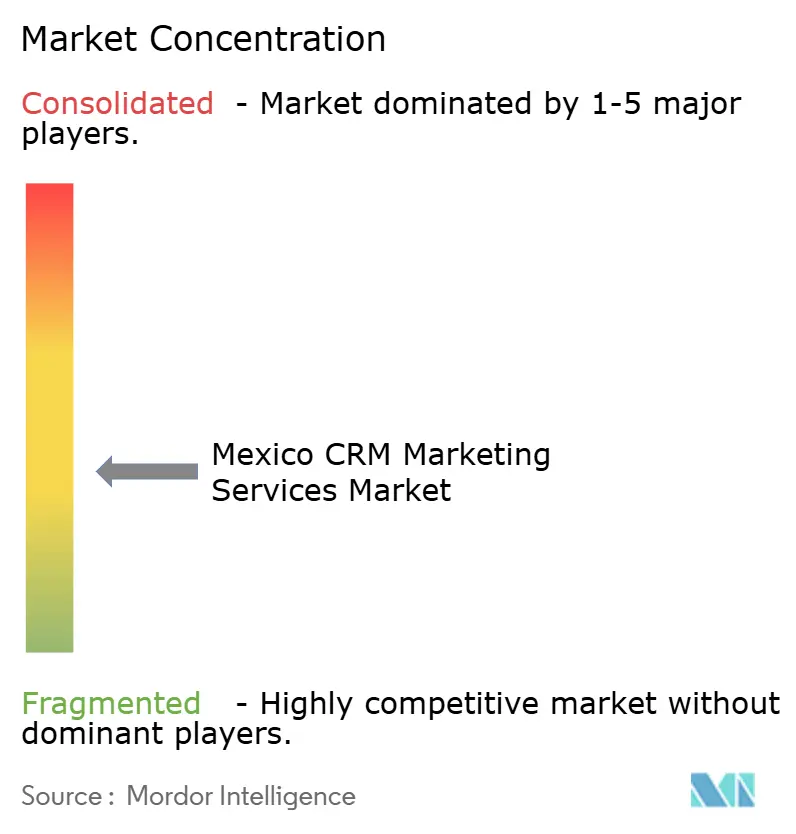
| Market Concentration | Medium |
Major Players *Disclaimer: Major Players sorted in no particular order Image © Mordor Intelligence. Reuse requires attribution under CC BY 4.0. | |
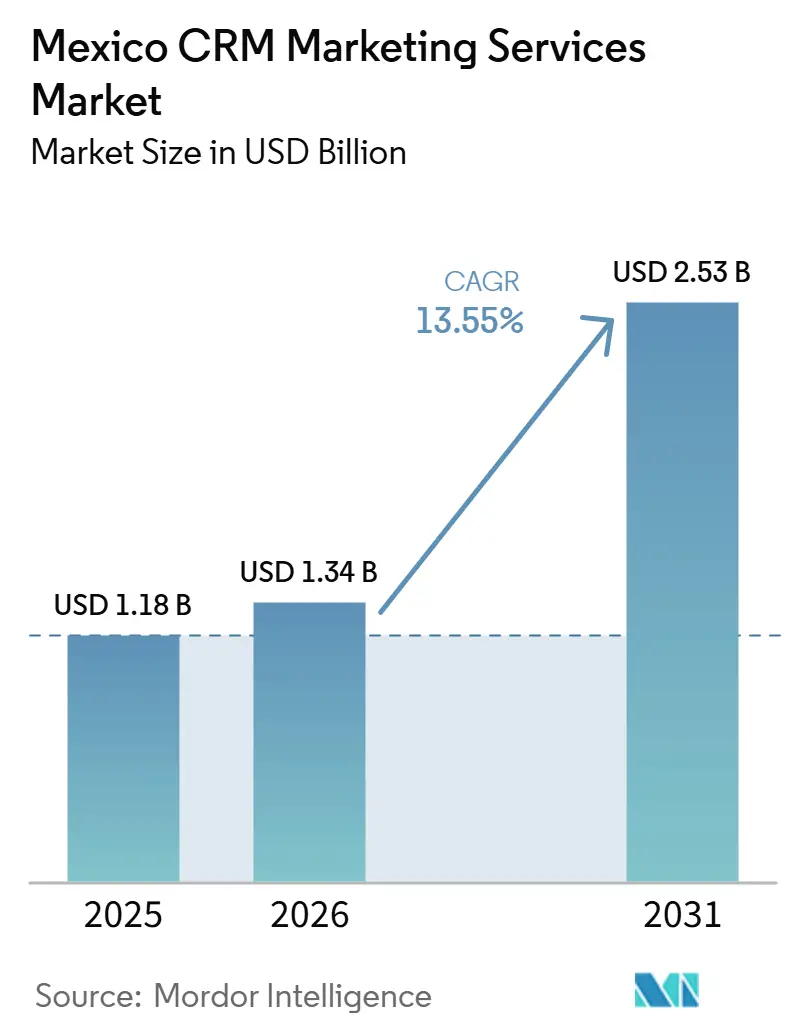
Mexico CRM Marketing Services Market Analysis by Mordor Intelligence
The Mexico CRM marketing services market size is projected to be USD 1.18 billion in 2025, USD 1.34 billion in 2026, and reach USD 2.53 billion by 2031, growing at a CAGR of 13.55% from 2026 to 2031. The Mexico CRM marketing services market is shifting from one-time deployment work toward longer managed service relationships, which gives providers better visibility on revenue and staffing needs. A second cycle of modernization is also building across the Mexico CRM marketing services market as enterprises that already implemented core platforms during 2020-2023 now need upgrades for agentic AI, workflow redesign, and stronger data controls. First-party data requirements are pushing buyers to revisit architecture, migration, and governance choices, which is expanding the scope of work for strategy, integration, and post-go-live support. Compliance demands across privacy and data handling rules are raising project complexity, and this is moving the competitive advantage within the CRM services market toward firms that can combine industry expertise, platform certifications, and managed delivery depth. The result is a Mexico CRM marketing services market where recurring contracts, specialized capabilities, and selective consolidation are becoming more important than basic implementation scale.
Key Report Takeaways
- By service type, CRM implementation and integration held 32.41% of revenue in 2025, while Mexico CRM managed services market is projected to expand at a 16.11% CAGR through 2031.
- By enterprise size, large enterprises held 66.82% of the CRM services market in 2025, while small and medium enterprises are projected to record the highest CAGR at 15.27% through 2031.
- By service application, customer acquisition accounted for 26.71% of revenue in 2025, while marketing automation services are expected to advance at a 16.78% CAGR through 2031.
- By end-user industry, retail and e-commerce held 28.56% of revenue in 2025, while healthcare and life sciences are projected to grow at a 16.21% CAGR through 2031.
Note: Market size and forecast figures in this report are generated using Mordor Intelligence’s proprietary estimation framework, updated with the latest available data and insights as of January 2026.
Mexico CRM Marketing Services Market Trends and Insights
Drivers Impact Analysis*
| DRIVER | (~) % IMPACT ON CAGR FORECAST | GEOGRAPHIC RELEVANCE | IMPACT TIMELINE |
|---|---|---|---|
| Rising Demand for Cloud-Based CRM Outsourcing and Managed Services | +3.0% | Strong demand in Mexico City, Monterrey, and Guadalajara where enterprises outsource CRM and managed services | Short term (≤ 2 years) |
| Accelerating Digital Transformation Creating Sustained CRM Implementation Pipelines | +2.5% | Nationwide, with emphasis on financial services, retail, and telecom sectors adopting CRM | Medium term (2-4 years) |
| Agentic AI Reshaping CRM Implementation Scope and Triggering Re-Implementation Cycles | +2.5% | Mexico’s enterprise clusters in Monterrey and Mexico City adopting AI‑driven CRM re‑implementation | Medium term (2-4 years) |
| First-Party Data Mandates Driving CRM Architectural Overhaul Projects | +2.0% | Mexico City and federal regulatory environment pushing CRM architectural changes | Short term (≤ 2 years) |
| Retail Media Network Growth Accelerating CRM Integration and Personalization Projects | +1.5% | Retail hubs in Mexico City, Guadalajara, and Monterrey driving CRM personalization projects | Medium term (2-4 years) |
| Nearshore Delivery Models Reducing CRM Implementation and Managed Service Costs | +1.0% | Northern Mexico (Nuevo León, Baja California) benefiting from nearshore CRM delivery to U.S. clients | Medium term (2-4 years) |
| Source: Mordor Intelligence | |||
Rising Demand for Cloud-Based CRM Outsourcing Reshapes Service Delivery Economics
The Mexico CRM Marketing services market is benefiting from the steady move toward cloud-first CRM environments, because enterprise teams now spend less time on infrastructure and more time on configuration, integration, and workflow tuning. That change has increased the need for outside partners that can manage day-to-day optimization, upgrades, and user support across sales, service, and marketing functions. Salesforce stated in 2026 that 87% of sales teams now use AI tools in their daily workflow, up from 57% in 2024, which shows how quickly CRM operating models are changing after deployment.[1] In the Mexico CRM Marketing services market, this creates more frequent reviews of data models, permissions, automations, and user journeys during annual renewal cycles. It also shifts provider economics toward recurring contracts with longer tenures and steadier expansion work. That pattern supports stronger delivery utilization in the Mexico CRM Marketing services market and makes certified managed support capacity more valuable than it was in earlier implementation-led cycles.
Accelerating Digital Transformation Sustains CRM Implementation Pipelines Across Late-Adopter Industries
The Mexico CRM Marketing services market continues to draw support from broader digital transformation programs, because CRM work remains tied to cloud migration, analytics modernization, and customer process redesign. HCLTech expanded its Salesforce partnership in June 2025 to accelerate enterprise adoption of Agentforce across financial services, healthcare, retail, and manufacturing, which signals that implementation demand is spreading across several major verticals rather than staying concentrated in a narrow buyer group.[2] TCS also announced its acquisition of Coastal Cloud in December 2025, a move that shows large providers are still building scale in Salesforce consulting and delivery. In the Mexico CRM Marketing services market, late adopters typically need more organizational change work, more integration mapping, and more governance design than firms that adopted earlier. That raises revenue per engagement and lengthens project duration for providers with strong consulting depth. It also explains why the Mexico CRM Marketing services market is seeing continued demand for higher-value strategy and transformation work alongside core implementation services.
Agentic AI Resets the Scope of CRM Implementation Engagements
The Mexico CRM Marketing services market is entering a new phase in which AI is not just an add-on feature, but a design factor that changes how CRM systems are built and governed. Genesys launched what it described as the industry's first agentic virtual agent built with large action models for enterprise CX in February 2026, while Salesforce made its Summer '26 release generally available in June 2026 with multi-agent orchestration, Slack-first workflows, and real-time data activation. These changes expand the work required after the initial deployment, because service partners now need to address agent governance, data pipeline integrity, workflow sequencing, and cross-system coordination. Genesys also reported in March 2026 that AI-powered adoption on its platform was accelerating, which reinforces the speed at which enterprise buyers are moving toward more advanced operating models. For the Mexico CRM Marketing services market, the installed base of existing platform users becomes a large re-implementation opportunity, not just a maintenance pool. That dynamic broadens demand beyond greenfield projects and supports a deeper pipeline for providers that can modernize existing environments.
First-Party Data Mandates Drive CRM Architecture Overhaul Projects
The Mexico CRM Marketing services market is also being supported by the need to rebuild customer architecture around first-party data, consent management, and tighter governance controls. As privacy obligations expand, buyers are treating CRM programs less as isolated software projects and more as enterprise data programs that require staged work across strategy, migration, and long-term support. In the Mexico CRM Marketing services market, the scope of contracts expands because identity resolution, data quality, permissions, workflow triggers, and audit needs all become part of implementation decisions. Salesforce reported in its 2026 research that 62% of enterprises increased their budgets for first-party data infrastructure during 2024-2025, which gives a direct demand signal for service providers aligned with data-led CRM redesign. This shift is especially meaningful because it creates multi-year client relationships rather than single deployment events. It also strengthens providers that can combine integration skills with governance design and ongoing managed oversight.
Restraints Impact Analysis*
| RESTRAINT | (~) % IMPACT ON CAGR FORECAST | GEOGRAPHIC RELEVANCE | IMPACT TIMELINE |
|---|---|---|---|
| Data Privacy Regulations Escalating CRM Compliance Overhead | -1.5% | Mexico City and federal regulatory environment, where compliance with Mexico’s Federal Law on Protection of Personal Data (LFPDPPP) is most stringent | Short term (≤ 2 years) |
| Fragmented CRM Vendor Ecosystem Complicating Integration Project Scope | -1.5% | Nationwide, with integration challenges most visible in mid‑market firms across Monterrey, Guadalajara, and Mexico City | Medium term (2-4 years) |
| Budget Pressures Limiting CRM Service Investment, Particularly in SMBs | -1.0% | Concentrated among SMEs in northern and central Mexico, where smaller firms face cost constraints in adopting CRM services | Medium term (2-4 years) |
| Limited Integration Capabilities With Legacy IT Infrastructure in Industrial and Public-Sector Segments | -1.0% | Industrial manufacturing hubs in Nuevo León, automotive clusters in Puebla, and public‑sector agencies in Mexico City | Long term (≥ 4 years) |
| Source: Mordor Intelligence | |||
Data Privacy Regulation Escalates CRM Compliance Costs and Project Timelines
The Mexico CRM Marketing services market faces a clear constraint from rising compliance requirements, because CRM systems hold customer data that falls under several active privacy and sector rules. Buyers now need stronger audit trails, tighter access controls, and more careful data handling across deployments, which raises both project effort and post-go-live support demands. In healthcare, the 2025-2026 HIPAA Security Rule updates required annual documented compliance audits, multi-factor authentication, and faster response requirements for patient data access, all of which added technical and operational work around CRM programs. In Mexico, financial-sector data localization requirements also limit standard hosting choices for some regulated entities, which raises the need for locally compliant CRM architectures.[3] For the Mexico CRM Marketing services market, these obligations can extend implementation timelines and reduce the efficiency of standardized delivery models. They also favor providers that already have compliance processes, regulated-sector experience, and documentation discipline embedded into delivery.
Fragmented CRM Vendor Ecosystem Extends Integration Timelines and Inflates Costs
The Mexico CRM Marketing services market also has to operate across a fragmented technology base, where buyers often manage multiple platforms with different data models, APIs, and licensing structures. This issue becomes harder after mergers, regional expansion, or business unit autonomy, because service partners must reconcile different systems before they can optimize workflows or analytics. The European Commission's Digital Markets Act has pushed major gatekeepers toward more open digital interfaces, which lowers some lock-in but increases the number of integration points that providers need to manage. Microsoft also noted in its Dynamics 365 2026 Release Wave 1 plan that Copilot Studio added native Model Context Protocol server support, including cross-CRM agent interactions, which expands testing and orchestration requirements for service teams. In the Mexico CRM Marketing services market, this translates into longer discovery phases, heavier testing cycles, and more budget scrutiny from buyers. It also means that firms with strong integration engineering and reusable delivery methods are better positioned than providers that rely on simple rollout capacity.
*Our forecasts treat driver/restraint impacts as directional, not additive. The impact forecasts reflect baseline growth, mix effects, and variable interactions.
Segment Analysis
By Service Type: Implementation Services Lead While Managed Services Gain Pace
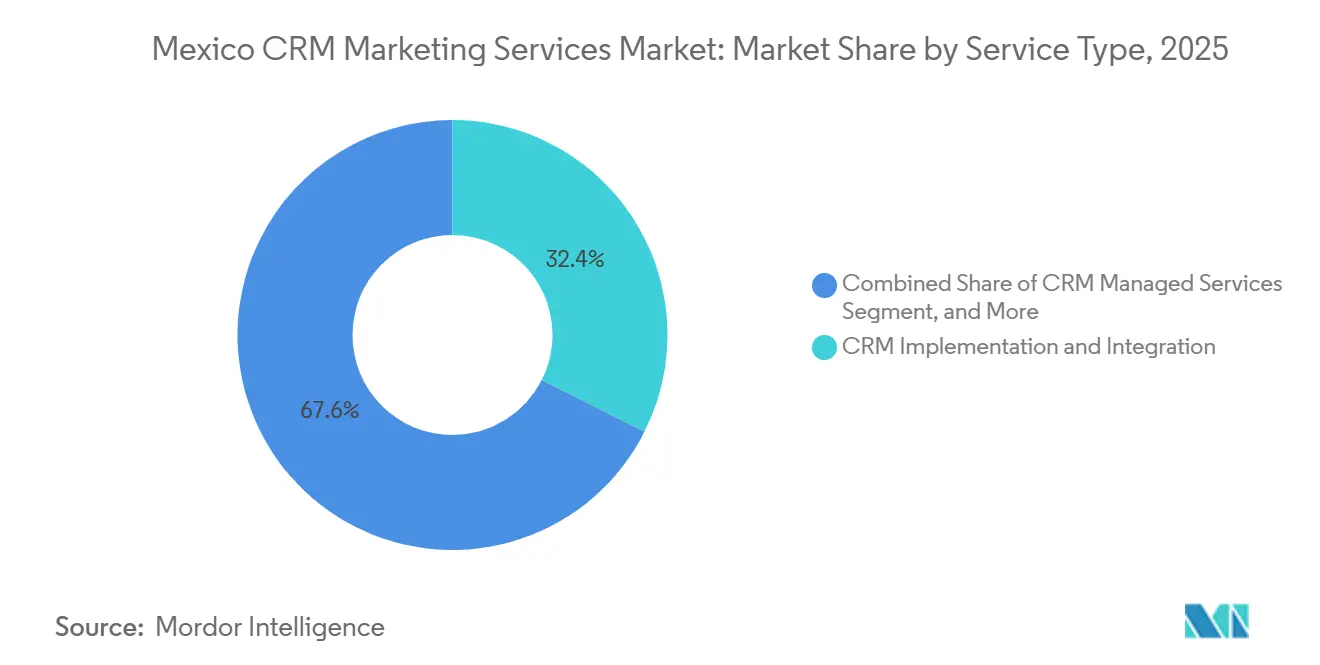
CRM Implementation and Integration held 32.41% of revenue in 2025, which made it the largest service type in the Mexico CRM Marketing services market. This segment remains the main revenue pool because deployments often run across several months and require certified resources across CRM setup, workflow design, API work, and integration with adjacent systems. Implementation work also tends to capture the most budget when clients are deploying Salesforce, Microsoft Dynamics 365, SAP CRM, or HubSpot across multiple teams and business processes. Migration services are benefiting from the move away from older on-premise and legacy environments, because many of those setups cannot support newer AI-led workflows or the data architecture now expected in the Mexico CRM Marketing services market. Strategy services continue to gain relevance because buyers need upfront decisions on governance, orchestration, and integration order before they commit to large-scale upgrades.
CRM Managed Services is projected to expand at a 16.11% CAGR through 2031, making it the fastest-growing service type in the Mexico CRM Marketing services market. This reflects a clear change in buyer behavior, because enterprises that completed deployments during 2020-2023 are now shifting into longer operating support relationships. Salesforce reported that 87% of sales teams use AI tools in daily workflows, which supports the case for constant tuning, training, monitoring, and workflow updates after go-live. Training remains the smallest service type by revenue, but it is drawing renewed demand as organizations prepare teams to use AI-enabled sales, marketing, and service workflows with more consistency. The Mexico CRM Marketing services market is also raising the bar on managed delivery, because certifications such as ISO/IEC 27001 increasingly shape procurement decisions in sectors where privacy and uptime carry higher weight.

By Enterprise Size: Large Enterprises Hold Scale While SMBs Expand Faster
Large enterprises held 66.82% of the Mexico CRM Marketing services market in 2025, which shows how strongly revenue is concentrated in buyers with broad geographic and organizational complexity. These organizations usually operate across multiple business units, legacy systems, compliance regimes, and customer channels, which makes CRM programs larger and harder to standardize. In the CRM services industry, that translates into higher spending on implementation, governance, integration, and long-term managed support. Large enterprises are also more likely to run multi-country operations, which increases the need for role controls, audit structures, workflow consistency, and platform upgrades over time. That combination keeps them central to revenue generation across the Mexico CRM Marketing services market, even as smaller clients become more active.
Small and medium enterprises are projected to grow at a 15.27% CAGR through 2031, making them the fastest-growing enterprise cohort in the Mexico CRM Marketing services market. The main reason is that cloud-based entry points have reduced infrastructure barriers and made CRM adoption easier for firms that previously stayed outside larger deployment cycles. The service model for these clients is different because they need shorter timelines, standardized configurations, and pricing that aligns closely with business outcomes. That is pushing providers in the Mexico CRM Marketing services market to build packaged deployment accelerators and learner-managed support models. This cohort is especially important because it adds volume growth without relying on the same large-account sales cycle as top-tier enterprise deals.
By Service Application: Customer Acquisition Leads While Marketing Automation Accelerates
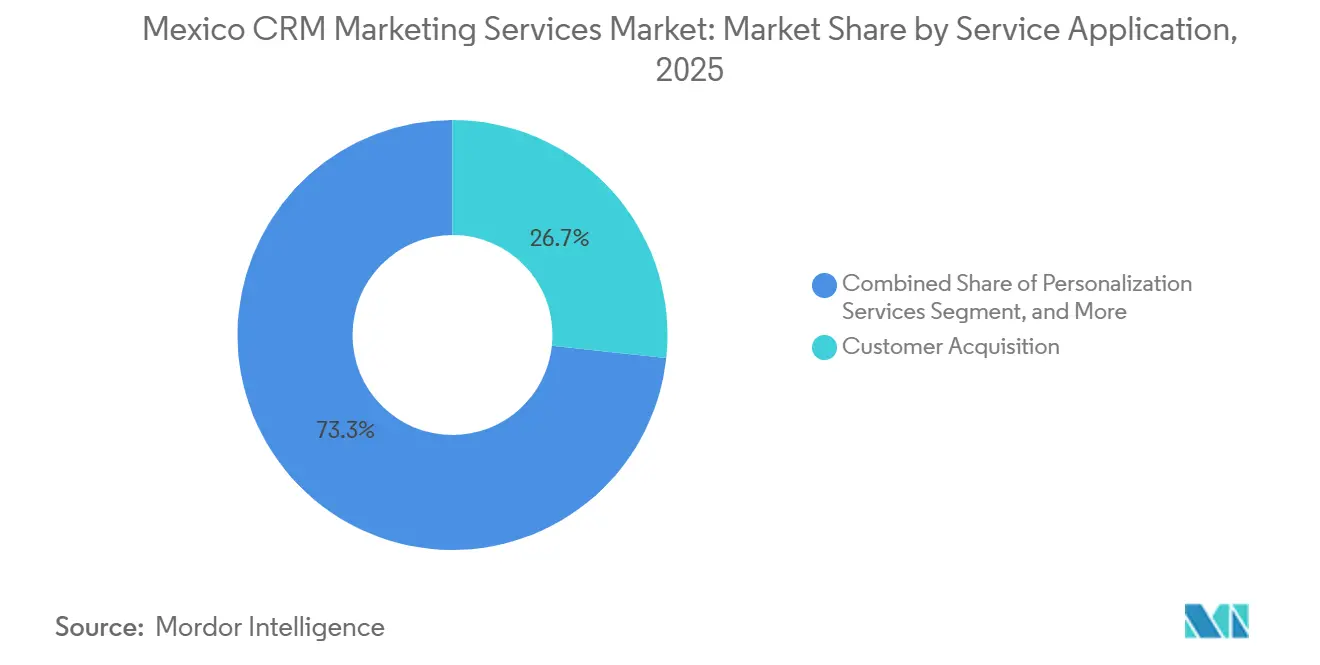
Customer Acquisition accounted for 26.71% of the Mexico CRM Marketing services market size in 2025, which made it the largest service application segment. This position reflects the original economic case for CRM investment, because lead generation, opportunity management, outbound campaigns, and sales visibility still attract strong spending from enterprise buyers. The segment also covers a broad range of technical work, including lead scoring configuration, CPQ integration, sales process design, and reporting layers that link CRM usage to revenue outcomes. In the Mexico CRM Marketing services market, these capabilities remain important because customer acquisition use cases are easier for buyers to tie to measurable near-term returns. That keeps this segment at the center of implementation budgets across BFSI, technology, retail, and other sales-intensive end-user groups.
Marketing Automation Services is projected to advance at a 16.78% CAGR through 2031, making it the fastest-growing application area in the Mexico CRM Marketing services market. Klaviyo reported 28% revenue growth in Q1 2026 and more than 196,000 paying customers, while also launching its AI marketing agent Composer into public beta in June 2026.[4] That combination supports demand for implementation, migration, and optimization work tied to real-time campaigns and coordinated service execution. Omnichannel, personalization, customer analytics, campaign management, and retention functions are also moving forward with the same shift toward more dynamic data use. For providers in the Mexico CRM Marketing services market, marketing automation creates multi-stage engagements that often continue well after the first deployment. It also strengthens the value of partners that can connect customer data, campaign logic, and service interactions inside one operating model.
By End-User Industry: Retail and E-Commerce Leads While Healthcare Builds Momentum
Retail and E-Commerce held 28.56% of the Mexico CRM Marketing services market share in 2025, which kept it as the largest end-user segment. This vertical uses CRM across acquisition, loyalty, personalization, omnichannel coordination, and post-purchase service, which gives it one of the widest service footprints in the Mexico CRM Marketing services market. Retail buyers also tend to connect CRM activity more directly to revenue, conversion, and retention outcomes, which supports steady investment in both implementation and managed optimization. That makes the vertical important not only because of its size, but also because it usually combines several application areas inside the same account. The breadth of these use cases helps explain why retail and e-commerce remain the anchor end-user group in the Mexico CRM Marketing services market.
Healthcare and Life Sciences is projected to grow at a 16.21% CAGR through 2031, making it the fastest-growing end-user segment in the Mexico CRM Marketing services market. The vertical is benefiting from patient engagement modernization, but it is also being shaped by compliance rules that make implementation more specialized and less price-driven. The U.S. Department of Health and Human Services outlined 2025-2026 HIPAA Security Rule updates that required annual documented audits, multi-factor authentication, and tighter handling of electronic protected health information.[5] HubSpot introduced HIPAA compliance capabilities in 2024 and expanded them in 2025 for healthcare enterprise customers, which widened the need for partners that can implement compliant configurations and business associate agreement workflows. In the Mexico CRM Marketing services market, healthcare work is hard to commoditize because access controls, audit trails, and data minimization have to be embedded into the operating model. That keeps pricing discipline firmer for specialists with regulated-sector delivery experience.
Geography Analysis
Mexico’s digital transformation sector is expanding rapidly, creating a supportive environment for the country’s CRM marketing services market. Cloud-native architectures and subscription-based delivery models are increasingly replacing traditional perpetual software licenses, while strong cloud adoption is reshaping ICT services. This transition is significant for CRM marketing services, as service-intensive delivery models align more effectively with subscription platforms that require ongoing integration, optimization, and support. Retail, BFSI, and fintech remain the primary demand areas, as these sectors combine high customer process intensity with stricter compliance and workflow requirements.
Mexico also stands out in the Mexico CRM Marketing services market because it can serve both domestic demand and cross-border delivery needs. A 2026 joint paper from AMITI and ITI on the USMCA Chapter 19 review emphasized cross-border data flows, limits on unjustified localization, and protection for digital trade, all of which support service contracts that connect Mexican delivery teams with North American clients. Softtek stated in 2026 that 6 of its 18 global delivery centers are in Mexico, which highlights the country's established role in nearshore services. Softtek also promoted Salesforce services from its nearshore model, which underlines the operational fit between local delivery capacity and the Mexico CRM Marketing services market.
A second feature of the Mexico CRM Marketing services market in Mexico is the compliance layer around certain regulated workloads. The U.S. International Trade Administration noted that Mexico's central bank and banking commission require some financial-sector data to be processed domestically, which limits standard cloud options for some institutions. That requirement increases the value of locally compliant architecture, migration planning, and managed oversight for financial clients in the Mexico CRM Marketing services market. It also gives an edge to providers that can combine regional delivery with configuration knowledge across regulated workflows. The domestic opportunity and the export platform role, therefore, reinforce each other, because the same delivery base can support complex local projects and cross-border work. This combination keeps Mexico strategically relevant to the Mexico CRM Marketing services market, even without a published country-level revenue share figure in the draft. It also aligns with the broader shift toward subscription software, cloud operations, and longer-term service contracts across enterprise technology spending.
Competitive Landscape
The Mexico CRM Marketing services market remains moderately fragmented, with a visible divide between large IT services firms, platform-linked service teams, and niche CRM consultancies. HCLTech, TCS, Softtek, and the professional services arms of Salesforce and Oracle compete on implementation depth, certified talent, and the ability to support complex, regulated accounts. In the Mexico CRM Marketing services market, this means scale matters, but scale alone is not enough because buyers are increasingly comparing providers on AI readiness, integration strength, and sector-specific delivery methods. The competitive field remains active rather than consolidated, which is why acquisition, partnership expansion, and capability building continue to shape the market.
TCS announced the acquisition of Coastal Cloud in December 2025, showing that large providers are willing to use M&A to strengthen Salesforce consulting and accelerate delivery scale in the Mexico CRM Marketing services market. HCLTech expanded its Salesforce partnership in June 2025 to support enterprise adoption of Agentforce across financial services, healthcare, retail, and manufacturing, which points to a strategy centered on higher-value agentic AI programs rather than standard deployment work. Salesforce then widened the technical surface for partners through the Summer '26 release and Headless 360 announcement, both of which increased the need for orchestration, data activation, and API-led configuration work. These moves show that competition in the Mexico CRM Marketing services market is increasingly tied to how well providers adapt to rapid platform change.
Technology differentiation is now more important than price differentiation across much of the Mexico CRM Marketing services market. Genesys launched an agentic virtual agent in February 2026 and later reported strong AI-led momentum, which shows how quickly platform capabilities are moving into more autonomous operating models that require service partner support.[6] NICE also announced in June 2026 that agentic AI was native at the core of its CX platform, while highlighting compliance standards such as SOC 2 Type II, ISO 27001, PCI DSS, and FedRAMP authorization. That compliance posture matters because it raises buyer expectations for service partners that want to work on complex enterprise deployments. White-space opportunities in the Mexico CRM Marketing services market remain strongest in healthcare, government, and AI governance services, where compliance demands and workflow complexity limit the number of credible providers. Softtek's nearshore model is another form of differentiation, because delivery structure and time-zone alignment still influence buyer choice for North American programs.
Mexico CRM Marketing Services Industry Leaders
-
Intercom, Inc.
-
Zoho Corporation Pvt. Ltd.
-
Salesforce, Inc.
-
Pipedrive, OÜ
-
HubSpot, Inc.
- *Disclaimer: Major Players sorted in no particular order
Recent Industry Developments
- June 2026: Salesforce made the Summer '26 Release generally available, introducing multi-agent orchestration, Slack-first agentic workflows, real-time data activation, and AI-powered customer engagement across its enterprise suite. The release includes AgentExchange, aggregating 10,000 Salesforce apps and over 1,000 Agentforce agents from partners including Google, Docusign, and Notion.
- June 2026: NICE announced a fundamental platform shift with agentic AI native at the core of its CX platform, enabling enterprises to operate AI agents, human teams, workflows, data, and systems as a unified intelligent operating model.
- April 2026: Salesforce introduced Salesforce Headless 360, exposing CRM capabilities as APIs, MCP tools, and CLI commands for AI agents to access and act on Salesforce data across any surface or environment.
- February 2026: Genesys launched the industry's first agentic virtual agent built with large action models (LAMs) for enterprise CX, enabling autonomous end-to-end resolution of customer requests without human handoffs across front- and back-office systems.
Mexico CRM Marketing Services Market Report Scope
The Mexico CRM marketing services market refers to the platforms and services that help businesses manage customer relationships and enhance marketing operations in Mexico. The market includes customer data management, campaign automation, analytics, personalization, and omnichannel engagement solutions tailored to the country’s business environment and regulatory frameworks. Strong mobile adoption, expanding e-commerce activity, and compliance with national data protection laws support market growth, enabling companies to strengthen customer loyalty, optimize marketing spend, and increase digital engagement across diverse consumer segments.
The Mexico CRM Marketing Services Market Report is Segmented by Service Type (CRM Strategy and Consulting, CRM Implementation and Integration, CRM Migration and Modernization, CRM Managed Services, and CRM Training and Support), Enterprise Size (Large Enterprises, and Small and Medium Enterprises), Service Application (Customer Acquisition, Customer Retention and Loyalty, Campaign Management Services, Marketing Automation Services, Customer Analytics and Insights, Omnichannel Customer Engagement, and Personalization Services), and End-user Industry (Banking, Financial Services, and Insurance (BFSI), Healthcare and Life Sciences, Information Technology and Telecom, Retail and E-commerce, Industrial Manufacturing, Government and Public Administration, and Other End-user Industries). The Market Forecasts are Provided in Terms of Value (USD).
| CRM Strategy and Consulting |
| CRM Implementation and Integration |
| CRM Migration and Modernization |
| CRM Managed Services |
| CRM Training and Support |
| Large Enterprises |
| Small and Medium Enterprises |
| Customer Acquisition |
| Customer Retention and Loyalty |
| Campaign Management Services |
| Marketing Automation Services |
| Customer Analytics and Insights |
| Omnichannel Customer Engagement |
| Personalization Services |
| Banking, Financial Services, and Insurance (BFSI) |
| Healthcare and Life Sciences |
| Information Technology and Telecom |
| Retail and E-commerce |
| Industrial Manufacturing |
| Government and Public Administration |
| Other End-user Industries |
| By Service Type | CRM Strategy and Consulting |
| CRM Implementation and Integration | |
| CRM Migration and Modernization | |
| CRM Managed Services | |
| CRM Training and Support | |
| By Enterprise Size | Large Enterprises |
| Small and Medium Enterprises | |
| By Service Application | Customer Acquisition |
| Customer Retention and Loyalty | |
| Campaign Management Services | |
| Marketing Automation Services | |
| Customer Analytics and Insights | |
| Omnichannel Customer Engagement | |
| Personalization Services | |
| By End-user Industry | Banking, Financial Services, and Insurance (BFSI) |
| Healthcare and Life Sciences | |
| Information Technology and Telecom | |
| Retail and E-commerce | |
| Industrial Manufacturing | |
| Government and Public Administration | |
| Other End-user Industries |
Key Questions Answered in the Report
What is the current and forecast value of Mexico CRM marketing services market?
The Mexico CRM marketing services market size was USD 1.18 billion in 2025, is estimated at USD 1.34 billion in 2026, and is forecast to reach USD 2.53 billion by 2031 at a 13.55% CAGR.
Which service type leads revenue in CRM services?
CRM Implementation and Integration led in 2025 with a 32.41% revenue share, reflecting the scale and complexity of deployment and upgrade work.
Which application area is growing the fastest in CRM services?
Marketing Automation Services is projected to expand at a 16.78% CAGR through 2031, supported by first-party data needs and AI-led campaign execution.
Why are managed services becoming more important in CRM programs?
Enterprises that completed earlier deployments are now shifting to recurring support, optimization, and AI workflow management, which is why CRM Managed Services is projected to grow at 16.11% through 2031.
Which end-user group offers the strongest growth potential?
Healthcare and Life Sciences is projected to grow the fastest at a 16.21% CAGR, because patient engagement modernization now overlaps with stricter compliance and audit needs.
How is competition changing among CRM service providers?
Competition is moving toward firms with stronger AI, integration, and compliance capabilities, while acquisitions, platform partnerships, and nearshore delivery models are reshaping how providers build scale.