
North America Automotive Fastener Cold Forming Market Size and Share
Market Overview
| Study Period | 2019 - 2031 |
|---|---|
| Forecast Data Period | 2026 - 2031 |
| Base Year Market Size (2025) | USD 15.42 Billion |
| Market Size (2026) | USD 16.46 Billion |
| Market Size (2031) | USD 22.73 Billion |
| Growth Rate (2026 - 2031) | 6.67 % |
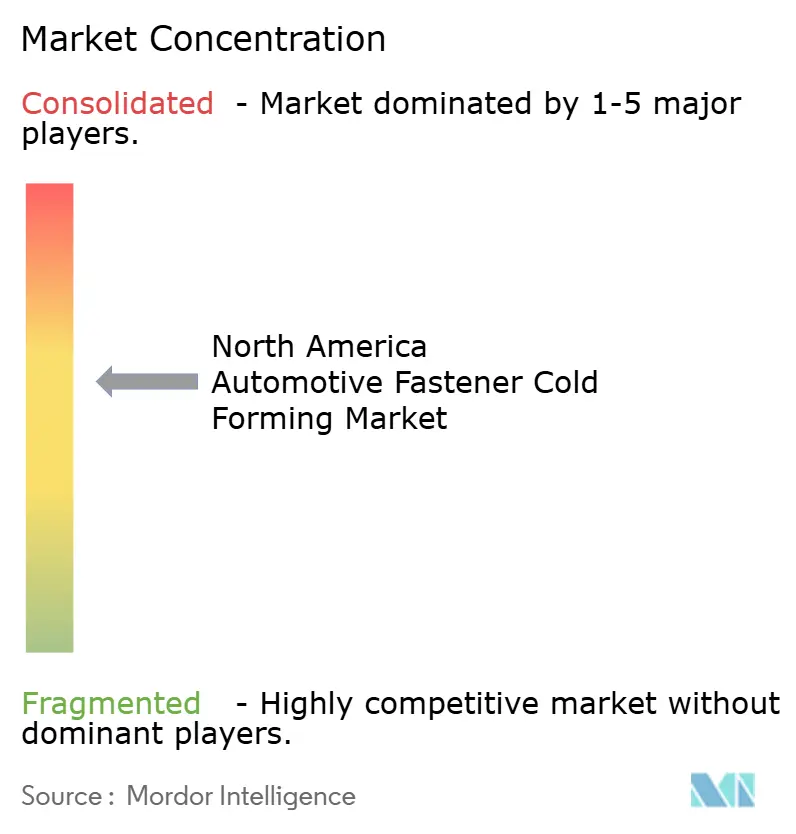
| Market Concentration | Medium |
Major Players *Disclaimer: Major Players sorted in no particular order Image © Mordor Intelligence. Reuse requires attribution under CC BY 4.0. | |
North America Automotive Fastener Cold Forming Market Analysis by Mordor Intelligence
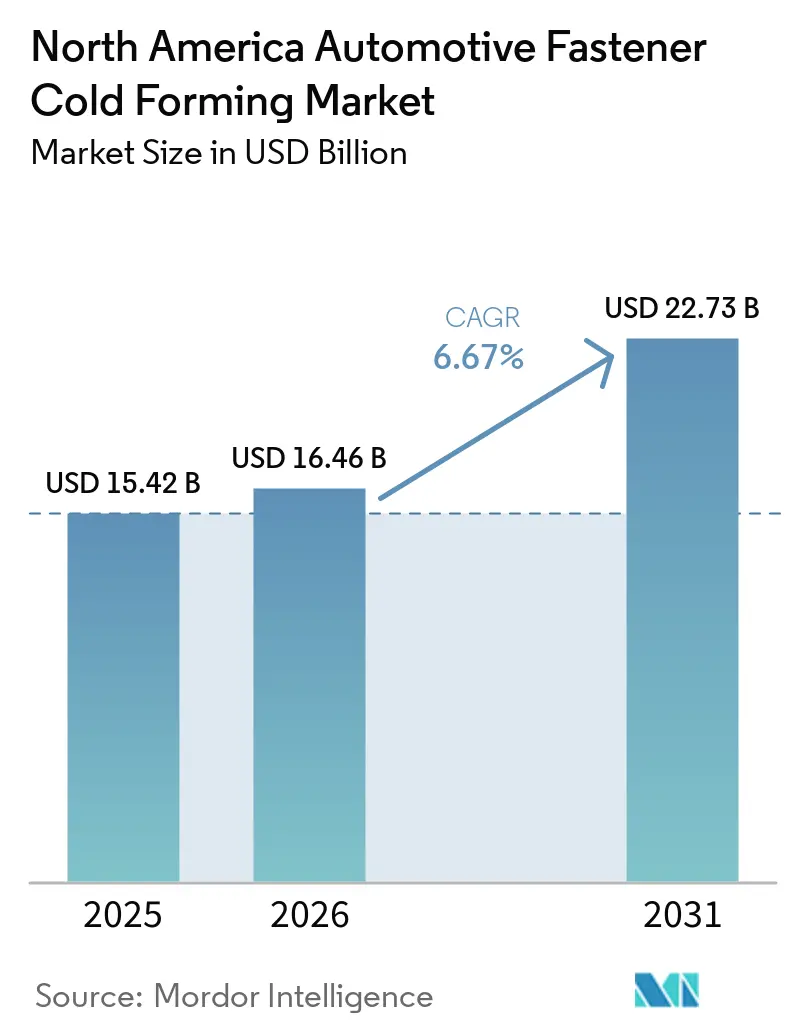
The North America automotive fastener cold forming market is projected to grow from USD 15.42 billion in 2025 to USD 16.46 billion in 2026 and reach USD 22.73 billion by 2031, at a CAGR of 6.67% during the forecast period (2026–2031). Electric propulsion fasteners are experiencing significant growth, even as internal-combustion applications continue to lead in unit volumes. As the weight of vehicles increases, particularly with battery-electric SUVs and trucks being substantially heavier than their gasoline equivalents, aluminum and magnesium fasteners are gaining traction. Technologies like rivets, which seamlessly bond aluminum to advanced high-strength steel without pre-drilling, are driving the transition to multi-material chassis. With USMCA local-content thresholds in play, there's a noticeable pivot towards North American suppliers. Additionally, state incentives are fostering a new cold-heading capacity, specifically tailored for battery plants. On the tech front, machine-vision systems, equipped with extensive defect image databases, are now monitoring high-speed headers, though many pilot programs face challenges during brownfield integration.
Key Report Takeaways
- By material, steel commanded 66.14% revenue share in 2025, whereas aluminum fasteners are advancing at an 8.12% CAGR to 2031.
- By fastener type, bolts led with a 41.25% share in 2025, yet rivets posted the highest projected CAGR at 7.04% through 2031.
- By application, chassis accounted for 32.51% of the 2025 revenue base, and electrical components are moving at an 8.84% CAGR into 2031.
- By distribution channel, the OEM segment held an 87.04% share in 2025, while the aftermarket is on a 7.66% CAGR trajectory through 2031.
- By end-user, automotive OEMs represented 54.11% of sales in 2025; fastener distributors and assemblers expand at a 7.75% CAGR through 2031.
- By vehicle type, light commercial vehicles captured 61.36% share in 2025, while medium and heavy-duty commercial vehicles registered the fastest growth at 9.13% CAGR.
- By propulsion, internal-combustion vehicles held 90.17% of North America's automotive fastener cold forming market share in 2025, while electric platforms are forecast to grow at a 29.46% CAGR through 2031.
- By country, the United States retained an 85.42% share in 2025, while Mexico is projected to grow at a 7.48% CAGR through 2031.
Note: Market size and forecast figures in this report are generated using Mordor Intelligence’s proprietary estimation framework, updated with the latest available data and insights as of January 2026.
North America Automotive Fastener Cold Forming Market Trends and Insights
Drivers Impact Analysis*
| Driver | (~) % Impact on CAGR Forecast | Geographic Relevance | Impact Timeline |
|---|---|---|---|
| EV Skateboard Chassis Adoption | +1.8% | United States, Canada (concentration in Michigan, Tennessee, California) | Medium term (2-4 years) |
| USMCA Local-Content Rules | +1.5% | United States, Mexico, Canada; Mexico tier-2 capacity (Monterrey, Querétaro) and U.S. re-shoring (Midwest, Southeast) | Short term (≤ 2 years) |
| Push for Al and Mg Fasteners | +1.2% | North America-wide; strongest in U.S. EV hubs (MI, TX, TN) and Mexican clusters (Nuevo León, San Luis Potosí) | Medium term (2-4 years) |
| Gigafactory Driving Tier-2 Capacity | +1.0% | United States (MI, TN, TX, KS); Mexico (Nuevo León); Canada (Ontario) | Medium term (2-4 years) |
| Federal/State Tax Credits | +0.7% | United States (MI, TN, OH, KS); limited reach in Mexico/Canada | Short term (≤ 2 years) |
| AI-Guided Defect Detection | +0.5% | Global applicability; early use in the United States and German-owned plants in Mexico | Long term (≥ 4 years) |
| Source: Mordor Intelligence | |||
Rapid EV Skateboard Chassis Adoption
Electric skateboard frames, like Ford's rear underbody megacast, are now using large castings to consolidate structural loads. This innovation has led to a significant reduction in the total count of fasteners. As electric SUVs and pickups come equipped with large battery packs, these fasteners secure essential components like modules, cooling plates, and enclosures, resulting in increased unit fastener intensity. To maintain structural integrity, no-hole stud welding is employed to attach inserts to aluminum castings. With General Motors localizing electric assembly at Fairfax and Spring Hill, there's a surge in demand for specialty fasteners in North America. Additionally, the increased curb weight necessitates the use of high-strength bolts and rivets, designed to withstand heightened suspension loads.
USMCA Local-Content Rules Boosting Regional Sourcing
Under the trade pact, passenger cars must meet specific regional value and labor value requirements. Fastener plants located in Michigan, Ohio, and Illinois are now complemented by new cold-heading clusters in Querétaro, Nuevo León, and León, all working to meet these thresholds [1]. Birmingham Fastener has set up a new unit in Querétaro, while Optimas Solutions has expanded operations in Monterrey, both highlighting the trend of near-shoring. KAMAX operates a facility in León that not only backs OEM programs on both sides of the border but also utilizes its R&D center in Michigan for product validation. Additionally, the Interoceanic Corridor rail route has shortened the transit time from the Pacific to the Atlantic, enhancing the supply chain's agility for both imported wire rods and finished fasteners.
OEM Push for Lightweight Al and Mg Cold-Formed Fasteners
Aluminum-magnesium alloy bolts cut component mass by 60–70% compared with carbon-steel equivalents, meeting range-extension targets. Suppliers now cold-form these alloys to ISO-compliant strength grades while maintaining corrosion resistance. Thread-rolling studies on titanium TC4DT(ELI) reduce forming force, opening niche use in premium EVs. MacLean-Fogg’s MacLite3 series shows how integrated warm forming and precision machining can trim vehicle mass without sacrificing joint reliability. USMCA requires 70% regional steel and aluminum content, which pushes OEMs toward local lightweight fastener sources.
Gigafactory Build-Out Driving Adjacent Tier-2 Capacity
In Tennessee, Michigan, and Ontario, battery cell projects are driving a surge in demand for thermal-management bolts, current-carrying studs, and aluminum rivet nuts. Stanley Engineered Fastening has landed contracts with two North American battery plants focused on electric SUVs and pickups. Component Solutions Group provides fasteners that not only mechanically secure but also create conductive paths within battery modules. Yazaki is expanding its operations in Nuevo León with an investment, boosting its high-voltage wiring capacity, which depends on IP67-rated screw terminals. Additionally, state incentive packages and complete tax holidays in Mexico’s emerging industrial zones are further spurring local investments.
Restraints Impact Analysis*
| Restraint | (~) % Impact on CAGR Forecast | Geographic Relevance | Impact Timeline |
|---|---|---|---|
| Skilled-Labor Shortage | –1.3% | United States, Canada (Midwest clusters); Mexico skilled-trades gaps | Medium term (2-4 years) |
| Steel Wire-Rod Price Volatility | –0.8% | North America-wide; U.S. mills dominate supply, imports from Mexico/Canada | Short term (≤ 2 years) |
| CO₂-Compliance CAPEX Burden | –0.6% | United States, Canada (Scope 3 reporting); EU CBAM on exports; limited near-term effect in Mexico | Long term (≥ 4 years) |
| Substitution for Selected Joints | –0.4% | North America-wide; most prevalent in multi-material EV body structures | Medium term (2-4 years) |
| Source: Mordor Intelligence | |||
Skilled-Labor Shortage in Precision Cold Forming
From 2024 to 2034, the United States is expected to experience a significant decline in employment for forging and machine operators. Similarly, jobs in the manufacturing of screws, nuts, and bolts are projected to decrease even further. By 2026, rising production wages are anticipated to create challenges for mid-sized fastener firms. Training programs, which require extensive time, are crucial to develop skilled multi-station header operators, delaying capacity expansions. While labor costs in Mexico remain comparatively lower, proposed reforms aimed at reducing the workweek and enhancing benefits could lead to notable cost increases. Automation continues to play a critical role in the industry; however, most AI vision pilots fail to progress beyond the proof-of-concept stage due to the lack of standardized lighting and data infrastructure in existing facilities.
CHQ Steel Wire-Rod Price Volatility
In January 2026, cold-heading-quality wire rod prices stabilized after a dip in auto demand late in 2025. Suppliers, bound by long-term OEM contracts, felt the pinch from fluctuating spot prices. North American mills gained leverage as regional-value rules limited cheaper imports from Asia. To safeguard their interests, major fastener companies are either securing multiyear steel supply agreements or establishing in-house drawing facilities. Meanwhile, the EU's Carbon Border Adjustment Mechanism, imposing a charge for imported steel, has driven up material costs in Europe and may shift sourcing preferences towards local mills.
*Our forecasts treat driver/restraint impacts as directional, not additive. The impact forecasts reflect baseline growth, mix effects, and variable interactions.
Segment Analysis
By Material: Aluminum Gains Traction
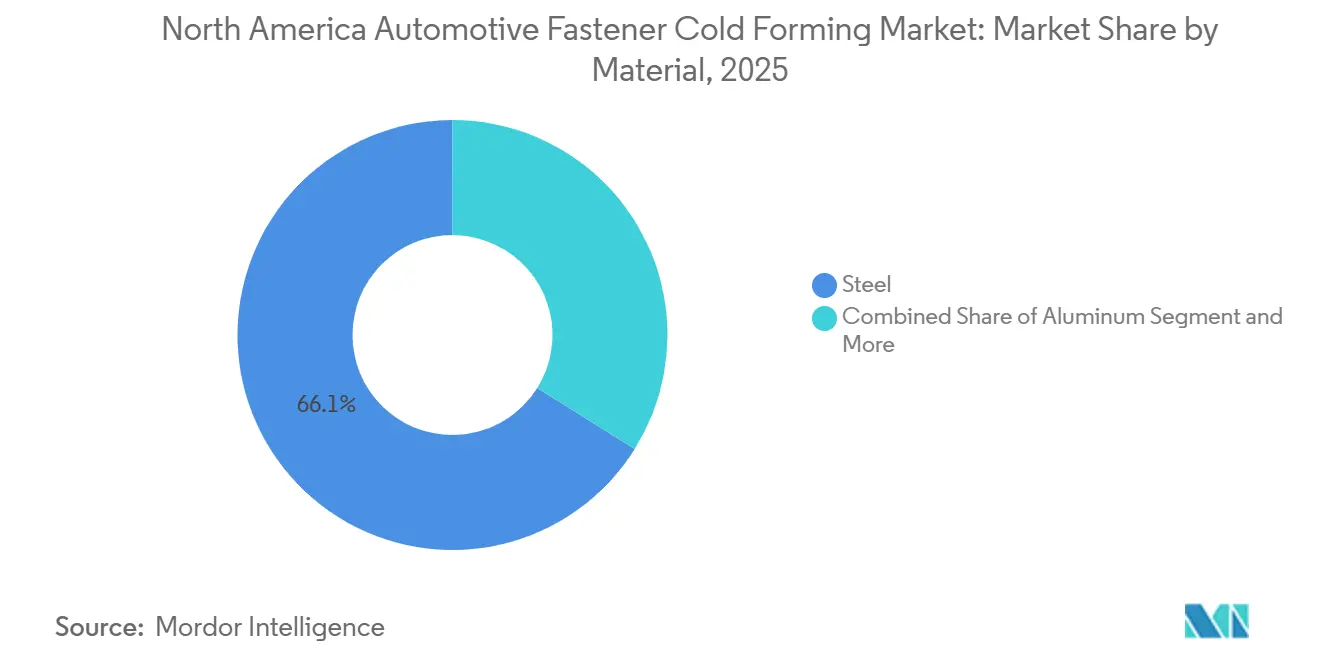
Steel retained 66.14% of 2025 sales, underpinning engine, chassis, and suspension joints across the North American automotive fastener cold forming market. Stainless grades handle corrosion-sensitive areas, and alloy steel supports 1,000 MPa service loads. Aluminum fasteners grow at an 8.12% CAGR as OEMs trim curb weight, while magnesium alloys appear in low-stress battery covers.
Proprietary Al-Mg bolts now match the fatigue life of low-carbon steel and cut mass up to 70%. Titanium remains niche but benefits from a lower thread-forming force, which reduces tool wear. Plastics enter the interior panel attachment, although volume remains small. Local sourcing accelerates because USMCA demands 70% regional metal content, supporting supply-chain resiliency.

By Fastener Type: Rivets Accelerate
Bolts led with 41.25% North America automotive fastener cold forming market share in 2025. They dominate powertrain and suspension assembly, where torque retentiveness is critical. Rivets are the growth engine at a 7.04% CAGR because self-pierce and friction self-pierce processes join aluminum to high-strength steel without pilot holes, a must for EV skateboard frames [2].
Hybrid riv-bonding marries structural adhesive with self-pierce rivets, delivering immediate handling strength and long-term fatigue resistance, particularly in battery trays. Stud-welding inserts for megacastings safeguard casting integrity and shorten cycle time. SAE J1701M and revised ASTM F3125 grades formalize high-strength tightening procedures and anchoring design consistency.
By Application: Electrical Components Outpace Legacy Systems
Chassis assembly comprised 32.51% of 2025 volume as body-in-white, suspension, and subframe joints continue to drive steel bolt demand. Electrical components register the fastest rise at 8.84% CAGR as battery packs and power electronics multiply threaded and riveted joints. Large battery enclosures employ more than 350 fasteners, lifting unit counts despite megacast consolidation.
Current-carrying bolts and thermal-management screws integrate mechanical fixation with conductive or heat-spreading functions. Low-magnetic-permeability stainless steel and aluminum benefit from EMI shielding and corrosion immunity. Steer-by-wire and regenerative braking add new vibration-tolerant joints that conform to LV215 specifications.
By Distribution Channel: OEM Keeps Scale, Aftermarket Gains Speed
The OEM route accounted for 87.04% of 2025 revenue inside the North America automotive fastener cold forming market, supported by direct ship programs, IATF 16949 certification, and vendor-managed inventory. Aftermarket activity moves at a 7.66% CAGR as first-generation EVs begin battery service cycles.
Distributors such as Fastenal and Würth leverage cloud-linked vending machines and big-box hubs to reduce downtime for fleet operators. Specialty EV kits include IP67 fasteners, dielectric washers, and thermal pads, areas where branded service parts command higher margins.
By End-User: Distributors Capture Complexity-Driven Growth
Automotive OEMs held 54.11% share in 2025, yet fastener distributors and assemblers expand at 7.75% CAGR by bundling design support, kitting, and predictive replenishment. Tier-1 module makers depend on sequenced kits to feed mixed-model production lines, reducing on-line inventory.
MacLean-Fogg integrates warm forging, cold extrusion, and injection molding across several U.S. sites, letting OEMs outsource non-core fastening tasks. USMCA wage floors steer higher-value sub-assemblies toward U.S. and Canadian plants while commodity parts remain in Mexico, producing a three-tier regional network.
By Vehicle Type: Heavy Trucks Pull Ahead
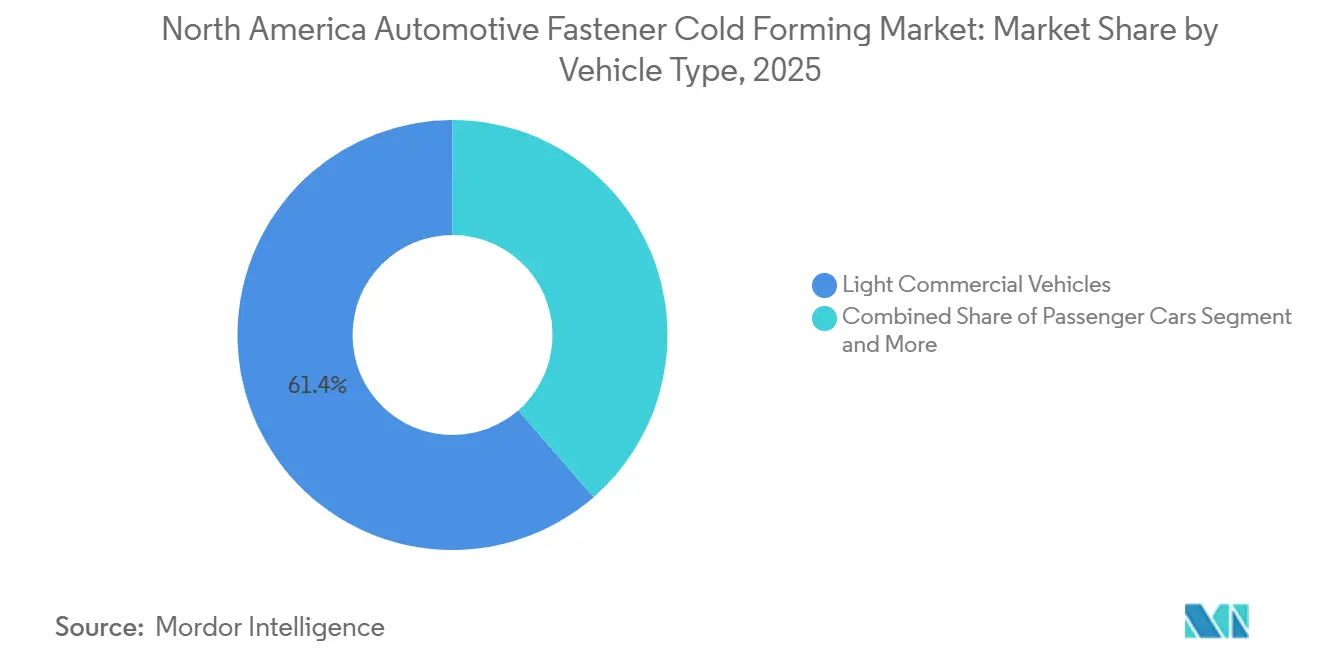
Light commercial vehicles supplied 61.36% of 2025 demand, mirroring North America’s pickup and SUV mix. Medium and heavy-duty vehicles surge at a 9.13% CAGR because large battery packs require 1,000-N·m-class bolts and vibration-proof rivets.
ASTM F3125’s new 144 KSI grade aligns with these higher tensile needs. State voucher programs and zero-emission mandates in California and New York accelerate electric truck adoption, lifting demand for high-strength, corrosion-protected fasteners in Class 8 chassis.
By Propulsion: Electric Gains Ground
Internal-combustion vehicles still consumed 90.17% of units in 2025, yet battery-electric platforms push the fastest growth with 29.46% CAGR. Each EV carries 15–25% more fasteners because of battery, cooling, and high-voltage cabling, although megacasting removes some body-in-white bolts.
Battery-pack fasteners must survive -40 °C to +85 °C cycles and maintain IP67 seals. Cold-formed aluminum and coated steel designs meet galvanic-corrosion limits when joining aluminum enclosures to steel subframes. Hybrid vehicles bridge the transition by blending ICE and EV fastener sets.
Geography Analysis
The United States retained 85.42% of 2025 revenue, driven by Michigan, Tennessee, Texas, and Kansas assembly corridors. Gigafactory clustering within 200 miles of vehicle plants creates just-in-time pull for specialty fasteners. However, the Bureau of Labor Statistics projects an 18.9% decline in forging-machine operators by 2034, which may cap U.S. capacity expansion [3].
Mexico posts the quickest pace with 7.48% CAGR as new cold-heading lines in Querétaro, Nuevo León, and León come online to serve battery and vehicle plants. Birmingham Fastener, Optimas Solutions, and Yazaki have all announced incremental investments to localize supply and exploit tax holidays in federal industrial zones. Rail upgrades connecting Salina Cruz and Coatzacoalcos shorten Pacific-Atlantic transit, aiding wire-rod imports and finished-fastener exports. Rising Mexican wages and potential labor-law reforms could trim the cost gap but still leave an advantage over U.S. locations.
Canada remains a smaller share yet benefits from Ontario’s proximity to Detroit OEM hubs. New joint ventures, such as ATM Automotive Parts in Ontario, add aluminum body-frame capability that requires lightweight fasteners. Energy costs and a similar skilled-labor crunch restrain larger-scale cold-heading expansions.
Competitive Landscape
In North America, a handful of players dominate the automotive fastener cold forming market. Stanley Engineered Fastening, Illinois Tool Works, LISI Automotive, and Bulten AB hold a significant share of the market's shipments. Notably, Stanley Engineered Fastening provides fasteners for the majority of the region's vehicles and maintains an impressive portfolio of patents filed annually.
Leading-edge technologies include self-pierce riveting, AI-driven vision inspections, and mixed-material stud welding. Suppliers employing in-house wire-drawing and heat-treatment techniques can better navigate steel price fluctuations and reduce lead times. Bulten's innovative Full Service Provider model integrates design, logistics, and inventory management, effectively reducing the working capital demands on OEMs [4].
New market entrants are focusing on conductive fasteners for battery interconnections, titanium bolts tailored for high-end electric vehicles, and hybrid adhesive-rivet solutions for aluminum battery trays. While 36ZERO Vision, a machine-vision expert, has developed a comprehensive image library for real-time detection of head cracks and shank laps, many automotive plants are still in the pilot phase of implementation. Recent ISO updates addressing hydrogen embrittlement and SAE's torque-tension guidelines present new compliance challenges, benefitting companies with a strong metallurgical expertise.
North America Automotive Fastener Cold Forming Industry Leaders
-
Stanley Engineered Fastening
-
Illinois Tool Works (ITW)
-
Fontana Gruppo
-
LISI Automotive
-
Würth Group
- *Disclaimer: Major Players sorted in no particular order
Recent Industry Developments
- April 2026: Aisin began contract production of Mazda six-speed automatic transmissions at Aisin Drivetrain Inc., Indiana, to meet growing demand for localized driveline supply in North America.
- February 2026: Aisin, Toyota Tsusho, and Minth formed ATM Automotive Parts Inc. in Ontario to manufacture aluminum body-frame parts that house batteries in BEVs and PHEVs.
North America Automotive Fastener Cold Forming Market Report Scope
The scope includes segmentation by material (steel [carbon steel, alloy steel, and stainless steel], aluminum, brass, titanium, and plastic/polymer composites), fastener type (bolts, screws, nuts, rivets, studs, and washers and others), application (engine assembly, transmission systems, chassis, powertrain, suspension system, body interior/exterior, brake system, steering system, and electrical components), distribution channel (OEM and aftermarket), end-user (automotive OEMs, tier-1 suppliers, and astener distributors and assemblers), vehicle type (passenger cars, light commercial vehicles, and medium and heavy-duty commercial vehicles), propulsion (internal combustion engine and electric). The analysis also covers country-level segmentation, including the United States, Canada, Mexico, and the rest of North America. Market size and growth forecasts are presented by value in USD.
| Steel | Carbon Steel |
| Alloy Steel | |
| Stainless Steel | |
| Aluminum | |
| Brass | |
| Titanium | |
| Plastic/Polymer Composites |
| Bolts |
| Screws |
| Nuts |
| Rivets |
| Studs |
| Washers and Others |
| Engine Assembly |
| Transmission Systems |
| Chassis |
| Powertrain |
| Suspension System |
| Body Interior/Exterior |
| Brake System |
| Steering System |
| Electrical Components |
| OEM |
| Aftermarket |
| Automotive OEMs |
| Tier-1 Suppliers |
| Fastener Distributors and Assemblers |
| Passenger Cars |
| Light Commercial Vehicles |
| Medium and Heavy-duty Commercial Vehicles |
| Internal Combustion Engine (ICE) |
| Electric |
| United States |
| Canada |
| Mexico |
| Rest of North America |
| By Material | Steel | Carbon Steel |
| Alloy Steel | ||
| Stainless Steel | ||
| Aluminum | ||
| Brass | ||
| Titanium | ||
| Plastic/Polymer Composites | ||
| By Fastener Type | Bolts | |
| Screws | ||
| Nuts | ||
| Rivets | ||
| Studs | ||
| Washers and Others | ||
| By Application (Vehicle Sub-system) | Engine Assembly | |
| Transmission Systems | ||
| Chassis | ||
| Powertrain | ||
| Suspension System | ||
| Body Interior/Exterior | ||
| Brake System | ||
| Steering System | ||
| Electrical Components | ||
| By Distribution Channel | OEM | |
| Aftermarket | ||
| By End-User | Automotive OEMs | |
| Tier-1 Suppliers | ||
| Fastener Distributors and Assemblers | ||
| By Vehicle Type | Passenger Cars | |
| Light Commercial Vehicles | ||
| Medium and Heavy-duty Commercial Vehicles | ||
| By Propulsion | Internal Combustion Engine (ICE) | |
| Electric | ||
| By Country | United States | |
| Canada | ||
| Mexico | ||
| Rest of North America |
Key Questions Answered in the Report
What is the North American automotive fastener cold forming market size forecast for 2031?
The market is expected to reach USD 22.73 billion by 2031, reflecting a CAGR of 6.67% from 2026 to 2031.
Which propulsion category will add the most fastener demand by 2031?
Battery-electric vehicles grow fastest at a 29.46% CAGR, lifting unit fastener counts for batteries, cooling plates, and high-voltage wiring.
Which fastener type is outpacing the overall market?
Self-pierce and friction self-pierce rivets register a 7.04% CAGR because they join aluminum to advanced high-strength steel in EV chassis.
Why is aluminum gaining share in cold-formed automotive fasteners?
Al-Mg bolts cut component mass up to 70%, helping offset heavier battery packs, and they grow at an 8.12% CAGR to 2031.