
Automotive Brake Linings Market Size and Share
Market Overview
| Study Period | 2019 - 2030 |
|---|---|
| Market Size (2025) | USD 3.95 Billion |
| Market Size (2030) | USD 4.81 Billion |
| Growth Rate (2025 - 2030) | 4.02 % |
| Fastest Growing Market | North America |
| Largest Market | Asia Pacific |
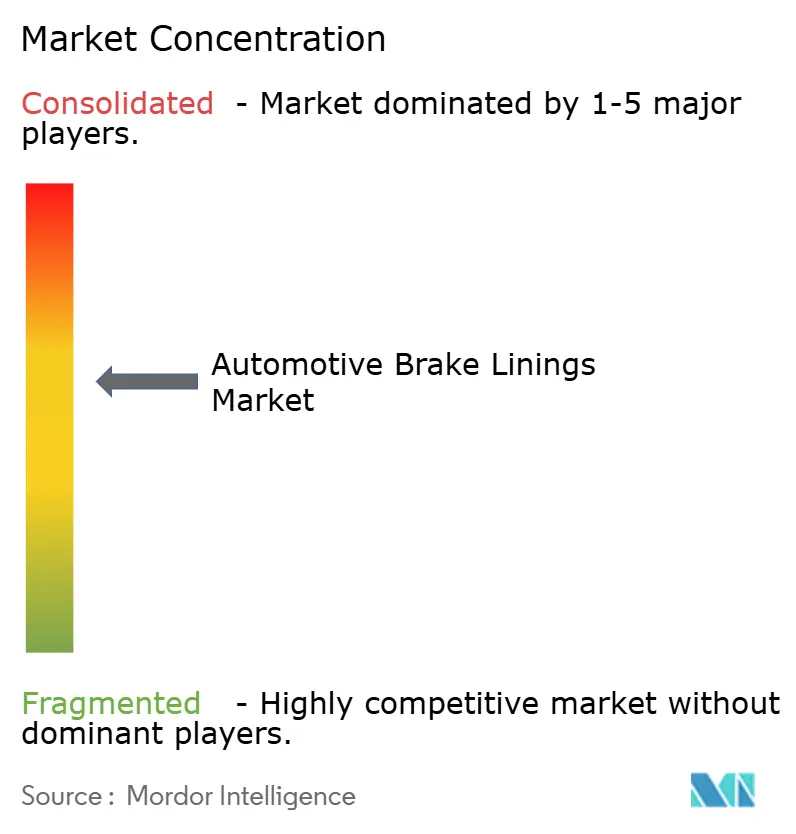
| Market Concentration | Medium |
Major Players *Disclaimer: Major Players sorted in no particular order Image © Mordor Intelligence. Reuse requires attribution under CC BY 4.0. | |

Automotive Brake Linings Market Analysis by Mordor Intelligence
The automotive brake linings market size is valued at USD 3.95 billion in 2025 and is forecast to reach USD 4.81 billion by 2030, advancing at a 4.02% CAGR. This trajectory underscores how the automotive brake linings market remains resilient even as electrification, regenerative braking, and advanced driver-assistance systems redefine braking architectures. Regulatory pressure on copper and asbestos, surging commercial vehicle mileage, and the accelerated shift from drum to disc systems widen the addressable demand pool. Manufacturers that master low-emission formulations, predictive-maintenance sensor integration, and rapid prototyping platforms are capturing share from slower rivals. Meanwhile, raw-material volatility and concentrated specialty-fiber supply chains force continuous cost-engineering and supplier-diversification efforts.
Key Report Takeaways
- By brake type, disc brake linings led with 65.12% of the automotive brake linings market share in 2024; drum replacements linked to rear-axle conversions are projected to grow at a 4.65% CAGR through 2030.
- By material type, non-asbestos formulas maintained 49.33% of the automotive brake linings market share in 2024, while ceramic brake linings commanded the fastest expansion, moving at a 5.12% CAGR to 2030.
- By application, front-axle products captured 58.16% of the automotive brake linings market share in 2024; rear-axle linings are expected to post a 6.25% CAGR between 2025-2030.
- By vehicle type, passenger vehicles held 61.25% of the automotive brake linings market share in 2024, although light commercial vehicles outpaced all segments with a 5.63% CAGR through 2030.
- By geography, Asia-Pacific retained 38.45% of the automotive brake linings market share in 2024, while North America is forecast to climb at a 6.03% CAGR from 2025-2030.
Note: Market size and forecast figures in this report are generated using Mordor Intelligence’s proprietary estimation framework, updated with the latest available data and insights as of January 2026.
Market Trends and Insights
Drivers Impact Analysis of Automotive Brake Linings Market*
| Driver | (~) % Impact on CAGR Forecast | Geographic Relevance | Impact Timeline |
|---|---|---|---|
| Regulatory Bans On Materials | +1.2% | EU, North America, global spill-over | Medium term (2-4 years) |
| Rising Vehicle Population And Aftermarket | +0.8% | APAC, North America | Long term (≥ 4 years) |
| Shift From Drum To Disc Brakes | +0.6% | APAC core, MEA spill-over | Medium term (2-4 years) |
| Smart Linings With Wear Sensors | +0.4% | North America, the EU, and expanding APAC | Long term (≥ 4 years) |
| 3-D Printed Custom Formulations | +0.3% | North America, EU | Long term (≥ 4 years) |
| Autonomous Fleet Low-PM Demand | +0.2% | North America, EU, APAC pilots | Long term (≥ 4 years) |
| Source: Mordor Intelligence | |||
Regulatory Bans on Asbestos and Copper
Euro 7 introduces brake-particle limits that require copper-free and asbestos-free recipes across the European Union by 2026, while California’s copper rules accelerate similar North American mandates [1]“Euro 7—New Emission Standards for Cars, Vans and Heavy-Duty Vehicles,” United Nations Economic Commission for Europe, unece.org. Formulators with advanced tribology labs and validated eco-friendly chemistries shorten approval windows for OEM sourcing programs and secure premium pricing. The expanding ban aligns global requirements, giving suppliers with multinational certification portfolios a first-mover advantage in the automotive brake linings market.
Rising Global Vehicle Parc and Aftermarket Replacement Cycles
The global vehicle fleet will grow significantly in 2025, with the average age in mature markets edging above 12 years. Older cars and trucks need pads more often, and heavy-duty trucks logging 120,000-150,000 miles annually replace linings every 12-18 months. This consistent replacement pulls the automotive brake linings market upward even when new-vehicle output softens.
Transition From Drum to Disc Brakes Increasing Low-Noise, High-Performance Lining Demand
Disc systems dissipate heat, support stability-control modules, and operate more quietly than drum assemblies, prompting passenger-car and commercial-vehicle manufacturers to retrofit rear axles and specify disc brakes on new platforms. Premium blends optimized for fade resistance and vibration control lift unit prices and enlarge the value pool for innovators within the automotive brake linings market.
Adoption of Smart Linings with Embedded Wear-Sensors for Predictive Maintenance
Pads outfitted with conductive traces or RFID tags relay real-time thickness and temperature data to fleet portals, reducing brake-related failures and trimming lifecycle cost for early adopters. The technology links hardware sales to subscription analytics, providing a recurring-revenue layer that raises switching costs for fleet customers.
Restraints Impact Analysis of Automotive Brake Linings Market*
| Restraint | (~) % Impact on CAGR Forecast | Geographic Relevance | Impact Timeline |
|---|---|---|---|
| EV Regenerative Braking Reduces Duty Cycles | -0.9% | EU, North America, global spill-over | Medium term (2-4 years) |
| Raw-Material Price Volatility | -0.6% | Worldwide | Short term (≤ 2 years) |
| Compliance Costs for Particulate Rules | -0.4% | EU, North America, widening | Medium term (2-4 years) |
| Specialty Fiber Supply Chain Concentration | -0.3% | Global, APAC exposure | Short term (≤ 2 years) |
| Source: Mordor Intelligence | |||
EV Regenerative Braking Reducing Friction-Brake Duty Cycles
Battery-electric drivetrains recapture 60-70% of kinetic energy, extending pad life from roughly 40,000 miles to beyond 100,000 miles in stop-and-go traffic [2]“Regenerative Braking Impact on Friction Pads,” Andreas Müller, Environmental Science and Pollution Research, springer.com. Reduced wear tempers aftermarket volume but triggers R&D in corrosion-resistant, instant-bite formulations to ensure readiness after long idle intervals, particularly in colder climates.
Raw-Material Price Volatility (Phenolic Resins, Aramid Fibers)
Phenolic shortages lifted prices in 2024, while energy swings drove aramid spikes, squeezing smaller suppliers’ margins. Substituting lignin-phenolic hybrids or basalt reinforcements eases exposure but demands lengthy validation, complicating just-in-time inventory strategies across the automotive brake linings market.
*Our forecasts treat driver/restraint impacts as directional, not additive. The impact forecasts reflect baseline growth, mix effects, and variable interactions.
Automotive Brake Linings Market Segment Analysis
By Brake Type:
Disc systems steer structural changeDisc pads accounted for 65.12% of the automotive brake linings market share in 2024 and are forecast to expand at a 4.65% CAGR, reflecting new-platform specifications and rear-axle retrofits that increase heat-dissipation and noise-reduction performance. Disc products enjoy a stable aftermarket pull within the automotive brake linings market because every OE fitment yields multiyear replacement streams.
Drum pads still serve entry models and mechanical parking mechanisms, but their share erodes steadily. Makers deploy copper-free organic blends and vibration-control shims to defend remaining niches, yet many factories pivot capacity toward disc output to align with future volume.



By Material Type:
Ceramic pushes performance frontierNon-asbestos organic formulas captured 49.33% of the automotive brake linings market share in 2024, underlining success in eliminating carcinogenic fibers. Ceramic linings are projected to grow at a 5.12% CAGR as luxury OEMs prioritize dust-free wheels, quiet brake engagement, and extended rotor life.
Semi-metallic pads dominate vocational trucks for their high thermal threshold, while copper-free lines gain momentum in U.S. regions enacting 0.5% copper ceilings. Across the automotive brake linings industry, teams juggle binder swaps, fiber scarcity, and metal-powder costs, feeding an arms race for proprietary recipes that can clear Euro 7 particle limits without inflating price beyond fleet budgets.
By Application:
Front-rear dynamics tighten design loopsFront-axle pads generated 58.16% of the automotive brake linings market share in 2024 since front calipers carry 60-70% of braking energy. Electrification and stability-control logic increase rear-axle engagement, promoting disc conversions and driving a 6.25% rear-axle CAGR through 2030.
Aftermarket catalogs now segment rear-disc pads by electronic parking-brake motor interface and automated emergency braking compatibility. The shift rebalances formulation priorities toward low-temperature bite and corrosion resistance as rear brakes experience longer idle spells yet must deliver instantaneous friction for stability events.

By Vehicle Type:
Commercial use cases acceleratePassenger cars supplied 61.25% of the automotive brake linings market share in 2024, yet light commercial vans and pickups registered the strongest 5.63% CAGR thanks to e-commerce and gig-delivery mileage surges. Fleets demand sensor-ready pads that fit predictive-maintenance dashboards, spurring suppliers to embed RFID or loop circuits in high-volume SKUs.
Medium and heavy trucks absorb thicker pads and pricier semi-metallic blends, making each replacement set more valuable. Suppliers serving these operators package linings with rotor machining services and telematics insights, deepening customer stickiness in the highly competitive automotive brake linings market.
Geography Analysis
APAC Automotive Brake Linings Market
Asia-Pacific sustained a 38.45% of the automotive brake linings market share in 2024, leveraging China’s 30-million-unit vehicle output and India’s expanding parc. Domestic producers meet entry-level price points, while Japanese and Korean labs create copper-free chemistries exported worldwide. Regulatory convergence toward Euro-aligned particle caps raises compliance costs, encouraging alliances between local factories and global formulation houses.
North America Automotive Brake Linings Market
North America leads growth at a 6.03% CAGR. California’s copper ban and early sensor adoption in Class-8 fleets accelerate premium pad uptake. Electric-pickup programs necessitate low-corrosion instant-bite pads, and autonomous truck pilots stipulate ultralow particulate outputs, widening revenue streams for U.S. and Canadian friction innovators in the automotive brake linings market.
EMEA and South America Automotive Brake Linings Market
Europe maintains steady momentum under Euro 7 timelines that demand dynamometer particle counts and decibel caps. German, French, and Italian test centers anchor global certification pipelines, while Central European plants supply cost-optimized aftermarket pads. The Middle East and Africa gain from infrastructure and ride-hailing growth, whereas South American demand fluctuates with currency cycles yet remains buoyed by commercial-vehicle replacement volume.


Competitive Landscape
Akebono, Brembo, and Tenneco command a significant share of global shipments, leveraging scale to secure aramid contracts and dynamometer capacity. Brembo’s USD 405 million acquisition of Öhlins in 2024 aligned premium damping and braking stacks under one R&D roof, enhancing integration potential for autonomous-ready modules [3]“Acquisition of Öhlins Completed,” Brembo Investor Relations, brembo.com. Akebono's sensor-embedded pads for electric SUVs helped tap predictive maintenance revenue and reinforce OE ties.
ZF Friedrichshafen rolled out brake-by-wire systems in 2025, altering pad performance envelopes and opening co-development opportunities for friction suppliers attuned to electronic actuation. Regional challengers in India, China, and Turkey compete on cost and proximity, yet face steeper regulatory hurdles as Euro-style particulate and copper bans diffuse. Specialty-fiber scarcity pushes large firms toward backward integration in nano-ceramic powders and lignin derivatives, boosting resilience yet raising capital requirements.
The automotive brake linings market favors manufacturers that own proprietary materials, hold cross-regional certifications, and embed digital features. Suppliers unable to meet emissions, noise, and sensor compatibility benchmarks risk relegation to legacy niches or aftermarket overstock.
Automotive Brake Linings Industry Leaders
Tenneco, Inc.
Akebono Brake Industry Co., Ltd.
Nisshinbo Holdings Inc.
Robert Bosch GmbH
Continental AG
- *Disclaimer: Major Players sorted in no particular order
Automotive Brake Linings Market Companies Covered in this Report
- Tenneco, Inc.
- Akebono Brake Industry Co., Ltd.
- Nisshinbo Holdings Inc.
- Continental AG
- Robert Bosch GmbH
- ZF Friedrichshafen AG
- Brembo S.p.A.
- BorgWarner (Delphi Technologies)
- ADVICS Co., Ltd.
- Carlisle Brake & Friction
- Rane Brake Lining Ltd.
- Sundaram Brake Linings Ltd.
- Sangsin Brake
- Honeywell International
- MAT Holdings, Inc.
- Hitachi Astemo
- Knorr-Bremse AG
- Haldex AB
- Miba AG
- Valeo SA (Valeo Service)

Recent Industry Developments in Automotive Brake Linings Market
- July 2025: ZF Friedrichshafen unveiled brake-by-wire architectures requiring pads formulated for electronic actuation precision and low residual drag.
- February 2025: Waabi and Volvo Trucks partnered to integrate autonomous freight platforms with ultra-low particulate linings aimed at minimizing aftermarket replacements.


Global Automotive Brake Linings Market Report Scope
| Disc Brake Linings |
| Drum Brake Linings |
| Asbestos-Based Brake Linings |
| Non-Asbestos Brake Linings |
| Ceramic Brake Linings |
| Semi-Metallic Brake Linings |
| Copper-Free Brake Linings |
| Front Brake Linings |
| Rear Brake Linings |
| Passenger Vehicles |
| Light Commercial Vehicles |
| Medium and Heavy Commercial Vehicles |
| North America | United States |
| Canada | |
| Rest of North America | |
| South America | Brazil |
| Argentina | |
| Rest of South America | |
| Europe | United Kingdom |
| Germany | |
| Spain | |
| Italy | |
| France | |
| Russia | |
| Rest of Europe | |
| Asia-Pacific | India |
| China | |
| Japan | |
| South Korea | |
| Rest of Asia-Pacific | |
| Middle East and Africa | United Arab Emirates |
| Saudi Arabia | |
| Turkey | |
| Egypt | |
| South Africa | |
| Rest of Middle East and Africa |
| By Brake Type | Disc Brake Linings | |
| Drum Brake Linings | ||
| By Material Type | Asbestos-Based Brake Linings | |
| Non-Asbestos Brake Linings | ||
| Ceramic Brake Linings | ||
| Semi-Metallic Brake Linings | ||
| Copper-Free Brake Linings | ||
| By Application | Front Brake Linings | |
| Rear Brake Linings | ||
| By Vehicle Type | Passenger Vehicles | |
| Light Commercial Vehicles | ||
| Medium and Heavy Commercial Vehicles | ||
| By Geography | North America | United States |
| Canada | ||
| Rest of North America | ||
| South America | Brazil | |
| Argentina | ||
| Rest of South America | ||
| Europe | United Kingdom | |
| Germany | ||
| Spain | ||
| Italy | ||
| France | ||
| Russia | ||
| Rest of Europe | ||
| Asia-Pacific | India | |
| China | ||
| Japan | ||
| South Korea | ||
| Rest of Asia-Pacific | ||
| Middle East and Africa | United Arab Emirates | |
| Saudi Arabia | ||
| Turkey | ||
| Egypt | ||
| South Africa | ||
| Rest of Middle East and Africa | ||


Key Questions Answered in the Report
What is the value of the automotive brake linings market in 2025?
The market is valued at USD 3.95 billion in 2025 and is projected to reach USD 4.81 billion by 2030.
What CAGR is expected for brake linings through 2030?
A compounded annual growth rate of 4.02% is forecast for 2025-2030.
Which lining material segment is expanding the fastest?
Ceramic pads are growing at a 5.12% CAGR due to low dust, high thermal stability, and emissions compliance.
Why is North America the fastest-growing regional market?
Stricter copper bans, high commercial-vehicle mileage, and early adoption of smart pads lift regional growth to a 6.03% CAGR.
Page last updated on:





