
Mexico Mining Equipment Market Size and Share
Market Overview
| Study Period | 2019 - 2031 |
|---|---|
| Forecast Data Period | 2026 - 2031 |
| Base Year Market Size (2025) | USD 2.31 Billion |
| Market Size (2026) | USD 2.51 Billion |
| Market Size (2031) | USD 3.84 Billion |
| Growth Rate (2026 - 2031) | 8.82 % |
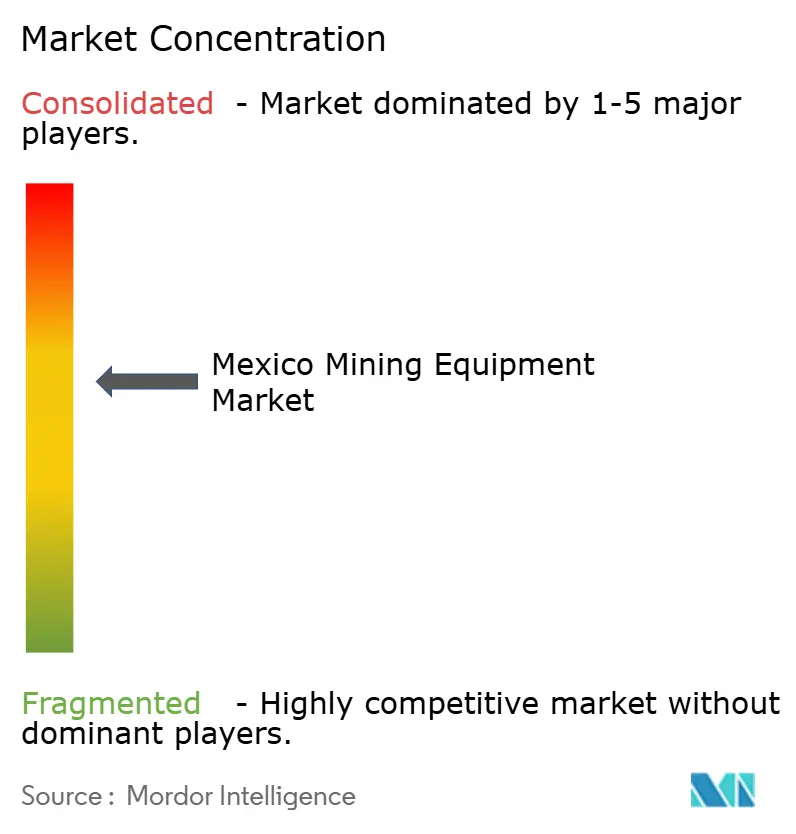
| Market Concentration | Medium |
Major Players
*Disclaimer: Major Players sorted in no particular order Image © Mordor Intelligence. Reuse requires attribution under CC BY 4.0. |
|
Mexico Mining Equipment Market Analysis by Mordor Intelligence
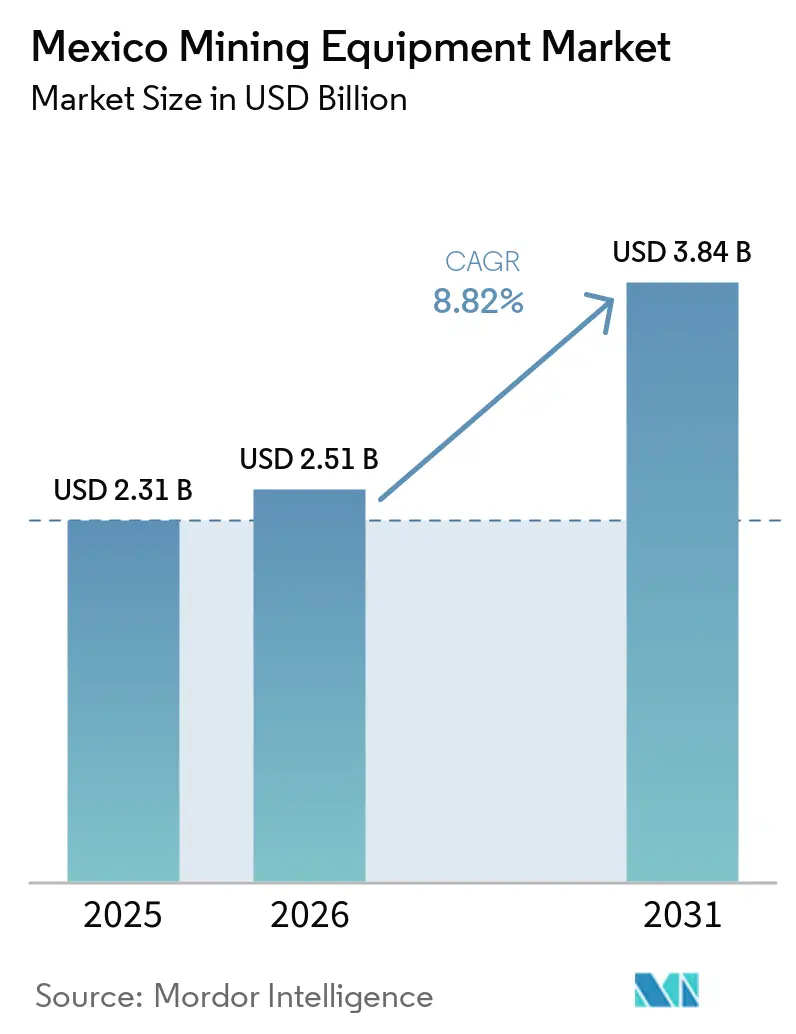
The Mexico mining equipment market size was valued at USD 2.31 billion in 2025 and is estimated to grow from USD 2.51 billion in 2026 to reach USD 3.84 billion by 2031, at a CAGR of 8.82% during the forecast period (2026-2031), with equipment purchases reflecting the combined effects of project schedules, mine operating plans, fleet condition, and the availability of specialized service support. Demand is being supported by mine development activity in northern states, where open-pit copper operations require large fleets and related support services that can be mobilized, maintained, and supplied under demanding operating conditions across varied mine locations and operational settings over the operating period. Fleet replacement is also becoming more important as operators evaluate lower-emission equipment, remote operation, and systems that improve maintenance planning while considering the practical limits of power, workforce readiness, and established maintenance routines. Tax measures for new fixed assets can make replacement decisions easier. However, procurement still depends on site conditions and available power, as well as each operator’s ability to organize installation, servicing, and daily equipment use.
Key Report Takeaways
- By equipment type, surface mining equipment accounted for 40.73% of the Mexican mining equipment market share in 2025, and the same segment is projected to record the highest CAGR of 12.74% through 2031.
- By automation level, manual equipment held 61.18% of the Mexican mining equipment market share in 2025, while fully autonomous equipment is expected to grow with the highest projected CAGR of 16.03% through 2031.
- By powertrain type, internal-combustion engine equipment held an 87.51% share in 2025, while battery-electric vehicles are projected to record the highest CAGR of 17.45% through 2031.
- By power output, the 500-to-1,000 HP band held 49.24% share in 2025, while the above-1,000 HP band is set to record the highest projected CAGR of 9.51% through 2031.
- By application, metal mining held 55.79% share in 2025, while mineral mining is projected to record the highest projected CAGR of 11.25% through 2031.
Note: Market size and forecast figures in this report are generated using Mordor Intelligence’s proprietary estimation framework, updated with the latest available data and insights as of January 2026.
Mexico Mining Equipment Market Trends and Insights
Drivers Impact Analysis*
| Driver | (~) % Impact on CAGR Forecast | Geographic Relevance | Impact Timeline |
|---|---|---|---|
| Open-Pit Copper Projects | +2.8% | Sonora (Cananea, Buenavista, El Pilar, La Caridad corridor) | Medium term (2-4 years) |
| Incentives for Low-Carbon Haulage Fleets | +1.8% | Nationwide, with early concentration in Sonora, Chihuahua, Zacatecas | Short term (≤ 2 years) |
| OEM Digital-Twin Service Contracts | +1.3% | Sonora, Zacatecas, Guerrero (sites with active OEM service agreements) | Short term (≤ 2 years) |
| Cross-Border Financing | +1.0% | Sonora, Zacatecas, Chihuahua, Coahuila | Medium term (2-4 years) |
| Expansion of Lithium Exploration | +0.4% | Sonora (Bacadehuachi), Baja California | Long term (≥ 4 years) |
| Overhaul of Mining Royalty Regime | +0.2% | Nationwide; heightened significance in Zacatecas, Sonora, Chihuahua | Short term (≤ 2 years) |
| Source: Mordor Intelligence | |||
Surge in Open-Pit Copper Projects, Especially in Sonora
The Mexican mining equipment market is closely linked to the development pipeline around Sonora’s large copper operations. Southern Copper received environmental approval for El Pilar in July 2026, supporting the project’s progression toward site preparation and subsequent construction[1]Juan Martinez, "Southern Copper Secures El Pilar Permits in Sonora," The Rio Times, riotimesonline.com. The project adds to a corridor that already has established mine infrastructure, parts supply, and trained service personnel. This concentration can reduce the difficulty of mobilizing equipment and support teams for new work. It also favors suppliers that can provide haulage, drilling, maintenance, and field support from a coordinated local base. As projects move forward, the Mexican mining equipment market can benefit from demand for new machines, replacement components, and technical services.
Federal Incentives for Low-Carbon Haulage Fleets
Fleet investment is increasingly shaped by the operating economics of newer equipment rather than by purchase price alone. The accelerated-depreciation framework in Plan México supports investment in eligible fixed assets and can improve the timing of fleet replacement. This matters for buyers considering battery-electric, hybrid, and more efficient diesel equipment, especially where older machines carry higher operating burdens. The Mexican mining equipment market, therefore, presents an opportunity for suppliers that can clearly explain lifecycle costs and provide dependable local support. Remote sites still need practical access to energy, charging, fuel, and maintenance services before technology choices can be scaled. The result is a measured transition where site readiness remains as important as equipment availability.
OEM Digital-Twin Service Contracts Boosting Uptime
Service contracts are becoming increasingly important in the Mexican mining equipment market because unplanned downtime can disrupt mine schedules and increase repair costs. Metso introduced data-driven performance services in 2025 that combine condition monitoring with remote expert support for mining equipment[2]"Metso introduces Data-driven Performance Services to support the mining industry with equipment reliability and performance," Metso, metso.com . These services are relevant to crushing, grinding, and processing systems that operate under demanding conditions. Remote diagnostics can be particularly useful where a mine is far from a supplier workshop or specialized labor pool. Equipment suppliers can deepen customer relationships when parts planning, monitoring, and maintenance advice are delivered together. This supports a shift from one-time equipment transactions toward longer service relationships.
Cross-Border Financing via USMCA-Aligned ESG Funds
Financing conditions can influence the pace at which miners replace equipment and adopt newer technologies. Investors and lenders increasingly look for clear environmental reporting, safety practices, and operational controls when assessing mining projects. Equipment that provides reliable emissions information or supports lower-emission operations can help operators prepare for these expectations. The Mexican mining equipment market may therefore favor suppliers that can document equipment performance across its working life. This advantage is stronger where financing, permitting, and customer requirements are considered together rather than as separate decisions. It can also make service providers and equipment makers more involved in project planning before a purchase order is issued.
Restraints Impact Analysis*
| Restraint | (~) % Impact on CAGR Forecast | Geographic Relevance | Impact Timeline |
|---|---|---|---|
| Permitting Delays after 2023 Mining Law Reforms | -1.4% | Sonora, Chihuahua, Zacatecas, Durango | Medium term (2-4 years) |
| Rising Security Costs | -0.9% | Zacatecas, Guerrero, Sinaloa, Chihuahua, Durango | Long term (≥ 4 years) |
| Intermittent Power-Grid Curtailments | -0.5% | Sonora, Guerrero, Oaxaca, Baja California | Medium term (2-4 years) |
| Peso Volatility | -0.2% | Nationwide | Short term (≤ 2 years) |
| Source: Mordor Intelligence | |||
Permitting Delays After 2023 Mining Law Reforms
Permitting uncertainty can delay mine development and, in turn, defer equipment orders. The mining law reforms have changed the operating context for companies seeking to advance new projects. When project schedules become less predictable, operators often focus on maintaining existing fleets rather than committing to large expansion purchases. The Mexican mining equipment market is affected because equipment requirements usually become clearer once a project reaches the construction and operating stages. Delays can also reduce visibility for dealers, contractors, and parts suppliers that plan around future mine activity. Greater regulatory clarity would help buyers align fleet decisions with confirmed project schedules.
Rising Security Costs in Gold-Silver Belts
Security conditions remain a practical concern for mining operations in several producing areas. Higher security needs can raise operating costs and make managers more cautious about large equipment commitments. They can also change the type of equipment under consideration, particularly when remote operation may reduce personnel exposure. The Mexican mining equipment market may see continued interest in automation-capable loaders, drills, and communication systems in affected regions. However, smaller operators may delay those investments if the upfront requirements exceed available capital. Suppliers that offer training, maintenance coverage, and flexible commercial support are better placed to address these conditions.
*Our forecasts treat driver/restraint impacts as directional, not additive. The impact forecasts reflect baseline growth, mix effects, and variable interactions.
Segment Analysis
By Equipment Type: Surface Mining Supports Copper Project Requirements
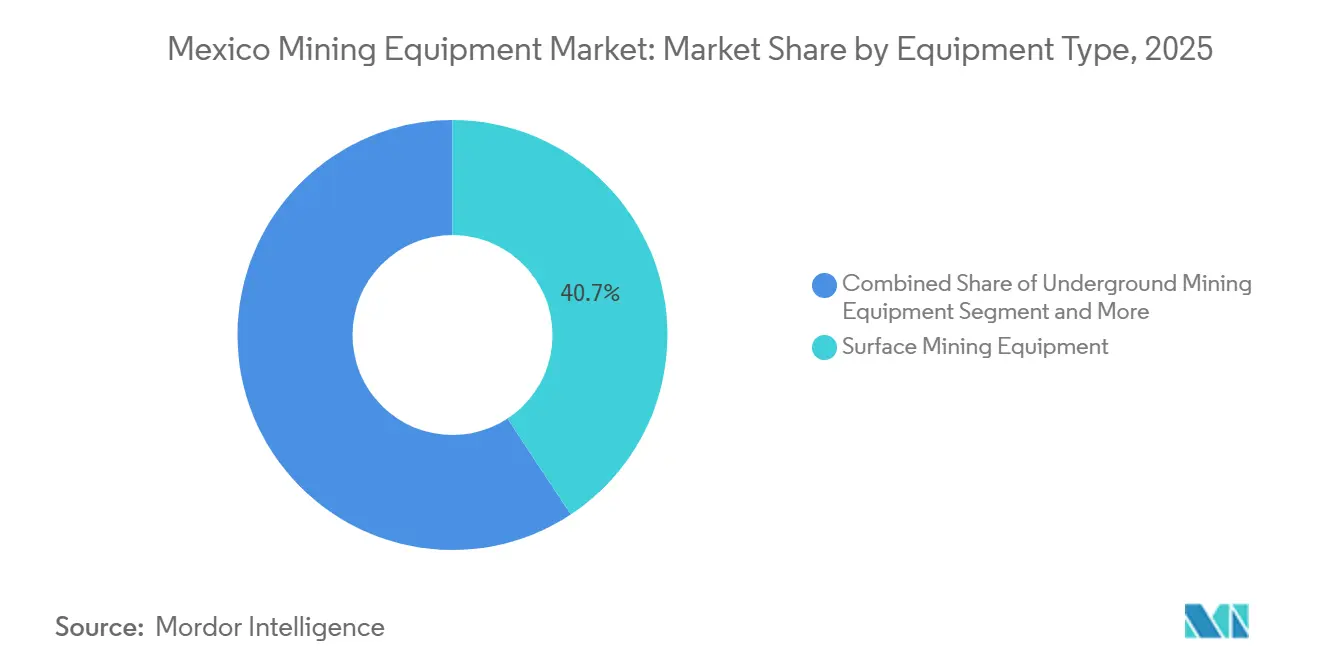
Surface mining equipment accounted for 40.73% of the Mexican mining equipment market in 2025 and is projected to record the highest CAGR of 12.74% through the forecast period. Large open-pit copper operations, especially in northern Mexico, support this segment. Haul trucks, hydraulic shovels, drills, and support machines move material across these sites. Buyers value machine availability because downtime can disrupt pit-wide production. Suppliers that provide parts, field service, and maintenance planning remain critical to fleet performance.
Underground mining equipment remains important for silver, zinc, gold, and other deposits that need different operating methods. Mineral processing equipment, drills and breakers, crushing and screening systems, and other equipment support extraction and material handling. Buyers choose equipment based on mine design, ore characteristics, and installed assets. Suppliers compete by matching machines to local conditions. Strong service capability, specialized attachments, and quick deployment help customers repair, replace, or upgrade equipment while limiting disruption to loading, hauling, processing, and maintenance activities.



By Automation Level: Manual Fleets Remain Important as Autonomous Use Expands
Manual equipment held 61.18% of the Mexican mining equipment market share in 2025, while fully autonomous equipment is expected to record the highest projected CAGR of 16.03% through the forecast period. Manual fleets remain common where operating practices, workforce skills, and capital plans were built around conventional equipment. Operators can add remote functions in stages, retain serviceable machines, and test training needs before broader adoption. The Mexican mining equipment market offers opportunities for suppliers that support practical transitions from manual operations to greater automation.
Semi-autonomous equipment can bridge the gap between established practices and fully autonomous systems. Remote-operated loaders and tele-remote drills can improve safety while keeping controls familiar to site teams. Epiroc presented the Simba E70 S autonomous drill rig in Mexico during 2025, showing that advanced drilling technology is being introduced to local operators. Adoption will depend on reliable communications, maintenance capability, clear work-area procedures, and continued access to parts, software support, and technical assistance.
By Powertrain Type: Established Diesel Fleets Coexist With Electric Alternatives
Internal-combustion engine equipment is expected to account for 87.51% of the Mexican mining equipment market in 2025, while battery-electric vehicles are projected to post the highest CAGR at 17.45% during the forecast period. Diesel remains common because many remote mines already have fuel logistics but limited charging infrastructure. Elevation, haul routes, ventilation needs, and electricity access will shape adoption. Buyers will likely retain diesel fleets while testing electric or hybrid options where site conditions, maintenance capacity, and operating schedules support the shift.
Battery-electric equipment is particularly relevant for underground mines, where ventilation and energy management matter. Sandvik has supported Torex Gold’s electric equipment program at the Media Luna operation, showing how battery-electric mining equipment can work in Mexico. Hybrid equipment can help sites that cannot yet fully support electric fleets. Powertrain choices depend on maintenance capability, electricity supply, route design, and duty cycle. Suppliers that support charging plans, service readiness, workforce training, and mine planning can gain an advantage with buyers.
By Power Output: Mid-Range Equipment Remains Central to Mine Operations
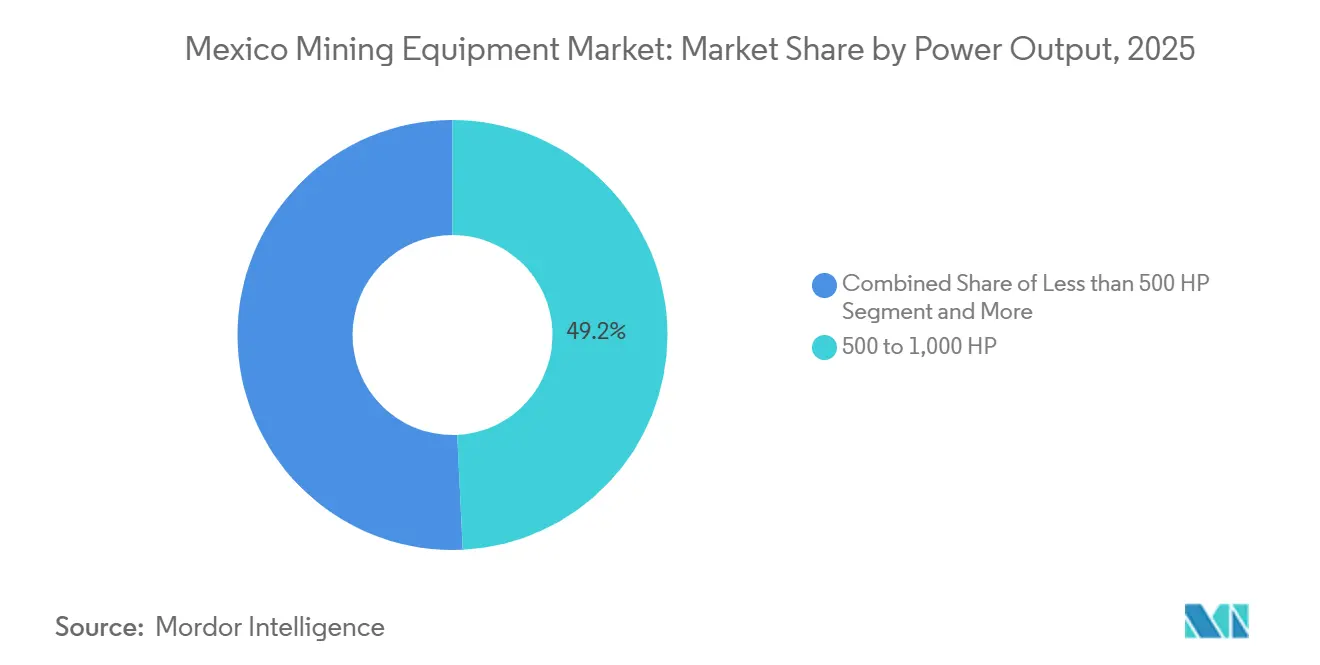
The 500-1,000 HP band is expected to account for 49.24% of the Mexican mining equipment market in 2025, while the above-1,000 HP band is projected to record the highest CAGR, at 9.51%, during the forecast period. Mid-range equipment supports hauling, drilling, and processing across mines in Mexico. Buyers prioritize reliability, access to service, and compatibility with existing practices. Suppliers add value by helping operators match machine capacity with current production needs and future operating requirements.
Higher-power equipment supports large open-pit projects that require greater hauling and material-handling capacity. Lower-power equipment remains important for compact drilling, utility work, and narrower underground areas. Operators select equipment based on site conditions, payload, terrain, materials handled, and fleet requirements, not engine output alone. Manufacturers and dealers can strengthen customer relationships by offering flexible portfolios, standardized parts and controls, and practical support that simplifies training, inventory management, maintenance planning, and lifetime service.
By Application: Metal Mining Anchors Equipment Demand
Metal mining is expected to account for 55.79% of the Mexican mining equipment market size in 2025. Mineral mining is projected to record the highest CAGR, at 11.25%, during the forecast period. Metal mining drives demand for haulage, drilling, loading, and processing equipment used in copper, silver, zinc, gold, and related operations. Open-pit and underground mines require different fleet designs, so suppliers with reliable local service and application support remain important as operating conditions and ore-handling needs change.
Mineral mining creates opportunities for equipment used in industrial mineral extraction and material processing, while coal mining remains a smaller application with distinct requirements. Buyers evaluate machines based on application, duty cycle, service support, ore characteristics, and mine layout. Strong parts support helps manage wear, availability, and operating costs. Manufacturers that understand the full mining workflow can help customers avoid equipment choices that disrupt material handling, maintenance access, throughput, or production continuity as mine conditions evolve.
Geography Analysis
Sonora is a major center for the Mexican mining equipment market because its open-pit copper operations require large, well-supported fleets. The state has established mine infrastructure and a concentration of equipment users, dealers, service teams, and parts logistics. Southern Copper’s El Pilar received environmental approval in July 2026, adding a clear project milestone for the region. The clustering of active and planned operations can make it easier to organize maintenance support and workforce training. This can favor suppliers that already have a local presence and detailed knowledge of site conditions. Power availability, roads, and project schedules will continue to influence the pace at which equipment is ordered and deployed.
Zacatecas, Chihuahua, and Durango are important for underground mining equipment and mineral processing systems. These states have established precious-metal and base-metal operations that require loaders, drill rigs, ventilation equipment, and plant support. Underground mine layouts, ore handling requirements, and access to qualified maintenance support shape their equipment needs. Chihuahua’s proximity to the United States can assist parts logistics for some operations. Durango’s project activity can create demand when permits and mine plans advance. Security conditions continue to affect the timing of fleet renewal and the appeal of remote-capable equipment.
Guerrero and other southern areas have distinct operating conditions that influence equipment selection. Underground gold operations can prioritize machines that support safety, communications, and dependable maintenance coverage. The Media Luna operation demonstrates how power arrangements and equipment choices can be addressed together in a remote setting. Coahuila drives demand for coal operations, while producers in Oaxaca, Jalisco, and San Luis Potosí support more localized requirements. These markets may not set the national equipment cycle, but they sustain demand for specialized machines and processing systems. The Mexican mining equipment market, therefore, requires suppliers to tailor support models to regional mine methods, infrastructure, and operating risks.
Competitive Landscape
The Mexican mining equipment market is moderately concentrated, with global manufacturers holding strong positions through product range, service coverage, and installed fleets. Caterpillar, Komatsu, Sandvik, Epiroc, and Liebherr are widely recognized as leading suppliers. Their position is strengthened when customers depend on local parts supply, trained technicians, and established equipment controls. Buyers often assess the reliability of long-term support alongside a machine's capabilities. This makes service agreements and aftermarket planning important parts of competitive positioning. Suppliers with a sustained local presence can reduce operational uncertainty for mine operators.
Sandvik’s equipment order for Mexican contractor CoMinVi in July 2026 included trucks, loaders, drill rigs, parts supply, and rebuild services, illustrating the value of integrated support arrangements. Such arrangements link equipment selection to ongoing service and maintenance needs[3]“Sandvik Wins Large Underground Equipment Order in Mexico from Mining Contractor CoMinVi,” Sandvik, home.sandvik.com. Epiroc’s introduction of autonomous drilling in Mexico is another example of suppliers using technology to strengthen their role at mine sites. Digital monitoring, remote support, and automation can make a supplier more difficult to replace once systems are embedded in daily operations. Competition is therefore not limited to the initial equipment sale. It also includes the supplier’s ability to support productivity, safety, and fleet availability over time.
Chinese manufacturers, including SANY and XCMG, are seeking opportunities where buyers place a strong emphasis on price and are open to newer supplier relationships. Their presence can increase options for contractors and smaller operators that need flexible procurement approaches. Established suppliers retain an advantage where customers require broad service coverage and proven local support. Environmental reporting, machine data, and technology readiness are becoming more relevant in supplier assessment. Equipment makers that can provide clear operational information may be better positioned for projects with demanding financing or reporting requirements. The Mexican mining equipment market remains competitive because buyers can choose among premium, specialized, and value-oriented offerings.
Mexico Mining Equipment Industry Leaders
-
Caterpillar Inc.
-
Komatsu Ltd.
-
Sandvik AB
-
Epiroc AB
-
Liebherr-International AG
- *Disclaimer: Major Players sorted in no particular order

Recent Industry Developments
- August 2026: Borr Drilling added 5 jackup rigs in Mexico through BC Ventures. Keppel planned to monetize up to 10 legacy offshore rigs through a new offshore fund as drilling activity strengthened.
- July 2026: Sandvik received a 46-unit order for underground equipment from CoMinVi, valued at approximately SEK 340 million (~USD 32 million), comprising trucks, loaders, and drill rigs for mining sites in Mexico.
- July 2026: Epiroc Mexico and Rajant Corporation partnered to deploy Kinetic Mesh self-healing wireless networks at Mexican mining sites, supporting mobile fleets and autonomous operations, with potential expansion across Latin America.
- December 2025: Silver Storm Mining Ltd. ordered critical equipment for underground work at its 100%-owned La Parrilla Silver Mine Complex (“La Parrilla”) in Durango State, Mexico, including drills and ventilation system fans.


Mexico Mining Equipment Market Report Scope
The Mexico Mining Equipment market is segmented by equipment type, automation level, powertrain type, power output, and application. By Equipment Type, the market is segmented into Surface Mining Equipment, Underground Mining Equipment, Mineral Processing Equipment, Drills and Breakers, Crushing, Pulverizing and Screening Equipment, and Other Equipment Types. By Automation Level, the market is segmented into Manual Equipment, Semi-Autonomous Equipment, and Fully Autonomous Equipment. By Powertrain Type, the market is segmented into Internal-Combustion Engine, Battery-Electric Vehicles, and Hybrid Vehicles. By Power Output, the market is segmented into Less than 500 HP, 500 to 1,000 HP, and above 1,000 HP. By Application, the market is segmented into Metal Mining, Mineral Mining, and Coal Mining. Market forecasts are provided in terms of Value (USD) and Volume (Units).
| Surface Mining Equipment |
| Underground Mining Equipment |
| Mineral Processing Equipment |
| Drills and Breakers |
| Crushing, Pulverizing and Screening |
| Others Equipment Type |
| Manual Equipment |
| Semi-Autonomous Equipment |
| Fully Autonomous Equipment |
| Internal-Combustion Engine Vehicles |
| Battery-Electric Vehicles |
| Hybrid Vehicles |
| Less than 500 HP |
| 500 to 1,000 HP |
| Above 1,000 HP |
| Metal Mining |
| Mineral Mining |
| Coal Mining |
| By Equipment Type | Surface Mining Equipment |
| Underground Mining Equipment | |
| Mineral Processing Equipment | |
| Drills and Breakers | |
| Crushing, Pulverizing and Screening | |
| Others Equipment Type | |
| By Automation Level | Manual Equipment |
| Semi-Autonomous Equipment | |
| Fully Autonomous Equipment | |
| By Powertrain Type | Internal-Combustion Engine Vehicles |
| Battery-Electric Vehicles | |
| Hybrid Vehicles | |
| By Power Output | Less than 500 HP |
| 500 to 1,000 HP | |
| Above 1,000 HP | |
| By Application | Metal Mining |
| Mineral Mining | |
| Coal Mining |


Key Questions Answered in the Report
What is the size of the Mexican mining equipment market, and how fast is it expected to grow?
The Mexico mining equipment market size is valued at USD 2.31 billion in 2025 and is estimated to grow from USD 2.51 billion in 2026 to USD 3.84 billion by 2031, registering a CAGR of 8.82% during the forecast period (2026-2031).
Which equipment type leads demand in Mexico?
Surface mining equipment led the equipment type category with a 40.73% share in 2025 and also had the highest projected growth rate in that category.
Why are autonomous mining machines gaining attention in Mexico?
Autonomous and remote-capable equipment can support safety, equipment availability, and operating control, especially at complex or remote mine sites. Adoption still requires suitable communications, trained teams, workable maintenance processes, and deployment plans that fit each mine’s operating conditions.
How is electrification affecting mining fleets in Mexico?
Battery-electric equipment is gaining interest where mine power, charging plans, ventilation needs, and maintenance support can accommodate the technology. Diesel and hybrid options remain relevant where those conditions are not yet in place or where operating routes make a gradual transition more practical.
Page last updated on:





